Is Justice Really the Karma Card?

The Justice Card and an exploration of karma.

What if the Justice card isn’t really about getting what you deserve?

That familiar interpretation—“Justice means you’ll get what’s coming to you”—turns the card into a kind of cosmic courtroom. Somewhere in the universe, an invisible judge is apparently keeping score.

But there may be a much more interesting—and useful—way to understand Justice.

Karma Isn’t Cosmic Punishment

In popular Western culture, karma often gets reduced to cosmic revenge: do something bad and sooner or later the universe will smack you for it.

But karma is fundamentally about action and consequence. Actions create causes. Causes produce effects. Those effects create new circumstances from which further actions arise.

Seen this way, Justice becomes a remarkably good image of karma.
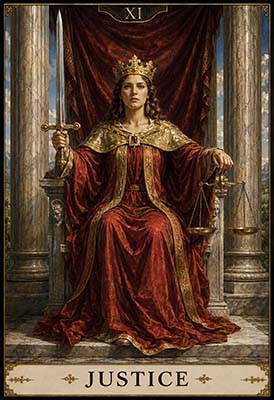
Justice poster – 13 X 19 – Available on Etsy

The Scales and the Sword

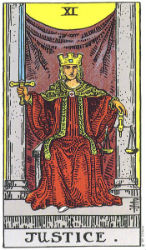
Look at the two objects Justice holds.

The scales represent cause and effect. Everything we think, choose and do enters the balance. Nothing happens entirely in isolation. Actions have consequences.

The sword represents those consequences becoming manifest. Eventually the abstract chain of causes produces an actual result.

The seed becomes the harvest.

And then notice Justice herself.

She isn’t angry. She isn’t pleased. She isn’t getting even.

She is impersonal.

Gravity doesn’t punish you for stepping off a roof. Fire doesn’t become angry because you put your hand into it. Cause and effect simply operate according to their nature.

That gives us a powerful metaphysical definition of the card:

Justice represents the law by which causes become consequences.

What Might Justice Mean in a Reading?

Suppose someone has spent years in a job they hate because they’re afraid to take a risk. Eventually they find themselves exhausted, resentful and wondering how their life became so small.

Justice doesn’t necessarily say, “You deserve this.”

Instead, it might say: Look at the chain of causes that brought you here.

Fear led to staying. Staying led to stagnation. Stagnation led to unhappiness.

That’s not punishment. It’s cause and effect.

And here’s the important part: the chain isn’t finished.

A different choice today creates a different cause—and potentially a different future.

Or imagine someone repeatedly entering relationships in which they ignore early warning signs. Justice appearing in a reading doesn’t have to mean that the universe has sentenced them to another disastrous relationship. It may be asking them to recognize the pattern itself.

What choice keeps setting the same sequence in motion?

Change that choice, and you begin changing what follows from it.

Justice Looks in Two Directions

This makes Justice both retrospective and prospective.

The scales look backward: What have I already set in motion?

The sword looks forward: What will follow from it?

And that gives the card considerably more agency than the old idea that Justice simply means “you’re going to get what you deserve.”

Justice isn’t necessarily announcing an unavoidable cosmic sentence.

It may be saying:

Look clearly at the causal chain. If you want a different consequence, this is where you change the cause.

And perhaps that is where Justice becomes not merely a card of karma, but a card of personal power.
Tarot and the Art of Alignment – Available on Amazon

The Justice Tarot Card

The meaning of the Justice card in the Tarot, including definitions for the upright and reversed positions.

justice

This is one of the simpler and least symbolic cards of the deck.  On a very basic level it represents justice and fairness.

Since justice is usually played out in the court systems in our society this may indicate a favorable legal settlement for the questioner.  On the same level it may indicate an honest lawyer or a fair and impartial judge or jury.

In the realm of relationships this may indicate a romantic or business relationship which is well balanced and in which both parties are getting what they deserve.

On a personal level this can indicate that the questioner is a fair and honest person who treats others carefully and with consideration.

REVERSED:  If there are legal matters pending there may be an unfavorable outcome for the questioner.  On a personal level this may indicate a person who overly judgmental and critical, even harsh.  The questioner needs to take a good hard look at his or her life and relationships and decide if she’s being honest, open, and fair.

How you perceive the Justice card depends upon whether you want to think of it as Justice-small-j or Justice-big-j.

If you have questions about this card or its meaning in one of your readings, please don’t hesitate to leave a comment.  I’ll get back to you as soon as I can.

A Few More Thoughts About Justice:

Justice-small-j has to do with our court systems and what you might call ordinary, earth based justice.  It will almost always appear in readings when the questioner is involved with some legal process or litigation.  

From a small-j perspective it looks very much like The Hierophant card.  A person sitting on a throne between two gray pillars. The Hierophant represents organized religion as opposed to true spirituality and, in the same sense, Justice represents organized justice as opposed to morality based justice.  The Hierophant is spirituality as it has been collected in books and organized into long standing traditions. Justice-small-j represents justice as it has been collected in books and organized into long standing precedents.

Justice-small-j is all about court rooms, judges, law books, and lawyers.  It’s what attorneys go to law school to learn.

Justice-big-j is a whole different kettle of fish.  It’s about the principle of justice and whether or not it exists independently from the court systems.  We don’t talk about that much anymore but it was actually a very hot topic from ancient times right through the early twentieth century.

Plato argued that there was a, “form,” of Justice, sort of an archetype of righteousness that descended into the material plane and the human mind and heart.

In her wonderful book, “Jung and Tarot, An Archetypal Journey,”  Sallie Nichols quotes Carl Jung as saying this:

“It should never be forgotten . . . that morality was not brought down on tables of stone from Sinai and imposed on the people, but is a function of the human soul, as old as humanity itself.”

Dig that:  morality is a function of the human soul.  In other words, we instinctively seek to do right and to avoid doing what’s wrong.  

The Tibetan Buddhists talk about the human soul in much the same way.  Chagdud Tulku Rinpoche described it as a beautiful, glowing crystal that’s encased in rock.  Each time that we meditate or intentionally act with love and compassion a little more of the rock obscuring the crystal gets chipped away.  A little more of our beauty emerges.

We know that at the time the Tarot first appeared Plato was still being studied as the Great Master of philosophy.  And we know that the rest of the cards in the Major Arcana are very much archetypal images. So it’s not a stretch at all to assume that Justice was included in the Tarot deck not as a small-j but as a big-j.  

When you get Justice in a reading, yes, look for legal matters to crop up in your life.  But also look for the principle of Justice to be blowing through your life.  Something has been out of balance in the way you’ve been treated and karmic principles are stepping in to adjust that and bring it back into balance.  

BIG J!

 
“Just the Tarot,” by Dan Adair – a kindle ebook available on Amazon