What if the Justice card isn’t really about getting what you deserve?
That familiar interpretation—“Justice means you’ll get what’s coming to you”—turns the card into a kind of cosmic courtroom. Somewhere in the universe, an invisible judge is apparently keeping score.
But there may be a much more interesting—and useful—way to understand Justice.
Karma Isn’t Cosmic Punishment
In popular Western culture, karma often gets reduced to cosmic revenge: do something bad and sooner or later the universe will smack you for it.
But karma is fundamentally about action and consequence. Actions create causes. Causes produce effects. Those effects create new circumstances from which further actions arise.
Seen this way, Justice becomes a remarkably good image of karma.
The Scales and the Sword
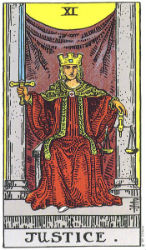
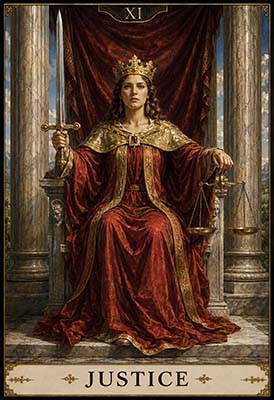
Look at the two objects Justice holds.
The scales represent cause and effect. Everything we think, choose and do enters the balance. Nothing happens entirely in isolation. Actions have consequences.
The sword represents those consequences becoming manifest. Eventually the abstract chain of causes produces an actual result.
The seed becomes the harvest.
And then notice Justice herself.
She isn’t angry. She isn’t pleased. She isn’t getting even.
She is impersonal.
Gravity doesn’t punish you for stepping off a roof. Fire doesn’t become angry because you put your hand into it. Cause and effect simply operate according to their nature.
That gives us a powerful metaphysical definition of the card:
Justice represents the law by which causes become consequences.
What Might Justice Mean in a Reading?
Suppose someone has spent years in a job they hate because they’re afraid to take a risk. Eventually they find themselves exhausted, resentful and wondering how their life became so small.
Justice doesn’t necessarily say, “You deserve this.”
Instead, it might say: Look at the chain of causes that brought you here.
Fear led to staying. Staying led to stagnation. Stagnation led to unhappiness.
That’s not punishment. It’s cause and effect.
And here’s the important part: the chain isn’t finished.
A different choice today creates a different cause—and potentially a different future.
Or imagine someone repeatedly entering relationships in which they ignore early warning signs. Justice appearing in a reading doesn’t have to mean that the universe has sentenced them to another disastrous relationship. It may be asking them to recognize the pattern itself.
What choice keeps setting the same sequence in motion?
Change that choice, and you begin changing what follows from it.
Justice Looks in Two Directions
This makes Justice both retrospective and prospective.
The scales look backward: What have I already set in motion?
The sword looks forward: What will follow from it?
And that gives the card considerably more agency than the old idea that Justice simply means “you’re going to get what you deserve.”
Justice isn’t necessarily announcing an unavoidable cosmic sentence.
It may be saying:
Look clearly at the causal chain. If you want a different consequence, this is where you change the cause.
And perhaps that is where Justice becomes not merely a card of karma, but a card of personal power.