The High Priestess: What It Really Means to Trust Your Intuition

The High Priestess Archetype and learning to trust our intuition.

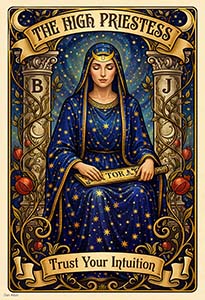
In my High Priestess affirmation poster, I chose the phrase:

“Trust Your Intuition.”

It sounds simple. Almost obvious.

And yet it’s one of the most misunderstood instructions in the entire Tarot.

We say things like:

“I have a feeling . .

“I just have a hunch . . .”

“I’m getting bad vibes about this . . .”

All human beings have intuition — some more than others. Some people sneer at it as a primitive, pseudo-mystical leftover from a less scientific age. Others practically swim in it, using it as their primary guide through life.

Most of us fall somewhere in the middle.

We occasionally get flashes of clarity about which path to take and which to avoid. But most of the time we default to logic. We try to predict outcomes. We use our brains rather than our hearts.

And then sometimes — usually in hindsight — we think:

“Damn, I knew better . . .”

So it’s worth asking:

What is intuition… and what is it not?

“Just the Tarot,” by Dan Adair – available on Amazon

It’s Not Fear

One of the biggest confusions we have is mixing intuition up with the limbic system — the ancient part of the brain responsible for fight-or-flight.

That system exists to keep us alive. It detects threat. It reacts instantly.

It was what warned our ancestors that something dangerous was hiding in the trees. We experience it today as:

  • The hairs rising on the back of our neck
  • A sudden jolt of anxiety
  • The feeling that someone is watching us

That reaction can feel mysterious. But it isn’t mystical. It’s biological.

True intuition does not trigger fight-or-flight.

It doesn’t flood the body with adrenaline. It doesn’t tighten the chest.

Real intuition is calm.

It arrives quietly, with a sense of understanding. It clarifies rather than agitates. Instead of panic, it brings steadiness — a subtle reassurance that says:

“This is right – you’ll be okay.”


It’s Not Rapid-Fire Prediction

The brain is constantly predicting the future based on the past.

When we encounter a new situation, the mind instantly searches its archives for similar experiences. It matches patterns, runs comparisons, and projects possible outcomes — all in a fraction of a second.

We’re mostly unaware this is happening.

So when we say we “have a feeling” about someone, what we often have is a memory.

If we once had a terrible experience with a brunette woman wearing purple socks, we may feel wary of a new brunette wearing purple socks. We call that a vibe.

It isn’t.

Some people process these patterns so quickly that it seems magical. Certain personality types — INFJs and INFPs, for example — are especially skilled at rapid, intuitive-seeming synthesis.

But that process is still rooted in past data.

True intuition is different.

It is not logical.

It is not based on memory.

It may have absolutely nothing to do with what has happened before.

It is a clear message about the present moment — even when there’s no obvious reason you should understand what you understand.


It’s Not Fragmented

You may have met highly sensitive or empathic people whose lives are chaotic.

On the surface, that seems contradictory. If they absorb more information than most, shouldn’t they navigate life more easily?

Not necessarily.

When someone takes in too much external input without discernment, they can lose track of what belongs to them and what belongs to others.

If they’re near someone who is anxious, they become anxious. If they’re around anger, they internalize anger.

Soon they feel as if they’re having five contradictory “intuitions” at once.

But intuition does not contradict itself.

It does not conduct committee meetings in your head.

It does not present twelve equally compelling paths and demand that you choose one immediately.

True intuition is singular.

It points.

It does not debate.


Clear, Calm, and Quietly Joyful

Perhaps the greatest hallmark of genuine intuition is that it brings relief.

It removes doubt.

It dissolves mental noise.

It doesn’t shout. It doesn’t demand. It doesn’t come with fireworks.

It simply settles into you and says:

“Yes, this is it.”

And when it does, there is often a subtle happiness attached to it — not excitement, not mania — but a deep rightness.

That is the High Priestess.

She does not force reality.

She does not argue.

She does not panic.

She knows.

And when that knowing arrives within you, the work is not to question it endlessly — it is to honor it.

That is what “Trust Your Intuition” really means.


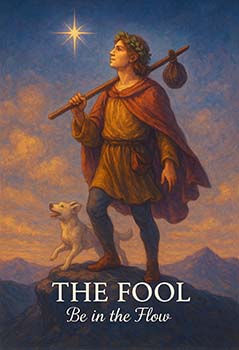
The Fool: Be in the Flow

The Fool card as the archetype of the Flow State.

Most people misunderstand The Fool.

They think he’s reckless. Naïve. Careless. About to step off a cliff because he doesn’t know any better.

But The Fool is not stupidity.

The Fool is original harmony.

The Soul in Its First Breath

The Fool represents the new Soul in the world. He carries the energy closest to what we had when we first incarnated — before cynicism, before conditioning, before we learned how to overthink everything.

In that original state, we are in harmony with our environment. Our perception is clear. Our energy hums. We are not fighting life. We are participating in it.

That’s why, when I designed my Tarot affirmation for The Fool, I chose the phrase: Be in the Flow.

Available as a 13 X 19 inch poster on my Etsy shop.

The Fool doesn’t force the river. He walks with it.

What Happens When We’re in the Flow?

Two remarkable things tend to show up when we’re in this state:

Synchronicity and serendipity.

Synchronicity occurs when your internal mental and emotional state aligns so cleanly with the outer world that meaningful coincidences begin to appear.

You’re thinking about needing a new job. A gust of wind blows a newspaper to your feet. The classified section is open. Someone has circled a listing that’s strangely perfect for you.

That’s synchronicity — the outer world answering an inner alignment.

Serendipity is its carefree cousin. It’s good fortune arriving without an obvious causal chain. It’s stumbling into opportunity. It’s finding gold doubloons tucked inside a thrift-store chest of drawers.

Synchronicity feels meaningful.

Serendipity feels lucky.

Both tend to emerge when we stop strangling life with effort.

Wu Wei and the Zero

The Fool’s number is zero.

Zero is potential. Zero is openness. Zero is the circle that contains everything.

In Taoist philosophy, there’s a concept called Wu Wei, which means “effortless action.” It’s not laziness. It’s not passivity. It’s action that arises from alignment rather than strain.

Instead of striving against the current, we move with it.

The more we harmonize with life’s rhythms, the easier life becomes. Paradoxically, we accomplish more by forcing less. When we loosen our grip, synchronicity and serendipity begin to move.

It can feel as if the Universe starts supplying what we need the moment we stop demanding it.

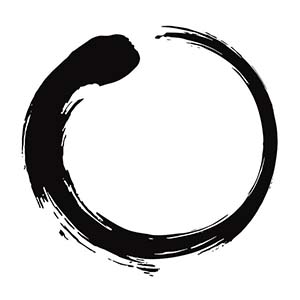
The symbol of Wu Wei is the Enso — a single open circle. It looks suspiciously like a Zero.

It looks suspiciously like The Fool.

The Trick of the Dialogue

Here’s the delicate part.

Flow is not a switch you flip.

Researchers who study the flow state consistently find that it emerges when we are relaxed, engaged, playful, and open. It does not emerge when we are clenched, controlling, or desperately trying to optimize ourselves.

You don’t command The Fool state.

You invite it.

And this is where the dialogue begins.

When we relax and allow life to surprise us, we send a subtle signal:

“Okay. Show me what you’ve got.”

That’s when things begin to move.

The Universe does not respond well to micromanagement.

The Pink Elephant Problem

Of course, we immediately run into a paradox.

You cannot work very, very hard at not working hard.

You cannot become extremely serious about not being serious.

Try this: do not think about a pink elephant with purple polka dots.

Exactly.

The harder we try to relax, the more tense we become. The more we strive to enter Flow, the further away it seems.

In our self-improvement culture, we are experts at turning everything — even surrender — into a project.

But The Fool is not a project.

Dancing Instead of Driving

The Fool state is not about giving up responsibility. It is not about sitting on the couch waiting for destiny to knock.

It is not about “surrendering your will” in some dramatic spiritual gesture.

It is about remembering.

Remembering that we were born playful. Born curious. Born in rhythm with the world.

The Fool doesn’t run the Universe.

He dances with it.

When we return to that original ease — relaxed, alert, a little amused at our own smallness in a very large cosmos — something remarkable happens.

Life softens.

Doors open.

Wind blows newspapers at our feet.

We stop trying to force magic — and we discover that it was already in motion.

The Fool smiles because he knows a secret:

The cliff isn’t always a cliff.

Sometimes it’s just the next step into the Flow.

If you were to reduce all of that to a single affirmation, it would be simple:

Be in the Flow.

And then — gently — stop trying so hard to do even that.

“Just the Tarot,” by Dan Adair, available on Amazon.

The Art of Receiving: A Holiday Lesson from the Ace of Pentacles

Are you great at giving but secretly uncomfortable receiving? This holiday-inspired reflection on the Ace of Pentacles explores why receiving is the true key to abundance — and how learning to allow support, blessings, and prosperity can transform your life.

We hear it every year: “It’s the season of giving.”

And while generosity is beautiful, here’s a question we rarely ask:

How good are you at receiving?

Most of us are excellent givers.

We’ll show up for others, offer help, carry the emotional load, and give until we’re exhausted…

Yet when something is offered to us — kindness, support, a compliment, an opportunity, or even abundance — we freeze. We deflect. We downplay. We say, “Oh, you shouldn’t have…”

But in manifestation, and in the symbolic language of the Tarot, receiving is not an afterthought — it’s the core skill.

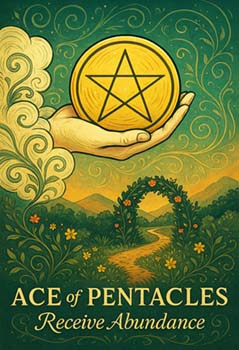
And the Ace of Pentacles, with its golden hand offering a gift from the sky, is the perfect reminder that abundance can’t enter your life until you’re willing to let it in.

Ace of Pentacles Affirmation Poster by Dan Adair – Available on Etsy.

Why Receiving Is the Real Skill in Manifestation

Genevieve Davis puts it beautifully in her book, “Doing Magic: A Course in Manifesting an Exceptional Life.”

“As soon as you have asked for anything, your next immediate job is to get out of the way. You need to get out of asking and into the receiving state as soon as you possibly can.”

Most people stay stuck in:

• asking

• wishing

• visualizing

• striving

• trying harder

But manifestation isn’t powered by effort.

It’s powered by allowing.

During the holidays we pour energy outward — buying gifts, doing favors, meeting expectations — but the universe doesn’t respond only to what we give. It responds to what we’re willing to accept.

 Receiving Requires Softening, Not Effort

In, “Ask and It Is Given: Learning to Manifest Your Desires” Abraham/Hicks calls this the Art of Allowing:

“Unless you are in the receiving mode, your desires will not be fulfilled.”

Receiving isn’t about deserving more or working harder.

It’s the opposite — a gentle softening.

Receiving happens when you:

• relax your shoulders

• loosen your defenses

• stop arguing with your blessings

• stop explaining your worth

• allow yourself to be supported

Winter energy itself teaches this.

The natural world slows, quiets, and becomes receptive.

There is no pushing — only opening.

The Holiday Block: Feeling Unworthy of Good Things

Here’s the core wound for many people — especially during the holidays:

We don’t believe we deserve good things.

Old stories rise up:

• “Other people need it more.”

• “I haven’t earned that.”

• “I don’t want to be a burden.”

• “I’m not enough.”

Many of us learned as children to receive less so others could have more.

So now, when life tries to hand us something beautiful, we reject it without even realizing we’re doing it.

But the Ace of Pentacles offers a different truth:

You are worthy of abundance.

You are worthy of support.

You are worthy of receiving joy, money, kindness, opportunity — just as you are.

The Ace of Pentacles: A Gift You Are Meant to Receive

TheAce of Pentacles  captures this moment perfectly:

• the hand offering a golden coin

• the floral archway

• the path leading into a new beginning

• the vibrant, fertile landscape

This is the universe extending a gift — potential, prosperity, a fresh start.

The affirmation, “Receive Abundance,” is not a command.

It’s an invitation.

A permission slip.

This holiday season, abundance may appear in quiet ways:

• someone offering help

• an unexpected opportunity

• a compliment

• money flowing in

• a door opening you didn’t expect

Your job?

Let yourself say yes.

A Simple Holiday Receiving Ritual (2 Minutes)

Try this before bed or during a quiet moment in the day:

1. Place your hand over your heart.

2. Take a slow breath.

3. Say gently:

“It is safe for me to receive.”

4. Picture the golden hand of the Ace of Pentacles offering you a gift.

5. Say:

“I allow good things to enter my life.”

Small practice, big shift.

This Season, Let Receiving Be Part of the Celebration

Giving is beautiful.

Generosity is sacred.

But so is allowing yourself to be blessed.

Let this be the season you stop deflecting your good.

Stop stepping aside.

Stop shrinking back.

Let this be the season you say, without apology:

“I am ready to receive abundance.”

Because the universe can only deliver what you’re willing to accept.

Love, Limerence, and The Ace of Cups? How to Heal Obsessive Attraction with Self-Generated Love

Ever fallen in love with someone you couldn’t have? Psychologists call it “limerence,” but spiritually it’s more than just a crush. This post explores the difference between obsessive attraction and true love, why we sometimes fall for the “wrong” people, and how to heal by generating love from within. Featuring insights from psychology, past-life theory, Ram Dass, and the Ace of Cups, it’s a guide to shifting from longing to self-created wholeness.

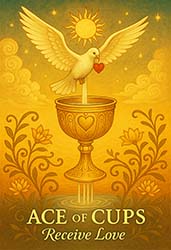
Ace of Cups – A Tarot affirmation poster available at Synergy Studio.

Did you ever fall in love with someone you shouldn’t have?  Someone who was unavailable, but you still felt intensely attracted to them?

Maybe it was your next door neighbor who was happily married.  Maybe it was a co-worker and you KNEW that a work place romance would be a disaster.  Hell, maybe it was your 8th grade teacher who was just SO perfect in every way.

GETTING CRUSHED

We used to call that, “getting a crush,” on someone.  We meet someone and we just know that we’re supposed to be together, even though everything else is saying, “No, you’re not.”

Psychologists – as psychologists tend to do – have invented a new term for it which is, “limerence.”  Here’s a definition:

Limerence is an involuntary, intense, romantic obsession characterized by intrusive thoughts and a longing for emotional reciprocation, often leading to emotional suffering due to unmet romantic needs.”

In other words, having a crush on someone you probably shouldn’t have a crush on.

IT’S ALL PERFECTLY NATURAL

Now, this has been going on ever since the world began and, of course, it’s caused a passel of trouble. Marriages end, people lose their jobs, reputations and careers are destroyed.  All in the name of love.

Which is puzzling, isn’t it?  Love is supposed to be this grand, wonderful adventure that lets us soar to new heights on the wings of the person we’re in love with.  So why is all of this so painful and frustrating?  

THE CALM, INNER VOICE

I had a teaching dream once about spirit guides and spiritual guidance.  I call them, “teaching dreams,” because they’re very lucid, very clear and they usually have to do with some issue that’s really bothering me.

The subject of this dream was, “How do I distinguish true spiritual guidance from my own desires and ego?”

And the answer was that spiritual guidance is never harsh, never critical, never ominous.  It’s always gentle, loving, and kind and leaves us feeling nurtured rather than criticized or beaten up.

The same principle applies to falling in love.  If it feels sweet and kind, it’s probably real love.  If it involves obsessive thinking, insecurity, self-doubt, or criticism . . . hey, it may be a hell of a crush, but it ain’t love.

WHY DOES IT HAPPEN?

Why do we fall in love with people who aren’t, “right,” for us?

Psychologists, philosophers and playwrights have been trying to figure that one out for hundreds of years and really haven’t made much progress.

My personal theory is that these are relationships that are, “out of time.”  And I don’t mean that in the sense of, “Whoops, we’re out of time.”

Rather, what I’m talking about is old relationships from previous incarnations that have been displaced in time.  The feelings are still there, but they’re no longer appropriate in their old form.

Perhaps we were married to someone or had a super, sizzling hot sexual affair with them two lifetimes ago.  Because of that intense attraction, we meet them again in this lifetime.

Only – guess what? – they’re married to someone else.  Or they’re our teacher or mentor.  Or perhaps we’re straight, but they’re the same sex that we are.

The feelings are just as intense.  The desire to be with them is just as strong.  But it just ain’t happening this go-round.

WHAT SHOULD WE DO?

Well . . . nothing, in most cases.  Just observe it and sit with it.  Realize that you love this person but that the love has to take a different form than romantic love.

We can feel it.  We can cherish it.  But we don’t have to act on it.  If there’s a huge internal conflict about getting romantically or sexually involved with someone, that’s not a very good way to start out, is it?

FILL YOUR HEART WITH LOVE

Ram Dass said that we frequently mistake other people as the source of love, rather than realizing that they’re just vehicles that get us to the love.

When we’re seriously crushing on someone we shouldn’t be crushing on, we feel that as a loss, as a deficit, as if we’ve got this Grand Canyon sized hole in our hearts that only they can fill.

Fortunately, we’ve got this wonderful part of our energy systems called, “the heart chakra.”    It can generate an infinite amount of love because love actually IS infinite.  

We can sit down at any time or place and just meditate on love, meditate on that chakra filling up with that sweet, kind essence that is love and the feeling of not being complete immediately goes away.

IT ISN’T THEM, IT’S US

We’ve been programmed into believing that love always flows out of someone else and into us.  That if someone, “out there,” doesn’t love us, we won’t get the love we need.

That’s really the source of the pain in limerence.  We’re convinced that without that other person’s love, we’re just going to be miserable and unfulfilled.  We can’t get to the love we want and so it hurts.

Not true.

We create our own love, in our own hearts.  We receive love when we open our heart centers and intentionally, consciously fill them up.

THE ACE OF CUPS

When we look at the Ace of Cups we can see this message very clearly.  The cup is our heart and the love isn’t flowing out of another person into the cup.  It’s flowing straight out of the Universe.  Love is everywhere.  It’s a Universal energy and we just need to open ourselves to receiving it.  If we occasionally receive it from another person, that’s great.

But if we don’t, that’s not a tragedy and it doesn’t need to be painful. The source of love is always in our own hearts.

“Just the Tarot,” by Dan Adair – A kindle ebook available on Amazon

Dreaming Big vs. Building Bridges

Why don’t manifestation techniques work for everyone? This post explores the pitfalls of one-size-fits-all manifesting advice, including why “dreaming big” may backfire for some people — and how “bridge affirmations” and quiet repetition can be just as powerful. Learn how to tailor your visualization style to your own emotional wiring, and find a manifestation method that actually fits you.

Ace of Pentacles – A Tarot affirmations poster available at Synergy Studio.

Why some manifestation advice doesn’t work — and what to do instead

One of the sillier ideas floating around in the world of visualizing and manifesting is the notion that “one size fits all.”

The way this usually goes is that a manifesting guru announces they’ve been studying this stuff for decades, and they’ve refined all of that knowledge into THE ONE TRUE METHOD that will make us rich, famous, and sexually irresistible.

A variation on that is the guru was visited by beings from another dimension who gave them the real lowdown. A variation of that is that the guru is now channeling spirit guides, divine beings, angels, or ancient Atlanteans who have imparted secret knowledge for the good of all mankind.

Now, I happen to be a huge fan of manifesting, visualization, and affirmations. But there are a couple of big fallacies baked into these presentations.

 Fallacy #1: One method works for everyone

If any one guru truly had the one method that worked for everyone, we’d all have signed up for that seminar by now. We’d all be millionaires. And we’d be so busy in bed we’d have to replace our mattresses every three months.

And… um… there still seem to be a lot of us who aren’t millionaires. Have you noticed?

I know that the last time I looked at my bank balance, I was shocked — shocked, mind you — to discover I still wasn’t rich.

Maybe you’ve had a similar experience.

Fallacy #2: Any method works for you

This is the one I want to dig into today: the idea that any particular method is going to work for everyone who uses it.

It’s understandable that the gurus would push that narrative. After all, the more seminars, books, and videos they sell, the more fully they manifest their vision of wealth. If they came right out and said, “You know… this might work for some of you but not all of you,” their book sales would definitely decline.

But the truth is: we’re all different, and we need to find the method that fits us best.

Dreaming Big vs. Building Bridges

One helpful concept from the psychology side of affirmations is the idea of “bridge affirmations,” also known as “ladder affirmations.”

Here’s the basic idea:

Your visualizations need to at least resemble your current reality enough that your brain doesn’t reject them outright. If you’re living under a bridge, eating beans out of a can, and you’ve just lost your can opener, it’s going to be really hard to visualize yourself living in a mansion with a butler serving you caviar.

A more realistic visualization might be:

• You have a brand new can opener

• That can opener lives in a drawer

• That drawer lives in a kitchen

• That kitchen lives in a cozy little apartment you can afford

Bit by bit, you’re bridging the gap between your present and your vision.

I won’t get too deep into the science here, but our brains have a filtering system called the reticular activating system (RAS). It decides what information to notice based on what we already believe is possible.

So if you try to visualize something your brain sees as ridiculous, the RAS stands behind you whispering: “Uh, uh. Not happening.”

“I’m a wildly wealthy kazillionaire!”

No, you’re not.

“I attract money like a magnet!”

Then why can’t you pay your bills?

“I’m irresistible to the opposite sex!”

So why don’t you ever HAVE sex?

Now, it’s possible that you are one of those super-manifesters the gurus talk about — the kind who visualizes a million dollars falling from the sky and then has to wear a helmet for protection from the cash downpour.

But if you’re not? That’s okay.

You may just be a bridge manifester, not a straight-to-the-moon manifester.

Sometimes your subconscious doesn’t need the big dream — it just needs the next step.

“Feel It Big!” Doesn’t Work for Everyone

Another favorite bit of advice from the manifestation gurus is: You have to really FEEL it.

Like, really really.

Don’t just visualize the million dollars — visualize all the wonderful stuff you’re going to buy with it.

Visualize how damn happy you’re going to be.

Do a happy dance.

Flap your arms.

Howl at the moon.

Shake your booty and cackle because you’re rich, rich, RICH, I tell you!

The idea is that emotion supercharges visualization — the more passion you inject, the faster it manifests.

But what if you’re just… not a very emotional person?

Maybe you’re a trauma survivor.

Maybe you’re neurodivergent.

Maybe you’re just a pragmatic flatliner who feels fine but doesn’t emote like a Broadway actor.

Does that mean you’re out of luck when it comes to manifestation?

Absolutely not.

Some of us don’t feel our way to manifestation — we focus our way.

That’s where repetitive affirmations come in.

What we’re trying to do is impress the visualization on the subconscious mind so that it starts working on it behind the scenes.

Yes, a giant burst of emotional energy can plant the seed deep.

But so can steady repetition — even without fireworks.

Write:

“I am attracting abundance into my life.”

Twenty or thirty times every morning.

Or listen to gentle affirmation recordings while you go about your day.

The subconscious doesn’t need drama. It just needs consistency.

Find Your Flavor

So if you’re not rich, famous, and ravishing just yet — relax.

Maybe you don’t need to “dream bigger.”

Maybe you just need to cross the next bridge.

By all means, try the big, bold, wildly emotional manifesting techniques. If that works for you — congratulations! (And maybe lend me a hundred grand while you’re at it.)

But if it doesn’t work?

Don’t give up.

Just try a different route.

Build bridges.

Use repetitions.

Focus instead of forcing.

As Ram Dass said:

“Ultimately, we’re our own gurus.”

And nobody knows you better than you.

“Just the Tarot,” by Dan Adair.  A kindle ebook available on Amazon.