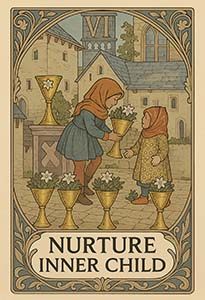
The Six of Cups — Protecting the Inner Child of Your Art

The Six of Cups reminds us that our creativity flows from the innocence of the inner child. Protecting that child means honoring your art, choosing who sees it, and never letting careless criticism silence your joy.

When Beauty Meets Criticism

Have you ever created something you thought was beautiful — a painting, an essay, even a garden — and when you finally shared it, the first thing someone did was point out the flaws? Instead of seeing what you were trying to express, they zeroed in on what they thought was wrong.

There’s always a tension between creating and sharing. When we make something real — assuming we’re not just hacking away — we’re revealing a piece of our heart, our soul, our lived experience. A careless critique can feel like a personal attack. It can leave us feeling exposed, vulnerable, even ashamed.

The Inner Child at Play

Picasso once said, “All children are born artists; the problem is to remain an artist as we grow up.” Creativity flows from the same source as play — from the child who once molded mud into castles or splashed finger paints across paper just for the joy of it.

That inner child still lives inside us, but it’s easily wounded. A thoughtless comment can silence it. A dismissive tone can make it retreat. And when that happens, the creative flow — the very essence of who we are — begins to dry up.

The Birth of the Critic

Mel Brooks joked that with the birth of art came the inevitable afterbirth — the critic. And he wasn’t wrong. If you take your creativity seriously, you’ll eventually encounter people who feel compelled to “fix” your work.

Julia Cameron wrote that before we can become good artists, we must first give ourselves permission to be bad ones. Every artist, writer, gardener, or musician produces clumsy beginnings — and even seasoned creators sometimes turn out a piece that just doesn’t land.

The creative process is messy and human. Yet while you’re admiring what went right, someone else may focus only on what went wrong.

The Wound of the Inner Artist

Cameron also warned that exposing your inner artist to harsh criticism is the emotional equivalent of child abuse. It’s like taking the eager, innocent child who offers you their finger painting and saying, “That’s terrible. You don’t really have any talent, do you?”

If you choose a creative life, criticism is inevitable. Some people simply won’t resonate with your vision, and occasionally you’ll make something that misses the mark. That’s part of the territory. But you can — and must — protect your inner artist with the same fierce loyalty you’d show a child under attack.

Learning by Heart

I became an artist late in life and am entirely self-taught. I picked up a mallet and chisel and learned to carve wood through trial, error, and stubborn joy. I learned to paint the same way.

Looking back, I can see how rough those early pieces were — primitive, awkward, untrained — and yet they were full of life. I still remember the pride I felt each time I saw progress take shape beneath my hands.

Claiming the title artist took courage. The first time I walked into a gallery and asked, “Would you show my work?” was absolutely terrifying.

A Pact of Protection

One simple, unbreakable pact guides me still: when someone criticizes my art, that’s the last time they see my art.

Showing your work is an act of intimacy — an unveiling of something deeply personal. The art flows from the child within you, and that child deserves protection.

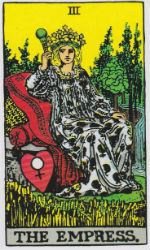
The Empress and Remembering Creativity

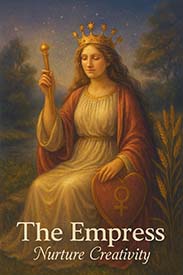
We’re all born creative—but somewhere along the way, we forget. This post explores how to reconnect with your natural creative spark by nurturing it gently, playfully, and without judgment. Centered around the Empress Tarot card and the affirmation “Nurture Creativity,” this is a soulful guide to reclaiming your artistic joy, silencing your inner critics, and remembering who you really are.

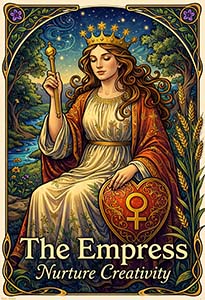
A tarot affirmation poster available at Synergy Studio

 Nurture Creativity: A Message from The Empress

We are born creative. That’s not poetry—it’s biology. The moment a child is given space, they draw in the dirt, sing nonsense songs, build forts out of chairs and blankets. As Picasso once said, “Every child is an artist. The problem is how to remain an artist once he grows up.”

Substitute the word artist with creative and the truth holds. It’s not just painters or poets or musicians who are creative—it’s gardeners and cooks and problem-solvers and dreamers. Creativity is our birthright. The trouble is, somewhere along the way, we forget that.

That’s why when I created the affirmation poster for The Empress, I chose the words: “Nurture Creativity.” She’s not just a symbol of beauty or abundance—she is the Earth Mother of inspiration itself. Her power doesn’t lie in striving or perfection. It lies in growing, tending, and trusting.

 So What Happened?

If we’re born creative, why do we have to learn how to nurture it?

Because somewhere along the line, that light was dimmed.

It happens early—often by people who love us. Well-meaning parents may tell their children, “You can’t make a living as an artist,” or “You should do something more practical.” The message is subtle but clear: creativity is fine for hobbies, but not for life.

Teachers, too, can unwittingly squash that spark. A child who colors outside the lines, who doesn’t draw a tree the “right” way, or who writes odd little poems that don’t rhyme may be corrected, redirected, or even shamed. In the name of order, achievement, and conformity, imagination is often sacrificed.

Then there’s the school system itself, which tends to reward left-brain thinking—math, logic, memorization—while cutting funding for art, music, poetry, and play. Creative expression is often treated as an “extra” instead of a core part of human development.

Add to that a culture that idolizes productivity over process, perfection over exploration, and we end up with generations of adults who believe they are not creative simply because they were never given the space—or the encouragement—to grow.

But that creativity didn’t vanish. It just went quiet.

The First Step Back

The first step in being creative is remembering that you already are.

You were born that way. Creativity isn’t something you have to earn, or prove, or qualify for—it’s part of your wiring. Despite all the conditioning you received growing up, despite what teachers, parents, or critics may have said, your creativity never left you.

It’s not gone. It’s just… misplaced.

Think of it like losing your car keys. You don’t panic because they’ve stopped existing—you just start retracing your steps. You check your pockets, your coat, the kitchen counter, under the couch cushion. And eventually, you find them right where you left them. Creativity is like that: it’s tucked into your daydreams, your doodles, your half-finished journal entries and quiet longings. It’s waiting for you to remember.

You’re not starting from scratch. You’re simply coming home.  Here are some simple steps to get you there.

Remember It’s Play

One of the most important things to remember as you reconnect with your creativity is this: it’s supposed to be fun.

You’re not going to get a work evaluation. You’re not going to be graded. There’s no report card, no gold star, and no panel of judges waiting to declare whether what you made is “good enough.” There’s no wrong way to write a poem or paint a picture or design your garden. If it feels good to your spirit, you’re doing it right.

If you catch yourself getting tense, self-critical, or frozen with perfectionism, think back to finger painting as a kid. You weren’t trying to master composition or worry about the light source. You were just joyfully smearing color across a page—ooey, gooey, and gloriously free. You didn’t second-guess whether it was “real art.” You just made it.

That’s the energy you want to invite back. Not pressure. Not performance. Just play.

Get rid of the critics in your head.

Those voices telling you you’re not good enough? They’re not the voice of truth. They’re the echo of someone you met along the way—probably in childhood. Maybe it’s creepy Mrs. Finglestermer, your second-grade teacher who chewed with her mouth open and told you you weren’t “doing it right.” Or maybe it’s your perfectionist father who criticized how you made your bed—so of course now you think your sketch isn’t good enough either.

Whatever form they take, those voices don’t belong in your creative space. Tell them to sit down and shut up.

Second: protect your creativity from external critics too.

Don’t ask people what they think of your poem, or your painting, or your dream, unless they’ve earned the right to hold it gently. If someone mocks or dismisses your work, they never get to see it again. Your creativity is like a small child—it deserves to feel safe, encouraged, and loved. You wouldn’t leave your kid with someone who belittles them. Don’t do that to your art either.

Create in sacred space. Share it only with the people who nurture, not the ones who nitpick. The Empress doesn’t seek approval—she creates because it is her nature.

Return to the Garden

The Empress reminds us that creativity doesn’t thrive under pressure—it blossoms in safety, in slowness, in love. When we nurture our creativity, we’re not just making art—we’re healing the part of ourselves that was told to be quiet, to be small, to be practical. We’re reclaiming the joy of making for its own sake. So whether it’s through paint or words or music or movement, give yourself the grace to grow. You don’t need permission. You only need space. And a little bit of faith.

You are already creative. You always have been. All that’s left is to remember.

“Just the Tarot,” by Dan Adair.  A kindle ebook at available at Amazon.

The Ten of Pentacles, Grandma Moses, and Rocking Getting Older

A closer look at the new paradigm of aging and how we can combat our own internalized ageism.

One thing that’s been apparent watching the demonstrations against the Trump regime is that there are a LOT of gray hairs in those crowds.  What in the hell are all of those old people doing out there demonstrating?  Aren’t old people supposed to sit at home in their rocking chairs with cats in their laps?

Well, what if everything we’ve been told about aging is wrong?

OLD IS THE NEW YOUNG?

Think of some of the standard images and words that come up when we discuss older people.  Words like:

Doddering;

Absent minded;

Frail;

Diminished;

Weak;

Senile

There is a cultural perception of older people as being in a period of decline, fragility, and irrelevance.  It isn’t just our societal obsession with youth; it’s an active attack on aging itself.  Ironically, of course, it’s something we all do sooner or later (if we’re lucky) so it seems like a peculiar notion on the face of it. 

Thankfully, there’s a new paradigm emerging.  It’s an entirely different way of aging that embraces it as a time of expansion, reinvention, and wisdom-driven creativity.  Before we can do that, though, we need to be mindful of the old paradigm of aging.

THE DISEASE MINDSET

Western cultures tend to treat aging as if it’s a medical problem, rather than a perfectly natural transition.  Billions of dollars are being made every year by convincing us that there’s something terribly, terribly wrong with having white hair and a few wrinkles.

There’s really no way to describe it other than as an anti-aging industry.  On the one hand, big pharma is busy programming the elderly to believe that they can’t possibly survive without a medicine cabinet full of pills.  On the other hand, the cosmetics companies are selling boatloads of product to, “restore your lost youth and vitality.”

The over-all message to anyone past the age of 60 is, “be afraid, be very afraid, because you’re useless, ugly and doomed.  You have a terminal disease called, ‘aging.’”  

But what if we learn to see aging as a form of enhancement, rather than a decline?

LATE LIFE FLOURISHING

There’s actually a term for that which is, “the Grandma Moses Effect.”

Anna Mary Robertson Moses (AKA Grandma Moses) left home at the age of 12 to go to work as a domestic for a farmer and his wife.  For the next 65 years of her life, she had a pretty grueling existence.  She and her husband were itinerant farm workers, drifting from job to job and doing back breaking field work.  She bore 10 children, five of whom died and she lived on the edge of poverty for most of her adult years.

She took up painting at the age of 78 and only because arthritis was making it painful for her to do needlework.  She initially sold her paintings out of the window of a local pharmacy for 2 dollars a piece.  By the time that she died at the age of 101, her paintings were being sold for millions of dollars, Hollywood had made a movie about her life, and she’d received a medal of honor at the White House.  

All because she picked up a paintbrush when she was obviously too old.

Now, suppose she’d been alive in our time.  What messages might she have been receiving at the age of 78?  “Let’s face it, dear, your life is over.  You’ve got one foot in the grave. I hope that you’ve got medical insurance because it’s all downhill from here.  As a matter of fact, you’re at the bottom of the hill and a boulder is about to run over you.”

Grandma Moses was the first time that millions of Americans really got it on a visceral level that being older doesn’t equate to being the walking dead.  Being older can be a magical beginning, instead of a tragic end.

REJECTING THE STEREOTYPES

Margaret Nash talks about this in her book, “Rebellious Aging.”  One of the key takeaways from that book is that we have to actively reject the stereotypes of what our culture thinks older people should be like.

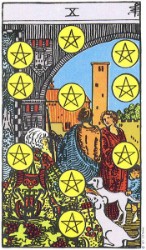
The Ten of Pentacles shows one of those stereotypes.  An old man sits quietly in a corner, wrapped in a shawl, while younger people engage with each other in the light.  There are dozens of other stereotypes in our culture, of course. Perhaps we should take up knitting or learn to play shuffleboard.  Maybe move into a nice retirement community where we don’t have to cook for ourselves anymore and we can scoot around in golf carts instead of actually walking.  Maybe join a book club or take a nice cruise with other old people.  The overall emphasis with these activities is that we should find something harmless to do while we’re waiting to die.

But suppose – horror of horrors – that we don’t die?  

Suppose that Grandma Moses had bought into the perspective that her life was over at the age of 78 and she just needed to sit down and wait to die?  That would have been 23 years of sitting there twiddling her thumbs, staring out the window, and asking people, “Am I dead, yet?”  Instead, the next 23 years were the richest and most fulfilling of her life.

THE AGE OF NEW AGING

There IS a new paradigm for aging emerging in our societies.  

 – Older people are staying creative, starting businesses, exploring spirituality, and reinventing themselves.

 – Longevity science and neuroscience show that the brain remains adaptable well into later life.  Neuroplasticity is showing that the idea that old dogs can’t learn new tricks is bullshit.  We still have lots of tricks up our sleeves.

 – And, as older people begin to behave differently, we begin to reject the stereotypes of how we’re supposed to be. The cultural narratives of aging are beginning to evolve.  We’re seeing much more positive portrayals of older people which in turn provide more positive role models for all of us.

 INTERNALIZED AGEISM

Probably the most important element in rebellious aging is rejecting our own internalized ageism.  That means taking the time to really examine how we feel about aging.

* How do we, personally, feel about, “old people?”

* Do we think our, “best years,” are over?

* Do we think, deep down, that young people are somehow, “better,” than old people?

* Are we rejecting our own sexuality because we think it’s inappropriate for older people to like sex?

* Are we constantly telling ourselves things like, “I’m too old for that?”

* Are we obsessing about our high school or college years instead of fully living in our present lives?

* Are we afraid to try new, creative endeavors because we just don’t have the time left to learn to play the piano or paint or sculpt?

* Are we obsessing over our health and expecting that we’re going to get sick, simply because we’re getting older?

If some, or all, of those things ring true for you, don’t feel bad about it.  That’s what we’ve been programmed to believe.  That doesn’t mean that we have to believe any of it any longer, though.  

RECLAIMING OUR POWER

We might think of this as learning to embrace our Inner Grandma Moses.  If we’re older, try to imagine that we’re actually going to live to be 101 years old, just like she did.  What do we want to do with all of that time?  If you’re 70, for instance, do you really want to spend the next 30 years bitching about your aching joints or would you rather roll a joint and listen to some music?  If you’re 80, do you want to spend the next 20 years sitting in a rocking chair or would rather dance to some rock and roll?

As other people have said, aging is inevitable but getting old isn’t.  Aging is a transition into wisdom, creativity, and new possibilities.  Celebrate it.

The Two of Pentacles, Multipotentialites, and Specializing in Being a Non-Specialist

How to distinguish creativity from attention deficit disorder.

Did you ever walk into a room and then have absolutely NO clue why you did it?  We stand there for a couple of seconds, asking ourselves, “What in the hell am I doing in here?  What did I want in this room?”  Blank. And then we remember that we were looking for our car keys or we wanted to make the bed or maybe there’s a book that we left somewhere and we need to find it.

That happens to everyone, of course, and older people even joke about it.  “I wouldn’t remember where my head was if it wasn’t screwed on.  Maybe I’m getting the OldTimers Disease.”

If it KEEPS happening, though, we may start to hear a little voice inside our mind that’s sounding an alarm.  “Hey, dude, maybe you are getting Alzheimer’s.  Or maybe you shouldn’t have taken all of those recreational drugs when you were a kid.  Or – oh, my god – maybe you’ve got a brain tumor!  Or maybe you’ve got ADHD!”

ADHD-ISH

The truth of the matter is that a lot of us are feeling ADHD-ish these days.  After all, attention deficits can also spring straight out of anxiety and depression and these aren’t the most tranquil of times, are they?  Even if we don’t have personal problems, the news networks and the internet are constantly blasting out the message that the sky is falling and we’re all going to die.  Climate change, pandemics, wildfires, dead celebrities, crazy politicians, oh, my!

Huge numbers of people are feeling distracted, nervous, upset, and having trouble concentrating.  There’s an epidemic of lost car keys and many of us aren’t just keeping to-do lists, we’re keeping lists of our to-do lists.  Try an internet search on, “how to get organized,” and you’ll see how very many us are bewildered, befuddled and befucked.  

AN ALTERNATE VIEW

Now, WAY BACK in the 2010s, Emilie Wapnick noticed that there were many, many people feeling this way.  It wasn’t just that they were having trouble with their attention spans or with getting organized.  Their entire lives felt unfocussed, as if they simply couldn’t decide what they should do next.  

She gave an incredibly influential TED talk called, “Why Some of Us Don’t Have One True Calling,”  and she introduced a radical idea.  Maybe, she suggested, we’re not really ding bats who keep getting distracted by shiny objects.  Maybe we’re actually just incredibly creative people who can’t and won’t be satisfied by a single pursuit. 

The term that she uses to describe people like that is, “multipotentialite.” As she outlines in her wonderful book, “How to Be Everything: A Guide for Those Who (Still) Don’t Know What They Want to Be When They Grow Up,” there are some of us who simply aren’t wired to be single-pursuit human beings.  We may be simultaneously (and passionately) pursuing vocations in art, writing, and auto repair, all the while researching a half a dozen other fields that we’re interested in.  In the past, such a person might have been admired and even lauded for their intellectual curiosity.  Today, they’re frequently labeled as being dysfunctional or misdiagnosed as having attention deficit disorder.

HENRY FORD’S DEMON BABY

Almost from its inception, the Industrial Revolution attempted to turn human beings into mere slaves who operated the machines in the factories.  The model wasn’t really perfected, though, until Henry Ford introduced his, “rolling assembly line,” in December of 1913.  Using that model, workers stand in one place as the product rolls by on a conveyor belt.  Each worker performs one job in assembling the product, and they do that one job over and over, hundreds of times a day. This ushered in the age of specialists.

There is no question that Henry Ford was a thoroughly evil man.  He was such a rotten person that Adolph Hitler mentioned him admiringly in Mein Kampf and kept a large portrait of Ford behind his desk.  Perhaps the worst thing that he did, though, was to champion the idea that a person should specialize in only one thing and do it over and over until his soul dies from sheer boredom.

NOT BELONGING IN THE AGE OF SPECIALIZATION

That idea of specializing in only one thing has it’s advantages, of course.  For instance, if we’re having a heart valve replaced it’s comforting to know that the surgeon has performed the same operation hundreds of time before.  Still, it can have devastating effects if it’s presented as the ONLY model of functioning in our society.

To be clear, multipotentialites don’t just like to pursue multiple interests at once:  it’s what they do.  It’s wired into their brains.  Telling a multipotentialite to specialize in just one area is like telling an introvert to go to more parties or telling a cat to fetch a stick and bark.

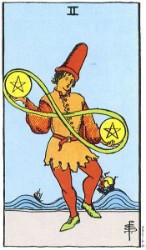
When we take that natural behavior, though – that need to pursue many different interests at once – and drop it into our linear, specialized society, it looks a lot like . . . guess what?  ADHD.  In a culture where concentrating on one task at a time is the behavior that’s rewarded and reinforced, the multipotentialite is frequently perceived as being highly dysfunctional.   Why can’t you concentrate?  Why don’t you ever get anything finished?  Why do you keep jumping from one thing to the next?  Those are questions that the multipotentialite will hear her entire life and it can leave her feeling inadequate, guilty, and shamed.  Like the figure in the Two of the Pentacles, life seems like a constant balancing act, rather than a fulfilling adventure.

STRATEGIZING FOR A HAPPY LIFE

If all of this is striking a chord with you, if you feel that you may be a multipotentialite, then rest assured, there are still ways to find happiness.  There are a few simple strategies that can make you feel like you’ve got super-powers instead of constantly feeling less than.

1. Embrace Your Identity and Fix Your Self-Image: Recognize that being a multipotentialite is a strength, not a flaw. Celebrate your curiosity and versatility instead of forcing yourself into a specialist mold.

2. Consciously Design a Portfolio Career: Instead of choosing one path, build a career that allows you to explore multiple interests. This could mean freelancing, consulting, or combining part-time roles.  If you’re an artist and a writer, for instance, you could do illustrations set off with poetry.

3. Set “Seasons” for Your Passions: Focus on specific interests for a set period, then rotate to another. This prevents burnout and keeps things fresh. This allows you to hyper-focus on a particular avocation, but use boredom as a signal for when it’s time to switch to another.

4. Create a “Renaissance Schedule”: Dedicate blocks of time to different pursuits. For example, Mondays for art, Tuesdays for coding, and so on. Structure helps manage your many passions without feeling scattered.

5. Prioritize Projects: Not every interest needs to become a lifelong commitment. Learn to distinguish between short-term fascinations and long-term passions.

6. Find Overlaps: Look for ways to combine your interests into unique projects. A multipotentialite superpower is the ability to innovate by connecting ideas from different fields.

If you’re interested in exploring more multipotentialite options for living, I’d really encourage you to visit Emilie’s website, “puttylike.   Creativity and curiosity are options that many people seem to have missed out on, so let’s take them to the max.

The Eight of Pentacles and the Death of Creativity

The Eight of Pentacles looks like a pretty happy card.  A craftsman sits at his bench carving away at one pentacle after another and seems to have several of them displayed, as if they were for sale.  My original definition of the card in my book, “Just the Tarot,” pretty much agrees with that:

Profiting from your skills.  Learning new skills that will advance your career.  Possible promotions or awards at work.

And, yet, as an artist and a writer, I have to say, “Ugh.”

And, “Yuck.”

In some ways the Eight of Pentacles is sort of the anti-creativity card.  Real creativity involves an interesting balance between competence and incompetence.

If you’ve ever gone through the pains of starting a new job or you’ve supervised someone who was new at their job, you know that there’s a definite learning curve.  For about the first six months you can count on a pretty high level of screwing up. The new employee has to learn new skills or – in some cases – unlearn what he thought he knew.  At about six months to a year, she’ll start to develop the abilities to perform the job and, after a year, it should be easy peasy.

We see a lot the same thing with artists.  Having a creative vision isn’t enough. The painter has to learn how to blend the colors and which brushes to use.  The wood carver has to know which chisels do what and what types of wood have smooth, tight grains that will take the details of the carving.

You study it, you practice it, and you learn it.  I used to refer to that as, “getting the knowledge out of my head and into my hands.”

But, the thing is, the second you’ve REALLY learned it, the second you can do it perfectly over and over and over again . . . you’ve stopped creating.  You’re just repeating.

That’s what I see when I look at the Eight of Pentacles:  a line of perfectly carved pentacles that are all exactly the same.  It would have been really cool if some of them were orange and some of them were purple, if there were a few folk art pentacles mixed in with some abstract pentacles.  

But there aren’t.

Henry Ford invented the assembly line in 1913.  It was a novel concept at the time: a product moving down a line, being assembled by a team of workers.  Each worker was highly trained in doing one separate part of the assembly, over and over and over. Doing exactly the same thing day after day after day until they retired or dropped dead from boredom.

It was a brilliant idea for a capitalist and an absolute soul killer for the workers.  Real creativity involves trying something new that you don’t actually know how to do perfectly.  It’s a meshing of your skill set with unknown territory that results in something unique and different AND increases your skills.

Unfortunately, we don’t see a lot of that in our work places.  We see people stuck in jobs where they do one or two things over and over again and are never challenged and never grow.  We actually give them awards for that and congratulate them on knowing how to do those one or two things better than anyone else, on accepting the concept that they should be, “good”, but not creative or different.

The Eight of Pentacle is a safe card, a card that shows that nothing bad is happening to that person.  But nothing particularly wonderful is happening to that person, either.  The real story is in the definition of the Eight of Pentacles Reversed:

 Employment problems that may involve a need for retraining or learning new job skills.  Possibly the questioners position being eliminated or some sort of a reshuffle of employees that will place him or her in a job requiring different skills.

In other words, THAT person is going to have to GROW.  It’s all really a question of choosing emotional safety or choosing growth.  Sit in the nest or jump out and learn how to fly.

Life is way too short to choose safety.

The Three of Pentacles and the Creative Process

We know that humans essentially have two different brains in one skull.  The left hemisphere of the brain is involved in logical and linear processes such as math, writing, driving a car, and analyzing problems.  The right hemisphere is the, “creative brain,” and deals with dreams, symbols, intuition, inspiration, poetry and art.

While the right brain is more involved in the genesis of art, both sides of the brain are necessary to make it materialize.  Here’s an example: Janis is an artist and has a dream about a beautiful, glowing landscape. Upon awakening, she’s determined to paint the image she dreamed and share it with the world.  That’s right brain working.

She goes to her studio and has to select which paints will work best with the image, what size canvas she wants to paint it on, and which brushes she want to use.  That’s left brain working.

As she begins to paint she falls into a sort of a trance and hours go by without her being aware of anything but the painting.  Right brain is in charge again.

When she’s finished for the day she sits back and critiques what she’s done.  Did she get the lines right? Is the shading perfect? Did she capture the source of light?  That’s left brain engaging in the process.

So there’s this interesting back and forth between the two sides of the brain, each side contributing its’ own powers and skills to creating.  And that’s what we see in the Three of Pentacles.

The Three of Pentacles is unusual for a Minor Arcana card because it incorporates two figures from the Major Arcana.  A stonemason stands on a bench, mallet in hand, pausing between strokes to listen to two people who are conferring over a plan.  The two people are obviously The Fool and The Hierophant.

They are represented here, it seems, not so much as the formal individuals they are in the Major Arcana, but as the energies or vibrations associated with those two cards.

The Fool is wild, intuitive, intoxicated with divine energy but with no need to interpret or define what he’s doing.  The Hierophant is stodgy, stolid, conventional, not unkind but a stickler for the rules. The Fool is all about Right Brain energy and The Hierophant is all about Left Brain energy.

So we have this almost perfect representation of the creative process:  Left Brain and Right Brain working together while the craftsman waits to create their synthesis in the material world.

And one of the fun things about this card is that it’s not about art at all, according to its’ common definitions.  It’s about buying real estate and making improvements to your home, being enthusiastic about it but paying careful attention to details.  Which is a wonderful reminder that everything – everything – we do in life is a creative process. 

 Life is a canvas – use bright colors.