
The Emperor and the Empress are obviously paired cards—one female and the other male. But if we stop at gender, we miss their deeper meaning entirely.
On a more profound level, they represent the Yin and Yang energies that exist within every human being.
Every woman has testosterone in her body. Every man has estrogen. Wholeness comes not from exaggerating one pole and suppressing the other, but from integrating both. Strength and compassion. Power and vulnerability. Fierceness and tenderness.
This is what the ancient Yin–Yang symbol illustrates so elegantly: Yin contains Yang, and Yang contains Yin.

When these energies are balanced, they produce whole, grounded human beings. When they are separated and exaggerated, they produce caricatures.
That’s where we find emotionally stunted men obsessed with dominance and control. That’s where we find people who abdicate their agency entirely and wait for someone else to take care of their lives.
Me Tarzan. You Jane.
Man strong. Woman weak.
This is not balance. This is Yang attempting to overwhelm Yin. But Yin and Yang are not enemies. They are partners.
Creation requires both.
The Peculiar Paradox of Yin Energy
Modern culture often assumes that Yang energy—the active, assertive, masculine principle—is the true creative force, while Yin energy is passive or secondary.
Nature shows us exactly the opposite.
Consider procreation. A man’s biological contribution to the creation of a child may take minutes. But the woman’s body then undertakes nine months of continuous creation—growing, forming, and sustaining new life from her own substance.
She gives birth. She nourishes the infant. She does the creating.
THE YIN ENERGY DOES 99% OF THE WORK OF CREATION.
This pattern appears everywhere.
The receptive, Yin principle is not inert. It is generative. It is the matrix from which life emerges.
The Kybalion expresses this clearly: the feminine principle does the creative work. The masculine principle directs and structures it.
Without Yin, nothing would exist.
⸻
The Artist and the Subconscious
We see this same pattern in the creative process.
When we imagine an artist, we picture someone standing at an easel, brush in hand, actively painting.
But the visible act of painting is only the final stage.
Long before the brush touches the canvas, the image has already been forming in the artist’s subconscious mind. It grows invisibly. It gestates. It organizes itself.
We call this “inspiration,” as if it appeared suddenly.
But inspiration is the flowering of something that has been developing quietly within.
The conscious mind—the Yang principle—provides skill, technique, discipline, and execution. But the image itself emerges from the Yin subconscious.
Again, the receptive principle does the creative work.
⸻
The Function of the Emperor
Does this mean the Emperor—the Yang principle—is unnecessary?
Not at all.
The Emperor is essential.
The Empress creates. The Emperor protects and stabilizes what she creates.
Consider the garden.
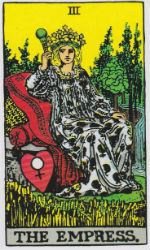
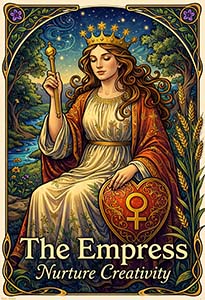
The Empress is the lush, living growth. She is the fertile soil, the green leaves, the flowing water. She is life itself.
But without structure, the garden cannot reach its full potential.
The Emperor builds the raised beds. He enriches the soil. He installs irrigation. He builds the fence to keep the deer out.
He does not create the life. He ensures its survival. The Emperor provides continuity. He creates the conditions under which life can flourish and endure.
⸻
The Emperor Is Always Grounded in the Empress
In my own Emperor affirmation card, I made a subtle but important change. The Emperor still sits on his stone throne, armored and immovable.
But I surrounded him with life.
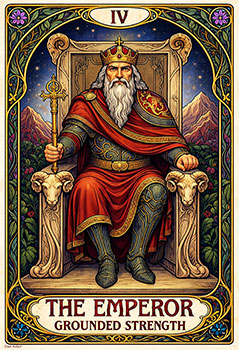
Because the Emperor does not exist independently of the Empress. He exists to protect her. He exists to serve creation. Within each of us, the Emperor is the part that creates structure for our creative and emotional lives.
If you are an artist, your Emperor sets up your studio, organizes your materials, and protects your time.
If you are a writer, your Emperor establishes the discipline to write regularly and brings your work into the world.
If you are in a relationship, your Emperor establishes boundaries that protect emotional safety and mutual respect.
The Emperor does not suppress the Empress.
He protects her so she can fully express herself.
When the Emperor Is Separated from the Empress
When the Emperor loses his connection to the Empress, he becomes distorted.
His structure serves nothing. His authority protects nothing.
He becomes the petty tyrant. The rigid bureaucrat. The hollow authoritarian. His armor is empty. He enforces rules not to protect life, but to compensate for his own inner disconnection.
True authority does not arise from domination. It arises from service to life.
The Emperor’s true purpose is not control. It is protection. He is the guardian of the garden. He is the structure that allows creativity to endure.
He is sovereignty in service of life itself.
When we see beyond the illusion of gender, the deeper purpose of these archetypes becomes clear. The Empress and the Emperor are not separate beings, but complementary forces within each of us. One creates. The other protects what has been created. One generates life from the invisible depths. The other builds the structure that allows that life to endure.
Our true purpose is not to choose between them, but to embody both—to allow our inner Empress to bring forth creativity, love, and vision, and to allow our inner Emperor to establish the boundaries, discipline, and stability that allow those creations to survive and flourish in the world. When these two forces work in harmony, we cease to live reactively and begin to live sovereignly, shaping a life that is both fertile and enduring.



 Just the Tarot