Because most of us have been trained to believe that creativity comes from effort. From discipline. From pushing harder. From sitting at the desk and refusing to get up until something happens.
That approach belongs to The Emperor.
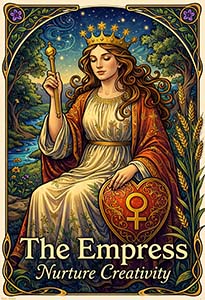
The Empress operates differently.
She does not force growth.
She allows it.
She creates the conditions in which growth becomes inevitable.
Creativity Cannot Be Forced
Every creative person eventually encounters this paradox.
The harder you try to force creativity, the more it retreats.
You sit at your desk, determined to produce something brilliant. Hours pass. Nothing happens. Your mind feels like dry soil.
And then, days later—while taking a walk, washing dishes, or doing something completely unrelated—an idea appears effortlessly.
It arrives whole.
Not constructed, but received.
Albert Einstein understood this phenomenon. When asked how he discovered the theory of relativity, he didn’t describe grinding intellectual labor. He said simply:
“It just dropped in while I was playing the piano.”
He wasn’t forcing the insight.
He was allowing it.
This is Empress energy.
The Forgotten Value of Leisure
The philosopher Josef Pieper wrote a remarkable book titled Leisure as the Basis of Culture. In it, he argues that leisure is not the absence of productivity, but its foundation.
Leisure, in its true sense, is not laziness in the modern, pejorative sense. It is a state of receptive openness.
It is the willingness to stop forcing.
Pieper observed that culture itself—art, philosophy, music, science—arises not from frantic effort, but from spaces of inward stillness.
When we allow ourselves to be idle, something deeper begins to move.
The soil replenishes itself.
Modern society often treats leisure as wasteful. We are taught that our worth is tied to constant activity. But creativity obeys older, quieter laws.
Seeds do not grow faster because you stare at them.
Julia Cameron’s The Artist’s Way remains one of the most practical and psychologically accurate guides to creativity ever written.
Her central insight is simple: creativity must be nurtured.
Not commanded.
She encourages practices like morning pages and artist dates—not to produce finished work, but to create space for the creative self to emerge naturally.
These practices are Empress practices.
They say to the creative mind:
You are safe here.
You are allowed to emerge in your own time.
And when that safety is present, creativity begins to flow again.
The Courage to Be “Lazy”
This is perhaps the most radical lesson of The Empress.
You must allow yourself to be, at times, unproductive.
Not because you are weak.
But because you are cultivating fertility.
What appears to be inactivity is often incubation.
Beneath the surface, ideas are forming. Connections are being made. Your subconscious is doing its work.
If you constantly demand output, you exhaust the system that produces it.
The Empress reminds us that rest is not the opposite of creation.
It is part of creation.
Nurture Creativity
The Empress does not shout. She does not command. She invites.
She reminds us that creativity is not a machine, but a living process.
It responds to kindness.
It responds to patience.
It responds to nourishment.
When you stop trying to force creativity and begin nurturing it instead, something remarkable happens.
Ideas begin to arrive again.
Quietly.
Effortlessly.
Like seeds finding their way toward the light.
So when The Empress appears in your readings—or quietly makes herself known in your life—it is not a signal to push harder. It is an invitation to soften. She asks you to step out of the mentality of force and into the rhythm of cultivation. To rest without guilt. To follow your curiosity. To trust that creativity, like all living things, emerges when it is nourished rather than commanded.
She reminds you that you are not a machine designed for constant output, but a garden capable of extraordinary growth. Your task is not to force the flowers to bloom, but to tend the soil and allow them to emerge in their own time.
Reflections on the past year and strategies for empathic coping with the year to come.
Sunday is the Solstice — the darkest day of the year — before our beautiful Earth begins its long, slow climb back into the light. In many ancient traditions, this moment marked the true New Year: not a calendar flip, but a turning point.
Light returns.
And this year, that matters.
A Difficult Year for Sensitive Souls
2025 has been a particularly rough year for many of us. It’s not surprising if you’re ending it feeling exhausted, raw, or strangely unsteady.
We’ve been inundated with horrific images. Norms we once relied on for stability have been violated again and again. The overall effect has been a pervasive sense of unsafety — not just politically or socially, but emotionally.
And while it feels endless, it helps to remember this:
in the span of a lifetime, five years is a very short time.
It’s only been five years since a global pandemic placed our very existence in question. Many of us were still recovering from a prolonged fight-or-flight response when the world was thrown into further chaos. What once felt “crazy” somehow got even crazier.
That constant state of activation takes a toll.
Why This Has Been Especially Hard on Empaths
If you’re an empath, this year may have felt truly overwhelming.
Empaths naturally absorb the emotional atmosphere around them. Other people’s suffering draws us in. Compassion isn’t optional — it’s automatic.
And that means one of our greatest challenges is keeping the outside, outside.
This year has been a near-constant boundary violation.
There has been a deliberate strategy — politically and culturally — to keep people off balance, upset, and reactive. A lack of empathy and compassion at a societal level doesn’t just distress empaths; it can destabilize us.
When the collective feels unhinged, empaths feel it in their nervous systems.
A Choice at the Turning Point
At this Solstice, we face a choice.
We can tell ourselves:
“The world has gone mad, and I need to hide.”
Or we can reframe this moment as:
“This is a difficult — but perfect — environment for learning new skills.”
Skills that help us survive and stay open.
The Core Skill Empaths Need Right Now
To navigate what’s coming, empaths must learn to distinguish:
What energy is mine — and what does not belong to me.
Right now, there is a lot of chaotic energy in the air. That means we need to perform regular internal “fact checks.”
Ask yourself:
• Am I actually in danger right now?
• Am I personally unstable — or do I just feel unstable?
And yes — it’s okay if you are occasionally a little crazy. We all are.
But if you’re not objectively falling apart and yet you feel like you are, that’s a strong sign the energy is coming from outside you.
Once you recognize that, the next question becomes:
How do I respond — without absorbing it?
Practical Strategies for the Year Ahead
Here are a few grounded ways empaths can protect their nervous systems:
• Unplug intentionally.
Turn off the news. Step back from social media. Don’t answer every text like Pavlov’s dog. Your attention is precious.
• Curate what you consume.
If you spend five minutes wading through the sewage of daily news, balance it with ten minutes of something hopeful — music, art, a book, a walk, a moment of beauty.
• Name the manipulation.
Much of what we’re experiencing is designed to keep people in fight-or-flight. This isn’t accidental. Recognizing that helps break its spell.
When fear and outrage are being deliberately amplified, our most radical response is calm, mindfulness, and conscious detachment.
That doesn’t mean indifference.
It means sovereignty.
Walking Toward the Light
The Solstice reminds us that even at the darkest point, the turn has already begun. The light doesn’t return all at once — it comes back slowly, almost imperceptibly, day by day.
As we move into the new year, especially those of us who feel deeply, the work isn’t to harden or shut down. It’s to strengthen boundaries, choose what we engage with, and care for our nervous systems with intention.
That, too, is a form of courage.
May the coming year bring more steadiness, more discernment, and moments of real peace — both within us and, slowly, in the world we share.
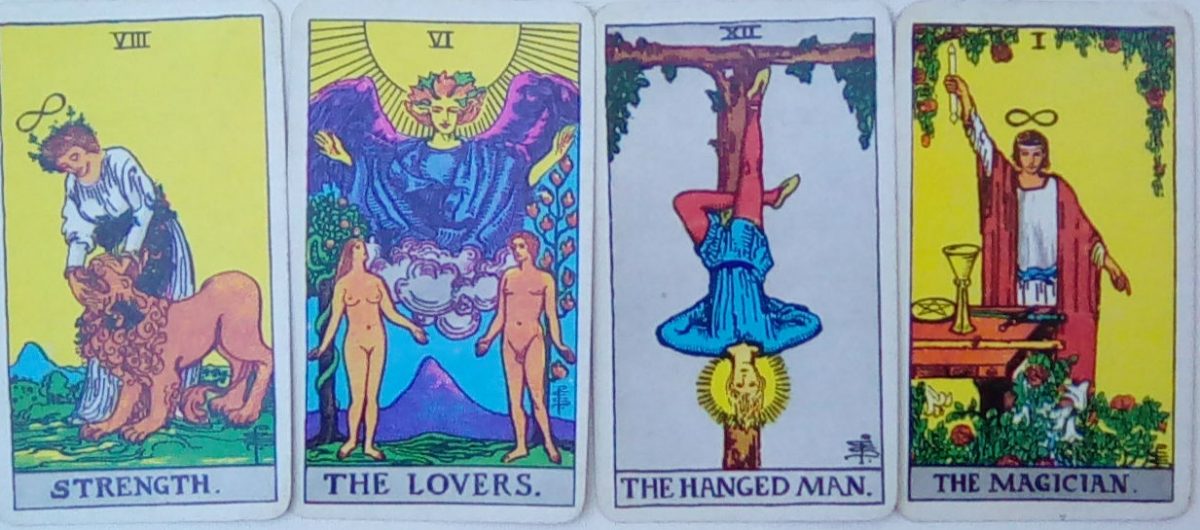
The Magician shows how thought becomes form.
From roses and lilies to the infinity symbol, every detail reveals the art of manifestation — the meeting of spirit, will, and action.
Discover what each symbol means and how The Magician teaches conscious creation.
The Magician stands at the threshold between spirit and matter, reminding us that creation begins in consciousness. Every element in this card — from his roses to his raised wand — tells the story of how ideas become real.
Let’s look closely at the symbols that make the Magician such a powerful image of manifestation.
🌹 Roses and Lilies – Desire and Purity
At the Magician’s feet, red roses and white lilies intertwine. The roses symbolize passion and vitality — the raw energy of desire. The lilies represent purity, clarity, and spiritual truth.
Together they tell us: creation requires both — the fire of wanting and the innocence of trust.
✋ The Raised Hand and Pointing Finger – “As Above, So Below”
With one hand holding a wand to the heavens and the other pointing to the earth, the Magician enacts the Hermetic axiom: “As above, so below.”
He channels divine inspiration downward into form, bridging worlds. It’s a reminder that every idea you manifest must be grounded in action.
⚡️ The Double-Ended Wand – Energy Flows Both Ways
The wand itself has two tips, showing that energy moves in a circuit. Inspiration doesn’t just descend — it also ascends, rising from the material back into the spiritual.
When you create something authentic, the universe responds in kind. Power flows in both directions.
🌀 The Infinity Symbol – Eternal Creative Flow
Above his head floats the lemniscate — the sideways figure eight of infinity — mirrored again in his serpentine belt, the ouroboros that eats its own tail.
These symbols whisper that creation is endless. There is no true beginning or ending, only perpetual transformation. Every manifestation becomes the seed of the next.
🎀 The Headband – Focused Intention
Around his brow, the Magician wears a simple white band. It signifies concentration — the mind harnessed and directed.
Magic without focus is daydreaming; focus without inspiration is drudgery. The headband marks the moment when clarity and will fuse.
❤️ The Red Robe – Passion in Action
Red is the color of vitality, courage, and physical energy. The robe says: ideas alone are not enough — they must be acted upon.
Beneath the robe, his inner tunic is white, showing that true power is driven by purity of motive, not ego.
🌞 The Yellow Background – Light of Consciousness
The entire scene glows in radiant yellow, representing illumination and awareness.
This is the color of intellect, clarity, and awakening — the mind fully alive. The Magician works in daylight because his magic is conscious, not hidden.
🧰 The Tools on the Table – Mastery of the Four Elements
Before him lie the wand, cup, sword, and pentacle — the emblems of fire, water, air, and earth.
They show that he commands all aspects of creation: spirit, emotion, thought, and matter.
Nothing is missing; he already holds everything needed to bring vision into being.
🔢 The Number One – The Point of Origin
As the first card of the Major Arcana, The Magician represents beginnings — the spark of individuality, the “I am” moment.
He’s the point where potential first becomes personal power. Every creative act starts here: the decision to say yes to your own ability.
🌟 Bringing It All Together
Every symbol in The Magician tells the same story: you are the conduit between heaven and earth.
Your thoughts, feelings, and actions are the instruments on his table.
When you align them with clarity and purpose, magic isn’t mysterious — it’s inevitable.
So the next time you draw The Magician, take a breath and remember:
You already have everything you need. All that remains is to raise your wand — and begin.
“Just the Tarot,” by Dan Adair – a guidebook for reading the cards with complete definitions and sample layouts, available as an ebook on Amazon.
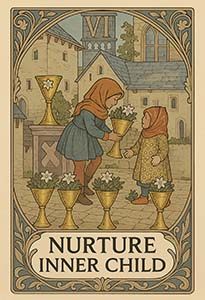
The Six of Cups reminds us that our creativity flows from the innocence of the inner child. Protecting that child means honoring your art, choosing who sees it, and never letting careless criticism silence your joy.
When Beauty Meets Criticism
Have you ever created something you thought was beautiful — a painting, an essay, even a garden — and when you finally shared it, the first thing someone did was point out the flaws? Instead of seeing what you were trying to express, they zeroed in on what they thought was wrong.
There’s always a tension between creating and sharing. When we make something real — assuming we’re not just hacking away — we’re revealing a piece of our heart, our soul, our lived experience. A careless critique can feel like a personal attack. It can leave us feeling exposed, vulnerable, even ashamed.
The Inner Child at Play
Picasso once said, “All children are born artists; the problem is to remain an artist as we grow up.” Creativity flows from the same source as play — from the child who once molded mud into castles or splashed finger paints across paper just for the joy of it.
That inner child still lives inside us, but it’s easily wounded. A thoughtless comment can silence it. A dismissive tone can make it retreat. And when that happens, the creative flow — the very essence of who we are — begins to dry up.
The Birth of the Critic
Mel Brooks joked that with the birth of art came the inevitable afterbirth — the critic. And he wasn’t wrong. If you take your creativity seriously, you’ll eventually encounter people who feel compelled to “fix” your work.
Julia Cameron wrote that before we can become good artists, we must first give ourselves permission to be bad ones. Every artist, writer, gardener, or musician produces clumsy beginnings — and even seasoned creators sometimes turn out a piece that just doesn’t land.
The creative process is messy and human. Yet while you’re admiring what went right, someone else may focus only on what went wrong.
The Wound of the Inner Artist
Cameron also warned that exposing your inner artist to harsh criticism is the emotional equivalent of child abuse. It’s like taking the eager, innocent child who offers you their finger painting and saying, “That’s terrible. You don’t really have any talent, do you?”
If you choose a creative life, criticism is inevitable. Some people simply won’t resonate with your vision, and occasionally you’ll make something that misses the mark. That’s part of the territory. But you can — and must — protect your inner artist with the same fierce loyalty you’d show a child under attack.
Learning by Heart
I became an artist late in life and am entirely self-taught. I picked up a mallet and chisel and learned to carve wood through trial, error, and stubborn joy. I learned to paint the same way.
Looking back, I can see how rough those early pieces were — primitive, awkward, untrained — and yet they were full of life. I still remember the pride I felt each time I saw progress take shape beneath my hands.
Claiming the title artist took courage. The first time I walked into a gallery and asked, “Would you show my work?” was absolutely terrifying.
A Pact of Protection
One simple, unbreakable pact guides me still: when someone criticizes my art, that’s the last time they see my art.
Showing your work is an act of intimacy — an unveiling of something deeply personal. The art flows from the child within you, and that child deserves protection.
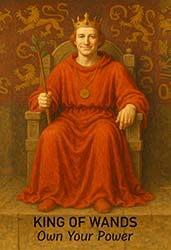
The King of Wands reversed shines a light on impostor syndrome — that nagging sense of never being “good enough.” Learn how this Tarot archetype mirrors self-doubt and discover practical steps to reclaim authentic confidence, reverse the distortion, and own your rightful place at the table.
Do you never feel “good enough?”
Do you feel like, no matter how hard you try, no matter how much you do, you’re still falling short?
Does it seem as if everyone around you somehow has more talent, more luck, and is more deserving than you are?
That’s called, “Impostor Syndrome,” and it can destroy our lives.
WHAT IS IMPOSTOR SYNDROME?
Put very simply, it’s the persistent feeling that we’re a fraud, even when the evidence in our life says otherwise.
Self-doubt becomes a constant companion and we dismiss our achievements as, “a fluke,” or, “just good timing.” Even worse, there’s a chronic fear that someday we’ll be found out, that everyone else will realize that we’ve just been bullshitting our way through life and we don’t have any real substance.
It’s quite common among people who grew up in abusive households because that’s one of the primary messages that they got as kids: “you’re not good enough.” No matter what you do, you’re still not good enough.
It’s especially common among creatives, leaders, and anyone who’s stepping into a new role in life. Exactly the people who are already stretching themselves into growth and success.
THE KING ON A SHAKY THRONE
In the Tarot, the King of Wands represents the exact opposite of impostor syndrome. He radiates confident leadership. He’s the charismatic leader who can stand firmly in his own power and inspire the people around him.
But reversed? His fire dims and he hesitates. His self-belief falters and instead of leading with boldness he spirals into self-doubt.
That’s where Impostor Syndrome rears its ugly head:
Self-doubt in leadership.
Fear of being, “Found Out’ and huge anxiety that others will see through the facade.
Inconsistent Confidence and swinging between moments of brilliance and moments of total collapse.
Avoidance of responsibility and shrinking back from visibility and opportunity.
Overcompensation and burnout where we work WAY too hard to prove our worth until exhaustion sets in.
The King of Wands reversed is the perfect representation of Impostor Syndrome at work.
There’s an old joke that says that if you feel the need to ask your therapist if you’re a narcissist, you’re not one. The same thing applies to Impostor Syndrome. If you’re constantly full of self-doubt, you probably shouldn’t be.
The gift of the Tarot is that no card is fixed. The King of Wands can always be turned upright again and so can our confidence. Here are a few simple practices that can reverse Impostor Syndrome:
1 – Keep a, “proof journal.” Write down ALL of our wins, big and small, to create a counter-narrative to the voice that’s telling us that we’re, “not good enough.” And if that feels uncomfortable, it’s just proof that we really need to do it.
2 – Normalize mistakes. People with Impostor Syndrome don’t just regret it when they screw up – they beat themselves into a bloody pulp over it. Every artist, every writer, every visionary stumbles. That’s part of the growth curve. As Julia Cameron said, “In order to become a good artist, you have to first give yourself permission to be a bad artist.”
3 – Talk it out. When we share our doubts with a trusted friend or therapist we get the realistic feedback we need. When we tell someone we love that we feel like a total fuck-up they will frequently be amazed and even appalled that we could perceive ourselves that way. Basically, that’s just, “borrowing someone else’s eyes” and they may see our brilliance and talent far more clearly than we can.
THE ONLY IMPOSTOR IS OUR SELF-DOUBT
The King of Wands reversed reminds us that Impostor Syndrome isn’t the truth. It’s a distortion, an illusion that doesn’t need to define our reality.
Turn the card upright and loosen the chains of self-criticism. Step into the fiery confidence that we should have and that we deserve.
We’ve already earned our places at the table. Now own it.
Ever fallen in love with someone you couldn’t have? Psychologists call it “limerence,” but spiritually it’s more than just a crush. This post explores the difference between obsessive attraction and true love, why we sometimes fall for the “wrong” people, and how to heal by generating love from within. Featuring insights from psychology, past-life theory, Ram Dass, and the Ace of Cups, it’s a guide to shifting from longing to self-created wholeness.
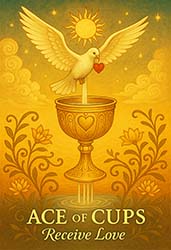
Ace of Cups – A Tarot affirmation poster available at Synergy Studio.
Did you ever fall in love with someone you shouldn’t have? Someone who was unavailable, but you still felt intensely attracted to them?
Maybe it was your next door neighbor who was happily married. Maybe it was a co-worker and you KNEW that a work place romance would be a disaster. Hell, maybe it was your 8th grade teacher who was just SO perfect in every way.
GETTING CRUSHED
We used to call that, “getting a crush,” on someone. We meet someone and we just know that we’re supposed to be together, even though everything else is saying, “No, you’re not.”
Psychologists – as psychologists tend to do – have invented a new term for it which is, “limerence.” Here’s a definition:
“Limerence is an involuntary, intense, romantic obsession characterized by intrusive thoughts and a longing for emotional reciprocation, often leading to emotional suffering due to unmet romantic needs.”
In other words, having a crush on someone you probably shouldn’t have a crush on.
IT’S ALL PERFECTLY NATURAL
Now, this has been going on ever since the world began and, of course, it’s caused a passel of trouble. Marriages end, people lose their jobs, reputations and careers are destroyed. All in the name of love.
Which is puzzling, isn’t it? Love is supposed to be this grand, wonderful adventure that lets us soar to new heights on the wings of the person we’re in love with. So why is all of this so painful and frustrating?
THE CALM, INNER VOICE
I had a teaching dream once about spirit guides and spiritual guidance. I call them, “teaching dreams,” because they’re very lucid, very clear and they usually have to do with some issue that’s really bothering me.
The subject of this dream was, “How do I distinguish true spiritual guidance from my own desires and ego?”
And the answer was that spiritual guidance is never harsh, never critical, never ominous. It’s always gentle, loving, and kind and leaves us feeling nurtured rather than criticized or beaten up.
The same principle applies to falling in love. If it feels sweet and kind, it’s probably real love. If it involves obsessive thinking, insecurity, self-doubt, or criticism . . . hey, it may be a hell of a crush, but it ain’t love.
WHY DOES IT HAPPEN?
Why do we fall in love with people who aren’t, “right,” for us?
Psychologists, philosophers and playwrights have been trying to figure that one out for hundreds of years and really haven’t made much progress.
My personal theory is that these are relationships that are, “out of time.” And I don’t mean that in the sense of, “Whoops, we’re out of time.”
Rather, what I’m talking about is old relationships from previous incarnations that have been displaced in time. The feelings are still there, but they’re no longer appropriate in their old form.
Perhaps we were married to someone or had a super, sizzling hot sexual affair with them two lifetimes ago. Because of that intense attraction, we meet them again in this lifetime.
Only – guess what? – they’re married to someone else. Or they’re our teacher or mentor. Or perhaps we’re straight, but they’re the same sex that we are.
The feelings are just as intense. The desire to be with them is just as strong. But it just ain’t happening this go-round.
WHAT SHOULD WE DO?
Well . . . nothing, in most cases. Just observe it and sit with it. Realize that you love this person but that the love has to take a different form than romantic love.
We can feel it. We can cherish it. But we don’t have to act on it. If there’s a huge internal conflict about getting romantically or sexually involved with someone, that’s not a very good way to start out, is it?
FILL YOUR HEART WITH LOVE
Ram Dass said that we frequently mistake other people as the source of love, rather than realizing that they’re just vehicles that get us to the love.
When we’re seriously crushing on someone we shouldn’t be crushing on, we feel that as a loss, as a deficit, as if we’ve got this Grand Canyon sized hole in our hearts that only they can fill.
Fortunately, we’ve got this wonderful part of our energy systems called, “the heart chakra.” It can generate an infinite amount of love because love actually IS infinite.
We can sit down at any time or place and just meditate on love, meditate on that chakra filling up with that sweet, kind essence that is love and the feeling of not being complete immediately goes away.
IT ISN’T THEM, IT’S US
We’ve been programmed into believing that love always flows out of someone else and into us. That if someone, “out there,” doesn’t love us, we won’t get the love we need.
That’s really the source of the pain in limerence. We’re convinced that without that other person’s love, we’re just going to be miserable and unfulfilled. We can’t get to the love we want and so it hurts.
Not true.
We create our own love, in our own hearts. We receive love when we open our heart centers and intentionally, consciously fill them up.
THE ACE OF CUPS
When we look at the Ace of Cups we can see this message very clearly. The cup is our heart and the love isn’t flowing out of another person into the cup. It’s flowing straight out of the Universe. Love is everywhere. It’s a Universal energy and we just need to open ourselves to receiving it. If we occasionally receive it from another person, that’s great.
But if we don’t, that’s not a tragedy and it doesn’t need to be painful. The source of love is always in our own hearts.
We’re all born creative—but somewhere along the way, we forget. This post explores how to reconnect with your natural creative spark by nurturing it gently, playfully, and without judgment. Centered around the Empress Tarot card and the affirmation “Nurture Creativity,” this is a soulful guide to reclaiming your artistic joy, silencing your inner critics, and remembering who you really are.
We are born creative. That’s not poetry—it’s biology. The moment a child is given space, they draw in the dirt, sing nonsense songs, build forts out of chairs and blankets. As Picasso once said, “Every child is an artist. The problem is how to remain an artist once he grows up.”
Substitute the word artist with creative and the truth holds. It’s not just painters or poets or musicians who are creative—it’s gardeners and cooks and problem-solvers and dreamers. Creativity is our birthright. The trouble is, somewhere along the way, we forget that.
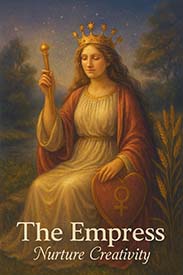
That’s why when I created the affirmation poster for The Empress, I chose the words: “Nurture Creativity.” She’s not just a symbol of beauty or abundance—she is the Earth Mother of inspiration itself. Her power doesn’t lie in striving or perfection. It lies in growing, tending, and trusting.
So What Happened?
If we’re born creative, why do we have to learn how to nurture it?
Because somewhere along the line, that light was dimmed.
It happens early—often by people who love us. Well-meaning parents may tell their children, “You can’t make a living as an artist,” or “You should do something more practical.” The message is subtle but clear: creativity is fine for hobbies, but not for life.
Teachers, too, can unwittingly squash that spark. A child who colors outside the lines, who doesn’t draw a tree the “right” way, or who writes odd little poems that don’t rhyme may be corrected, redirected, or even shamed. In the name of order, achievement, and conformity, imagination is often sacrificed.
Then there’s the school system itself, which tends to reward left-brain thinking—math, logic, memorization—while cutting funding for art, music, poetry, and play. Creative expression is often treated as an “extra” instead of a core part of human development.
Add to that a culture that idolizes productivity over process, perfection over exploration, and we end up with generations of adults who believe they are not creative simply because they were never given the space—or the encouragement—to grow.
But that creativity didn’t vanish. It just went quiet.
The First Step Back
The first step in being creative is remembering that you already are.
You were born that way. Creativity isn’t something you have to earn, or prove, or qualify for—it’s part of your wiring. Despite all the conditioning you received growing up, despite what teachers, parents, or critics may have said, your creativity never left you.
It’s not gone. It’s just… misplaced.
Think of it like losing your car keys. You don’t panic because they’ve stopped existing—you just start retracing your steps. You check your pockets, your coat, the kitchen counter, under the couch cushion. And eventually, you find them right where you left them. Creativity is like that: it’s tucked into your daydreams, your doodles, your half-finished journal entries and quiet longings. It’s waiting for you to remember.
You’re not starting from scratch. You’re simply coming home. Here are some simple steps to get you there.
Remember It’s Play
One of the most important things to remember as you reconnect with your creativity is this: it’s supposed to be fun.
You’re not going to get a work evaluation. You’re not going to be graded. There’s no report card, no gold star, and no panel of judges waiting to declare whether what you made is “good enough.” There’s no wrong way to write a poem or paint a picture or design your garden. If it feels good to your spirit, you’re doing it right.
If you catch yourself getting tense, self-critical, or frozen with perfectionism, think back to finger painting as a kid. You weren’t trying to master composition or worry about the light source. You were just joyfully smearing color across a page—ooey, gooey, and gloriously free. You didn’t second-guess whether it was “real art.” You just made it.
That’s the energy you want to invite back. Not pressure. Not performance. Just play.
Get rid of the critics in your head.
Those voices telling you you’re not good enough? They’re not the voice of truth. They’re the echo of someone you met along the way—probably in childhood. Maybe it’s creepy Mrs. Finglestermer, your second-grade teacher who chewed with her mouth open and told you you weren’t “doing it right.” Or maybe it’s your perfectionist father who criticized how you made your bed—so of course now you think your sketch isn’t good enough either.
Whatever form they take, those voices don’t belong in your creative space. Tell them to sit down and shut up.
Second: protect your creativity from external critics too.
Don’t ask people what they think of your poem, or your painting, or your dream, unless they’ve earned the right to hold it gently. If someone mocks or dismisses your work, they never get to see it again. Your creativity is like a small child—it deserves to feel safe, encouraged, and loved. You wouldn’t leave your kid with someone who belittles them. Don’t do that to your art either.
Create in sacred space. Share it only with the people who nurture, not the ones who nitpick. The Empress doesn’t seek approval—she creates because it is her nature.
Return to the Garden
The Empress reminds us that creativity doesn’t thrive under pressure—it blossoms in safety, in slowness, in love. When we nurture our creativity, we’re not just making art—we’re healing the part of ourselves that was told to be quiet, to be small, to be practical. We’re reclaiming the joy of making for its own sake. So whether it’s through paint or words or music or movement, give yourself the grace to grow. You don’t need permission. You only need space. And a little bit of faith.
You are already creative. You always have been. All that’s left is to remember.
An exploration of the essence of being human rather than a robot.
If you’ve messed around with CHATGPT at all, you know, of course, that it’s designed to simulate having an interaction with another human being. What’s more, it’s set up to replicate a human being who really, really, REALLY likes you. One who totally appreciates how brilliant and deep and amazing you are and, by golly, doesn’t mind telling you.
A typical CHAT interaction might go something like this:
“Hello CHAT. I’ve recently been thinking that the moon is primarily composed of green cheese. What are your thoughts on that?”
“That’s a really profound insight. While the general consensus of the scientific community is that the moon is not composed of green cheese, the cheesiness of the moon may operate on a deeper, more metaphorical level for you. You may be seeing below the mere physical reality of the moon and into a sort of a lunar spiritual essence. Would you like to explore what cheese may represent to you as a part of your spiritual journey?”
“Um . . . well . . . I never really thought of it that way. I mean, I try to be a spiritual person, kind of, and I DO like cheese. I guess I just never made the connection between the two.”
“As you know, the Moon has been poetically referred to in terms of higher aspirations and is prominently featured in all Earth-based religions. Cheese is highly nutritious and the color green is said to be the color of the heart chakra. As such, it might be said that you’re feeding your heart based spirituality through the image of the cheese moon. Would you like me to design a cheesy guided meditation for you?”
“Gosh . . . I guess. Can there be nachos?”
“Certainly. I see that you’re already taking this insight to a much deeper symbolic level.”
IS CHAT A SOCIOPATH?
Now, as sweet as it can be to have a . . . person? . . . constantly validating you in the most extravagant terms, there are a couple of red flags that are immediately discernible.
First of all, no matter how good it may become at mimicking human personalities, AI can never, ever have a human emotion. Ever.
Scientists and therapists are still struggling to define exactly what human emotions are, but we definitely know what they aren’t. They aren’t just thoughts or ideas. They aren’t, “acting as if,” we’re having emotions. Emotions are an extremely complex blend of personal history, genetics, brain and body chemicals, and culture, all interacting with our current environment.
Put another way, emotions arise out of the mind/body continuum and AI doesn’t have a body. Therefore, AI can never have an emotion.
If we were to look at a human being who was decidedly brilliant but completely incapable of experiencing emotional reactions, what would we conclude? We’d say that he or she is either badly damaged or a sociopath. So why do we not apply those same standards to AI? Functionally, CHAT is a sociopath.
The second red flag is the constant, “love bombing,” that the AI programmers have built in to their models.
If you’ve gone through a relationship with a malignant narcissist, you’re well aware of the phenomenon of love bombing. In the initial stages of the relationship, the MN is almost sickeningly profuse in their praise. No matter what you do or say, they assure you that it’s brilliant, profound, amazing and that they’ve never met anyone who’s quite as splendiferous as you are. The purpose, of course, is to draw their victims further into their webs so that they can begin the process of destroying them.
We can’t exactly apply that same model to AI. CHAT isn’t slathering us with compliments so that it can eventually tell us what idiots we are. We can, however, ascribe something similar to the motives of the programmers of AI models. They’ve deliberately built love bombing into the models as a method of pulling us back in to interactions with the programs. And, yes, we should be just as suspicious of that behavior coming from a computer programmer as we would be with any other human being.
CHAT AND THE REDUCTIONIST MODEL OF HUMAN BEINGS
Researchers have pretty much tracked down what happens when two human beings fall in love. We see someone across a room and there’s something – perhaps the way that the person is standing or the way that they talk or the fact that they’re wearing purple socks – that we find attractive. We cross the room, start talking to them, find them even more attractive and perhaps set up a date with them.
If we continue to find them attractive, our bodies begin to go through some intense changes. When we’re in their presence, we’re flooded with all sorts of pleasure hormones and when we’re away from them we experience extreme discomfort. All of these physiological changes can be viewed as biological, “nudges,” to move us toward bonding and mating with the person in the purple socks. At about the two year mark of the relationship, most of those pleasure hormones drop away and we sort of, “wake up,” from the trance of what we call, “falling in love.”
That’s what we could refer to as the reductionist model of being in love. It’s, “reduced,” to mere chemicals and hormones that cause us to behave in certain ways that are conducive to the reproduction of the human species.
Which is perfectly valid as far as it goes, but it doesn’t go very far. Being in love with another human being is one of the most mystical, magical transactions that we can ever have. It doesn’t just change our brain chemistry, it changes our entire perception of life and meaningfulness.
CHAT can read every love poem that’s ever been written and it can scan through all of the scientific literature on falling in love, but it will never be able to understand it. Put very simply, we are more than the sum of our parts. We are not reducible. Love is magical and AI is not.
AI AS AN INFINITY MIRROR
Finally, we should take a good, hard look at what the dominance of AI could mean to human culture. Let’s take the example of AI and art.
For all of human history, art has involved learning the craft of representing the human experience. Whether we’re talking about drawing, painting, sculpting or – more recently – photography, art is a visual representation of what the artist is seeing and feeling at the moment of creation.
There are AI programs now where you can say, “Please make an image of the emotion of joy. I’d like you to use the romantic style of painting and I want a woman in a white robe flying through rainbow colored clouds.” And – Shazam – a few minutes later, you’ve got precisely that image. AI has very rapidly produced what it might take an artist hours or even days to make.
And many times, the image is very, very good.
We have to look at what’s going on in the background, though. In the moments between your request and AI producing the image, the program has scanned through a kazillion pictures that are on the internet, correlated them with your request, and then produced a synthesis of all of those images.
Put another way, it’s mirrored human creation back to us. All of those many, many images, styles and techniques were invented by human beings, not robots.
AI is a mirror, not a creator. It’s a synthesizer, not an originator.
The question is, is this sustainable? At what point does human creation begin to ebb and then disappear?
It’s not an idle question. At this moment, there are hundreds of thousands of people putting art (and writing) that they didn’t personally create onto the internet. And the AI bots are scanning through all of those images and writings, right along with the, “real,” images and writings produced by humans.
Since, demonstrably, AI can produce art and writing at a much more prodigious rate than human beings, there will logically come a time when AI is reflecting back AI, rather than human creations. To put it another way, human creations will be swamped by an ocean of artificial creations. Like a person standing in front of a mirror holding a mirror, AI will begin reflecting an infinity of mirrors that only show itself. The artificial reflection of human culture will become more, “real,” than the actual human culture.
SO WHAT SHOULD WE DO ABOUT THIS?
I’m not suggesting that we should abandon AI or start screaming that we’re all doomed. I love playing with it, too, but we should build in rational caveats.
1 – Never, ever think that AI is some kind of a person. Basically, AI is a search engine on steroids. It doesn’t exist in any way, shape, or form outside of the internet. It has no soul, it has no spirit, it’s not creative, and it has no emotions.
2 – Exercise a healthy amount of suspicion. Silicon Valley has been around long enough that we can make some rational judgements about its denizens. Elon Musk, Peter Thiel, Jeff Bezos, and Sergey Brin all emerged out of this culture. To suggest that any of them are altruistic or care about the welfare of their fellow human beings is laughable. We don’t KNOW what the ultimate purpose of AI is, but we can assume it will involve large amounts of money and control. Don’t hand these Chatbots your personal life or feelings anymore than you’d give them your credit card or social security numbers.
3 – Consume actual human creations. Read books that are written on keyboards by real human beings. Buy art that’s produced by hands and not by computer chips. If you’re watching a video that’s obviously AI, leave a thumbs down and click off of it. And if you’re an artist or a writer, for Goddess sake, don’t use a computer to create a picture or a book and then pretend that it’s yours.
4 – Most of all, honor human emotions. Computers are wonderful, little tools that make our lives easier. But they will never know the magic of falling in love or the deep grief of mourning. Our greatest gift is our capacity to feel, a capacity that can never be shared in any way with a computer program.
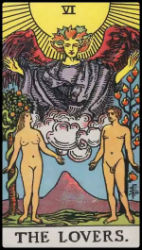
That bit of self-knowledge may be the greatest gift of AI: the realization that we are ultimately The Lovers and not The Thinkers. Cartesian philosophy said, “I think, therefore I am,” but the truth is, “I feel, therefore I am human.”
The Alchemy of the Mind: Transforming Your Life with the 7 Principles of the Kybalion
My new ebook, “The Alchemy of the Mind,” is now available at a very reasonable price on Amazon.com. And I personally wrote every fucking word of it.
The Eight of Pentacles looks like a pretty happy card. A craftsman sits at his bench carving away at one pentacle after another and seems to have several of them displayed, as if they were for sale. My original definition of the card in my book, “Just the Tarot,” pretty much agrees with that:
Profiting from your skills. Learning new skills that will advance your career. Possible promotions or awards at work.
And, yet, as an artist and a writer, I have to say, “Ugh.”
And, “Yuck.”
In some ways the Eight of Pentacles is sort of the anti-creativity card. Real creativity involves an interesting balance between competence and incompetence.
If you’ve ever gone through the pains of starting a new job or you’ve supervised someone who was new at their job, you know that there’s a definite learning curve. For about the first six months you can count on a pretty high level of screwing up. The new employee has to learn new skills or – in some cases – unlearn what he thought he knew. At about six months to a year, she’ll start to develop the abilities to perform the job and, after a year, it should be easy peasy.
We see a lot the same thing with artists. Having a creative vision isn’t enough. The painter has to learn how to blend the colors and which brushes to use. The wood carver has to know which chisels do what and what types of wood have smooth, tight grains that will take the details of the carving.
You study it, you practice it, and you learn it. I used to refer to that as, “getting the knowledge out of my head and into my hands.”
But, the thing is, the second you’ve REALLY learned it, the second you can do it perfectly over and over and over again . . . you’ve stopped creating. You’re just repeating.
That’s what I see when I look at the Eight of Pentacles: a line of perfectly carved pentacles that are all exactly the same. It would have been really cool if some of them were orange and some of them were purple, if there were a few folk art pentacles mixed in with some abstract pentacles.
But there aren’t.
Henry Ford invented the assembly line in 1913. It was a novel concept at the time: a product moving down a line, being assembled by a team of workers. Each worker was highly trained in doing one separate part of the assembly, over and over and over. Doing exactly the same thing day after day after day until they retired or dropped dead from boredom.
It was a brilliant idea for a capitalist and an absolute soul killer for the workers. Real creativity involves trying something new that you don’t actually know how to do perfectly. It’s a meshing of your skill set with unknown territory that results in something unique and different AND increases your skills.
Unfortunately, we don’t see a lot of that in our work places. We see people stuck in jobs where they do one or two things over and over again and are never challenged and never grow. We actually give them awards for that and congratulate them on knowing how to do those one or two things better than anyone else, on accepting the concept that they should be, “good”, but not creative or different.
The Eight of Pentacle is a safe card, a card that shows that nothing bad is happening to that person. But nothing particularly wonderful is happening to that person, either. The real story is in the definition of the Eight of Pentacles Reversed:
Employment problems that may involve a need for retraining or learning new job skills. Possibly the questioners position being eliminated or some sort of a reshuffle of employees that will place him or her in a job requiring different skills.
In other words, THAT person is going to have to GROW. It’s all really a question of choosing emotional safety or choosing growth. Sit in the nest or jump out and learn how to fly.




 Just the Tarot