Love, Therapy, Ram Dass, and God in Drag

A look at the sources of love.

I’ve been reading a book called, “Getting the Love You Want,” by a psychotherapist named Harville Hendrix.  The theme of the book is basically, “We all fall in love, a lot of us fall out of love, and here’s how to fix that.”  He’s a smart guy, did some excellent analysis, and I’d probably recommend the book.

But he never did get into that basic question of, “What IS love?”

Now, there’s been an awful lot of brain and biochemistry research over the last 20 years.  What the scientists have determined is that when we magically meet, “the right person,”  giant sparks fly out of both our genitals and our subconscious minds, then our brains start pumping huge amounts of endorphins, and – SHAZAM! – we’re in love.

That’s what we could call the, “reductionist,” approach to love.  What we call love is ultimately reduced to brain and body chemicals that cause us to feel wonderful.  From that point of view, love is nothing more than a biochemical reaction – probably based on the need for the species to procreate – that we dress up with a lot of romantic notions, boxes of candy, and Hallmark cards.

It’s a classic case of the whole being more than the sum of the parts, though.  Love isn’t just hormones.

Love is an energy.  When we have it in our lives, we don’t just feel better, our lives actually work better.  Its presence seems to trigger huge amounts of synchronicity and serendipity, we suddenly have solutions to most of the problems that we encounter, and we’re harmonious with the Tao, the Universal Flow.  When we don’t have it, life can feel like a meaningless slog through knee deep mud.

So the obvious course of action seems to be that we should all run right out, throw a net over someone, and fall in love with them.  Unfortunately, as Hendrix pointed out, right around 50% of us fall out of love, which is extremely painful, and we’re right back where we started, only we hurt a little more than we did before and we’re a lot more cynical.  Then we go back out, find another person to fall in love with, and rinse and repeat. 

 As much as Americans revere the idea of finding our Soul Mates, most of us are actually serial monogamists, who find one Soul Mate after another after another until one of them finally sticks.

I got a BIG clue on all of this a few years ago when I was listening to a Ram Dass talk after my partner had died.  He said that the reason that we feel so devastated after a death, a divorce, or a break up is that we mistake the person for the love.  The person is the vehicle that gets us to the love, not the love itself.  Since we have so totally identified the love with the person, though, when they go away it feels as if all of the love has gone away.

As near as I’ve been able to figure out, there are basically three sources of love.  There’s the love we derive from our relationships with other people.  There’s self-love, which so many of us struggle to achieve.  And then there’s the love that flows out of our spiritual connection with Source Energy, the god-head, the Tao, the Flow.

The trick is to understand that all three of the different forms are actually the same energy, the Source Energy, dressed up in different costumes.

Human beings are hardwired to receive love from other human beings.  And that’s a very good thing, indeed.  It’s like a built in on-ramp to Source Energy and it should be an effortless, natural process.  Unfortunately, the second that we enter the world, a lot of other ingredients get added to that process.  We start out with pure love and then we throw in crazy parents, cultural expectations, dysfunctional partners, etc., etc., etc, until the love becomes a shit show.  

Then we find ourselves sitting in a therapist’s office, asking, “What happened?  All I wanted was for someone to love me.  What happened?”  If we’re blessed with a really good therapist, we can start to untangle those knots and sort it all out.  “Okay, this part of the shit show came from your depressed mother and this part of the shit show came from high school and this part of the shit came from your ex-husband.”  As we identify and subtract more and more of the added ingredients that doomed our relationships, we move closer to that model of pure love that we were born with.

Where our culture lets us down, though, is in not identifying the actual origin of that energy that we call, “love.”  When we finally realize that the love is flowing OUT of Source and THROUGH our partners, then we can wake up and realize, “Huh . . .the love is always there and it’s abundant.  I can find it through my partners, but I can find it in a lot of other ways, too.  I can actually love myself.  I can meditate on Source.  I can connect with that energy in a zillion different ways.”

That’s not to put down romantic love in any way.  Romantic love is a grand sort of a feeling and it’s probably the fastest way for us, as a species, to reach that love energy.  BUT . . . it’s not the origin of the energy.

Perhaps the best solution is something else that Ram Dass suggested:  “Treat everyone you meet as if they were God in drag.”  When we start looking at the people we love as little bits of that God/Goddess/Love energy shining out at us through their human forms, then we can honor them, honor the process, and honor the love.

The Five of Pentacles, Karma, and God’s Little Baskets of Muffins

Transforming ourselves through karmic selfishness.

I have a younger friend who HATES karma.

More specifically, he hates when he’s in the middle of an, “Oh poor me,” bitching session and someone shrugs her shoulders and says, “Well, that’s karma.”  

First of all, it interrupts the rhythm of his complaining and he has to go back and remember what he was so upset about.  

“What was I saying?  I know it was important . . . oh, I remember . . . life is meaningless and no one understands me . . .”

Secondly, it infuriates him because it suggests that the mess he finds himself in is somehow HIS fault and the whole point of his rap is that it’s everything and everyone else’s fault.  Which is just further proof that no one understands him.

This guy was raised by a Buddhist and that may have something to do with his constant irritation.  It’s developmentally important that teenagers be able to rebel against their parents.  The first way that we really begin to define who we are in the world is by making it clear that we aren’t our parents.  I imagine that it must be pretty damned difficult for a teenager to get any rebellion traction against a Buddhist parent.

“You know, Dad, sometimes I really hate you.”

“Well, son, all strong emotions will pass if we simply do a little deep breathing.  Remember, you’re the sky and your emotions are just clouds drifting by.”

Or

“I’ve been think about getting a tattoo.  What do you think about that?”

“Ah . . . perhaps you should get a tattoo of a double dorje or some other sacred symbol.  In a sense, it would be a constant reminder of the spiritual nature that dwells in physical matter.”

Or

“Maybe I’ll paint my face blue and dye my hair orange.”

“Hmmm . . . I wonder if you were a Druid in a past life.  Do you feel a particular attraction to oak trees?”

Aargh!  So it’s possible that this guy was deeply emotionally scarred by all of that loving kindness and unconditional acceptance from his parents.  If only they’d yelled at him or told him he was an idiot occasionally!  

Still, he does have a bit of a point about the notion of karma.

It’s perfectly understandable that people get a little riled up over the idea of crappy things happening to them because of what they may have done in a past life.  After all, most of us have absolutely no memory of our past lives and so it feels like we’re being punished for something that someone else did.  

Suppose I was Attila the Hun in a past life and in a fit of Barbarian Rage I whipped out my scimitar and beheaded a turtle.  Then 200 lifetimes later –   as Dan Adair –  I’m in a traffic accident and I get whiplash BECAUSE I decapitated that turtle.  That seems a little . . . unjust.  I mean, I’m NOT Attila in any sort of a meaningful sense, so why should I get sent to the principal’s office because Attila was a dick?

And then, to make it even worse, when I’m sitting there in my cervical collar reflecting on exactly HOW unjust it all is, an acquaintance says, “Oh, well, that’s karma.”  As my younger friend would put it:  “Fuck you.”

Now, there’s a particularly odious Christian doctrine called, “predestination.”  It holds that some people are born with the unchangeable destiny that they’re going to heaven when they die. Other people are born with the unchangeable destiny that they’re going straight to hell when they die.  It doesn’t matter what we do or how we behave, our ultimate destiny has already been decided at the moment of birth.

It’s like God is up there in the Kosmic Kitchen baking up human Souls and, as he pulls each one out of the Soul Muffin Pan, he tosses them into separate baskets marked, “Heaven,” and, “Hell.”

“Okay, heaven, heaven, heaven – whoops, you’re fucked – hell, heaven, fucked again, heaven . . .”  Like the beggars in the Five of Pentacles, we’re out in the cold and we’re going to stay there.

Theologians came up with a perfectly logical reason for this totally insane doctrine.  The idea is that God is all powerful and all knowing.  So if God knows everything, then that must mean that he knows everything that happened in the past, the present, AND the future!  And if God already knows what’s going to happen in the future, then he must already know who’s going to heaven and who’s going to hell.  Shazam!  There you are – it’s already determined.

That’s the kind of weird, Left-Brain, cuckoo for coco puffs vibe that a lot of people get off of the notion of karma.  It seems to be some sort of an inexorable process that was put into motion a long time before we came along and there’s not a damned thing we can do about it.  We’re either in the Heaven Basket or we’re in the Oh, You’re So Fucked Basket.  Like it’s something that happens TO us for no particular reason.

Of course, the important point that most of us miss is that karma isn’t happening to us, we’re happening to karma.  It’s a totally dynamic process and it’s something that we can change every single day simply by the ways that we behave right now.

The most simplistic way to think of it is as a sort of a bank account.  Rather than being born into a You’re-Going-to-Hell Basket or a You’re-Going-to-Heaven Basket, we’re born with a certain amount of Karmic Kash that we earned (or didn’t earn) in past lives.  The Dalai Lama will probably be reborn with several savings accounts, a really huge checking account, many certificates of deposit and a great coin collection.  Attila the Turtle Beheader, on the other hand, will be reborn with 50 cents in the bank and a lot of overdue bills.

The thing is, though, that the way that we’re born isn’t our destiny.  The way that we behave is our destiny.  Attila, for instance, might start a refuge for homeless turtles.  Every single time that he saves a turtle and gives it a meaningful life – KA -CHING – that’s another deposit in his Karma Account.  The Dalai Lama, on the other hand, might decide to support Eric Trump for President and – ZAP – that’s a major withdrawal from his Karmic Account.

As David Michie said in, “Buddhism for Busy People,” 

In what is one of the most outstandingly ingenious aspects of Buddhist teachings, we come to realize that our own selfish interests lie in being altruistic . . .months, years or decades of being generous for selfish reasons begin to have a predictable effect . . .what starts out as a contrived and self-conscious change of attitude and behavior results in a genuine metamorphosis.

In other words, we don’t have to start out as Mother Theresa or an Awakened Master.  We can start out as perfectly normal, selfish, self-centered human beings who are being kind to other beings because we DON’T want to end up wearing a cervical collar.  When we pick up a turtle that’s in the middle of the road and leave it safely on the other side, we can be doing it for the completely selfish reason of wanting to fill up our Karmic Account.

As we continue those little acts of kindness they gradually transform us.  They become acts of loving/kindness, where we’re actually noticing and caring about the welfare of the people and beings around us.  The translation of the word, “karma,” is, “action,” and that’s the key.  Our actions change us, even if they originate in selfishness.

And that’s how Attila the Hun becomes the Dalai Lama.  Pretty simple.

The Four of Swords, Sigmund Freud, and the Case of the Disappearing Clitoris

The role of Sigmund Freud in removing magic from our dreams.

Do you feel safe when you go to sleep at night?

Do you really look forward to getting a wonderful, full night’s sleep and waking up feeling restored, refreshed, and re-created?

Do you actually look forward to going to sleep because you know there’s a good possibility that you’re going to have wonderful, magical dreams that will put you in touch with Spirit World and give you greater guidance, understanding, and insight in your life?

And, if not, why not?

For most of human history, sleep has been seen as a deeply restorative, healing process.  We still recognize that fact in many of our behaviors.  If you’re sick, stay in bed.  If you’re really upset, get a good night’s sleep and you’ll feel better in the morning.  

And, for most of human history, sleep has also been recognized as a spiritual experience.  Dreams weren’t just dreams, they were omens, portents, messages from the gods or the angels.  Dreams were a unique path to the realm of the divine that ALL of us – each and every man, woman and child – possessed and no one could take them away from us or claim ownership of them.

The Four of Swords in the Tarot deck points toward that truth.  The individual in the card is so profoundly, deeply asleep that he almost looks as if he’s dead.  The definition of the card is one of intense healing through the vehicle of resting the mind and body.  His hands are clasped in prayer and there is a stained glass window above him, reminding us of that spiritual connection with the divine that we achieve through sleep.

Yet, over 60% of Americans report that they’ve fallen asleep with their cell phones in their hands.  That’s not exactly preparing for a spiritual, rejuvenating experience is it?

So what happened?  Why have we lost that connection with the higher dream realms in our modern culture?  One might argue that Sigmund Freud happened.  Here’s how Arianna Huffington expressed it in The Sleep Revolution: Transforming Your Life, One Night at a Time

“With the work of Sigmund Freud, dreams went from being a unique way of accessing divine knowledge to being a unique way of accessing self-knowledge.  Dreams were still a journey, but they became less of a sacred journey.”  

To really get the significance of that shift in thinking we have to consider the word, “permeable.”  Permeable means, “porous,” or something that will allow other things to pass through it.  Humans had always considered the subconscious space that we experience in our dreams as being permeable.  Other beings, gods, angels, spirits could pass in and out of our dreams, communicating with us and leaving messages, symbols, and lessons.  Our dreams, then, were a sort of a royal road to the divine, to regions that we were unable to access in our daily lives.

Freud, however, saw the subconscious mind as an impermeable, closed system.  It didn’t contain or allow access to ANYTHING but the content of our own minds.  Even more significant, the content that was stored in our subconscious minds and came out in our dreams were the worst parts of us, the parts of us that were so horrible, so primitive, so nasty that we couldn’t even deal with them on a conscious basis.

You know . . . sex.

Freud was, after all, a Victorian, and Victorians were probably the most sexually repressed, puritanical beings who have ever walked the earth.  When you boil down Freud’s views to their essence, they are ALL about sex.  We want it, we can’t have it, we feel guilty about it, we repress our desires into the subconscious, and then the repressed desires bite us in the ass and make us crazy.

Now, in that context – where EVERYTHING is about sex, the very character and quality of our dreams are changed.  If everything is about sex, then our dreams MUST be about our repressed sexual desires.  And if they appear to NOT be about our repressed sexual desires, that’s because we haven’t really INTERPRETED them right.

“I dreamed I was on a train, Doctor Freud.”

“That’s actually a penis.”

“Oh . . . um . . . alright . . . it sure SEEMED like a train, though.  It had a dining car.”

“That’s your sexual appetite.”

“I had scrambled eggs.”

“You want to fertilize your wife’s eggs.”

“And I had a biscuit.”

“The biscuit represents your wife’s buttocks.”

“Oh, my . . . couldn’t it just be a biscuit?”

“No, no, NO!  I’m telling you, you weren’t having breakfast, you were having sex with your wife and you got her pregnant with your giant train penis!”

“Oh, dear . . .”

And so, if an angel appears in our dreams, that’s just someone we want to have sex with.  Or a demon.  Or a horse or a dog or a doughnut or a tortilla.  We pretty much want to fuck all of them.

Kind of takes the magic out of dreams, doesn’t it?

In historical perspective we can look back at Sigmund Freud and realize that he was pretty much of a nut case.  In his book,Freud: The Making of an Illusion, Frederick Crews points out that Freud was a lifelong cocaine addict, that he cheated on his wife with his wife’s sister,  and that at one point he was thoroughly convinced that women had a pleasure center in their noses that caused them to masturbate uncontrollably when it was malfunctioning.

Nonetheless, the man cast a LONG and evil shadow.  Freud decided at one point that he wanted to have sex with his mother and so he posited that every male must also want to have sex with their mothers and – shazam! – the Oedipal complex was born and analyzed and analyzed and analalyzed. 

At another point, he decided – without the benefit of being a woman or talking to women about it – that only vaginal orgasms were REAL orgasms because only they had to do with reproduction.  Clitoral orgasms, on the other hand, were somehow fake or immature orgasms and so clitorises were pretty much ignored until Masters and Johnson, “rediscovered,” them decades later.

In very much the same sense, we are STILL suffering from his staggeringly wrong interpretation of the subconscious.  It is entirely possible to have a dream about a train and have it just be about a train.  It’s also possible to have a dream about an angel, and actually have it be about an angel.

Let’s sleep on it.

Disclaimer: “As an Amazon Associate I earn from qualifying purchases.”

The Death Card, Spaghetti and Ghosts

The Death card is one of those scary Tarot cards that no one wants to see in their reading.  As one British writer put it, “This card usually sends the wind up people . . .”  

Death . . . eeeew!  Creepy.

We should talk about that . . .

I’ve attended a weekly bereavement support group since my life partner died.  We get together once a week – on Zoom, since Covid happened – discuss the grief process, check in with each other, and offer emotional support to members who are hurting.  At one of the meetings a new member whose husband had died a few weeks earlier asked, rather hesitantly, “Um . . . have any of you had any experiences with . . . like . . . ghosts?”

Every hand in the room went up.

Every single one of us had experienced strange messages or pictures of our loved ones inexplicably falling off of shelves or lights that flickered on and off when we mentioned the names of the people who had died or books that we hadn’t taken off of the shelf lying on the floor opened to passages that comforted us.  

Every single one of us.

And here’s an odd thing about that:  even though a LOT of people have these experiences, “normal people,” (and by, “normal,” I mean people who aren’t in the grief process) don’t want to hear about them.  Oh,they try to reassure the person who’s grieving that their dead person isn’t, somehow, dead. They’re well armed with the standard, trite phrases.

“I’m sure he’s right there with you.”

“She’s looking down on you from heaven.”

“You have a new guardian angel watching out for you now.”

Still, they really don’t want to hear about how the dead person is RIGHT THERE in your living room turning lights on and off and leaving books out for you to peruse.  Because, you know, that’s kind of spooky.  

And, yes, spooks ARE spooky.  When you’re cooking spaghetti and you get a flash of someone who’s dead sitting at the kitchen table, it does tend to pucker your pasta.  But it happens all the time.  Ask anyone in any grief group.  

So why don’t people want to talk about it?

Well, there’s probably a primal fear of the dead that’s hard wired into our bodies and minds.  The horror story genre is built straight out of that energy and authors like Stephen King know exactly how to evoke it and make the hair on our necks stand up.  

And, of course, there’s all of the religious crap that our culture embraces:  dead people are supposed to be in heaven eating pancakes with Jesus or they’re supposed to be in hell roasting marshmallows with Satan,  but they are NOT supposed to be reclining in their favorite barcalounger playing with the cat.

There’s also a certain amount of it that flows out of good old fashioned denial.  The more we focus on death, the more we have to acknowledge that someday we, too, are going to be dead and, by golly, that’s just plain depressing, doncha think?  We even have a word for people who want to talk about death, “too much,”:  morbid.  According to the Cambridge dictionary, that’s, “too interested in unpleasant subjects, esp. Death.”

(LOL – if you’re going to die – and you are – how can you be, “too,” interested in that?)

And there’s the strong atheist/empiricist current that flows through our culture.  If a phenomenon can’t be plopped onto a scale, weighed, dissected, and held with our hands, it doesn’t really exist, and you can’t weigh a ghost.  By that standard, or course, rainbows and emotions don’t exist, either.

I think, though, that there’s a further element involved here and that’s the day to day implications of ghosts.

A huge amount of human culture is built around this simple question:  what happens to us when we die?  HUGE.  All of our religions are really premised on that one idea: something happens to us after we die.  What is it?  Is it good?  Is it bad?  Is it horrible? How can we massage that outcome from this side?  How many Hail Mary’s do I have to say to end up in heaven instead of hell?  How much incense do I have to burn and how many incantations do I have to chant to have better karma?  

European art and  culture in the Middle Ages were almost entirely devoted to those questions.

Morbid, right?

Ghosts, in a very real sense, are where the rubber meets the road in religions and spirituality.  They are the interface between this world and whatever happens to us when we die.  They are a constantly repeated phenomenon that has occurred throughout all of human history.  The story of Jesus appearing to his disciples after he was crucified is, essentially, a ghost story, right?

If we really accept the fact that ghosts and ghostly phenomena do exist – and millions of perfectly rational people attest to that existence – then it shifts a lot of our thinking and our sense of being in this world.  

If the person we love HASN’T ceased to exist, if they are somehow still here in some other form, then grief doesn’t make a lot of sense, does it?  It’s more like a dear friend deciding that they’re going to move to Europe.  It might make us sad.  We might miss them terribly.  But we don’t have to throw ourselves on the ground, sob, and rip our clothing.  They’re still here, but they’re over-there/here, instead of here/here.

And, what exactly does, “here,” mean?  If someone’s dead, they’re supposed to be WAY, “over there.”  You know . . . in heaven or hell or zooming around the astral plane on a portable golden throne.  But if they’re sitting in your kitchen watching you cook spaghetti or they’re in the barcalounger playing with the cat, then they’re, “here.”  But they’re also, “there,” because . . . um . . . they’re dead.  Maybe the truth is closer to what some Native American tribes believe and the dead aren’t gone at all – they’re still walking around with us in another dimension that we just can’t see.

I don’t know the answers.  But I know it’s a conversation that we ought to be having and we ought to be having it outside of the confines of bereavement support groups and pastors offices.  If Uncle Bob is dead but he’s hanging out in the den watching television, that’s important.  Maybe instead of throwing white sage and holy water at him and telling him to, “go to the light,” we ought to just say, “Hey, Bob – what’s up?”

Maybe he’ll tell us.  

Tarot Readings, Archetypes, and God-Fearing Southern Women

I recently heard a very nice woman describe herself as, “a good, God-fearing Christian.”  And it really gave me a bad case of the creepy-crawlies because it’s such a death blow to any true spirituality.

I spent a substantial portion of my life in the Southern United States, so expressions like that aren’t anything particularly new to me.  Many people in the South are not only God-fearing but they also have a lot of things, “put the fear of God,” in them. God, for them, is a pretty scary dude.

I didn’t really think much about those sayings until recently, when my life took a drastic turn toward the worst and I had to reassemble the jigsaw puzzle that my incarnation had become.  When confronted with the death of a loved one and the financial disaster that ensued, I began a spiritual quest of sorts, trying to put some meaning back into a life that had become dangerously Meaning-Less.

The Tarot was a big part of that quest.  In reading after reading it provided a basic framework for understanding where I was in life and where I wanted to go.  It was my touchstone through the darkest times l’ve lived through.

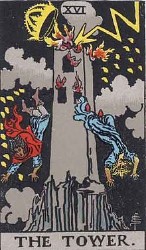
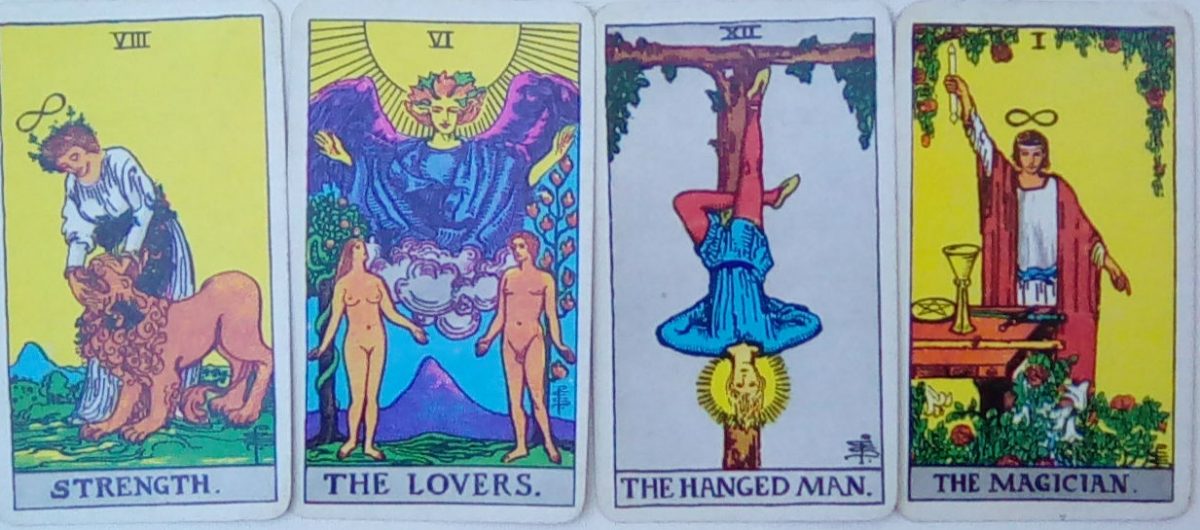
One of the most profound lessons it taught me was, “don’t be afraid.”  The readings were . . . well . . . readings. It was like, “Okay, THIS is happening in your life and THAT’S happening in your life, and in order to move forward you need to do THIS and then THAT.”  Or, to put it in more concrete terms, “Okay, the Death Card is in your life right now and so is The Tower, so you need to channel The Hermit and retreat and heal and then you’ll get the spiritual lessons of The Hanged Man.”

It was a road map, really.  Or, perhaps more accurately, a sort of a spiritual GPS system that kept telling me, “Okay, now turn right and go 12 miles more . . .”  And I learned to see that everything that was happening to me was a necessary step on the road.

I learned to trust.  To trust in the process of life and in the Universe as a loving, benevolent energy that was always there and always supporting me.

That’s a necessary pre-condition for any serious spiritual quest.  You have to believe, deep in your heart and mind, that you are ultimately safe and that you are moving toward something or someone that loves you.  Otherwise, why would you do it? Why would you deliberately seek out something that could harm you?  Something that’s scary?

Let’s look at the way that we, as Westerners, usually view the whole God thing, whether consciously or not.  We see the universe as a sort of a triangle or pyramid. God sits at the very top of the pyramid and everything – all the energy and forms in the universe – flow downward from him/her to us, who live very close to the bottom of the pyramid.

In most mystical traditions and many non-western religions, God is seen as a sort of pure, loving energy that flows down to us, but becomes more diffused and faint as it enters the physical realm where we exist.  The quest for the holy grail, then, becomes a quest to bring ourselves more in alignment with that pure, loving energy and to expand its presence in our lives.  

We may use a variety of means to get there – meditation, psychedelics, yoga, loving/kindness, etc. – but there is a basic belief that the underlying energy in the universe is love.  That it nourishes us and completes us and comforts and guides us through the dark times in our lives. Conscious contact with that energy heals us.

But . . . then we have the Judeo/Christian/Islamic model of the universe.  It’s still a pyramid with God sitting at the top, but God is a sort of a psychotic, abusive, completely unpredictable father.  And not only does love flow down, but a LOT of punishing, sadistic shit also flows down. This God is, a “jealous God,” a, “fearful God,” a God who claims to love you but is perfectly willing to pitch you into eternally burning flames if you even question what he tells you to do.

This is a God who blows up cities because there are gay people living in them.  Who tells Abraham to tie his son down to a stone altar and thrust a dagger into the child’s heart.  Who destroys Job’s family and his bnlife over a casual bet with the Devil.

This is one sick puppy.

There is no, “God Card,” in the Tarot.  We don’t think about it but it really is a curious omission.  The Major Arcana contains nearly all of the archetypes that blow through our lives:  death, love, luck, rebirth, judgement. But no God. And God IS kind of a major archetype, right?

Historians tell us that the first Tarot decks emerged in the 15th century, a time when Europe was absolutely obsessed with and dominated by the Christian God-Model.  The scary, crazy dude who you kind of hoped wouldn’t notice you and do something awful to you. That may be the very simple reason that the creators of the Tarot decided to just leave the God-Model out of the deck:  because a malevolent, harmful God is a complete short circuit to the spiritual quest.

If there’s no belief that you’re moving toward love and healing, why would you go there?  And if your God is a foul tempered narcissist who is off of his medications, why would you think there’s any genuine love flowing out of that?

The model of God emerging out of the Middle Eastern religions – the angry, hateful, capricious, male god of war – has been an absolute spiritual disaster for the Western world.  We have been deeply wounded by it and we need to KNOW that and begin to consciously heal our hearts and minds. And the way to do that is to move toward love.  

Always.

The Death Card – Signs, Symbols and Candles Burning Bright

“Mortality is not kind, and do not let anyone tell you it is; if there is such a thing as wisdom, and I have serious doubts about its presence in my own life, it lies in the acceptance of the human condition and perhaps the knowledge that those who have passed on are still with us, out there in the mist, showing us the way, sometimes uttering a word of caution from the shadows, sometimes visiting us in our sleep, as bright as a candle burning in a basement with no windows.”

James Lee Burke – “Robicheaux”

I love that sentence, not just for the incredible poetry of Southern writing, but especially for the last part:  “as bright as a candle burning in a basement with no windows.”

If someone you loved intensely dies you know that feeling of being in a basement too well.  Suddenly they’re . . . gone. All of their magic, all of their thoughts, their words, their touches and glances, have disappeared forever.

No matter what your spiritual beliefs may be – and I personally believe very strongly in an afterlife – the physical body, the material presence of the person you loved is gone.

There is, I think, a natural reaching out which most of us do after a death.  Trying to somehow contact the other person, to imagine them and how they are. Are they confused and disoriented?  Are they blissful and satisfied? Are they finally out of the pain that they were in and experiencing peace? There’s just that burning need to touch them, to feel their spirit one more time.

Religious people will tell you that they’re in heaven having pancakes with Jesus and, by golly, they have REAL maple syrup in heaven, not Mrs. Butterworth’s.  Spiritual people will tell you that they’re on, “the other side,” and dancing on rainbows or cruising through the astral plane. Psychic mediums may be able to give you very detailed descriptions like, “She’s in the garden and she’s wearing a white lace dress and your dog Skipper who died twenty years ago is there with her.”

And it’s all very comforting and sweet, all of those well intentioned words and Hallmark cards, but what we really want is to be able to see our loved ones for ourselves.  Instead, it’s like we’re, “in a basement with no windows.” We can’t see up and we can’t see out. We can’t see them.

If you actually talk to people who are grieving a death you’ll find an amazing number of them HAVE felt or seen some sort of a contact from their loved ones.  Maybe a pair of earrings suddenly appear on a bedside table, or a long lost note from them falls out of a book, or the lights flicker on and off whenever the dead come to mind.  There are signs and signals from them and, yet, we can’t quite get through to them. No matter much we miss or desire that contact we just can’t touch them.

It feels, of course, like a great big Cosmic Door has been slammed shut.  We’re on one side and they’re on the other. We may hear a faint murmur of their voices but we can’t get past the door.

Oddly, though, Death can be the start of a journey that will take you to much greater heights than you could have ever imagined.  Getting through that goddamned door can become a Quest.

The Sioux tribes believe that people who are grieving over Death are closer to Spirit World than normal humans.  That the veil between the two worlds is thinner for them, that the Spirits hear them more clearly, and that their prayers have greater powers. Certainly deep grief feels that way.  It’s as if you exist in a world apart from ordinary life and you see and feel things that others who are aren’t grieving can’t see and feel.

In other words, people who are close to Death – either their own or a loved one – are existing in a Sacred Space.  There is no other time when we are more likely to ask the right questions and get the right answers than when we are in the presence of Death.

Death leaves clues and symbols for us that point to a higher, Spiritual realm. What we do with them is up to us.  We don’t have to understand them at first, we just need to acknowledge that they’re real.  Yes, those earrings DID appear out of nowhere. Yes, it IS odd that a note from my husband fell out of a book just as I was thinking of him.  Yes, the lights DO flicker on and off for no reason when I talk about my dead child.

And, yes, it’s entirely possible that our departed loved ones are still here, “as bright as a candle burning in a basement with no windows.”