Impostor Syndrome and The King of Wands Reversed

The King of Wands reversed shines a light on impostor syndrome — that nagging sense of never being “good enough.” Learn how this Tarot archetype mirrors self-doubt and discover practical steps to reclaim authentic confidence, reverse the distortion, and own your rightful place at the table.

Do you never feel “good enough?”

Do you feel like, no matter how hard you try, no matter how much you do, you’re still falling short?

Does it seem as if everyone around you somehow has more talent, more luck, and is more deserving than you are?

That’s called, “Impostor Syndrome,” and it can destroy our lives.

WHAT IS IMPOSTOR SYNDROME?

Put very simply, it’s the persistent feeling that we’re a fraud, even when the evidence in our life says otherwise.

Self-doubt becomes a constant companion and we dismiss our achievements as, “a fluke,” or, “just good timing.”  Even worse, there’s a chronic fear that someday we’ll be found out, that everyone else will realize that we’ve just been bullshitting our way through life and we don’t have any real substance.

It’s quite common among people who grew up in abusive households because that’s one of the primary messages that they got as kids:  “you’re not good enough.” No matter what you do, you’re still not good enough.

It’s especially common among creatives, leaders, and anyone who’s stepping into a new role in life.  Exactly the people who are already stretching themselves into growth and success.

THE KING ON A SHAKY THRONE

In the Tarot, the King of Wands represents the exact opposite of impostor syndrome.  He radiates confident leadership.  He’s the charismatic leader who can stand firmly in his own power and inspire the people around him.

But reversed?  His fire dims and he hesitates.  His self-belief falters and instead of leading with boldness he spirals into self-doubt.

That’s where Impostor Syndrome rears its ugly head:

Self-doubt in leadership.

Fear of being, “Found Out’ and huge anxiety that others will see through the facade.

Inconsistent Confidence and swinging between moments of brilliance and moments of total collapse.

Avoidance of responsibility and shrinking back from visibility and opportunity.

Overcompensation and burnout where we work WAY too hard to prove our worth until exhaustion sets in.

The King of Wands reversed is the perfect representation of Impostor Syndrome at work.

King of Wands Affirmation Poster available on my etsy site.

HOW TO OVERCOME IT

There’s an old joke that says that if you feel the need to ask your therapist if you’re a narcissist, you’re not one.  The same thing applies to Impostor Syndrome.  If you’re constantly full of self-doubt, you probably shouldn’t be.

The gift of the Tarot is that no card is fixed.  The King of Wands can always be turned upright again and so can our confidence.  Here are a few simple practices that can reverse Impostor Syndrome:

1 – Keep a, “proof journal.”  Write down ALL of our wins, big and small, to create a counter-narrative to the voice that’s telling us that we’re, “not good enough.”  And if that feels uncomfortable, it’s just proof that we really need to do it.

2 – Normalize mistakes.  People with Impostor Syndrome don’t just regret it when they screw up – they beat themselves into a bloody pulp over it.  Every artist, every writer, every visionary stumbles.  That’s part of the growth curve.  As Julia Cameron said, “In order to become a good artist, you have to first give yourself permission to be a bad artist.”

3 – Talk it out.  When we share our doubts with a trusted friend or therapist we get the realistic feedback we need.  When we tell someone we love that we feel like a total fuck-up they will frequently be amazed and even appalled that we could perceive ourselves that way.  Basically, that’s just, “borrowing someone else’s eyes” and they may see our brilliance and talent far more clearly than we can.

THE ONLY IMPOSTOR IS OUR SELF-DOUBT

The King of Wands reversed reminds us that Impostor Syndrome isn’t the truth.  It’s a distortion, an illusion that doesn’t need to define our reality.

Turn the card upright and loosen the chains of self-criticism.  Step into the fiery confidence that we should have and that we deserve.

We’ve already earned our places at the table. Now own it.

Thought-Forms, Astral Pornography, and The Ace of Wands

Are our thoughts actually energy forms?

A few years ago I was reading a fascinating book called, “You Are Not Your Brain,” and the authors made a statement that was positively shocking to me:  “To this day, scientists and psychologists cannot agree on exactly what a thought is.”

At first blush, that sounds completely ridiculous because we all know what thoughts are.  They’re . . . um . . . they’re like . . . these little things that jump up in our heads and live in our brains, right?  

There . . . I solved that one.  You’re welcome.

Seriously, though, there really isn’t a good working definition of what a thought actually is.  There’s a sort of reductionist explanation of how our nervous systems and brains produce thoughts.  We can hook someone up to a brain monitor and see which parts of their brains light up with activity when they’re thinking about a particular subject.  Perhaps their fear center – the amygdala – lights up because they’re thinking of something really scary.  Or their prefrontal cortex – the thinking brain – lights up because they’re doing some heavy problem solving.  

That doesn’t really do anything but describe the process of making the idea, though.  It doesn’t tell us what the finished product is.  That theory – that the brain makes ideas – exists cheek by jowl with the stimulus/response model where something in our environment makes us think certain things.  Perhaps we see a picture of Donald Trump and we think, “Ohhh, scary clown,” which makes us think of circuses which makes us think of Stephen King horror novels about murderous clowns which makes us think about our overdue library book.

That concept seems to be counter-intuitive when we think about . . . well . . . intuition.  When we have  intuitions or  flashes of insight, it feels as if they’ve popped right up in our brains without anything else making them happen.  When someone asked Einstein how he invented the theory of relativity he said, “Oh, it just dropped in while I was playing the piano.”

For centuries, human beings viewed some types of ideas in just that way:  as something that came into our minds from an outside source.  That’s why the word, “inspire,” means to have something breathed into you.  The notion was that something out there – perhaps the Universe or the Gods or the fairies – inserted the idea into your mind.

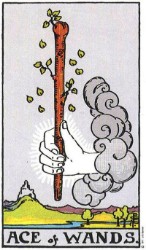
That’s what’s portrayed in the Tarot card, The Ace of Wands.  Wands represent ideas and this is an idea or thought coming into the world in its purest form of mental energy.  It’s, “divinely inspired.”

That STILL doesn’t tell us exactly what an idea IS, though.  It’s just talking about it’s source, rather than it’s contents.

Now, the Theosophists and Victorian occultists had very specific ideas of exactly what an idea is.  They viewed ideas as thought-forms, which is to say, individual little packets of energy produced by our brains and emotions and auric fields.  And – important point – they felt that they were independent of the human being once they were produced.

We’ve all seen those cartoons where there’s a person having a thought that appears as a bubble with text in it, hovering over the character’s head.  That’s a convenient way to visualize what the Theosophists were talking about.  Every time that we have a thought, it’s like our bio-field – our brains, emotional energies, energy bodies – are extruding a little, tiny thought-form bubbles that exists outside of us.

Most of the bubbles don’t last very long because they don’t contain much energy.  Let’s face it, many of us are NOT thinking about the theory of relativity while we play the piano.  Instead, we’re having really profound thoughts like, “Where’d I put my car keys?  Need a cup of coffee.  Gotta walk the dog.  Did I do the laundry?”   So these are little bubbles that appear for a moment, pop, and disappear.

When the thought forms are really heavily charged with energy, though, they stick around.  How do they get charged?  Well, through emotions and through repetition.

Suppose you just went to bed with someone and you had a super-duper, unbelievable, I-think-my-ears-just-fell-off orgasm at the exact moment that you thought, “I love you.”  That, “I love you,” thought is super-charged with energy and it will last.  Ditto, if you’ve been badly shocked or frightened by something.  The more intense the emotion, the more of an energetic charge the thought-form has and the longer it will exist.

We can also charge the thought-forms with energy by thinking of them over and over and over.  On a positive note, we can see that happen when someone thinks of their lover constantly, as we tend to do in the early stages of falling in love.  The obsessive thinking keeps adding energy to that same, “I love you,” thought-form and makes it’s last.  On a negative note, we can see the same pattern with chronic anxiety and depression.  Constantly thinking of things that frighten us or make us sad just increases the charge in the thought-forms and so the depression will linger long after the original cause.

Two of the early Theosophists, Annie Besant and Charles Leadbeater, published a book called, “Thought Forms.” It had illustrations of the forms as they emerged from people’s auras, as seen by psychic mediums.  Here’s one of a peaceful thought:

And here’s one of an angry thought.

I would have liked to have seen one of a horny thought – sort of astral pornography, I guess – but the Victorians didn’t roll that way.

So is all of this true?  Maybe.  It certainly forms the basis for much of what we call visualization and manifestation, as well as the concepts of either cursing or blessing someone.  I’ll be writing more about that in the immediate future but for the time being it’s a fun concept to play with.  What if our thoughts are actual things that exist in our personal energy space and exert an influence on us and those around us?  How can we change the negative thought-forms and increase the positive-forms?  Can we pick up someone else’s thought-forms, much like a virus?

Before you dismiss the idea out of hand, remember what we started off with here: the most preeminent psychologists and scientists in the world have absolutely no idea what a thought is.  The theory of thought-forms is just as good – and maybe better – than most of their theories.

Remember that my e-book, “Just the Tarot,” is still available – dirt cheap! – on Amazon. In fact, I’m sending thought-forms at you right now. You should buy this book . . . you should buy this book . . . you should buy this book . . .

The Five of Wands, Louise Hay, and Becoming the Grown Up Who Lives in Our Heads.

A look at childhood programming and using affirmations.

If I were to say, “Your thoughts are total bullshit,” you’d probably feel highly insulted.  On the other hand, if I were to say, “My thoughts are total bullshit,”  you might agree with me or you might tell me that’s not true and wonder where I got such a terrible self-image.

But if I were to say, “A lot of OUR thoughts, as human beings, are total bullshit,” that’s a more fertile ground for discussion simply because it depersonalizes it and takes us out of a fight-or-flight reaction.  We don’t have to defend anything or run away from being criticized.

In, “You Can Heal Your Life,” Louise Hay made the point that, at their base, our thoughts really mean nothing at all.  They’re just words that we string together and they don’t take on any meaning by themselves.  We have to ASSIGN meaning to them.  We have to say, “I believe these thoughts are true.”

And, oddly, our beliefs are nothing more than thoughts that we’ve repeated over and over and over until we believe that they’re true.  When we take a little closer look at those thoughts we can understand exactly why so many of them really are bullshit.

First of all, a lot of our thoughts were, “installed,” in our little brains when we were far, far too young to make any rational judgements about their validity.  By the time that we reach late adolescence most of us have been thoroughly programmed with unexamined thoughts that we believe to be true.  The richest source of the programming is our families, of course, but we get a hefty dose of it from our teachers and peers, as well.  Some of those thoughts might be things like:

I’m no good at math.

I can’t dance.

I’m a terrible athlete.

I’m not very good looking.

I’m too fat or too skinny or too tall or too short.

I don’t fit in.

Nobody likes me.

Or the thoughts might be something like:

Democrats are communists.

Republicans are fascists.

Rich people are heartless.

People who don’t practice my religion are evil.

Black people are scary or white people are arrogant honkies.

Immigrants are too lazy to work AND they’re going to steal my job.

These are all just words, strung together to make thoughts, which were repeated over and over when we were young until we came to believe that they must be true.

The truth of these beliefs were totally unexamined when we were kids because we didn’t have the mental capacity to evaluate them.  If our parents or teachers told us they were true, well then – hey –  they must be true because that’s what the grownups said. For the most part, though, they remain unexamined when we’re adults, which is the second reason that many or our thoughts are total bullshit.

Most of our thoughts are subliminal, which literally means, “below the light.”  In this case, we mean, “below the light of consciousness.”  We just think them, without even being aware of the fact that we’re thinking them.  That’s the infamous, “stream of consciousness,” or, “monkey mind,” that engages about 20 seconds after we wake up in the morning.  It’s just a ceaseless chatter that runs along by itself and contains – buried in its content – all of that programming that we got as kids.  It sounds like this:

Gotta get the coffee going, godamn it’s cold, I wonder if I have enough gas in the car, should have balanced the checkbook but I’m no good at math, gotta get the kids up and make breakfast, can’t believe the price of eggs, it’s the rich Republicans driving the prices up, nobody cares about working people, if only I had a better job but I’m not smart enough to get a better job, where are my socks . . .”

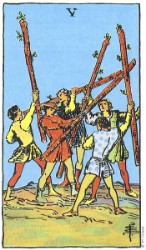
The unexamined thoughts that were programmed into us when we were kids are running over and over again, all the time, and remain unexamined.  And, yes, thoughts that are repeated over and over become beliefs and, like the people in the Five of Wands, we’ll fight to the death to defend our beliefs.

Which is the third reason that most of our thoughts are bullshit.  We’re totally ego involved with them.  Most of us, most of the time, completely identify with that subliminal thought stream.  We experience it as, “These are MY thoughts in MY mind, therefore, they’re a part of me.”  It never occurs to us that they’re not really our thoughts.  They’re our parent’s thoughts and our teacher’s thoughts and maybe even the thoughts of that bully who tortured us at recess in the third grade.

Affirmations, as Louise Hay points out, are a simple way to step out of that thought stream and start changing our beliefs by changing our thoughts.  Let’s face it:  most of don’t have the time to just sit there all day and watch our thoughts.  “Ah HA!  There’s another negative thought from my childhood programming!  Take THAT, negative thought!”

What we can do, though, is to become a little more conscious of our thought streams.  Even when we’re working or driving to the store or taking a shower, we can watch the mind chattering away and consciously think, “Okay, that’s a pretty negative thought,  And it’s probably not MY thought; it’s just something my mind was taught when I was a kid.”

When we begin to dis-identify with that constant stream of thoughts, we immediately lose the need to defend them.  After all, they’re not really my thoughts, so why should I care about them?  And then we can begin to replace all of that subliminal programming with programming that we consciously choose.

Just pick a positive thought – any positive thought – and repeat it 3 or 400 times a day.  Does that seem like a lot?  Well, how many times a day do we say something negative to ourselves with that childhood programming?  Hundreds of times, right?

If that sounds like a sort of a forced, Pollyanna Positivity it’s because it is. We are quite literally pushing our thoughts in a new direction and it can feel completely unnatural to begin with.  But that’s the whole point:  there’s nothing, “natural,” about our unhappy beliefs, either.  They were just thoughts that were repeated again and again, often by the miserably unhappy adults who raised us.  That’s all that happy beliefs are, too – thoughts that are repeated again and again until they become beliefs.  And we get to be the adults who are repeating them, which is pretty cool.

Small Town America, the Chat ‘N’ Chew Cafe’, and the Five of Wands.

A look at why small town Americans overwhelmingly support Donald Trump.

When we look at the electoral map of the United States, we can’t help but notice that there is a veritable sea of Red States that stretches from one coast to the other.  When we look a little closer at that sea, we notice that it’s actually composed of millions of tiny, little towns in thousands of tiny, little counties.  This is rock solid Trump country and – since Trump is a Master Salesman – it might behoove us to look at exactly what it is that he’s selling to these folks.

In a word, it’s, “nostalgia.”  Nostalgia for a simpler, cleaner, more understandable way of life.  You know . . . like we all had in the 1950s.

Now, I passed through a fair number of those little towns as I was growing up and, in many ways, they were all remarkably similar.

1 – They all had a local cafe’/hamburger joint with a cute name like, “The Chat ’N’ Chew,” where folks gathered for Sunday brunch or morning coffee.

2 -They all had one barber shop and one beauty salon.

3 -They all had a local high school and the Friday night football game at that high school was the most important event of the week.

4 -The high school football team was always called, “The Fightin’ ___________, “ (fill in the blank according to the local animal mascot, although I never encountered, “The Fighting’ Oysters.”)

5 -They all had some version of a local swimming hole where the younger kids frolicked and the older kids might go skinny dipping on a dare.

6 -They all had a, “lovers lane,” which was usually a small road on a hill or bluff where the high school kids went to explore their sexualities and lose their virginities.

7 – Except in the South, they all had one or two, “Negro,” families whose children might be allowed to attend the local schools, but were de facto segregated in every other way.

8 – They all had one token, “queer,” who was usually a single, older male who owned the local antique shop, cared for his aging mother, and was known to be, “a little light in the loafers, if ya know what I mean.”

9 – They were all convinced that their little town was somehow unique, different, and better than all of the other little towns and they usually had a billboard right outside of the town to tell you just exactly that.

I mention all of this, not to make fun of or denigrate those towns, but to point out that THEY WERE REALLY REAL.  Millions of Americans were born in and grew up those places and lived extremely happy lives in them.  

And then they left.

A big factor in their leaving is that Small Town America doesn’t have many ways to make a living.  Unless your Daddy owned a farm or your Mama owned The Chat ’N’ Chew, you were pretty well screwed in finding a job.  Another reason, of course, is that young people naturally want to get out and explore the world, to see what lies beyond that billboard on the edge of town.

There are many other millions of us who never had those small town experiences.  We can legitimately point out that while they were living their Ozzie and Harriet/white picket fences/1950s lives, Black people were still being lynched in the South.  Latinos were walled into barrios.  Gay folks were routinely beaten and sometimes killed.  Middle class women were quietly losing their minds and becoming addicted to Valium in record numbers.

That’s not to say that those small towns were hot beds of racism and homophobia.  For most of the people who lived there, those simply weren’t issues that they dealt with.  Except for that local antique dealer, there weren’t any queers and the few Black folks who lived there weren’t a problem because they kept their heads down and kept to themselves.

The end result is that we have millions of Americans who look back on their lives in Small Town, USA, as a golden, magical time.  These are the folks who spend thousands of dollars to travel back to high school reunions and reminisce over, “that year when the football team was the district champion.”

You also see these folks on the local community pages on FaceBook.   They chime in with comments like, “Hey, I lived in Thimble Town in the 1960s.  Does anybody else remember the milk shakes at Stegner’s 5 and dime?”  Or, “Whatever happened to Mrs. Peachtree?  She was my favorite teacher.”

That’s exactly what Trump is selling to that sea of Red Counties and Towns: nostalgia for a time that they viewed as simpler and easier, where everything, “made sense.”  It isn’t just the people who are still living there, it’s also the millions of people who USED to live there.

And so we’ve ended up with an America that’s essentially divided into two different cultures:  the rural folks, who remember a time when their lives were so much better; and the urban and coastal dwellers who view that life as largely incomprehensible, if not a down right lie.  Much like the Five of Wands, we’ve got a whole bunch of people swinging sticks at each other but never quite connecting.

The ironic thing, of course, is that the man who’s selling that nostalgic vision to the rural folks has never gone camping or hiking, never gone fishing or hunting, never owned a dog, lived most of his life in a penthouse in New York City, and wouldn’t be caught dead in a pair of blue jeans.

All of which doesn’t matter to his supporters in the least. A good salesman doesn’t just sell a product.  He sells an illusion.  And there is no better illusionist in the world than Donald J. Trump.

The Ten of Wands, Energy Healing, and Over-Thinking Enchiladas

Using energy healing to overcome overthinking.

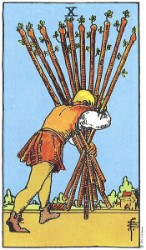
I find myself understanding the poor dude in the 10 of Wands more and more as time goes by.

In the Tarot, the four suits of cards represent different realms of the human experience.  Swords = personal power.  Cups = emotions. Pentacles = material possessions.  And wands = ideas.

So we see this guy in the 10 of Wands who has SO MANY ideas that he can barely stagger along under the weight of them.  His head is pressed firmly into the bundle of wands and he can’t even see what’s going on around him.  He’s just trudging toward a distant destination, hoping he’s going in the right direction and trying to put one foot in front of the other.  His ideas own him, not the other way around.

I was watching an interview with Eileen McKusick, author of, “Electric Body, Electric Health,” and she flat out said, “Overthinking is a cultural brain virus.  Overthinking never, ever solves anything.”  Naturally, my reaction was, “I’ll need to overthink that statement.”

She’s right, though.  What we refer to as, “thinking,” usually means shuffling around a lot of different concepts, trying to make them fit some sort of a coherent pattern.  It’s like a Rubik’s Cube that we keep flipping and flipping and flipping, hoping that all of the squares will line up. 

But conceptualizing is just one part of a much larger process and when we get stuck in that one part, it doesn’t work.  We can never, ever solve anything by just thinking at it.

Somewhere along the line in human evolution -probably about the time we began to develop alphabets and writing – we started to pull out of our bodies and into our heads.  Which is to say that we started to think of our heads, our brains and thoughts, as being somehow separate from our bodies.  Philosopher Gilbert Ryle referred to that as, “the ghost in the machine.”

That name is so apt because most of us suffer from this incredible, mass hallucination that there’s some separate, non-material, “self,” much like a ghost, that sort of rides around in our bodies, as if they were machines that we’re driving.  The ghost, of course, lives in our heads and we peer out at the world through our eyes, just as if they were windshields.

We call the ghost in our heads our, “selves,” or our, “personalities,” or even our, “souls.”  So there’s a ghost that’s our REAL self and then there’s the body, which we’re sort of temporarily driving around in.  That scene is very much like our real self landed at the Earth Airport and went straight to the Hertz Rent a Body so that we’d have a cool ride to tool around in.  “Hey, I’ll take something with fins and a lot of chrome.  Bucket seats.”

We even see that dualism in New Age philosophy, right?  How often have we heard that expression, “You’re not a body that has a Soul;  you’re a Soul that has a body?”  Which is a nice shift toward the spiritual, but it still maintains that strange hallucination that our bodies are somehow NOT our real selves. 

Which is exactly what McKusick was getting at:  we’re not just our brains and we’re not just our bodies – we’re our body/brains/nervous systems/emotions/thoughts/memories, Soul – the whole enchilada.

Or perhaps I should say, “the Soul Enchilada.”

She’s an energy worker who uses the energy of sound to heal us.  Like most energy workers, she heals from the outside in, which is contrary to some New Age thinking.  The basic New Age formula for life runs like this:

Our beliefs create our thoughts.

Our thoughts create our emotions.

Our emotions create our vibrations.

Our vibrations create what we draw into our lives.

New Agers have tended to jump in at the level of thought and say, “Well, if we change our thoughts, we change our emotions, which changes our vibrations, which changes our lives.”  Also known as the power of positive thinking and it’s true.

Energy healers like McKusick, though, are flipping the script on that.  They’re saying, “If we change our vibrations, we change our emotions, which changes our thoughts.”  She’s taking the same holistic approach – we’re all one great big electromagnetic vibration and if you change one thing, you change all of it – but she’s working from the vibration inward to the thoughts.

Her idea is that sound is a form of energy and so are we.  When we listen to certain sound frequencies that are coherent, solid frequencies, it reorganizes the energy in our bioelectric field into a solid, coherent vibration.  As our vibrations become more coherent, so do our emotions and our thoughts.

Does it work?  I don’t know, yet.  I’m spending a significant part of my day banging away on my Tibetan meditation bowl and grooving on the rising and falling of the sounds.  It does seem to be very soothing and it does take me out of my head and into my body.

And now that I’ve over-thought it, I like it.  I really do.

Please remember that my amazing e-book, Just the Tarot, is still available on Amazon for MUCH less than an order of enchiladas. Hell, it’s less than a side of refried beans. What an incredible bargain!

EMPATHS, EARTHING, AND MEDITATING CODEPENDENTS

Staying grounded as an empath.

So I just received my Amazing Hooga Earthing Mat from the very nice UPS driver and I should be incredibly spiritual after just a few days of using it.  

The basic theory behind them is that our energy systems get in a kerfuffle because we’re exposed to negative people, places, and things and, when we walk barefoot on the Earth, it restores our systems to their natural, harmonious balance.  Earthing Mats simulate that very same energy and get our auras all fluffy and pretty again.

I decided to get one because I’ve recently become aware of the fact that it is of tantamount importance for empaths to stay thoroughly grounded.  If we don’t, we start to dissolve like a piece of salt in the rain.  Earthing is a dandy way to avoid that.

EMPATHS AND EMPATHY

Being an empath is sort of hard to describe to a, “normal,” person.  First of all, of course, being an empath is not equivalent to being empathetic, although most empaths are highly empathetic.  An empathetic person might sympathize with another individual to a point where they can imagine what the other person is feeling and thinking.  Empaths actually experience what the other person is feeling in real time.

Empaths are also not psychics, although most psychics are empaths.  A psychic will focus on another person, “read,” their energy, their emotions and their thoughts, and then weave all of that into a coherent meaning, much like telling a story.  Empaths, on the other hand, are simply bombarded with information about the other person without really knowing what it all means.  We automatically glean far more details about the other person’s energetic and emotional state than what’s on the surface, but we don’t necessarily know how to put it all together.

To make it even more confusing, there isn’t just one type of empath.  There are empaths who actually hear what other people are thinking.  Other empaths feel other people’s emotions as they occur.  Some are telemetric empaths who, “get a reading,” merely by touching a piece of clothing or jewelry that someone else has owned.  A few empaths are highly attuned to the feelings of animals, but won’t pick up anything from other human beings.  Precognitive empaths may get very strong insights about what’s going to happen to a person in the future.

EMPATHS AND EGO STRUCTURE

One thing that all empaths have in common is a relatively weak ego structure.  It makes perfect sense, when we think about it.  Our ego is our sense of who we are, and the first part of knowing who we are is knowing that you’re over there and I’m over here.  Your, “you,” starts with your skin and all of your emotions, energy, and thoughts reside inside of your skin and all of mine reside in mine.  The only way that another human could possibly know what we’re thinking is if we tell them.

Which is very much not true for empaths.  For an empath, what’s going on in the other person’s mind is also going on in our minds, simultaneously with what WE’RE thinking.

All of which can make for a very confusing state of affairs, because we’re never quite sure which part of the conversation is ours and which part is yours.  For an un-grounded empath, there really ARE no significant boundaries or borders.  

There’s an old Spanish expression which goes, “Mi casa, su casa,” or, “My house is your house.”  Now change that to, “My brain is your brain,” and you get an idea of how truly weird it can be for an empath to hold a simple conversation.  Most empaths have to sit quietly after a meaningful exchange and decode exactly what thoughts came from which person.

EMPATHS AND CODEPENDENCY

One of the ways that the weak ego structure of empaths shows up is in codependent behavior.  Codependents tend to revolve around other people, much like the moon revolves around the earth.  Sometimes that’s a result of having been raised in an alcoholic or abusive family.  Sometimes it’s because we have a particular personality type.  And sometimes it’s because we’re empaths who haven’t learned to separate ourselves from other people.  

What happens with empaths is that we become enmeshed in the other person’s energy, in their thoughts, emotions, and their life patterns.  Since empaths already have a weakened sense of boundaries, they can easily dissolve into a more dominant person’s energy system.  In essence, they become overwhelmed and end up as bit players in someone else’s movie, instead of starring in their own.  They not only feel the other person’s emotions, they become the other person’s emotions.

EMPATHS AND MEDITATION

Empaths also need to be very careful about the type of meditation they practice.  

Many types of meditation are geared toward weakening the ego structure.  We’re basically trying to get past that chattering mind stream that prevents us from truly relaxing into deep meditation.  Those techniques involve what’s referred to as a, “bare awareness,” method, where we might focus on our breath or a mantra, or a candle flame, until the chattering mind calms down and recedes into the background.

BUT . . . studies have increasingly shown that meditation is highly correlated with PSI or psychic abilities.  If we tritty trot off to a meditation center for a two week retreat, we’re probably going to be more psychic coming out of it than we were going in.  For a normal person, that involves a significant decrease in ego control and, “becoming one,” with the universe and our fellow humans.

An empath, though, is already wide open and our challenge lies in shutting down some of that in-flow of information.  Deep meditation can destroy whatever barriers we’ve managed to erect and leave us completely adrift in other people’s energies.

Mindfulness meditation seems to be the, “go to,” method for empaths.  It’s a constant reminder to stay in our own bodies in the present moment and to separate from all of the drama out there.

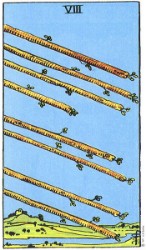
THE EIGHT OF WANDS

Being an empath can feel very much like the Eight of Wands looks.  Wands represent ideas and this card shows inspired ideas raining down from heaven.  For an empath, though, the ideas may be far from inspired and not at all our own.  

If everyone we met was in a perfect, loving place, being an empath could be pure heaven.  We’d just walk around grinning while all of those good vibes poured straight into us. Unfortunately, that’s far from the current state of affairs and a tremendous amount of what we absorb is toxic.

The answers for empaths seem to be strengthening ego structure, not weakening it.  Building boundaries and borders, not letting them down.  And, above all, staying grounded.  Which we can begin to do by planting our tootsies firmly on the Amazing Hooga Earthing Mat.

Cheatin’ Horndogs, Vibrators in the Refrigerator, and Tarot Cards that Indicate Infidelity

Tarot cards that indicate infidelity in a relationship.

“She just started liking cheating songs,
And what’s bothering me,
I don’t know if it’s the cheating she likes,
Or just the melody.” – John Anderson

If you read Tarot cards for other people, you’ll find that one of the major topics that those people want to know about is love and romance.

Is she the right one for me?
Does he feel the same about me that I feel about him?
Should I ask her out?
Should we move in together?
Are we meant to get married?
Will this relationship last?

And, of course, with love and romance there are frequently questions about fidelity and cheating. Most marriages and relationships are, “monogamous,” which is derived from the Greek, meaning, “keep your dick in your pants,” (except when you’re with me.) A very large part of the marital and partnership contract is that when we fall in love we’ll be sexually and emotionally exclusive to that one other person.

Just the Tarot by Dan Adair – a kindle ebook available on Amazon

Having sex with or becoming emotionally attached to a third party is seen as a major violation of that contract and is grounds for terminating it. And there are major penalties that go along with that violation, such as being locked out of your house in your bathrobe, or having your partner pour maple syrup all over your best clothes just before she throws them out into the front yard. And many times, it’s not even REAL maple syrup, it’s that cheap, artificially flavored crap like Mrs. Butterworths.

Quite naturally, then, people who are cheating on their partners will go to great lengths to conceal it. And, quite naturally, the partner who’s being cheated on will somehow know, on a very deep, almost psychic level, that their mates are being unfaithful. There may be extremely subtle, subliminal clues, such as your husband having a giant hickey on his neck, or finding a pair of jockey shorts under the pillow when you wear boxer shorts. Or perhaps coming home early from work and seeing a naked man running out your back door, or finding a strange vibrator in the refrigerator next to the carton of eggs.

Those are the kinds of subdued, low key signals that will often make a person stop and ponder if there’s something more going on in their marriage than meets the eye. Still, their partners will tend to deny it. The vibrator in the refrigerator must have accidentally fallen into the grocery bag at the supermarket and really belongs to someone else. The naked man running out the backdoor was the plumber, who was sleepwalking, and was completely shocked when he awakened without clothes while he was working on the dripping faucet in the bathroom. The hickey on your husband’s neck was the result of a near tragic vacuum cleaner accident at work. The jockey shorts under the pillow were meant to be a present and now you’ve gone and ruined the surprise.

Even though these are all perfectly rational, reasonable explanations, there may still be lingering suspicions and so your client will want to consult the Tarot cards to determine the truth. Here are a few cards that may indicate that the questioner’s partner is what is clinically referred to as a, “cheatin’ horndog.”

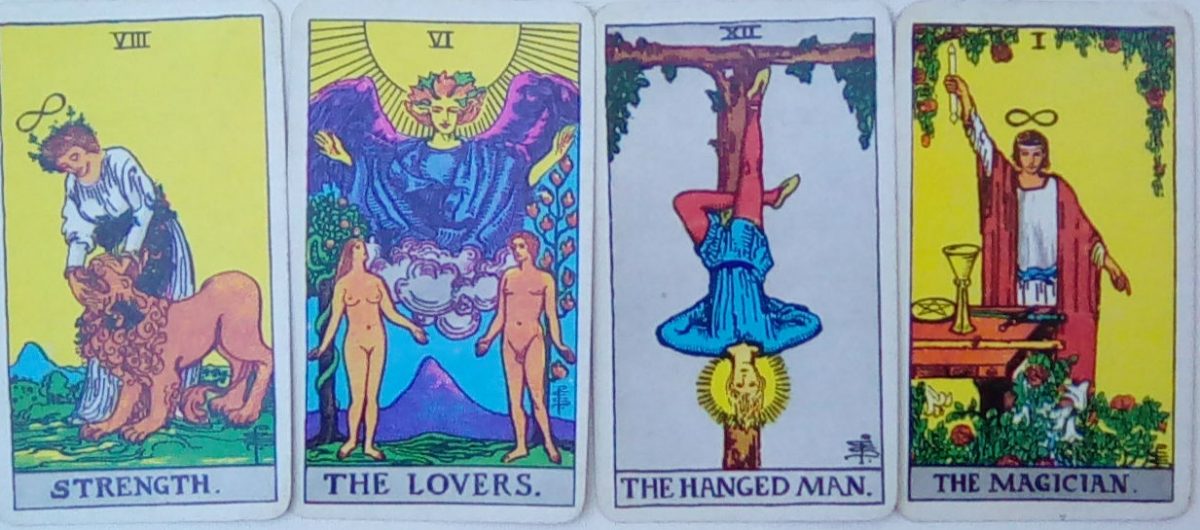
THE LOVERS REVERSED

The Lovers is obviously THE romantic relationship card in the Tarot deck. It shows that period of time when you’re first together with your romantic partner and the whole world seems magical and glowing. It’s just the two of you, in your shining little garden. Just you and the angels and . . . um . . . that pesky snake climbing up the tree. When it’s reversed, the party’s over, baby. You’ve been thrown out of the garden and it’s time to deal with reality.

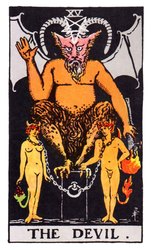
THE DEVIL (UPRIGHT OR REVERSED)

The Devil card shows the same two figures from The Lovers card, only things don’t seem to be as peachy anymore. For one thing, instead of an angel hovering over them, there’s a great big horny kind of a goat/bat demon thingie. They’re chained to a black stone or altar and they have tails which are on fire. (Having your tail burst into flames is another one of those subtle signs that there may be something wrong.) The Devil card can mean a lot of rotten things, such as addictions, super negativity, etc, etc,, but in this context – cheatin’ horndogs – it probably indicates a sexual affair that’s going on and it probably indicates that it’s a pretty heavy duty affair that may have strong elements of BDSM. I mean, horny goats, chains and flaming tails? Really?

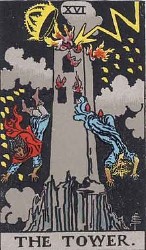
THE TOWER (UPRIGHT OR REVERSED)

The Tower, as you might guess, is NOT a positive card. It usually indicates a freaking disaster that’s happening right in the middle of our happy little lives. The flash of the lightning bolts indicates that it’s sudden and shocking. It tends to destroy our lives right down to the foundation and then we’ve got to start rebuilding them, piece by piece. Having this show up in a reading about fidelity would indicate the sudden knowledge that your partner has been unfaithful and the relationship has been completely destroyed by that lack of fidelity.

FIVE OF WANDS

The Five of Wands may show up in a relationship where there’s a LOT of emotional turmoil. In the South, they talk about, “fight and fuck,” relationships. These are relationships where the two people involved have huge fights with much screaming and throwing of plates, and then they reconcile and have make-up sex that’s incredibly good. There are spoken phrases in there like, “Oh, baby, I’m so sorry,” and, “I promise this will never happen again, ‘cause you’re the dumplings in my chicken soup, honey buns.” Yes, I know honey buns and chicken soup are a disgusting combination, but you get the idea. There’s cheating going on, but they’ll probably reconcile and spend the next week in bed.


QUEEN OF WANDS REVERSED

The Queen of Wands has a lot of good characteristics and, among them, is fidelity. If she shows up reversed, there’s a very good chance that someone isn’t practicing that virtue.

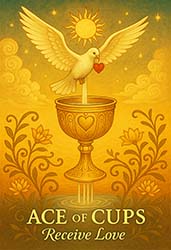
ACE OF CUPS REVERSED

The Ace of Cups shows pure, unadulterated love pouring into the world. It tends to appear when someone is just starting off on a new romantic relationship and their hearts are full of love. When it’s reversed, there’s a good chance that their love got adulterated by a cheatin’, adulterating horndog.

THREE OF CUPS REVERSED

Obviously, this is very much of a party hardy card. When it’s upright, it’s healthy, joyous and free partying. When it’s reversed and shows up in this kind of a reading it can indicate that the joy is leaving or that your partner is partying with someone else.

TEN OF CUPS REVERSED

Among other things, the Ten of Cups is the Happy Family card. When it’s reversed it can be a sign that the happy family is breaking up, particularly if it’s a family with children involved.

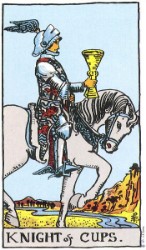
KNIGHT OF CUPS REVERSED

The Knight of Cups is riding out on a sincere quest for love. Reversed, it indicates that the love wasn’t found.

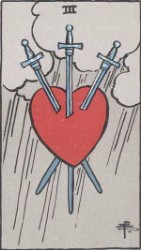
THREE OF SWORDS

LOL – well . . . yeah . . . that one’s pretty obvious. Stabbed right in the heart.

SEVEN OF SWORDS

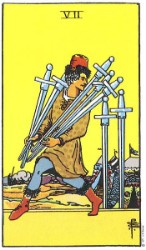
The Seven of Swords is all about sneaking around and stealing someone else’s power. This is the kind of person who has an affair right in front of everyone’s eyes and somehow gets away with it. This card also shows up frequently when you’re involved with a malignant narcissist who’s just using you for their own ego gratification.

TWO OF PENTACLES

The Two of Pentacles may show up in a reading like this to indicate someone who’s trying to juggle two different love affairs and keep both of them going.

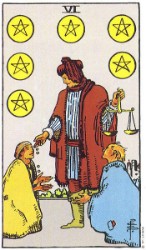
SIX OF PENTACLES

This may indicate a lover who’s not really giving with a whole, loving heart. Love is being measured out very carefully.

Those are just a few of the red flags that may show up if your questioner wants to know if his or her partner is running around.

Remember to be very careful with these types of readings. Many people are in a great deal of denial when relationships are falling apart and really, really DON’T want you to tell them what you see in the reading. What they want is for you to tell them that they were wrong and that the vibrator in the refrigerator is really just a whipped cream dispenser. If you’re doing a reading for your best friend and you tell her that her husband is playing hide-the-sausage with his secretary, she may not be pleased with you. At all.

And, of course, it’s always possible that the questioner’s partner might NOT be a cheatin’ horn dog. He could just be a rat faced dingleberry, which is an entirely different kettle of fish. In either case, approach this topic with caution. Practice using phrases such as:

It seems that all may not be as it appears.
There’s a certain murkiness here.
There appears to be a fork in the road of life.

Avoid using phrases such as:

I think he’s dipping his wick with your best friend.
She’s a real bottom feeder and believe me, I MEAN bottom.
You should have listened to your mother. By the way, does your mother still have that spare room?

The Pragmatism of Happiness, Colliding with Bubbles and The Five of Wands

The pragmatism of choosing to be happy.

Maybe we’re just meant to be happy.

That may sound a bit simplistic and silly on the face of it.  “Duh . . . who doesn’t want to be happy?”  Still, when we consider all of the hoops we jump through in order to NOT be happy, it’s kind of amazing.  Happiness, for many of us, always seems to be a future event rather than something we enjoy in the present moment.

  • I’ll be happy when I finally get out of high school.
  • I’ll be happy when I finally get laid.
  • I’ll be happy when I get a good job.
  • I’ll be happy when I get that new computer.
  • I’ll be happy when I get a new car.
  • I’ll be happy when I fall in love.
  • I’ll be happy when I get married.
  • I’ll be happy when I get divorced.
  • I’ll be happy when the kids are grown up and I have some time for myself.

And on and on and on.  That approach is valid, to a certain extent.  We do get some measure of happiness from all of these things and events, but it never seems to last.  It never seems like real happiness.  It’s like we’re microdosing instead of getting the whole pill.

One of the problems is that we always look at happiness as something that happens to us, rather than something we generate on our own.  We see this reflected in the way that we talk about the process.  “You make me happy.”  Or, “this made me sad.”  Or, “I couldn’t believe how happy that made me feel.”  

The way we verbalize it sounds like there are these bubbles floating around the universe that we occasionally have collisions with and it changes the way that we feel.  “Uh, oh, I just ran into a sad bubble, so I’m sad now.”  Or, “Oh, man, that happy bubble felt good.  Yay!”

Since we don’t control those sources of happiness, since they’re things that happen to us rather than by us, we never feel as if we control our own happiness.  Yes, we can try to maximize our lives so that we run into more happy bubbles than sad bubbles.  We can get rid of the negative people in our lives.  We can find jobs that don’t totally suck.  We can intentionally pick out books or videos that are uplifting, rather than depressing.  But that’s still giving that power of happiness away to exterior sources.  We’re still just trying to control the exterior sources rather than realize our own ability to be happy just because we want to be.

So a good first step in being happy is to just claim our own emotional states.  That means realizing that our happiness, sadness, joy, depression, anger, love, etc. are all things that we are generating ourselves.  They don’t come from outside of us – we’re making them up as we go along.  

Put another way, it’s not a simple stimulus/response interaction.  We don’t have to automatically respond to our life’s events in certain pre-programmed ways.  We can – and do – interpret them.  We just usually interpret them in a very unconscious way.  We’ve been taught that some events are supposed to make us sad and some events are supposed to make us happy and we never stop to question why.

For instance, marriage = happiness and divorce = sadness.  We accept that equation instantly, despite the fact that about half the marriages in our country are miserable experiences and divorce often feels like being let out of a prison.  As the bumper sticker says, “It is better to have loved and lost than to go on living with a psychopath.” 

Now, once we’ve gotten there, when we’re willing to accept that WE are making our own emotions happen rather than colliding with random happy or sad bubbles, then the next step is to actually ask ourselves why we’re choosing those emotions.  A good yardstick to use in that process is evaluating whether they’re actually doing anything for us.  Are they making our lives better?  Are they moving things forward?  Are they improving the quality of our lives?

By way of an example, I used to love, love, LOVE my self-righteous anger.  If I really, genuinely felt that I was right and someone else was wrong, I was willing to argue all night and fight to the death to defend my position and change the other person’s opinion.  I was angry because I had every right to be angry.  

In my defense, I don’t think I’m exactly alone in that process.  Social media groups often feel like the Five of Wands, where everyone is madly swinging their opinions at everyone else, all of us sure that we’ve got the real skinny on what’s true and what’s not.  Our current politics are even worse.

A peculiar thing happened to me, though, where I reached a point of realization that anger just didn’t work very well.  It was this sudden revelation that every single time I got angry, it made things worse instead of better.  Every single time.  Without fail, if I lost my temper I ended up with shit on my shoes and feeling like hell.  Far from changing anyone’s mind about the issue we were arguing over, it just convinced them that I was an angry asshole and there was no reason to listen to me.

And so I just gave it up.  Sure, I get irritated or impatient, just like any other human being, but I haven’t been angry in several years.  Not because I’m some kind of Mahatma Gandhi, but simply because it doesn’t work.  It’s like trying to use the wrong key to start your car.  If you know it’s not going to work, why would you do it?

In the same sense, sadness and depression are emotions that just don’t work very well for human beings.  They make life a lot harder, instead of a lot easier.  They freeze us in place and keep us from attaining our goals and feeling connections with life and joy.  

They are basically an unnatural act, in the true sense of that term.  When we look at young critters, what’s their primary activity?  Play.  Puppies, kittens, young humans, young apes, any young being gets up in the morning and plays until they’re so exhausted that they fall over.  And then they get up and do it again.  We’re born happy and we have to learn how to be unhappy.

Now, it’s true that into every life a little shit must fall.  We aren’t going to feel happy and positive when someone we love has just died or we’ve just gotten run over by a truck.  About 90% of the time, though, NOTHING IS WRONG.  That means that in about 90% of our lives, we can make that simple choice of how we’re going to feel:  happy or sad?  Can you imagine having a life that was 90% happy?  Sounds pretty good, doesn’t it?

It doesn’t have to be some bold, existential statement, either.  It doesn’t have to be some phony Pollyanna stance that everything in life is sweetness and light.  It can be a simple act of pragmatism.  Happiness makes us feel connected with life and our fellow beings.  We move forward toward our goals and opportunities for growth seem to appear out of nowhere.  Depression makes us miserable and we feel that we have no choices and no growth in life.

In a nutshell, depression doesn’t work very well.  Sadness doesn’t work very well.  We can give them up, just like a bad habit, because ultimately that’s all they are.  

The Nine of Wands, Buddhist Emotions, and Having Sex While We’re Water Skiing

On the emotional nature of ideas.

In the Tarot, each suit of the minor arcana represents a different realm of the human experience.  Cups represent emotions, pentacles are physical possessions, swords are energy, and wands are the intellectual realm of ideas.

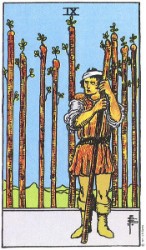
At first glance, we’d hardly associate the Nine of Wands with ideas at all.  A man stands there clutching a wand, a fearful, almost paranoid look on his face, and a bandage tied around his forehead.  He looks like he came out on the losing end of a bar fight much more than he looks like he’s swarming with ideas.

When we  stop for a moment and ponder just exactly what ideas really are, though, the card starts to make sense.  We all have thoughts – a  LOT of them – from the moment that we wake up in the morning until the moment that we fall asleep.  Some meditators call our thoughts, “the mind stream,” because they feel like an endless stream constantly rushing along from one point to the next to the next.

And, let’s face it – many, if not most of them, really aren’t worth much.  The Buddhists talk about, “monkey mind,” which basically means that our minds are like monkeys jumping randomly from one branch to another, with no particular order or meaning.  Rather than having truly great thoughts, our thoughts are more like:

-did I turn off the coffee pot?

-why is the cat crying?

-remember to buy more cat food.

-what am I making for dinner tonight?

– should I wear brown socks?

-who invented toast?

-I think I’m a little hung over.

-where’s the alka seltzer?

-remember to buy alka seltzer when you get the cat food.

All of those thoughts occur in mere seconds and they go on like that all day, every day.  Most of our thoughts, then, are just immediate, fleeting responses to whatever’s happening in our environments at any given moment.

There are, of course, more organized thoughts that we generate with problem solving activities.  That’s where we sit down and really concentrate on how we’re going to get from point A to point B, how we’re going to get through work activities or budget enough money to pay the rent.  How to organize our shopping lists and plan meals before we go to the grocery store.  What we’re going to say at a business presentation and how to prioritize the points that we want to make.

Yet another type of thought is what we could call intuition, where an idea or a notion just seems to pop up out of nowhere.  We may be shocked or surprised or delighted by an intuition because it frequently has little in common with our usual thinking patterns and provides us with a whole new way of looking at a problem or even life in general.  When someone asked Einstein how he’d come up with the theory of relativity, he said that it, “just dropped in,” while he was playing the piano.  Intuition may occur as a thought but there’s no feeling that we somehow generated it.  It really is as if someone or something else dropped it into our mindstreams.

Now, one thing that all three of these ways of thinking – rapid responses to our environments, organized problem solving, and intuition – have in common is that they all appear to be relatively innocuous, relatively harmless.  It’s hard to figure out how you could go from them to the character in the Nine of Wands who looks like he got the snot beaten out of him.  What the hell happened?  Did he beat himself with his own ideas?  Did someone else dislike his ideas so much that they beat him up?

We find a clue to that process in Eckhart Tolle’s book, “A New Earth, Awakening to Your Life’s Purpose.”  In his discussion of the, “pain body,” (the accumulation of subconscious emotional pain that we all carry) he states:  “. . . emotion is the body’s reaction to your mind . . . An emotion is the body’s response to a thought.”

In other words, thoughts never occur in isolation.  There are always emotions attached to them.  With many of them, the emotions, like the thoughts themselves, may arise and fall away so rapidly that we’re not even aware of them, but they’re there.

To use the example from above, we might think, “Remember to buy more cat food,” and not even realize we’re feeling anything.  Just below the surface though, there may be a fair number of emotional reactions, like, “I love my cat, I hate the smell of that fish flavored cat food, I miss my other cat who died, it all costs so much and I’m so worried about money . . .”  Love, hate, sadness, worry, all flashing through us over a damned can of cat food.

We might think that thoughts obviously can’t hurt us.  We can think of a purple polka dotted hippopotamus or the theory of relativity and neither of those thoughts is going to hurt us or anyone else.  They’re just ideas.  But – again – they’re ideas with emotions attached to them, and, yes, emotions can hurt us or help us.

If we obsessively ruminate over unhappy thoughts all day, that will hurt us.  It causes our blood pressure to shoot up, our bodies are flooded with cortisol and adrenaline, our serotonin levels drop and we become much more susceptible to depression and disease.  

If we interrupt those obsessively unhappy thoughts with the memories of something that made us happy – a vacation, great sex, a good friend, water skiing,  a vacation where we had great sex with a good friend while we were water skiing – that will help us.  Our blood pressure drops, serotonin levels increase, stress hormones drop, our immune systems get a boost.

So a good first step in not getting beaten up by our ideas is to consciously realize that every thought has some emotional component to it.  Every time we think something, we feel something.  The more aware we are of that, the more aware we become of what we’re actually feeling and we can gradually start to eliminate the thoughts that make us have bad feelings.  Like fish flavored cat food.

Another thing that can help us is to meditate a bit on the Buddhist notion that NOTHING HAS ANY VALUE.  At first blush, that may sound like a radically nihilistic notion.  “What the hell do you mean, nothing has any value?  I’ll tell you what has some value, Bubba – my new IPhone.  THAT’S what has some value.  Exactly $799.98, plus shipping, that’s how much value it’s got.  Don’t tell ME nothing has any value.”

To express the idea a little more clearly, nothing has any INTRINSIC value.  It only has the value that we assign to it, the value that we project into it.  An IPhone is just a piece of plastic and electronic components.  There’s nothing in it that’s intrinsically, “happy making,”  until we decide that IPhones make us happy.  Or unhappy.

Buddhists put a little finer edge on it by saying that we assign one of two feelings to virtually everything we encounter in life:  attraction or aversion.  Either we like it, in which case we want it, or we don’t like it, in which case we want to avoid it.  

The tricky part is in realizing that there is NOTHING that’s either likable or unlikable until we decide it’s likable or unlikable.  It’s wonderful to realize that because it gets rid of a whole host of unconscious motivations like greed, prejudice, possessiveness, materialism.  Literally, nothing has any value unless we want to think it has some value. Nothing’s good unless we think it, nothing’s bad unless we think it.

It also makes us deliciously responsible for our own lives because we’re no longer victims of circumstance.  How many times have we all said, “I’ll be happy when I get a new car, or a new computer, or a new job, or a better lover, or a nicer house?”  We chronically think that there is something or someone OUT THERE that will magically make us happy.  And if it’s OUT THERE, then we don’t have any control over it.  It’s something that happens to us or it doesn’t, either something outside of us makes us happy, or we’re just doomed to be miserable.

Once we realize that it’s our own thoughts that are assigning happy or miserable feelings to the things out there, that we are unconsciously deciding that some things are attractive and some things are aversive, then we control our own happiness.  Or we can be just as miserable as we want to be.

Happy, sad, mean, joyful, miserable.  They all start with thoughts and we, and we alone, make our thoughts.

Bundles of Sticks, Ajahn Brahm, and the Ten of Wands

Finding closure on experiences that don’t make any sense.

Should we carry our past with us or just throw it away?

The Ten of Wands shows a person plodding along, carrying a large bundle of sticks.  The, “sticks,” are wands, the suit of the Tarot that represents ideas, so he’s actually carrying a massive number of ideas.  

If we take a little closer look at the card we notice a few odd things about it.  First, he’s not at all carrying the sticks the way that we’d expect.  If we pick up a big old honker of a load of sticks, we’d throw them over our shoulder, right?  Instead,  he’s carrying them in front of himself, with his head pressed into the bundle. 

Second, the sticks are all crossed up at the bottom and going in different directions at the top.  If someone asked us to lug a large pile of sticks across the yard, we’d probably throw a rope around them and tie them together, not carry them in a loose, unwieldy mess.

Third, he’s definitely not watching where he’s going.  His head is tilted down, as if he’s watching each step he’s taking, rather than keeping his eyes on his destination.

So just by looking at the face of the card, we can deduce quite a few things about it.  This guy is probably an intellectual, or at least someone who thinks a great deal, because he has many, many ideas that he’s carrying around.  His ideas don’t really, “fit,” together, and they’ve become quite a burden for him.  In fact, he’s so involved with carrying his ideas that he really has no idea where he’s going.  He’s so lost in his ideas that he has no perspective on his life.

The Australian Buddhist monk, Ajahn Brahm, tells a funny story about sticks.  When he was a novice monk he was strolling through the forest with his teacher, the head monk at the monastery where he was studying.  The master suddenly picked up a stick from the forest floor and asked, “How heavy is this stick, Ajahn Brahm?”  And then he threw it away and asked, “How heavy is it now?”

The point, of course, is that something is, “heavy,” only when we hold on to it.  It’s the act of PICKING IT UP AND CARRYING IT that makes it heavy.  We don’t look at a stick on the ground and say, “Oh, crap, that’s heavy.”  We only say it when we try to pick it up.  It’s our act of grasping something that makes it seem heavy, not the thing itself.

Human beings are natural storytellers.  We all reflexively try to make sense out of our lives and weave the events we experience into a coherent, sensible narrative.  We have an innate drive to try to make sense out of what happens to us and so we’re constantly reviewing our pasts and rearranging the puzzle pieces of our lives into some sort of a rational structure.

We don’t just say, “Well, I lost my fucking mind and decided to quit my job, leave my husband, and move to Montana to grow dental floss.  Just for no particular reason.”  Instead, we say, “After several years of marriage I felt a yearning for solitude and spiritual growth that could only be satisfied by disconnecting from social obligations that had become increasingly mundane.”  

That feels ever so much better.

We need to feel that it all makes sense, somehow.

From a Buddhist perspective, constantly trying to make sense out of our pasts is tantamount to picking up that stick.  It only becomes heavy, it only becomes a burden, when we grasp it and carry it around with us.  In fact, Ajahn Brahm actually recommends writing, “this is my past,” on a stick and throwing it as far away as we can.  Just let it go.  When we’re not carrying it, it’s not heavy.

Now, modern psychology has a different take on it.  Therapists tell us that it IS important to try to make sense out of what’s happened to us and to strive for a sense of meaningfulness in our lives.  Bottom lining it, that’s why we go to therapists:  because our lives aren’t making any sense and we need someone to help us sort it all out.

I suspect that for most of us, the truth lies somewhere in the middle.  If we wake up one morning and have no past, we may have suffered a psychotic break.  Or, in the case of people like Eckhart Tolle, perhaps we’ve had a massive revelation, a huge psychic shift that made us realize how absurd our previous thinking was.

For those of us who are neither psychotics nor enlightened spiritual masters, though, just tossing our pasts out the window isn’t an option.  It seems we can’t just NOT think about it.

Which brings us to that tired, but still valid, word:  closure.

We think of closure as having worked through a problem or a process in life until we’ve made sense of it, until it fits logically into our coherent narrative of what our lives mean.  If we go through a divorce, for instance, we may go to a therapist and try to figure out why it happened.  What was our role in the relationship breaking apart?  What was our spouses role?  What did we do wrong?  What did we do right?  What can we learn from it to make our future relationships better?  Eventually, when we’ve talked through all of those issues, we start to achieve closure and we’re ready to move on from it.  We haven’t necessarily thrown the stick away, but we’ve made it a hell of a lot lighter to carry.

There are other issues, though, that we can never seem to make any sense out of.

– If you were badly abused as a child, that doesn’t make any sense.  You didn’t do anything to deserve it and there’s no logical or emotional reason it should have happened to you.

-If you’re an open and loving person and you got chewed up and spit out by a malignant narcissist, that doesn’t make any sense.  You didn’t ask for it, you didn’t deserve it, and it shouldn’t have happened.

-If the new boss from hell fires you from your dream job because he’s a sexist or a sadist, that doesn’t make any sense.  You were a great employee, there’s no justice in it, and it shouldn’t have happened.

So there’s a kind of a subclass of experiences that we all have that we could call, “doesn’t make any sense,” experiences.  Those are the experiences that get really, “sticky.”  Those are the experiences that we pick up and carry with us.  We go over and over and over them, trying to figure them out, trying to make them somehow fit into our narratives, our story.  But they never do.

“Doesn’t make any sense,” experiences are the ones that are most likely to wound us spiritually and emotionally.  They keep us stuck.  They keep us wounded.  They keep us living in pain.

Oddly, though, they’re also the experiences that are easiest to let go of, if we think of them in the right way.  If we’ve honestly, sincerely, conscientiously tried to figure them out and we can’t do it, we can just say, “Well, fuck it.  This doesn’t make any sense.”  And then we can put that experience in a nice, “doesn’t make any sense,” box, tie a brightly colored, “doesn’t make any sense,” ribbon around it, and toss it in the nearest river.

Maybe we’re not enlightened or smart enough to throw all of our, “sticks,” away, but we can throw some of them away.  We can consciously choose which parts are valuable and which parts are worthless.  We can drop some of the burden and make it a little easier to move forward in our lives.  

And that’s a good start.