New Moon in Sagittarius: Tarot-Friendly Rituals for Big Vision, Fresh Starts, and Better Luck

This New Moon in Sagittarius invites us to lift our eyes from daily worries and reconnect with a bigger sense of purpose. In this post, we explore how Sagittarius energy supports vision, belief, and fresh starts.

Tomorrow’s New Moon in Sagittarius is the kind of lunar reset that doesn’t whisper — it calls you forward. Sagittarius energy is optimistic, truth-seeking, and future-focused. It’s less about fixing what’s broken and more about asking:

“Where am I going next — and why does it matter?”

If you’ve been feeling stuck, uninspired, or a little too boxed in by routine, this is a beautiful New Moon to work with. Below are simple, Tarot-friendly practices (no complicated rituals required) that align with Sagittarius themes: expansion, belief, faith, and big-picture intention.

“Just the Tarot,” by Dan Adair – Available on Amazon

Why the Sagittarius New Moon Feels Different

Sagittarius is ruled by Jupiter, the planet of growth and opportunity. That’s why Sagittarius New Moons tend to feel like:

• a spark of hope returning

• a desire to try again (but smarter)

• an urge to explore new ideas, paths, or possibilities

• a hunger for meaning, not just productivity

This isn’t the New Moon for micromanaging.

This is the New Moon for choosing a direction.

7 Sagittarius New Moon Activities (That Pair Beautifully With Tarot)

1) Set “Big Horizon” Intentions

Sagittarius intentions work best when they’re directional rather than rigid.

Try writing intentions like:

• “I move toward a life that feels expansive and true.”

• “I welcome opportunities that widen my world.”

• “I allow myself to outgrow old limits.”

Think: vision, not logistics.

2) Do a One-Card Tarot Draw for the Next Chapter

Ask:

“What energy wants to grow in my life next?”

Pull one card and write three sentences:

1. What the card is inviting you to become

2. What it wants you to release

3. One small step you can take this week

Sagittarius loves simple, bold action.

3) Release One Limiting Belief

Sagittarius rules beliefs — the inner stories that shape your whole life.

Ask yourself:

• What belief has been quietly shrinking my world?

• Where have I been playing small because it felt safer?

Write the belief down. Then write:

“I no longer consent to this story.”

You don’t have to replace it with a perfect new belief yet.

Just loosen the grip.

4) Start a “Meaningful Study”

Sagittarius energy thrives on learning and perspective.

New Moon ideas:

• start a book that expands your worldview

• explore mythology, philosophy, or spiritual symbolism

• study one Tarot archetype more deeply this week

Even one chapter read with intention can shift your whole mood.

5) Go Outside and Ask One Big Question

Sagittarius is the open sky, the horizon, the road.

Take a walk and hold one question:

“If I trusted life more, what would I do next?”

Let the answer come slowly. Don’t force it.

6) Use a Mini Tarot Spread for Sagittarius Vision

Try this simple 3-card spread:

1. The Road I’m On

2. The Road That’s Calling

3. The First Step

This spread is perfect when you feel like you’re between chapters.

7) Create a “Jupiter List” (Luck & Expansion)

Write a list titled:

“What I’m Ready to Expand.”

Add anything that fits:

• creativity

• money

• confidence

• love

• freedom

• health

• visibility

• joy

Then circle the one that matters most. That’s your New Moon focus.

A Simple Sagittarius New Moon Ritual (5 Minutes)

If you like simple ritual, do this:

1. Light a candle

2. Write three big-picture intentions

3. Pull one Tarot card for guidance

4. Speak your intentions aloud

5. Close with:

“I trust the larger arc of my life.”

Sagittarius responds beautifully to spoken intention. It’s a “say it and claim it” kind of moon.

What to Avoid Under This New Moon

This is not the time for:

• micromanaging outcomes

• overthinking every emotion

• heavy, endless processing

• forcing certainty before you act

Sagittarius New Moons reward faith, courage, and forward motion — even if the path isn’t fully visible yet.

Closing Thought

The Sagittarius New Moon reminds us that life isn’t meant to be endured in a narrow hallway. It’s meant to be lived with curiosity and a sense of possibility.

Choose a direction that feels meaningful.

Then take one honest step toward it.

Happy New Moon.

Seven Lessons the Tarot Can Teach About Surviving the Holidays

Feeling overwhelmed by the holiday season? The Tarot has a surprising amount of wisdom — and humor — to offer.From The Fool’s fresh start to The World’s end-of-year perspective, these cards remind us that the holidays don’t have to be perfect to be meaningful.

A little humor, a little magic, and just enough perspective will get you through the Holiday Haze.

1. The Fool — You’re Allowed to Start Fresh

Every holiday season is a reset button.

Don’t carry last year’s stress into this year’s festivities.

Don’t walk off of emotional cliffs at family dinners.

Leap lightly… but maybe look down for gift-wrapping paper on the floor.

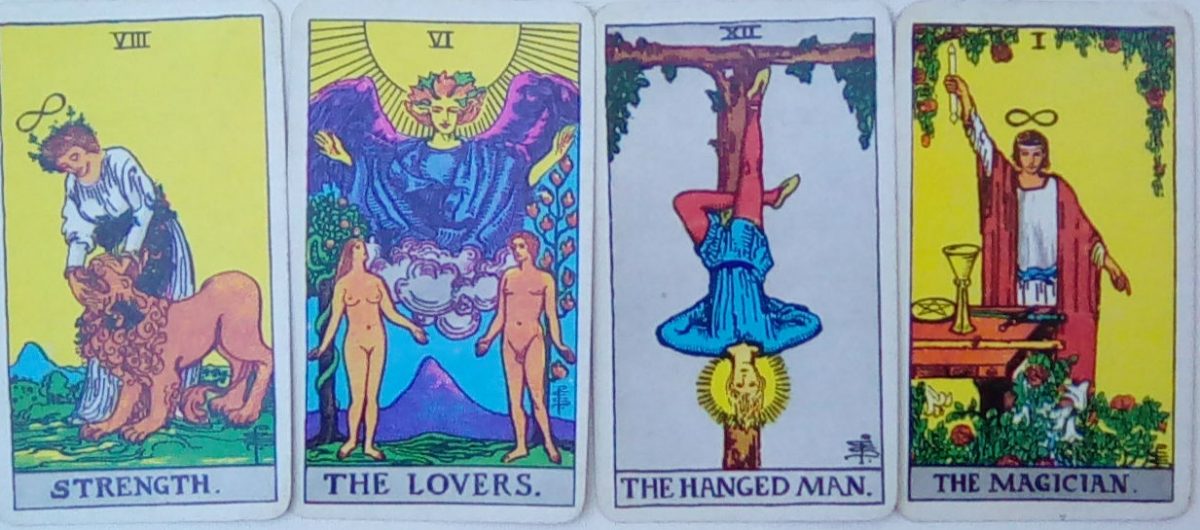
2. The Magician — Use the Tools You Actually Have

Trying to make a perfect holiday with imperfect resources?

The Magician whispers: Use what’s already on the table.

Don’t overspend now and stress later. 

Aim for gifts that are magical, not expensive.

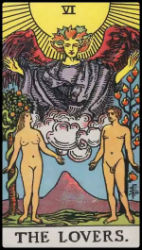
3. The Lovers — Choose Peace, Not Drama

The holidays tend to bring opinions.

And relatives.

And opinions from relatives.

The Lovers reminds you: choose connection, not combat… or at least choose silence and pie.

If one of your loved ones says something absolutely outrageous, remember that you can just put a piece of pie in your mouth and smile.  Add whipped cream to make it an extra sweet conversation.

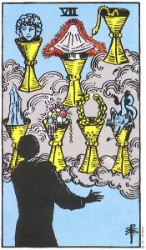
4. The Seven of Cups — Beware of Overcommitment

Shopping! Baking! Parties! Rituals! Volunteering! Travel!

The Seven of Cups says: You cannot say yes to all seven.

Pick the cup with the least glitter and the most sanity.

You don’t have to be all things to all people – just be the you that people love.

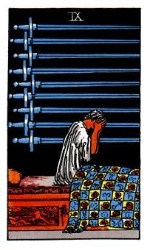
5. The Nine of Swords — Anxiety Lies

That nagging feeling that everything will go wrong?

It’s just the Nine of Swords doing its nightly stand-up routine.

Thank it for its service… and then ignore it.

Don’t just make it a holiday – make it a vacation from worry.

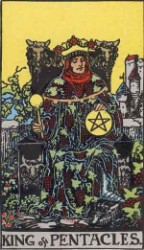
6. The King of Pentacles — Treat Yourself Like a Honored Guest

Warm food, soft blankets, comfortable socks —

This is not indulgence, this is holiday self-care strategy.

Just look at all the things you’ve done for other people!  Don’t you deserve a little pampering, too?

The King of Pentacles approves.

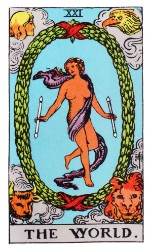
7. The World — You Made It Through Another Year

Pause. Breathe. Celebrate the cycle completing.

On the Winter Solstice, the solar year will end.  Take the time to reflect, to congratulate yourself for another trip around the sun. 

Give yourself credit for all the chapters you survived this year — and all of the growth that went along with that.

Bonus Holiday survival secret:

Lower expectations. Raise kindness. Wear stretchy pants.

Available on Amazon

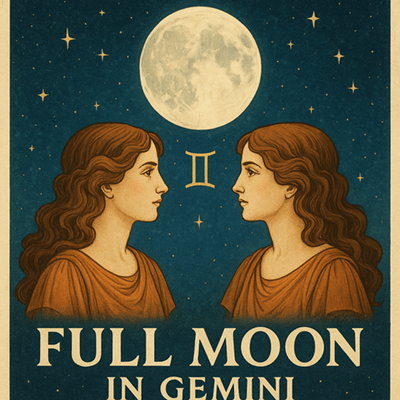
GOOD GEMINI FULL MOON ACTIVITIES (For Everyone)

Activities of the Full Moon in Gemini.

1. Talk It Out

Gemini is ruled by Mercury, so this moon loves:

• good conversations

• honest check-ins

• clearing misunderstandings

• catching up with someone you care about

If something needs to be said, today is a great day to say it — with curiosity instead of judgment.

2. Write Something (Anything)

The Gemini moon is ideal for:

• journaling

• blogging

• brainstorming

• making lists

• outlining a project

• writing a letter you may or may not send

Gemini energy likes movement, not perfection.

Write badly! Write freely! That’s the point.

“Just the Tarot,” by Dan Adair – Available on Amazon

3. Learn Something New

A Gemini full moon is curiosity on steroids.

Great activities:

• watch a documentary

• read something weird

• take a short online class

• dive into a topic you’ve always wondered about

• explore a new tarot idea or card history

Your brain is extra “sparkable” today.

4. Mix Things Up

Gemini hates routines that feel stale.

Try:

• working in a different room

• rearranging something small

• taking a different route

• visiting a new café

• choosing a new deck to read with

Tiny disruptions = big inspiration under this moon.

5. Light Decluttering

Gemini rules mental clarity, and physical clutter can feel “noisy” today.

But keep it gentle:

• toss old papers

• clear a drawer

• tidy your desk

• delete apps you don’t use

This is not a “deep clean” moon — it’s an “open the windows and let air in” moon.

6. Play with Ideas (Without Committing to Anything Yet)

The full moon illuminates, but Gemini doesn’t demand decisions.

Today is perfect for:

• exploring multiple options

• casting wide nets

• letting possibilities bubble up

• following mental rabbit holes

• gathering puzzle pieces

Choose later — today is for variety.

7. Light, Airy Rituals (If you do them)

This moon works best with:

• incense or diffusing uplifting scents

• breathwork

• music or chanting

• tarot spreads focused on clarity or “What am I not seeing?”

• light meditation rather than deep shadow work

Keep it breezy.

 THE OVERALL THEME

A Gemini Full Moon is excellent for anything involving:

• clarity

• communication

• curiosity

• small changes

• flexible thinking

• opening mental windows

• connecting dots

It’s a mentally stimulating, slightly restless, very dynamic moon — great for creativity, experimentation, and fresh insight.

THE EMPRESS AND THE ART OF FLUNKING OUT OF EARTH SCHOOL

A playful look at the New Age paradox of being “perfect souls” who still come to “Earth School” to learn lessons. The post explores both views and suggests that real growth comes not from suffering, but from joy, play, and becoming more fully ourselves.

There’s a rather large pothole in New Age philosophy that I keep tripping over. Let’s call it The Earth School Fallacy — the strange contradiction between “We are perfect divine beings” and “We’re here to learn lessons because… well, we’re NOT perfect divine beings.”

Somehow, we manage to carry both of those ideas around in our heads and not notice that they don’t quite fit together.

“Just the Tarot,” available on Amazon

THE EARTH SCHOOL MODEL

You’ve heard this one. If you’ve been on a spiritual path longer than a week, you’ve probably used this one.

Earth, we’re told, is a sort of cosmic classroom we incarnate into repeatedly. Each lifetime is a syllabus of Very Important Lessons, and with each incarnation we supposedly level up until we become Spiritually Perfect.

In this model, we actually choose our life challenges before we’re born.

Have a temper? Great! Let’s incarnate into a family whose daily activities include pushing all of your buttons like they’re competing for a prize. Assuming we don’t murder each other we eventually learn enough humility and patience and – SHAZAM –  we transform into Mahatma Gandhi.

Have an obsession with sex? Wonderful! Let’s incarnate into a world filled with gorgeous, eager, naked partners who—

Okay, that one never happens. But you get the drift.

Pass your lessons and you move up a grade.

Fail your lessons and you come back as a cockroach or a MAGA supporter and start over in Spiritual First Grade, eating glue and making macaroni art.

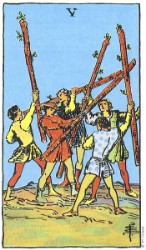
In Tarot Talk, Gaia’s classroom often looks like the Five of Wands — a bunch of souls flailing around wildly until one of us finally figures out what the sticks are for.

THE ANGEL WITHIN

Now we arrive at the second New Age idea — the one that directly contradicts the first.

This is the belief that we’re already spiritually perfect, but we’ve forgotten that fact. Our task isn’t to improve ourselves… it’s to remember that we don’t need improving.

Buddhists describe it as our original nature: a perfect jewel hidden under a crust of plain gray rock. Chip away the rock and — surprise! — you’ve been luminous the whole time.

Joni Mitchell phrased it better than all the gurus combined:

“We are stardust, we are golden,

and we’ve got to get back to the garden.”

In this view, we are pure, radiant beings from Source Energy who come to Earth, promptly forget who we are, and then spend the rest of our lives meditating, journaling, and buying inspirational calendars in an attempt to remember.

Put another way:

We’ve got a sleeping angel inside us, and the angel really needs to get its butt out of bed.

THE CONTRADICTION

Here’s the uncomfortable question no one asks:

If we’re already perfect, why would we CHOOSE to forget that and struggle?

It’s like becoming a master at algebra, then signing up for a lobotomy just so you can relearn quadratic equations from scratch.

Imagine your higher self sitting in another dimension saying,

“I’m a being of luminous perfection. You know what sounds fun? Forgetting everything and getting pissed off at the traffic while I drive to a boring, meaningless job that I hate.”

Something about that doesn’t quite compute.

EARTH SCHOOL AND THE WORK ETHIC PROBLEM

The Earth School model borrows heavily from Christian theology, a worldview in which:

• Humans are inherently sinful.

• Life is full of temptations that make us more sinful.

• If we behave ourselves and avoid having sex with the neighbor’s spouse, we get to go somewhere nice after we die.

In this model, Earth is basically the rough school on the dangerous side of town, with a curriculum of suffering, discipline, and fear.

Just keep your head down, work hard, and eventually—good news!—you’ll die.

THE VEDANTA SOLUTION (AKA: THE EMPRESS APPROACH)

Vedanta, from the Hindu tradition, on the other hand, leans toward Joni Mitchell’s interpretation. It suggests that:

• We are already perfect.

• Life is not meant to be hard.

• We’re not here to learn painful lessons.

• We’re here to experience, enjoy, and expand.

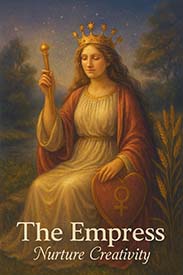
If the Vedanta version of Earth School has a model, it’s not the stern monk or stressed-out student — it’s The Empress.

Empress Poster available on Etsy

She’s not here to ace the test. She’s here to savor the banquet.

Play, creativity, pleasure, beauty — these are not distractions from the spiritual path.

They are the spiritual path.

That’s a really hard concept for Westerners to wrap our heads around.  We’re taught from the moment that we’re born that life is a series of assignments that we’re supposed to complete and that the next assignment will be better than the last.  That’s really the way that our whole society is set up.  We go to kindergarten so that we can go to grade school so that we can go to high school so that we can go to college or trade school so that we can get jobs so that we can get promotions so that we can retire comfortably and have enough money to pay for our funerals.

If we do all of that, we’ve been, “successful.”  If we don’t, our lives have been meaningless.

When someone tells us that the whole purpose of Earth School might actually be recess, it feels slightly insane.

LIVING SOMEWHERE IN THE MIDDLE

We can argue both sides.

If you lean toward Earth School, you can point to all the suffering and struggle that seem baked into our reality. As the English philosopher Thomas Hobbes famously put it, human life often appears “nasty, brutish, and short.”

But if you look again, you’ll also see breathtaking amounts of love, generosity, joy, and compassion.

So what’s the truth?

Probably something in the middle.

No, we’re not perfect angelic beings slumming on Earth…

but we can be.

Maybe life isn’t about learning painful lessons, and maybe it’s not about effortless perfection either.

Maybe it’s simply about becoming more yourself, more awake, more playful, more alive.

And oddly enough, the way we get there isn’t through suffering…

it’s through joy. It’s through learning how to play.

We don’t have to wait until we die to graduate.

We can do that right now — as soon as we remember that recess was always the point.

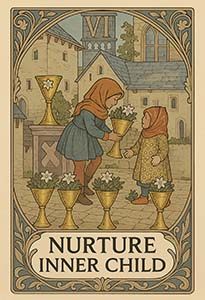
The Six of Cups — Protecting the Inner Child of Your Art

The Six of Cups reminds us that our creativity flows from the innocence of the inner child. Protecting that child means honoring your art, choosing who sees it, and never letting careless criticism silence your joy.

When Beauty Meets Criticism

Have you ever created something you thought was beautiful — a painting, an essay, even a garden — and when you finally shared it, the first thing someone did was point out the flaws? Instead of seeing what you were trying to express, they zeroed in on what they thought was wrong.

There’s always a tension between creating and sharing. When we make something real — assuming we’re not just hacking away — we’re revealing a piece of our heart, our soul, our lived experience. A careless critique can feel like a personal attack. It can leave us feeling exposed, vulnerable, even ashamed.

The Inner Child at Play

Picasso once said, “All children are born artists; the problem is to remain an artist as we grow up.” Creativity flows from the same source as play — from the child who once molded mud into castles or splashed finger paints across paper just for the joy of it.

That inner child still lives inside us, but it’s easily wounded. A thoughtless comment can silence it. A dismissive tone can make it retreat. And when that happens, the creative flow — the very essence of who we are — begins to dry up.

The Birth of the Critic

Mel Brooks joked that with the birth of art came the inevitable afterbirth — the critic. And he wasn’t wrong. If you take your creativity seriously, you’ll eventually encounter people who feel compelled to “fix” your work.

Julia Cameron wrote that before we can become good artists, we must first give ourselves permission to be bad ones. Every artist, writer, gardener, or musician produces clumsy beginnings — and even seasoned creators sometimes turn out a piece that just doesn’t land.

The creative process is messy and human. Yet while you’re admiring what went right, someone else may focus only on what went wrong.

The Wound of the Inner Artist

Cameron also warned that exposing your inner artist to harsh criticism is the emotional equivalent of child abuse. It’s like taking the eager, innocent child who offers you their finger painting and saying, “That’s terrible. You don’t really have any talent, do you?”

If you choose a creative life, criticism is inevitable. Some people simply won’t resonate with your vision, and occasionally you’ll make something that misses the mark. That’s part of the territory. But you can — and must — protect your inner artist with the same fierce loyalty you’d show a child under attack.

Learning by Heart

I became an artist late in life and am entirely self-taught. I picked up a mallet and chisel and learned to carve wood through trial, error, and stubborn joy. I learned to paint the same way.

Looking back, I can see how rough those early pieces were — primitive, awkward, untrained — and yet they were full of life. I still remember the pride I felt each time I saw progress take shape beneath my hands.

Claiming the title artist took courage. The first time I walked into a gallery and asked, “Would you show my work?” was absolutely terrifying.

A Pact of Protection

One simple, unbreakable pact guides me still: when someone criticizes my art, that’s the last time they see my art.

Showing your work is an act of intimacy — an unveiling of something deeply personal. The art flows from the child within you, and that child deserves protection.

Donald Trump and the Dark Archetypes of the Tarot

A closer look at the dark archetypes the Donald Trump embodies and has brought into our national consciousness.

Most of us embody certain archetypes as we move through life.

Some of us are “The Wounded Healer” and endeavor to share our personal healing with others. Some of us are “The Magical Child,” who lead others back to their own creativity and wonder. Yet others are “The Wizards,” who have a deep understanding of life’s mysteries.

Donald Trump seems to embody several archetypes symbolized in the Tarot—none of them good—and it might be interesting to take a look at them.

THE MAGICIAN REVERSED

In order to really understand this one, we need to look at the older version of The Magician from the original Tarot decks. Contrary to the shining image portrayed in the modern decks, The Magician was much more of a street performer than an occultist. The closest we have to that in modern life is the stage magician who makes flowers appear out of his sleeve or pulls rabbits from his hat. In a word, he was an illusionist.

Another version of that is what is referred to as a “flim-flam man” in the South. He’s the guy who sets up three shells on a table and you have to guess which one the pea is hidden under while he shifts the shells faster than the eye can see. He’s also known as a con artist.

Trump is very much in that tradition. From his fake university to his fake charities to his golden tennis shoes and engraved guitars, he’s been conning people his entire life. He is such an excellent illusionist that he’s actually managed to con his way into the White House—not once but twice.

THE HIEROPHANT REVERSED

The Hierophant is basically a religious leader—more specifically, a leader of a formal religion rather than a spiritual path. When he’s reversed, he’s a false teacher, a pastor who’s leading his sheep-like followers down a path to the slaughterhouse.

This “religious” aspect of Trump may be the most surprising of all. As many people have noted, his most devoted followers have all of the characteristics of cult members. Despite the facts that he’s a serial adulterer, a pathological liar, a convicted felon, and an adjudicated rapist, they’re convinced that he’s been sent by God to watch over the United States. He’s violated every single teaching of Jesus Christ, yet he’s become the de facto leader of Christian nationalism.

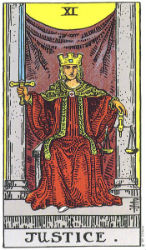
JUSTICE REVERSED

The Justice card is strongly associated with the legal system. Quite simply, when it’s upright it indicates a fair and balanced outcome in the law. Reversed, it indicates injustice and a lack of fairness.

Using his immense wealth and a stable of crooked lawyers, Trump has managed to evade 90% of the legal consequences that he should have faced. Yes, he fomented an insurrection; yes, he stole top secret documents and lied about it; yes, he’s committed one impeachable offense after another. But he continues to skate on the consequences. When his pet attorney general says, “No one is above the law,” she means no one but Trump.

THE DEVIL

If The Lovers card exemplifies love, then The Devil exemplifies hate. Trump is very fond of saying that he hates his opponents, he hates Democrats, he hates liberals, and he hates immigrants. In many ways, he’s hatred and vindictiveness personified.

Moreover, The Devil is a card of people being chained to their basest instincts. Trump has an amazing power to bring out the very worst in people. In just a few short years, he’s managed to turn half of the country into xenophobic, homophobic, misogynist racists who are happily ripping up our Constitution in order to celebrate their prejudices.

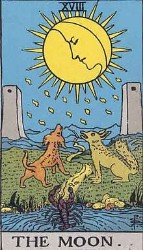
THE MOON

At its root, The Moon is the card of insanity. It’s the card of both delusions and illusions. You only have to listen to one of Trump’s speeches to know that he’s out of his mind. From rambling about sharks eating electric boats to windmills driving whales insane to his obsession with toilets that won’t flush, he’s a never-ending fountain of gibberish and word salads.

And beyond that, he drives the rest of us to the verge of insanity. He’s like this brain virus that’s slowly eating away at our serenity and sense of well-being. His view of the world is so skewed, so bizarre, so out of touch with reality that it’s astounding—and yet, here he is in our daily lives, ranting and raving and frothing at the mouth.

CONCLUSION – NAMING THE ARCHETYPES TO WEAKEN THEM

Archetypes are powerful forces shaping our destinies, our worldviews, and even our collective behavior. When they surface on a national scale, they can feel like hurricanes we can only endure.

But awareness is its own kind of power. By recognizing these archetypes and calling them by name, we loosen their grip. We stop being unwitting participants in someone else’s drama and begin to reclaim our agency. In a time when dark archetypes seem to walk among us, simple recognition is a first act of resistance.

“Just the Tarot,” by  Dan Adair – a kindle ebook available on Amazon

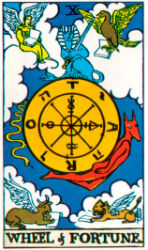
The Wheel of Fortune and Flowing with these Strange Rhythms

This post explores the deeper meaning of The Wheel of Fortune Tarot card and its connection to the Kybalion’s Principle of Rhythm. Life’s ups and downs are not random but part of a greater pattern that ultimately arcs toward the positive. Discover how to maintain perspective, rise above collective fear, and navigate dark times with love, compassion, and inner strength.

Let’s face it: we’re all a little exhausted from the constant insanity in the world right now. Whether you’re right, left, or middle-of-the-bird, it can feel like we’re adrift in a sea of chaos. When it goes on long enough, we start to lose our perspective and wonder if things will ever be “normal” again.

The message of The Wheel of Fortune is that everything passes and everything changes. The people who are at the top of the wheel right now will eventually be cast down, and the people who are at the bottom will eventually be elevated again.

Life is always cyclical — and this, too, shall pass.

The Principle of Rhythm

As I discussed in my book about The Kybalion, Western Occultism calls this The Principle of Rhythm. Here in Earth School, everything is rhythmic, and we only have to open our eyes to see it.

The tides come in and then go out.

The Moon waxes and then wanes.

Life explodes into the richness of spring and then recedes into the cold bleakness of winter.

Even great nations expand and then ultimately diminish into shadows of what they once were.

Everything rises and falls — and then rises again.

The same principle applies to human beings and all our affairs. We may have a string of incredibly good luck and then a period where we can’t buy a break. We may feel joyously happy for a while and then deeply depressed and anxious before we find our way back to happiness. We may fall deeply in love with someone and then end up despising them.

The Pendulum

The Kybalion envisions this process as the pendulum of a clock. It swings to the left, and then it swings to the right. And as the Principle of Rhythm states: “The swing to the left is always equal to the swing to the right.”

Modern science recognizes this in Newton’s Third Law of Motion: “Every action has an equal and opposite reaction.”

When we think about human life, we can see it in terms of alternating energies. We may go through incredibly negative periods — full of stress, sadness, and anxiety — only to be followed by times of great happiness, when everything seems to go our way.

We may have moments where we’re counting quarters to buy groceries, followed by periods of real abundance when the cash flows in like a river.

The collective energy of politics follows the same law – a hard swing to the right is inevitably followed by a hard swing to the left. Hatred is eventually replaced by compassion.

But It’s Not a Closed System

If that was all there was to the rhythms of life, it would be a pretty depressing scenario. It would feel like: “Okay, things are going well right now, but I can’t really enjoy it because it’s all going to turn to shit again.”

If life were nothing but good/bad/good/bad — ad infinitum — it would be the spiritual equivalent of one step forward and one step back. We’d be living, but not progressing. Stuck in an endless cycle of growth and degeneration. A closed system where nothing ever really improves.

The good news is that, as The Kybalion puts it, “nature favors the positive.” Positive energy will always overcome negative energy. Love will always be stronger than hate. Compassion will always conquer cruelty.

Put another way: yes, as long as we’re in Earth School, the pendulum will appear to move equally in both directions. The truth, though, is that it’s always arcing just a little more toward the positive — whether we can see it or not.

So What Should We Do Right Now?

We are, right now, in dark times. As Asha Nayaswami says in this wonderful video, there is demonstrable evil in the world, and some humans are acting out their darkest impulses.

So how do we deal with that? What should we do right now?

The advice of The Kybalion is to “rise above it.” We can’t control the Principle of Rhythm or the turns of the Wheel of Fortune. Those are built into the fabric of Earth School. We don’t have to be swung by the pendulum, though. We can rise above it spiritually.

What we can control is our reaction to it. We can make a conscious effort not to be swept along in the collective energies of hatred, fear, and anger. We can maintain our own little bubbles of love and compassion and keep putting out as much positive energy as we can.

As Nayaswami says, that doesn’t mean we become spiritual doormats. It doesn’t mean we avoid confronting evil when we encounter it. It means we confront it with truth, with as much gentleness and understanding as we can muster, and that we refuse to join it in any way, shape, or form.

Perspective

Above all, it means maintaining perspective. Keep your eyes on the horizon, not just on the dirt road full of potholes. Remember that the pendulum will swing back in the opposite direction.

When it does, life will not only be positive again — it will be more positive. People will learn from these experiences, and they’ll use that knowledge to build a better world.

We just have to be patient… and wait for the wheel to turn.

“Just the Tarot,” by Dan Adair – a kindle ebook available on Amazon.

The Hierophant Card, Spirituality, and That Time That Ram Dass Got Conned

In this candid exploration of The Hierophant Tarot card, I unpack both the light and shadow sides of spiritual authority. From my own rocky history with organized religion to cautionary tales of gurus gone wrong, this post looks at how The Hierophant can represent both guidance and manipulation. Learn how to spot the difference between a true spiritual teacher and a false one, and why, in the end, your own connection to the Sacred should always be at the center.

The Hierophant Card from the Waite Tarot Deck

I’ve always had a hostile feeling toward The Hierophant card. I was raised in the old, Latin, fundamentalist Catholic Church, and like many a recovering Catholic, the mere sight of a priest, pope, or prelate is enough to make me start hissing and spitting.

The image of the Hierophant sitting on his golden throne while tonsured followers bow before him is a perfect example of what I don’t like about organized religion. It’s not the Sacred Divine that’s central to the image—it’s the priest. The priest is the intermediary you have to go through to get to the Sacred.

This setup isn’t limited to Catholicism, of course. We find it in all religions. There are countless priests, rabbis, pastors, vicars, imams, and gurus who claim to hold the Key to the Kingdom—and you’ve got to drop them a little sugar before they’ll let you see it.

Religion Versus Spirituality

“I’m more spiritual than religious.”

We’ve all heard that one—so often, in fact, it’s become almost a cliché in New Age circles. In very simple terms, religions claim to hold knowledge from God/dess—usually in the form of a book or oral teachings—and you have to pay someone (priest, rabbi, guru, etc.) to interpret it for you.

Spirituality, on the other hand, involves direct knowledge of the Sacred through personal meditation, taking psychedelic drugs, or having some other form of mystical insight. You don’t need to pay anyone to interpret it because you’re the one having the experience.

In Tarot terms, that’s the polarity between The High Priestess and The Hierophant: The High Priestess represents direct spiritual experience, while The Hierophant represents organized religion.

The Good and the Bad Faces of The Hierophant

I recently had a discussion with another Tarot reader who seemed mildly shocked by my open hostility to The Hierophant. I could have jumped right in with thousands of examples: pedophile priests, pastors who are sleeping with members of their flocks, imams and rabbis calling for each other’s destruction.

Organized religion makes that all too easy, right? There really are a lot of creepy critters living under that rock.

But I held off and listened to her. Her point was that The Hierophant can also represent the spiritual teacher who is genuinely a spiritual teacher. Examples might include yoga teachers, meditation guides, or instructors at temples and spiritual retreats.

And yes, I suppose that includes priests and pastors who sincerely try to teach compassion, love, and charity.

There are plenty of people who don’t know how to even begin their spiritual journey, much less reach the destination. For them, spiritual “instructors” can be a vital step on the ladder.

Still… be very, very careful.

The Guru Who Got Conned by a Guru

I’ve long been a fan of Ram Dass. Maybe it’s because he was a fellow Aries and I understood him on that level. Maybe it was his gentle, self-deprecating humor. Maybe it was because about 80% of what he said was solid truth.

If I were to name a “good” spiritual instructor, he’d be near the top of my list.

Despite all of that, he wrote an astounding article in a 1976 edition of Yoga Journal outlining how he had been thoroughly and totally conned by another guru named Joya.  

This was years after receiving his own spiritual transmission from his original guru in India. Despite that grounding, he stumbled right into Joya’s web. Within months, he was having sex with her, convinced she was channeling Indian goddesses, and buying her gold bracelets and rings to “protect her energy.”

He bought it—hook, line, and sinker.

Add to that the drunken sexual abuses of Chögyam Trungpa, the murders and kidnappings that evolved out of the Hari Krishna movement, and, of course, the horrors of the Bhagwan Rajneesh compound in Oregon, and you begin to get the picture.

Even the “good” face of The Hierophant can turn bad. No one following these leaders woke up and thought, “Hey, I’d really like to find a guru who’s going to rip me off, sexually abuse me, and get me involved in criminal activities.”

Who’s in the Center?

We can actually learn a lot just by looking at The Hierophant card.

A. The pope figure is in the center. If the spiritual teaching you’re receiving revolves around a particular person—if that person’s existence is central to the teaching—you’ve got a false teacher.

B. The figure is being worshipped. Unless your teacher can levitate six feet into the air and float around the room, don’t buy the idea that there’s something “divine” about them. Even then, check for wires. Real teachers may have siddhis—extraordinary spiritual powers—but they don’t flaunt them, expect worship, or claim to be gods or goddesses.

C. The figure sits on a throne wearing a golden crown. There’s a reason people contrast the spiritual with the material. Real spiritual teachers don’t hoard treasures. As the old country song asked, “Would Jesus wear a Rolex?”

Um… no. He wouldn’t.

Teachers Are Stepping Stones

If you’re involved in a religious practice—whether Tibetan Buddhism or American Christianity—and you feel it’s making you a better person, more power to you.

But remember: we are meant to evolve beyond teachers. We absorb what we need from them and then move on to the next plateau. Organized religion can be a stepping stone at the start of the journey, but it’s not the destination.

And no… I still don’t like The Hierophant.

“Just the Tarot,”  by Dan Adair, a kindle ebook available on Amazon.

The Empress and Remembering Creativity

We’re all born creative—but somewhere along the way, we forget. This post explores how to reconnect with your natural creative spark by nurturing it gently, playfully, and without judgment. Centered around the Empress Tarot card and the affirmation “Nurture Creativity,” this is a soulful guide to reclaiming your artistic joy, silencing your inner critics, and remembering who you really are.

A tarot affirmation poster available at Synergy Studio

 Nurture Creativity: A Message from The Empress

We are born creative. That’s not poetry—it’s biology. The moment a child is given space, they draw in the dirt, sing nonsense songs, build forts out of chairs and blankets. As Picasso once said, “Every child is an artist. The problem is how to remain an artist once he grows up.”

Substitute the word artist with creative and the truth holds. It’s not just painters or poets or musicians who are creative—it’s gardeners and cooks and problem-solvers and dreamers. Creativity is our birthright. The trouble is, somewhere along the way, we forget that.

That’s why when I created the affirmation poster for The Empress, I chose the words: “Nurture Creativity.” She’s not just a symbol of beauty or abundance—she is the Earth Mother of inspiration itself. Her power doesn’t lie in striving or perfection. It lies in growing, tending, and trusting.

 So What Happened?

If we’re born creative, why do we have to learn how to nurture it?

Because somewhere along the line, that light was dimmed.

It happens early—often by people who love us. Well-meaning parents may tell their children, “You can’t make a living as an artist,” or “You should do something more practical.” The message is subtle but clear: creativity is fine for hobbies, but not for life.

Teachers, too, can unwittingly squash that spark. A child who colors outside the lines, who doesn’t draw a tree the “right” way, or who writes odd little poems that don’t rhyme may be corrected, redirected, or even shamed. In the name of order, achievement, and conformity, imagination is often sacrificed.

Then there’s the school system itself, which tends to reward left-brain thinking—math, logic, memorization—while cutting funding for art, music, poetry, and play. Creative expression is often treated as an “extra” instead of a core part of human development.

Add to that a culture that idolizes productivity over process, perfection over exploration, and we end up with generations of adults who believe they are not creative simply because they were never given the space—or the encouragement—to grow.

But that creativity didn’t vanish. It just went quiet.

The First Step Back

The first step in being creative is remembering that you already are.

You were born that way. Creativity isn’t something you have to earn, or prove, or qualify for—it’s part of your wiring. Despite all the conditioning you received growing up, despite what teachers, parents, or critics may have said, your creativity never left you.

It’s not gone. It’s just… misplaced.

Think of it like losing your car keys. You don’t panic because they’ve stopped existing—you just start retracing your steps. You check your pockets, your coat, the kitchen counter, under the couch cushion. And eventually, you find them right where you left them. Creativity is like that: it’s tucked into your daydreams, your doodles, your half-finished journal entries and quiet longings. It’s waiting for you to remember.

You’re not starting from scratch. You’re simply coming home.  Here are some simple steps to get you there.

Remember It’s Play

One of the most important things to remember as you reconnect with your creativity is this: it’s supposed to be fun.

You’re not going to get a work evaluation. You’re not going to be graded. There’s no report card, no gold star, and no panel of judges waiting to declare whether what you made is “good enough.” There’s no wrong way to write a poem or paint a picture or design your garden. If it feels good to your spirit, you’re doing it right.

If you catch yourself getting tense, self-critical, or frozen with perfectionism, think back to finger painting as a kid. You weren’t trying to master composition or worry about the light source. You were just joyfully smearing color across a page—ooey, gooey, and gloriously free. You didn’t second-guess whether it was “real art.” You just made it.

That’s the energy you want to invite back. Not pressure. Not performance. Just play.

Get rid of the critics in your head.

Those voices telling you you’re not good enough? They’re not the voice of truth. They’re the echo of someone you met along the way—probably in childhood. Maybe it’s creepy Mrs. Finglestermer, your second-grade teacher who chewed with her mouth open and told you you weren’t “doing it right.” Or maybe it’s your perfectionist father who criticized how you made your bed—so of course now you think your sketch isn’t good enough either.

Whatever form they take, those voices don’t belong in your creative space. Tell them to sit down and shut up.

Second: protect your creativity from external critics too.

Don’t ask people what they think of your poem, or your painting, or your dream, unless they’ve earned the right to hold it gently. If someone mocks or dismisses your work, they never get to see it again. Your creativity is like a small child—it deserves to feel safe, encouraged, and loved. You wouldn’t leave your kid with someone who belittles them. Don’t do that to your art either.

Create in sacred space. Share it only with the people who nurture, not the ones who nitpick. The Empress doesn’t seek approval—she creates because it is her nature.

Return to the Garden

The Empress reminds us that creativity doesn’t thrive under pressure—it blossoms in safety, in slowness, in love. When we nurture our creativity, we’re not just making art—we’re healing the part of ourselves that was told to be quiet, to be small, to be practical. We’re reclaiming the joy of making for its own sake. So whether it’s through paint or words or music or movement, give yourself the grace to grow. You don’t need permission. You only need space. And a little bit of faith.

You are already creative. You always have been. All that’s left is to remember.

“Just the Tarot,” by Dan Adair.  A kindle ebook at available at Amazon.

Dreaming Big vs. Building Bridges

Why don’t manifestation techniques work for everyone? This post explores the pitfalls of one-size-fits-all manifesting advice, including why “dreaming big” may backfire for some people — and how “bridge affirmations” and quiet repetition can be just as powerful. Learn how to tailor your visualization style to your own emotional wiring, and find a manifestation method that actually fits you.

Ace of Pentacles – A Tarot affirmations poster available at Synergy Studio.

Why some manifestation advice doesn’t work — and what to do instead

One of the sillier ideas floating around in the world of visualizing and manifesting is the notion that “one size fits all.”

The way this usually goes is that a manifesting guru announces they’ve been studying this stuff for decades, and they’ve refined all of that knowledge into THE ONE TRUE METHOD that will make us rich, famous, and sexually irresistible.

A variation on that is the guru was visited by beings from another dimension who gave them the real lowdown. A variation of that is that the guru is now channeling spirit guides, divine beings, angels, or ancient Atlanteans who have imparted secret knowledge for the good of all mankind.

Now, I happen to be a huge fan of manifesting, visualization, and affirmations. But there are a couple of big fallacies baked into these presentations.

 Fallacy #1: One method works for everyone

If any one guru truly had the one method that worked for everyone, we’d all have signed up for that seminar by now. We’d all be millionaires. And we’d be so busy in bed we’d have to replace our mattresses every three months.

And… um… there still seem to be a lot of us who aren’t millionaires. Have you noticed?

I know that the last time I looked at my bank balance, I was shocked — shocked, mind you — to discover I still wasn’t rich.

Maybe you’ve had a similar experience.

Fallacy #2: Any method works for you

This is the one I want to dig into today: the idea that any particular method is going to work for everyone who uses it.

It’s understandable that the gurus would push that narrative. After all, the more seminars, books, and videos they sell, the more fully they manifest their vision of wealth. If they came right out and said, “You know… this might work for some of you but not all of you,” their book sales would definitely decline.

But the truth is: we’re all different, and we need to find the method that fits us best.

Dreaming Big vs. Building Bridges

One helpful concept from the psychology side of affirmations is the idea of “bridge affirmations,” also known as “ladder affirmations.”

Here’s the basic idea:

Your visualizations need to at least resemble your current reality enough that your brain doesn’t reject them outright. If you’re living under a bridge, eating beans out of a can, and you’ve just lost your can opener, it’s going to be really hard to visualize yourself living in a mansion with a butler serving you caviar.

A more realistic visualization might be:

• You have a brand new can opener

• That can opener lives in a drawer

• That drawer lives in a kitchen

• That kitchen lives in a cozy little apartment you can afford

Bit by bit, you’re bridging the gap between your present and your vision.

I won’t get too deep into the science here, but our brains have a filtering system called the reticular activating system (RAS). It decides what information to notice based on what we already believe is possible.

So if you try to visualize something your brain sees as ridiculous, the RAS stands behind you whispering: “Uh, uh. Not happening.”

“I’m a wildly wealthy kazillionaire!”

No, you’re not.

“I attract money like a magnet!”

Then why can’t you pay your bills?

“I’m irresistible to the opposite sex!”

So why don’t you ever HAVE sex?

Now, it’s possible that you are one of those super-manifesters the gurus talk about — the kind who visualizes a million dollars falling from the sky and then has to wear a helmet for protection from the cash downpour.

But if you’re not? That’s okay.

You may just be a bridge manifester, not a straight-to-the-moon manifester.

Sometimes your subconscious doesn’t need the big dream — it just needs the next step.

“Feel It Big!” Doesn’t Work for Everyone

Another favorite bit of advice from the manifestation gurus is: You have to really FEEL it.

Like, really really.

Don’t just visualize the million dollars — visualize all the wonderful stuff you’re going to buy with it.

Visualize how damn happy you’re going to be.

Do a happy dance.

Flap your arms.

Howl at the moon.

Shake your booty and cackle because you’re rich, rich, RICH, I tell you!

The idea is that emotion supercharges visualization — the more passion you inject, the faster it manifests.

But what if you’re just… not a very emotional person?

Maybe you’re a trauma survivor.

Maybe you’re neurodivergent.

Maybe you’re just a pragmatic flatliner who feels fine but doesn’t emote like a Broadway actor.

Does that mean you’re out of luck when it comes to manifestation?

Absolutely not.

Some of us don’t feel our way to manifestation — we focus our way.

That’s where repetitive affirmations come in.

What we’re trying to do is impress the visualization on the subconscious mind so that it starts working on it behind the scenes.

Yes, a giant burst of emotional energy can plant the seed deep.

But so can steady repetition — even without fireworks.

Write:

“I am attracting abundance into my life.”

Twenty or thirty times every morning.

Or listen to gentle affirmation recordings while you go about your day.

The subconscious doesn’t need drama. It just needs consistency.

Find Your Flavor

So if you’re not rich, famous, and ravishing just yet — relax.

Maybe you don’t need to “dream bigger.”

Maybe you just need to cross the next bridge.

By all means, try the big, bold, wildly emotional manifesting techniques. If that works for you — congratulations! (And maybe lend me a hundred grand while you’re at it.)

But if it doesn’t work?

Don’t give up.

Just try a different route.

Build bridges.

Use repetitions.

Focus instead of forcing.

As Ram Dass said:

“Ultimately, we’re our own gurus.”

And nobody knows you better than you.

“Just the Tarot,” by Dan Adair.  A kindle ebook available on Amazon.