
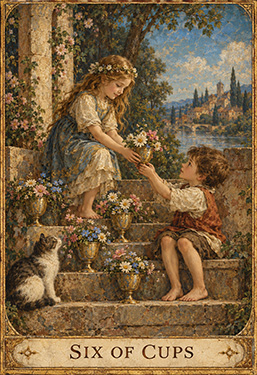
I like to think of the Six of Cups as the Inner Child card. It evokes nostalgia, childhood joy, innocence and the memory of a safe, comforting place.
But what if our childhood wasn’t safe and sweet?
One of the most interesting things about the Tarot is that we can use it to read the past as well as the future. That may sound a little paradoxical. After all, we KNOW our past already, don’t we? We lived it, so surely we ought to remember it.
Frequently, though, we don’t.
Doing Inner Child work can be frustrating because there may be whole stretches of childhood that we remember only vaguely—or seemingly not at all. Sometimes difficult or traumatic experiences leave memories that are fragmented, confused or difficult to access. A child may also have been too young to understand what was happening or to put it into words.
And sometimes we’re dealing with experiences that occurred before we had the language or conceptual ability to make sense of them. The child experienced the fear, loneliness, confusion or joy, but couldn’t create the coherent story that the adult mind expects to find later.
So our past can sometimes seem almost as blank and mysterious as our future.
And that’s where the Tarot can become interesting. Rather than using the cards to establish exactly what happened, we can use their symbolic language to explore the emotional landscape of the child we once were.
THE INNER CHILD READING
This simple ten-card reading can be used to explore a period of childhood that feels distant, unclear or emotionally significant. For this example, let’s imagine that we’re trying to understand ourselves at the age of eight.
1. The Child
Who was I at eight? Begin with the child herself, before considering everything that was happening around her. Don’t assume that the eight-year-old you was simply a smaller version of the person you are today. The intervening years may have made you remarkably strong, while the eight-year-old was frightened and vulnerable.
Or perhaps the opposite is true. Maybe the eight-year-old was a fearless little artist, explorer or dreamer whose creativity was gradually pushed underground.
Who was that child before the world finished teaching her who she was supposed to be?
2. The Home
What was the emotional atmosphere of my home? Was home a refuge or a place of anxiety? Was it warm and affectionate, emotionally distant, chaotic or unpredictable?
Did you feel free to relax and simply be a child, or did you need to remain alert to the moods and reactions of the people around you?
3. The Parents or Caregivers
How did I experience the adults responsible for me?
Notice that the question isn’t whether your caregivers were objectively “good” or “bad.” We’re interested in how the child experienced them.
You may have had genuinely loving parents who were nevertheless exhausted, overwhelmed or stretched too thin. Their intentions may have been loving while the child still experienced loneliness or neglect.
The Tarot card describes the child’s world.
4. School and the Outside World
How did I experience teachers, classmates, rules, achievement and the larger social world?
Was school exciting or frightening? Were you accepted by other children, or did you feel different from them? Were you encouraged by teachers, bullied by classmates, praised for achievement or made to feel that you could never quite measure up?
For many children, school is the first sustained encounter with a world beyond the family. What did that world teach you about yourself?
5. What I Needed
What emotional or psychological need was strongest at that age?
Perhaps you needed recognition, affection, protection or encouragement. Maybe you needed someone to listen to you. Or perhaps what you desperately needed was simply peace and quiet.
Try not to judge the need. Ask instead whether the child received enough of it.
6. What I Feared
What made the eight-year-old feel unsafe, ashamed, rejected, powerless or uncertain?
Did you feel secure at home? Were the adults around you supportive or critical? Did you fear failure, punishment, abandonment or humiliation? Sometimes childhood fears seem trivial to the adult mind. They weren’t trivial to the child experiencing them.
7. How I Adapted
What strategy did I develop to navigate that world?
This may be one of the most revealing cards in the reading. Perhaps you learned to become invisible. Maybe you became the good child, the funny child, the successful child, the rebellious child or the child who took care of everybody else.
Perhaps you escaped into books, art, fantasy or imagination.
What did the “little you” learn to do in order to function in the world?
8. What I Believed About Myself
What conclusion did the child draw from all of this?
This may be the heart of the reading.
Children naturally try to make sense of their experiences, but they don’t have an adult’s perspective. A child who isn’t receiving enough attention may not conclude, “My mother is exhausted and overwhelmed.” The child may conclude, “I’m not important.”
Those childhood conclusions can quietly become the beliefs through which we interpret our adult lives.
9. What I Carried Forward
What belief, behavior or emotional pattern formed then that the adult still carries?
Perhaps you learned to please everyone else while putting your own needs last. Maybe you learned never to ask for help, never to appear vulnerable or always to prove your worth through achievement.
The important question is whether the strategy that helped the child is still serving the adult.
10. What the Child Still Has to Give Me
What survived intact?
This card isn’t about what needs fixing. It’s about imagination, courage, sensitivity, humor, curiosity, independence, creativity, playfulness and wonder.
That’s another side of the Six of Cups that we sometimes overlook. Your Inner Child isn’t merely carrying wounds. Your Inner Child is carrying gifts.
What did that child possess that you need to reclaim?
TAROT IS NOT A MEMORY-RECOVERY DEVICE
There’s an important caution to all of this.
Tarot speaks through symbols, associations, emotions and intuition. A card may unexpectedly trigger an image, feeling or apparent memory, but that doesn’t establish that the event literally happened in the way we imagine it.
We’re exploring our experience of the past, not conducting a historical investigation.
Memory itself is reconstructive and imperfect, and attempts to recover supposedly hidden memories can sometimes produce sincere but inaccurate conclusions. That’s particularly important when a reading seems to suggest abuse or another serious event that you don’t independently remember.
The feeling may be real and worth exploring. The interpretation of its cause may or may not be.
If you’re dealing with a particularly traumatic childhood or powerful memories begin emerging during this kind of work, consider exploring them with a qualified mental-health professional rather than relying upon the Tarot to determine what happened.
And don’t be shy about it. Take your Tarot cards to your next therapy session.
RECEIVING THE GIFT FROM YOUR INNER CHILD
Too often, Inner Child work focuses entirely on what went wrong.
Sometimes that’s necessary. If we were mistreated, frightened, ignored or neglected as children, understanding those experiences can help us stop interpreting their consequences as evidence that something was inherently wrong with us.
But eventually another question becomes possible.
Instead of asking only: What went wrong? We can begin asking: What can I understand now that I couldn’t understand then?
And finally: What does that child still have to give me?
Perhaps that’s the deeper message of the Six of Cups. The child we once were isn’t simply waiting somewhere in the past to be rescued. She may also be waiting there with something we left behind.

