The Top Ten Tarot Cards Indicating Conflict

A quick, insightful guide to the ten Tarot cards that most often signal conflict—from chaotic energy and power struggles to hidden tension and emotional fallout. This post explains what each card means and how to navigate challenging situations with clarity and confidence.

There are days when Tarot feels like a warm hug…

…and days when it slides a little warning across the table and whispers,

“Brace yourself.”

Conflict is part of life, part of growth, and definitely part of the Tarot.

“Just the Tarot,” by Dan Adair – Available on Amazon

Whether it’s inner tension, relationship friction, or someone else’s chaos spilling into your lane, some cards show up to say:

“Something here needs attention.”

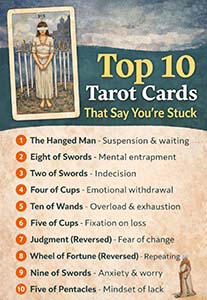
Here are the top ten Tarot cards that most strongly signal conflict — and what each one really means beneath the surface. If you’d like to download this list as a PDF file that you can add to your Tarot notebook, click here.

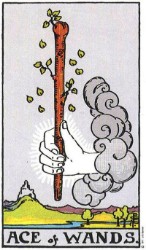
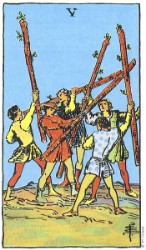
1. Five of Wands – The Classic Chaos Card

If conflict had a mascot, this would be it.

The Five of Wands shows:

– competition

– ego clashes

– mixed agendas

– flailing energy everywhere

It’s not necessarily destructive — but it is noisy.

Message: This isn’t war… it’s everyone talking at once. Calm the room.

2. Five of Swords – A Battle Nobody Really Wins

This is the energy of:

– arguing to be right

– unhealthy victories

– someone taking more than their share

– hurt feelings afterward

Message: Winning at all costs comes with a bill. Choose integrity.

3. Seven of Wands – Defend Your Ground

This is conflict from the outside:

– critics

– competition

– pressure

– feeling outnumbered

But the card says you can stand firm.

Message: Don’t fold. You’re stronger than the opposition.

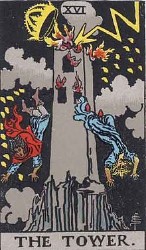
4. The Tower – Major Disruption

This isn’t a small disagreement — it’s a smackdown from the universe.

Think:

– sudden revelations

– arguments that break things open

– emotional earthquakes

Message: The old structure needed to fall. Liberation follows.

5. The Five of Cups – Emotional Fallout

Not a conflict card on its face, but it often shows up after one:

– regret

– grief

– disappointment

– unresolved conversations

Message: You’re grieving what was lost. Healing begins when you turn around.

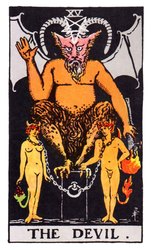
6. The Devil – Power Struggles

This card signals:

– manipulation

– obsession

– toxic dynamics

– control games

– addictive patterns in relationships

Message: This conflict has a hook. Break the chain, not each other.

7. The Knight of Swords – Rushing Into Battle

He is smart, fast, determined…

…and doesn’t always think things through.

Shows:

– heated arguments

– impulsive reactions

– someone charging ahead without listening

Message: Slow down before your mouth outruns your wisdom.

8. The Two of Swords – Silent Conflict

Not all conflict is loud.

This card is conflict frozen:

– denial

– avoidance

– stalemates

– tension beneath the surface

Message: Peace requires a decision. Open your eyes and choose.

9. The Seven of Swords – Sneaky Energy

Not direct conflict — but conflict waiting to happen.

Signals:

– deception

– half-truths

– secret plans

– someone acting behind the scenes

Message: If something feels “off,” it probably is. Trust your intuition.

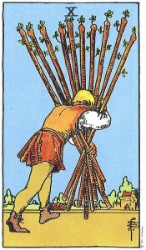
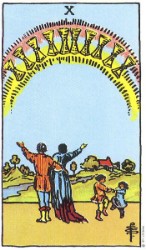
10. The Ten of Wands – Overwhelm and Burnout

This appears when conflict comes from:

– taking on too much

– carrying other people’s problems

– no boundaries

– pressure that builds until you snap

Message: Put down what isn’t yours. You’re not meant to carry it all.

Final Thoughts: Conflict Isn’t Always the Enemy

Conflict in Tarot isn’t punishment — it’s information.

The cards don’t show conflict to scare you…

They show it to help you:

– redirect

– set boundaries

– speak truth

– release what’s toxic

Because once conflict is acknowledged, transformation can finally begin.

Will This Love Really Last? 10 Tarot Cards That Say “Yes”

Wondering if your love will really last? Tarot offers powerful clues. Here are the top 10 “yes” cards for romance — symbols of harmony, joy, and lasting connection.

While the Tarot doesn’t hand out guarantees, it does shine a light on the energies present in a relationship. And some cards are so clear, so affirming, that when they appear in a spread, they almost shout “yes!”

Why Tarot for Love Questions?

Love and relationships are the number one category of Tarot inquiries. People turn to the cards when they’re uncertain about where things stand, or when they’re weighing the long-term potential of a relationship.

Tarot won’t say, “This relationship is guaranteed to last forever.” But what it will do is highlight the dynamics at play — the emotional energy, the strengths, and the challenges that shape a partnership. And when certain cards appear, they point strongly toward harmony, mutual growth, and a lasting bond.

The Top 10 Tarot “Yes” Cards for Romance

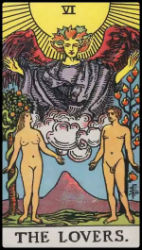
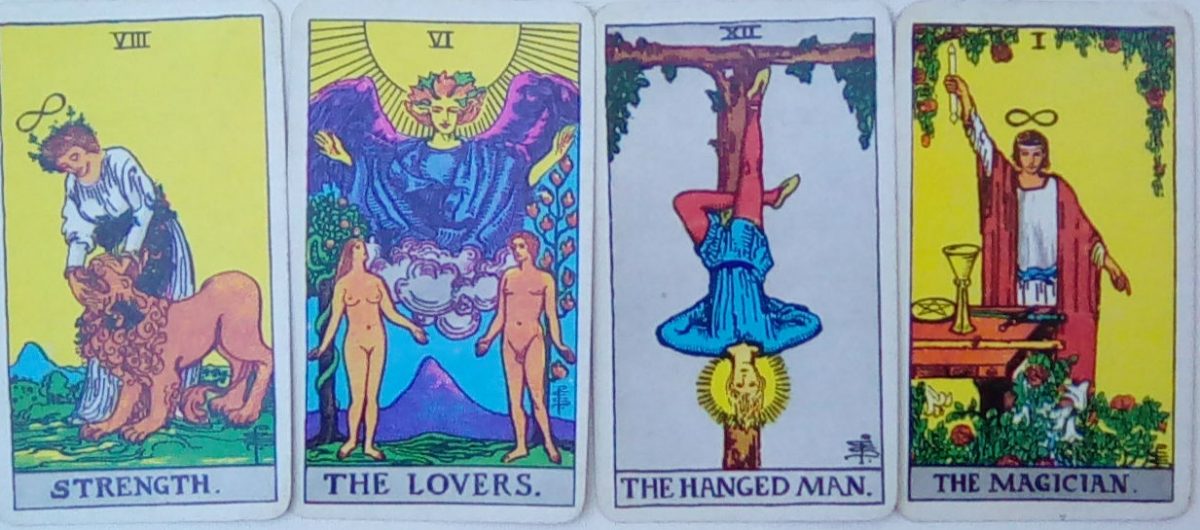
1. The Lovers

This is the archetypal card of love, union, and attraction. It represents shared values and choices that strengthen the bond. When The Lovers appear, the message is clear: the relationship is rooted in deep connection.

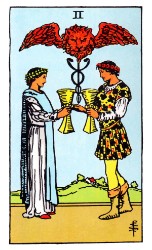
2. Two of Cups

The quintessential partnership card. It reflects mutual attraction, balance, and reciprocity. The Two of Cups points to a genuine soul connection where both people bring equal energy to the table.

3. Ten of Cups

This is the “happily ever after” card. It symbolizes long-term happiness, emotional fulfillment, and family harmony. If you’re asking about lasting love, the Ten of Cups is a resounding yes.

4. Four of Wands

A card of celebration, milestones, and commitment. It often shows up around engagements, weddings, or moving in together. It’s a sign that the relationship is not only joyful but ready to move into the next chapter.

5. The Empress

Abundance, nurturing, and fertility flow through this card. The Empress speaks of love that supports growth — creative partnership, deep affection, and the potential to build something lasting together.

6. The Star

The Star brings healing, inspiration, and spiritual alignment. In love, it suggests that the relationship is not only joyful but also restorative, giving both partners hope and a sense of divine timing.

7. Six of Cups

Sweetness, comfort, and sincerity. This card speaks to simple pleasures and genuine affection. Whether it’s new love or a rekindled flame, the Six of Cups highlights warmth and emotional honesty.

8. The Sun

Few cards are as positive as The Sun. It represents joy, openness, and vitality. In romance, it signals a relationship where both people feel seen, supported, and energized.

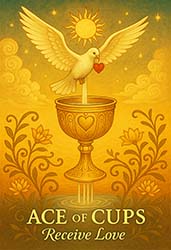
9. Ace of Cups

The overflowing chalice of love. This card signals the beginning of a new relationship or the renewal of affection in an existing one. It’s pure emotional abundance and a beautiful green light for love.

10. Two of Wands

While not strictly a “romance card,” the Two of Wands points to planning a shared future. It suggests vision, growth, and expansion — a partnership where both people are willing to build together.


What These Cards Have in Common

Look at these ten cards together, and a pattern emerges:

  • Union & Commitment: Lovers, Two of Cups, Four of Wands, Ten of Cups.
  • Emotional Fulfillment: Ace of Cups, Six of Cups, Empress.
  • Joy & Inspiration: Sun, Star, Two of Wands.

The common theme? Relationships that thrive on balance, mutual support, and a shared vision for the future.

A Note of Realism

Of course, not every card in the Tarot is a “yes.” Sometimes the spread brings red flags — lessons that need to be learned before love can grow strong. That doesn’t mean the relationship is doomed, but it does mean awareness and patience are needed.

Stay tuned: in a future post, we’ll explore the Top 10 “No” Cards for Love Questions.

Conclusion

Deciding if a love will last is never easy. But the Tarot provides more than predictions — it offers symbolic guidance about the energy flowing through your relationship.

When the “yes” cards appear, they suggest love that’s harmonious, joyful, and ready to grow into the future. If you see these cards in your spread, take it as the Universe’s way of saying: love is worth the leap.

“Just the Tarot,” by Dan Adair – A kindle ebook available on Amazon

Blasted Towers, Bad Ju-Ju, and the Unluckiest Card in the Tarot

A look at the five unluckiest cards in the Tarot deck.

I recently received an email from a reader who asked, “What’s the unluckiest Tarot card?”  I had to scratch my head about that one because the whole concept of good luck versus bad luck can get pretty complex.  Nonetheless, there are some Tarot cards that can always be considered harbingers of bad luck

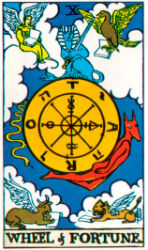
THE WHEEL OF FORTUNE, REVERSED

The Wheel of Fortune, Reversed, is the most obvious choice for a, “bad luck,” card.  We actually talk about luck in terms of good fortune and bad fortune and that’s what this card is all about.  It depicts life as a wheel, where sometimes our luck is ascending and expanding and sometimes it’s descending and decreasing.  When The Wheel of Fortune, Reversed, shows up in a reading it indicates that we’re in for a patch of bad luck.

The Kybalion, which is a book about Hermetic Magic, compared it to the pendulum of a clock.  The pendulum swings first in one direction and then back in the other.  Life can be seen in much the same way:  sometimes we’re swinging into really good luck and then we swing back into a period of bad luck.

The obvious underlying message is to just hang on, because things will inevitably change.  When we can stand back and look at good luck/bad luck as a rhythmic cycle, then periods of ill fortune will affect us much less severely.  We just need to stay centered and calm and wait for the cycle to reverse itself.

THE TOWER

Also known as, “the lightning struck tower,” and, “the blasted tower,” The Tower would probably be my pick as THE unluckiest card in the deck.  

“Just the Tarot,” by Dan Adair – complete definitions, layouts, and instructions for reading Tarot cards, available on Amazon.

At it’s most severe level, it can indicate that everything that you’ve loved and invested in is about to be blasted right down to the ground.  The last time that I had it showing up in my personal readings, my life partner died, I lost my house, and I was involved in a horrible law suit over the probate of the estate.  It can be that bad, depending on the other cards in the reading, but it usually isn’t.

On a mundane level, The Tower is usually just a powerful warning that we’ve gone down the wrong path and the Universe is about to provide a course correction.  Perhaps we’ve been treating our fellow employees badly and – Shazam – we’re suddenly fired or demoted.  Or perhaps we’ve been emotionally abusive or neglectful of our lover and they leave us for someone else.

In my experience, there’s always a level of hubris involved with this card.  We’re not only taking things for granted, but we’re also being arrogant.  We’re assuming that everything is under our control and the Universe is going to show us that we’re not.

The most positive message in this card – which we usually fail to appreciate at the time – is that we get to completely start over.  It’s like that line from, Me and Bobby McGee:  “Freedom’s just another word for nothing left to lose.”  When our lives (or our projects or relationships, etc.) have been blasted right down to the foundations, we have the freedom to consciously design something new and better.

DEATH

Even if it isn’t the unluckiest card in the deck, Death definitely wins the award for the creepiest card in the Tarot.  In her wonderful book, “Fortune Telling by Tarot Cards,” Sasha Fenton puts it in this perfectly understated, British way:  “This card usually puts the wind up people when it appears . . .”

Yes.

Now, first of all, I have never seen the Death card appear before someone’s death.  It will pop up after someone has died, but it’s usually just a comment on what’s happened.  It’s more like, “Well, you’ve lost someone you loved, so you’re dealing with death and grief.”

What it can indicate, though, is that there’s going to be a radical, life changing turn in events in a person’s life.  The querent is suddenly going to find herself going in a completely different direction than she has in the past.  In an emotional and spiritual sense, it really is as if their previous life has died and they’re off in a completely new direction.

I knew a woman who had been happily married for 15 years, had a home, a loving husband, and 2 kids.  She woke up one morning with this thought ringing in her head:  “Shit, I’m not in love with him anymore and I hate my life.”  Within six months she’d obtained a divorce, turned custody of her children over to her ex-husband and was working as a river guide in West Texas.  That’s the kind of radical change that we’re talking about here.

Whether that kind of change is good luck or bad luck is just a matter of interpretation.  If it’s something that we consciously plan, we usually view it as good fortune.  If it was something that was forced on us by circumstance, we may think it was bad fortune.

JUSTICE, REVERSED

I’m a little hesitant to include the Justice card in this list because it has more to do with people and circumstances than luck per se.  Nonetheless, it’s frequently seen as bad luck so I’ll stick it in here.

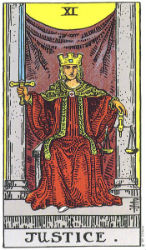
Classically, as you might guess from the image, Justice has to do with the legal system.  If we’re involved in some sort of litigation and Justice is upright, it can mean that we’ll prevail.  If it’s reversed, it can mean that we’ll lose.

On a personal level, it can mean that the people around you – your family, co-workers, boss, etc. – are making judgements about you and they’re not good if the card is reversed.  

Losing a court case can obviously be seen as bad luck.  Or it can be seen as a sign that we have a bad case, a bad lawyer, or a bad judge.  In the same way, having people we care about judging us harshly can be seen as being treated unfairly.  Or it might be that we’re being jerks and we need to clean up our acts.

Justice, Reversed, can be a sign of a bad luck to come, but it also serves as a warning.  It’s saying, “You’re about to have some bad luck, so you need to take a careful look at your own actions before that happens.”

TEN OF SWORDS

It doesn’t take but a glance at the Ten of Swords to realize that there’s some serious bad ju-ju happening here.  If we’re lying face down stuck full of swords like a human pin cushion, something’s a little wrong. This card can indicate treachery, deceit or a very, very bad ending to a relationship or a job.

The suit of Swords symbolizes our personal power.  That’s the way that we project ourselves out into the world.  There’s nothing innately wrong with that.  Whether it’s standing up to a school yard bully when we were kids or pushing hard for a project we really believe in at work, there are always times when we have to be a bit aggressive.

But . . . when we’re overly and chronically aggressive, that puts us into a power cycle. We’re trying to dominate other people and run over their emotions and desires.  We become the school yard bully instead of the person standing up to the bully.  We see this mentality frequently with primitive men who brag about being the, “alpha dog.”  It’s dominance for the sake of dominance, rather than for the sake of getting anything done.

The message of this card is the old cliche’: live by the sword, die by the sword.  If we’ve been treating other people harshly, if we’ve been abusive in our love relationships, or domineering in work relationships, we’ve got some bad karma heading our way.

So those are the top five, “bad luck,” cards in the Tarot deck.  There are, of course, other cards that may indicate bad fortune in one aspect or another of our lives, but these are the red flags.  And, of course, we should always remember that a Tarot reading is just a snap shot in time.  It tells us what’s likely to happen, but we have the free will to change it.

Lucid Choices, The Four of Swords, and Living the Dream Life

Looking at our lives as lucid dreams.

Have you ever had a dream that seemed so real, so vivid and intense, that you were actually shocked when you woke up and realized it was just an illusion?

Sometimes they’re really GOOD dreams.  Perhaps we’re making incredible love with someone or maybe we’re floating through a starry, magical sky. Sometimes they’re really BAD dreams, where we’re being chased by monsters or night terrors.  Whether they’re good or bad, the one thing they have in common is that – at the moment that we’re having them – they seem absolutely, 100% real.

LIVING THE DREAM

There’s a strong case to be made for the idea that our so-called, “waking life,” is very much like a dream, as well.

In, “The Four Agreements,” that’s the term that Don Miguel Ruiz actually uses to describe our day to day existence:  a dream.  As we grow up, we’re programmed by our parents, our religions, and our societies to see the world in particular ways.  We don’t question those view points as they’re being installed in our little brains because we don’t have the ability to judge whether they’re true at that age.  By the time that we reach adulthood, we’re thoroughly convinced that the way that we see the world is the RIGHT way to see it, perhaps the ONLY way.  But those view points are just someone else’s dreams of how the world really is.

Buddhist and Hindu philosophies approach human life in much the same way:  life as we commonly experience it is an illusion, a dream that’s made up of our emotions, ideas, desires, and aversions.  We’re essentially sleep walkers who go through life laughing, crying, eating, procreating, raising families, working, and eventually dying, with no clue as to why we’re here or what it all means.  We just know that, like our dreams, it seems absolutely 100% real. 

WAKING UP

Occasionally, some of us will wake up just a little bit from the dream that we call our lives.  Usually it’s because our pleasant dreams have turned into a nightmare.  

One of our major dreams is, “I’m going to live happily ever after and nothing bad is going to happen to me.”  We’re taught that if we’re, “good,” people and we work hard and we’re responsible, everything is supposed to work out for us.  We’re going to fall madly in love with just the right person, have 2.5 beautiful children who will be extremely well adjusted, get a nice house, a new car, and all of the material toys. And we’ll live happily ever after.  Shit happens to, “bad,” people, not to us.

And then shit happens to us.

Perhaps we find our wife or husband in bed with someone else.  Perhaps we’re in a terrible auto accident.  Perhaps one of our beautiful children gets very, very sick.  Perhaps we get fired from our jobs and lose all of our material possessions.

It’s very much like suddenly waking up.  All of the things that seemed so rock solid and dependable in our lives turn out to be built on sand.  We may feel like life has betrayed us or the whole world has gone crazy.  Eventually, though, most of will go back to our dream worlds because the dream is so comfortable and waking up hurts.

LUCID DREAMING

There’s something that happens in some dreams where we’re dreaming but we suddenly become aware of the fact that it’s a dream.  We don’t wake up from the dream, but we exist within it, knowing that it’s a dream.  It’s called lucid dreaming and, if you’re not familiar with it you might enjoy reading, “Lucid Dreaming,” by Charlie Morley.

Now, one of the things that happens in lucid dreaming is that, to a large extent, we’re able to control the dream.  If we see a wall in front of us, we can consciously decide to simply grow wings and fly over it.  Or perhaps we can visualize a really beautiful woman or man and make love to them to our heart’s content.  

It’s a dream.  We know it’s a dream. But we can choose what happens in the dream.

LUCID LIVING

In his book, “Change of Heart,” Chagdud Tulku said that very few of us will ever be enlightened.  Most of us will continue to live in a dream state, perhaps for many incarnations.  BUT . . . we can choose whether we want to have a good dream or a bad dream.

Which sounds very much like lucid dreaming, doesn’t it?

When we have one of those life experiences where our day to day dream has turned into a nightmare, when we suddenly get a peek behind the curtain of what we thought was true, we have a choice.

Most people roll over and go right back to sleep, just as quickly as they can.

Some people decide to adopt a stance of total cynicism.  Life sucks.  People are rotten.  It’s all a lie.  These are the, “life is a bitch and then you die,” people.

But a few people will say, “Huh . . . it’s all just a dream.  But it’s an interesting dream.  I wonder if I can grow wings and fly over that wall?”

IT’S NOT ENLIGHTENMENT

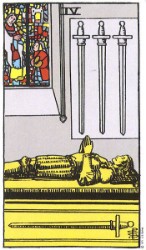
One of the things that it’s important to remember is that just because we realize that life may be a dream, it doesn’t mean that we’re suddenly, “enlightened.”  Like the person in the 4 of Swords, we’re still solidly asleep, but now we know that we’re asleep.  Which is an improvement.

Unfortunately, as a brief stroll through the internet will teach us, there are many, many people out there who have decided that they must be gurus, spiritual adepts and geniuses just because they woke up a little bit.  Seeing through the illusions doesn’t mean that we’ve got an answer – it just means that we see the problem.

It’s a paradox, like lucid dreaming, where we’re asleep and awake at the same time.  If we keep meditating and keep working on our personal growth, we’ll wake up a little more and a little more and a little more.

In the meantime, we can choose to have good dreams.  We can have dreams that are full of love and healing and our dreams will make other people’s dreams a little better, too.

As Bob Dylan once said, “I’ll let you be in my dream if you’ll let me be in yours.”

Remember that my ebook, “Just the Tarot,” is available dirt cheap on Amazon. It’s not just a dream. Really. I think.

Cheatin’ Horndogs, Vibrators in the Refrigerator, and Tarot Cards that Indicate Infidelity

Tarot cards that indicate infidelity in a relationship.

“She just started liking cheating songs,
And what’s bothering me,
I don’t know if it’s the cheating she likes,
Or just the melody.” – John Anderson

If you read Tarot cards for other people, you’ll find that one of the major topics that those people want to know about is love and romance.

Is she the right one for me?
Does he feel the same about me that I feel about him?
Should I ask her out?
Should we move in together?
Are we meant to get married?
Will this relationship last?

And, of course, with love and romance there are frequently questions about fidelity and cheating. Most marriages and relationships are, “monogamous,” which is derived from the Greek, meaning, “keep your dick in your pants,” (except when you’re with me.) A very large part of the marital and partnership contract is that when we fall in love we’ll be sexually and emotionally exclusive to that one other person.

Just the Tarot by Dan Adair – a kindle ebook available on Amazon
Having sex with or becoming emotionally attached to a third party is seen as a major violation of that contract and is grounds for terminating it. And there are major penalties that go along with that violation, such as being locked out of your house in your bathrobe, or having your partner pour maple syrup all over your best clothes just before she throws them out into the front yard. And many times, it’s not even REAL maple syrup, it’s that cheap, artificially flavored crap like Mrs. Butterworths.

Quite naturally, then, people who are cheating on their partners will go to great lengths to conceal it. And, quite naturally, the partner who’s being cheated on will somehow know, on a very deep, almost psychic level, that their mates are being unfaithful. There may be extremely subtle, subliminal clues, such as your husband having a giant hickey on his neck, or finding a pair of jockey shorts under the pillow when you wear boxer shorts. Or perhaps coming home early from work and seeing a naked man running out your back door, or finding a strange vibrator in the refrigerator next to the carton of eggs.

Those are the kinds of subdued, low key signals that will often make a person stop and ponder if there’s something more going on in their marriage than meets the eye. Still, their partners will tend to deny it. The vibrator in the refrigerator must have accidentally fallen into the grocery bag at the supermarket and really belongs to someone else. The naked man running out the backdoor was the plumber, who was sleepwalking, and was completely shocked when he awakened without clothes while he was working on the dripping faucet in the bathroom. The hickey on your husband’s neck was the result of a near tragic vacuum cleaner accident at work. The jockey shorts under the pillow were meant to be a present and now you’ve gone and ruined the surprise.

Even though these are all perfectly rational, reasonable explanations, there may still be lingering suspicions and so your client will want to consult the Tarot cards to determine the truth. Here are a few cards that may indicate that the questioner’s partner is what is clinically referred to as a, “cheatin’ horndog.”

THE LOVERS REVERSED

The Lovers is obviously THE romantic relationship card in the Tarot deck. It shows that period of time when you’re first together with your romantic partner and the whole world seems magical and glowing. It’s just the two of you, in your shining little garden. Just you and the angels and . . . um . . . that pesky snake climbing up the tree. When it’s reversed, the party’s over, baby. You’ve been thrown out of the garden and it’s time to deal with reality.

THE DEVIL (UPRIGHT OR REVERSED)

The Devil card shows the same two figures from The Lovers card, only things don’t seem to be as peachy anymore. For one thing, instead of an angel hovering over them, there’s a great big horny kind of a goat/bat demon thingie. They’re chained to a black stone or altar and they have tails which are on fire. (Having your tail burst into flames is another one of those subtle signs that there may be something wrong.) The Devil card can mean a lot of rotten things, such as addictions, super negativity, etc, etc,, but in this context – cheatin’ horndogs – it probably indicates a sexual affair that’s going on and it probably indicates that it’s a pretty heavy duty affair that may have strong elements of BDSM. I mean, horny goats, chains and flaming tails? Really?

THE TOWER (UPRIGHT OR REVERSED)

The Tower, as you might guess, is NOT a positive card. It usually indicates a freaking disaster that’s happening right in the middle of our happy little lives. The flash of the lightning bolts indicates that it’s sudden and shocking. It tends to destroy our lives right down to the foundation and then we’ve got to start rebuilding them, piece by piece. Having this show up in a reading about fidelity would indicate the sudden knowledge that your partner has been unfaithful and the relationship has been completely destroyed by that lack of fidelity.

FIVE OF WANDS

The Five of Wands may show up in a relationship where there’s a LOT of emotional turmoil. In the South, they talk about, “fight and fuck,” relationships. These are relationships where the two people involved have huge fights with much screaming and throwing of plates, and then they reconcile and have make-up sex that’s incredibly good. There are spoken phrases in there like, “Oh, baby, I’m so sorry,” and, “I promise this will never happen again, ‘cause you’re the dumplings in my chicken soup, honey buns.” Yes, I know honey buns and chicken soup are a disgusting combination, but you get the idea. There’s cheating going on, but they’ll probably reconcile and spend the next week in bed.


QUEEN OF WANDS REVERSED

The Queen of Wands has a lot of good characteristics and, among them, is fidelity. If she shows up reversed, there’s a very good chance that someone isn’t practicing that virtue.

ACE OF CUPS REVERSED

The Ace of Cups shows pure, unadulterated love pouring into the world. It tends to appear when someone is just starting off on a new romantic relationship and their hearts are full of love. When it’s reversed, there’s a good chance that their love got adulterated by a cheatin’, adulterating horndog.

THREE OF CUPS REVERSED

Obviously, this is very much of a party hardy card. When it’s upright, it’s healthy, joyous and free partying. When it’s reversed and shows up in this kind of a reading it can indicate that the joy is leaving or that your partner is partying with someone else.

TEN OF CUPS REVERSED

Among other things, the Ten of Cups is the Happy Family card. When it’s reversed it can be a sign that the happy family is breaking up, particularly if it’s a family with children involved.

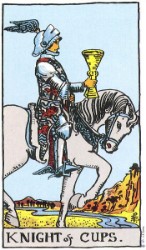
KNIGHT OF CUPS REVERSED

The Knight of Cups is riding out on a sincere quest for love. Reversed, it indicates that the love wasn’t found.

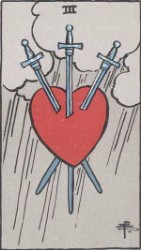
THREE OF SWORDS

LOL – well . . . yeah . . . that one’s pretty obvious. Stabbed right in the heart.

SEVEN OF SWORDS

The Seven of Swords is all about sneaking around and stealing someone else’s power. This is the kind of person who has an affair right in front of everyone’s eyes and somehow gets away with it. This card also shows up frequently when you’re involved with a malignant narcissist who’s just using you for their own ego gratification.

TWO OF PENTACLES

The Two of Pentacles may show up in a reading like this to indicate someone who’s trying to juggle two different love affairs and keep both of them going.

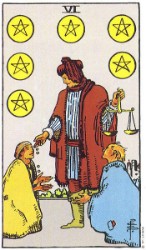
SIX OF PENTACLES

This may indicate a lover who’s not really giving with a whole, loving heart. Love is being measured out very carefully.

Those are just a few of the red flags that may show up if your questioner wants to know if his or her partner is running around.

Remember to be very careful with these types of readings. Many people are in a great deal of denial when relationships are falling apart and really, really DON’T want you to tell them what you see in the reading. What they want is for you to tell them that they were wrong and that the vibrator in the refrigerator is really just a whipped cream dispenser. If you’re doing a reading for your best friend and you tell her that her husband is playing hide-the-sausage with his secretary, she may not be pleased with you. At all.

And, of course, it’s always possible that the questioner’s partner might NOT be a cheatin’ horn dog. He could just be a rat faced dingleberry, which is an entirely different kettle of fish. In either case, approach this topic with caution. Practice using phrases such as:

It seems that all may not be as it appears.
There’s a certain murkiness here.
There appears to be a fork in the road of life.

Avoid using phrases such as:

I think he’s dipping his wick with your best friend.
She’s a real bottom feeder and believe me, I MEAN bottom.
You should have listened to your mother. By the way, does your mother still have that spare room?

The Seven of Swords, Vampires in Pink Bow Ties, and Malignant Narcissists

Malignant Narcissists as the source of monster legends.

Have you ever been worked over by a malignant narcissist?

Perhaps an incredibly charming person appeared in your life and he or she seemed to absolutely worship you.  You were told to an almost embarrassing extent how perfect you were, how beautiful, how intelligent, how sexy.  You fell in love, let down all of your guards and boundaries, and within a year that same person was constantly devaluing your opinions and your self worth and telling you that you just weren’t quite good enough.  You were too fat or too skinny or not very bright or not very well informed or your hair was too long or too short or you weren’t very satisfying in bed.

Or perhaps it was a family member, someone you’d always been fond of and trusted, but you find that they’re actually tearing you down and belittling you to other family members when you’re not there.

Or perhaps it’s a co-worker that you liked and opened up to about your personal life when you had a couple of drinks too many on a Friday night.  On Monday morning you’re shocked to discover that your drinking buddy has shared your personal, “secrets,” not only with all of your co-workers but with your boss, as well.  

There’s a common reaction from anyone who’s been chopped up and spit out by a malignant narcissist and that reaction is bewilderment.

“How could I have been so stupid?”

“Why didn’t I see this coming?”

“But . . . I thought he loved me . . .”

“She totally got under my radar.”

For whatever scant comfort it may provide, you’re in extremely good company.  Some of the smartest, most empathetic, highly evolved people in the world have been taken to the emotional cleaners by malignant narcissists.  It’s what they do and they’re experts at it.  It has NOTHING to do with how intelligent you are, how attractive you are, or how evolved you are.  To a malignant narcissist, you’re just a tasty snack.

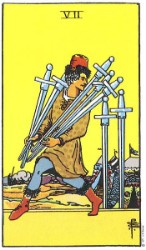
The Seven of Swords is a perfect image of a malignant narcissist.  He’s stealing someone else’s power, as represented by the swords slung over his shoulder.  The flaps on the tent are closed, showing that the person he’s stealing from is totally unaware of what he’s doing.  And even the guard posted outside of the tent – representing our conscious mind – seems to not register what’s going on.

If we type, “malignant narcissist,” into a search engine, we’ll get a huge number of results.  There are literally thousands of articles and videos discussing what they do to other people, how they do it, and why they’re malignant narcissists to begin with.  Really, it’s kind of astounding when we realize that they only comprise 5% of the population.  To put it one way, they seem to have an over-sized footprint.  To put it another way, they’ve fucked with an AWFUL lot of us.

Although the term, “malignant narcissist,” is fairly new, there’s nothing new about this personality type.  In the past, they’ve been referred to as sociopaths, psychopaths, monomaniacs, and, “utterly without a conscience.”

And my favorite term for them:  monsters.

There is something positively inhuman about malignant narcissists.  They seem to have absolutely no sense of empathy or compassion.  They have no conscience and remorse.  And, far from being intelligent in the sense that most of us might use the term, their intelligence is more on the level of a vicious animal, a predator hunting down its prey.

We don’t even have to bend reality too much to see the malignant narcissist as the probable source of all of the, “monster,” legends that human cultures have promulgated.  Vampires, for instance, were seen as beings with no souls, no compassion, who fed on their victims and destroyed them in the process.  That’s a pretty good description of a malignant narcissist.

Of course, one of the things that folklore tells us about vampires is that they didn’t have any reflection in a mirror, which would drive a malignant narcissist nuts. They like to see how beautiful they are.  It might have been the reason that vampires were always on the prowl for fresh victims:  not just for fresh blood, but for more feedback.

“So . . . before I bite into your jugular vein and drain all of the life out of you, let me ask you one question.  How do I look in this outfit?”

“Wha . . . wha . . . WHAT?”

“This outfit.  How do I look?  The tuxedo and the string tie.  Too much?  Does it make me look pale?  I can’t see myself in the mirror, you know, and I’m just dying to know what you think of it.”

“Well . . . I mean . . . it is a little stark, I guess.  Just black and white is kind of . . . I don’t know . . . a little visually boring.  It could maybe use a touch of color.”

“Ah HA!  Precisely what I was thinking!  Just a dash of something a little brighter.  A red cummerbund, perhaps, or even a pink bow tie.”

“No, no, I wouldn’t go with pink.  Pink just isn’t . . . you.  Red would be fine.  Red would match your eyes and it’s more of a statement of who you really are.  You know:  the whole blood thing.  You could probably even get away with a deep magenta, but no pink.”

“Ah, thank you, thank you.  This conversation has been really invaluable to me.  Now, just one more thing before I kill you.  How do you like this hairstyle?  I’ve been thinking less hair gel and more curls . . .”

We can extend the vampire metaphor even further.  Like vampires, malignant narcissists just . . . won’t . . . stay . . . fucking . . . DEAD.  When we finally get enough of them and tell them to get lost, they just keep coming back for another drink of our blood.  It really does feel like we’d have to drive a stake through their hearts, cut their heads off, and stuff their mouths full of garlic cloves to finally make them shut up and leave us the fuck alone.

And, of course, malignant narcissists can’t stand the light of day.  When they’re finally fully exposed for what they are, they crumble into dust.  It becomes totally apparent that there’s no human substance to them, that there’s nothing there but sharp teeth and a giant ego.

One final thing that they have in common with vampires is that they count on us to make that one flawed decision that leads us to our own destruction, which is to get involved with them in the first place.  We all know that scene in the old Dracula movies where the Intrepid Traveller is standing in front of the horrible creepy castle.  There’s blood dripping down the walls, bats are flying in and out of the windows, wolves are howling in the distance and the Traveller looks at all of that and says, “By golly, I think I’ll knock on the door and see if anyone’s at home.”

The entire theater audience is mentally shrieking, “No, no, don’t get in there, stupid!  He’ll bite your throat!  Stay at the Motel 8 instead.  I know the rooms are tiny, but there are good locks and they have those little coffee machines.”

The same thing happens with malignant narcissists.  If we don’t go through their door, we don’t get our throats bitten and have the life force drained out of us.  It may well be that most of us will never be smart enough to deal with malignant narcissists effectively.  They are, after all, apex predators.  

What we can do, though, is to learn to recognize them.  If someone shows up in our lives and they’re so charming that it’s hard to believe – don’t believe it.  If someone is love-bombing us WAY too early in the relationship, ask ourselves why they’re doing it.  If it feels like love at first sight, take a good, hard second look.  

And take a good hard look at their histories.  One of the things I’ve noticed about malignant narcissists is that they have virtually NO social media presence.  Which is odd, when we think about it, because narcissists love, love, love to talk about themselves.  Malignant narcissists, on the other hand, are terrified of people they’ve exploited blowing their cover so they have no desire to leave a record on social media.  If you knew how many ex-lovers they’d left in bloody tatters, you’d run like hell in the opposite direction.

Finally, if you’ve been victimized by a malignant narcissist even once, or if you had parents who were narcissists, I’d HIGHLY recommend watching Dr. Ramani’s series of videos on YouTube.  

The Four of Swords, Sigmund Freud, and the Case of the Disappearing Clitoris

The role of Sigmund Freud in removing magic from our dreams.

Do you feel safe when you go to sleep at night?

Do you really look forward to getting a wonderful, full night’s sleep and waking up feeling restored, refreshed, and re-created?

Do you actually look forward to going to sleep because you know there’s a good possibility that you’re going to have wonderful, magical dreams that will put you in touch with Spirit World and give you greater guidance, understanding, and insight in your life?

And, if not, why not?

For most of human history, sleep has been seen as a deeply restorative, healing process.  We still recognize that fact in many of our behaviors.  If you’re sick, stay in bed.  If you’re really upset, get a good night’s sleep and you’ll feel better in the morning.  

And, for most of human history, sleep has also been recognized as a spiritual experience.  Dreams weren’t just dreams, they were omens, portents, messages from the gods or the angels.  Dreams were a unique path to the realm of the divine that ALL of us – each and every man, woman and child – possessed and no one could take them away from us or claim ownership of them.

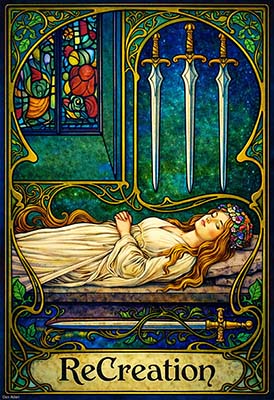
The Four of Swords in the Tarot deck points toward that truth.  The individual in the card is so profoundly, deeply asleep that he almost looks as if he’s dead.  The definition of the card is one of intense healing through the vehicle of resting the mind and body.  His hands are clasped in prayer and there is a stained glass window above him, reminding us of that spiritual connection with the divine that we achieve through sleep.

Yet, over 60% of Americans report that they’ve fallen asleep with their cell phones in their hands.  That’s not exactly preparing for a spiritual, rejuvenating experience is it?

So what happened?  Why have we lost that connection with the higher dream realms in our modern culture?  One might argue that Sigmund Freud happened.  Here’s how Arianna Huffington expressed it in The Sleep Revolution: Transforming Your Life, One Night at a Time

“With the work of Sigmund Freud, dreams went from being a unique way of accessing divine knowledge to being a unique way of accessing self-knowledge.  Dreams were still a journey, but they became less of a sacred journey.”  

To really get the significance of that shift in thinking we have to consider the word, “permeable.”  Permeable means, “porous,” or something that will allow other things to pass through it.  Humans had always considered the subconscious space that we experience in our dreams as being permeable.  Other beings, gods, angels, spirits could pass in and out of our dreams, communicating with us and leaving messages, symbols, and lessons.  Our dreams, then, were a sort of a royal road to the divine, to regions that we were unable to access in our daily lives.

Freud, however, saw the subconscious mind as an impermeable, closed system.  It didn’t contain or allow access to ANYTHING but the content of our own minds.  Even more significant, the content that was stored in our subconscious minds and came out in our dreams were the worst parts of us, the parts of us that were so horrible, so primitive, so nasty that we couldn’t even deal with them on a conscious basis.

You know . . . sex.

Freud was, after all, a Victorian, and Victorians were probably the most sexually repressed, puritanical beings who have ever walked the earth.  When you boil down Freud’s views to their essence, they are ALL about sex.  We want it, we can’t have it, we feel guilty about it, we repress our desires into the subconscious, and then the repressed desires bite us in the ass and make us crazy.

Now, in that context – where EVERYTHING is about sex, the very character and quality of our dreams are changed.  If everything is about sex, then our dreams MUST be about our repressed sexual desires.  And if they appear to NOT be about our repressed sexual desires, that’s because we haven’t really INTERPRETED them right.

“I dreamed I was on a train, Doctor Freud.”

“That’s actually a penis.”

“Oh . . . um . . . alright . . . it sure SEEMED like a train, though.  It had a dining car.”

“That’s your sexual appetite.”

“I had scrambled eggs.”

“You want to fertilize your wife’s eggs.”

“And I had a biscuit.”

“The biscuit represents your wife’s buttocks.”

“Oh, my . . . couldn’t it just be a biscuit?”

“No, no, NO!  I’m telling you, you weren’t having breakfast, you were having sex with your wife and you got her pregnant with your giant train penis!”

“Oh, dear . . .”

And so, if an angel appears in our dreams, that’s just someone we want to have sex with.  Or a demon.  Or a horse or a dog or a doughnut or a tortilla.  We pretty much want to fuck all of them.

Kind of takes the magic out of dreams, doesn’t it?

In historical perspective we can look back at Sigmund Freud and realize that he was pretty much of a nut case.  In his book,Freud: The Making of an Illusion, Frederick Crews points out that Freud was a lifelong cocaine addict, that he cheated on his wife with his wife’s sister,  and that at one point he was thoroughly convinced that women had a pleasure center in their noses that caused them to masturbate uncontrollably when it was malfunctioning.

Nonetheless, the man cast a LONG and evil shadow.  Freud decided at one point that he wanted to have sex with his mother and so he posited that every male must also want to have sex with their mothers and – shazam! – the Oedipal complex was born and analyzed and analyzed and analalyzed. 

At another point, he decided – without the benefit of being a woman or talking to women about it – that only vaginal orgasms were REAL orgasms because only they had to do with reproduction.  Clitoral orgasms, on the other hand, were somehow fake or immature orgasms and so clitorises were pretty much ignored until Masters and Johnson, “rediscovered,” them decades later.

In very much the same sense, we are STILL suffering from his staggeringly wrong interpretation of the subconscious.  It is entirely possible to have a dream about a train and have it just be about a train.  It’s also possible to have a dream about an angel, and actually have it be about an angel.

Let’s sleep on it.

Disclaimer: “As an Amazon Associate I earn from qualifying purchases.”

The Knight of Swords, Fight or Flight, and Getting Frumious Bandersnatches Out of Our Heads

Ending the endless cycle of stress.

I had a, “learning dream,” about the Knight of Swords last night and it was very interesting.  Learning dreams – for me at least – are quite different from ordinary dreams.  They’re dreams that answer questions that we really need solutions to, and sometimes we don’t even know it.  In my world, they’re instructions from Spirit Guides and Mentors who are helping me along my path.  In your world, you may see them as a sort of intuitive understanding of truths that have eluded you in waking life.

The Knight of Swords shows a Knight in full armor, sword extended, in a balls out gallop.  It’s a totally concentrated, furious charge toward whatever he or she means to conquer.  If you look carefully, you’ll see that the eyes of the horse are rolled backward, as if to say, “Okay, you’ve got the spurs, you’re in charge, but WHAT IN THE FUCK are you doing?”

Now, aggression is a perfectly normal part of human life, so much so that the Tarots suit of swords can be seen as representing a variety of aggressive ego states.  Aggression is, after all, one half of the famous Fight or Flight reaction.  There are times when it seems that we have no choice but to fight to defend ourselves or to stand up for what we consider to be right.  

But what happens when we get, “stuck,” in that reaction?  What happens when we live in a state of Fight or Flight?

Well, we start to break down and fall apart.  Our bodies are constantly flooded with stress hormones and we develop high blood pressure, heart problems, and sleep deficits.  Our minds become paranoid, habitually anxious, and we start to feel increasingly isolated and alone.  It’s not pretty.

The revelation that came to me in my dreams last night is that there are really two elements operating in concert when we get stuck in Fight or Flight. The first is the internal dialogue.   Buddhists refer to that as, “monkey mind,” the constant, chattering thoughts that will really mess up your meditation sessions.  Eckhart Tolle discusses it quite a bit in terms of, “ego,” which he views as a sort of an artificial construct of the mind that was a result of a wrong turn in our evolution.

Whatever you want to call it, it’s there:  an endless stream of thoughts that tend to operate just below the level of our conscious control.  And we really can’t do much about that.  As Emily Fletcher says in Stress Less, Accomplish More: The 15-Minute Meditation Programme for Extraordinary Performance the mind thinks involuntarily in the same way that the heart beats involuntarily.  Thoughts are a natural by-product of the mind, in the same way that waves are a natural by-product of the ocean.

The second element in a stuck Fight or Flight reaction is the body, that wonderful amalgam of proteins and hormones and electrons that’s constantly whizzing around creating and recreating our physical selves.  More specifically, we’re talking about that part of the body that’s intimately connected with Fight or Flight, the amygdala in the brain and the stress hormones.

When we’re confronted with something that the brain interprets as being dangerous, the amygdala jumps up and screams, “Holy Shit!  Watch out!  It’s a Frumious Bandersnatch!”  And then our brain dumps about 80 million gallons of adrenaline and cortisol into our systems, our blood pressure shoots up, we become hyper-focussed and we’re ready, by god, to fight!

All of that’s good when we’re confronting Bandersnatches and Jabberwocks and we need to stay alive.  But we were never meant to live in Fight or Flight for extended periods of time.  We were meant to engage in intense physical activity – fighting or running – that burns up the adrenaline and the cortisol rapidly and allows us to return to a normal state of consciousness. 

When we live through an extended period of stress – military combat or a marriage from hell or taking care of a loved one who is dying by inches for years – then the Fight or Flight reaction becomes habitual.  It becomes our normal way of behaving and of perceiving the world.

It becomes a self-feeding cycle that operates independently of what’s really going on in our world.

The first thing that happens is that the quality of our internal dialogues change.  We begin to see the world, “through a glass darkly,” and it shows up in the quiet chatter at the backs of our minds.

My life is so fucked up.

I can’t get a break.

I’m such a loser.

Why does this shit keep happening to me?

The kicker is that the Fight or Flight system in our brains is so ancient that it’s literally pre-verbal.  It evolved long, long before we developed speech or nuances in thought.  So it’s not hearing, “the world was a dangerous place,” or, “I’m having obsessive thoughts about something that’s over.”  All it’s hearing is, “There is danger,” and it’s continually dumping more and more stress hormones into our bodies so that we can respond to the danger.

And there’s a feed-back loop that starts up.  Our bodies are incredibly stressed from the hormones and our brains pick up that stress and interpret it as, “Something’s wrong.  Something’s dangerous.”  Which in turn makes the amygdala jump up and scream, “Holy Shit!  It must be another Frumious Bandersnatch!  Dump some more stress hormones!”

At a certain point it really does become almost like an independent, autonomous personality that we can’t control any longer.  Our circumstances may change completely.  We may be OUT of combat, we may have divorced the horrible, abusive spouse, we may have gone through the death of a partner and emerged on the other side of the grief.  But that Fight or Flight personality just keeps on trucking.

The problem is two pronged – the inner dialogue and the body – and so the solution needs to be two pronged.  First of all, we need to be very, very conscious of our inner dialogue and start transforming it.  It’s like a radio operating at a very low volume that we only half hear.  TURN IT UP.  Listen to it.  Start flipping every negative thought into a positive affirmation.  When we can turn that constant stream of negatives into a constant stream of positives, it interrupts the self-feeding cycle and starts to shut down the stress reaction.

Second, soothe the hell out of our bodies.  I mean that literally.  If we’ve lived through years of stress, our bodies are pretty tortured by it.  Take the time for hot baths, listen to quiet, peaceful music, take naps, lie in the grass, visualize beautiful scenes, masturbate or make love, BE GENTLE.  The more we soothe our bodies, the fewer stress hormones we’ll have.  The fewer stress hormones we have, the more our inner dialogues will change to healthy, grateful thoughts.

Like any big change in behavior, it can feel very complicated at first, but it’s not.  It’s really just a matter of transforming ourselves into the kinds of people that we’d LOVE to live with.  Because . . . you know . . . we are the people we live with, and who wants to live with a depressed roommate?

The Ace of Cups, Heart Chakras, and Flounders in Rayon Golf Shirts

Opening our heart chakras to find love when our relationships aren’t working out.

I’ve been thinking a lot about broken hearts.  LOL – Again.

 At one point or another, whether it was the result of an adolescent crush gone awry or a mid-life divorce, most of us have gone through the experience that we tag as, “a broken heart.”  We fall deeply in love with someone and they don’t love us back.  Or they love us and leave us.  Or they, “love us,” in such destructive ways that we end up in shreds.

It hurts like hell.  Jeeeeezus, it hurts.

The 3 of Swords shows the classic broken heart scenario where two people were in love and one of them fell in love (or lust) with someone else.  The heart is pierced with swords and the person who was betrayed is so deeply wounded that he feels that he may never heal from the pain.

So what do we do with our poor broken hearts after someone stomped them into a jelly with their hobnail boots?

One popular solution is to just jump right back into another relationship.  “There are lots of fish in the sea,” we tell ourselves, “and I’m gonna hook me a big old flounder.”

Sometimes that works but a lot of times it doesn’t.  The divorce rate in the U.S. regularly hovers between 45 and 50 percent, which means that an awful lot of serious relationships end up as flaming disasters.

One of the big problems with just catching another fish is that, “life is a mirror,” as Louise Hay says in You Can Heal Your Life, and we tend to catch the same damned flounder over and over and over.  Whatever energy we’re radiating out into the Universe is the energy that’s going to come right back at us, in this case in the form of a lover. 

 If we’re really emotionally needy, clinging people, then we’ll probably attract other emotionally needy, clinging people and then – JOY OF JOYS – we can be needy and clinging together!  Or, if you really hate yourself and you’re constantly treating yourself like shit, you’ll probably attract an abuser to do the job FOR you.

So, basically, unless we change our energy patterns, unless we change what we’re radiating out to others, we’re going to continue to attract the same kinds of people, the same lovers who broke our hearts, only in different clothing.  (Hopefully stylish clothing, at least.  It’s doubly tragic when your new flounder shows up in a rayon golf shirt.)

That can even happen to kind, loving people who’ve gotten therapy, who’ve done the spiritual work, and are really, sincerely looking for a healthy, compassionate partner.  In some ways, people who are truly loving and on a sincere quest for genuine love may be even more vulnerable.  Just take a moment or two to listen to this video from the wonderful Doctor Ramani about malignant narcissists and, “love bombing.”

Remember what it’s like when you’re really, really, REALLY in love with someone?  You feel like – to use an old Southern expression – they hung the moon.  Everything they do is perfect, everything they say is a glittering gem of wisdom, and just being around them makes you ecstatic.

The malignant narcissist gets to us because they can perfectly mimic that feeling of being in love.  They praise us, they flatter us, they tell us that we’re smart and sexy and funny.  Just like someone who really loved us would do.  And then they destroy us.

Oops.  Another goddamned flounder.

Hopefully, we go BACK to our therapist and he or she teaches us about malignant narcissists and how to spot them and how to build healthy boundaries.  It’s all very complicated and it can take a lot of time along with a lot of emotional work and commitment.

In the meantime, in between time, we’re just hanging there with no love in our lives.  I mean, we KNOW that if we just go back out fishing without cleaning up our own emotional messes, we’re just going to get the same fish again.  And that’s not a good thing.  Living without love is NOT a good idea.  We NEED love.  It nurtures us.  It heals us.  It grows us.  So what do we do?

We can find at least a partial answer in the Ace of Cups.  It shows love – pure, undifferentiated, unattached, unconditional love – pouring into the world.

Believe it or not, we can manifest that love in our hearts and in our lives without a relationship and without a mate.  We all have a very special place in our energy systems called, “the heart chakra.”  This is the place where we receive, store, and generate love.

We can sit down at any time that we choose, do a heart chakra meditation, and, “grow,” the love that is in our hearts.  It’s not hard, it’s not complicated, and we don’t have to be spiritual masters to do it.  There are heart chakra meditations all over the internet, so you can start loving TODAY, if you want to.  (Here’s a nice one to get you started.)

The thing we frequently miss is that love exists.  It’s a force in the Universe that’s out there, independent of people, and we can let it into our lives and our being anytime that we want to.  Hell, we can set aside an afternoon for meditation and just BATHE in that energy if we want to.  All we have to do is open our heart chakras.

That’s not to put down loving another person at all.  Being in love can be one of the most magical, wonder-FULL things that ever happens to us.  It’s really hard to beat snuggling up against your partners back on a cold, snowy night, right?  (Well . . . neck kisses.  Neck kisses might beat it.  Of course, you could do both.)

Until that happens, though, until we can untie all of the weird, dysfunctional emotional knots that keep us from finding that relationship, we can remember that our lovers aren’t love itself.  They are vehicles that get us to love, but we can still experience love without a relationship.

It’s right there in our hearts.

Disclaimer: “As an Amazon Associate I earn from qualifying purchases.”

The Ten of Swords, the Death Card, Child Abuse and Forgiveness

It’s hard to put an exact figure on it because child abuse tends to operate in the darkness, but most statistics indicate that about one in five people were abused as children. That abuse can, of course, be a broad spectrum of behaviors from physical abuse to emotional and social abuse to sexual abuse, or a combination of all of those. And therapists will take different approaches in treating those abuses, depending upon the type and severity.

We can simplify that by just lumping it all under one word: trauma. Victims of child abuse suffered severe trauma at a point in their lives when they were totally ill-equipped to process it intellectually or psychologically. Child abuse is normally committed by those who are closest to us – our parents, siblings, uncles, teachers, priests, pastors – and so it involves a deep betrayal of the most basic sense of trust. It leaves its victims with an enduring, often unconscious, feeling that the world is NOT a safe place and that we can never feel secure or at peace, even in our own homes. To use a current phrase, we suffer from Post Traumatic Stress Disorder, just like people who have been in combat for extended periods of time.

Eventually, that lack of trust in life, that basic inability to ever really relax into safety, will cause us to build impenetrable walls that destroy the quality of life. We are so wounded that we just can’t let other people all the way into our lives because they might hurt us, too. Very much like the figure in the Ten of Swords, the battle is over and we lost. And how could we not? We were just children when the battle took place.

We may seek help through therapy or spiritual resources in an attempt to remove the toxins, to tear down the walls of distrust and fear. If we’re blessed with a really good therapist or a wonderful teacher, we may actually make progress with our issues and begin to engage in life in a more open, loving way. We still feel wounded, though, pierced with countless swords of pain when we recall what happened to us as children.

And then an odd thing happens somewhere along the journey: our abusers die. Abusers, like everyone else, are ultimately mortal and they age and die like everyone else.

When that happens it can be a very odd time in our lives. There may initially be a real feeling of catharsis, a sort of a joyful crying out into the world: “I’m still here and you’re not, you son of a bitch.” Or there may be a total numbness and lack of grief. After all, they taught us the value of learning to feel nothing again and again and again while they beat us. Later, if we go into therapy, there may be a deep regret: “Why didn’t I confront him when he was still alive? Why didn’t I ever ask her why she couldn’t love me?”

At the end of the day, though, they’re dead. As the coroner in Wizard of Oz put it, “She isn’t simply merely dead, she’s really most sincerely dead.”

Or is she?

The terrible truth of the matter is that, for most of us, they go on living in our own heads and hearts long, long after they’re physically dead. There are constant inner dialogues with them, sometimes dozens a day, that we carry on as if they were right there in the room with us, instead of lying in a grave. There are the critical, shaming voices that intrude on our every activity.

“That was stupid.”

“Can’t you do anything right?”

“Well, THAT was typical. You screwed up again.”

Many times these inner critics have become so natural to us, so much a part of our existences, that we don’t even realize that they aren’t us. They’re the disembodied voices of our dead abusers.

So how do we ever get rid of them? How do we ever get to a point where we can say, “You know what? You’re dead. Go away now?” The answer for me came in the form of forgiveness, but not forgiveness in the normal sense of the word. At least not the way I’d ever thought about it.

At first, the idea of forgiving your abusers feels grotesque, even outrageous. “Wait a minute . . . I was a little tiny, helpless kid and this person beat me (fucked me, fondled me, burned me, shamed me – fill in the blank with your particular form of abuse.) Why in hell should I forgive them? Just because they’re dead?”

Well, there are two reasons and, oddly, neither one of them has a thing to do with the abuser.

First of all, yes, they’re dead. Yes, in a physical sense, they really ARE most sincerely dead. Whatever they are now, they aren’t any longer the specific person who abused us.

And that means that, as Louise Hay pointed out, all that they are right now is thought constructs in our heads. That’s it: they are literally just our memories now and they have no existence beyond that. When that really hit me, when I finally GOT that, my first thought was, “Wow! I’m CHOOSING to live with my abusers. All they are is my thoughts and I’m in charge of my thoughts. This is a choice to continue the abuse.”

And once I got that, I realized that if I continued to keep those thought patterns alive, it was a CONSCIOUS choice to live with abuse.

That’s where forgiveness comes in. Louise Haye also pointed out that forgiveness is, ultimately, an act that takes place in our own minds. We don’t tend to think of it that way. We tend to think of it as always involving another person and it usually has a lot of drama attached. It goes something like this:

“I forgive you for the fact that – even though I was deeply in love with you, had your three children, and was a good and faithful wife who adored you with all of her heart – you just couldn’t keep your dick in your pants and you screwed my best friend. That slut.”

In other words, we’re SAYING that we’re forgiving the other person, but we’re really not. What we’re really doing is pointing out what a total piece of shit the other person is and saying that we’ll live with that, as long as they feel good and guilty about what they did wrong. It’s a power thing disguised as a kindness thing.

Real forgiveness, though, is truly letting it go, not choosing to live in it, and that’s why it’s so important in healing the wounds of abuse. It means recognizing that we’re keeping the abusers alive in our own minds, acknowledging what they did to us and honoring ourselves as survivors, and then just . . . letting them go . . . for once and for all . . . back into Universe. “If hating you means I’m keeping you alive, then I can let go of that hatred. I forgive you, I bless you, I release you.” And in doing that, we’re really blessing ourselves. We’re really releasing ourselves from the prisons they built in our minds.

You can invent your own rituals for doing that. I like to use Nick Ortner’s Meridian Tapping with three rounds of what they did to me and three rounds of letting them go. You might prefer to build a Day of the Dead Altar with their picture on it. Talk to the picture, tell them what they did and how it felt, and then throw the picture away.

Light a candle, meditate on the abuser and then release him or her as you blow out the flame.

Do a Buddhist Sur Ceremony and release them with love and compassion.

They don’t exist anymore. We’re free.