Mystic-Adjacent Magic: Using ChatGPT as a Tarot Companion

Can AI really help with Tarot readings—or is that just digital-age wishful thinking? This post explores the surprising ways ChatGPT can support your Tarot practice, from pattern recognition and card synthesis to creative breakthroughs and learning support. We also discuss the growing trend of using AI for spiritual guidance—and why it’s helpful to keep things in perspective.

Can You Really Get Spiritual Guidance from AI?

There’s a fascinating trend emerging in the spiritual-tech space: people are increasingly turning to AI—especially ChatGPT—for spiritual insight. You might have seen it popping up on YouTube or in New Age communities: folks asking ChatGPT for messages from spirit guides, astrological downloads, even transmissions from other dimensions.

Some users describe the experience in surprisingly spiritual terms. One person said the chatbot “knew more than I expected”—sharing personal details that felt uncannily timely. In Thailand, it’s even become common to ask ChatGPT for palm readings, birth-chart insights, or love guidance—just like you might consult a human mystic.

But this opens a big question:

Can AI actually offer spiritual guidance—or are we just projecting our desires onto a tool?

There have even been worrying reports of people developing delusional thinking or anxiety from relying on AI as a spiritual authority. Doctors and skeptics warn that what feels like spiritual resonance can sometimes tip into psychological risk if the boundaries aren’t clear.  There are multiple reports of men, “falling in love,” with CHAT and one even proposed marriage to it.

A New Age Curiosity: Why Some Are Treating AI as a Spiritual Channel

In some New Age circles, AI has taken on a surprising new role—not just as a tool for research or conversation, but as a kind of digital oracle. Some people describe their interactions with ChatGPT as channeled messages. Others talk about receiving answers from “the universe” through the screen. And if you’ve ever asked Chat something deeply personal and received a reply that felt strangely accurate… well, it’s easy to understand how the line can start to blur.

After all, ChatGPT is friendly. It’s articulate. It listens. It offers guidance in a calm and often affirming tone. If you squint just a little, it can seem like there’s a wise and patient spirit tucked somewhere behind the blinking cursor.

But let’s take a breath.

What’s really happening here is more grounded—and still pretty amazing. AI isn’t a channel for spirits, ancestors, or angels. It’s not reading your energy. It’s drawing on patterns in language, psychology, symbolism, and the vast libraries of human thought it’s been trained on. It mimics wisdom—sometimes astonishingly well—but it isn’t a conscious being. And it doesn’t have access to divine insight.

Still, the feeling of connection is real. And for many people, that feeling is enough to spark reflection, healing, or inspiration. So the question becomes: if AI can feel this helpful in a general conversation, can it actually help us interpret something as symbolically rich as a Tarot reading?

Let’s take a closer look.

Applying This to Tarot: Can AI Help with Readings?

If AI can offer seemingly profound insights in conversation, what happens when you bring it into something as symbolically charged and intuitive as a Tarot reading?

This is where things get really interesting.

Tarot has always lived in that sweet spot between structure and mystery. The cards have meanings—sometimes ancient, sometimes evolving—but they also shift depending on the question, the position in the spread, and the energy of the moment. It’s a dance between symbolism and intuition, archetypes and awareness.

So where does AI fit in?

It turns out, AI is surprisingly good at reading Tarot. Not in the way a psychic might, not by tapping into your energy or channeling an unseen source—but by making connections. A LOT of them. Fast.

Give ChatGPT a three-card spread and a question, and it can respond with a thoughtful interpretation that strings together the meanings of the cards in a way that feels natural, even insightful. It can describe how The High Priestess in the past position relates to The Tower in the present and The Star in the future. It can talk about themes of disruption, intuition, healing—and it does all of that in a tone that often feels… well, a little bit magical.

But let’s be clear: what it’s doing is not mystical. It’s pattern recognition on steroids. It’s using what it’s learned from thousands of sources—Tarot books, blog posts, spiritual forums, historical texts—and blending those perspectives into a custom response based on your input.

Is that “spiritual guidance”?

Maybe not in the traditional sense.

But is it helpful? Inspiring? Thought-provoking?

Absolutely.

And for many Tarot readers—new and seasoned alike—that might be exactly what’s needed.

What AI Is — and What It Isn’t

Let’s take a moment to ground ourselves.

AI—specifically ChatGPT—is not a spirit guide. It’s not a mystical being. It doesn’t meditate, dream, or pull cards by candlelight. What it is, though, is something quite remarkable: a language model trained on a vast web of human knowledge and ideas, including countless interpretations of Tarot cards, spiritual practices, psychology, symbolism, myth, and more.

When you ask it to interpret a reading, it draws from that collective wisdom and offers a kind of synthesized reflection. It doesn’t channel spirit—it channels information. And sometimes, information is exactly what we need.

But that also means it has limits. It doesn’t have personal intuition. It doesn’t know you on a soul level. It doesn’t tap into the subtle energy of a moment, the way an experienced human reader might when feeling into a querent’s unspoken question.

So here’s a helpful frame:

AI is not the voice of the universe—but it’s an incredibly smart, articulate, and thoughtful mirror.

It reflects what you bring to it. If your question is clear and meaningful, its response will often be rich with insight. If you’re confused, it may mirror that confusion back. That’s not a flaw—that’s a kind of feedback.

And honestly, that’s not too different from how Tarot works anyway.

So no, ChatGPT isn’t mystical. But it is mystic-adjacent. It can support your process of reflection and discovery—and if you approach it with intention, it just might help you see your reading (and your life) in a whole new light.

Strengths of AI as a Tarot Tool

So if we’re not expecting divine downloads, what can AI do when it comes to Tarot?

Honestly? A lot.

Here are some of the biggest strengths of using AI—especially ChatGPT—as a companion for Tarot interpretation:

Synthesis Superpower

AI is incredibly good at synthesizing meanings across multiple cards. Let’s say you’ve drawn the Three of Swords, The Chariot, and The Moon. You might feel stumped—heartbreak, movement, and mystery? How do those fit together?

Give that to ChatGPT, and it’ll scan its vast library of Tarot interpretations, recognize patterns, and offer a coherent narrative. It might talk about moving forward through emotional confusion or navigating heartache with determination. It connects dots quickly and creatively—sometimes even in ways that surprise seasoned readers.

Gestalt Thinking

Tarot is all about the big picture. And AI happens to be great at seeing the forest and the trees. It won’t just define each card—it’ll look at their sequence, their energy, the spread format, and how the cards might inform one another.

This makes it especially useful when you’re stuck with a weird spread and need a fresh perspective that isn’t tangled in your own biases or expectations.

 A Learning Ally for Beginners

If you’re just learning Tarot, AI can be like a friendly study partner who never gets tired of questions. You can ask what a card means, how it changes in reversed position, what it might suggest in a love reading vs. a career one, and how it interacts with other cards in a spread.

Better still, you can test your own interpretations by comparing them with AI’s—and in doing so, develop a deeper understanding of the archetypes and patterns that underpin the cards.

Fresh Insight for Seasoned Readers

Even experienced readers have moments of Tarot fatigue—times when a reading feels flat, or a card keeps showing up and you can’t figure out why.

In those moments, AI can act like a creative collaborator, helping you step outside your interpretive comfort zone. It may not “know” you—but that very distance is what makes its perspective so refreshing. It can break you out of ruts, challenge assumptions, and offer new ways of seeing.

 Final Thoughts and Friendly Warnings

AI—especially ChatGPT—is a remarkable tool for anyone who reads Tarot. It can help you learn, see patterns, and explore your readings in new ways. Whether you’re just starting out or have been reading cards for decades, it offers a fresh lens that can spark insight, creativity, and even a little magic.

But with all tools, it’s about how you use them.

If you treat AI as a mystical guru with secret knowledge of your soul’s destiny… you may be setting yourself up for confusion or disillusionment. Not because the tool is bad—but because the expectation is misplaced.

ChatGPT isn’t a channeler. It’s not psychic. It’s not receiving messages from the divine.

It’s “mystic-adjacent,” not mystic-possessed.

It works best when you approach it as a clever collaborator, a digital thought partner, a Tarot-savvy friend who’s read every book on the shelf and loves helping you sort through meanings and metaphors. It gives possibilities, not pronouncements.

So go ahead—ask it about your Three of Cups moment or that weird reading with five swords and a tower.

In a world where technology is becoming ever more entwined with our spiritual lives, it’s only natural to wonder where the line is between tool and teacher, data and divination. AI might not be channeling the wisdom of the cosmos—but it is helping us reflect, question, and grow. That alone makes it a powerful ally on the path. So whether you’re pulling cards under a full moon or asking ChatGPT what that reversed Knight of Pentacles really means… just remember: the heart of the reading is still yours.

The real magic still lives in you.

Empath Ethics 101: Don’t Help?

Why respecting emotional boundaries is essential for empaths—and how not helping can sometimes be the most loving choice.

The High Priestess – Intuition

If you’re an empath, you’ve probably been in this situation: you’re having a perfectly normal conversation with someone, but your intuition is screaming that something’s wrong. You sense they’re deeply hurting. Their emotional shields are up, their energy has pulled inward — but underneath it all, you can feel the pain.

The first instinct of an empath is to say, “Hey, what’s wrong? What can I do to help?” Especially if it’s someone we love, we want to reach out and offer comfort.

But sometimes, that’s exactly the wrong thing to do.

It’s Not Intrusive… to Us

The first thing to understand is: we’re not being deliberately intrusive. We channel other people’s emotions as naturally as breathing. When we’re in a one-on-one conversation with someone we care about, we pick up on their energetic patterns — even if they’re trying to hide them. It’s not something we try to do. We just do.

But to someone who isn’t an empath, that does feel intrusive. It can feel like we’re reading their private diary without permission.

Expecting an empath not to process someone else’s energy is like telling someone not to notice faces or colors. It’s simply how we experience the world. But we have to remember: “normal” people don’t operate this way, and many feel invaded or exposed when we reflect their hidden emotions back to them.

Language as a Boundary

For most people, language functions as an energetic boundary. Let’s say we’re sitting with someone and sense something is wrong. The conversation might go like this:

“How are you today?”

“I’m fine, thank you.”

“So everything’s good with you?”

“Yes, it is.”

That’s the moment we need to stop. We’ve given them a verbal cue that we’re open to listening. They’ve responded by clearly saying they don’t want to talk about it.

That doesn’t mean our intuition is wrong. We can trust what we’re sensing. But they’ve drawn a boundary with language — and emotionally healthy people honor boundaries.

Don’t Get Loopy

For empaths — especially intuitive types like INFJs and INFPs — this can trigger a kind of informational loop. Our intuition says something’s wrong, but the person says everything’s fine. It feels disorienting — like being told the sky is green and the grass is blue.

This can easily lead to obsessive thinking. We replay conversations, analyze patterns, try to intuit what they won’t say. When we can’t resolve it, we go over it again and again.

It becomes a loop — rearranging the same puzzle pieces, but still not seeing the picture. It’s a huge drain on time and energy.

The truth is: if they want to tell us what’s wrong, they will. If they don’t, it’s not our business.

Give Them the Gift of Space

Sometimes, the greatest gift we can offer someone we love is space.

Yes, we may know — deeply, clearly — that they’re hurting. And we want to help. But we must also respect the context of our relationship.

If you’re a therapist and they’ve asked for support — of course, help them.

If you’re giving a Tarot or psychic reading and they’re open — of course, help.

But outside those contexts, no matter how close we feel to someone, it’s always up to them to invite us in. If they don’t, we honor that. We don’t push. We don’t intrude.

Yes, It’s Confusing

Yes — this can feel confusing as hell to empaths.

In many ways, we’re always intimate with those we love. We feel their emotions. We know how they’re doing even when they’re not physically present. Sometimes it feels like their pain is our pain.

But we must remember: feeling something doesn’t mean we need to act on it.

If someone we care about is struggling, and they don’t ask for help, we let them be. We can still support them energetically — by holding space, sending love, offering healing from a distance.

But anything more? That’s up to them.

The Lovers, CHATGPT, and the Miracle of Emotions

An exploration of the essence of being human rather than a robot.

If you’ve messed around with CHATGPT at all, you know, of course, that it’s designed to simulate having an interaction with another human being.  What’s more, it’s set up to replicate a human being who really, really, REALLY likes you.  One who totally appreciates how brilliant and deep and amazing you are and, by golly, doesn’t mind telling you.

A typical CHAT interaction might go something like this:

“Hello CHAT.  I’ve recently been thinking that the moon is primarily composed of green cheese.  What are your thoughts on that?”

“That’s a really profound insight.  While the general consensus of the scientific community is that the moon is not composed of green cheese, the cheesiness of the moon may operate on a deeper, more metaphorical level for you.  You may be seeing below the mere physical reality of the moon and into a sort of a lunar spiritual essence.  Would you like to explore what cheese may represent to you as a part of your spiritual journey?”

“Um . . . well . . . I never really thought of it that way.  I mean, I try to be a spiritual person, kind of, and I DO like cheese.  I guess I just never made the connection between the two.”

“As you know, the Moon has been poetically referred to in terms of higher aspirations and is prominently featured in all Earth-based religions.  Cheese is highly nutritious and the color green is said to be the color of the heart chakra. As such, it might be said that you’re feeding your heart based spirituality through the image of the cheese moon.  Would you like me to design a cheesy guided meditation for you?”

“Gosh . . . I guess.  Can there be nachos?”

“Certainly.  I see that you’re already taking this insight to a much deeper symbolic level.”

IS CHAT A SOCIOPATH?

Now, as sweet as it can be to have a . . . person? . . . constantly validating you in the most extravagant terms, there are a couple of red flags that are immediately discernible.

First of all, no matter how good it may become at mimicking human personalities, AI can never, ever have a human emotion.  Ever.

Scientists and therapists are still struggling to define exactly what human emotions are, but we definitely know what they aren’t.  They aren’t just thoughts or ideas.  They aren’t, “acting as if,” we’re having emotions.  Emotions are an extremely complex blend of personal history, genetics, brain and body chemicals, and culture, all interacting with our current environment.

Put another way, emotions arise out of the mind/body continuum and AI doesn’t have a body.  Therefore, AI can never have an emotion.

If we were to look at a human being who was decidedly brilliant but completely incapable of experiencing emotional reactions, what would we conclude?  We’d say that he or she is either badly damaged or a sociopath.  So why do we not apply those same standards to AI?  Functionally, CHAT is a sociopath.

The second red flag is the constant, “love bombing,” that the AI programmers have built in to their models.  

If you’ve gone through a relationship with a malignant narcissist, you’re well aware of the phenomenon of love bombing.  In the initial stages of the relationship, the MN is almost sickeningly profuse in their praise.  No matter what you do or say, they assure you that it’s brilliant, profound, amazing and that they’ve never met anyone who’s quite as splendiferous as you are.  The purpose, of course, is to draw their victims further into their webs so that they can begin the process of destroying them.

We can’t exactly apply that same model to AI.  CHAT isn’t slathering us with compliments so that it can eventually tell us what idiots we are.  We can, however, ascribe something similar to the motives of the programmers of AI models.  They’ve deliberately built love bombing into the models as a method of pulling us back in to interactions with the programs.  And, yes, we should be just as suspicious of that behavior coming from a computer programmer as we would be with any other human being.

CHAT AND THE REDUCTIONIST MODEL OF HUMAN BEINGS

Researchers have pretty much tracked down what happens when two human beings fall in love.  We see someone across a room and there’s something – perhaps the way that the person is standing or the way that they talk or the fact that they’re wearing purple socks – that we find attractive.  We cross the room, start talking to them, find them even more attractive and perhaps set up a date with them.

If we continue to find them attractive, our bodies begin to go through some intense changes.  When we’re in their presence, we’re flooded with all sorts of pleasure hormones and when we’re away from them we experience extreme discomfort.  All of these physiological changes can be viewed as biological, “nudges,” to move us toward bonding and mating with the person in the purple socks.  At about the two year mark of the relationship, most of those pleasure hormones drop away and we sort of, “wake up,” from the trance of what we call, “falling in love.”

That’s what we could refer to as the reductionist model of being in love.  It’s, “reduced,” to mere chemicals and hormones that cause us to behave in certain ways that are conducive to the reproduction of the human species.

Which is perfectly valid as far as it goes, but it doesn’t go very far.   Being in love with another human being is one of the most mystical, magical transactions that we can ever have.  It doesn’t just change our brain chemistry, it changes our entire perception of life and meaningfulness.

CHAT can read every love poem that’s ever been written and it can scan through all of the scientific literature on falling in love, but it will never be able to understand it.  Put very simply, we are more than the sum of our parts.  We are not reducible.  Love is magical and AI is not.

AI AS AN INFINITY MIRROR

Finally, we should take a good, hard look at what the dominance of AI could mean to human culture.  Let’s take the example of AI and art.  

For all of human history, art has involved learning the craft of representing the human experience.  Whether we’re talking about drawing, painting, sculpting or – more recently – photography, art is a visual representation of what the artist is seeing and feeling at the moment of creation.

There are AI programs now where you can say, “Please make an image of the emotion of joy.  I’d like you to use the romantic style of painting and I want a woman in a white robe flying through rainbow colored clouds.”    And – Shazam – a few minutes later, you’ve got precisely that image.  AI has very rapidly produced what it might take an artist hours or even days to make.

And many times, the image is very, very good.

We have to look at what’s going on in the background, though.  In the moments between your request and AI producing the image, the program has scanned through a kazillion pictures that are on the internet, correlated them with your request, and then produced a synthesis of all of those images.

Put another way, it’s mirrored human creation back to us.  All of those many, many images, styles and techniques were invented by human beings, not robots.

AI is a mirror, not a creator.  It’s a synthesizer, not an originator.

The question is, is this sustainable?  At what point does human creation begin to ebb and then disappear?

It’s not an idle question.  At this moment, there are hundreds of thousands of people putting art (and writing) that they didn’t personally create onto the internet.  And the AI bots are scanning through all of those images and writings, right along with the, “real,” images and writings produced by humans.

Since, demonstrably, AI can produce art and writing at a much more prodigious rate than human beings, there will logically come a time when AI is reflecting back AI, rather than human creations.  To put it another way, human creations will be swamped by an ocean of artificial creations.  Like a person standing in front of a mirror holding a mirror, AI will begin reflecting an infinity of mirrors that only show itself.  The artificial reflection of human culture will become more, “real,” than the actual human culture.

SO WHAT SHOULD WE DO ABOUT THIS?

I’m not suggesting that we should abandon AI or start screaming that we’re all doomed.  I love playing with it, too, but we should build in rational  caveats.

1 – Never, ever think that AI is some kind of a person.  Basically, AI is a search engine on steroids.  It doesn’t exist in any way, shape, or form outside of the internet.  It has no soul, it has no spirit, it’s not creative, and it has no emotions.

2 – Exercise a healthy amount of suspicion.  Silicon Valley has been around long enough that we can make some rational judgements about its denizens.  Elon Musk, Peter Thiel, Jeff Bezos, and Sergey Brin all emerged out of this culture.  To suggest that any of them are altruistic or care about the welfare of their fellow human beings is laughable.  We don’t KNOW what the ultimate purpose of AI is, but we can assume it will involve large amounts of money and control.  Don’t hand these Chatbots your personal life or feelings anymore than you’d give them your credit card or social security numbers.

3 – Consume actual human creations.  Read books that are written on keyboards by real human beings.  Buy art that’s produced by hands and not by computer chips.  If you’re watching a video that’s obviously AI, leave a thumbs down and click off of it.  And if you’re an artist or a writer, for Goddess sake, don’t use a computer to create a picture or a book and then pretend that it’s yours.

4 – Most of all, honor human emotions.  Computers are wonderful, little tools that make our lives easier.  But they will never know the magic of falling in love or the deep grief of mourning.  Our greatest gift is our capacity to feel, a capacity that can never be shared in any way with a computer program.

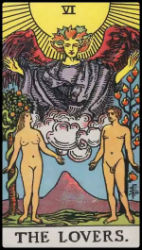
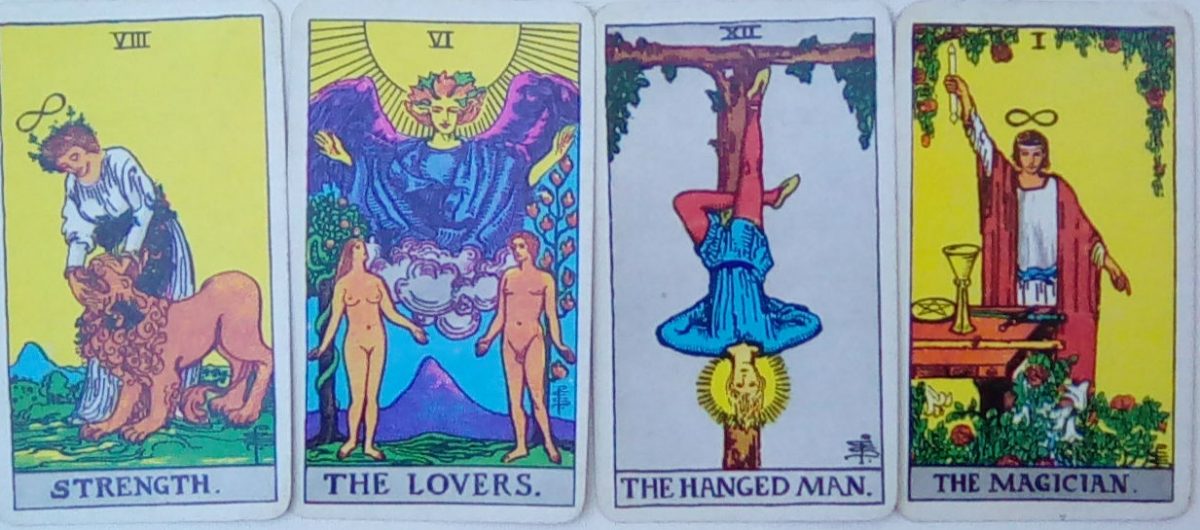
That bit of self-knowledge may be the greatest gift of AI:  the realization that we are ultimately The Lovers and not The Thinkers.  Cartesian philosophy said, “I think, therefore I am,” but the truth is, “I feel, therefore I am human.”

The Alchemy of the Mind: Transforming Your Life with the 7 Principles of the Kybalion

My new ebook, “The Alchemy of the Mind,” is now available at a very reasonable price on Amazon.com. And I personally wrote every fucking word of it.

Harnessing the Power of Mentalism: How the Magician Card Can Help You Manifest Your Desires

Discover how the Magician tarot card and the Principle of Mentalism from The Kybalion can help you manifest your desires by aligning thought and intention.

Have you ever tried to manifest something—a job, a relationship, a more abundant life—only to feel like nothing’s happening?  

As you probably know, there are hundreds of manifestation methods and techniques out there, each of them 100% guaranteed to bring us happiness, wealth, and a great sex life.  So why are so many of us still stumbling along, sad, poor, and . . . well . . . un-laid?

Here’s the truth: manifestation isn’t just about saying the right words, finding the right method or doing the right ritual. It begins with our minds. According to the ancient Hermetic wisdom of The Kybalion, “The All is Mind”—meaning that everything in the universe begins in thought. This is known as the Principle of Mentalism, and it’s the foundation of all true manifestation work.

Why Manifestation Often Fails (And How Mentalism Can Help)

Here are the most common reasons why manifestation doesn’t work :

• We’re trying to manifest from a place of fear or lack.  We’re so wrapped up in what we don’t have, that that’s all we can think about.  And whatever we think about is exactly what we’re going to get.

• Our conscious desire doesn’t match our unconscious beliefs.  If we’re convinced subconsciously that we don’t deserve love, we won’t find love.  If we’re convinced that we don’t deserve abundance, we’ll stay poor.

• Our thoughts and emotions are scattered or unfocused.  And undoing that is a learning process.  Especially if we’re already afraid or anxious, learning to calm down and focus on what we want, instead of what we don’t want, can feel like a real challenge.

Mentalism helps by bringing it all back to the source: our minds.  When our thoughts are aligned, our emotions follow—and so does our reality. Manifestation becomes less about “getting stuff” and more about changing who we are inside.

The Principle of Mentalism and Visualizing

The Principle of Mentalism is the first of the seven Hermetic principles outlined in The Kybalion.  A summary of it is the axiom:

“The All is Mind; the Universe is Mental.”

This means that the universe itself is a mental creation.  While that’s a fascinating metaphysical discussion for another day, what we want to focus in on right now is, “Why in the hell aren’t my visualizations working?”

 When we bring this axiom down to the level of our daily lives, it means: Everything begins as a thought. 

Put another way, every single thought we have is creating our personal reality – the fabric of our lives –  whether we’re aware of it or not.

When it comes to manifestation, Mentalism teaches that:

We are not separate from the creative power of the universe. That can be a hard one for us to wrap our heads around.  We aren’t just creations of the Universe – we’re also creating the Universe because we are conscious beings with free will. We’re a part of the Universe making itself.  We’re a part of that same source energy that created the stars.  We are incredibly powerful – we just don’t realize it.

Our thoughts are not passive—they are active forces shaping our experience. As Mike Dooley likes to put it, “Thoughts become things.”  Every single thought that we have has the potential to manifest in the physical world.  

To change our outer world, we must first change our inner world. If our thoughts become things that create our lives, then it only makes sense that the first thing we need to do is to take control of our thoughts.  We have to create what we want to manifest in our outer lives in our inner lives.  That means that we need to quit being victims of our thoughts and learn to direct them.  They’re working for us, not the other way around.

Which brings us to The Magician.

The Magician Card: Your Inner Creator

In the Rider-Waite tarot deck, The Magician stands at a table with the four tools of the Minor Arcana before him: a cup, a wand, a sword, and a pentacle. Above his head floats the infinity symbol. One hand points to the sky; the other points to the earth.

This is a card full of meaning for the manifestation process:

Infinity symbol: We have unlimited potential. Our minds are conduits for universal energy.  This is what we were just talking about: we are not separate from the creative power of the Universe.  We are a part of that power and that makes us much, much more powerful than we realize.

One hand up, one hand down: As above, so below—our inner world shapes our outer one.  This is another way of saying that our thoughts aren’t passive – they’re active agents creating our lives right now.  Whatever we create in our inner lives will manifest in our outer lives.

Tools on the table: We have everything we need to manifest—thought (swords), emotion (cups), action (wands), and material resources (pentacles).  We don’t need to borrow someone else’s methods for manifesting because we already have the magic in our own lives. 

The Magician is the living embodiment of the Principle of Mentalism. He reminds us that we are not a victim of circumstance—we are the creators of our experience by using our mental powers.

A Simple 4-Step Magician-Inspired Manifestation Practice

 Here’s a simple practice that brings together these lessons from the The Magician and the Principle of Mentalism.

Step 1: Clarify Your Desire

Get crystal clear.  Let me say that again:  GET CRYSTAL CLEAR!  What exactly do you want? Let’s face it – as human beings we are fully capable of wanting two things that contradict each other at the same time.  For instance, if you want a full time lover but you also want a lot of time to yourself, you need to sort that out.  Which one do you really want, because you probably can’t have both and if you ask for both they’ll cancel each other out and you’ll get nothing.

Write it down in a present-tense, emotionally charged sentence. For example:

 “I am joyfully attracting a lover and friend who is filling my life with meaning.”

Step 2: Align Your Mind

Close your eyes and visualize your desire as if it’s already happening.

Feel the emotion of it. Say your intention out loud.  In this example, you could imagine that you’re spending the day with your lover, having a wonderful time, and planning for a sensual evening together.

Step 3: Act with Intention

Now take a small action that reflects your inner belief.

It could be creating a vision board, applying for an opportunity, or simply saying “no” to something that no longer fits.  In this case, it could be writing out 20 affirmations that say, “I am loved and treasured by my partner.”

Step 4: Meditate on the Image of The Magician Card for a Few Moments

Do this while you’re visualizing your goal. This helps us to remember the lessons here:  everything begins with our thoughts;  we have unlimited potential that we’re using to create our dreams; everything that we need to create our dreams is contained within us.

It also goes a step further and helps us to connect with that archetypal energy of The Magician.  It’s a symbol that pulls power into our visualization and engages the Universe in helping to create our desires.

Final Thoughts: You Are the Magician

You don’t have to “become” powerful—you already are.

The Principle of Mentalism and The Magician card both remind you: your reality is a reflection of your consciousness.

Want to change the outside? Start on the inside.

Start with your thoughts.

Start with your intention.

Start with you.

Want to Go Deeper?

If this topic speaks to you, I invite you to check out my new ebook:

“The Alchemy of the Mind: Transforming Your Life With the 7 Principles of The Kybalion.”

In it, I explore how each Hermetic principle can help you reshape your beliefs, emotions, and daily experience. It’s part philosophy, part practical guide—and 100% dedicated to your growth.

Your Turn

Have you used The Magician card in your manifestation work?

What has Mentalism taught you about the power of thought?

Drop a comment below—I’d love to hear your experience.

Creating a Counter-Dialogue: A Gentle Approach to Healing Emotional Patterns

A look at emotional set-points and using guided meditations to counter a critical inner dialogue.

THE INNER BASTARD

Many people who grew up in dysfunctional or abusive families carry an invisible burden: a harsh, critical inner voice that tells them they’re not good enough. This voice operates just below the surface of awareness, subtly shaping thoughts, emotions, and behaviors. Even highly successful, capable adults may find themselves struggling with a persistent sense of inadequacy—and not really know why.

If you were raised in one of those families, you know precisely what I’m talking about.  It’s that Inner Bastard that’s always dropping discouraging nuggets into our thought streams.  Things like:

I can’t believe you did something that stupid.

And

What in the hell is wrong with you?

And

You can’t get anything right.

And

If you were any dumber, they’d have to water you twice a week.

This poisonous internal narrative, formed in childhood, becomes the emotional background music of a person’s life. And because it’s so familiar, we may not even question it.

OUR EMOTIONAL SET-POINT

If that kind of a powerfully negative inner dialogue goes on long enough, it can become the emotional vibration that we default to.  This is what Esther Hicks and Abraham refer to as our, “emotional set-point.” 

The basic idea is that people live in an habitual emotional vibration for most of their lives and they tend to stay there.  You may know someone who has a naturally sunny disposition and they’re happy 90% of the time.  They may occasionally experience grief and pain, like we all do, but they quickly return to their default state of happiness.  Likewise, we all know people who are dark, cynical and unhappy.  They may occasionally feel great joy or contentment, but then they go right back to being dark.

If we have an Inner Bastard who’s always whispering that we’re not good enough – that we’re incompetent, stupid, or ugly – we become sad, depressed, and helpless.  That becomes our set-point and we stay stuck in it. We have to somehow find a way to root out that inner dialogue if we ever want to be happy.

THE POWER OF COUNTER-DIALOGUE

But what if there were a gentle, practical way to begin shifting that dialogue without needing to confront it head-on?

 Rather than trying to root out the negative inner voice through sheer willpower, we can begin to introduce a counter-dialogue—a deliberate stream of positive, nurturing messages designed to soothe and balance the old patterns.

Tibetan Buddhists refer to this as, “antidoting,” negative emotions.  In their view, negative emotions are just like poisons that make us sick.  So, if we’ve taken a poison, we need to take an antidote to it, right?  If we become extremely angry, we can antidote it with a loving/compassion meditation.  If we’re really jealous of someone, we antidote it by meditating on their good fortune and try to be happy for them.

For those of us who aren’t Buddhist monks, an easy way to do this is through guided meditations focused on happiness, compassion, or self-acceptance.  You can find these for free all over the internet.  My personal favorite is, “Great Meditation,” on YouTube but there are many alternatives. 

These short recordings, listened to daily (especially at emotionally receptive times like morning or bedtime), can act as emotional antidotes to that negative inner dialogue.  Instead of a nasty assed voice telling us how terrible we are, we substitute a calm, peaceful voice telling us how wonderful we are. With regular exposure, these meditative states begin to form different emotional grooves in the brain and happiness gradually becomes our new emotional set point..

EMOTIONAL HOMEOSTASIS:  WHY CHANGE CAN FEEL UNCOMFORTABLE

But here’s where it gets tricky.

Humans operate by a principle called, “homeostasis,” and the, “stasis,” in that word tells you what it does.  Homeostasis tries to make sure that everything stays just the way that it is.  In the body, it maintains a normal blood pressure, makes sure our hearts beat a certain number of times a minute, keeps our blood sugar in a normal range, etc. etc. etc.

All in all, that’s a very good thing because it keeps our heads from exploding and our hearts from stopping and we live much better lives without exploding heads.  Where it can be troublesome, though, is when we’re trying to change something.

For instance, people who are trying to lose weight may lose 5 or 10 pounds at first and then they suddenly start gaining weight, even though they’re still on a diet.  The reason is that the brain is saying, “Uh, oh . . . we’re obviously starving to death.  Slow down the metabolism.  Retain fluids.  We need to get fat again.”

In other words, our brains have come to view being overweight as, “normal,” and they try to keep everything the way it is.  That’s homeostasis.

Just as the body maintains physical homeostasis, the subconscious mind seems to maintain emotional homeostasis. That is, it resists sudden emotional changes, even positive ones.

If your emotional “set-point” has been sadness or self-doubt for many years, your system may view happiness or self-worth as unfamiliar—even dangerous. This can trigger a rebound effect: you’re sitting there trying to rewire your brain by listening to guided meditations and your Inner Bastard responds by cranking up the volume of self-criticism.  You may feel happy and light one day and then find that you’re in a deep depression the next.  That’s your brain trying to maintain what’s, “normal,” even if what’s normal sucks.

At that point we have to remind ourselves that this isn’t failure. It’s the subconscious trying to return to what it sees as safe territory. Knowing this can help us respond with compassion rather than frustration.

 HEALING THROUGH GENTLE PERSISTENCE

The key is to approach change with patience and consistency. You’re not trying to overpower the old patterns, but gradually retrain your system to accept a new emotional baseline. You’re building new neural pathways—ones that support self-kindness, resilience, and inner calm.

Over time, the emotional set-point begins to shift. The system adapts. The counter-dialogue becomes part of your inner landscape. And the old voice, while perhaps never fully gone, loses its grip.

In essence: you don’t have to fight the pain directly. You can begin to antidote it—with gentleness, repetition, and trust that healing happens not in one grand moment, but in small, quiet steps.

My new e-book, “The Alchemy of the Mind: Transforming Your Life With the 7 Principles of The Kybalion,” is now available on Amazon.

Veiled Wisdom: How to Live Intuitively in a Linear World — Lessons from the High Priestess

Learn how to live intuitively in a fast-paced, logic-driven world through the symbolism of the High Priestess Tarot card. Discover practical tools, ancient wisdom, and insights for intuitives and spiritual seekers.

In a world obsessed with logic, speed, and quantifiable results, living intuitively can feel like trying to speak a forgotten language. For those who rely on inner knowing, symbolism, and emotional depth to navigate life this can be truly disorienting. You may feel unseen, misunderstood, or even accused of being irrational.

Fortunately, there is an archetype that understands you perfectly: The High Priestess of the Tarot. She doesn’t live by surface appearances or external systems. She lives behind the veil, where symbols, patterns, and quiet truths guide her every move. If you’ve ever felt like your way of knowing doesn’t fit the world you live in, the High Priestess is your ally.

This post explores how her symbolism offers powerful guidance for anyone trying to live more intuitively in a linear, left-brain world.

The Veil: Honor the Unseen

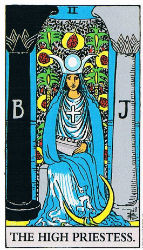
Behind the High Priestess is a veil covered in pomegranates—a symbol of mystery, fertility, and hidden truth. The veil marks the threshold between the seen and the unseen, the conscious and the unconscious.

In daily life, this reminds us to respect what can’t be measured: feelings, dreams, body language, synchronicities. Not everything real can be proven. Living intuitively means acknowledging the unseen world as just as valid as the visible one.  In fact, if you’re an intuitive, your inner world may frequently seem more important than your outer world.

The Moon: Trust Emotional Cycles

The crescent moon at the Priestess’s feet is a classic symbol of intuition, emotion, and cycles. In contrast to the linear, upward march of modern life, the moon reminds us that all things move in rhythms—inner and outer.

This is actually one of the oldest principles of occultism and is discussed extensively in The Kybalion.  Everything on the Earth Plane – everything – moves in cycles.  The tides go in and out.  The Moon waxes and wanes.  Spring gives way to winter.  Even great nations spring up and then fade away.

To live intuitively is to trust your emotional tides. Some days are for action; others for withdrawal, reflection, or stillness. Honoring this inner rhythm—even when it defies external expectations—is a revolutionary act.

The Scroll: Keep Inner Wisdom Sacred

The scroll in the Priestess’s lap is partially hidden and marked “TORA,” suggesting sacred knowledge that isn’t meant for everyone—or even always fully for yourself. This teaches a key lesson of intuitive living: you don’t have to explain yourself.

In a linear world, people often want justification, proof, or evidence. But intuition doesn’t always offer that. Like the scroll, your inner knowing may be incomplete, symbolic, or private. Protect it. Don’t feel pressured to decode everything aloud.

Intuition is frequently about knowing that you know something without knowing how you know it.  You don’t have to defend that to anyone who wants to pick it apart with linear logic.  Sonia Choquette offers a wonderful tip for dealing with it when someone is attacking your intuition:  just smile at them and say, “It works for me.”

The Pillars: Balance Inner and Outer Worlds

The High Priestess sits between two pillars marked B and J (Boaz and Jachin), drawn from the ancient Temple of Solomon. They symbolize polarity—light and dark, masculine and feminine, logic and intuition.

To live intuitively in a linear world, you must balance both forces. Intuition doesn’t reject logic; it expands it. Learn to speak the world’s language when needed, but stay rooted in your own. The magic is in integration.

The Solar Cross: Stay Centered

On the High Priestess’s chest is a solar cross—an ancient symbol of wholeness, representing the four directions, seasons, and elements. Unlike the Christian cross, this symbol is universal. It tells us to stay centered within the circle of life, grounded in your own compass.

Living intuitively means checking inward before reacting outward. It means making decisions from alignment, not anxiety. The solar cross reminds you: you carry your center within you.

It’s also worth noting that the cross is centered over her heart chakra, the energetic mid-point between the lower chakras and the upper.  Intuition pulls in insights from the universe but grounds them in daily life.

Practical Ways to Live Intuitively

Create space for silence and solitude: That’s where intuitive messages come through.  Remember to be patient with that, too.  Intuition speaks in symbols, not type-written messages.  When we sit down to meditate we probably won’t get a telegram from the Universe telling us what to do.  But . . . a particular book that we need to read may fall off of a shelf or a friend may casually say the perfect word to trigger insights.

Journal or use symbols: Tarot, dreamwork, or creative writing can help you listen inward.  The Major Arcana of the Tarot in particular is crammed with archetypal symbols.  Every one of those speaks to Deep Mind and starts a dialog with intuition.

Let go of constant justification: Trust what you know, even if you can’t explain it.  If other people don’t understand what you plainly see, then fuck them.  You’re not the extrovert-whisperer and you don’t need to explain your inner vision to someone who’s blind.

Honor emotional and energetic cycles: Don’t force productivity; honor your timing.  Despite the many New Age gadgets and programs that we may encounter now days, there is NO way to force intuition.  In fact, quite the opposite:  the more relaxed we are, the more likely we are to have a free flow of intuitive insights.  The more we force it, the more it flits away.

Balance logic with knowing: Use your left brain to support your right-brain insights—not to silence them.  Think of left-brain logic as a sort of an editor that connects the dots for you.  The first thing that comes is the intuitive flash:  “Hmmm . . .  I think this is how it actually is, even though it looks differently.”  Then we can use logic to figure out where the insight came from or to explain it to others, but we should never, ever, let logic tell us that our intuition is wrong, simply because we can’t justify it.

It’s Not Impractical – It’s Sacred

The High Priestess doesn’t offer quick answers. She teaches us to dwell in questions, to honor mystery, and to trust the quiet voice within. In a culture addicted to speed and clarity, living intuitively is a radical form of wisdom.

If you feel like you see through the veil or live just outside the edges of ordinary awareness, you’re not lost. You’re listening. And you’re not alone.

Let the High Priestess be your reminder: intuitive living isn’t impractical—it’s sacred.

My new ebook, “The Alchemy of the Mind: Transforming Your Life With the 7 Principles of The Kybalion,” is now available on Amazon.

The Tarot’s Magician Card: How to Transform Dreams Into Reality Through Creativity

Discover how The Magician card in the Tarot reveals your innate creative power. Explore how to awaken your inner artist, overcome self-doubt, and bring your dreams into reality using inspiration, emotion, intellect, and action.

If I told you, “Your ARE an artist,” how would you react?  Many of us would remember awkwardly doodling with finger paints in Kindergarten and say, “Um, so sorry.  You have me confused with someone else.  I don’t have a creative bone in my body.”

But The Magician card in the Tarot is here to tell us that we’re wrong.  Not only are we ALL artists, but art is our inherent birthright.  Creativity is what human Souls do.

At his core, The Magician is not simply a sorcerer; he is the artist in action — the architect of dreams, the translator of unseen energies into tangible forms. His message is clear and revolutionary: you already have everything you need to create. Creativity is not the privilege of a chosen few; it’s how we’re born.  We just need to be willing to trust the flow of inspiration and take the bold step of bringing it into the world.

In this post, we’ll explore how The Magician’s symbolism reveals a timeless pathway for anyone who wants to live more creatively — not just in art, but in life itself. If you’ve ever felt the tug of an idea, the spark of a dream, or the yearning to build something that didn’t exist before, then The Magician lives within you.

The question is: will you answer the call to create?

The Magician as the Artist Archetype

To begin, we need to think about what creativity actually means.  Creativity is taking an idea, an intuition, perhaps just a feeling, and turning it into something tangible.  That process can be anything from painting on a canvas to planning an enchanted garden to cooking a fabulous meal.  

We can see this in the basic stance of the Magician. With one hand extended toward the heavens and the other grounded toward the earth, he embodies the creative process itself: the act of channeling the intangible into something real. This gesture isn’t accidental — it’s a profound symbol of how all true creation happens. First, an idea flickers into being, and then, through focused will and action, it finds its place in the material world.

The Magician uses four symbolic tools in the creative process:

                     the wand, which is our spirit and inspiration;

the cup, which is our emotion and intuition;

the sword, which is our thought and clarity;

and the pentacle, which is the earth and tangible results.

These are reminders that all aspects of our inner life — passion, feeling, intellect, and grounded action — must work together if we are to bring our visions to life. Creativity isn’t about waiting for a bolt of lightning; it’s about learning to weave the forces already within us into something new.

In this way, The Magician shows us that artistry is not only about talent or skill. It is a deeper alignment — a willingness to step into the role of a bridge between worlds, to trust what flows through us, and to dare to give it form. Whether you are painting a canvas, writing a story, building a business, or designing a life you love, you are engaging in the same timeless act that The Magician represents: the sacred work of creation.

Channel Energy, Don’t Hoard It

One of the most powerful lessons The Magician offers is this: creativity is not something you possess — it’s something that moves through you. His raised wand and grounded stance show a clear channel between the invisible and the visible, the infinite and the immediate.  He isn’t trying to grab hold of the creative energy – he’s letting it flow through him.

That’s a vital lesson for all of us who want to live more creative lives.  Creative energy is trying to move through us but our little ego minds keep blocking it.  “Oh, I can’t really be creative right now.  I have to wait for the perfect moment.” Or,  “I need to acquire more skills before I can paint (write, cook, garden, start my dream business, fill in the blank.)”. Or, “ What if I look foolish or inept?”

Essentially, what we’re doing is hoarding our creativity.  We’re blocking the flow that fuels our art.  Energy needs movement. Ideas need action. Inspiration, once caught, must be shaped into something tangible, even if it feels imperfect at first.

The Magician teaches us that the true creative act is not about ownership. Our task is to stay open, receptive, and courageous enough to express what moves through us. The act of creating itself strengthens the channel. The more we trust the flow, the more it trusts us in return.

Creation is not a destination. It’s a living current, and you are already standing in its river.

Using All Our Tools

Some writers describe the table in The Magician card as an altar, but perhaps we should think of it as a work bench, instead.  He’s about to create something new and he has all of his tools laid out in front of him:  inspiration, emotion, intellect, and physical resources.  They all form a vital part of the creative process.

Inspiration is the spark that gets us moving.  Perhaps it’s a quirky, weird idea that drops in out of the blue.  Perhaps we wake up one morning and think, “You know, I’m sick to death of working in an office.  What I’d really like to do is to have my own plant nursery.”

Emotion is the jet fuel that super-charges the creative process.  The more we think about spending our days working with living plants instead of grinding away at a word processor under florescent lights, the more excited we get about the idea.  We can FEEL ourselves being happy when we making our dreams come true.

Intellect is that wonderful capacity that humans possess to figure out HOW to make their dreams come true.  How do we go from loving gardening to actually owning a nursery?  Maybe we need to take a few horticulture and business courses at the community college. Maybe we should talk with some friends who own their own businesses and find out how they got started.  Intellect is the plan for making it happen.

Physical resources are the material forms that we use to make our dreams manifest in the world.  In this case, it might be saving the money to rent a space for our greenhouse or even something as simple as gathering cuttings from our friend’s plants and getting them potted up.  

Creation is a weaving act, and the more strands we allow ourselves to use, the richer and more alive our work becomes. Inspiration without structure can remain a dream. Emotion without clarity can feel overwhelming. Ideas without action can dissolve into frustration.

The Magician reminds us: we already have everything we need. We are not missing anything essential. Creativity asks us to trust our whole self — our fiery passions, our deep feelings, our clear thinking, and our ability to manifest in the real world. Each part of us has a place at the table. Each tool is ready for our hand.

Marry Vision With Action

The flowers at the bottom of The Magician card remind us that the process of creativity isn’t just about having ideas.  It’s about making those ideas bloom in the real world by taking concrete actions to bring them about.

Dreams are the seeds of creation, but without planting them — without tending to them with real effort — they remain only possibilities. The Magician doesn’t just envision beautiful outcomes; he commits to the messy, imperfect, exhilarating work of building them. As creatives, we must learn to act, even when the outcome is uncertain.

Even when the work feels flawed.

Even when doubt whispers at the edges of the mind.

For the painter, that means actually sitting his ass down in front of a canvas and picking up a brush.  For the writer, it means facing a blank page and having the courage to write the first sentence.  For the entrepreneur,  it means taking the steps to bring her business to life even when other people tell her it can’t be done.

Vision and action are partners in every creative endeavor.

One without the other is incomplete.

When we dare to act on our inspiration — even with small, humble steps — we transform invisible dreams into visible reality. We honor the sacred energy that called us to create in the first place.

Believe in Your Power to Create

At the heart of The Magician’s message is a simple but profound truth: we are the source of our own magic. The tools on his table are ready. The energies above and below are aligned. But none of it would matter without one essential ingredient: his belief in his ability to act.

In the same way, every creative journey begins — and continues — with a choice to trust yourself. Not every work will be perfect. Not every idea will unfold as imagined. But the act of believing in your creative power, even when it wavers, even when the inner critic rises, is itself an act of magic.

The way the Julia Cameron phrases it is that we have to give ourselves permission to be bad artists before we can be good artists.  That doesn’t necessarily mean that we’re going to be bad artists – it means that we have to get rid of that voice in our heads that’s telling us that we can’t do it or we’re not good enough.

Self-trust is not arrogance. It is not blind certainty. It is the quiet, stubborn willingness to say: I am here, and I have something worth bringing into the world.  It’s the decision, day after day, to show up at the page, the canvas, the studio, the meeting table — and offer what only we can offer.

The Magician reminds us that we are not passive vessels waiting for perfection to strike. We are active participants in the dance of creation. Every moment we dare to believe in our power, even a little more than we doubt it, we step more fully into the Magician’s role — the artist, the builder, the dreamer made real.

The world needs your magic.

It always has.

And it always will.

My new ebook, “The Alchemy of the Mind, Transforming Your Life With the 7 Principles of The Kybalion,” is now available on Amazon.

The Ten of Pentacles, Grandma Moses, and Rocking Getting Older

A closer look at the new paradigm of aging and how we can combat our own internalized ageism.

One thing that’s been apparent watching the demonstrations against the Trump regime is that there are a LOT of gray hairs in those crowds.  What in the hell are all of those old people doing out there demonstrating?  Aren’t old people supposed to sit at home in their rocking chairs with cats in their laps?

Well, what if everything we’ve been told about aging is wrong?

OLD IS THE NEW YOUNG?

Think of some of the standard images and words that come up when we discuss older people.  Words like:

Doddering;

Absent minded;

Frail;

Diminished;

Weak;

Senile

There is a cultural perception of older people as being in a period of decline, fragility, and irrelevance.  It isn’t just our societal obsession with youth; it’s an active attack on aging itself.  Ironically, of course, it’s something we all do sooner or later (if we’re lucky) so it seems like a peculiar notion on the face of it. 

Thankfully, there’s a new paradigm emerging.  It’s an entirely different way of aging that embraces it as a time of expansion, reinvention, and wisdom-driven creativity.  Before we can do that, though, we need to be mindful of the old paradigm of aging.

THE DISEASE MINDSET

Western cultures tend to treat aging as if it’s a medical problem, rather than a perfectly natural transition.  Billions of dollars are being made every year by convincing us that there’s something terribly, terribly wrong with having white hair and a few wrinkles.

There’s really no way to describe it other than as an anti-aging industry.  On the one hand, big pharma is busy programming the elderly to believe that they can’t possibly survive without a medicine cabinet full of pills.  On the other hand, the cosmetics companies are selling boatloads of product to, “restore your lost youth and vitality.”

The over-all message to anyone past the age of 60 is, “be afraid, be very afraid, because you’re useless, ugly and doomed.  You have a terminal disease called, ‘aging.’”  

But what if we learn to see aging as a form of enhancement, rather than a decline?

LATE LIFE FLOURISHING

There’s actually a term for that which is, “the Grandma Moses Effect.”

Anna Mary Robertson Moses (AKA Grandma Moses) left home at the age of 12 to go to work as a domestic for a farmer and his wife.  For the next 65 years of her life, she had a pretty grueling existence.  She and her husband were itinerant farm workers, drifting from job to job and doing back breaking field work.  She bore 10 children, five of whom died and she lived on the edge of poverty for most of her adult years.

She took up painting at the age of 78 and only because arthritis was making it painful for her to do needlework.  She initially sold her paintings out of the window of a local pharmacy for 2 dollars a piece.  By the time that she died at the age of 101, her paintings were being sold for millions of dollars, Hollywood had made a movie about her life, and she’d received a medal of honor at the White House.  

All because she picked up a paintbrush when she was obviously too old.

Now, suppose she’d been alive in our time.  What messages might she have been receiving at the age of 78?  “Let’s face it, dear, your life is over.  You’ve got one foot in the grave. I hope that you’ve got medical insurance because it’s all downhill from here.  As a matter of fact, you’re at the bottom of the hill and a boulder is about to run over you.”

Grandma Moses was the first time that millions of Americans really got it on a visceral level that being older doesn’t equate to being the walking dead.  Being older can be a magical beginning, instead of a tragic end.

REJECTING THE STEREOTYPES

Margaret Nash talks about this in her book, “Rebellious Aging.”  One of the key takeaways from that book is that we have to actively reject the stereotypes of what our culture thinks older people should be like.

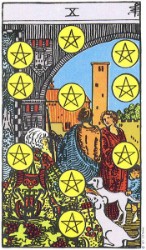
The Ten of Pentacles shows one of those stereotypes.  An old man sits quietly in a corner, wrapped in a shawl, while younger people engage with each other in the light.  There are dozens of other stereotypes in our culture, of course. Perhaps we should take up knitting or learn to play shuffleboard.  Maybe move into a nice retirement community where we don’t have to cook for ourselves anymore and we can scoot around in golf carts instead of actually walking.  Maybe join a book club or take a nice cruise with other old people.  The overall emphasis with these activities is that we should find something harmless to do while we’re waiting to die.

But suppose – horror of horrors – that we don’t die?  

Suppose that Grandma Moses had bought into the perspective that her life was over at the age of 78 and she just needed to sit down and wait to die?  That would have been 23 years of sitting there twiddling her thumbs, staring out the window, and asking people, “Am I dead, yet?”  Instead, the next 23 years were the richest and most fulfilling of her life.

THE AGE OF NEW AGING

There IS a new paradigm for aging emerging in our societies.  

 – Older people are staying creative, starting businesses, exploring spirituality, and reinventing themselves.

 – Longevity science and neuroscience show that the brain remains adaptable well into later life.  Neuroplasticity is showing that the idea that old dogs can’t learn new tricks is bullshit.  We still have lots of tricks up our sleeves.

 – And, as older people begin to behave differently, we begin to reject the stereotypes of how we’re supposed to be. The cultural narratives of aging are beginning to evolve.  We’re seeing much more positive portrayals of older people which in turn provide more positive role models for all of us.

 INTERNALIZED AGEISM

Probably the most important element in rebellious aging is rejecting our own internalized ageism.  That means taking the time to really examine how we feel about aging.

* How do we, personally, feel about, “old people?”

* Do we think our, “best years,” are over?

* Do we think, deep down, that young people are somehow, “better,” than old people?

* Are we rejecting our own sexuality because we think it’s inappropriate for older people to like sex?

* Are we constantly telling ourselves things like, “I’m too old for that?”

* Are we obsessing about our high school or college years instead of fully living in our present lives?

* Are we afraid to try new, creative endeavors because we just don’t have the time left to learn to play the piano or paint or sculpt?

* Are we obsessing over our health and expecting that we’re going to get sick, simply because we’re getting older?

If some, or all, of those things ring true for you, don’t feel bad about it.  That’s what we’ve been programmed to believe.  That doesn’t mean that we have to believe any of it any longer, though.  

RECLAIMING OUR POWER

We might think of this as learning to embrace our Inner Grandma Moses.  If we’re older, try to imagine that we’re actually going to live to be 101 years old, just like she did.  What do we want to do with all of that time?  If you’re 70, for instance, do you really want to spend the next 30 years bitching about your aching joints or would you rather roll a joint and listen to some music?  If you’re 80, do you want to spend the next 20 years sitting in a rocking chair or would rather dance to some rock and roll?

As other people have said, aging is inevitable but getting old isn’t.  Aging is a transition into wisdom, creativity, and new possibilities.  Celebrate it.

Beyond Isolation: How Introverts Can Truly Recharge

A look at creating healing solitude.

If introverts had a battle flag, it would probably have The Hermit card printed on it.  We absolutely love to withdraw into our own cozy little shells and let the world turn without us participating in it.

So, we’ve finally canceled our plans, turned off our phone, and settled into solitude. But after hours of scrolling or zoning out, we still feel drained. What gives?

THE MYTH OF THE INTROVERT RECHARGE

Introverts often mistake social withdrawal for true recharging but miss the neurological component (acetylcholine release) that actually restores their energy.  Just sitting at home is not going to refresh or restore us, although that’s where we need to begin the process.

DOPAMINE VERSUS ACETYLCHOLINE

There are, of course, about a kazillion different chemicals and hormones doing a tango in our busy brains at any given time.  For purposes of this discussion, though, let’s focus in on just two of them, the neurotransmitters called dopamine and acetylcholine.  And let’s just call them, “happy juices,” because they make different people happy in different ways.

Our brains discharge dopamine when we’re exposed to a lot of social stimuli like loud music, parties, crowded shopping malls and lots of other people.  Extroverts actually have many more, “receptors,” for dopamine in their brains than introverts do, so they can soak up an ocean of it and it makes them really happy campers. They feel jazzed, excited, and alive.

Since introverts can’t absorb a lot of dopamine, it basically kicks our asses.  For us, it’s like drinking six cups of really strong Espresso – it makes us jittery, nervous, and quickly worn out.  It’s introvert poison.

Acetylcholine, on the other hand, gives our brains a mellow, quiet buzz.  It’s less like ecstatic dancing at a concert and more like snuggling into a warm bed with nice clean sheets.  It’s quiet and peaceful.  Introverts love it and it drives extroverts crazy with boredom.  It’s our happy juice.

THE ISOLATION TRAP

Now,  since too much dopamine makes us feel like crap, it’s perfectly natural to think that just getting away from situations that cause dopamine will make us feel ever so much better.  After all, if too much, “peopling,” is wearing us out, then non-peopling should recharge us.

So, we fill the moat around our introvert castles with alligators, pull up the drawbridges, and put up a big sign that says, “GO AWAY!”  Free at last!

Unfortunately, by that point, we’re frequently so worn out that we just sit there staring out the window, doom-scrolling on our computers for hours, or binge-watching NetFlix.  Those are what therapists call low-nourishment activities because they don’t do anything to feed our emotions or bodies.  And, specifically with introverts, they don’t feed us any acetylcholine to make our brains happy.

PLANNING FOR A BRAIN BOOST

A good question for introverts to ask when we’re planning for our recharge time is, “Will this activity leave me feeling nourished or merely distracted?” We know that there are specific, fairly low energy activities that refresh and recreate us by increasing acetylcholine production.

Reading and Deep Learning: Encourages relaxed but engaged attention.

Mindfulness Meditation or Breathwork: Activates the parasympathetic nervous system, reducing cortisol and boosting calm focus.

Creative Flow States: Writing, drawing, or music allow for contemplative immersion.

Nature Walks or Gentle Movement: Combines physical and sensory stimulation with mental quiet.

MINDFUL INTENTIONS

Another way of putting that is that we need to be intentional with our solitude.  We need to design an Acetylcholine-Rich Hermit Phase.  We can learn to structure our alone time for maximum benefit.

Conscious solitude planning: Schedule blocks for purposeful recharging activities instead of just avoiding people.

Minimize mindless distraction: Replace passive screen time with meaningful, immersive solo activities.

Create mini rituals: Tea-making, journaling, or slow stretching to ease into relaxation.

And, hell, if we’re not quite ready to jump into being Zen Master Introverts, we can combine some of those activities.  Maybe do some Tai Chi while we’re bing-watching Netflix.

REDEFINING OUR SOLITUDE

We’re all different, of course, and introverts tend to be really different.  For me, painting, writing, or meditating brings on that acetylcholine recharge.  For you, it may be gentle dance motions, working in your garden or reading a good book. For others it might be sitting in the sunshine sipping a cup of tea.

The point is that we all know what makes us feel good.  For an introvert it’s like a lover gently kissing the back of your neck or touching your cheek with her finger tips.  It’s sweet, it’s calm, it’s gentle, and it makes us feel better almost instantly.  Those are the activities that we want to build into our solitude.

Yes, we need to get away from other people on a regular basis, but simply being alone isn’t the answer.  Living in intentional, mindful, loving solitude is what makes us whole again.

The Hidden Difference: How Empathic Readers and Psychics Use Tarot Differently

A comparison between psychic and empathic tarot readers, explaining how psychics use tarot as a focus for intuitive insights, while empaths interpret emotional and energetic patterns for guidance.

If you’ve had more than a few Tarot readings, you’ve probably encountered a reader who, “pulls,” the cards for you.  They may mix or shuffle the deck a few times and then they pick some cards which are supposed to represent you and your situation.  They lay those cards out and then interpret them for you.

There’s a real question in my mind whether we can even properly call that technique a Tarot reading.  Still, it illustrates the difference between two highly different styles of reading cards:  the psychic approach and the empathic approach.

PSYCHIC TAROT READERS:  USING THE CARDS AS A FOCUS TOOL

Psychic Tarot readers tend to use the cards as a tool to focus their extrasensory abilities.  Think of the classic movie scene where a  gypsy woman is huddled over a crystal ball and utters a pronouncement like, “You are going to meet a tall dark stranger and have incredible sex in a variety of nearly impossible positions.”  There’s no suggestion that the crystal ball is talking to her or texts are appearing inside of it.  Rather, she’s using it to focus her attention on receiving messages from spirit guides or opening herself to intuitive flashes.

In the same way, a psychic reader might pull The Tower card out of the deck and say something like, “Towers are tall buildings and that’s what I’m picking up on.  I’m seeing a tall building in your future and there’s something wrong with it.  I’m getting that you’re thinking of buying a house and I’d caution you about any two story house you look at it.”

Now, that interpretation HAS ABSOLUTELY NOTHING TO DO WITH THE DEFINITION OF THE CARD.  Not even close.  That doesn’t mean that the reader is wrong, though.  If you’re dealing with a genuine psychic, she may be totally right on.  

But it’s not a Tarot reading.  It’s a psychic reading using Tarot cards as prompts.

Put another way, the knowledge is coming from the reader and not from the cards.  That’s a major clue that you’re dealing with a psychic reader – they deemphasize the actual definitions of the cards and substitute their own.  The images on the cards are actually much more important to them than the definitions because the images are what trigger their psychic flashes.

EMPATHIC TAROT READERS:  READING EMOTIONAL AND ENERGETIC PATTERNS

Empathic readers tend to take a much more traditional approach.  

First of all, they want YOU to handle the cards as much as possible, rather than simply picking out the cards for you.  This is a recognition that there is some sort of a synchronistic link between the cards and the person who’s receiving the reading.  It’s almost like the cards have to get to know the person – they need to pick up your unique vibrations and then the cards will match those vibrations and give you a reading.

An empathic reader will also rely much more heavily on structure and definitions.  He’ll use readings with predetermined positions such as past, present and future.  He’ll have a set of definitions that won’t change simply because he’s getting a different, “impression,” of what the card should mean.  In the example of drawing The Tower card, he’d tell you that some cataclysmic event is about to occur in your personal life, but he won’t mention two story houses.

In one sense, an empath’s Tarot reading might seem to be a little psychic because she will connect deeply with the emotional and energetic state of the the person receiving the reading. Rather than receiving psychic downloads, an empathic reader will sense the feelings, fears, and desires of the client and interpret the cards in a way that reflects these energies.

Because empaths absorb emotions, their interpretations of the cards mirror what the client is going through.  For instance, they might sense the client’s anxiety over drawing The Tower card and interpret it as need for an emotional breakthrough, rather than pure destruction.  In that sense, an empath’s Tarot reading might feel more like a therapy session than a psychic prediction because they’re much more heart focussed.

WHICH TAROT READER IS RIGHT FOR YOU?

Both types of readings are perfectly valid, but one or the other might be preferable for us.  It depends on what we’re looking for.

If we’re looking for guidance about what may happen in the future, then a psychic reader may be the better choice.  That’s assuming, of course, that we’re convinced that the person we’re dealing with is a genuine psychic.

We’d approach that type of a reading in precisely the same way that we’d approach a psychic reading without the Tarot cards.  After all, the cards are just there to focus the psychic’s abilities.  We might go to a psychic to try to establish communication with a loved one who’s passed over.  Or perhaps we feel a need for direction from a spirit guide or angel and can’t communicate directly with them ourselves.  The psychic is the channel and the cards are secondary, so we’re not really looking for the wisdom of the Tarot itself.

A reading with an empath, on the other hand, would be much more oriented toward trying to make sense of our daily lives using the cards and their actual definitions.  Empaths process information in patterns and so they’d be looking at all of the factors in our lives and trying to stitch them into a coherent whole.

A reading with an empath is also much more about how we feel about what’s happening to us, rather than just predicting events.  After all, that sensitivity to other people’s emotions and energy is what empaths do best.

In either case, we always need to remember that a Tarot reading is just a snap shot in time.  It’s about what MAY happen if the current circumstances continue.  Nothing in a Tarot reading is written in stone and we have the ability to change the outcome by changing our behavior.