A concise, Tarot-based guide to the ten cards that most often indicate feeling stuck, stalled, or unable to move forward — and what each one reveals about the deeper source of that stuckness.
Being “stuck” in Tarot rarely means something is broken or hopeless. It usually means energy is stalled, attention is misdirected, or a transition is incomplete. These cards point to places where movement is paused — and where a shift is quietly waiting to happen.
Here are the ten cards that most often signal that kind of stuckness.
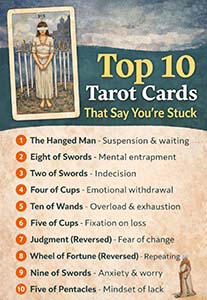
1. The Hanged Man
Stuck because of suspension or waiting.
This card indicates a pause imposed by timing, perspective, or the need for surrender. Progress isn’t possible yet because something deeper is still rearranging.
2. Eight of Swords
Stuck because of limiting beliefs or mental loops.
You feel trapped, restricted, or powerless — but the restriction is largely internal. The situation may not be as closed as it feels.
3. Two of Swords
Stuck because of indecision or avoidance.
Movement is blocked by a refusal to choose, usually because neither option feels safe or pleasant.
4. Four of Cups
Stuck because of emotional disengagement.
Nothing feels interesting or meaningful enough to respond to. Opportunities may exist, but the heart isn’t open to them yet.
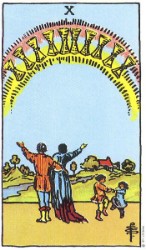
5. Ten of Wands
Stuck because of overload or exhaustion.
You’re carrying too much. Forward motion is technically possible, but not sustainable in the current state.
6. Five of Cups
Stuck because of grief or fixation on loss.
Attention is anchored in what’s gone wrong, making it hard to see what remains or what could still grow.
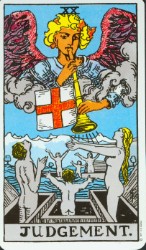
7. Judgment (Reversed)
Stuck because of self-doubt or fear of stepping into a new identity.
The call to change is present, but something inside is resisting answering it.
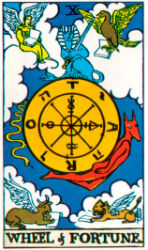
8. Wheel of Fortune (Reversed)
Stuck because of repeating patterns or feeling caught in cycles.
Life feels like it’s looping instead of evolving. This often points to unconscious habits or unresolved lessons.
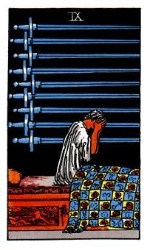
9. Nine of Swords
Stuck because of anxiety, rumination, or worry.
The mind is so busy anticipating problems that it can’t access solutions or rest.
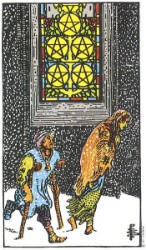
10. Five of Pentacles
Stuck because of a mindset of lack or survival.
Fear around resources, support, or worthiness makes it difficult to imagine improvement or receive help.
A Note on “Stuckness” in Tarot
In Tarot, being stuck is rarely a punishment or a failure. It’s usually a sign that:
• something internal needs to shift before something external can move,
• a lesson is still integrating,
• or attention needs to be redirected.
These cards don’t say “nothing will ever change.”
They say: this is the part of the story where motion pauses and meaning is being formed.
That’s often where the most important change begins.
Running It By the Numbers explores the numerological structure behind the Tarot suits from Ace through Ten.
When we look at the Tarot, it’s easy to get lost in the images, stories, and archetypes of each card. But underneath the pictures, symbols, and personalities lies a beautifully simple structure: number.
In each suit — Wands, Cups, Swords, and Pentacles — the cards numbered One through Ten follow a consistent energetic progression. The suit shows where the energy is playing out (creativity, emotion, thought, or material life), and the number shows how that energy is unfolding.
So let’s run it by the numbers.
Below you’ll find the numerological meaning of the cards from Ace (One) through Ten, and how that meaning expresses itself across all four suits.
One (Ace): Beginnings, Seeds, Potential
Ones represent the spark.
They are beginnings, raw potential, the moment when something new is offered into your life.
Numerologically, One is unity, origin, and creative impulse — the first expression of energy.
In Tarot:
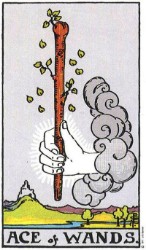
• Aces show opportunities.
• They don’t guarantee outcomes — they offer possibility.
Each Ace says: “Here is a seed. Will you plant it?”
Two: Balance, Choice, Polarity
Twos represent the moment when the One becomes aware of an “other.”
Numerologically, Two is duality, relationship, contrast, and choice.
In Tarot:
• Twos often show balance, tension, or decision.
• They ask you to relate — to a person, a feeling, a path, or a truth.
Twos say: “Now that something exists, how will you engage with it?”
Three: Growth, Expansion, Expression
Threes are the first moment of outward growth.
Numerologically, Three is creativity, expression, and development.
In Tarot:
• Threes show movement, growth, collaboration, and early results.
• Something is starting to take form.
Threes say: “This is beginning to live and move in the world.”
Four: Structure, Stability, Foundation
Fours bring form, boundaries, and stability.
Numerologically, Four is structure, order, and grounding.
In Tarot:
• Fours stabilize the energy of the suit.
• They create something solid enough to rest on — or sometimes something rigid enough to get stuck in.
Fours say: “Let’s make this real and sustainable.”
Five: Disruption, Challenge, Change
Fives introduce instability.
Numerologically, Five is movement, friction, and necessary disruption.
In Tarot:
• Fives often show conflict, loss, challenge, or tension.
• They shake what has become too fixed.
Fives say: “Something needs to change — even if it’s uncomfortable.”
Six: Harmony, Integration, Adjustment
Sixes restore balance after the disruption of Five.
Numerologically, Six is harmony, healing, and realignment.
In Tarot:
• Sixes often show cooperation, support, generosity, or healing.
• They smooth what was roughened.
Sixes say: “Let’s bring this back into balance.”
Seven: Assessment, Testing, Inner Work
Sevens are a pause for evaluation.
Numerologically, Seven is reflection, inner work, and spiritual testing.
In Tarot:
• Sevens often show challenges that are internal, subtle, or strategic.
• They ask you to examine your approach.
Sevens say: “Is this truly aligned — and is this worth continuing?”
Eight: Power, Mastery, Momentum
Eights represent focused energy and effective action.
Numerologically, Eight is power, movement, and manifestation.
In Tarot:
• Eights show work, effort, discipline, and progress.
• Things move quickly here, for better or worse.
Eights say: “Apply yourself. This can be accomplished.”
Nine: Fulfillment, Culmination, Near Completion
Nines bring things close to completion.
Numerologically, Nine is culmination, wisdom, and harvest.
In Tarot:
• Nines often show satisfaction, insight, or emotional/spiritual fullness.
• They can also show isolation, depending on the suit.
Nines say: “This cycle is almost complete — what have you learned?”
Ten: Completion, Overflow, Transition
Tens complete the cycle — and often overwhelm it.
Numerologically, Ten is completion that tips over into excess, leading back toward a new beginning.
In Tarot:
• Tens show endings, fulfillment, or overload.
• They signal that a cycle has run its course.
Tens say: “This is complete. It’s time to release and begin again.”
In Summary
Across every suit, the numbers tell a story:
1. Seed
2. Choice
3. Growth
4. Structure
5. Disruption
6. Harmony
7. Assessment
8. Effort
9. Fulfillment
10. Completion
When you read Tarot “by the numbers,” you gain a deeper sense of where you are in a process — not just what’s happening, but what stage it’s in.
And that can be incredibly clarifying.
Because sometimes the most important message isn’t what is happening…
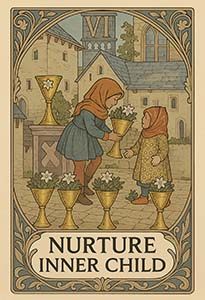
The Six of Cups reminds us that our creativity flows from the innocence of the inner child. Protecting that child means honoring your art, choosing who sees it, and never letting careless criticism silence your joy.
When Beauty Meets Criticism
Have you ever created something you thought was beautiful — a painting, an essay, even a garden — and when you finally shared it, the first thing someone did was point out the flaws? Instead of seeing what you were trying to express, they zeroed in on what they thought was wrong.
There’s always a tension between creating and sharing. When we make something real — assuming we’re not just hacking away — we’re revealing a piece of our heart, our soul, our lived experience. A careless critique can feel like a personal attack. It can leave us feeling exposed, vulnerable, even ashamed.
The Inner Child at Play
Picasso once said, “All children are born artists; the problem is to remain an artist as we grow up.” Creativity flows from the same source as play — from the child who once molded mud into castles or splashed finger paints across paper just for the joy of it.
That inner child still lives inside us, but it’s easily wounded. A thoughtless comment can silence it. A dismissive tone can make it retreat. And when that happens, the creative flow — the very essence of who we are — begins to dry up.
The Birth of the Critic
Mel Brooks joked that with the birth of art came the inevitable afterbirth — the critic. And he wasn’t wrong. If you take your creativity seriously, you’ll eventually encounter people who feel compelled to “fix” your work.
Julia Cameron wrote that before we can become good artists, we must first give ourselves permission to be bad ones. Every artist, writer, gardener, or musician produces clumsy beginnings — and even seasoned creators sometimes turn out a piece that just doesn’t land.
The creative process is messy and human. Yet while you’re admiring what went right, someone else may focus only on what went wrong.
The Wound of the Inner Artist
Cameron also warned that exposing your inner artist to harsh criticism is the emotional equivalent of child abuse. It’s like taking the eager, innocent child who offers you their finger painting and saying, “That’s terrible. You don’t really have any talent, do you?”
If you choose a creative life, criticism is inevitable. Some people simply won’t resonate with your vision, and occasionally you’ll make something that misses the mark. That’s part of the territory. But you can — and must — protect your inner artist with the same fierce loyalty you’d show a child under attack.
Learning by Heart
I became an artist late in life and am entirely self-taught. I picked up a mallet and chisel and learned to carve wood through trial, error, and stubborn joy. I learned to paint the same way.
Looking back, I can see how rough those early pieces were — primitive, awkward, untrained — and yet they were full of life. I still remember the pride I felt each time I saw progress take shape beneath my hands.
Claiming the title artist took courage. The first time I walked into a gallery and asked, “Would you show my work?” was absolutely terrifying.
A Pact of Protection
One simple, unbreakable pact guides me still: when someone criticizes my art, that’s the last time they see my art.
Showing your work is an act of intimacy — an unveiling of something deeply personal. The art flows from the child within you, and that child deserves protection.
Wondering if your love will really last? Tarot offers powerful clues. Here are the top 10 “yes” cards for romance — symbols of harmony, joy, and lasting connection.
While the Tarot doesn’t hand out guarantees, it does shine a light on the energies present in a relationship. And some cards are so clear, so affirming, that when they appear in a spread, they almost shout “yes!”
Why Tarot for Love Questions?
Love and relationships are the number one category of Tarot inquiries. People turn to the cards when they’re uncertain about where things stand, or when they’re weighing the long-term potential of a relationship.
Tarot won’t say, “This relationship is guaranteed to last forever.” But what it will do is highlight the dynamics at play — the emotional energy, the strengths, and the challenges that shape a partnership. And when certain cards appear, they point strongly toward harmony, mutual growth, and a lasting bond.
The Top 10 Tarot “Yes” Cards for Romance
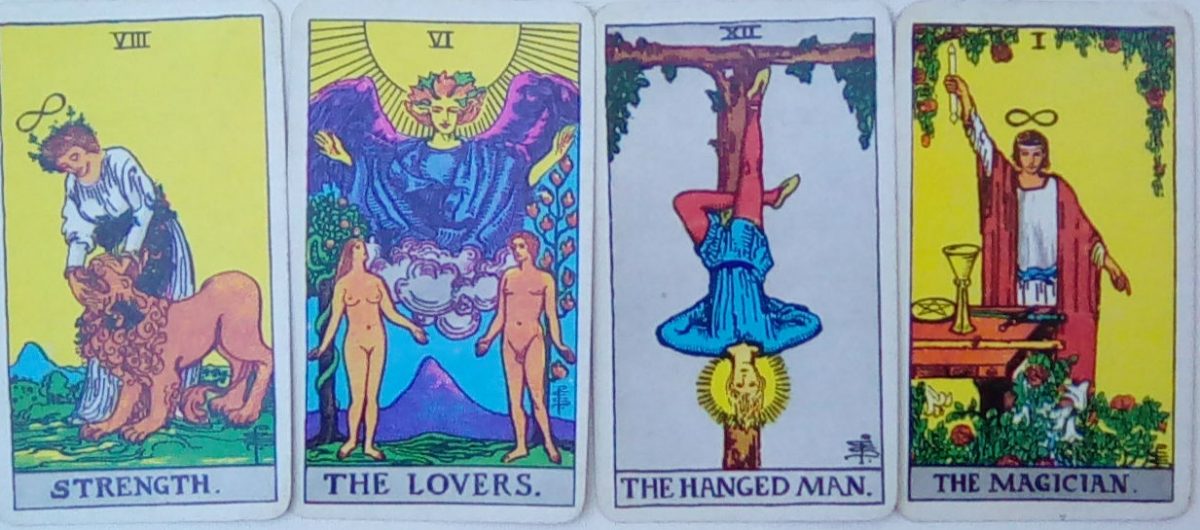
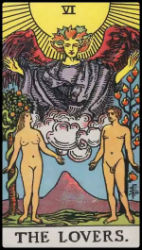
1. The Lovers
This is the archetypal card of love, union, and attraction. It represents shared values and choices that strengthen the bond. When The Lovers appear, the message is clear: the relationship is rooted in deep connection.
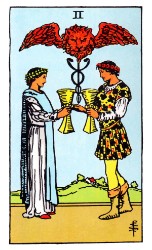
2. Two of Cups
The quintessential partnership card. It reflects mutual attraction, balance, and reciprocity. The Two of Cups points to a genuine soul connection where both people bring equal energy to the table.
3. Ten of Cups
This is the “happily ever after” card. It symbolizes long-term happiness, emotional fulfillment, and family harmony. If you’re asking about lasting love, the Ten of Cups is a resounding yes.
4. Four of Wands
A card of celebration, milestones, and commitment. It often shows up around engagements, weddings, or moving in together. It’s a sign that the relationship is not only joyful but ready to move into the next chapter.
5. The Empress
Abundance, nurturing, and fertility flow through this card. The Empress speaks of love that supports growth — creative partnership, deep affection, and the potential to build something lasting together.
6. The Star
The Star brings healing, inspiration, and spiritual alignment. In love, it suggests that the relationship is not only joyful but also restorative, giving both partners hope and a sense of divine timing.
7. Six of Cups
Sweetness, comfort, and sincerity. This card speaks to simple pleasures and genuine affection. Whether it’s new love or a rekindled flame, the Six of Cups highlights warmth and emotional honesty.
8. The Sun
Few cards are as positive as The Sun. It represents joy, openness, and vitality. In romance, it signals a relationship where both people feel seen, supported, and energized.
9. Ace of Cups
The overflowing chalice of love. This card signals the beginning of a new relationship or the renewal of affection in an existing one. It’s pure emotional abundance and a beautiful green light for love.
10. Two of Wands
While not strictly a “romance card,” the Two of Wands points to planning a shared future. It suggests vision, growth, and expansion — a partnership where both people are willing to build together.
What These Cards Have in Common
Look at these ten cards together, and a pattern emerges:
Union & Commitment: Lovers, Two of Cups, Four of Wands, Ten of Cups.
Emotional Fulfillment: Ace of Cups, Six of Cups, Empress.
Joy & Inspiration: Sun, Star, Two of Wands.
The common theme? Relationships that thrive on balance, mutual support, and a shared vision for the future.
A Note of Realism
Of course, not every card in the Tarot is a “yes.” Sometimes the spread brings red flags — lessons that need to be learned before love can grow strong. That doesn’t mean the relationship is doomed, but it does mean awareness and patience are needed.
Stay tuned: in a future post, we’ll explore the Top 10 “No” Cards for Love Questions.
Conclusion
Deciding if a love will last is never easy. But the Tarot provides more than predictions — it offers symbolic guidance about the energy flowing through your relationship.
When the “yes” cards appear, they suggest love that’s harmonious, joyful, and ready to grow into the future. If you see these cards in your spread, take it as the Universe’s way of saying: love is worth the leap.
Deciding whether to take a new job can feel overwhelming — but the Tarot offers surprising clarity. In this post, we explore the top 10 “yes” cards that signal opportunity, growth, and success in a new role.
There are two areas that cover 99% of what people ask in Tarot readings. And they are – guess what? – love and money.
To be more specific about the latter, a lot of people are very worried about finances right now. Younger people, older people, many of us are living just a paycheck away from destitution.
Most of the questions that revolve around finances can be broken down into two major areas: Should I keep this job? And, should I take that new job?
Unfortunately, that frequently breaks down further into, “I really, really hate my job but I’m afraid to quit it.” And, “I’m really thinking about taking this new job, but how do I know it isn’t going to be just another hell hole?”
Obviously, the Tarot can’t make those decisions for us, but it can put up some pretty clear markers one way or the other. In keeping with that, here are the top ten cards that indicate that, yes, we should take that new job.
The Top 10 Tarot “Yes” Cards for a New Job
1. The Magician
This card is all about skill and personal power. If you’re considering a new role, The Magician suggests you already have the tools and talent you need to succeed. It’s a reminder that you can create your own opportunities — and this one is ready for you to shape.
2. The Sun
Few cards are as positive as The Sun. It brings energy, confidence, and joy. In career terms, it signals that the new job will bring vitality and success — the kind of role where you can thrive, not just survive.
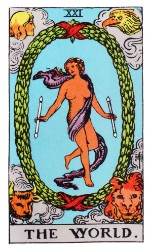
3. The World
The World represents completion and stepping into a bigger arena. It’s a sign that an old cycle is closing, and a new, more expansive chapter is waiting. Professionally, this card says, “Yes — you’re ready for the next level.”
4. Ace of Pentacles
The Ace of Pentacles is the clearest symbol of a new financial or career opportunity. Think of it as the seed of prosperity being handed to you. It’s a resounding “yes” that the new role holds real promise.
5. Three of Pentacles
This card highlights teamwork, recognition, and skill-sharing. If it shows up, it suggests the new job will give you the chance to collaborate with others and be appreciated for your contributions.
6. Six of Wands
The Six of Wands is about victory, advancement, and being noticed. In a career spread, it signals success in your new role and the recognition that comes with it.
7. Eight of Pentacles
This is the card of steady skill-building and mastery. If you’re entering a new field or learning new tasks, the Eight of Pentacles assures you that you’ll gain expertise and grow stronger through the work itself.
8. The Star
The Star brings inspiration, hope, and alignment with your higher purpose. In job matters, it suggests the new opportunity isn’t just a paycheck — it’s a chance to do something meaningful that feeds your spirit.
9. Two of Wands
The Two of Wands is about expansion and long-term vision. It tells you that the new job opens up possibilities for growth, planning, and future success. It’s less about a quick win and more about building something lasting.
10. Ten of Pentacles
This is the card of stability, prosperity, and legacy. If it appears, it suggests the new role has the potential to provide long-term security, financial reward, and a sense of belonging within a larger structure.
What These Cards Have in Common
Looking at these ten cards together, a pattern emerges:
Material success & stability: Ace, Eight, Ten, and Three of Pentacles.
Recognition & growth: The Magician, The World, and Six of Wands.
Fulfillment & inspiration: The Sun, The Star, and Two of Wands.
When these cards appear in your spread, they point to opportunity, alignment, and security — the kind of energies that make a new job worth considering.
A Note of Balance
Of course, not every card says “yes.” It’s always sweet when we get clear yes and no cards in a reading, but sometimes they can be frustratingly ambiguous.
When that happens, the Tarot suggests waiting, rethinking, or being cautious about what’s really on offer. The future may reveal that the opportunity isn’t as golden as it first appears or maybe it will be. Things are still developing.
In a future post, we’ll explore the Top 10 “No” Cards for a New Job — the ones that raise red flags and encourage you to pause before leaping.
Conclusion
Deciding whether to take a new job is never easy. It’s a choice that can ripple out through every part of your life. While Tarot can’t choose for you, it can help reveal whether the energies surrounding a new opportunity are supportive, promising, and aligned with your bigger goals.
So the next time you’re staring at an offer letter, pull out your deck. If the “yes” cards show up, it may just be the Universe’s way of saying: step forward with confidence.
If you’d like a downloadable PDF copy of the Top Ten Job Cards, click here. When the list pops up, go to your browser menu and click on, “print file.”
Ever fallen in love with someone you couldn’t have? Psychologists call it “limerence,” but spiritually it’s more than just a crush. This post explores the difference between obsessive attraction and true love, why we sometimes fall for the “wrong” people, and how to heal by generating love from within. Featuring insights from psychology, past-life theory, Ram Dass, and the Ace of Cups, it’s a guide to shifting from longing to self-created wholeness.
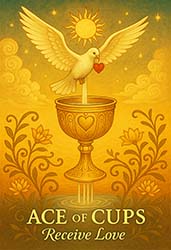
Ace of Cups – A Tarot affirmation poster available at Synergy Studio.
Did you ever fall in love with someone you shouldn’t have? Someone who was unavailable, but you still felt intensely attracted to them?
Maybe it was your next door neighbor who was happily married. Maybe it was a co-worker and you KNEW that a work place romance would be a disaster. Hell, maybe it was your 8th grade teacher who was just SO perfect in every way.
GETTING CRUSHED
We used to call that, “getting a crush,” on someone. We meet someone and we just know that we’re supposed to be together, even though everything else is saying, “No, you’re not.”
Psychologists – as psychologists tend to do – have invented a new term for it which is, “limerence.” Here’s a definition:
“Limerence is an involuntary, intense, romantic obsession characterized by intrusive thoughts and a longing for emotional reciprocation, often leading to emotional suffering due to unmet romantic needs.”
In other words, having a crush on someone you probably shouldn’t have a crush on.
IT’S ALL PERFECTLY NATURAL
Now, this has been going on ever since the world began and, of course, it’s caused a passel of trouble. Marriages end, people lose their jobs, reputations and careers are destroyed. All in the name of love.
Which is puzzling, isn’t it? Love is supposed to be this grand, wonderful adventure that lets us soar to new heights on the wings of the person we’re in love with. So why is all of this so painful and frustrating?
THE CALM, INNER VOICE
I had a teaching dream once about spirit guides and spiritual guidance. I call them, “teaching dreams,” because they’re very lucid, very clear and they usually have to do with some issue that’s really bothering me.
The subject of this dream was, “How do I distinguish true spiritual guidance from my own desires and ego?”
And the answer was that spiritual guidance is never harsh, never critical, never ominous. It’s always gentle, loving, and kind and leaves us feeling nurtured rather than criticized or beaten up.
The same principle applies to falling in love. If it feels sweet and kind, it’s probably real love. If it involves obsessive thinking, insecurity, self-doubt, or criticism . . . hey, it may be a hell of a crush, but it ain’t love.
WHY DOES IT HAPPEN?
Why do we fall in love with people who aren’t, “right,” for us?
Psychologists, philosophers and playwrights have been trying to figure that one out for hundreds of years and really haven’t made much progress.
My personal theory is that these are relationships that are, “out of time.” And I don’t mean that in the sense of, “Whoops, we’re out of time.”
Rather, what I’m talking about is old relationships from previous incarnations that have been displaced in time. The feelings are still there, but they’re no longer appropriate in their old form.
Perhaps we were married to someone or had a super, sizzling hot sexual affair with them two lifetimes ago. Because of that intense attraction, we meet them again in this lifetime.
Only – guess what? – they’re married to someone else. Or they’re our teacher or mentor. Or perhaps we’re straight, but they’re the same sex that we are.
The feelings are just as intense. The desire to be with them is just as strong. But it just ain’t happening this go-round.
WHAT SHOULD WE DO?
Well . . . nothing, in most cases. Just observe it and sit with it. Realize that you love this person but that the love has to take a different form than romantic love.
We can feel it. We can cherish it. But we don’t have to act on it. If there’s a huge internal conflict about getting romantically or sexually involved with someone, that’s not a very good way to start out, is it?
FILL YOUR HEART WITH LOVE
Ram Dass said that we frequently mistake other people as the source of love, rather than realizing that they’re just vehicles that get us to the love.
When we’re seriously crushing on someone we shouldn’t be crushing on, we feel that as a loss, as a deficit, as if we’ve got this Grand Canyon sized hole in our hearts that only they can fill.
Fortunately, we’ve got this wonderful part of our energy systems called, “the heart chakra.” It can generate an infinite amount of love because love actually IS infinite.
We can sit down at any time or place and just meditate on love, meditate on that chakra filling up with that sweet, kind essence that is love and the feeling of not being complete immediately goes away.
IT ISN’T THEM, IT’S US
We’ve been programmed into believing that love always flows out of someone else and into us. That if someone, “out there,” doesn’t love us, we won’t get the love we need.
That’s really the source of the pain in limerence. We’re convinced that without that other person’s love, we’re just going to be miserable and unfulfilled. We can’t get to the love we want and so it hurts.
Not true.
We create our own love, in our own hearts. We receive love when we open our heart centers and intentionally, consciously fill them up.
THE ACE OF CUPS
When we look at the Ace of Cups we can see this message very clearly. The cup is our heart and the love isn’t flowing out of another person into the cup. It’s flowing straight out of the Universe. Love is everywhere. It’s a Universal energy and we just need to open ourselves to receiving it. If we occasionally receive it from another person, that’s great.
But if we don’t, that’s not a tragedy and it doesn’t need to be painful. The source of love is always in our own hearts.
Many people feel disconnected, numb, or unable to access joy—especially after childhood trauma. This post explores emotional flatness, toxic positivity, and why realness may matter more than happiness.
Did you get ACED when you were a kid?
ACE stands for Adverse Childhood Experience, and the odds are fairly high that you experienced one. ACEs include things like emotional abuse, neglect, parental mental illness, substance abuse, and divorce or separation of the parents.
We tend to think of those kinds of negative experiences as relatively rare. Maybe we got the hell beaten out of us by a crazed, drunk parent—but most people didn’t, right?
After all, just look at how happy everyone else seems.
But according to the CDC-Kaiser ACEs Study, 61% of adults across 25 states reported experiencing at least one ACE. And nearly 1 in 6 (16.7%) reported four or more.
The truth is, a sizable portion of the population is living with the long-term effects of unresolved trauma—including dissociation, emotional blunting, chronic anxiety, and difficulty accessing joy.
The Cultural Pressure to Be Happy
One of the strongest side effects of long-term trauma is the belief that, “Man, I must really be fucked up, because I’m just not happy. Everyone else is happy, but I’m a train wreck. In fact, I’m not even a train wreck, I’m completely off of the tracks.”
That belief is especially potent if you’re American.
American culture—especially through media and marketing—places enormous value on positivity, confidence, and personal success. Like the figures in the Three of Cups, we’re all supposed to be dancing with joy, smiling through life, bubbling over with gratitude. The message is:
“You should be happy, empowered, and in control of your life at all times.”
And if you’re not?
Then something must be seriously wrong with you.
This pressure to appear happy, even when we’re not, creates:
• Emotional dissonance: A split between what we feel and what we think we should feel.
• Shame about feeling bad: A second layer of suffering on top of the original pain.
• Social masking: We say we’re “fine” or “happy” because it’s expected—and we believe others are genuinely feeling that way (even when they aren’t).
Antidepressants and the Emotional Economy
A recent Gallup poll reported that a whopping 78% of Americans say they feel satisfied or very satisfied with their lives. The poll even bemoaned the fact that the “happiness index” was down by two points.
Meanwhile, the U.S. is among the highest consumers of antidepressants in the world.
Some people take them for serious clinical issues—but many of us take them simply to cope with lives that feel emotionally flat or chronically overwhelming.
Years ago, psychologists discovered that one of the most useless surveys in the world was asking teenage boys if they’d had sex. The overwhelming majority said, “yes, of course I have,” —even though many of them didn’t have the slightest clue how to unfasten a bra, let alone what to do next. They thought they were supposed to be having sex, because they assumed all the other boys were doing it—even though they weren’t.
In much the same way, Americans seem to be lying to pollsters about how happy we are, because we think we’re supposed to be happy.
After all, everyone else is smiling.
Even if they’re not.
We’re taking pills to create artificial happiness because we think we should be happy, even when we’re not.
Living With “Flat” Emotions
What if, instead of constantly trying to fix our feelings, we first learned to live with them?
Assuming there’s no organic brain issue involved, there’s always a reason that we’re not happy.
As Gabor Maté points out, when we suffer trauma that we can neither fight nor flee from, we dissociate. We leave our bodies. We stop feeling.
Not feeling becomes a survival mechanism—a way of coping with pain that would otherwise overwhelm and break us.
If you’re among the 61% who’ve had at least one ACE, you’ve probably experienced dissociation and emotional flatness.
If you’re in the 16% who had four or more ACEs, emotional flatness may be how you live most of the time. It’s not that we don’t want to be happy—we just don’t know how.
And that, in itself, can be traumatic, because we’ve been programmed to believe that we should be happy—even when we can’t feel it.
But we can reframe that.
Rather than chasing a happiness ideal that may not be accessible—especially after trauma—it’s possible to:
• Honor emotional flatness as a survival adaptation.
• Shift the goal from happiness to authenticity.
• Value calmness, neutrality, or quiet presence as valid emotional states.
• Find meaning not in chasing joy, but in living gently and truthfully with what is.
This doesn’t mean giving up on healing, but healing might not look like “feeling great all the time.”
It might look more like “being okay with feeling whatever I feel.”
A New Emotional Ethic: Realness Over Happiness
Ideally, we need a massive cultural shift—from:
“I must feel good in order to be okay”
to:
“I’m okay because I’m allowing myself to feel what’s true for me.”
But… yeah. Don’t hold your breath on that one.
What is possible—what’s powerful—is to make that shift within ourselves.
If you’ve had the hell beaten out of you, either physically or emotionally, as a child or as an adult, it’s okay to feel sad.
It’s okay to feel numb.
It’s not just okay—it’s rational.
That doesn’t mean we want to live there forever.
That doesn’t mean we resign ourselves to an existence without joy. But maybe healing begins when we stop pretending. When we stop performing. When we let ourselves feel—or not feel—exactly where we are.
In this new ethic:
• Sadness is not a problem.
• Numbness is a messenger.
• Joy, when it comes, is a gift—not a requirement.
Back in the 1960s the Transactional Psychology movement came up with the catch phrase: “I’m Okay, You’re Okay.”
To which Elisabeth Kubler-Ross replied: “I’m Not Okay, You’re Not Okay. And That’s Okay.”
The first step in the path seems to be honestly saying, “This is who I am. This is where I’m at. I hurt when I feel and so I try not to feel. And for right now, that’s okay.”
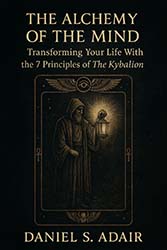
The Alchemy of the Mind: Transforming Your Life With the Seven Principles of the Kybalion
When you’re overwhelmed by choices but none of them inspire you, the 7 of Cups offers deep insight into emotional flatness, spiritual paralysis, and the fog of indecision. This post explores what it means to feel stuck not from a lack of options, but from a disconnection from desire — and how gentle, imperfect movement can reawaken synchronicity, clarity, and personal magic. With insights from tarot, spiritual practice, and the idea that every choice is a spell, this is a compassionate guide for anyone feeling adrift in a sea of possibility.
We all know what it feels like to be stuck in a situation that offers no way out — a dead-end job, a draining relationship, a town or routine that feels too small for who we are. In those moments, the lack of options is the problem, and we ache for even one open door.
But there’s another kind of stuckness, quieter and harder to name. It happens when you look at your life and see too many doors — job possibilities, creative paths, lifestyle shifts, spiritual practices, places you could move to, people you could become — and yet none of them stir your heart. It’s not that you don’t have options. It’s that nothing feels real enough to move toward. Every possibility feels equally vague, equally weightless. You scroll through them in your mind like a streaming menu of “meh.”
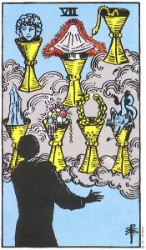
That’s where the 7 of Cups comes in — a card that doesn’t warn of limitation, but of overabundance without embodiment. When we’re caught in that state, the problem isn’t a lack of imagination. It’s that we’ve lost our connection to desire, motivation, or meaning. And that kind of emotional flatness can leave us just as frozen as having no choices at all.
In this post, I want to explore that space of spiritual paralysis — what it really means, why it happens, and how we might begin to move forward again, even when nothing calls to us.
The 7 of Cups – Castles in the Sky
In the classic Rider-Waite tarot deck, the 7 of Cups shows a figure standing before a cloud filled with seven golden cups. Each cup holds something different — a castle, a laurel wreath, a snake, a dragon, a veiled figure, jewels, and even a head. These images float in the sky like a surreal dream, untouchable and unresolved. Some of the items represent temptation or danger. Others represent success, beauty, or mystery. Together, they evoke a kind of psychic overload: too many choices, too many desires, too many unknowns.
This card is often read as a symbol of fantasy, illusion, or indecision — a time when your head is in the clouds and your feet aren’t on the ground. You may be imagining all the things you could do, be, or have, but none of it is actually manifesting. The possibilities feel “up in the air” — compelling, maybe even glamorous, but disconnected from real life.
But the 7 of Cups doesn’t just speak to confusion. It speaks to the pain of disconnection from clarity, purpose, and desire. You might be a visionary, a dreamer, or someone with a deep well of creative imagination. And yet you feel suspended in a kind of fog — no longer trapped, but adrift.
This is the paradox: you can have a wealth of potential and still feel empty. You can imagine endless paths and still feel like you’re going nowhere.
Defining the Emotional Problem
Let’s be clear about something: this isn’t laziness. It’s not procrastination, and it’s not fear of commitment — at least, not in the way people usually frame those things.
What we’re really talking about here is a kind of emotional flatness — a sense that, no matter how many options are available, none of them feel alive. Nothing moves you. You’re not overwhelmed by too many passions; you’re stalled because nothing seems to matter. And when well-meaning people tell you to “follow your bliss” or “just pick something you’re passionate about,” you want to scream — because the truth is, you don’t feel passionate about anything.
This is a deeply misunderstood kind of stuckness. On the surface, it might look like you’re being indecisive or flaky. Underneath, there’s often a more painful story: burnout, disappointment, grief, disillusionment, even trauma. You may have spent years surviving rather than living. You may have pursued dreams in the past that led nowhere. Or you may simply be exhausted — mentally, emotionally, spiritually — and unable to summon the spark that used to drive you.
When this kind of numbness settles in, imagination alone won’t fix it. Vision boards and journaling prompts can feel like cruel jokes when you’re not connected to any real sense of desire. You become a ghost in your own life, haunting the possibility of change without feeling motivated to pursue it.
That’s where the 7 of Cups becomes not just a warning about illusion, but a mirror for a very human experience: the ache of possibility without passion.
Why We Get Frozen: The Paradox of Too Many Options
At first glance, having lots of options seems like a good thing — a sign of freedom, creativity, expansion. But if you’re not grounded in what you actually want or need, too many options can feel like a kind of psychic noise. Instead of liberating you, they overwhelm your system. Nothing feels real, and everything feels like a distraction.
This is the hidden danger of the 7 of Cups: abundance without anchoring.
You might bounce from idea to idea — start a new project, research a new career path, flirt with the idea of moving somewhere else — but none of it takes root. Each choice is hypothetical, weightless, floating just out of reach like the cups in the card. Without an emotional connection to any of them, they begin to blur together until doing nothing feels like the only viable option.
This paralysis often leads to guilt or self-blame: Why can’t I commit? Why don’t I care more? But the deeper issue isn’t about making a bad choice. It’s about the fear that no choice will lead anywhere meaningful.
And that fear can become self-fulfilling. We stop moving because we don’t feel inspired. But inspiration often follows movement — not the other way around. If we wait to feel perfectly clear before taking action, we can stay stuck for years.
The 7 of Cups teaches us that too much floating — too much dreaming without doing — eventually collapses into disconnection. The way out isn’t to find the perfect choice. It’s to ground ourselves in imperfect motion.
The Turn: A Way Out — “Three Least Sucky Choices”
So what do you do when everything feels empty? When every option seems flat, pointless, or too far away to matter?
Spiritual teacher Mike Dooley offers a surprisingly helpful piece of advice:
If all your choices suck, pick the three least sucky ones — and start moving.
It sounds irreverent, even a little cynical. But it’s actually a lifeline disguised as a joke.
Dooley isn’t saying you should build your life around mediocrity. He’s pointing to a truth that’s both practical and mystical: the universe can’t help you until you start moving. When you’re standing still, waiting for a lightning bolt of clarity, you’re not sending any clear signals. You’re broadcasting static.
But when you take even one step — toward something, anything — the whole energetic field around you begins to shift. Possibilities you couldn’t see before start to appear. A “meh” project might lead you to a person who lights you up. A half-hearted attempt at self-care might reawaken something long asleep. A seemingly random decision might become the breadcrumb trail that leads you home.
It’s not about pretending your choices feel great. It’s about trusting that momentum creates meaning, not the other way around.
And sometimes, choosing the “least sucky” option is the boldest move you can make — because it’s a choice made not from fantasy, but from faith.
The Role of Synchronicity
Synchronicity is the universe’s way of saying, “I see you.” It’s that perfect book showing up just when you need it, that person calling when you were thinking about them, that quiet nudge that leads you to an unexpected breakthrough. But synchronicity doesn’t happen in a vacuum. It happens when we’re in motion.
That’s the secret: the universe doesn’t respond to fantasy, it responds to engagement. It’s like a dance partner waiting for you to take the first step. As long as you’re frozen, the dance doesn’t begin.
You don’t need to be confident. You don’t need to be inspired. You just need to move — to start walking down the path of those three “least sucky” choices, trusting that better ones may be waiting just beyond the next curve.
This is how clarity often works. It’s not a neon sign pointing to your destiny. It’s more like a fog slowly lifting as you walk through it. You don’t get to see the whole map. You get to see the next few steps — and only after you take them.
And as you move, something begins to awaken. You start to feel little sparks again — a flicker of interest here, a glimpse of meaning there. What once felt flat starts to feel possible. New paths begin to emerge, and those dreamlike cups that once floated far above your head start to descend, one by one, into your hands.
Magical Reframing: Choice as a Spell
Here’s a radical way to reframe this moment of stuckness:
Every choice is a spell.
Not a perfect choice. Not a destined choice. Just… a choice. Made with intention. Infused with energy. Cast like a stone into the unknown.
In magic, we don’t wait until we feel certain. We gather what we have — some herbs, a candle, a whisper of desire — and we act. We claim. We declare. And the ritual itself becomes the spark that transforms the ordinary into the sacred.
In the same way, when you make a choice — even a small, imperfect one — you send a ripple out into the unseen. You say, “I’m willing to engage. I’m willing to participate in the mystery of my own life.” That willingness alone shifts the vibration.
This is where the 7 of Cups becomes not a warning, but an initiation.
It says: You are standing before a cloud of dreams. You may not know which one is right. But your power lies not in the picking — it lies in the choosing.
By choosing, you collapse the infinite into the actual. You call energy down from the clouds and into the body of your life.
That is magic.
From Fog to Flow
The 7 of Cups reminds us that too many possibilities can be just as paralyzing as none at all — especially when we’re cut off from desire, drained of motivation, or unsure whether anything really matters. But emotional flatness is not a failure. It’s a signal. A season. A sacred pause.
And the way through it is not to wait for perfect clarity, or for passion to descend from the heavens. The way through is to begin — gently, imperfectly, even skeptically.
Pick the three least sucky choices. Make one small move. Cast one little spell. Not because you know where it leads, but because motion creates magic. Choice calls energy into form. The fog doesn’t lift before we move — it lifts because we move.
As you walk, the air clears. The heart flickers back to life. The cups begin to settle, and one of them — maybe one you never expected — begins to shine a little brighter than the rest.
And in that moment, you remember:
You’re not lost.
You’re just in the in-between.
And you are, in fact, already on your way.
The Alchemy of the Mind: Transforming Your Life With the 7 Principles of the Kybalion, by Dan Adair
A look at the Hindu concept of Leela and learning to be a part of a playful Universe.
We wouldn’t put water into the gas tank of our car and expect that it would somehow work alright, would we? Of course not.
Putting sadness, anxiety, depression and fear into our minds is exactly like that. In order for human beings to, “run,” we need to put the right fuel into our energy systems, and that fuel is happiness.
WE ALL KNOW THAT
That proposition isn’t really something that we have to prove, because we already know that it’s true.
We’ve all had the experience of having to go to work when we were sick. Perhaps we had the flu or a bad cold, but we still had to drag our asses into work and somehow slog through the day. No one – ourselves included – expected that we were going to be operating at peak efficiency or do a super duper job when we were ill. We just had to show up and keep our bodies going through the motions until we could get back home to bed.
Getting through life when we’re extremely depressed, fearful, or anxious is just like that. All of those states of mind are literally like a poison, like a bacteria or virus that seriously interferes with our abilities to function. Our bodies are in place, doing what we have to do, but we’re far from being at our best.
HAPPINESS IS THE RIGHT FUEL
In contrast to that, we’ve all had the experience of living when we were extremely happy. Perhaps we were in love. Or we just got a promotion. Or maybe it’s just Springtime and we feel completely zippety doo dah.
When we’re happy, life is easy. We seem to sail right through difficult projects, our relationships with other people are much easier and more positive, and we attract even more happiness into our existence.
In a very real sense, choosing happiness instead of depression is like putting gasoline into our car instead of water. It’s the right fuel to optimize human life.
HAPPINESS IS BEING IN THE FLOW
People talk a lot about being, “in the Flow.” That’s also known as being in the zone, or, as Taoists put it, being in the Tao.
When we’re in the Flow, life is smooth and effortless. We start to experience a lot of synchronicity and serendipity. We have an unusual amount of focus and concentration and the task at hand is easy.
Exactly the same things happen when we’re in a state of happiness. Some people might think that being in the Flow triggers the feeling of happiness, but it’s quite the opposite. Being happy triggers being in the Flow.
BUT CAN WE REALLY CHOOSE HAPPINESS?
To a large extent, yes, we can.
There are, of course, a few glaring exceptions. If we’re living in a war zone or someone we dearly love has just died or our house has just been destroyed by a disaster, it can be very difficult for those of us who aren’t spiritual masters to keep a smile on our faces.
The truth of the matter, though, is that for 90% of us, 90% of the time, NOTHING IS WRONG. Yes, we may have very unhappy memories or we may be very anxious about the future, but right here, right now, in the present moment, nothing is wrong.
The past and the future are just movies that we’re running our own minds. They literally have no existence outside of our mental images. We can, in the present moment, choose to be happy or choose to be sad. As Thich Nhat Hahn said in Peace Is Every Step: The Path of Mindfulness in Everyday Life, “Learn to love, enjoy and embrace what you have in the here and now. That’s all you really need to be happy.”
HOW DO WE DO THAT?
Oddly, the answer to that seems to be simple: play.
That can be difficult for us to grasp as Westerners, because our culture and our religions tell us that LIFE IS VERY SERIOUS!!! We’re supposed to get up in the morning and work hard and sacrifice. We’re supposed to put off all of the things that give us pleasure. That’s what it means to be a responsible adult, right?
The Hindu philosophy, on the other hand, has a delightful concept called, “Leela.” Leela literally means, “divine play.” The idea is that when the Goddess made the universe, she didn’t do it as a job, or with a purpose, or even for anything very serious. She did it because she was playing. Because it was fun!
“Hey, I think I’ll make the Universe. Ooh, that’s a nice color! Maybe I’ll throw a galaxy in over there. Why not put some rings around that planet? Oh, pretty . . .”
Like the people in the Three of Cups, she was having a ball.
PLAYING IS BEING IN THE FLOW
The real idea behind being in the Flow is that there’s some underlying energy that flows through the entire Universe. When we’re in alignment with that energy, everything goes smoothly because we’re moving with the natural flow of the Universe. When we’re out of alignment with that energy, then life is difficult because we’re swimming against the current.
It’s easy to see, then, that if Leela is true – if playfulness is the energy that underlies the entire Universe – then the happier and more playful that we are, the more that we’ll be in alignment with that energy, and the easier life will be.
WHAT ABOUT WHEN LIFE IS HARD?
Life here on the Earth Plane is cyclical. We see evidence of that everywhere we look. The moon waxes and wanes, the tides come in and then go out, animals and humans are born, flourish, and then grow old and eventually die. Even nations rise and then fall.
The Hermetic book, “The Kybalion,” refers to that as the Principle of Rhythm and likens it to the pendulum of a clock. The Pendulum swings to the left and then it swings an equal amount to the right.
Our emotions and our personal fortunes seem to operate according to that same principle. We may have a period of our lives when everything is going perfectly and then that’s followed by a period when everything is difficult. We may be incredibly happy for a while and then experience deep sorrow. It’s just the pendulum swinging back and forth.
When we consciously realize that, when we know that any difficulties and sadness that we’re having will change back into happiness eventually, then we cease to take it all so seriously. We can rise above it, and continue to play.
THE PLAY IS A PLAY
There’s another meaning to the word, “play,” that’s used in the concept of Leela. That’s the idea of life AS a play. As something that we might watch playing out on a stage at a theater.
Like the Principle of Rhythm, that points to the notion that none of this is real or permanent. These are just parts that we’re playing in this incarnation. All of our, “sound and fury,” all of the ups and downs, all of the victories and defeats, are just temporary roles that we’re playing and we’ll shed them like old costumes when we move on to our next incarnation.
All we have to do is learn to play at playing in the play. We can do that!
On the exterior level, the Two of Cups obviously represents two people who are falling in love. On a deeper level, though, it represents the Inner Marriage, the harmonious joining of the Divine Feminine and the Sacred Masculine in one person’s Soul. In a sense, it represents learning to fall in love with yourself. Or maybe your Self.
I was watching an interview about that the other day and I got plumb confused. The speaker was discussing the way that her Tantric Tradition deals with the Yin/Feminine and Yang/Masculine energies that we all contain. I followed the beginning of it with no great problem. Obviously, every human being incorporates both Yin and Yang and we give greater or lesser expressions to those energies at different times in our lives.
Then she got off into some territory where I felt like I needed to make a chart to keep track of it all. She said that every person has a Yin and a Yang, but women’s Yin have a Yang within the Yin and men’s Yang have a Yin within the Yang. The Yang in women’s Yin is apparently centered at the birth canal, because that’s where they project their being into the world. The Yin in men’s Yang is located in their testicles because that’s where they hold life and sort of . . . . um . . . percolate it.
It all just seemed really complicated.
Now, I want to be clear that I’m not in any way making fun of that tradition or denigrating it. In fact, I was really impressed that someone had invested that much time and effort thinking about testicles because most of us are perfectly happy to let them just hang around without analyzing them too much. Men, in particular, consider their testicles as really good buddies, despite the fact that they seem to cause a lot of problems in the world.
What came through to me, though, is how much more women have advanced than men in thinking about all of this. Despite the recent legal set-backs in reproductive rights, the women’s movement remains relatively robust. Women continue to question and examine their roles in society and try to sort out their emotional energies. The men’s movement on the other hand . . . um . . . oh, that’s right . . . there IS no men’s movement.
Well, there IS a sort of a men’s movement, but it’s pretty horrifying. It seems to be based on the idea that men have a divine right to be belching, farting, weight lifting, muscle car driving, gun toting swine and that anyone who questions that is a bitch or a fairy. If you type, “Toxic Masculinity,” into the YouTube search bar, here are a few of the videos that come up:
THE WAR ON MEN
START INCREASING TOXIC MASCULINITY LIKE A REAL MAN
THE RISE OF WEAK MEN: BREAKING DOWN TOXIC MASCULINITY IN AMERICA TODAY
THE INSIDIOUS TOXIC MASCULINITY MYTH IS HARMING HUMANITY
Here’s a screen shot from one of them that kind of says it all:
Ironically, there’s a female side to that story, as well. Under the same topic we find vids (by women) with titles like:
DON’T BE A SIMP: WOMEN LIKE BAD BOYS
WOMEN HATE MEN WHO ARE IN TOUCH WITH THEIR, “FEMININE
SIDE”
WHY WOMEN CRAVE DOMINANCE
and my personal favorite: MEN TRY TO GUILT US BY BEING,
“NICE.”
So there seem to be a fair number of women who don’t want any Yin in their Yangs. Men, of course, take note of that and process it as, “Yeah, I know they SAY they want sensitive men but I’ll never get laid by being evolved.” And, really, we even see quite a few, “feminists,” who are still dating knuckle draggers because it, “just feels right.”
Despite all of that, I still see a fair amount of hope on the sexual horizon. For one thing, we virtually never see a debate over what it means to be a REAL woman. Women seem to be pretty accepting of each other’s life choices now days and career women and lesbians are just as welcome in the tribe as homemakers and mommies.
Kansas City Chiefs football player Harrison Butker recently got into some serious trouble by suggesting that women are much more fulfilled by having babies than they are by having careers. A lot of Yins suggested cutting his Yang off, but it really hasn’t been that long since that would have been considered normal speech.
Up until the late 1960s, it was commonly accepted that the only, “natural,” role for women was producing babies until their uteruses fell out. A corollary to that was the widely held stereotype that only women who had large breasts were truly sexy, a belief that must have made most women feel fairly uncomfortable.
Thankfully, a huge amount of the sexual stereotyping around women has fallen away. Unfortunately, men seem to still be stuck at first base, he said, using a very masculine, butch sports metaphor. So what is it going to take for men to dribble their balls down the court and kick one over the goal posts for a home run?
Well, first and foremost, it’s going to involve men actually claiming that Yin side of their nature and saying, “Yes, REAL men have sensitivities and emotions and needs and men who don’t have them aren’t real in any human sense of the word.”
And, second, it going to involve more women letting go of that toxic stereotype, as well. As long as women continue to have sex with emotionally primitive men, men will continue to be emotionally primitive.









 Just the Tarot