The Wheel of Fortune and Flowing with these Strange Rhythms

This post explores the deeper meaning of The Wheel of Fortune Tarot card and its connection to the Kybalion’s Principle of Rhythm. Life’s ups and downs are not random but part of a greater pattern that ultimately arcs toward the positive. Discover how to maintain perspective, rise above collective fear, and navigate dark times with love, compassion, and inner strength.

Let’s face it: we’re all a little exhausted from the constant insanity in the world right now. Whether you’re right, left, or middle-of-the-bird, it can feel like we’re adrift in a sea of chaos. When it goes on long enough, we start to lose our perspective and wonder if things will ever be “normal” again.

The message of The Wheel of Fortune is that everything passes and everything changes. The people who are at the top of the wheel right now will eventually be cast down, and the people who are at the bottom will eventually be elevated again.

Life is always cyclical — and this, too, shall pass.

The Principle of Rhythm

As I discussed in my book about The Kybalion, Western Occultism calls this The Principle of Rhythm. Here in Earth School, everything is rhythmic, and we only have to open our eyes to see it.

The tides come in and then go out.

The Moon waxes and then wanes.

Life explodes into the richness of spring and then recedes into the cold bleakness of winter.

Even great nations expand and then ultimately diminish into shadows of what they once were.

Everything rises and falls — and then rises again.

The same principle applies to human beings and all our affairs. We may have a string of incredibly good luck and then a period where we can’t buy a break. We may feel joyously happy for a while and then deeply depressed and anxious before we find our way back to happiness. We may fall deeply in love with someone and then end up despising them.

The Pendulum

The Kybalion envisions this process as the pendulum of a clock. It swings to the left, and then it swings to the right. And as the Principle of Rhythm states: “The swing to the left is always equal to the swing to the right.”

Modern science recognizes this in Newton’s Third Law of Motion: “Every action has an equal and opposite reaction.”

When we think about human life, we can see it in terms of alternating energies. We may go through incredibly negative periods — full of stress, sadness, and anxiety — only to be followed by times of great happiness, when everything seems to go our way.

We may have moments where we’re counting quarters to buy groceries, followed by periods of real abundance when the cash flows in like a river.

The collective energy of politics follows the same law – a hard swing to the right is inevitably followed by a hard swing to the left. Hatred is eventually replaced by compassion.

But It’s Not a Closed System

If that was all there was to the rhythms of life, it would be a pretty depressing scenario. It would feel like: “Okay, things are going well right now, but I can’t really enjoy it because it’s all going to turn to shit again.”

If life were nothing but good/bad/good/bad — ad infinitum — it would be the spiritual equivalent of one step forward and one step back. We’d be living, but not progressing. Stuck in an endless cycle of growth and degeneration. A closed system where nothing ever really improves.

The good news is that, as The Kybalion puts it, “nature favors the positive.” Positive energy will always overcome negative energy. Love will always be stronger than hate. Compassion will always conquer cruelty.

Put another way: yes, as long as we’re in Earth School, the pendulum will appear to move equally in both directions. The truth, though, is that it’s always arcing just a little more toward the positive — whether we can see it or not.

So What Should We Do Right Now?

We are, right now, in dark times. As Asha Nayaswami says in this wonderful video, there is demonstrable evil in the world, and some humans are acting out their darkest impulses.

So how do we deal with that? What should we do right now?

The advice of The Kybalion is to “rise above it.” We can’t control the Principle of Rhythm or the turns of the Wheel of Fortune. Those are built into the fabric of Earth School. We don’t have to be swung by the pendulum, though. We can rise above it spiritually.

What we can control is our reaction to it. We can make a conscious effort not to be swept along in the collective energies of hatred, fear, and anger. We can maintain our own little bubbles of love and compassion and keep putting out as much positive energy as we can.

As Nayaswami says, that doesn’t mean we become spiritual doormats. It doesn’t mean we avoid confronting evil when we encounter it. It means we confront it with truth, with as much gentleness and understanding as we can muster, and that we refuse to join it in any way, shape, or form.

Perspective

Above all, it means maintaining perspective. Keep your eyes on the horizon, not just on the dirt road full of potholes. Remember that the pendulum will swing back in the opposite direction.

When it does, life will not only be positive again — it will be more positive. People will learn from these experiences, and they’ll use that knowledge to build a better world.

We just have to be patient… and wait for the wheel to turn.

“Just the Tarot,” by Dan Adair – a kindle ebook available on Amazon.

The Hierophant Card, Spirituality, and That Time That Ram Dass Got Conned

In this candid exploration of The Hierophant Tarot card, I unpack both the light and shadow sides of spiritual authority. From my own rocky history with organized religion to cautionary tales of gurus gone wrong, this post looks at how The Hierophant can represent both guidance and manipulation. Learn how to spot the difference between a true spiritual teacher and a false one, and why, in the end, your own connection to the Sacred should always be at the center.

The Hierophant Card from the Waite Tarot Deck

I’ve always had a hostile feeling toward The Hierophant card. I was raised in the old, Latin, fundamentalist Catholic Church, and like many a recovering Catholic, the mere sight of a priest, pope, or prelate is enough to make me start hissing and spitting.

The image of the Hierophant sitting on his golden throne while tonsured followers bow before him is a perfect example of what I don’t like about organized religion. It’s not the Sacred Divine that’s central to the image—it’s the priest. The priest is the intermediary you have to go through to get to the Sacred.

This setup isn’t limited to Catholicism, of course. We find it in all religions. There are countless priests, rabbis, pastors, vicars, imams, and gurus who claim to hold the Key to the Kingdom—and you’ve got to drop them a little sugar before they’ll let you see it.

Religion Versus Spirituality

“I’m more spiritual than religious.”

We’ve all heard that one—so often, in fact, it’s become almost a cliché in New Age circles. In very simple terms, religions claim to hold knowledge from God/dess—usually in the form of a book or oral teachings—and you have to pay someone (priest, rabbi, guru, etc.) to interpret it for you.

Spirituality, on the other hand, involves direct knowledge of the Sacred through personal meditation, taking psychedelic drugs, or having some other form of mystical insight. You don’t need to pay anyone to interpret it because you’re the one having the experience.

In Tarot terms, that’s the polarity between The High Priestess and The Hierophant: The High Priestess represents direct spiritual experience, while The Hierophant represents organized religion.

The Good and the Bad Faces of The Hierophant

I recently had a discussion with another Tarot reader who seemed mildly shocked by my open hostility to The Hierophant. I could have jumped right in with thousands of examples: pedophile priests, pastors who are sleeping with members of their flocks, imams and rabbis calling for each other’s destruction.

Organized religion makes that all too easy, right? There really are a lot of creepy critters living under that rock.

But I held off and listened to her. Her point was that The Hierophant can also represent the spiritual teacher who is genuinely a spiritual teacher. Examples might include yoga teachers, meditation guides, or instructors at temples and spiritual retreats.

And yes, I suppose that includes priests and pastors who sincerely try to teach compassion, love, and charity.

There are plenty of people who don’t know how to even begin their spiritual journey, much less reach the destination. For them, spiritual “instructors” can be a vital step on the ladder.

Still… be very, very careful.

The Guru Who Got Conned by a Guru

I’ve long been a fan of Ram Dass. Maybe it’s because he was a fellow Aries and I understood him on that level. Maybe it was his gentle, self-deprecating humor. Maybe it was because about 80% of what he said was solid truth.

If I were to name a “good” spiritual instructor, he’d be near the top of my list.

Despite all of that, he wrote an astounding article in a 1976 edition of Yoga Journal outlining how he had been thoroughly and totally conned by another guru named Joya.  

This was years after receiving his own spiritual transmission from his original guru in India. Despite that grounding, he stumbled right into Joya’s web. Within months, he was having sex with her, convinced she was channeling Indian goddesses, and buying her gold bracelets and rings to “protect her energy.”

He bought it—hook, line, and sinker.

Add to that the drunken sexual abuses of Chögyam Trungpa, the murders and kidnappings that evolved out of the Hari Krishna movement, and, of course, the horrors of the Bhagwan Rajneesh compound in Oregon, and you begin to get the picture.

Even the “good” face of The Hierophant can turn bad. No one following these leaders woke up and thought, “Hey, I’d really like to find a guru who’s going to rip me off, sexually abuse me, and get me involved in criminal activities.”

Who’s in the Center?

We can actually learn a lot just by looking at The Hierophant card.

A. The pope figure is in the center. If the spiritual teaching you’re receiving revolves around a particular person—if that person’s existence is central to the teaching—you’ve got a false teacher.

B. The figure is being worshipped. Unless your teacher can levitate six feet into the air and float around the room, don’t buy the idea that there’s something “divine” about them. Even then, check for wires. Real teachers may have siddhis—extraordinary spiritual powers—but they don’t flaunt them, expect worship, or claim to be gods or goddesses.

C. The figure sits on a throne wearing a golden crown. There’s a reason people contrast the spiritual with the material. Real spiritual teachers don’t hoard treasures. As the old country song asked, “Would Jesus wear a Rolex?”

Um… no. He wouldn’t.

Teachers Are Stepping Stones

If you’re involved in a religious practice—whether Tibetan Buddhism or American Christianity—and you feel it’s making you a better person, more power to you.

But remember: we are meant to evolve beyond teachers. We absorb what we need from them and then move on to the next plateau. Organized religion can be a stepping stone at the start of the journey, but it’s not the destination.

And no… I still don’t like The Hierophant.

“Just the Tarot,”  by Dan Adair, a kindle ebook available on Amazon.

The Empress and Remembering Creativity

We’re all born creative—but somewhere along the way, we forget. This post explores how to reconnect with your natural creative spark by nurturing it gently, playfully, and without judgment. Centered around the Empress Tarot card and the affirmation “Nurture Creativity,” this is a soulful guide to reclaiming your artistic joy, silencing your inner critics, and remembering who you really are.

A tarot affirmation poster available at Synergy Studio

 Nurture Creativity: A Message from The Empress

We are born creative. That’s not poetry—it’s biology. The moment a child is given space, they draw in the dirt, sing nonsense songs, build forts out of chairs and blankets. As Picasso once said, “Every child is an artist. The problem is how to remain an artist once he grows up.”

Substitute the word artist with creative and the truth holds. It’s not just painters or poets or musicians who are creative—it’s gardeners and cooks and problem-solvers and dreamers. Creativity is our birthright. The trouble is, somewhere along the way, we forget that.

That’s why when I created the affirmation poster for The Empress, I chose the words: “Nurture Creativity.” She’s not just a symbol of beauty or abundance—she is the Earth Mother of inspiration itself. Her power doesn’t lie in striving or perfection. It lies in growing, tending, and trusting.

 So What Happened?

If we’re born creative, why do we have to learn how to nurture it?

Because somewhere along the line, that light was dimmed.

It happens early—often by people who love us. Well-meaning parents may tell their children, “You can’t make a living as an artist,” or “You should do something more practical.” The message is subtle but clear: creativity is fine for hobbies, but not for life.

Teachers, too, can unwittingly squash that spark. A child who colors outside the lines, who doesn’t draw a tree the “right” way, or who writes odd little poems that don’t rhyme may be corrected, redirected, or even shamed. In the name of order, achievement, and conformity, imagination is often sacrificed.

Then there’s the school system itself, which tends to reward left-brain thinking—math, logic, memorization—while cutting funding for art, music, poetry, and play. Creative expression is often treated as an “extra” instead of a core part of human development.

Add to that a culture that idolizes productivity over process, perfection over exploration, and we end up with generations of adults who believe they are not creative simply because they were never given the space—or the encouragement—to grow.

But that creativity didn’t vanish. It just went quiet.

The First Step Back

The first step in being creative is remembering that you already are.

You were born that way. Creativity isn’t something you have to earn, or prove, or qualify for—it’s part of your wiring. Despite all the conditioning you received growing up, despite what teachers, parents, or critics may have said, your creativity never left you.

It’s not gone. It’s just… misplaced.

Think of it like losing your car keys. You don’t panic because they’ve stopped existing—you just start retracing your steps. You check your pockets, your coat, the kitchen counter, under the couch cushion. And eventually, you find them right where you left them. Creativity is like that: it’s tucked into your daydreams, your doodles, your half-finished journal entries and quiet longings. It’s waiting for you to remember.

You’re not starting from scratch. You’re simply coming home.  Here are some simple steps to get you there.

Remember It’s Play

One of the most important things to remember as you reconnect with your creativity is this: it’s supposed to be fun.

You’re not going to get a work evaluation. You’re not going to be graded. There’s no report card, no gold star, and no panel of judges waiting to declare whether what you made is “good enough.” There’s no wrong way to write a poem or paint a picture or design your garden. If it feels good to your spirit, you’re doing it right.

If you catch yourself getting tense, self-critical, or frozen with perfectionism, think back to finger painting as a kid. You weren’t trying to master composition or worry about the light source. You were just joyfully smearing color across a page—ooey, gooey, and gloriously free. You didn’t second-guess whether it was “real art.” You just made it.

That’s the energy you want to invite back. Not pressure. Not performance. Just play.

Get rid of the critics in your head.

Those voices telling you you’re not good enough? They’re not the voice of truth. They’re the echo of someone you met along the way—probably in childhood. Maybe it’s creepy Mrs. Finglestermer, your second-grade teacher who chewed with her mouth open and told you you weren’t “doing it right.” Or maybe it’s your perfectionist father who criticized how you made your bed—so of course now you think your sketch isn’t good enough either.

Whatever form they take, those voices don’t belong in your creative space. Tell them to sit down and shut up.

Second: protect your creativity from external critics too.

Don’t ask people what they think of your poem, or your painting, or your dream, unless they’ve earned the right to hold it gently. If someone mocks or dismisses your work, they never get to see it again. Your creativity is like a small child—it deserves to feel safe, encouraged, and loved. You wouldn’t leave your kid with someone who belittles them. Don’t do that to your art either.

Create in sacred space. Share it only with the people who nurture, not the ones who nitpick. The Empress doesn’t seek approval—she creates because it is her nature.

Return to the Garden

The Empress reminds us that creativity doesn’t thrive under pressure—it blossoms in safety, in slowness, in love. When we nurture our creativity, we’re not just making art—we’re healing the part of ourselves that was told to be quiet, to be small, to be practical. We’re reclaiming the joy of making for its own sake. So whether it’s through paint or words or music or movement, give yourself the grace to grow. You don’t need permission. You only need space. And a little bit of faith.

You are already creative. You always have been. All that’s left is to remember.

“Just the Tarot,” by Dan Adair.  A kindle ebook at available at Amazon.

Dreaming Big vs. Building Bridges

Why don’t manifestation techniques work for everyone? This post explores the pitfalls of one-size-fits-all manifesting advice, including why “dreaming big” may backfire for some people — and how “bridge affirmations” and quiet repetition can be just as powerful. Learn how to tailor your visualization style to your own emotional wiring, and find a manifestation method that actually fits you.

Ace of Pentacles – A Tarot affirmations poster available at Synergy Studio.

Why some manifestation advice doesn’t work — and what to do instead

One of the sillier ideas floating around in the world of visualizing and manifesting is the notion that “one size fits all.”

The way this usually goes is that a manifesting guru announces they’ve been studying this stuff for decades, and they’ve refined all of that knowledge into THE ONE TRUE METHOD that will make us rich, famous, and sexually irresistible.

A variation on that is the guru was visited by beings from another dimension who gave them the real lowdown. A variation of that is that the guru is now channeling spirit guides, divine beings, angels, or ancient Atlanteans who have imparted secret knowledge for the good of all mankind.

Now, I happen to be a huge fan of manifesting, visualization, and affirmations. But there are a couple of big fallacies baked into these presentations.

 Fallacy #1: One method works for everyone

If any one guru truly had the one method that worked for everyone, we’d all have signed up for that seminar by now. We’d all be millionaires. And we’d be so busy in bed we’d have to replace our mattresses every three months.

And… um… there still seem to be a lot of us who aren’t millionaires. Have you noticed?

I know that the last time I looked at my bank balance, I was shocked — shocked, mind you — to discover I still wasn’t rich.

Maybe you’ve had a similar experience.

Fallacy #2: Any method works for you

This is the one I want to dig into today: the idea that any particular method is going to work for everyone who uses it.

It’s understandable that the gurus would push that narrative. After all, the more seminars, books, and videos they sell, the more fully they manifest their vision of wealth. If they came right out and said, “You know… this might work for some of you but not all of you,” their book sales would definitely decline.

But the truth is: we’re all different, and we need to find the method that fits us best.

Dreaming Big vs. Building Bridges

One helpful concept from the psychology side of affirmations is the idea of “bridge affirmations,” also known as “ladder affirmations.”

Here’s the basic idea:

Your visualizations need to at least resemble your current reality enough that your brain doesn’t reject them outright. If you’re living under a bridge, eating beans out of a can, and you’ve just lost your can opener, it’s going to be really hard to visualize yourself living in a mansion with a butler serving you caviar.

A more realistic visualization might be:

• You have a brand new can opener

• That can opener lives in a drawer

• That drawer lives in a kitchen

• That kitchen lives in a cozy little apartment you can afford

Bit by bit, you’re bridging the gap between your present and your vision.

I won’t get too deep into the science here, but our brains have a filtering system called the reticular activating system (RAS). It decides what information to notice based on what we already believe is possible.

So if you try to visualize something your brain sees as ridiculous, the RAS stands behind you whispering: “Uh, uh. Not happening.”

“I’m a wildly wealthy kazillionaire!”

No, you’re not.

“I attract money like a magnet!”

Then why can’t you pay your bills?

“I’m irresistible to the opposite sex!”

So why don’t you ever HAVE sex?

Now, it’s possible that you are one of those super-manifesters the gurus talk about — the kind who visualizes a million dollars falling from the sky and then has to wear a helmet for protection from the cash downpour.

But if you’re not? That’s okay.

You may just be a bridge manifester, not a straight-to-the-moon manifester.

Sometimes your subconscious doesn’t need the big dream — it just needs the next step.

“Feel It Big!” Doesn’t Work for Everyone

Another favorite bit of advice from the manifestation gurus is: You have to really FEEL it.

Like, really really.

Don’t just visualize the million dollars — visualize all the wonderful stuff you’re going to buy with it.

Visualize how damn happy you’re going to be.

Do a happy dance.

Flap your arms.

Howl at the moon.

Shake your booty and cackle because you’re rich, rich, RICH, I tell you!

The idea is that emotion supercharges visualization — the more passion you inject, the faster it manifests.

But what if you’re just… not a very emotional person?

Maybe you’re a trauma survivor.

Maybe you’re neurodivergent.

Maybe you’re just a pragmatic flatliner who feels fine but doesn’t emote like a Broadway actor.

Does that mean you’re out of luck when it comes to manifestation?

Absolutely not.

Some of us don’t feel our way to manifestation — we focus our way.

That’s where repetitive affirmations come in.

What we’re trying to do is impress the visualization on the subconscious mind so that it starts working on it behind the scenes.

Yes, a giant burst of emotional energy can plant the seed deep.

But so can steady repetition — even without fireworks.

Write:

“I am attracting abundance into my life.”

Twenty or thirty times every morning.

Or listen to gentle affirmation recordings while you go about your day.

The subconscious doesn’t need drama. It just needs consistency.

Find Your Flavor

So if you’re not rich, famous, and ravishing just yet — relax.

Maybe you don’t need to “dream bigger.”

Maybe you just need to cross the next bridge.

By all means, try the big, bold, wildly emotional manifesting techniques. If that works for you — congratulations! (And maybe lend me a hundred grand while you’re at it.)

But if it doesn’t work?

Don’t give up.

Just try a different route.

Build bridges.

Use repetitions.

Focus instead of forcing.

As Ram Dass said:

“Ultimately, we’re our own gurus.”

And nobody knows you better than you.

“Just the Tarot,” by Dan Adair.  A kindle ebook available on Amazon.

Shine Your Light: The Star Card, Shame, and the Courage to Be Seen

This post explores the deeper meaning of The Star card in the Tarot and reflects on why so many of us struggle to shine our light in the world. Drawing on the work of Brené Brown, Tibetan Buddhism, and real-life dynamics like shame and codependency, I look at the messages—both cultural and personal—that lead us to dim our brilliance. The Star invites us to pour our gifts into the world, not for recognition, but because it’s who we truly are. This is a reflection on healing, self-worth, and the sacred courage it takes to be seen.• shine your light

This image is from one of my new Tarot Affirmation posters, now available on my Etsy art site. I really love how it turned out—but even more than that, I love the message it carries: Shine Your Light.

And yet, for so many of us, that’s easier said than done.

Instead of shining, we hide. Instead of pouring ourselves out like starlight, we dim, shrink, withdraw. Why is it so hard to be radiant in a world that so desperately needs our brilliance?

The Culture of Shame and the Fear of Being Seen

In one of her powerful TED Talks, Brené Brown speaks about the culture of shame we all live in. Even if you didn’t grow up in a dysfunctional family (and statistically, about 60% of us did), we’re still marinated in a society that constantly criticizes, compares, and belittles.

Maybe you brought home a report card with a B, and your parent asked, “Why didn’t you get an A?”

Maybe you’re in a job where meeting your performance goals doesn’t bring a sense of completion—it just earns you a fresh, even more demanding set.

Maybe you’ve internalized the billions of dollars spent by the beauty industry telling you that your face, your body, your age, or your hair simply aren’t good enough.

On social media, the message is constant: unless you’re being validated with likes and followers, you’re invisible.

Advertising tells you your house isn’t elegant enough, your car’s too old, your wardrobe outdated.

Even spirituality isn’t immune. We whisper to ourselves: I should be better. I should care more. I should meditate more. Pray more. Try harder.

Let’s face it: in this world, it’s all too easy to believe that we should be ashamed of simply being ourselves.

As Brown puts it, shame drives two powerful tapes in our heads:

1. You’re never good enough, and

2. Who do you think you are?

And because those tapes run deep, we begin to engineer our own smallness. We shrink ourselves to stay invisible—because visibility feels like a threat. We dim our light so no one will see just how “inadequate” we believe we are. And in doing so, we fail to shine.

Codependency and Dimming Our Own Lights

Sometimes, the reason we hide isn’t culture—it’s relationships.

Too many of us are caught in dynamics where one partner shines while the other fades into the background. It might be dressed up in the language of care or sacrifice, but the effect is the same: one person takes center stage, while the other erases themselves.

It could be a relationship with a narcissist, where one partner is expected to provide constant praise, attention, and emotional caretaking.

It could be a more obvious kind of abuse, where failing to meet someone else’s needs results in punishment, blame, or even violence.

It might even look noble—like staying small to “support” someone who is ill, unstable, or in need. But the underlying belief is this: there isn’t enough light to go around.

And so, we dim ourselves to make the other person shine.

We play down our accomplishments. We pretend we’re not that talented. We take the backseat in our own story. And we tell ourselves it’s virtuous.

But it’s not noble to disappear. It’s not compassionate to go dark.

We were meant to shine.

The Star Card and the Sacred Act of Sharing

The Star card in the Tarot is a card of healing—but it’s not just personal healing. It’s about reconnecting with the world by letting your own light flow into it.

In Tibetan Buddhism, there’s a teaching that each of us carries a radiant jewel inside. It may be buried under layers of dust or encased in stone, but it’s there—glimmering with our true nature. And our task in life is to uncover that jewel and offer it to the world.

That’s what the woman in The Star card is doing. She kneels beside the stream and pours out her water—not hoarding, not holding back. She gives freely to the land and to the flow of life itself.

She’s not asking for praise. She’s not trying to be impressive.

She’s just being who she is: a vessel of light.

And so are you.

You don’t shine for applause.

You don’t shine to prove anything.

You shine because it’s your nature.

And this world is thirsty for that kind of offering.

A Final Thought

You are not just a person. You are a sacred gift.

You are a hidden jewel.

You are starlight in human form.

Let yourself shine.

“Just the Tarot,” by Dan Adair – a kindle ebook available on Amazon

The Influence of The Magician Card

Today’s post offers a practical tarot reference chart for readers and practitioners, focusing on the influence of The Magician card when paired with each of the other Major Arcana cards. Whether upright or reversed, these pairings reveal powerful nuances about manifestation, power, focus, and intentional action. Ideal for deepening your tarot readings and understanding how The Magician works in tandem with archetypal energies throughout the deck.

The Magician Tarot Card – Magic and Manifestation

In the absence of a regular blog post for today, I would like to offer a chart detailing the influence of The Magician Tarot card when paired with the other cards of the Major Arcana. Please feel free to print this and use it for reference in your readings.

Or, if you’d prefer, you can download this by clicking here. Just click on the link and when it comes up go to your browser menu and click on PRINT.

The Magician + The Fool – Inspired action from spontaneous beginnings. Manifesting through instinct and openness. Reversed: Rash decisions, manipulative potential, lack of grounding.

The Magician + The High Priestess – Balanced mastery of outer action and inner knowing. Power guided by intuition.  Reversed: Secrets manipulate outcomes; unclear motives under the surface.

The Magician + The Empress  – Creative manifestation. Birthing beauty and abundance through conscious intent. Reversed: Over-controlling creativity, blocked expression, false appearances.

The Magician + The Emperor – Strategic manifestation with solid foundations. Power used with authority. Reversed: Control issues, misuse of power, over-managing outcomes.

The Magician + The Hierophant – Mastery aligned with tradition or spiritual systems. Teacher or ritual magician energy. Reversed: Manipulation under the guise of doctrine; rigidity or rebellion.

The Magician + The Lovers – Manifesting partnership or choice through alignment of will and desire. Reversed: Manipulative dynamics in relationships; choices clouded by illusion.

The Magician + The Chariot – Focused willpower brings success. Victory through deliberate action. Reversed: Scattered energy, ego-driven direction, force without alignment.

The Magician + Strength – Harnessing inner strength to empower manifestation. Quiet mastery. Reversed: Power games, coercion, or internal sabotage.

The Magician + The Hermit – Manifesting through inner wisdom and spiritual insight. Solitary mastery. Reversed: Isolation misused for manipulation; false guru energy.

The Magician + Wheel of Fortune – Intentional action within cycles of change. Turning fate through conscious will. Reversed: Manipulating chance; resistance to natural cycles.

The Magician + Justice – Creating balance through skillful choices. Ethical manifestation. Reversed: Twisting truth, unfair dealings, imbalance created through intent.

The Magician + The Hanged Man – Power in surrender. Shifting perspectives leads to deeper manifestation. Reversed: Stagnation disguised as action; martyrdom as manipulation.

The Magician + Death – Transformation through focused intent. Shedding the old to create anew. Reversed: Resisting transformation; clinging to control in times of change.

The Magician + Temperance – Alchemical mastery. Harmonizing elements to create lasting magic. Reversed: Imbalance, forced outcomes, or spiritual bypassing.

The Magician + The Devil – Mastery misused; power becomes entrapment. Illusion of control. Reversed: Breaking free of manipulation or unhealthy control dynamics.

The Magician + The Tower – Radical awakening through dismantled illusions. Creation from chaos. Reversed: Trying to control a collapse; resisting necessary upheaval.

The Magician + The Star – Inspired manifestation aligned with hope and higher vision.  Reversed: False promises, disillusioned effort, manipulation of ideals.

The Magician + The Moon – Magical work through dreams, symbols, and hidden realms. Reversed: Deceptive illusions, manipulation through fear or confusion.

The Magician + The Sun – Empowered creation, joyful manifestation, clarity in action. Reversed: Ego-driven displays, illusion of success, superficial charm.

The Magician + Judgement – Conscious rebirth, purpose-driven action, manifesting a new self. Reversed: Manipulating redemption; resisting accountability.

The Magician + The World – Complete mastery and fulfillment. Manifesting global or life-level success. Reversed: Incomplete projects, scattered focus, illusion of wholeness.

“Just the Tarot,” by Dan Adair – A kindle ebook available on Amazon

Tarot, Synchronicity, and Cactus Chewing: Notes on Revising My Book

I’ve just released a revised edition of my book, “Just the Tarot” — newly formatted for Kindle, with added quick-reference charts and a fresh cover. In the process of revisiting the material, I found myself reflecting on Tarot as a powerful “synchronicity machine” — a simple but profound way to communicate with the Universe. This post is part update, part spiritual meditation, and part love letter to what Tarot can really do.

I just finished revising and publishing the new edition of my e-book, Just the Tarot, and, boy, THAT was a bitch. After weeks and weeks of writing and formatting, my immediate reaction is, “I’m so happy with how this turned out,” and also, “I’d rather chew on a cactus than do that again.”

There was also a little ambiguity about the content itself. I wrote the original edition during one of the most intense periods of my life. My life partner had just died, I was about an inch away from bankruptcy, and my entire world was crumbling around me.

In Tarot parlance: The Tower and Death.

During periods like that, we’re pulling in a LOT of spiritual assistance and living in heavy archetypes, so I was very pleased with the actual content. As I re-read it, I realized that I’d been channeling some pretty potent insights on the card definitions and really didn’t want to change much at all.

In addition to the longer, more expansive interpretations, I’ve added some quick reference charts for all 78 cards with one- or two-sentence definitions for upright and reversed meanings. I also threw in a couple more layouts, tweaked the writing here and there, and painted a spiffy new cover for the book.

So it remains pretty much what I set out to do when I wrote it eight years ago. It’s a basic, totally dependable, sturdy little book that continues to be a great reference for both new and more experienced readers. No metaphysics. No wild theories about what the Tarot really means. No decoding secret methods or unlocking hidden mystical maps.

Just a book that says:

“If you want to read Tarot cards, this is how you do it, and this is what the cards mean.”

You know… Just the Tarot.

Reflections on the Tarot

As I did the re-write, I inevitably pondered a bit on WHY we read Tarot cards. When we sit down and lay out a reading, what is it that we’re actually looking for?

When we’re young, of course, the two main topics are love and money.

Well… love, money, and sex.

When you’re reading the cards for anyone under 40, the questions usually sound something like:

Does he/she find me attractive?

Should we go out on another date?

Should I go to bed with him/her?

Should we move in together?

Is he/she cheating on me?

And in the second category:

I really hate my job. Should I look for another one?

Am I going to get promoted?

How can I make more money?

Can I afford that new car?

Should I go back to school?

In other words, the questions are mainly predictive. As in: What’s going to happen? Am I going to like it? And, by the way, am I going to get laid?

That’s where most of us start out in our Tarot adventure.

Synchronicity and Tarot

As the many years of reading Tarot have passed, though, I’ve come to realize that the most important part of a Tarot reading is synchronicity.

I once read a brilliant line in a Tarot forum that stuck with me:

“The Tarot is a synchronicity machine.”

Every time we sit down to do a reading, we engage the field of synchronicity.

I’m not going to get into a long rap here about synchronicity (though if you’re curious, check out my earlier post, Finding Meaning with Synchronicity). The main point I want to make is this:

WHEN WE TALK TO THE UNIVERSE, THE UNIVERSE TALKS BACK.

And that’s actually a big, fat deal.

We’re in a sort of post-religion, post-scientific-revolution phase of humanity. A lot of us have rejected the old, superstitious, patriarchal, hate-based formal religions. Those beliefs have been replaced by the scientific model, which basically says, “There are no gods or goddesses, no angels, no spirit guides, and certainly no magic.”

Which has left a great big hole in our hearts.

It’s left us feeling alone and isolated in what science tells us is essentially a dead universe.

But when we engage with the synchronistic field, the Universe starts giving us answers to our questions. We might ask, “What should I do about my job?” — and suddenly we’ve got clues dropping out of nowhere.

Maybe we get a surprise promotion.

Maybe the jobs section of the newspaper blows down the street and wraps around our ankles.

Maybe a friend opens a new business and hires us on the spot.

And underneath all of that is a HUGE shift away from the old idea of being all alone in a cold, impersonal cosmos. Suddenly we realize that not only is the Universe alive — it actually cares about us and is helping us. Personally.

The whole damn Universe cares about little old you and me.

What a trip!

If you scroll through the internet for a bit, you’ll find that there’s a massive industry dedicated to helping people reach that exact point — spiritually and psychologically. Books, videos, workshops, seminars — all trying to teach people how to establish a relationship with the Universe, their spirit guides, their angels.

But really?

All we need to do is pick up a deck of Tarot cards, ask a question, and lay out a reading.

It’s that simple.

You don’t have to be a psychic.

You don’t have to meditate for years.

You don’t need to channel, astral travel, or decode ancient texts.

Just pick up the cards, ask a question — and the Universe will talk back to you.

Yes, YOU.  

Just the Tarot, By Dan Adair – a kindle ebook available on Amazon.

Learning to Live Without Joy

Many people feel disconnected, numb, or unable to access joy—especially after childhood trauma. This post explores emotional flatness, toxic positivity, and why realness may matter more than happiness.

Did you get ACED when you were a kid?

ACE stands for Adverse Childhood Experience, and the odds are fairly high that you experienced one. ACEs include things like emotional abuse, neglect, parental mental illness, substance abuse, and divorce or separation of the parents.

We tend to think of those kinds of negative experiences as relatively rare. Maybe we got the hell beaten out of us by a crazed, drunk parent—but most people didn’t, right?

After all, just look at how happy everyone else seems.

But according to the CDC-Kaiser ACEs Study, 61% of adults across 25 states reported experiencing at least one ACE. And nearly 1 in 6 (16.7%) reported four or more.

The truth is, a sizable portion of the population is living with the long-term effects of unresolved trauma—including dissociation, emotional blunting, chronic anxiety, and difficulty accessing joy.

The Cultural Pressure to Be Happy

One of the strongest side effects of long-term trauma is the belief that, “Man, I must really be fucked up, because I’m just not happy. Everyone else is happy, but I’m a train wreck. In fact, I’m not even a train wreck, I’m completely off of the tracks.”

That belief is especially potent if you’re American.

American culture—especially through media and marketing—places enormous value on positivity, confidence, and personal success. Like the figures in the Three of Cups, we’re all supposed to be dancing with joy, smiling through life, bubbling over with gratitude. The message is:

“You should be happy, empowered, and in control of your life at all times.”

And if you’re not?

Then something must be seriously wrong with you.

This pressure to appear happy, even when we’re not, creates:

Emotional dissonance: A split between what we feel and what we think we should feel.

Shame about feeling bad: A second layer of suffering on top of the original pain.

Social masking: We say we’re “fine” or “happy” because it’s expected—and we believe others are genuinely feeling that way (even when they aren’t).

Antidepressants and the Emotional Economy

A recent Gallup poll reported that a whopping 78% of Americans say they feel satisfied or very satisfied with their lives. The poll even bemoaned the fact that the “happiness index” was down by two points.

Meanwhile, the U.S. is among the highest consumers of antidepressants in the world.

Some people take them for serious clinical issues—but many of us take them simply to cope with lives that feel emotionally flat or chronically overwhelming.

Years ago, psychologists discovered that one of the most useless surveys in the world was asking teenage boys if they’d had sex. The overwhelming majority said, “yes, of course I have,” —even though many of them didn’t have the slightest clue how to unfasten a bra, let alone what to do next. They thought they were supposed to be having sex, because they assumed all the other boys were doing it—even though they weren’t.

In much the same way, Americans seem to be lying to pollsters about how happy we are, because we think we’re supposed to be happy.

After all, everyone else is smiling.

Even if they’re not.

We’re taking pills to create artificial happiness because we think we should be happy, even when we’re not.

Living With “Flat” Emotions

What if, instead of constantly trying to fix our feelings, we first learned to live with them?

Assuming there’s no organic brain issue involved, there’s always a reason that we’re not happy.

As Gabor Maté points out, when we suffer trauma that we can neither fight nor flee from, we dissociate. We leave our bodies. We stop feeling.

Not feeling becomes a survival mechanism—a way of coping with pain that would otherwise overwhelm and break us.

If you’re among the 61% who’ve had at least one ACE, you’ve probably experienced dissociation and emotional flatness.

If you’re in the 16% who had four or more ACEs, emotional flatness may be how you live most of the time. It’s not that we don’t want to be happy—we just don’t know how.

And that, in itself, can be traumatic, because we’ve been programmed to believe that we should be happy—even when we can’t feel it.

But we can reframe that.

Rather than chasing a happiness ideal that may not be accessible—especially after trauma—it’s possible to:

• Honor emotional flatness as a survival adaptation.

• Shift the goal from happiness to authenticity.

• Value calmness, neutrality, or quiet presence as valid emotional states.

• Find meaning not in chasing joy, but in living gently and truthfully with what is.

This doesn’t mean giving up on healing, but healing might not look like “feeling great all the time.”

It might look more like “being okay with feeling whatever I feel.”

A New Emotional Ethic: Realness Over Happiness

Ideally, we need a massive cultural shift—from:

“I must feel good in order to be okay”

to:

“I’m okay because I’m allowing myself to feel what’s true for me.”

But… yeah. Don’t hold your breath on that one.

What is possible—what’s powerful—is to make that shift within ourselves.

If you’ve had the hell beaten out of you, either physically or emotionally, as a child or as an adult, it’s okay to feel sad.

It’s okay to feel numb.

It’s not just okay—it’s rational.

That doesn’t mean we want to live there forever.

That doesn’t mean we resign ourselves to an existence without joy. But maybe healing begins when we stop pretending. When we stop performing. When we let ourselves feel—or not feel—exactly where we are.

In this new ethic:

• Sadness is not a problem.

• Numbness is a messenger.

• Joy, when it comes, is a gift—not a requirement.

Back in the 1960s the Transactional Psychology movement came up with the catch phrase:  “I’m Okay, You’re Okay.”

To which Elisabeth Kubler-Ross replied:  “I’m Not Okay, You’re Not Okay.  And That’s Okay.”

The first step in the path seems to be honestly saying, “This is who I am.  This is where I’m at. I hurt when I feel and so I try not to feel. And for right now, that’s okay.”

The Alchemy of the Mind: Transforming Your Life With the Seven Principles of the Kybalion

When All the Choices Feel Wrong: The 7 of Cups and Emotional Paralysis

When you’re overwhelmed by choices but none of them inspire you, the 7 of Cups offers deep insight into emotional flatness, spiritual paralysis, and the fog of indecision. This post explores what it means to feel stuck not from a lack of options, but from a disconnection from desire — and how gentle, imperfect movement can reawaken synchronicity, clarity, and personal magic. With insights from tarot, spiritual practice, and the idea that every choice is a spell, this is a compassionate guide for anyone feeling adrift in a sea of possibility.

We all know what it feels like to be stuck in a situation that offers no way out — a dead-end job, a draining relationship, a town or routine that feels too small for who we are. In those moments, the lack of options is the problem, and we ache for even one open door.

But there’s another kind of stuckness, quieter and harder to name. It happens when you look at your life and see too many doors — job possibilities, creative paths, lifestyle shifts, spiritual practices, places you could move to, people you could become — and yet none of them stir your heart. It’s not that you don’t have options. It’s that nothing feels real enough to move toward. Every possibility feels equally vague, equally weightless. You scroll through them in your mind like a streaming menu of “meh.”

That’s where the 7 of Cups comes in — a card that doesn’t warn of limitation, but of overabundance without embodiment. When we’re caught in that state, the problem isn’t a lack of imagination. It’s that we’ve lost our connection to desire, motivation, or meaning. And that kind of emotional flatness can leave us just as frozen as having no choices at all.

In this post, I want to explore that space of spiritual paralysis — what it really means, why it happens, and how we might begin to move forward again, even when nothing calls to us.

 The 7 of Cups – Castles in the Sky

In the classic Rider-Waite tarot deck, the 7 of Cups shows a figure standing before a cloud filled with seven golden cups. Each cup holds something different — a castle, a laurel wreath, a snake, a dragon, a veiled figure, jewels, and even a head. These images float in the sky like a surreal dream, untouchable and unresolved. Some of the items represent temptation or danger. Others represent success, beauty, or mystery. Together, they evoke a kind of psychic overload: too many choices, too many desires, too many unknowns.

This card is often read as a symbol of fantasy, illusion, or indecision — a time when your head is in the clouds and your feet aren’t on the ground. You may be imagining all the things you could do, be, or have, but none of it is actually manifesting. The possibilities feel “up in the air” — compelling, maybe even glamorous, but disconnected from real life.

But the 7 of Cups doesn’t just speak to confusion. It speaks to the pain of disconnection from clarity, purpose, and desire. You might be a visionary, a dreamer, or someone with a deep well of creative imagination. And yet you feel suspended in a kind of fog — no longer trapped, but adrift.

This is the paradox: you can have a wealth of potential and still feel empty. You can imagine endless paths and still feel like you’re going nowhere.

Defining the Emotional Problem

Let’s be clear about something: this isn’t laziness. It’s not procrastination, and it’s not fear of commitment — at least, not in the way people usually frame those things.

What we’re really talking about here is a kind of emotional flatness — a sense that, no matter how many options are available, none of them feel alive. Nothing moves you. You’re not overwhelmed by too many passions; you’re stalled because nothing seems to matter. And when well-meaning people tell you to “follow your bliss” or “just pick something you’re passionate about,” you want to scream — because the truth is, you don’t feel passionate about anything.

This is a deeply misunderstood kind of stuckness. On the surface, it might look like you’re being indecisive or flaky. Underneath, there’s often a more painful story: burnout, disappointment, grief, disillusionment, even trauma. You may have spent years surviving rather than living. You may have pursued dreams in the past that led nowhere. Or you may simply be exhausted — mentally, emotionally, spiritually — and unable to summon the spark that used to drive you.

When this kind of numbness settles in, imagination alone won’t fix it. Vision boards and journaling prompts can feel like cruel jokes when you’re not connected to any real sense of desire. You become a ghost in your own life, haunting the possibility of change without feeling motivated to pursue it.

That’s where the 7 of Cups becomes not just a warning about illusion, but a mirror for a very human experience: the ache of possibility without passion.

Why We Get Frozen: The Paradox of Too Many Options

At first glance, having lots of options seems like a good thing — a sign of freedom, creativity, expansion. But if you’re not grounded in what you actually want or need, too many options can feel like a kind of psychic noise. Instead of liberating you, they overwhelm your system. Nothing feels real, and everything feels like a distraction.

This is the hidden danger of the 7 of Cups: abundance without anchoring.

You might bounce from idea to idea — start a new project, research a new career path, flirt with the idea of moving somewhere else — but none of it takes root. Each choice is hypothetical, weightless, floating just out of reach like the cups in the card. Without an emotional connection to any of them, they begin to blur together until doing nothing feels like the only viable option.

This paralysis often leads to guilt or self-blame: Why can’t I commit? Why don’t I care more? But the deeper issue isn’t about making a bad choice. It’s about the fear that no choice will lead anywhere meaningful.

And that fear can become self-fulfilling. We stop moving because we don’t feel inspired. But inspiration often follows movement — not the other way around. If we wait to feel perfectly clear before taking action, we can stay stuck for years.

The 7 of Cups teaches us that too much floating — too much dreaming without doing — eventually collapses into disconnection. The way out isn’t to find the perfect choice. It’s to ground ourselves in imperfect motion.

The Turn: A Way Out — “Three Least Sucky Choices”

So what do you do when everything feels empty? When every option seems flat, pointless, or too far away to matter?

Spiritual teacher Mike Dooley offers a surprisingly helpful piece of advice:

If all your choices suck, pick the three least sucky ones — and start moving.

It sounds irreverent, even a little cynical. But it’s actually a lifeline disguised as a joke.

Dooley isn’t saying you should build your life around mediocrity. He’s pointing to a truth that’s both practical and mystical: the universe can’t help you until you start moving. When you’re standing still, waiting for a lightning bolt of clarity, you’re not sending any clear signals. You’re broadcasting static.

But when you take even one step — toward something, anything — the whole energetic field around you begins to shift. Possibilities you couldn’t see before start to appear. A “meh” project might lead you to a person who lights you up. A half-hearted attempt at self-care might reawaken something long asleep. A seemingly random decision might become the breadcrumb trail that leads you home.

It’s not about pretending your choices feel great. It’s about trusting that momentum creates meaning, not the other way around.

And sometimes, choosing the “least sucky” option is the boldest move you can make — because it’s a choice made not from fantasy, but from faith.

The Role of Synchronicity

Synchronicity is the universe’s way of saying, “I see you.” It’s that perfect book showing up just when you need it, that person calling when you were thinking about them, that quiet nudge that leads you to an unexpected breakthrough. But synchronicity doesn’t happen in a vacuum. It happens when we’re in motion.

That’s the secret: the universe doesn’t respond to fantasy, it responds to engagement. It’s like a dance partner waiting for you to take the first step. As long as you’re frozen, the dance doesn’t begin.

You don’t need to be confident. You don’t need to be inspired. You just need to move — to start walking down the path of those three “least sucky” choices, trusting that better ones may be waiting just beyond the next curve.

This is how clarity often works. It’s not a neon sign pointing to your destiny. It’s more like a fog slowly lifting as you walk through it. You don’t get to see the whole map. You get to see the next few steps — and only after you take them.

And as you move, something begins to awaken. You start to feel little sparks again — a flicker of interest here, a glimpse of meaning there. What once felt flat starts to feel possible. New paths begin to emerge, and those dreamlike cups that once floated far above your head start to descend, one by one, into your hands.

Magical Reframing: Choice as a Spell

Here’s a radical way to reframe this moment of stuckness:

Every choice is a spell.

Not a perfect choice. Not a destined choice. Just… a choice. Made with intention. Infused with energy. Cast like a stone into the unknown.

In magic, we don’t wait until we feel certain. We gather what we have — some herbs, a candle, a whisper of desire — and we act. We claim. We declare. And the ritual itself becomes the spark that transforms the ordinary into the sacred.

In the same way, when you make a choice — even a small, imperfect one — you send a ripple out into the unseen. You say, “I’m willing to engage. I’m willing to participate in the mystery of my own life.” That willingness alone shifts the vibration.

This is where the 7 of Cups becomes not a warning, but an initiation.

It says: You are standing before a cloud of dreams. You may not know which one is right. But your power lies not in the picking — it lies in the choosing.

By choosing, you collapse the infinite into the actual. You call energy down from the clouds and into the body of your life.

That is magic.

 From Fog to Flow

The 7 of Cups reminds us that too many possibilities can be just as paralyzing as none at all — especially when we’re cut off from desire, drained of motivation, or unsure whether anything really matters. But emotional flatness is not a failure. It’s a signal. A season. A sacred pause.

And the way through it is not to wait for perfect clarity, or for passion to descend from the heavens. The way through is to begin — gently, imperfectly, even skeptically.

Pick the three least sucky choices. Make one small move. Cast one little spell. Not because you know where it leads, but because motion creates magic. Choice calls energy into form. The fog doesn’t lift before we move — it lifts because we move.

As you walk, the air clears. The heart flickers back to life. The cups begin to settle, and one of them — maybe one you never expected — begins to shine a little brighter than the rest.

And in that moment, you remember:

You’re not lost.

You’re just in the in-between.

And you are, in fact, already on your way.

The Alchemy of the Mind: Transforming Your Life With the 7 Principles of the Kybalion, by Dan Adair

Synchronicity and The Tower Card: When Crisis Awakens the Miraculous

What if the worst moments of your life are also doorways to spiritual transformation? This post explores how synchronicity often emerges during personal crisis—revealing unseen help, guidance, and even grace. Through the lens of The Tower tarot card and Jungian psychology, discover how collapse can lead to awakening.

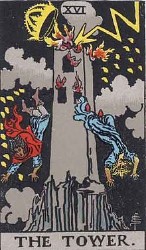
The Lightning Struck Tower

 The Bright Side of Synchronicity

New Age thought frequently recognizes synchronicity as something akin to the flow state—a kind of spiritual alignment where life feels effortless. Everything clicks. We meet the right people at the right time, stumble onto unexpected opportunities, and experience a wave of meaningful coincidences that seem to confirm we’re on the right path. It’s a feeling of being “in the zone,” as though the universe is subtly rearranging itself to support our intentions.

In these moments, synchronicity feels like a gift. A sign that we’re in harmony with some larger intelligence or natural rhythm. And it’s tempting to think that this is what synchronicity is supposed to feel like: smooth, supportive, and sweet.

But that’s only one face of it.

Synchronicity can also appear during the darkest, most desperate moments of our lives—when nothing is flowing, when everything has broken down, and when we feel completely alone.

And yet… it shows up.

Synchronicity in the Darkness

 I learned that synchronicity doesn’t only come when life is smooth. In fact, it can erupt—like lightning from a clear sky—when everything is falling apart.

A few years ago, after the loss of my life partner, I found myself in deep emotional and financial trouble. Her children challenged the probate and stripped the bank accounts. I was in devastating grief, virtually penniless, and desperately needed to sell the house we had shared.

And then the pandemic hit. Real estate offices closed indefinitely, and we were all quarantined for months.

I was suicidally depressed and felt completely hopeless. But in the midst of all that destruction, small miracles kept happening. I was able to see a wonderful therapist who helped keep me alive in the darkness. When I was down to my last bag of rice and a single can of beans, an uncashed check would float up from the back of a drawer. A few pieces of my art sold. I was even able to write a book.

Every time I reached what felt like rock bottom, something—or someone—would throw me a lifeline.

It felt very much like what Sonia Choquette describes in her book, “Ask Your Guides”: a kind of a guardian angel effect. As though some invisible presence was stepping in to help. For the first time in my life, I genuinely felt I was receiving spiritual help.

The Tower: Crisis as Awakening

In the Tarot, The Tower is one of the most feared cards in the deck. It shows a tall, rigid structure being blasted by lightning, flames pouring from its windows, and people falling through the air. It’s a card of shock, collapse, and sudden upheaval—those moments when the structures we’ve built our lives around come crashing down.

But The Tower is not a punishment. It’s a wake-up call.

The old structures fall because they’re no longer sustainable. Illusions, attachments, or false beliefs are struck down by truth—sometimes painfully, sometimes without warning. It can feel like a violent loss of control. But it also clears the way for something real, something truer to emerge.

In many ways, The Tower mirrors what I lived through. My life, as I knew it, collapsed. And yet, that collapse seemed to activate something—a kind of spiritual circuit that had never been switched on before. There was no comfort, no predictability, but there was also an undeniable sense of presence, a guiding intelligence operating just beyond the chaos.

That’s the secret of The Tower: what looks like destruction is often the beginning of liberation.

Jung, Crisis, and the Language of Synchronicity

Carl Jung, who first coined the term synchronicity, believed that these meaningful coincidences were not random at all—but messages from the deeper layers of the psyche, or even the soul. He observed that synchronistic events often intensified during times of emotional upheaval or transformation. In fact, crisis seemed to invite them.

As psychologist Richard Tarnas writes:

“Jung observed that in the therapeutic process of his patients, synchronistic events repeatedly played a role, sometimes a powerful one, especially during periods of crisis and transformation.”

It’s as if the breaking open of the known world allows something greater to break in. When our ego defenses collapse—when we’re too exhausted to pretend we’re in control—an opening appears. And through that opening, insight, grace, and symbolic guidance can flow.

These aren’t just random lucky breaks. They’re messages from the unconscious. From spirit. From the soul.

And often, they arrive only after something old has been destroyed—just like the crumbling tower.

When the Tower Appears in Your Life

If you’re going through a Tower moment right now—where everything seems to be falling apart, where the future is unclear and the ground beneath you feels unstable—I want to offer this thought:

You may be closer to grace than you think.

It’s not easy to see when you’re in the middle of it, but the collapse may be clearing space for something new, something more aligned with who you really are. Synchronicity often doesn’t show up instead of hardship—it shows up through it, like gold veins running through broken stone.

So pay attention.

That unexpected phone call. A book that practically falls into your lap. A dream that won’t leave you alone. A stranger’s words that strike you like lightning. These are more than coincidences—they’re the whispers of the sacred trying to help you rebuild, not what you had before, but what you actually need.

The Tower may shake you. But it also strips away what no longer serves. And in its wake, you may discover a deeper kind of support—one that’s always been there, just waiting for the old walls to fall.