The Five of Cups: When It’s Time to Turn Our Backs on the Past

The Five of Cups is traditionally associated with grief, sorrow, and loss. But what happens when we’re grieving not just a particular event, but an entire lifetime of missed opportunities, childhood wounds, and painful experiences? This exploration of the Five of Cups examines how suffering can become part of our identity, why acceptance is essential to healing, and how turning our attention from the past toward the possibilities that remain can transform our lives. Sometimes the most important step toward happiness is simply recognizing that two cups are still standing.

One of the most familiar images in the Rider-Waite-Smith Tarot is the Five of Cups. A solitary figure stands with his head bowed, wrapped in a long black cloak, contemplating three overturned cups. Behind him, unnoticed, are two cups that remain standing. In the distance, a bridge crosses a river toward a building on the opposite shore.

Traditionally, the Five of Cups is associated with grief, disappointment, sorrow, and loss. It frequently appears in readings involving the death of a loved one, the breakup of a relationship, or some other painful experience.

The symbolism is straightforward enough. The three overturned cups represent what has been lost. The two standing cups represent what remains. The grieving figure is so absorbed in his sorrow that he cannot see the possibilities that still exist.
But I’ve been thinking about this card lately, and it occurs to me that there’s another way of looking at it.

What if the Five of Cups isn’t always about grieving something that happened recently? What if it’s about grieving the life we’ve lived?

And, more importantly, what if it’s about learning to stop grieving that life and begin living the one we still have?

The Grief We Don’t Recognize

When we think about grief, we usually associate it with a specific event. Someone dies. A marriage ends. We lose a job, a friendship, or something else that was important to us.

But there are other kinds of grief that aren’t nearly so obvious.

Consider someone who grew up in a deeply dysfunctional family. Perhaps their parents were abusive, emotionally unavailable, alcoholic, or simply incapable of providing the love and security that children need.

That child experiences some very real losses.

They may lose the opportunity to develop a healthy sense of self-worth. They may never experience the security of knowing that they are loved unconditionally. They may grow up believing that the world is dangerous, that other people cannot be trusted, or that they are somehow fundamentally unworthy of happiness.

And here’s the interesting part.

They may not even realize that they’ve lost anything.

Children generally assume that their family environment is normal. They don’t have another childhood to compare it with. If they’re repeatedly told that they’re worthless, they may simply believe it. If they’re neglected, they may conclude that their needs aren’t important.

Those beliefs can follow them into adulthood.

They may repeatedly choose dysfunctional relationships, struggle with addiction, sabotage opportunities for success, or experience a persistent sense of dissatisfaction without understanding where it comes from.

Of course, not everyone who experiences a difficult childhood develops these problems. But for those who do, the consequences can persist for decades.

And beneath those consequences, there may be an enormous amount of unrecognized grief.

Grief for the childhood they never had.

Grief for the love they never received.

Grief for the person they might have become if circumstances had been different.

In a very real sense, they may be grieving an entire life without even knowing it.
Becoming Aware of the Loss

For many people, the healing process begins with a startling realization.

Perhaps they enter therapy because they’re depressed, struggling with relationships, or experiencing problems they can’t seem to resolve.

As they begin examining their personal history, they discover something they may never have consciously recognized before.

Their childhood wasn’t normal.

The way they were treated wasn’t acceptable. And the things they believed about themselves weren’t necessarily true.

This recognition can be enormously liberating, but it can also be painful.

Suddenly, the person begins to understand just how much they lost. They may become angry at their parents or caregivers. They may feel cheated out of opportunities that other people took for granted. They may experience profound sadness over the years they spent struggling with problems that originated in circumstances beyond their control.

In other words, they begin to grieve.

And that grief is not necessarily a setback. It may be an important part of the healing process. Before we can come to terms with a loss, we generally have to recognize that the loss occurred.

In terms of the Five of Cups, we have to see the three overturned cups before we can understand what they mean.

When Grief Becomes an Identity

Everyone experiences grief differently.

Some people recover from painful experiences relatively quickly. Others require months or years. There is no universal timetable, and the length of someone’s grieving process is not a measure of their character or emotional strength.

But there’s another possibility worth considering.

Sometimes grief becomes so deeply incorporated into our sense of self that it begins to define who we are.

Spiritual teacher Eckhart Tolle has written extensively about the way people construct identities around their suffering.

There’s a significant difference between saying, “I experienced something terrible,” and saying, “I am a person whose life was ruined by something terrible.”

In the first statement, suffering is something that happened to us. In the second, suffering has become part of our identity.

And once that happens, moving beyond the suffering can become surprisingly difficult.

We may become so accustomed to seeing ourselves as victims of our circumstances that we unconsciously continue to interpret our experiences through that identity.

Every disappointment becomes further evidence that life has treated us unfairly. Every failed relationship confirms our belief that we’re unlovable. Every setback reinforces the conviction that happiness is something other people experience.

The original suffering was real. The injustice may have been enormous.

But the identity we’ve constructed around that suffering can sometimes perpetuate its influence long after the original circumstances have ended.

And this brings us back to the Five of Cups.

Look at the figure in the illustration. He’s completely enveloped in his black cloak. We cannot see his face or identify much of anything about him.

For the moment, grief appears to be his entire identity.

He is not simply someone who has experienced a loss. He has become the grieving figure.

The Healing Process

Recognizing the origins of our suffering is an important beginning, but recognition alone doesn’t necessarily resolve it.

There may be years of conditioning to unravel.

We may need to examine beliefs about ourselves that were formed in childhood. We may have to recognize destructive patterns in our relationships. We may need to learn how to establish boundaries, trust other people, or experience emotions that we learned to suppress.

And we may have to grieve.

Not just for the original childhood experiences, but for the consequences that followed us into adulthood.

Perhaps we spent twenty years in an unhappy marriage because we never learned what a healthy relationship looked like.

Perhaps we abandoned opportunities because we believed we weren’t capable of succeeding.

Perhaps we spent much of our lives trying to win the approval of people who were incapable of giving it.

These realizations can be painful. And there’s no reason to pretend otherwise.

But at some point, another question begins to emerge. How long do we want to continue standing in front of those three overturned cups?

That’s not a question about how long someone should grieve. Nor does it suggest that grief can simply be switched off through an act of will.

It’s a question about the direction of our attention and, ultimately, the direction of our lives. Because while we’re examining everything that went wrong in the past, something else is happening.

Our present life is continuing. And the future is approaching.

Acceptance: The Moment We Turn Around

I think one of the most important elements in recovering from grief is acceptance.

And by acceptance, I don’t mean approval.

We don’t have to decide that the things that happened to us were acceptable. We don’t have to forgive people who hurt us. We don’t have to convince ourselves that our suffering was somehow necessary or that everything happened for a reason.

We can look back at our childhood and say, “That was terrible. It shouldn’t have happened. I deserved better.”

All of those things may be absolutely true. But there’s another truth that eventually has to be acknowledged.

It happened. And nothing we do today can change the fact that it happened.

We cannot go back and have a different childhood.

We cannot recover the years we spent in unhappy relationships.

We cannot undo the mistakes we made because we didn’t understand the forces influencing our behavior.

We can learn from those experiences. We can heal many of their consequences. We can change the way they influence our present lives. But we cannot change the past itself.

And perhaps that’s the turning point represented by the Five of Cups.

The grieving figure finally recognizes that the wine spilled from those three cups is not going to flow back into them. No amount of sorrow, anger, regret, or resentment will make that happen.

The loss is real. The past is over. And there are still two cups standing.

The Two Cups That Remain

Here’s something I find particularly beautiful about the symbolism of this card.

The figure doesn’t have to create the two remaining cups. They’re already there.

He doesn’t have to earn them. He doesn’t have to repair the three overturned cups before he’s allowed to enjoy them. He simply has to turn around and recognize their existence.

And what might those two cups represent?

Perhaps they represent the capacity to love and be loved.

Perhaps they represent creativity, friendship, curiosity, pleasure, or the ability to find meaning in ordinary experiences.

Perhaps they represent opportunities that we haven’t yet recognized because we’ve been so preoccupied with what went wrong.

Or perhaps they represent something even more fundamental. The realization that we are more than the sum of the things that happened to us.

Our childhood may have shaped us, but it doesn’t have to define every aspect of our future. Our losses may have changed us, but they don’t have to become our entire identity.

And the years we’ve already lived, however painful they may have been, don’t have to determine how we experience the years that remain.

Of course, turning around doesn’t mean that the grief magically disappears. We may continue to feel sadness about the past. We may occasionally find ourselves looking back at those overturned cups. Some losses may always hurt.

That’s part of being human.

But there’s an enormous difference between remembering our suffering and organizing our entire lives around it.

We can acknowledge what we’ve lost while also embracing what remains. In fact, doing so may be an essential part of healing.

The Bridge to the Future

There’s one final detail in the Five of Cups that deserves our attention.

In the background of the Rider-Waite-Smith illustration is a bridge leading across a river toward a building on the opposite shore.

The grieving figure has his back to that bridge. He’s so absorbed in contemplating the overturned cups that he cannot see the way forward.

And perhaps that’s the ultimate message of the card. The bridge doesn’t lead backward. It cannot take us into the past and give us the childhood we deserved, the marriage we wanted, or the opportunities we missed.

It leads toward something that hasn’t happened yet.

Our future.

And we don’t have to wait until every trace of grief has disappeared before we begin crossing it. We can carry our memories with us. We can acknowledge our wounds. We can continue healing as we move forward.

But first, we have to turn around.

What Does the Five of Cups Want?

In traditional Tarot readings, the Five of Cups is often interpreted as a warning against becoming so absorbed in loss that we overlook what remains.

I think that’s a perfectly valid interpretation. But I also think the card has something much more profound to tell us.

Sometimes the three overturned cups represent a particular disappointment or tragedy. And sometimes they represent an entire personal history of suffering, deprivation, and regret.

Either way, the message is essentially the same. We cannot change what has already happened.

We can recognize it. We can grieve it. We can learn from it. And, in time, we may come to accept it.

But eventually, if we want to experience the possibilities that still exist, we have to redirect our attention toward the life that remains available to us.

The Five of Cups doesn’t ask us to deny our suffering. It doesn’t ask us to pretend that the past was different. And it doesn’t demand that we finish grieving according to someone else’s timetable.

It simply reminds us that our losses are not the entirety of our lives.

Three cups have fallen.

Two are still standing.

And there’s a bridge waiting to be crossed.

At some point, we have to decide whether we’re going to spend the rest of our lives contemplating what we’ve lost—or begin discovering what we still have.
Donald Trump Voodoo Dolls, Recovering from the Election, and the Burning Times

Developing a strategy for dealing with Christian Nationalism and recovering from the trauma of the election.

Well, it’s been a few days since the United States election and many of us are still trying to get over the shock, sadness, and anger of what happened.  Still, it’s important to focus on how we’re going to survive for the next couple of years.  That’s especially true for people who are empaths and intuitives.

IT’S A GRIEF PROCESS

First of all, it’s important to realize that this is a genuine grief process.  Millions of us are experiencing this just as if something we’ve loved deeply has died.  There’s a sense that the America we believed in, the America that we thought we knew and could depend upon, is gone.

If you’ve experienced the death of someone you treasured, you know this feeling.  It’s as if the entire world has tilted off of it’s axis and nothing will ever be the same.  There is deep sadness, anger, and fear.

So the first step is to be as gentle with ourselves as we can be.  Acknowledge and honor our emotions.  Try to do all of the things that a therapist might recommend in the midst of grief.  Stay in the present moment.  Take care of ourselves physically.  Deal with the sadness without descending into depression.  Deal with with the fear without descending into anxiety. Deal with the anger without losing our compassion. 

We have a little over two months to move through the grief and heal our energy.  We need to use that time wisely.

RECOGNIZING REALITY

Healing our energy and staying positive does NOT mean being foolishly optimistic.  We can and we must contribute as much light and love to the collective energy as we can.  That doesn’t mean that we can visualize this election out of existence or immediately change things here on Earth School.  There are some harsh realities ahead and we need to be prepared for them.

IT ISN’T DONALD TRUMP

Donald Trump is a gibbering idiot.  He’s always had serious personality disorders and they’ve gotten much worse.  This is a 78 year male who is morbidly obese, in a constant state of narcissistic rage, and is suffering from dementia.  It’s obvious to any objective observer that he is not going to last for four years in the White House and will either die or be replaced because of mental incompetence.

In a word, Trump is nothing more than a figurehead.  He was used by a political group to seize power in the United States, but he is not in charge of them.  They are extremely intelligent and have planned this meticulously, so there can be no doubt that they know Trump is a paper tiger.

THE CHRISTIAN TALIBAN

The people who are really in charge of this political coup d’état are Christian nationalist extremists.  Many people refer to them as, “the Christian Taliban” because they share so many views with that group.  They are misogynistic to a point where they’re determined to turn women into breeding livestock and take away all of their basic rights.  They are racist, they are xenophobic, and they are fascists.  They have already taken over our Supreme Court and at least one branch of our legislature and now they’ve claimed the prize of the Presidency.  

These are the people who are now running our country and Donald Trump and his supporters mean nothing to them.  

THE BURNING TIMES

Wiccans and Witches refer to the Inquisition as, “the burning times,” in obvious reference to the thousands of people who were burned at the stake.  It’s important to remember that it wasn’t, “only,” witches who were massacred in that period of madness.  It was also Jews, Gypsies, Wise Women, Heretics, and anyone else who didn’t fit in to the mold of, “good Christians.”

We saw a reiteration of that in Hitler’s reign of terror.  The, “norm,” is defined very narrowly as a certain entitled class of people and anyone who is outside of the norm is, “the enemy within.”  Any time that a fascistic movement takes over the rule of a population, they will immediately start weeding out anyone who disagrees with them and they don’t care how brutal they have to be to do that.

IT’S OUR FIGHT, TOO

Am I suggesting that the Christian fascists who have taken over our country are going to start burning people in the public square?  No.  I’m simply saying that – left unchecked – they’re fully capable of it.  

If you’re a Tarot reader, or you like to toss the I Ching or play with Oracle cards, you’re on their list.  It may not happen immediately, but they WILL get around to it.  It’s in their book:

“Thou shalt not suffer a witch to live.” – Exodus, 22-18

They will first go after the marginalized minorities and the people who are powerless, but they will eventually go after us, as well.

SPIRITUAL WARFARE

I have no doubt that a certain number of my brothers and sisters here have already unpacked their black candles and voodoo dolls and are busily sticking pins into Donald Trump effigies.  That’s certainly one way to approach the coming threat and I totally understand it if that’s where you’re at.

The problem, though, is that you can’t be an empathic person or an intuitive and carry hatred in your heart at the same time.  Not for long.  It’s not our energy.  It’s not our essence at our core. It will eventually destroy who we are rather than change who they are.

A STRATEGY FOR RIGHT NOW

At this moment, there are only 4 things that we can do:

1 – Heal – Give ourselves time to heal psychologically and spiritually.  If our basic energy is fucked up, we’ll be much less effective when we need to be.

2 – Think and Ask for Guidance – We are much more creative than they are.  We need to come up with new solutions for dealing with this new reality and I have every confidence that we will.

3 – Stand Up and Speak Out – We can’t let this temporary loss silence us.  They are planning to start setting up concentration camps in our country in about two months and that’s just the beginning.  We have to speak out against every single injustice and atrocity that they have planned.

4 – Love – Yes, I understand that getting our heads and hearts into a place of love right now is extremely difficult.  Think of it as energy, though.  The collective unconscious has been filled with a flood of hatred and the ONLY spiritual antidote to hatred is love.  That doesn’t mean we need to go out and hug a Trumpster or even try to send healing to them.  It does mean that we need to generate as much love in our hearts, our auras and our environments as we possibly can as a counter force to their energy.  If they’re the disease, we’re the cure.

And finally, I would just like to say, “Namaste’” to all of you who are reading this.  That translates as, “I bow to the sacred within you.”  Let’s keep that sacred light burning bright.

PEACE AND LOVE – DAN

The Chariot, Choices, and Man in the Moon Epaulettes

Choosing new lives after devastating loss.

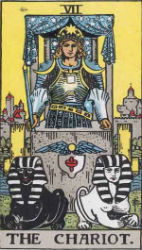
I’ve always loved the way that the guy is dressed in The Chariot Tarot card.    I mean, what a spiffy outfit!  He’s got a crown with a star on it, his very own scepter, and he’s rocking a sort of a skirt with all of the signs of the zodiac on it.  And the pièce de résistance is those wonderful Man in the Moon epaulettes. I mean, this is a guy that, if we saw him walking down the street, we’d definitely be impressed with how put together he is.   Not to mention his bold sartorial choices.

Of course, there’s a major wink in this card.  When we look at the two sphinxes that are pulling the chariot he stands in, we realize that (a) they’re sitting down; (b) they’re facing in opposite directions; and (c) there are no harnesses or reins attached to them.  In other words, the Charioteer, despite his glorious finery, is going nowhere any time soon.

The reason he’s not cruising is a matter of choice, and I don’t mean that he’s chosen not to move.  He’s psychically paralyzed.  The black and white sphinxes represent duality. The second that duality comes into the picture, we’ve got choices to make.  Should I go right or left?  Should I get this job or that job?  Should I get married or stay single?  Should I follow the Yellow Brick Road or just hang here with the Munchkins?

When we suddenly have too many choices, we can become frozen in place, like the classic deer in the headlights.  Which is ironic, because for so much of our lives we bitch about NOT having any choices.  We’re stuck in a dead end job.  Or we can’t leave a toxic relationship because we’re worried about the kids.  Or we’re living in a town we hate but we don’t have the money to move.

If only . . . if only . . . we had a choice.  Things would be different.  Life would be good.

Now, when our lives suddenly blow up – and I mean really blow up – we may not have much left.  If we go through a devastating divorce or our partner dies or we lose all of our money, we’re left standing there with nothing.  The one thing we DO have left is choices.  

It sounds paradoxical, because when we, “lose,” everything, we feel powerless.  We feel as if all of our usual, reliable resources have been stripped away from us and we have nothing left to work with.  Oddly, though, we find out that we have much more to work with than we did before we lost everything, and that’s because we suddenly have choices.  As Kristofferson said, “Freedom’s just another word for nothing left to lose.”  When we lose everything, we can actually be free, perhaps for the first time in our lives.

The Chariot is a wonderful metaphor for how we traverse our lives in ordinary times.  We may not actually be going anywhere, we may have no sense of direction, we may feel that our lives lack any real meaning, but by god we’re well dressed.  Before we step out into the world every day, we make sure our crowns are on straight, our zodiac skirts are clean and pressed, and we have a firm grasp on our scepters.  We may be, “leading lives of quiet desperation,” on the inside, but we see to it that our outsides are impeccable.

We’re standing there in our glorious, glittery chariots that we call our lives and – BOOM – we get fired or we come home and find our wife/husband shtupping our best friend or we get run over by an out of control ice cream truck.  Suddenly we’re lying there in the ditch with our crown all bent to hell, our scepter broken in two and our epaulettes torn off.

And, of course, we’re filled with immense grief for all that we’ve lost.

One of the first things that happens in the grief process is that we try to pretend that everything is normal.  Nora McInerny talks about that in one of her videos on grief. In a period of just a few months, her father died, her husband died and she had a miscarriage.  When friends and family would ask how she was doing, her constant refrain was, “I’m fine.  I’m alright.  I’m perfectly fine,” though she was shattered inside.

So basically, our first impulse is to pick ourselves up out of the ditch, dust off our zodiac skirts, glue our scepters together and put our bent crowns on our heads.  We’re fine.  Perfectly fine.

That works for some of us, after a fashion.  If we get our outsides together, then we can reassure ourselves that our insides must be okay, too.  Hey, I’m going to work, I’m paying my bills, I eat meals . . . sort of . . . so I must be okay.  Our friends and family will shine that back at us, too, because they really, really don’t want to deal with us NOT being okay.  Right around the six month mark after a death they’ll start to be worried and say something like, “Look, isn’t it time you start to get over this?  Maybe get out and meet someone?  You know . . . get on with your life?”

For many of us, though, that doesn’t work.  We know that the crown is never going to fit on our heads again, the goddamned scepter won’t stay glued together and our Man in the Moon epaulettes are in shreds.

At first blush, that can feel incredibly overwhelming, because there’s a realization that so much of what we used to call our lives was total bullshit.   If everything that we thought was so solid, so dependable, so . . . normal . . . can be taken away in a flash, then it wasn’t worth much to begin with, was it?

Then we enter into another phase of the grieving that can be just as painful as the first, shocking, phase, which is, “what do I do now?”  How do I put my life back together in such a way that it can’t be exploded into pieces by the next shit storm that blows through?  We have to make choices.

That secondary phase can be agonizingly slow and filled with crushing anxiety.  Like the Chariot, we can end up frozen in place for months, perhaps years. Just the realization that we made SO many wrong choices in our previous, pre-disaster lives, can render us terrified of making any choices now.  How do I not screw this up again?

The ironic thing is that eventually it turns out that even the idea of making new choices is bullshit.  There’s a new self that begins to emerge spontaneously and, much like the birth process, it shouldn’t forced and it can’t be stopped.  The new self is kinder, more compassionate, more loving, more patient, more authentic.  And a lot less concerned with how our crowns fit.

It was there all along, just waiting for the right circumstances to be born.  

The Buddhists talk about it in terms of, “original nature.”  They say that we each have an incredibly beautiful gem inside of us that’s covered with common rock.  As we chip away at the rock, we gradually reveal the jewel that is our real selves.  Sometimes it may take decades of patient meditation and practicing loving/kindness to reveal it.  Sometimes it just takes getting run over by an ice cream truck.