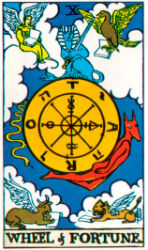

The Wheel of Fortune and Flowing with these Strange Rhythms

This post explores the deeper meaning of The Wheel of Fortune Tarot card and its connection to the Kybalion’s Principle of Rhythm. Life’s ups and downs are not random but part of a greater pattern that ultimately arcs toward the positive. Discover how to maintain perspective, rise above collective fear, and navigate dark times with love, compassion, and inner strength.

Let’s face it: we’re all a little exhausted from the constant insanity in the world right now. Whether you’re right, left, or middle-of-the-bird, it can feel like we’re adrift in a sea of chaos. When it goes on long enough, we start to lose our perspective and wonder if things will ever be “normal” again.

The message of The Wheel of Fortune is that everything passes and everything changes. The people who are at the top of the wheel right now will eventually be cast down, and the people who are at the bottom will eventually be elevated again.

Life is always cyclical — and this, too, shall pass.

The Principle of Rhythm

As I discussed in my book about The Kybalion, Western Occultism calls this The Principle of Rhythm. Here in Earth School, everything is rhythmic, and we only have to open our eyes to see it.

The tides come in and then go out.

The Moon waxes and then wanes.

Life explodes into the richness of spring and then recedes into the cold bleakness of winter.

Even great nations expand and then ultimately diminish into shadows of what they once were.

Everything rises and falls — and then rises again.

The same principle applies to human beings and all our affairs. We may have a string of incredibly good luck and then a period where we can’t buy a break. We may feel joyously happy for a while and then deeply depressed and anxious before we find our way back to happiness. We may fall deeply in love with someone and then end up despising them.

The Pendulum

The Kybalion envisions this process as the pendulum of a clock. It swings to the left, and then it swings to the right. And as the Principle of Rhythm states: “The swing to the left is always equal to the swing to the right.”

Modern science recognizes this in Newton’s Third Law of Motion: “Every action has an equal and opposite reaction.”

When we think about human life, we can see it in terms of alternating energies. We may go through incredibly negative periods — full of stress, sadness, and anxiety — only to be followed by times of great happiness, when everything seems to go our way.

We may have moments where we’re counting quarters to buy groceries, followed by periods of real abundance when the cash flows in like a river.

The collective energy of politics follows the same law – a hard swing to the right is inevitably followed by a hard swing to the left. Hatred is eventually replaced by compassion.

But It’s Not a Closed System

If that was all there was to the rhythms of life, it would be a pretty depressing scenario. It would feel like: “Okay, things are going well right now, but I can’t really enjoy it because it’s all going to turn to shit again.”

If life were nothing but good/bad/good/bad — ad infinitum — it would be the spiritual equivalent of one step forward and one step back. We’d be living, but not progressing. Stuck in an endless cycle of growth and degeneration. A closed system where nothing ever really improves.

The good news is that, as The Kybalion puts it, “nature favors the positive.” Positive energy will always overcome negative energy. Love will always be stronger than hate. Compassion will always conquer cruelty.

Put another way: yes, as long as we’re in Earth School, the pendulum will appear to move equally in both directions. The truth, though, is that it’s always arcing just a little more toward the positive — whether we can see it or not.

So What Should We Do Right Now?

We are, right now, in dark times. As Asha Nayaswami says in this wonderful video, there is demonstrable evil in the world, and some humans are acting out their darkest impulses.

So how do we deal with that? What should we do right now?

The advice of The Kybalion is to “rise above it.” We can’t control the Principle of Rhythm or the turns of the Wheel of Fortune. Those are built into the fabric of Earth School. We don’t have to be swung by the pendulum, though. We can rise above it spiritually.

What we can control is our reaction to it. We can make a conscious effort not to be swept along in the collective energies of hatred, fear, and anger. We can maintain our own little bubbles of love and compassion and keep putting out as much positive energy as we can.

As Nayaswami says, that doesn’t mean we become spiritual doormats. It doesn’t mean we avoid confronting evil when we encounter it. It means we confront it with truth, with as much gentleness and understanding as we can muster, and that we refuse to join it in any way, shape, or form.

Perspective

Above all, it means maintaining perspective. Keep your eyes on the horizon, not just on the dirt road full of potholes. Remember that the pendulum will swing back in the opposite direction.

When it does, life will not only be positive again — it will be more positive. People will learn from these experiences, and they’ll use that knowledge to build a better world.

We just have to be patient… and wait for the wheel to turn.

“Just the Tarot,” by Dan Adair – a kindle ebook available on Amazon.

Beyond Isolation: How Introverts Can Truly Recharge

A look at creating healing solitude.

If introverts had a battle flag, it would probably have The Hermit card printed on it.  We absolutely love to withdraw into our own cozy little shells and let the world turn without us participating in it.

So, we’ve finally canceled our plans, turned off our phone, and settled into solitude. But after hours of scrolling or zoning out, we still feel drained. What gives?

THE MYTH OF THE INTROVERT RECHARGE

Introverts often mistake social withdrawal for true recharging but miss the neurological component (acetylcholine release) that actually restores their energy.  Just sitting at home is not going to refresh or restore us, although that’s where we need to begin the process.

DOPAMINE VERSUS ACETYLCHOLINE

There are, of course, about a kazillion different chemicals and hormones doing a tango in our busy brains at any given time.  For purposes of this discussion, though, let’s focus in on just two of them, the neurotransmitters called dopamine and acetylcholine.  And let’s just call them, “happy juices,” because they make different people happy in different ways.

Our brains discharge dopamine when we’re exposed to a lot of social stimuli like loud music, parties, crowded shopping malls and lots of other people.  Extroverts actually have many more, “receptors,” for dopamine in their brains than introverts do, so they can soak up an ocean of it and it makes them really happy campers. They feel jazzed, excited, and alive.

Since introverts can’t absorb a lot of dopamine, it basically kicks our asses.  For us, it’s like drinking six cups of really strong Espresso – it makes us jittery, nervous, and quickly worn out.  It’s introvert poison.

Acetylcholine, on the other hand, gives our brains a mellow, quiet buzz.  It’s less like ecstatic dancing at a concert and more like snuggling into a warm bed with nice clean sheets.  It’s quiet and peaceful.  Introverts love it and it drives extroverts crazy with boredom.  It’s our happy juice.

THE ISOLATION TRAP

Now,  since too much dopamine makes us feel like crap, it’s perfectly natural to think that just getting away from situations that cause dopamine will make us feel ever so much better.  After all, if too much, “peopling,” is wearing us out, then non-peopling should recharge us.

So, we fill the moat around our introvert castles with alligators, pull up the drawbridges, and put up a big sign that says, “GO AWAY!”  Free at last!

Unfortunately, by that point, we’re frequently so worn out that we just sit there staring out the window, doom-scrolling on our computers for hours, or binge-watching NetFlix.  Those are what therapists call low-nourishment activities because they don’t do anything to feed our emotions or bodies.  And, specifically with introverts, they don’t feed us any acetylcholine to make our brains happy.

PLANNING FOR A BRAIN BOOST

A good question for introverts to ask when we’re planning for our recharge time is, “Will this activity leave me feeling nourished or merely distracted?” We know that there are specific, fairly low energy activities that refresh and recreate us by increasing acetylcholine production.

Reading and Deep Learning: Encourages relaxed but engaged attention.

Mindfulness Meditation or Breathwork: Activates the parasympathetic nervous system, reducing cortisol and boosting calm focus.

Creative Flow States: Writing, drawing, or music allow for contemplative immersion.

Nature Walks or Gentle Movement: Combines physical and sensory stimulation with mental quiet.

MINDFUL INTENTIONS

Another way of putting that is that we need to be intentional with our solitude.  We need to design an Acetylcholine-Rich Hermit Phase.  We can learn to structure our alone time for maximum benefit.

Conscious solitude planning: Schedule blocks for purposeful recharging activities instead of just avoiding people.

Minimize mindless distraction: Replace passive screen time with meaningful, immersive solo activities.

Create mini rituals: Tea-making, journaling, or slow stretching to ease into relaxation.

And, hell, if we’re not quite ready to jump into being Zen Master Introverts, we can combine some of those activities.  Maybe do some Tai Chi while we’re bing-watching Netflix.

REDEFINING OUR SOLITUDE

We’re all different, of course, and introverts tend to be really different.  For me, painting, writing, or meditating brings on that acetylcholine recharge.  For you, it may be gentle dance motions, working in your garden or reading a good book. For others it might be sitting in the sunshine sipping a cup of tea.

The point is that we all know what makes us feel good.  For an introvert it’s like a lover gently kissing the back of your neck or touching your cheek with her finger tips.  It’s sweet, it’s calm, it’s gentle, and it makes us feel better almost instantly.  Those are the activities that we want to build into our solitude.

Yes, we need to get away from other people on a regular basis, but simply being alone isn’t the answer.  Living in intentional, mindful, loving solitude is what makes us whole again.

The Five of Wands, Louise Hay, and Becoming the Grown Up Who Lives in Our Heads.

A look at childhood programming and using affirmations.

If I were to say, “Your thoughts are total bullshit,” you’d probably feel highly insulted.  On the other hand, if I were to say, “My thoughts are total bullshit,”  you might agree with me or you might tell me that’s not true and wonder where I got such a terrible self-image.

But if I were to say, “A lot of OUR thoughts, as human beings, are total bullshit,” that’s a more fertile ground for discussion simply because it depersonalizes it and takes us out of a fight-or-flight reaction.  We don’t have to defend anything or run away from being criticized.

In, “You Can Heal Your Life,” Louise Hay made the point that, at their base, our thoughts really mean nothing at all.  They’re just words that we string together and they don’t take on any meaning by themselves.  We have to ASSIGN meaning to them.  We have to say, “I believe these thoughts are true.”

And, oddly, our beliefs are nothing more than thoughts that we’ve repeated over and over and over until we believe that they’re true.  When we take a little closer look at those thoughts we can understand exactly why so many of them really are bullshit.

First of all, a lot of our thoughts were, “installed,” in our little brains when we were far, far too young to make any rational judgements about their validity.  By the time that we reach late adolescence most of us have been thoroughly programmed with unexamined thoughts that we believe to be true.  The richest source of the programming is our families, of course, but we get a hefty dose of it from our teachers and peers, as well.  Some of those thoughts might be things like:

I’m no good at math.

I can’t dance.

I’m a terrible athlete.

I’m not very good looking.

I’m too fat or too skinny or too tall or too short.

I don’t fit in.

Nobody likes me.

Or the thoughts might be something like:

Democrats are communists.

Republicans are fascists.

Rich people are heartless.

People who don’t practice my religion are evil.

Black people are scary or white people are arrogant honkies.

Immigrants are too lazy to work AND they’re going to steal my job.

These are all just words, strung together to make thoughts, which were repeated over and over when we were young until we came to believe that they must be true.

The truth of these beliefs were totally unexamined when we were kids because we didn’t have the mental capacity to evaluate them.  If our parents or teachers told us they were true, well then – hey –  they must be true because that’s what the grownups said. For the most part, though, they remain unexamined when we’re adults, which is the second reason that many or our thoughts are total bullshit.

Most of our thoughts are subliminal, which literally means, “below the light.”  In this case, we mean, “below the light of consciousness.”  We just think them, without even being aware of the fact that we’re thinking them.  That’s the infamous, “stream of consciousness,” or, “monkey mind,” that engages about 20 seconds after we wake up in the morning.  It’s just a ceaseless chatter that runs along by itself and contains – buried in its content – all of that programming that we got as kids.  It sounds like this:

Gotta get the coffee going, godamn it’s cold, I wonder if I have enough gas in the car, should have balanced the checkbook but I’m no good at math, gotta get the kids up and make breakfast, can’t believe the price of eggs, it’s the rich Republicans driving the prices up, nobody cares about working people, if only I had a better job but I’m not smart enough to get a better job, where are my socks . . .”

The unexamined thoughts that were programmed into us when we were kids are running over and over again, all the time, and remain unexamined.  And, yes, thoughts that are repeated over and over become beliefs and, like the people in the Five of Wands, we’ll fight to the death to defend our beliefs.

Which is the third reason that most of our thoughts are bullshit.  We’re totally ego involved with them.  Most of us, most of the time, completely identify with that subliminal thought stream.  We experience it as, “These are MY thoughts in MY mind, therefore, they’re a part of me.”  It never occurs to us that they’re not really our thoughts.  They’re our parent’s thoughts and our teacher’s thoughts and maybe even the thoughts of that bully who tortured us at recess in the third grade.

Affirmations, as Louise Hay points out, are a simple way to step out of that thought stream and start changing our beliefs by changing our thoughts.  Let’s face it:  most of don’t have the time to just sit there all day and watch our thoughts.  “Ah HA!  There’s another negative thought from my childhood programming!  Take THAT, negative thought!”

What we can do, though, is to become a little more conscious of our thought streams.  Even when we’re working or driving to the store or taking a shower, we can watch the mind chattering away and consciously think, “Okay, that’s a pretty negative thought,  And it’s probably not MY thought; it’s just something my mind was taught when I was a kid.”

When we begin to dis-identify with that constant stream of thoughts, we immediately lose the need to defend them.  After all, they’re not really my thoughts, so why should I care about them?  And then we can begin to replace all of that subliminal programming with programming that we consciously choose.

Just pick a positive thought – any positive thought – and repeat it 3 or 400 times a day.  Does that seem like a lot?  Well, how many times a day do we say something negative to ourselves with that childhood programming?  Hundreds of times, right?

If that sounds like a sort of a forced, Pollyanna Positivity it’s because it is. We are quite literally pushing our thoughts in a new direction and it can feel completely unnatural to begin with.  But that’s the whole point:  there’s nothing, “natural,” about our unhappy beliefs, either.  They were just thoughts that were repeated again and again, often by the miserably unhappy adults who raised us.  That’s all that happy beliefs are, too – thoughts that are repeated again and again until they become beliefs.  And we get to be the adults who are repeating them, which is pretty cool.

The Fool, Flowing into Fun, and Making Wu Wei Our Woo Hoo

A look at Flow State as a spiritual practice.

Most people know about being, “in the Flow,” also known as being, “in the Zone.”  It’s that feeling of engaging in an activity with such concentration and perfection that it’s as if we somehow become the activity and the activity becomes us.

Dancers and athletes talk about being in the Flow when they turn in a performance that’s absolutely flawless and they somehow go far beyond what they’ve ever been able to do before.  Artists and writers have the same sort of an experience when they plunge so deeply into their work that it’s almost as if the painting is painting itself, or the page is filling itself with beautiful images.

One of the fascinating things about Flow state is that the world seems to disappear for a while.  There’s nothing in our consciousness except the activity that we’re engaging in.  It’s like a trance. Painters will frequently start a painting and then, “wake up,” six hours later, having lost all track of time, their environment, and anything else but the surface of the canvas.

Oddly, we see very much the same phenomenon with people who are plagued by ADHD.  They may spend most of their lives jumping from one activity to another, unable to focus or stay on task for more than a few minutes.  When we take those same people, though, and sit them down in front of a video game, it’s a very different story.  They go into a state of hyper-focus and will frequently become so immersed in the game, so ultra-concentrated, that they may not leave it for hours.  They’re in a trance and the world has disappeared.  They’re in the Flow.

Hungarian psychologist Mihal Csikszentmihalyi first noted the Flow state in 1975, but Taoism pegged it centuries ago and calls it, “Wu Wei.”  Wu Wei can be translated as, “inaction,” or, “doing nothing,”  but a closer definition is, “effortless action.” Which is exactly how we feel when we’re in the Flow.  We feel that we’re completely in synch, in the groove, in harmony with whatever activity we’re engaged in and it becomes totally effortless.

Now, a lot of Westerners have had trouble with the idea of Wu Wei, because they glom onto the idea of just doing nothing, rather than doing something effortlessly. As lovely as it can be, sitting on a beach dangling our toes in the water is NOT Wu Wei.  

We are in the Flow state when we are involved in an activity for which we have some skill.  When we’re doing something completely. Somehow in that process our ego disappears, our environment disappears, and our sense of time disappears, which is pretty much the definition of a transcendent spiritual experience.

To put it another way, we’re co-creating with the Universe.

Mike Dooley hints at that process when he’s talking about the art of visualizing and manifestation.  He says that the Universe acts as a sort of a GPS system that guides us to our goals, constantly popping up directions and resources to get us where we want to go.  BUT . . . we have to actually start the car before the GPS system starts to work.  We have to get our asses in gear and move before the Flow state happens.

The closest that the Tarot gets to portraying that state is The Fool.  The Fool is dancing along at the edge of a cliff, so absorbed in his joy that he really doesn’t even see the precipice.  The message of the card is that even if he dances off of the edge he’ll just go on dancing on air.  He’s in the Flow.

The neat thing about all of this is that, when we look at being in the Flow AS an act of co-creating with the Universe, then it becomes a spiritual practice.  It becomes a way of communing with our higher powers or spirit guides or angels or whatever we want to call them.

All we have to do is to figure out what gets us into that state of Flow and DO IT.  It can be almost anything.  It can be painting or writing or dancing or gardening or cooking or having incredible, mind-blowing sex.  It’s just a matter of thinking about what activities come the closest to putting us into that trance state.  What is it that, when we do it, the world disappears for a while, time stops, and we completely forget our egos?

Once we identify the activity – and we all have at least one – then we build it into our lives more and more.  Every time that we engage in our particular Flow activity, we form a stronger and stronger bond with our higher powers and our higher selves.

And it’s fun.  It’s lots and lots of fun.

EMPATHS, EARTHING, AND MEDITATING CODEPENDENTS

Staying grounded as an empath.

So I just received my Amazing Hooga Earthing Mat from the very nice UPS driver and I should be incredibly spiritual after just a few days of using it.  

The basic theory behind them is that our energy systems get in a kerfuffle because we’re exposed to negative people, places, and things and, when we walk barefoot on the Earth, it restores our systems to their natural, harmonious balance.  Earthing Mats simulate that very same energy and get our auras all fluffy and pretty again.

I decided to get one because I’ve recently become aware of the fact that it is of tantamount importance for empaths to stay thoroughly grounded.  If we don’t, we start to dissolve like a piece of salt in the rain.  Earthing is a dandy way to avoid that.

EMPATHS AND EMPATHY

Being an empath is sort of hard to describe to a, “normal,” person.  First of all, of course, being an empath is not equivalent to being empathetic, although most empaths are highly empathetic.  An empathetic person might sympathize with another individual to a point where they can imagine what the other person is feeling and thinking.  Empaths actually experience what the other person is feeling in real time.

Empaths are also not psychics, although most psychics are empaths.  A psychic will focus on another person, “read,” their energy, their emotions and their thoughts, and then weave all of that into a coherent meaning, much like telling a story.  Empaths, on the other hand, are simply bombarded with information about the other person without really knowing what it all means.  We automatically glean far more details about the other person’s energetic and emotional state than what’s on the surface, but we don’t necessarily know how to put it all together.

To make it even more confusing, there isn’t just one type of empath.  There are empaths who actually hear what other people are thinking.  Other empaths feel other people’s emotions as they occur.  Some are telemetric empaths who, “get a reading,” merely by touching a piece of clothing or jewelry that someone else has owned.  A few empaths are highly attuned to the feelings of animals, but won’t pick up anything from other human beings.  Precognitive empaths may get very strong insights about what’s going to happen to a person in the future.

EMPATHS AND EGO STRUCTURE

One thing that all empaths have in common is a relatively weak ego structure.  It makes perfect sense, when we think about it.  Our ego is our sense of who we are, and the first part of knowing who we are is knowing that you’re over there and I’m over here.  Your, “you,” starts with your skin and all of your emotions, energy, and thoughts reside inside of your skin and all of mine reside in mine.  The only way that another human could possibly know what we’re thinking is if we tell them.

Which is very much not true for empaths.  For an empath, what’s going on in the other person’s mind is also going on in our minds, simultaneously with what WE’RE thinking.

All of which can make for a very confusing state of affairs, because we’re never quite sure which part of the conversation is ours and which part is yours.  For an un-grounded empath, there really ARE no significant boundaries or borders.  

There’s an old Spanish expression which goes, “Mi casa, su casa,” or, “My house is your house.”  Now change that to, “My brain is your brain,” and you get an idea of how truly weird it can be for an empath to hold a simple conversation.  Most empaths have to sit quietly after a meaningful exchange and decode exactly what thoughts came from which person.

EMPATHS AND CODEPENDENCY

One of the ways that the weak ego structure of empaths shows up is in codependent behavior.  Codependents tend to revolve around other people, much like the moon revolves around the earth.  Sometimes that’s a result of having been raised in an alcoholic or abusive family.  Sometimes it’s because we have a particular personality type.  And sometimes it’s because we’re empaths who haven’t learned to separate ourselves from other people.  

What happens with empaths is that we become enmeshed in the other person’s energy, in their thoughts, emotions, and their life patterns.  Since empaths already have a weakened sense of boundaries, they can easily dissolve into a more dominant person’s energy system.  In essence, they become overwhelmed and end up as bit players in someone else’s movie, instead of starring in their own.  They not only feel the other person’s emotions, they become the other person’s emotions.

EMPATHS AND MEDITATION

Empaths also need to be very careful about the type of meditation they practice.  

Many types of meditation are geared toward weakening the ego structure.  We’re basically trying to get past that chattering mind stream that prevents us from truly relaxing into deep meditation.  Those techniques involve what’s referred to as a, “bare awareness,” method, where we might focus on our breath or a mantra, or a candle flame, until the chattering mind calms down and recedes into the background.

BUT . . . studies have increasingly shown that meditation is highly correlated with PSI or psychic abilities.  If we tritty trot off to a meditation center for a two week retreat, we’re probably going to be more psychic coming out of it than we were going in.  For a normal person, that involves a significant decrease in ego control and, “becoming one,” with the universe and our fellow humans.

An empath, though, is already wide open and our challenge lies in shutting down some of that in-flow of information.  Deep meditation can destroy whatever barriers we’ve managed to erect and leave us completely adrift in other people’s energies.

Mindfulness meditation seems to be the, “go to,” method for empaths.  It’s a constant reminder to stay in our own bodies in the present moment and to separate from all of the drama out there.

THE EIGHT OF WANDS

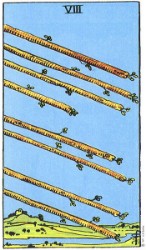
Being an empath can feel very much like the Eight of Wands looks.  Wands represent ideas and this card shows inspired ideas raining down from heaven.  For an empath, though, the ideas may be far from inspired and not at all our own.  

If everyone we met was in a perfect, loving place, being an empath could be pure heaven.  We’d just walk around grinning while all of those good vibes poured straight into us. Unfortunately, that’s far from the current state of affairs and a tremendous amount of what we absorb is toxic.

The answers for empaths seem to be strengthening ego structure, not weakening it.  Building boundaries and borders, not letting them down.  And, above all, staying grounded.  Which we can begin to do by planting our tootsies firmly on the Amazing Hooga Earthing Mat.

Time Travelers, Blackberry Salmons, and Babies in Sunbeams

Religious concepts of time and the destruction of mindfulness.

I love Eckhart Tolle’s statement that, “it’s never not now.”  

It’s totally true, but we really have to bend our minds a lot to get into that space.  It’s not too difficult intellectually, because we can look at it rationally and realize that there really is no past (except in our heads) and there really is no future (except in our heads.)  I mean, it’s not like there’s some Past Land, like a Disney adventure ride, that we can go visit.  IT DOESN’T EXIST. Ditto with the Future, because all that it really consists of is our projections of what we think will probably happen.  Maybe.  Could be.

Despite that, we humans spend a MASSIVE amount of our lives Time Traveling to the future or the past and very little time in the Now.  Put another way, we use a lot of our mental space living in something that doesn’t even exist and, as a result of that, we spend very little time existing in the space that actually does exist.  We’re so bad at living in the Now that we actually have to take mindfulness classes to learn how to do it.

So how in the hell did this sorry state of affairs come to be?  We should find the person responsible for this and give him a good thrashing.

Oddly, the answer seems to be that it was our old buddy, Organized Religion, that did it.  In the Tarot, organized religion is represented by The Hierophant and The Hierophant has rules and regulations that we’re all supposed to bend our knees to.  One of his Big Rules is about time and it says, “There isn’t enough of it.”

Now, probably the original way that humans experienced time was sort of like this: 

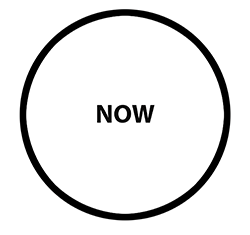
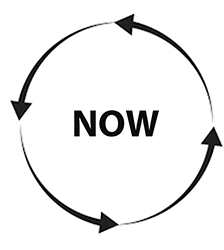
There was just a big NOW, with no concept of the past or the future.  We just sat there in the bliss of the present moment soaking it all in.  Or it might have been a little bit more like this, where one NOW moment just led into the next NOW moment. No concept of past or future, just NOW.

That’s much the way that babies seem to experience time.  They can lie there for hours staring at a sunbeam and not get worked up at all about what the sunbeams are going to look like tomorrow or worry about what the sunbeams were like yesterday.

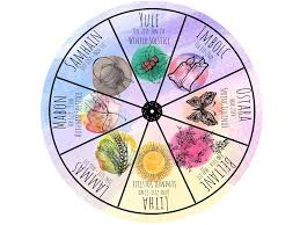
At a certain point in our evolution, our experience of time probably shifted more into the model we see with the Wiccan Wheel of Time.  

We started to notice the cycles of the Moon and the passing of the seasons.  There would have been some recognition of certain times of the year but not a great deal of worry about it.  The Native Americans of the Northwest expressed it in terms of activities.  “This is the time when we gather berries.  This is the time we catch salmon.  This is the time when we plant seeds.”  And so on.

Still, there was none of the huge anxiety that we seem to feel about time today.  Tribal people didn’t sit around their camp fires filling in dates on a calendar or trying to figure out how to, “use their time more productively.”  They just did what they needed to do when it was the right time of the year to do it.  “Hey, I’ll bet some fried salmon would go great with these blackberries!  We should probably stack up a little fire wood while we’re at it because it’s going to get cold sometime soon.”

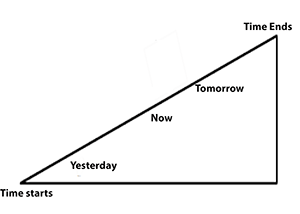
Unfortunately, while the Native Americans were sitting around having fish fries and enjoying their blackberry cobblers, humans in the Middle East were coming up with an entirely different concept of time, which historians refer to as the, “inclined plane,” model.  The reasoning behind this model of time ran very much like this:

  1. – If time exists, then there must have been a BEGINNING of time, because . . . you know . . . there just must have been.
  2. – And if someone, “started,” time, then it must have been someone who was OUTSIDE of time and that would be someone who was eternal and that would be God.
  1.  -And if there was a start to time, then there must also be a stop to time, which is when the world ends and God will do that, too, so I think we should call it The End Times.

Okay, so it wasn’t the best piece of human thinking that we’ve ever seen, but they didn’t have Google in those days so they couldn’t really look things up.  It also represents a HUGE shift in human perception and one that we’re still suffering from today.  All of a sudden, time looks like this:

So time has suddenly become a quantity, rather than a quality. It begins and it ends.  We can measure it, we can put it on calendars, we can plan it, we can carry it around on the daily planners of our phones. Shazam! – we have the concepts of the past and the future, of yesterdays and tomorrows.  We see this notion of time-as-a-quantity deeply ingrained in our languages.

I need to SPEND some time on that.

I’m not sure I want to INVEST that much time in it.

Time’s a WASTING.

This should be a real time SAVER.

I need to ORGANIZE my time.

We’re RUNNING OUT of time.

I’ll PAY you for your time.

When we look at all of those statements, the basic message is that THERE ISN’T ENOUGH TIME, goddamnit!  Which, of course, is ridiculous, because there’s all the time in the world.  Literally.

We’ve been so totally hypnotized by the religious concept of time that we  can’t imagine a world without it.  We’ve devolved from that perfect bliss of a baby tripping out on the sunbeams into beings who are missing our own lives because we’re constantly living in the past or in the future.  The only cure for it seems to be to re-train our brains back into living in the NOW through mindfulness meditations and living mindfully.

I mean, you know, if we can schedule the time for that.  I’ll have to look at my calendar . . .

Just a reminder that there is ALWAYS time to read my ebook, Just the Tarot, and it’s still available, dirt cheap, on Amazon