The Moon is traditionally one of the more unsettling cards in the Tarot.
Illusion. Confusion. Deception. Uncertainty. Blurred reality. Things are not quite what they seem.
Those are perfectly good definitions, but they leave us with a question: Why? Why does the Tarot choose this particular collection of images to represent those ideas?
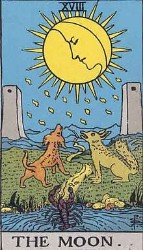
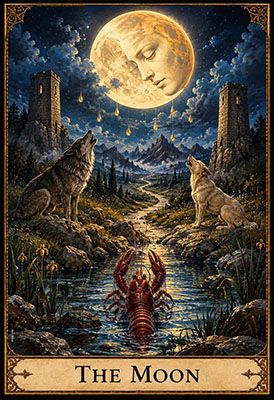
There is a pool of water with a strange crustacean crawling out of it. A dog and a wolf howl at the Moon. A road passes between two towers and winds away through an empty landscape. Strange drops of energy fall from the sky.
And above everything hangs an enormous Moon containing a human face.
Perhaps the key to understanding the entire card is right there.
The Moon’s eyes are closed.
THE DREAMING MOON
Look carefully at the Moon’s face. It isn’t screaming or displaying terror. It appears troubled, perhaps even melancholy, but its eyes remain firmly closed.
Nighttime. Moonlight. Closed eyes.
The Moon is dreaming. And perhaps it isn’t experiencing a nightmare so much as a troubled dream—the kind in which uncomfortable material from somewhere below consciousness begins working its way toward the surface.
That gives us a very different way of approaching the card.
During ordinary waking consciousness, we maintain a reasonably firm distinction between the world outside us and the world inside us. We distinguish memories from present events, imagination from observation, fears from facts.
Dreaming changes all of that.
The boundaries become porous. Memories mingle with fantasies. Fears become characters. Emotions become landscapes. People who died twenty years ago walk through the front door. Places we’ve never visited somehow feel completely familiar.
The subconscious speaks—but it speaks in its own peculiar language. And while we’re dreaming, we generally accept all of this as reality.
THE GATES ARE WIDE OPEN
The two towers in The Moon are usually interpreted as something we must pass through on our journey along the road.
But suppose we’ve been traveling in the wrong direction.
There is no obvious destination at the distant end of the road. The Tarot frequently used radiant light and other visual devices to suggest a glorious destination or spiritual attainment.
There is nothing like that here.
So what happens if we reverse direction?
Suppose we are traveling toward the pool rather than away from it.
Suddenly the towers become an entrance. And there’s something peculiar about that entrance: It’s wide open. The towers are separated by a broad expanse of land. There is no wall connecting them. No gate. No guardhouse. No barrier.
Nothing prevents us from entering.
That makes wonderful psychological sense if the landscape represents a dream—or, more broadly, a state in which the subconscious is becoming unusually active.
The gates between conscious and subconscious experience are open.
THE DOG AND THE WOLF
Just inside those gates we encounter two closely related animals: a dog and a wolf.
The wolf represents the primitive animal—the creature governed by instinct. The dog is essentially that same creature after thousands of years of domestication. It has learned the rules. It has adapted itself to human civilization.
Psychologically, the pairing is almost irresistible.
The wolf can represent our primal self: instinct, appetite, fear, aggression and everything else civilization has taught us to restrain. The dog can represent our conditioned self—perhaps even the ego attempting to maintain order.
And what does a guard dog do when something approaches the boundary?
It barks.
Both animals are howling at the Moon. The intruder is the subconscious material and that’s what the wolf and dog are trying to keep out.
The ego may try to keep the contents of the subconscious at bay, but under the influence of The Moon, it cannot maintain complete control.
SOMETHING IS COMING OUT OF THE WATER
Then we reach the pool.
Water has long been associated with the subconscious and emotional realms, and the Tarot places it prominently at the bottom of the card.
And something is crawling out of it.
The strange crayfish or lobsterlike creature appears almost prehistoric. It belongs to a much older world than either the dog or wolf.
If the pool represents the subconscious, this creature can represent something equally ancient within ourselves: primitive psychological material that predates our carefully constructed conscious identity.
And it is rising.
The Moon, of course, controls the tides. The Tarot imagery therefore gives us a marvelous metaphor: the Moon is drawing something out of the depths. Out of our depths.
Something normally submerged is coming to the surface.
That may be a forgotten memory. An instinct. A fear. A desire. An intuition. An old emotional wound. A creative image. Something we know without knowing how we know it.
The important point is that it has crossed—or is crossing—the boundary into consciousness.
WHAT IS A “MOON-LIKE” STATE?
This is where the symbolism becomes much broader than ordinary dreaming.
We might think of The Moon as depicting any Moon-like condition in which ordinary conscious control is weakened and subconscious material begins exerting an unusually powerful influence over our perception.
Dreaming is the most obvious example, but it isn’t the only one.
Intense anxiety can create a Moon-like state. So can grief, infatuation, obsession, fantasy, emotional overwhelm, trance, intense creativity and other experiences in which our interior world becomes unusually powerful.
And that’s when perception becomes tricky. Because we aren’t necessarily hallucinating something that doesn’t exist. More often, we’re interpreting something real through the light of our subconscious mind.
THE ROPE AND THE SNAKE
Imagine walking outside at night and seeing something long and curved lying across the path.
In daylight, you would immediately recognize it as a rope. But under uncertain moonlight, it looks remarkably like a snake. Your heart pounds. Your body tenses. You stop walking.
The rope is real.
The darkness is real.
Your fear is certainly real.
The snake isn’t.
Your subconscious has taken incomplete sensory information and supplied the rest.
That is The Moon.
And we do precisely the same thing psychologically.
An employer sends an email saying, “Could you come see me this afternoon?” If you’re already worried about losing your job, your subconscious may immediately finish the story. I’m getting fired.
Someone you love seems unusually quiet. They’re angry with me.
A new romantic interest doesn’t answer a message. They’re losing interest.
In each case, something actually happened. But subconscious fear, desire or expectation supplied information we didn’t possess.
The feeling may be real. The interpretation may not be.
BUT SOMETIMES THE SNAKE REALLY IS A SNAKE
And this is where The Moon becomes more interesting than a simple warning against illusion.
The subconscious isn’t necessarily wrong. Sometimes what we call intuition may be the subconscious assembling information the conscious mind hasn’t yet recognized.
Perhaps that quiet person really is angry. Perhaps something actually is wrong at work.
Perhaps some tiny combination of expression, tone of voice and behavior has registered below conscious awareness and produced the unmistakable feeling that something isn’t right.
That is why intuition belongs to The Moon just as surely as illusion does.
The problem is that under moonlight it can be extraordinarily difficult to distinguish between them.
Is this intuition—or fear? Am I perceiving something—or projecting something? Do I know this—or merely feel it very strongly?
The Moon doesn’t necessarily answer those questions.
It tells us that we need to ask them.
WHEN THE MOON APPEARS IN A READING
When The Moon appears, we don’t necessarily need to assume that somebody is lying to us or that everything around us is an illusion. Instead, the card may be telling us that subconscious material is strongly coloring our perception of the situation.
Something may be rising from the depths that deserves our attention. But this probably isn’t the moment to accept every fear, intuition, fantasy or suspicion as objective fact.
Ask yourself:
What do I actually know?
What am I assuming?
What am I afraid might be true?
What do I want to be true?
Is an old experience influencing how I interpret the present one?
Could my intuition be noticing something my conscious mind hasn’t recognized yet?
And perhaps most importantly:
Do I have enough light to see this clearly yet?
Sometimes we simply have to wait until we can see more clearly.
The lesson of The Moon may not be that we should distrust everything we experience in darkness. Dreams, emotions, instincts and intuitions can contain profound truths.
But they speak the symbolic language of the subconscious, and that language shouldn’t always be taken literally.
A rope may look like a snake.
A fear may masquerade as intuition.
And intuition may arrive disguised as an irrational fear.
The road is still there.
We simply have to remember that we’re seeing it by moonlight.

