THE MOON — DON’T MISTAKE MOONLIGHT FOR DAYLIGHT

The Moon is traditionally associated with illusion, uncertainty, and blurred reality—but why? By exploring the card’s dreaming face, open gateways, howling dog and wolf, and the strange creature rising from the water, we uncover a deeper meaning: The Moon represents those moments when subconscious fears, desires, memories, and intuitions begin coloring our perception of reality. The road is still there—we’re simply seeing it by moonlight.

The Moon is traditionally one of the more unsettling cards in the Tarot.

Illusion. Confusion. Deception. Uncertainty. Blurred reality. Things are not quite what they seem.

Those are perfectly good definitions, but they leave us with a question: Why? Why does the Tarot choose this particular collection of images to represent those ideas?

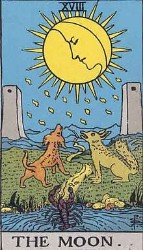
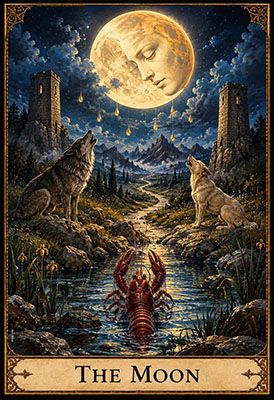
There is a pool of water with a strange crustacean crawling out of it. A dog and a wolf howl at the Moon. A road passes between two towers and winds away through an empty landscape. Strange drops of energy fall from the sky.

And above everything hangs an enormous Moon containing a human face.

Perhaps the key to understanding the entire card is right there.

The Moon’s eyes are closed.
THE DREAMING MOON

Look carefully at the Moon’s face. It isn’t screaming or displaying terror. It appears troubled, perhaps even melancholy, but its eyes remain firmly closed.

Nighttime. Moonlight. Closed eyes.

The Moon is dreaming. And perhaps it isn’t experiencing a nightmare so much as a troubled dream—the kind in which uncomfortable material from somewhere below consciousness begins working its way toward the surface.

That gives us a very different way of approaching the card.

During ordinary waking consciousness, we maintain a reasonably firm distinction between the world outside us and the world inside us. We distinguish memories from present events, imagination from observation, fears from facts.

Dreaming changes all of that.

The boundaries become porous. Memories mingle with fantasies. Fears become characters. Emotions become landscapes. People who died twenty years ago walk through the front door. Places we’ve never visited somehow feel completely familiar.

The subconscious speaks—but it speaks in its own peculiar language. And while we’re dreaming, we generally accept all of this as reality.
THE GATES ARE WIDE OPEN

The two towers in The Moon are usually interpreted as something we must pass through on our journey along the road.

But suppose we’ve been traveling in the wrong direction.

There is no obvious destination at the distant end of the road. The Tarot frequently used radiant light and other visual devices to suggest a glorious destination or spiritual attainment.

There is nothing like that here.

So what happens if we reverse direction?

Suppose we are traveling toward the pool rather than away from it.

Suddenly the towers become an entrance. And there’s something peculiar about that entrance: It’s wide open. The towers are separated by a broad expanse of land. There is no wall connecting them. No gate. No guardhouse. No barrier.

Nothing prevents us from entering.

That makes wonderful psychological sense if the landscape represents a dream—or, more broadly, a state in which the subconscious is becoming unusually active.

The gates between conscious and subconscious experience are open.

THE DOG AND THE WOLF

Just inside those gates we encounter two closely related animals: a dog and a wolf.

The wolf represents the primitive animal—the creature governed by instinct. The dog is essentially that same creature after thousands of years of domestication. It has learned the rules. It has adapted itself to human civilization.

Psychologically, the pairing is almost irresistible.

The wolf can represent our primal self: instinct, appetite, fear, aggression and everything else civilization has taught us to restrain. The dog can represent our conditioned self—perhaps even the ego attempting to maintain order.

And what does a guard dog do when something approaches the boundary?

It barks.

Both animals are howling at the Moon.  The intruder is the subconscious material and that’s what the wolf and dog are trying to keep out.

The ego may try to keep the contents of the subconscious at bay, but under the influence of The Moon, it cannot maintain complete control.

SOMETHING IS COMING OUT OF THE WATER

Then we reach the pool.

Water has long been associated with the subconscious and emotional realms, and the Tarot places it prominently at the bottom of the card.

And something is crawling out of it.

The strange crayfish or lobsterlike creature appears almost prehistoric. It belongs to a much older world than either the dog or wolf.

If the pool represents the subconscious, this creature can represent something equally ancient within ourselves: primitive psychological material that predates our carefully constructed conscious identity.

And it is rising.

The Moon, of course, controls the tides. The Tarot imagery therefore gives us a marvelous metaphor: the Moon is drawing something out of the depths.  Out of our depths.

Something normally submerged is coming to the surface.

That may be a forgotten memory. An instinct. A fear. A desire. An intuition. An old emotional wound. A creative image. Something we know without knowing how we know it.

The important point is that it has crossed—or is crossing—the boundary into consciousness.

WHAT IS A “MOON-LIKE” STATE?

This is where the symbolism becomes much broader than ordinary dreaming.

We might think of The Moon as depicting any Moon-like condition in which ordinary conscious control is weakened and subconscious material begins exerting an unusually powerful influence over our perception.

Dreaming is the most obvious example, but it isn’t the only one.

Intense anxiety can create a Moon-like state. So can grief, infatuation, obsession, fantasy, emotional overwhelm, trance, intense creativity and other experiences in which our interior world becomes unusually powerful.

And that’s when perception becomes tricky. Because we aren’t necessarily hallucinating something that doesn’t exist. More often, we’re interpreting something real through the light of our subconscious mind.

THE ROPE AND THE SNAKE

Imagine walking outside at night and seeing something long and curved lying across the path.

In daylight, you would immediately recognize it as a rope. But under uncertain moonlight, it looks remarkably like a snake. Your heart pounds. Your body tenses. You stop walking.

The rope is real.

The darkness is real.

Your fear is certainly real.

The snake isn’t.

Your subconscious has taken incomplete sensory information and supplied the rest.

That is The Moon.

And we do precisely the same thing psychologically.

An employer sends an email saying, “Could you come see me this afternoon?” If you’re already worried about losing your job, your subconscious may immediately finish the story. I’m getting fired.

Someone you love seems unusually quiet. They’re angry with me.

A new romantic interest doesn’t answer a message. They’re losing interest.

In each case, something actually happened. But subconscious fear, desire or expectation supplied information we didn’t possess.

The feeling may be real. The interpretation may not be.

BUT SOMETIMES THE SNAKE REALLY IS A SNAKE

And this is where The Moon becomes more interesting than a simple warning against illusion.

The subconscious isn’t necessarily wrong. Sometimes what we call intuition may be the subconscious assembling information the conscious mind hasn’t yet recognized.

Perhaps that quiet person really is angry. Perhaps something actually is wrong at work.

Perhaps some tiny combination of expression, tone of voice and behavior has registered below conscious awareness and produced the unmistakable feeling that something isn’t right.

That is why intuition belongs to The Moon just as surely as illusion does.

The problem is that under moonlight it can be extraordinarily difficult to distinguish between them.

Is this intuition—or fear? Am I perceiving something—or projecting something? Do I know this—or merely feel it very strongly?

The Moon doesn’t necessarily answer those questions.

It tells us that we need to ask them.

WHEN THE MOON APPEARS IN A READING

When The Moon appears, we don’t necessarily need to assume that somebody is lying to us or that everything around us is an illusion. Instead, the card may be telling us that subconscious material is strongly coloring our perception of the situation.

Something may be rising from the depths that deserves our attention. But this probably isn’t the moment to accept every fear, intuition, fantasy or suspicion as objective fact.

Ask yourself:

What do I actually know?

What am I assuming?

What am I afraid might be true?

What do I want to be true?

Is an old experience influencing how I interpret the present one?

Could my intuition be noticing something my conscious mind hasn’t recognized yet?

And perhaps most importantly:

Do I have enough light to see this clearly yet?

Sometimes we simply have to wait until we can see more clearly.

The lesson of The Moon may not be that we should distrust everything we experience in darkness. Dreams, emotions, instincts and intuitions can contain profound truths.

But they speak the symbolic language of the subconscious, and that language shouldn’t always be taken literally.

A rope may look like a snake.

A fear may masquerade as intuition.

And intuition may arrive disguised as an irrational fear.

The road is still there.

We simply have to remember that we’re seeing it by moonlight.
Panic Attacks, Gas Lighting and The Moon Card

Have you ever had a panic attack?

They’re absolutely, 100%, no doubt about it, HORRIBLE.  You can’t catch your breath, your pulse rate goes through the ceiling, your heart is like a jack hammer in the middle of your chest, and you feel like you’re going to die.

And it’s all an illusion.  There’s really NOTHING wrong with you, at all, but it FEELS like the world is ending and vultures are sitting on your shoulders.  

I had a series of them about ten years ago when my life partner was becoming seriously ill.  One of the lovely things about them is that they seem to come totally out of the blue.  With the first one, I was driving merrily along The Great Highway of Life in my little Honda and WHAM!!!  “Danger, Will Robinson, danger, danger!  Be afraid!  Be very, very afraid.”  I somehow managed to get myself to the local emergency room where they examined me and gave me an extremely professional shrug of the shoulders.

“Nothing’s wrong with you, man.  Blood pressure’s normal, EEG’s normal, you’re incredibly sexy and good looking.”

Well, they didn’t really say the part about being sexy and good looking but I’m sure it was on their minds.

I couldn’t believe it.  I was dying and it was just . . . in my head.  Hmmmm . . .

Once I figured out what was going on I did a lot of research on panic attacks.  There are some interesting theories out there about what causes them, but nothing definitive.  Breathing into a paper bag can help.  Benadryl can help.  My favorite piece of advice was, “Think of something else.  Sing something happy.”  Oddly it works.

But I want to go back to the part about them being illusions.  The Moon card is all about psychological illusions.  As I said in my original definition:

Think of seeing the world under the light of the moon rather than the sun.  Shadows and light blend into one another and our eyes and mind see things that aren’t really there.  Or maybe they are.

There is a tendency for the unconscious, unexamined contents of our minds to come forth when The Moon is present.

What I eventually figured out about my panic attacks is that I was living in an illusion and my subconscious didn’t like it.  Not at all.  My partner was becoming increasingly, seriously ill and I was trying to stay very upbeat  about it and reassure her – and myself and her children – that it was nothing to be concerned about, that if we just kept a positive attitude we’d get through it and she’d be just fine.  My subconscious, on the other hand, was looking at it and saying, “Holy shit!  Carol is really, really sick.  You need to pay attention to this, Dan!”

And, when I didn’t pay attention to it, my subconscious said, “Okay . . . well how about this?  How about if I throw an absolute screaming fit and make you FEEL like you’re dying?  How about a nice big fat panic attack or three?  Will you pay attention now?”

I paid attention.  The panic attacks stopped.

The point is that there is something in our psyches that is always watching over us and warning us if we go too far off track, if we get too disconnected from reality.  Eckhart Tolle calls it, “the Watcher.”  Jeffrey Schwartz calls it, “The Wise Advocate.”  I’m referring to it here as, “the subconscious.”  It’s reality based, it’s dispassionate, and it will always blow a very loud whistle if we get too delusional about what’s really going on in our lives.  Some of us may have panic attacks, some of us may start having inexplicable accidents or become very anxious and distracted or angry.  It’s our inner guidance system saying, “Pay attention.  This is serious.”

It’s also a great defense against narcissistic gaslighting.  The term gaslighting is derived from the 1944 film Gaslight, where a husband tries to convince his wife that she’s insane by causing her to question herself and her reality.  Gaslighting is standard operating procedure for narcissists at a certain point in their destructive relationships.

As Doctor Ramani explains in this video, narcissists will eventually begin to treat you like shit and betray your trust in every imaginable way.  It’s what they do.  BUT . . . just to make it a little bit worse, they will always tell you that you’re just imagining it.

They put you down in front of your friends – you’re just imagining it!

They devalue or ignore your opinions – you’re just being delusional!

They screw around on you – you’re just being paranoid!

There’s actually an old joke in Texas where a woman walks in on her husband while he’s in bed with another woman and he says, “Now, darlin’, who are you going to believe – me or your lying eyes?”

It’s a funny joke but that’s precisely the level that narcissists operate on.  And it makes their partners crazy, just like in the movie.

But that’s a good thing.  That’s our subconscious, our Watcher, our Wise Advocate, saying, “Something here is very, very, wrong. Pay attention.”

And, if we can manage that shift in perspective, if we can say, “Wait a minute . . . maybe I’m NOT crazy, maybe this really IS happening,” then our so-called symptoms are suddenly transformed into very healthy warning signs.  If I’m depressed, if I’m angry, if I’m anxious – and, yes, if I’m having panic attacks – something is out of whack in my life.  Something in my conscious life is out of synch with my Watcher and my Watcher is ALWAYS right.

When we do that course correction and bring our conscious perceptions back into alignment with our subconscious Watcher, the symptoms disappear.  It’s not necessarily because anything in our environment has changed or gotten better, it’s simply that we’re being honest about what’s going on and there’s no longer a split in our consciousness. 

We’ve achieved integrity as defined by the dictionary:  the quality or state of being complete or undivided. Which is way better than feeling like you have an elephant sitting on your chest and you’re about to die. In the immortal words of Douglas Adams in The Hitchhiker’s Guide to the Galaxy, “Don’t panic and carry a towel.”

And you’ll be alright.

The Moon Tarot Card

The meaning of The Moon Card in the Tarot. Definitions for both the upright and reversed positions are included.

Moon2

A bright moon hangs in the center of the sky, it’s unhappy face showing both the full and quarter moons.   Beneath it a dog and a wolf howl at its’ light while a cray fish crawls out of a pond, claws extended. A shining road runs off into the distance between two towers.

Upright: This is a card of illusion and self-deception.  Think of seeing the world under the light of the moon rather than the sun.  Shadows and light blend into one another and our eyes and mind see things that aren’t really there.  Or maybe they are.

There is a tendency for the unconscious, unexamined contents of our minds to come forth when The Moon is present.  The craw fish is a primitive, almost prehistoric, creature and it reminds us that our emotions are ultimately based in the very ancient and equally primitive portion of our brains.  That theme is repeated with the presence of both the dog and the wolf. The dog is our modern companion, tamed and loving, but its’ genes and brain rest squarely on it heritage with the wolf.  

The Moon shows that the questioner is involved in a very murky area of his or her life.  There doesn’t seem to be any definite goal or destination right now, just a road running off into the darkness.In terms of a relationship, The Moon shows that the questioner may be involved with someone on a very primitive, unconscious level and that there may be deception on the part of the partner or, more likely, denial on the part of the questioner.  There is a lot of emotion present but it may not be of a healthy, evolved nature.

If finances are involved, The Moon gives a huge warning that things are NOT what they seem to be.  Slow down, delay, wait for better light to illuminate what’s going on.

Another, somewhat vexing, aspect of this is that the Tarot may just be telling you that this really isn’t a good time to do a reading.  Things may be a bit murky and uncertain and it might be better to try again a little later.

Reversed:  Pretty much the same as the upright card but probably on a slightly less serious level.  Think of one of those irritating periods in your life when your friends are lying to you for no particular reason, nothing is going quite right and you keep losing your car keys, and you’ve got The Moon reversed.

If you have questions about this card or its meaning in one of your readings, please don’t hesitate to leave a comment.  I’ll get back to you as soon as I can.

A Few More Thoughts About The Moon:

The designers of the Tarot sort of crammed all of the astronomical cards in at the very end of the deck:  The Star, The Moon, The Sun, The World. Only The Moon had a bad reputation.

The Sun, of course, brings life to our planet.  It gives us warmth and light and makes seeds germinate into plants.  It’s power has been recognized and worshipped in nearly every culture.

The Moon, on the other hand, is a much closer body but it’s magic was poorly understood and frequently frightening to primitive humans.  True, it provided light, but it was a wavering, false light, so unlike The Sun, and provided neither warmth nor comfort. Moreover, it changed mysteriously, appearing as a sliver, growing into a silvery golden ball and then gradually diminishing until it disappeared.  What could be so ephemeral and fleeting as a creature that was born, grew to full life, and died, all in a few weeks?

Even the most primitive peoples, though, recognized its’ powers.  It seemed to pull the waves high out of the oceans and control their movements.  It caused women to bleed from their wombs and men built, “moon houses,” so that women might live apart from other people when they were, “stricken” by the beams of The Moon.

Worse, still, its’ energy seemed to drive some people insane and turned others into werewolves and monsters.  The words, “lunacy,” and, “lunatic,” still live in our language and hearken back to a commonly held belief that the Moon could make some unfortunate people quite mad.

There’s a certain amount of truth in the old tales.  Cops, firefighters, and emergency department nurses will all tell you that things get worse when there’s a full moon.  Many farmers still plant their crops according to the cycles of the moon. If you’re a psychically sensitive person you probably know what it’s like to be knocked ass over tea kettle by The Moon.

There is something about its’ power that calls to the most primitive part of our brains and souls.  The Moon card shows a cray fish – a VERY primitive organism – rising from the depths of a pool of water to contemplate a full moon, a perfect metaphor for the way that it affects and transforms us.

Fairly modern Tarot decks like the Waite deck usually depict both a wolf and a dog baying at The Moon to emphasize that its’ power still holds sway over us, no matter how much we may have evolved.    And, as in the Temperance card, a long road stretches off into the distance, as if showing the way out of the Land of Lunacy.

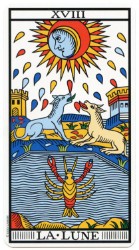
The older decks didn’t bother with the wolf/dog metaphor and there was no road leading to salvation.  There were just two howling beasts and a folk art moon with a fancy collar flinging out psychedelic moon beams.

marmoon

And perhaps that’s more fitting.  Madness is a part of the human psyche and – in measured doses – is just as important to our existence as sanity.  Madness makes us question reality in the same way that The Moons’ light makes us question what we see. Is it a rope lying there in the darkness or is it a snake?  Is it a bush or is it a bear?

When Magellan said that the world was round and not flat people told him he was mad.  Quite, quite mad, darling.

Time travel back to the early 1950s and tell someone that one day we’ll have computers that fit in the palms of our hands and we’ll be able to talk to anyone anywhere on the globe if they have one too.

What are you nuts?

It’s never comfortable having The Moon in your reading.  It feels like things are confused and muddled and don’t make any sense.  Still, sometimes we need that. If we didn’t have those periods of mild insanity we might never change, might never fall in love.

There’s a great line at the end of, “Zorba the Greek.”  Zorbas’ boss is a very proper Englishman who would never, ever do anything out of the ordinary.  Zorba looks at him and says, “I like you too much not to tell you, boss. You have everything a man needs except one thing.  Madness. A man needs a little madness or else he’ll never dare to cut the rope and be free.”

“Just the Tarot,” by Dan Adair – a kindle ebook available on Amazon