Veiled Wisdom: How to Live Intuitively in a Linear World — Lessons from the High Priestess

Learn how to live intuitively in a fast-paced, logic-driven world through the symbolism of the High Priestess Tarot card. Discover practical tools, ancient wisdom, and insights for intuitives and spiritual seekers.

In a world obsessed with logic, speed, and quantifiable results, living intuitively can feel like trying to speak a forgotten language. For those who rely on inner knowing, symbolism, and emotional depth to navigate life this can be truly disorienting. You may feel unseen, misunderstood, or even accused of being irrational.

Fortunately, there is an archetype that understands you perfectly: The High Priestess of the Tarot. She doesn’t live by surface appearances or external systems. She lives behind the veil, where symbols, patterns, and quiet truths guide her every move. If you’ve ever felt like your way of knowing doesn’t fit the world you live in, the High Priestess is your ally.

This post explores how her symbolism offers powerful guidance for anyone trying to live more intuitively in a linear, left-brain world.

The Veil: Honor the Unseen

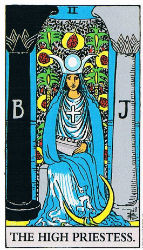
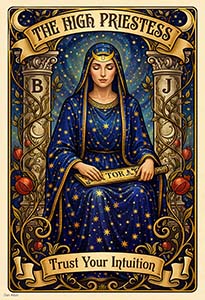
Behind the High Priestess is a veil covered in pomegranates—a symbol of mystery, fertility, and hidden truth. The veil marks the threshold between the seen and the unseen, the conscious and the unconscious.

In daily life, this reminds us to respect what can’t be measured: feelings, dreams, body language, synchronicities. Not everything real can be proven. Living intuitively means acknowledging the unseen world as just as valid as the visible one.  In fact, if you’re an intuitive, your inner world may frequently seem more important than your outer world.

The Moon: Trust Emotional Cycles

The crescent moon at the Priestess’s feet is a classic symbol of intuition, emotion, and cycles. In contrast to the linear, upward march of modern life, the moon reminds us that all things move in rhythms—inner and outer.

This is actually one of the oldest principles of occultism and is discussed extensively in The Kybalion.  Everything on the Earth Plane – everything – moves in cycles.  The tides go in and out.  The Moon waxes and wanes.  Spring gives way to winter.  Even great nations spring up and then fade away.

To live intuitively is to trust your emotional tides. Some days are for action; others for withdrawal, reflection, or stillness. Honoring this inner rhythm—even when it defies external expectations—is a revolutionary act.

The Scroll: Keep Inner Wisdom Sacred

The scroll in the Priestess’s lap is partially hidden and marked “TORA,” suggesting sacred knowledge that isn’t meant for everyone—or even always fully for yourself. This teaches a key lesson of intuitive living: you don’t have to explain yourself.

In a linear world, people often want justification, proof, or evidence. But intuition doesn’t always offer that. Like the scroll, your inner knowing may be incomplete, symbolic, or private. Protect it. Don’t feel pressured to decode everything aloud.

Intuition is frequently about knowing that you know something without knowing how you know it.  You don’t have to defend that to anyone who wants to pick it apart with linear logic.  Sonia Choquette offers a wonderful tip for dealing with it when someone is attacking your intuition:  just smile at them and say, “It works for me.”

The Pillars: Balance Inner and Outer Worlds

The High Priestess sits between two pillars marked B and J (Boaz and Jachin), drawn from the ancient Temple of Solomon. They symbolize polarity—light and dark, masculine and feminine, logic and intuition.

To live intuitively in a linear world, you must balance both forces. Intuition doesn’t reject logic; it expands it. Learn to speak the world’s language when needed, but stay rooted in your own. The magic is in integration.

The Solar Cross: Stay Centered

On the High Priestess’s chest is a solar cross—an ancient symbol of wholeness, representing the four directions, seasons, and elements. Unlike the Christian cross, this symbol is universal. It tells us to stay centered within the circle of life, grounded in your own compass.

Living intuitively means checking inward before reacting outward. It means making decisions from alignment, not anxiety. The solar cross reminds you: you carry your center within you.

It’s also worth noting that the cross is centered over her heart chakra, the energetic mid-point between the lower chakras and the upper.  Intuition pulls in insights from the universe but grounds them in daily life.

Practical Ways to Live Intuitively

Create space for silence and solitude: That’s where intuitive messages come through.  Remember to be patient with that, too.  Intuition speaks in symbols, not type-written messages.  When we sit down to meditate we probably won’t get a telegram from the Universe telling us what to do.  But . . . a particular book that we need to read may fall off of a shelf or a friend may casually say the perfect word to trigger insights.

Journal or use symbols: Tarot, dreamwork, or creative writing can help you listen inward.  The Major Arcana of the Tarot in particular is crammed with archetypal symbols.  Every one of those speaks to Deep Mind and starts a dialog with intuition.

Let go of constant justification: Trust what you know, even if you can’t explain it.  If other people don’t understand what you plainly see, then fuck them.  You’re not the extrovert-whisperer and you don’t need to explain your inner vision to someone who’s blind.

Honor emotional and energetic cycles: Don’t force productivity; honor your timing.  Despite the many New Age gadgets and programs that we may encounter now days, there is NO way to force intuition.  In fact, quite the opposite:  the more relaxed we are, the more likely we are to have a free flow of intuitive insights.  The more we force it, the more it flits away.

Balance logic with knowing: Use your left brain to support your right-brain insights—not to silence them.  Think of left-brain logic as a sort of an editor that connects the dots for you.  The first thing that comes is the intuitive flash:  “Hmmm . . .  I think this is how it actually is, even though it looks differently.”  Then we can use logic to figure out where the insight came from or to explain it to others, but we should never, ever, let logic tell us that our intuition is wrong, simply because we can’t justify it.

It’s Not Impractical – It’s Sacred

The High Priestess doesn’t offer quick answers. She teaches us to dwell in questions, to honor mystery, and to trust the quiet voice within. In a culture addicted to speed and clarity, living intuitively is a radical form of wisdom.

If you feel like you see through the veil or live just outside the edges of ordinary awareness, you’re not lost. You’re listening. And you’re not alone.

Let the High Priestess be your reminder: intuitive living isn’t impractical—it’s sacred.

My new ebook, “The Alchemy of the Mind: Transforming Your Life With the 7 Principles of The Kybalion,” is now available on Amazon.

Thought-Forms, Astral Pornography, and The Ace of Wands

Are our thoughts actually energy forms?

A few years ago I was reading a fascinating book called, “You Are Not Your Brain,” and the authors made a statement that was positively shocking to me:  “To this day, scientists and psychologists cannot agree on exactly what a thought is.”

At first blush, that sounds completely ridiculous because we all know what thoughts are.  They’re . . . um . . . they’re like . . . these little things that jump up in our heads and live in our brains, right?  

There . . . I solved that one.  You’re welcome.

Seriously, though, there really isn’t a good working definition of what a thought actually is.  There’s a sort of reductionist explanation of how our nervous systems and brains produce thoughts.  We can hook someone up to a brain monitor and see which parts of their brains light up with activity when they’re thinking about a particular subject.  Perhaps their fear center – the amygdala – lights up because they’re thinking of something really scary.  Or their prefrontal cortex – the thinking brain – lights up because they’re doing some heavy problem solving.  

That doesn’t really do anything but describe the process of making the idea, though.  It doesn’t tell us what the finished product is.  That theory – that the brain makes ideas – exists cheek by jowl with the stimulus/response model where something in our environment makes us think certain things.  Perhaps we see a picture of Donald Trump and we think, “Ohhh, scary clown,” which makes us think of circuses which makes us think of Stephen King horror novels about murderous clowns which makes us think about our overdue library book.

That concept seems to be counter-intuitive when we think about . . . well . . . intuition.  When we have  intuitions or  flashes of insight, it feels as if they’ve popped right up in our brains without anything else making them happen.  When someone asked Einstein how he invented the theory of relativity he said, “Oh, it just dropped in while I was playing the piano.”

For centuries, human beings viewed some types of ideas in just that way:  as something that came into our minds from an outside source.  That’s why the word, “inspire,” means to have something breathed into you.  The notion was that something out there – perhaps the Universe or the Gods or the fairies – inserted the idea into your mind.

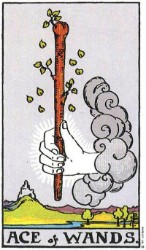
That’s what’s portrayed in the Tarot card, The Ace of Wands.  Wands represent ideas and this is an idea or thought coming into the world in its purest form of mental energy.  It’s, “divinely inspired.”

That STILL doesn’t tell us exactly what an idea IS, though.  It’s just talking about it’s source, rather than it’s contents.

Now, the Theosophists and Victorian occultists had very specific ideas of exactly what an idea is.  They viewed ideas as thought-forms, which is to say, individual little packets of energy produced by our brains and emotions and auric fields.  And – important point – they felt that they were independent of the human being once they were produced.

We’ve all seen those cartoons where there’s a person having a thought that appears as a bubble with text in it, hovering over the character’s head.  That’s a convenient way to visualize what the Theosophists were talking about.  Every time that we have a thought, it’s like our bio-field – our brains, emotional energies, energy bodies – are extruding a little, tiny thought-form bubbles that exists outside of us.

Most of the bubbles don’t last very long because they don’t contain much energy.  Let’s face it, many of us are NOT thinking about the theory of relativity while we play the piano.  Instead, we’re having really profound thoughts like, “Where’d I put my car keys?  Need a cup of coffee.  Gotta walk the dog.  Did I do the laundry?”   So these are little bubbles that appear for a moment, pop, and disappear.

When the thought forms are really heavily charged with energy, though, they stick around.  How do they get charged?  Well, through emotions and through repetition.

Suppose you just went to bed with someone and you had a super-duper, unbelievable, I-think-my-ears-just-fell-off orgasm at the exact moment that you thought, “I love you.”  That, “I love you,” thought is super-charged with energy and it will last.  Ditto, if you’ve been badly shocked or frightened by something.  The more intense the emotion, the more of an energetic charge the thought-form has and the longer it will exist.

We can also charge the thought-forms with energy by thinking of them over and over and over.  On a positive note, we can see that happen when someone thinks of their lover constantly, as we tend to do in the early stages of falling in love.  The obsessive thinking keeps adding energy to that same, “I love you,” thought-form and makes it’s last.  On a negative note, we can see the same pattern with chronic anxiety and depression.  Constantly thinking of things that frighten us or make us sad just increases the charge in the thought-forms and so the depression will linger long after the original cause.

Two of the early Theosophists, Annie Besant and Charles Leadbeater, published a book called, “Thought Forms.” It had illustrations of the forms as they emerged from people’s auras, as seen by psychic mediums.  Here’s one of a peaceful thought:

And here’s one of an angry thought.

I would have liked to have seen one of a horny thought – sort of astral pornography, I guess – but the Victorians didn’t roll that way.

So is all of this true?  Maybe.  It certainly forms the basis for much of what we call visualization and manifestation, as well as the concepts of either cursing or blessing someone.  I’ll be writing more about that in the immediate future but for the time being it’s a fun concept to play with.  What if our thoughts are actual things that exist in our personal energy space and exert an influence on us and those around us?  How can we change the negative thought-forms and increase the positive-forms?  Can we pick up someone else’s thought-forms, much like a virus?

Before you dismiss the idea out of hand, remember what we started off with here: the most preeminent psychologists and scientists in the world have absolutely no idea what a thought is.  The theory of thought-forms is just as good – and maybe better – than most of their theories.

Remember that my e-book, “Just the Tarot,” is still available – dirt cheap! – on Amazon. In fact, I’m sending thought-forms at you right now. You should buy this book . . . you should buy this book . . . you should buy this book . . .

The Nine of Wands, Buddhist Emotions, and Having Sex While We’re Water Skiing

On the emotional nature of ideas.

In the Tarot, each suit of the minor arcana represents a different realm of the human experience.  Cups represent emotions, pentacles are physical possessions, swords are energy, and wands are the intellectual realm of ideas.

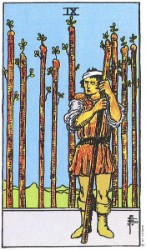
At first glance, we’d hardly associate the Nine of Wands with ideas at all.  A man stands there clutching a wand, a fearful, almost paranoid look on his face, and a bandage tied around his forehead.  He looks like he came out on the losing end of a bar fight much more than he looks like he’s swarming with ideas.

When we  stop for a moment and ponder just exactly what ideas really are, though, the card starts to make sense.  We all have thoughts – a  LOT of them – from the moment that we wake up in the morning until the moment that we fall asleep.  Some meditators call our thoughts, “the mind stream,” because they feel like an endless stream constantly rushing along from one point to the next to the next.

And, let’s face it – many, if not most of them, really aren’t worth much.  The Buddhists talk about, “monkey mind,” which basically means that our minds are like monkeys jumping randomly from one branch to another, with no particular order or meaning.  Rather than having truly great thoughts, our thoughts are more like:

-did I turn off the coffee pot?

-why is the cat crying?

-remember to buy more cat food.

-what am I making for dinner tonight?

– should I wear brown socks?

-who invented toast?

-I think I’m a little hung over.

-where’s the alka seltzer?

-remember to buy alka seltzer when you get the cat food.

All of those thoughts occur in mere seconds and they go on like that all day, every day.  Most of our thoughts, then, are just immediate, fleeting responses to whatever’s happening in our environments at any given moment.

There are, of course, more organized thoughts that we generate with problem solving activities.  That’s where we sit down and really concentrate on how we’re going to get from point A to point B, how we’re going to get through work activities or budget enough money to pay the rent.  How to organize our shopping lists and plan meals before we go to the grocery store.  What we’re going to say at a business presentation and how to prioritize the points that we want to make.

Yet another type of thought is what we could call intuition, where an idea or a notion just seems to pop up out of nowhere.  We may be shocked or surprised or delighted by an intuition because it frequently has little in common with our usual thinking patterns and provides us with a whole new way of looking at a problem or even life in general.  When someone asked Einstein how he’d come up with the theory of relativity, he said that it, “just dropped in,” while he was playing the piano.  Intuition may occur as a thought but there’s no feeling that we somehow generated it.  It really is as if someone or something else dropped it into our mindstreams.

Now, one thing that all three of these ways of thinking – rapid responses to our environments, organized problem solving, and intuition – have in common is that they all appear to be relatively innocuous, relatively harmless.  It’s hard to figure out how you could go from them to the character in the Nine of Wands who looks like he got the snot beaten out of him.  What the hell happened?  Did he beat himself with his own ideas?  Did someone else dislike his ideas so much that they beat him up?

We find a clue to that process in Eckhart Tolle’s book, “A New Earth, Awakening to Your Life’s Purpose.”  In his discussion of the, “pain body,” (the accumulation of subconscious emotional pain that we all carry) he states:  “. . . emotion is the body’s reaction to your mind . . . An emotion is the body’s response to a thought.”

In other words, thoughts never occur in isolation.  There are always emotions attached to them.  With many of them, the emotions, like the thoughts themselves, may arise and fall away so rapidly that we’re not even aware of them, but they’re there.

To use the example from above, we might think, “Remember to buy more cat food,” and not even realize we’re feeling anything.  Just below the surface though, there may be a fair number of emotional reactions, like, “I love my cat, I hate the smell of that fish flavored cat food, I miss my other cat who died, it all costs so much and I’m so worried about money . . .”  Love, hate, sadness, worry, all flashing through us over a damned can of cat food.

We might think that thoughts obviously can’t hurt us.  We can think of a purple polka dotted hippopotamus or the theory of relativity and neither of those thoughts is going to hurt us or anyone else.  They’re just ideas.  But – again – they’re ideas with emotions attached to them, and, yes, emotions can hurt us or help us.

If we obsessively ruminate over unhappy thoughts all day, that will hurt us.  It causes our blood pressure to shoot up, our bodies are flooded with cortisol and adrenaline, our serotonin levels drop and we become much more susceptible to depression and disease.  

If we interrupt those obsessively unhappy thoughts with the memories of something that made us happy – a vacation, great sex, a good friend, water skiing,  a vacation where we had great sex with a good friend while we were water skiing – that will help us.  Our blood pressure drops, serotonin levels increase, stress hormones drop, our immune systems get a boost.

So a good first step in not getting beaten up by our ideas is to consciously realize that every thought has some emotional component to it.  Every time we think something, we feel something.  The more aware we are of that, the more aware we become of what we’re actually feeling and we can gradually start to eliminate the thoughts that make us have bad feelings.  Like fish flavored cat food.

Another thing that can help us is to meditate a bit on the Buddhist notion that NOTHING HAS ANY VALUE.  At first blush, that may sound like a radically nihilistic notion.  “What the hell do you mean, nothing has any value?  I’ll tell you what has some value, Bubba – my new IPhone.  THAT’S what has some value.  Exactly $799.98, plus shipping, that’s how much value it’s got.  Don’t tell ME nothing has any value.”

To express the idea a little more clearly, nothing has any INTRINSIC value.  It only has the value that we assign to it, the value that we project into it.  An IPhone is just a piece of plastic and electronic components.  There’s nothing in it that’s intrinsically, “happy making,”  until we decide that IPhones make us happy.  Or unhappy.

Buddhists put a little finer edge on it by saying that we assign one of two feelings to virtually everything we encounter in life:  attraction or aversion.  Either we like it, in which case we want it, or we don’t like it, in which case we want to avoid it.  

The tricky part is in realizing that there is NOTHING that’s either likable or unlikable until we decide it’s likable or unlikable.  It’s wonderful to realize that because it gets rid of a whole host of unconscious motivations like greed, prejudice, possessiveness, materialism.  Literally, nothing has any value unless we want to think it has some value. Nothing’s good unless we think it, nothing’s bad unless we think it.

It also makes us deliciously responsible for our own lives because we’re no longer victims of circumstance.  How many times have we all said, “I’ll be happy when I get a new car, or a new computer, or a new job, or a better lover, or a nicer house?”  We chronically think that there is something or someone OUT THERE that will magically make us happy.  And if it’s OUT THERE, then we don’t have any control over it.  It’s something that happens to us or it doesn’t, either something outside of us makes us happy, or we’re just doomed to be miserable.

Once we realize that it’s our own thoughts that are assigning happy or miserable feelings to the things out there, that we are unconsciously deciding that some things are attractive and some things are aversive, then we control our own happiness.  Or we can be just as miserable as we want to be.

Happy, sad, mean, joyful, miserable.  They all start with thoughts and we, and we alone, make our thoughts.

The High Priestess and Growing Your Intuition

A discussion of intuition as a function of the right hemisphere of the brain making sudden contact with the left hemisphere and The High Priestess as a representation of that mid-brain connection.

The High Priestess represents our connection with what some people call, “deep mind.”  She is our – frequently unconscious – connection with the higher realms of spirit and magic.  She is the exact point where the truth travels through the creative, feminine right brain and emerges in consciousness in the linear, masculine left brain as a flash of, “intuition.”

It all sounds very complicated but it’s not.  It’s actually hardwired into our system but we’ve taught ourselves to ignore it.  Our language, however, is replete with phrases describing it.

“I had a hunch . . .”

“I just had a feeling . . .”

“Something told me . . .”

“I just knew . . .”

What all of that describes is suddenly reaching a firm, undoubtable conclusion without any preceding rational thought.  And, yes, it seems magical for exactly that reason: it seems to burst out of nowhere.

Another way that it manifests is as a, “sixth sense.”

If you’re hiking in the woods and a predator is watching you, you somehow, “know,” it and the hairs on the back of your neck stand on end.  Combat soldiers describe the same feelings just before the enemy starts shooting at them.

A classic example is thinking of someone you haven’t seen in years and the phone suddenly rings and it’s them.

A silly example is that if a man is walking behind a woman and stares at her butt she will always know that someone is staring at her butt.  I don’t know how women do that, but it’s true.

Now, to a rationalist all of that is impossible.  You can’t, “sense,” that a mountain lion is watching you or that a guy is staring at your butt or that an old friend is about to call.  But we still do. It happens and we all KNOW that it happens.

So, two thoughts on, “intuition,” that we should probably keep in mind.  First of all, we live in a society that denigrates it and treats it as if it’s irrational.  It’s not irrational, it’s NON rational, or perhaps META rational. It has nothing to do with the left brain, logical, linear thinking process that the western world worships.  It, “arrives,” out of thin air, like a telegram from an angel. But it’s also not a metaphysical belief.

It’s important to be clear about metaphysical beliefs.  I’ve known christian fundamentalists who believed that Jesus is right there at their sides 24/7 to solve each and every problem that they’ll ever have.  And that this beautiful world of ours is positively dripping with devils and demons who have nothing better to do than make people have, “impure thoughts,”  about their neighbor’s wives.

I think fundamentalists are total fruit cakes but, hey, they’re welcome to believe whatever they want.

I believe in ghosts and spirit guides and totem animals and the Goddess, and I’m sure the christian fundamentalists think I’m a total fruit cake.

The point with either set of beliefs is that they are metaphysical and totally unprovable one way or the other.  They are NOT demonstrable facts. They are beliefs.

Intuition, on the other hand, operates daily in the physical world.   There are millions of reported incidents of it and anyone who says it’s not real is either in denial or an idiot.

Second, we can all do it.  And we can get better at it.  That’s important.

We tend to think that some people are psychic and some people aren’t.  Some people can read Tarot cards and some people can’t. Some people can achieve enlightenment and some people never will.

It’s not true.  It’s just a function of time and effort.  I guarantee you that if you sit down every day and concentrate on your brow chakra for 15 minutes you WILL start to see some magical, astral scenes.  If you read Tarot cards over a period of time you WILL become more psychic.

It’s exactly the same deal with intuition.  It’s something that you were born with and it’s just a matter of practicing.  Start paying a little more attention to your feelings. Start asking the universe (or your angels or your spirit guides or your totem animals) for answers when you’re puzzled about something.  And the answers will appear. Just like magic.

You are The High Priestess.  You just forgot.