Learning to Live Without Joy

Many people feel disconnected, numb, or unable to access joy—especially after childhood trauma. This post explores emotional flatness, toxic positivity, and why realness may matter more than happiness.

Did you get ACED when you were a kid?

ACE stands for Adverse Childhood Experience, and the odds are fairly high that you experienced one. ACEs include things like emotional abuse, neglect, parental mental illness, substance abuse, and divorce or separation of the parents.

We tend to think of those kinds of negative experiences as relatively rare. Maybe we got the hell beaten out of us by a crazed, drunk parent—but most people didn’t, right?

After all, just look at how happy everyone else seems.

But according to the CDC-Kaiser ACEs Study, 61% of adults across 25 states reported experiencing at least one ACE. And nearly 1 in 6 (16.7%) reported four or more.

The truth is, a sizable portion of the population is living with the long-term effects of unresolved trauma—including dissociation, emotional blunting, chronic anxiety, and difficulty accessing joy.

The Cultural Pressure to Be Happy

One of the strongest side effects of long-term trauma is the belief that, “Man, I must really be fucked up, because I’m just not happy. Everyone else is happy, but I’m a train wreck. In fact, I’m not even a train wreck, I’m completely off of the tracks.”

That belief is especially potent if you’re American.

American culture—especially through media and marketing—places enormous value on positivity, confidence, and personal success. Like the figures in the Three of Cups, we’re all supposed to be dancing with joy, smiling through life, bubbling over with gratitude. The message is:

“You should be happy, empowered, and in control of your life at all times.”

And if you’re not?

Then something must be seriously wrong with you.

This pressure to appear happy, even when we’re not, creates:

Emotional dissonance: A split between what we feel and what we think we should feel.

Shame about feeling bad: A second layer of suffering on top of the original pain.

Social masking: We say we’re “fine” or “happy” because it’s expected—and we believe others are genuinely feeling that way (even when they aren’t).

Antidepressants and the Emotional Economy

A recent Gallup poll reported that a whopping 78% of Americans say they feel satisfied or very satisfied with their lives. The poll even bemoaned the fact that the “happiness index” was down by two points.

Meanwhile, the U.S. is among the highest consumers of antidepressants in the world.

Some people take them for serious clinical issues—but many of us take them simply to cope with lives that feel emotionally flat or chronically overwhelming.

Years ago, psychologists discovered that one of the most useless surveys in the world was asking teenage boys if they’d had sex. The overwhelming majority said, “yes, of course I have,” —even though many of them didn’t have the slightest clue how to unfasten a bra, let alone what to do next. They thought they were supposed to be having sex, because they assumed all the other boys were doing it—even though they weren’t.

In much the same way, Americans seem to be lying to pollsters about how happy we are, because we think we’re supposed to be happy.

After all, everyone else is smiling.

Even if they’re not.

We’re taking pills to create artificial happiness because we think we should be happy, even when we’re not.

Living With “Flat” Emotions

What if, instead of constantly trying to fix our feelings, we first learned to live with them?

Assuming there’s no organic brain issue involved, there’s always a reason that we’re not happy.

As Gabor Maté points out, when we suffer trauma that we can neither fight nor flee from, we dissociate. We leave our bodies. We stop feeling.

Not feeling becomes a survival mechanism—a way of coping with pain that would otherwise overwhelm and break us.

If you’re among the 61% who’ve had at least one ACE, you’ve probably experienced dissociation and emotional flatness.

If you’re in the 16% who had four or more ACEs, emotional flatness may be how you live most of the time. It’s not that we don’t want to be happy—we just don’t know how.

And that, in itself, can be traumatic, because we’ve been programmed to believe that we should be happy—even when we can’t feel it.

But we can reframe that.

Rather than chasing a happiness ideal that may not be accessible—especially after trauma—it’s possible to:

• Honor emotional flatness as a survival adaptation.

• Shift the goal from happiness to authenticity.

• Value calmness, neutrality, or quiet presence as valid emotional states.

• Find meaning not in chasing joy, but in living gently and truthfully with what is.

This doesn’t mean giving up on healing, but healing might not look like “feeling great all the time.”

It might look more like “being okay with feeling whatever I feel.”

A New Emotional Ethic: Realness Over Happiness

Ideally, we need a massive cultural shift—from:

“I must feel good in order to be okay”

to:

“I’m okay because I’m allowing myself to feel what’s true for me.”

But… yeah. Don’t hold your breath on that one.

What is possible—what’s powerful—is to make that shift within ourselves.

If you’ve had the hell beaten out of you, either physically or emotionally, as a child or as an adult, it’s okay to feel sad.

It’s okay to feel numb.

It’s not just okay—it’s rational.

That doesn’t mean we want to live there forever.

That doesn’t mean we resign ourselves to an existence without joy. But maybe healing begins when we stop pretending. When we stop performing. When we let ourselves feel—or not feel—exactly where we are.

In this new ethic:

• Sadness is not a problem.

• Numbness is a messenger.

• Joy, when it comes, is a gift—not a requirement.

Back in the 1960s the Transactional Psychology movement came up with the catch phrase:  “I’m Okay, You’re Okay.”

To which Elisabeth Kubler-Ross replied:  “I’m Not Okay, You’re Not Okay.  And That’s Okay.”

The first step in the path seems to be honestly saying, “This is who I am.  This is where I’m at. I hurt when I feel and so I try not to feel. And for right now, that’s okay.”
The Alchemy of the Mind: Transforming Your Life With the Seven Principles of the Kybalion

The Most Powerful Card in the Tarot – Getting Downright Foolish

An explanation of why The Fool is the most powerful card in the Tarot.

There’s an ongoing debate among Tarot aficionados about which card is THE strongest card in the deck.  The most prominent candidates are usually the first two cards of the Major Arcanum:  The Fool and The Magician.  I tend to lean toward The Fool, for reasons which I’ll explain, but the truth is that we need both of their energies in our personal and spiritual growth.  The Fool is pure potential, whereas The Magician is pure mastery.  Growth occurs when those two energies intersect.

LOOKING AT THE SYMBOLISM

In The Fool, we see a young, ambisexual person dancing along at the edge of a cliff.  He lightly holds a rose in one hand, and his meager possessions are contained in a satchel hanging from a pole that he carries over his shoulder.  A small dog joyously cavorts at his feet, despite the fact that The Fool appears to be about to walk straight off of the cliff.

If we had to select a couple of words to describe the image, they would probably be, “happy,” and, “unfocused.”  The person in the card seems to not have a care in the world.  He’s to telling us to stop and smell the roses, to trust in the present moment. The message is that if he walks off of the cliff, he’ll just keep strolling along on thin air.

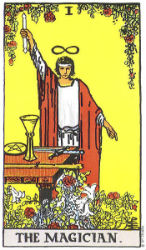
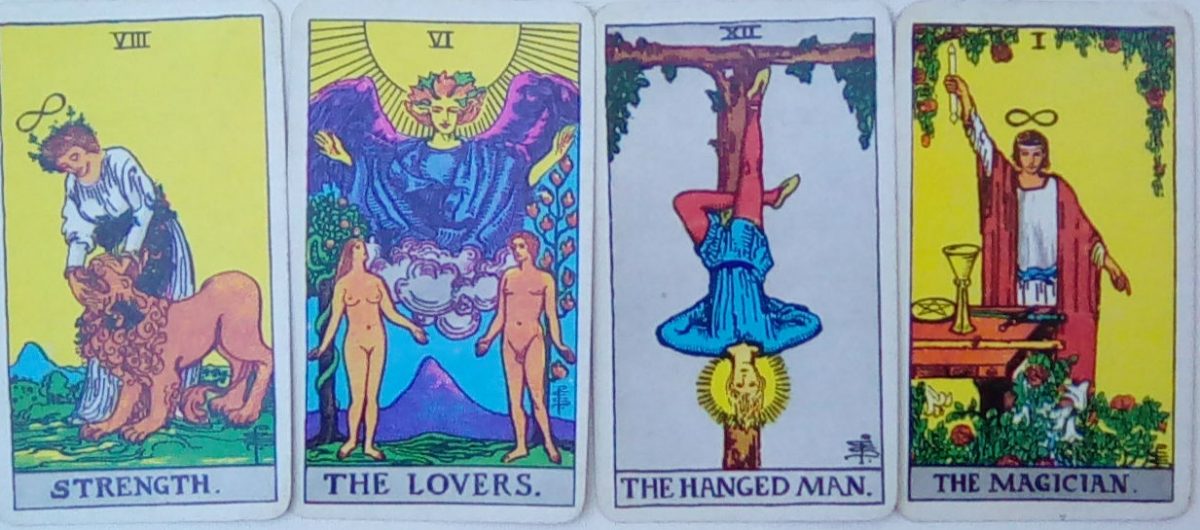
The Magician card, on the other hand, is an image of total concentration and focus.  He’s dressed in the formal robes of a ceremonial magician and looking very serious.  One hand, holding a wand with two points, is pointed toward the sky and the other is pointed at the ground.  His robe is belted with the ouroboros symbol of eternity, a snake eating it’s own tail, and that message is reinforced by the eternity symbol floating over his head.  The four symbols of earthly existence, the wand, pentacle, cup, and sword, lie on his altar.

“Just the Tarot” by Dan Adair – A complete set of definitions, layouts and instructions for reading Tarot cards.

The Magician is channeling the divine energy into the Earth Plane.  He’s using it to control the four elements and manifest his desires through the use of his will power.  If we had to select a couple of words to describe this image, they would be, “control,” and, “focus.”

THE MAGICIAN AS THE WESTERN PARADIGM OF POWER

The Magician is very much the Western paradigm of power.  We use phrases like, “He’s a take-charge sort of a guy,” or, “She’s always in control,” to describe this kind of power, and we tend to admire it.

The Magician is the type of a person who is very conscious of what she wants to accomplish, has a detailed plan for doing it, has the necessary skills to make it happen, and works the plan until she reaches her goals.

This is the type of linear, step-by-step thinking that Westerners have traditionally employed, and it can be very effective.  

It’s also very much an ego-based sort of a power.  It’s saying, “This is what I want and I’m going to use all of my abilities and will to make it manifest.”

THE FOOL AS THE EASTERN PARADIGM OF POWER

The Fool’s energy is much more in keeping with the Eastern paradigm of power.  It has more to do with aligning ourselves with a deeper, universal  power, rather than trying to run the whole show with our egos.

There’s a basic trust implicit in The Fool.  It’s a trust that, as the Desiderata put it, “whether or not it is clear to you, no doubt the universe is unfolding as it should.”  The idea is that there IS an underlying force in the Universe and that it’s a loving, compassionate force.  When we’re in alignment with that force, then we’re in The Flow, or the Tao, and our lives are much easier and happier because of it.  And, paradoxically, the more that we try to control that Flow, as the Magician does, the less in alignment we are and the harder life becomes.

VISUALIZING AND MANIFESTATION

We can see this sort of tension between The Magician energy and The Fool energy when we begin to delve into visualization and manifestation.  

Most of the books and seminars on the subject run pretty close to The Magician model of power. (A) We figure out what we want (the usual example being a million dollars.)  (B) We concentrate all of our will power on that goal by visualizing it, writing affirmations, and making vision boards.  (C) We cause that goal to manifest in our lives through repetition and the sheer power of our wills.  The Magician model is also very one-pointed and specific, as in, “I want a million bucks by September the first and I want it to be in unmarked hundred dollar bills.”

Of course, that frequently doesn’t work, as evidenced by the fact that most of us aren’t millionaires.  This is the point where many teachers will bring in the concept of The Fool energy.  The idea here is to relax, stay in the present moment, and quit telling the Universe how it’s supposed to behave.  Instead of setting a specific goal, right down to every detail, we set a general goal, but let the Universe work out the details.

Mike Dooley, in particular, works with this concept in many of his books like, “Manifesting Change.”  He refers to our trying to control all of the details (Magician energy) as, “the cursed hows.”  In other words, “I want a million bucks, Universe, and this is exactly HOW I want you to manifest it.”  The point that he’s making is that we may think we’re opening one door to financial abundance, but in reality we’re slamming shut a thousand other doors.  The Universe is infinite and it has an infinite number of ways of delivering what we want to manifest, unless we get too specific about how we want it done.

So, we bring in Fool energy.  We use a general statement like, “I’d like to manifest happiness and abundance in my life, Universe, and I’m sure you can work out the details.  After all, you make stars and solar systems, so this shouldn’t be much of a challenge for you.” And then we butt out and let it happen, while we stay happy and in the present moment.

CONSCIOUS AND SUBCONSCIOUS MINDS

The Kybalion – a discussion of Hermetic magic – talks about this dance between Magician energy and Fool energy in terms of the conscious and subconscious minds.

Our conscious mind is our everyday mind, which is the mind that we mostly identify with.  It’s ego based, logical, and linear and it’s very clever at performing mundane tasks.  It’s the mind that balances our budgets, pays the rent, buys groceries, and gets the kids to school on time.  We could call it Magician energy but it’s really just a tiny part of our larger mind.

The subconscious mind, on the other hand, comprises the majority of our minds.  Unlike the conscious mind, it never needs to sleep and it’s working 24/7, processing information, calculating what the future may look like and telling us when something’s wrong.

The most important thing about the subconscious mind, though, is that it’s our connection to the super-conscious mind, AKA the Universe.  Though that connection, it has almost infinite power to manifest anything that we truly desire.  That’s Fool energy.

Those two minds – conscious and subconscious – need to work together.  Although the subconscious mind is infinitely powerful, it just drifts without direction from the conscious mind.  Even worse, it can construct our reality based on the crap that flows through the internet, our televisions, our cultures and our religions, which may have very little to do with what we really want to manifest.

So we need to use that Magician energy – the conscious mind – to sort through our options and figure out where we want to actually go with our lives.  Do I want to be rich?  Do I want to be an artist?  Do I want more love in my life?  Once we determine what our overall goals and desires are, then we say, “Hey, subconscious mind/Universe – this is what I’d like to see happen.  Please get to work on that.”

THE FOOL DOES THE HEAVY LIFTING

Here’s the most important thing about all of that:  The Fool does the heavy lifting.  The SOLE PURPOSE of the conscious mind is to figure out where we want to go and turn it over to the subconscious mind/Universe.  

The conscious mind has a terrible time accepting that notion, because it’s ego based.  It wants to control every little detail of the manifestation process, and so it keeps snatching it back from the Universe and imposing more and more cursed hows on the process.  Every single time that we do that, we’re slamming doors shut instead of letting the subconscious mind open more doors.

And so, yes, in my opinion there can be no doubt that the most powerful card in the Tarot deck is The Fool.  It’s the primal energy that makes good things manifest in our lives.  The Magician can guide that energy but, by itself, it’s nothing but a control freak in a red robe.

The Three of Cups, Leela, and Playing in the Flow

A look at the Hindu concept of Leela and learning to be a part of a playful Universe.

We wouldn’t put water into the gas tank of our car and expect that it would somehow work alright, would we?  Of course not.  

Putting sadness, anxiety, depression and fear into our minds is exactly like that.  In order for human beings to, “run,” we need to put the right fuel into our energy systems, and that fuel is happiness.

WE ALL KNOW THAT

That proposition isn’t really something that we have to prove, because we already know that it’s true.  

We’ve all had the experience of having to go to work when we were sick.  Perhaps we had the flu or a bad cold, but we still had to drag our asses into work and somehow slog through the day.  No one – ourselves included – expected that we were going to be operating at peak efficiency or do a super duper job when we were ill.  We just had to show up and keep our bodies going through the motions until we could get back home to bed.

Getting through life when we’re extremely depressed, fearful, or anxious is just like that.  All of those states of mind are literally like a poison, like a bacteria or virus that seriously interferes with our abilities to function.  Our bodies are in place, doing what we have to do, but we’re far from being at our best.

HAPPINESS IS THE RIGHT FUEL

In contrast to that, we’ve all had the experience of living when we were extremely happy.  Perhaps we were in love.  Or we just got a promotion.  Or maybe it’s just Springtime and we feel completely zippety doo dah.

When we’re happy, life is easy.  We seem to sail right through difficult projects, our relationships with other people are much easier and more positive, and we attract even more happiness into our existence.

In a very real sense, choosing happiness instead of depression is like putting gasoline into our car instead of water.  It’s the right fuel to optimize human life.

HAPPINESS IS BEING IN THE FLOW

People talk a lot about being, “in the Flow.”  That’s also known as being in the zone, or, as Taoists put it, being in the Tao.

When we’re in the Flow, life is smooth and effortless.  We start to experience a lot of synchronicity and serendipity.  We have an unusual amount of focus and concentration and the task at hand is easy.

Exactly the same things happen when we’re in a state of happiness.  Some people might think that being in the Flow triggers the feeling of happiness, but it’s quite the opposite.  Being happy triggers being in the Flow.

BUT CAN WE REALLY CHOOSE HAPPINESS?

To a large extent, yes, we can.

There are, of course, a few glaring exceptions.  If we’re living in a war zone or someone we dearly love has just died or our house has just been destroyed by a disaster, it can be very difficult for those of us who aren’t spiritual masters to keep a smile on our faces.

The truth of the matter, though, is that for 90% of us, 90% of the time, NOTHING IS WRONG.  Yes, we may have very unhappy memories or we may be very anxious about the future, but right here, right now, in the present moment, nothing is wrong.

The past and the future are just movies that we’re running our own minds.  They literally have no existence outside of our mental images.  We can, in the present moment, choose to be happy or choose to be sad.  As Thich Nhat Hahn said in Peace Is Every Step: The Path of Mindfulness in Everyday Life, “Learn to love, enjoy and embrace what you have in the here and now. That’s all you really need to be happy.”

 HOW DO WE DO THAT?

Oddly, the answer to that seems to be simple:  play.

That can be difficult for us to grasp as Westerners, because our culture and our religions tell us that LIFE IS VERY SERIOUS!!!  We’re supposed to get up in the morning and work hard and sacrifice. We’re supposed to put off all of the things that give us pleasure.  That’s what it means to be a responsible adult, right?

The Hindu philosophy, on the other hand, has a delightful concept called, “Leela.”  Leela literally means, “divine play.” The idea is that when the Goddess made the universe, she didn’t do it as a job, or with a purpose, or even for anything very serious.  She did it because she was playing.  Because it was fun! 

“Hey, I think I’ll make the Universe.  Ooh, that’s a nice color!  Maybe I’ll throw a galaxy in over there.  Why not put some rings around that planet?  Oh, pretty . . .”  

Like the people in the Three of Cups, she was having a ball.

PLAYING IS BEING IN THE FLOW

The real idea behind being in the Flow is that there’s some underlying energy that flows through the entire Universe.  When we’re in alignment with that energy, everything goes smoothly because we’re moving with the natural flow of the Universe.  When we’re out of alignment with that energy, then life is difficult because we’re swimming against the current.

It’s easy to see, then, that if Leela is true – if playfulness is the energy that underlies the entire Universe – then the happier and more playful that we are, the more that we’ll be in alignment with that energy, and the easier life will be.

WHAT ABOUT WHEN LIFE IS HARD?

Life here on the Earth Plane is cyclical.  We see evidence of that everywhere we look.  The moon waxes and wanes, the tides come in and then go out, animals and humans are born, flourish, and then grow old and eventually die.  Even nations rise and then fall.

The Hermetic book, “The Kybalion,” refers to that as the Principle of Rhythm and likens it to the pendulum of a clock.  The Pendulum swings to the left and then it swings an equal amount to the right.  

Our emotions and our personal fortunes seem to operate according to that same principle.  We may have a period of our lives when everything is going perfectly and then that’s followed by a period when everything is difficult.  We may be incredibly happy for a while and then experience deep sorrow.  It’s just the pendulum swinging back and forth.

When we consciously realize that, when we know that any difficulties and sadness that we’re having will change back into happiness eventually, then we cease to take it all so seriously.  We can rise above it, and continue to play.

THE PLAY IS A PLAY

There’s another meaning to the word, “play,” that’s used in the concept of Leela.  That’s the idea of life AS a play.  As something that we might watch playing out on a stage at a theater.  

Like the Principle of Rhythm, that points to the notion that none of this is real or permanent.  These are just parts that we’re playing in this incarnation.  All of our, “sound and fury,” all of the ups and downs, all of the victories and defeats, are just temporary roles that we’re playing and we’ll shed them like old costumes when we move on to our next incarnation.  

All we have to do is learn to play at playing in the play.  We can do that!

How to Lighten the Fuck Up by Fooling Around with Magic

A Quick Look at the Playful Nature of Magic.

Magic.  

What is it, anyway?  We talk about magic a fair amount.  We say that something, “felt really magical,”  or we, “feel a lot of magic,” when we’re with another person,”  or a solution to a problem appeared, “just like magic.”  But what, exactly, is it?  Is it just a feeling, or is it a real thing that exists in the world independent of our feelings?

In The Magician card, we see a person channeling magical energy from, “above,” into the material plane.  He’s using his concentration, his will power, and his skills to pull that energy into what he wants to manifest.

Which, of course, is a major clue.  Magic is an energy, just like light, sound, radio waves, or solar flares.  What’s more, it is it’s own energy, meaning that it’s distinct from other energies.

We tend to get it mixed up with other energies, because it appears coincident with them.  When we’re madly in love with someone, it feels magical, and so we tend to mix magical energy up with being in love.  When we’re joyous, it feels magical, and so we tend to mix magic up with great happiness.  But magic is it’s own energy that appears with joy and love, but isn’t just joy and love.

We can see an analog of this with emotions and brain chemicals.  When we have a lot of serotonin in our bodies, we feel happier.  When we have a lot of cortisol and adrenaline in our bodies, we feel more stressed and anxious.  But . . . happiness causes serotonin to appear and serotonin causes happiness to appear, so it’s a definite, “which came first, the chicken or the egg?” situation.  They’re not equivalent – they just appear at the same time.

Reductionists would have us believe that serotonin = happiness, but it’s not true.  Antidepressants, which increase serotonin levels, can be a very effective band aid for depression, but they pretty much have to go along with good therapy to deal with the underlying problems.  If we don’t build in the therapy, the happiness goes away when we stop taking the antidepressants because – guess what? – the things that were making us unhappy are still there.

In very much the same way, magic appears in our lives coincident with love and and joy, but the love and joy don’t cause the magic.  Nor does the magic cause the love and joy.  They just appear at the same time.

There are some other clues we can find that point to what magic actually is.  Two major markers that appear in our lives when we’ve got magical energy flowing through us are synchronicity and serendipity.  Synchronicity and serendipity are really just short hand for, “life is easy.”  Solutions to our problems appear out of nowhere.  People, places and things that feel like gifts from the universe manifest with no effort at all.  

And, “life is easy,” is really just short hand for, “life is light.  Life is playful. Life is fun.”

Which are some more major clues about what magical energy really is.  In the same way that magic tends to appear when we’re joyous or in love, magic tends to appear when we’re happy and playful.  It’s almost as if the universe is saying, “You know, you really need to lighten the fuck up if you want me to play with you.  I get that you’re all sad and dour, but it’s a drag and I can find someone else to hang out with.”

So magic is an energy that tends to appear in our lives when we’re loving, joyous, happy and playful.  It doesn’t cause them and they don’t cause magic, but they definitely appear at the same time.

Which brings us to another card, The Fool.

The Fool is FULL of magic.  He’s dancing along at the edge of a cliff and he really doesn’t give a fuck about the danger because he’ll just float right off into the air and keep dancing.  His little dog is picking up on his joy and dancing right along with him, in just the way that dogs always will.

Now, the interesting thing about The Fool is that he’s the Zero card in the Tarot deck.  Every other card has a number, but The Fool is Zero.  Which means that he doesn’t belong anywhere and he belongs everywhere.  We can literally take any card in the Tarot deck, drop The Fool on top of it and things will start to get better.  Even extremely bad cards like Death and The Tower start to improve the second that we bring in magical energy.  

There are people in the world who will tell us that life is insane, tragic, and brutal and that there’s very little to be optimistic about.  And, when we look at the daily news, it can be hard to argue with that view.  Believing in love, joy, playfulness, happiness and lightness can seem downright . . . Foolish.   

But that’s the point.  No matter how bad the situation may be, if we start to drop The Fool on it, if we start to increase the magic in our lives, it will get better.  

Magic brings love, joy, happiness, playfulness, easiness, and lightness with it.

Yes, please.  I’ll have some of that.

My e-book, Just the Tarot, is still available on Amazon at a price that’s SO reasonable that it would be downright Foolish not to buy a copy.

The Five of Cups and the Dark and Magical Path to Happiness.

Happiness as a choice, rather than just a state of being.

The Five of Cups shows a person who is in deep grief.  He’s lost something vital in his life and he’s mourning it on the deepest, most profound  level.  In the system of the Tarot, Cups represent emotions and he sees three of his cups lying on the ground, tipped over, and spilling out their emotions.  He’s literally hypnotized and immobilized by his sadness.

A sub-theme of this card is that he is also NOT focusing on the two remaining cups, which are upright and full.  He is so concentrated on what he’s lost that he’s not perceiving that he still has something left to be grateful for.

Happiness is one of those things in life that we seldom contemplate until we lose it.  Most humans are born happy.  Sure, there are the inevitable times when babies get, “fussy,” or decide to stay awake screaming their little heads off all night, but most young critters are happy, playful and content.  It doesn’t matter if we’re talking about human babies, puppies, kittens, or deer, the young are pretty much happy, pretty much most of the time.

So in many ways, happiness is a birthright of most living beings.  It’s also frequently a matter of inertia – objects in motion tend to stay in motion and happy people tend to stay happy.  We don’t even think about it until it disappears – we’re just pretty much happy, pretty much most of the time.  In the words of the old blues song, “You don’t miss your water ‘til your well runs dry.”

We’re told that into each life a little shit must fall, and, sure enough, we all suffer a certain amount of loss and grief.  We all have loved ones who die or become very ill, we get fired from jobs, we go through separations and divorces, and we occasionally get into car wrecks or fall down and break something that we’d rather not have broken. 

Thankfully, for most of us, those losses come in fairly measured doses and we have enough support built into our lives to recover and return to our natural state of happiness.  But there are also those of us who get absolutely hammered by loss and grief.  Who don’t just experience the death of loved ones, but the tragic death of loved ones.  Who don’t just go through a divorce but go through a devastating divorce, lose their homes, lose their jobs, and find themselves out on the street with nothing but the lint in the pockets of their overcoats.  Who not only lose their happiness, but lose it for a LONG time.  

Oddly, those are the people who probably appreciate happiness the most, because they’re the people who were forced to live without it.  They’re the people who had to fight to regain it, often alone, frightened, and hopeless.  To my mind, they’re some of the real heroes in life, the spiritual warriors who made it back from the dark side, from the brink of madness and suicide.

If you’ve ever gone through that kind of a loss, you’ll know what I mean.  If you’ve suffered a major nervous breakdown, or battled with alcoholism and addiction, or lived with crippling depression, you know what it’s like to be so down that you can’t even see up anymore.  Life becomes a meaningless, seemingly endless, series of days and nights filled with darkness, sadness, and extreme anxiety.  You don’t really know why you go on living, but you do, putting one foot in front of the other and slogging along toward nothing.

Now, some of us don’t make it back from that journey into darkness.  Some of us get swept over the precipice into oblivion.  Suicide is the 12th leading cause of death in the United States.  In 2020 there were 1.2 million suicide attempts in the country and nearly 46,000 successful suicides.  Those are, of course, only the suicides we know about because many of them are concealed.

For those of us who do make it back, happiness becomes a desperate quest and a practice.  We realize at some point that if we’re going to stay alive we somehow have to find a way to recapture happiness and build it back into our lives.  For some of us, that means finding a really good therapist to help us unravel all of the emotional knots and heal the psychic wounds.  For others, the gateway to happiness is the doorway to an Alcoholics Anonymous meeting hall.  Perhaps happiness arrives in the form of a prescription for Prozac or a spiritual reawakening or even a psilocybin mushroom. 

Happiness doesn’t arrive all at once, neatly bound in wrapping paper and ribbons.  It’s something that we carefully build back into our lives, one trembling step at a time.  We may need to learn how to control our thoughts that obsessively lead us back to melancholy view points.  We may need to learn how to control our emotions and just do some deep belly breathing and meditation when we feel overwhelmed with sadness.  We may need to sit down with a therapist and do some serious exploration of why our paths crumbled under our feet.

Happiness at that point is transformed from a natural occurrence into a set of skills that we practice in our daily lives.

For me, one of the major breakthroughs was my therapist teaching me that we can be happy whenever we want to be.  We can sit down, meditate on something that makes us happy, and we will feel happy, even if just for a few moments.  If we string together enough of those meditations, we have a happy day.  If we string together enough of those days, we have a happy life.  It’s a skill.  It’s a practice.

The other day I was listening to this delightful video from author Mary Pipher about her book, “Women Rowing North.”  

The book is primarily about women and about aging, but it also has a lot of good information on happiness.  One of the things she said that really jumped out at me is that happiness is an existential choice.

There’s a deeply profound lesson in there because happiness can’t be a choice until we’ve lost it and then we’ve finally learned how to regain it.

When happiness is just our natural state of being, we’re on spiritual cruise control.  When we’re pretty much happy, pretty much most of the time, like puppies and kittens and babies,  we’re not choosing happiness – we just ARE happy.  And happiness is frequently perceived as something that’s outside of us, that happens to us, rather than something we create.  We meet the right partner, we stumble into a good job, we have a nice summer, we get laid, we see a funny movie.  It’s all a sort of a pleasant parade of sweet events that we have absolutely no control over.

When we lose our happiness – really and truly lose it for an extended period of time – and we learn how to recreate it in our lives, then it becomes something that we can control.  It becomes a product of practicing certain skill sets like meditating, staying in positive thinking, avoiding negative situations and people, and performing all of the little mental and emotional hygiene tasks that are required to stay in a state of happiness.  We’re trying to stay in a state of happiness because we KNOW that we’ll die if we don’t.

There’s a step beyond that, though, which is what Mary Pipher is talking about.  When we practice happiness long enough, there comes a wonderful day when we realize that we CHOOSE to be happy.  At that point, happiness isn’t just a survival mechanism, it isn’t just a way to avoid the darkness.  It’s an active, conscious embrace of the Light.  Happiness isn’t just a way to get along, it becomes our primary value and our choice and we know that we’ll never live without it again.

It’s a huge gift in life.  We only find it at the end of some very dark paths, but when we reach that point we realize that the journey has been a magical quest that led us to our own inner light.

Lost Car Keys, Emotional Ladders and Being Ram Dass’s Illegitimate Child

Learning to climb our emotional ladders.

Did you ever have one of those morning meditations that was absolutely perfect?  Maybe you get up out of bed, light a candle on your altar, close your eyes, and the love and peace just FLOW into you as you sit there.  You feel compassion for all living beings and you feel oneness with the entire cosmos.  You feel that if you aren’t totally Buddha-like, you must at least be the illegitimate child that Ram Dass never acknowledged.  You are just SO high, SO spiritual, SO totally in the flow!

The feeling may continue as you take your shower, allowing the warm water to wash all the negativity from your aura.  And then again, as you eat your oatmeal, reminding yourself that you honor all living beings by not eating the flesh of animals.  You know you’ll have a perfect day at work.

And then . . . and then . . . you can’t find your car keys.  You go through the pockets of the clothes you wore the day before.  Check your night stand.  Look under the bed.  Scour your sock drawer.  Crawl around on the floor in case you dropped them.  Within the span of a few moments you’ve been transformed from Pema Chodron into a snarling, wild eyed beast.

“Where are you, you goddamned little jingly bastards?  Where in the fuck ARE you?”

Ironically, at the very height of your fury and hysteria, you locate the keys.  On your altar.

Sigh.  Another failed leap into enlightenment.

In their book, “Ask and It Is Given,”  Esther and Jerry Hicks make the point that sometimes it’s perfectly okay to feel angry.  In fact, sometimes getting really pissed off can be a sign that our mental health is improving.

It’s kind of a breath of fresh air in the New Age/New Thought movement.  We are constantly being told that we must stay positive and that, because of the Law of Attraction, being angry will do nothing but attract angry people and unpleasant events into our lives.  We find ourselves trying to censor our emotions, consistently trying to not feel what we’re feeling –  if what we’re feeling is anger –  and then feeling guilty when we can’t do it.

The Hicks look at it from a slightly different vantage point, which is that angry emotion is better than no emotion.  The basic premise is that our emotions are what motivate us, what keep us moving in life, what draw us toward love and make us run away from hatred.  Without emotions, we’re just stuck, dead in the water.

They say we live on a sort of a ladder of emotions, with apathy and depression at the bottom rungs of the ladder and love and joy at the top. In between joy and depression there are our other emotional states like irritation, feeling overwhelmed, pessimism, hopefulness, and so on.  As we climb the ladder and become more fully emotionally engaged with joy, we become more fully alive. When we descend the ladder into depression and apathy, we’re not really living, we’re just existing.  The ladder would look a lot like this:

JOY

POSITIVE EXPECTATION

OPTIMISM

HOPEFULNESS

PESSIMISM

IRRITATION

OVERWHELM

BLAME

ANGER

REVENGE 

RAGE

DEPRESSION

APATHY

I really like that idea of an emotional ladder because it allows me to be the mess that I frequently am and be honest with myself about where I’m at.  As the Hicks said in another book, it’s easy to program a GPS to take you from Phoenix to L.A. but first you have to know that you’re in Phoenix.  If we’re on the second to the top rung of the ladder – positive expectation – then it’s relatively easy to take that next step up to joy.  On the other hand, if we’re stuck WAY down the ladder in anger and we try to jump straight  up into joy, we’re probably going to fall off of the ladder and land on our asses.  It’s important to be honest with ourselves about where we really are on our emotional journey.  It saves us from broken asses.

And that leads into another neat concept which the Hicks came up with: the, “emotional set point.”  Basically, that’s just the rung of the emotional ladder that we live on most of the time.  We humans tend to be creatures of habit and so we pretty much maintain a consistent emotional state.  If we’re happy most of the time, we’ll stay happy most of the time.  If we’re sad most of the time, we’ll stay sad most of the time.  We may occasionally climb up and down a few rungs on the emotional ladder as life brings us good or bad events, but we tend to return to what feels like our, “natural,” state of being.

And there is a certain natural, genetic component involved in that.  According to The Harvard Health Blog, about half of the reason we may be happy or sad is based on the disposition we were born with.  So that person you know who’s always chirpy and perky and bright and annoyingly happy?  Yeah, that’s probably real.  They were likely just born that way.  And the friend who always seems a little sad may have just inherited it from his parents.  It’s their natural emotional set points.

The good news behind that, though, is that we can change our emotional set points.  Just because it feels, “natural,” to be in a certain emotional state doesn’t mean that we have to stay in that emotional state.

Suppose, for instance, that I’m a perfectionist.  I would want everything to go exactly according to plan and turn out just the way I’d envisioned it. 

What would flow out of that state of being would be a great deal of impatience with my co-workers and/or family members because they weren’t living up to the high standards that I set.  I might be constantly criticizing them, sniping at them, belittling their efforts and generally acting like an insufferable prick.

The cure for that could be to do loving-kindness meditations.  Starting to actively envision what other people are going through and building in empathy for the fact that they’re struggling with life the same way that I am.  As I continued to do that, my perfectionist expectations would drop away and I’d begin to see the people around me as fully dimensional human beings who deserve caring and patience.  I’m changing my emotional set point.

Or perhaps, like so many of us, we grew up in physically or emotionally abusive families.  Our, “go to,” response to stress in life might then be emotional flatness.  We learned very early in life that it’s easier to just turn off our emotions rather than feel the pain of the abuse.  

What flows out of that is becoming emotionally absent with our partners or children whenever there’s a problem.  Even worse, we abandon ourselves emotionally and fail to experience joy and deep love because we’re so shut down.

The cure for that could be to start doing, “happiness meditations.”  Just sit down once or twice a day and meditate on something that makes us happy, even if it’s a distant childhood memory of a beloved dog.  Start learning to live in that emotion again.  Stopping several times during the day and asking ourselves, “Am I happy right now?”  And, if we’re not, pull up that memory again until happiness becomes a habit.

The point is that it’s a practice, the same way that yoga or meditation are practices.  We don’t get where we want to go all at once.  If we come home and find our life partner shtupping our best friend, it’s okay to be angry.  In fact, it’s a hell of a lot better to be angry than it is to be depressed.  Anger can empower us but depression takes our power away.

As long as we’re feeling something, we’re still okay.  We’re still moving.  We’re still growing.  And, as the Hicks said, we can reach up for that next best emotion on the ladder. We can change our emotional set point.  It’s better to feel irritation than to feel overwhelmed.  It’s better to feel pessimism than to feel irritation.  It’s better to feel hopefulness than to feel irritation.  We can steadily, consciously move our emotional set point upward toward joy as long as we’re honest about what we’re feeling and we don’t shut ourselves down.

If we don’t feel it, we don’t heal it.  If we don’t heal it, we don’t grow.  And growing toward happiness is even better than knowing where your car keys are hiding.

Happiness, Meaningfulness, and the Four of Pentacles

The importance and differences between happiness and meaningfulness in our live.

In her wonderful book,The Power of Misfits: How to Find Your Place in a World You Don’t Fit In, Anna LeMind references a study by Roy F. Baumeister on the differences between happiness and meaningfulness.  In some cases, the two experiences may overlap, but they aren’t always synonymous.

It turns out that human beings crave both happiness and meaningfulness.  The Buddha tells us that all sentient creatures want to feel happiness and avoid pain, and we share that drive with the birds and the bees, the turtles and the spiders.  Bring on the happiness, baby, and take away that pain.  That’s an old blues song, I think.

Where we differ from most of the animal world (we believe) is that we also need to have a sense of meaning in our lives.  Having a lot of orgasms may make us extremely happy, but it doesn’t necessarily bring any meaningfulness into our existence.  If we’re lying on our death beds reviewing our lives, we’re not likely to say, “Man, I had 20,000 orgasms.  Now that’s a life well lived.  My life really meant something.”

According to this study, it’s actually pretty easy to define what makes us happy.  Being happy involves three major components:

  1. – having our needs satisfied.  That’s a pretty simple one.  If we’re hungry, it makes us happy to eat.  If we’re cold, it makes us happy to get warmed up.  If we’re horny, it makes us happy to have sex.
  2. – having the sense that we can obtain what we need and want.  In other words, not just eating when we’re hungry but knowing that we have the powers and abilities to get out there and get that food all on our own.
  3. – feeling good most of the time.  That’s kind of a no-brainer, but it’s true.  People who mostly feel good are mostly happy and people who feel lousy are mostly unhappy.

None of those three factors necessarily make us feel that our lives are meaningful, though.  Feeling good, for instance, is very strongly associated with being happy, but not necessarily with feeling meaningful.  People who are very healthy tend to be happier than people who are sick, but both healthy and sick people have an equal shot at leading a meaningful life.

Having the powers and abilities to get what we need and want is another one that may make us happy, but it doesn’t necessarily bring meaningfulness along with it.  In our society, having the power to get what we need and want usually means having money.  If you really, really, really need and want that new computer, you have to have the dough-ray-me to pay for it, right?

But even money has a very strange relationship with meaningfulness.  In the Tarot, the suit of pentacles represents material possessions and money.  In the Four of Pentacles, we see a guy who’s really having a love affair with money.  He’s got his feet resting on money, he’s got his arms wrapped around money, and he’s got money sitting on his head.  What a happy guy!

Probably.

Maybe.

Could be.

The study found that people who have plenty of money tend to be happier people, BUT they don’t necessarily report living a life that’s more meaningful.  On the other hand, NOT having enough money makes people less happy and their lives feel less meaningful.  So it’s not really the money that counts, it’s the lack of it.

Here’s another interesting little snippet of information that’s about life being easy versus life being hard.  We’ve all known people who appeared to be unbelievably lucky.  It’s like anything they want just seems to fall into their laps with little or no effort on their parts.

And we’ve also known people who seem to be unbelievably unlucky.  No matter how hard they work, no matter how much they struggle and strive, life consistently turns into a shit sandwich for them and their desires and goals slip away like vapors in the wind.

Unsurprisingly, having an easy life makes people very happy.  And having a hard life makes people unhappy.  But neither one of those is linked in ANY way to a sense of meaningfulness.  You can have the easiest life in the world and still feel like it doesn’t mean anything.

There’s another fascinating element with meaningfulness and happiness, which is TIME.

We know how the mindfulness meditation people are constantly hammering at us about, “Stay in the present moment!  There’s no unhappiness in the present moment.”

It turns out they’re right!  Happiness is very highly correlated with living in the NOW, in the present moment, rather than ruminating about the past or worrying about the future.

But, unfortunately, it’s also inversely correlated with having a sense of meaning.  The more you live in the present moment, the happier you’ll be, but you also sacrifice a sense of your life having any overall meaning.

Why?  Because meaningfulness is a function of time.  The greater the span of time in your life that you’re contemplating, the greater a sense of meaningfulness you’ll have.  If you think about what yesterday and today meant, the odds are that they didn’t mean very much, unless something extraordinary happened.  On the other hand, if you think about what the last ten or twenty years of your life meant, you’re much more likely to see patterns and meaning.

And the same thing applies to the future.  The future gives the present moment meaning because it involves us in taking purposeful actions meant to create that future.  What we’re doing today is meaningful because it has a purpose – making the future.

So we have this odd conundrum.  The more we stay in the present moment, the happier we’ll be, but the less meaning we’ll derive from our lives.  The more we dwell on the future and the past, the less happy we’ll be, but the more our lives will feel meaningful.

The study also found an oddity in our perceptions of happiness and meaningfulness.  People tend to view happiness as being relatively fleeting, something we feel momentarily and then it gets away from us.  And they feel that meaningfulness is more permanent, something that will last long after happiness has disappeared.  Which is just not true.  Both meaningfulness and happiness tend to be fairly stable and long lasting.  We probably just feel that happiness passes quickly because it’s so intimately related to the present moment, which is always appearing and disappearing, appearing and disappearing, shazam!

Which brings us to the probable reason for why meaningfulness is so important to human beings.  The author concluded that MEANINGFULNESS IS AN ATTEMPT TO IMPOSE ORDER ON FLUX.  Life is chaotic, man.  Life is constantly changing, constantly transforming, constantly shazamming from one thing into another and then another and then another.

And it drives us nuts.  We need a sense of stability, of orderly progression, of the past moving logically into the present which will then move logically into the future.  We need to be able to connect the past, present and future of our lives in a MEANINGFUL way.  Otherwise it feels like life is something that just happened to us, rather than something we lived.

If all of this sounds very complex, it’s because IT IS.  We are very complex.  To seek happiness is to be alive.  Every single animal on the earth seeks happiness.  But to seek meaning is distinctively human.  It’s who we are.  It’s what we do.  Meaningfulness is not necessarily the same thing as happiness, but it’s just as important.

Happiness, Capitalists, Yellow Rocks, and Radical Meditators

Most people who are on a Spiritual Path eventually come to hold beliefs which conservatives consider, “politically radical.”  It’s ironic, because most people who are on a Spiritual Path have very little interest in politics, except to casually observe it as another form of human insanity.

When I use the term, “radical,” I mean it in its original use from the latin word, “radix,” or root, as in, “the root of a plant.”  To get radical is to get at the very root of something, to get to the place that it all grows out of, so to speak.

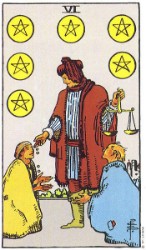
Let’s take the example of the Six of Pentacles.  It shows a richly dressed man, scattering coins to beggars, and holding a scale so that he can measure exactly what he’s giving away.

You couldn’t ask for a better representation of the, “scarcity,” view of life that’s at the root of our society.  There simply isn’t enough wealth to go around and some people have it and some people don’t.  Those who DO have it, should share it with those who don’t have it, but they need to be very, very careful about not giving too much away, because there’s never really enough.

In real time, we see that happening with the gazillionaires who live in penthouses, fly around in private jets, take vacations on yachts, and are DESPERATELY WORRIED that poor people might be getting too many food stamps.  Having enough to eat without working for it at minimum wage jobs is bad for their character, doncha know?  Makes them lazy and dependent.  Pass the champagne, darling . . .

As we move into a deeper level of spirituality, though, we begin to understand that there’s another model for looking at life, which is the, “abundance,” view.  The Universe and Mother Earth seem to be richly, almost insanely, abundant.  There are enough seeds in one tomato to plant an entire farm.  There are enough sperm cells in one tablespoon of semen to repopulate the world.  Women’s bodies produce far more eggs than they could ever bear as babies.  And, yes, we could produce enough food to feed every hungry person in the world.

And we begin to realize that the problem isn’t that there isn’t enough, the problem is that some people are spiritually sick and want far more than their share of the abundance.  Even worse, they want to be sure that other people have less than THEIR share, because they believe in their hearts that wealth is scarce and if they have more wealth, they’re better than other people.

Eckhart Tolle talks about this quite a bit in A New Earth: Awakening to Your Life’s Purpose (Oprah’s Book Club, Selection 61)  In a nutshell, the Ego always wants more STUFF, because the Ego believes that the more STUFF it has, the more important it is.  And, as a part of that contrast, if you’ve got less stuff than I have, then I’m just that much more important!  If I drive a BMW and you drive a Honda, I’m better than you.  If you have a two hundred dollar computer and mine cost five thousand, then I’m better than you.  If I live in a McMansion and you live in a trailer, then I’m better than you.

And so we get hypnotized into this weird dance of thinking that our STUFF makes us, “better people.”  But, as Tolle points out, it’s just a sugar rush, not real nutrition.  Yes, the new computer (or car or house or jewelry) makes us happy for a while, but then it doesn’t anymore.  So we have to buy more and more and more stuff to keep getting that rush, but somehow happiness keeps slipping away from us every time.  

If we keep walking down the Spiritual Path we realize that the STUFF doesn’t really make us happy, not for long.  As we continue to evolve, we start to get a glimpse of happiness WITHOUT the stuff.  Maybe that revelation comes to us in our meditations or our dreams or journals, but we begin to get just a glimmer that the material stuff really has very little to do with happiness.  We can actually BE HAPPY anytime that we want to and we don’t need a new computer to get there.

And that, my friends, is a RADICAL idea!  That goes right to the root of our whole economic system and way of life.  It short circuits the entire capitalist system which is based on consumers being convinced that they need to keep consuming STUFF in order to be happy.  If we quit buying all of that crap that doesn’t really make us happy, then the gazillionaires who are selling us all of that crap that doesn’t really make us happy are going to lose a lot of money.  

Dangerous, dangerous thinking!  LOL – it really is.  It’s why they killed Jesus.  “It is easier for a camel to pass through the eye of a needle than for a rich man to enter heaven.”  WHAT????  Kill that guy!  Quickly!

The point is that as we explore and grow spiritually, our values change and we become less and less in synch with society as whole.  We realize that, ultimately, what all of us want is love and happiness.  And we realize that love and happiness flow out of our hearts, not our possessions.  Possessions and materialism itself start to feel like a form of insanity, which it can easily become.

Consider the example of the genocide committed against Native Tribes in the United States.  We killed hundreds of thousands of Tribal Peoples in the Dakotas and Northern California because they were sitting on land that contained gold.

From their point of view, we were totally out of our minds because NO ONE HAD TOLD THEM THAT GOLD ISN’T JUST A ROCK.  Why kill someone over a rock?  Which, by the way, it IS just a rock.  You can’t eat it.  You can’t fertilize your fields with it.  You can’t make clothing out of it. Other than being pretty, gold is totally useless.

Except that somewhere, thousands of years ago, some asshole said, “I have this pretty yellow rock and you don’t, so I’m better than you.”  Since that original asshole, wars have been fought, untold numbers of people have been tortured and killed, and whole civilizations have been decimated, all because some people wanted to have ALL of the pretty, yellow rocks. 

 It really is monumentally nuts, when you think about it.

It’s my fervent hope that, as we move out of the ego-based scarcity model and into the new spiritual paradigm, we’ll see materialism begin to wither on the vine.  Contrary to their paranoia, that doesn’t mean we need to have a revolution and take all of the rich people’s stuff away from them. There’s plenty to go around and if their yellow rocks make them feel better, so be it.  

That’s abundance.

That’s radical.

Disclaimer: “As an Amazon Associate I earn from qualifying purchases.”

The World Card, Rebirth, and Designing Your Next Body


The World seems to be the only Tarot card that deals with birth, which is odd because you couldn’t find a more archetypal, universal experience than birth.  As I noted in my book, “Just the Tarot,” the wreath in The World card strongly resembles the shape of the birth canal and suggests a totally new beginning.

We all associate birth with that initial entry into the world, that first thrust through the placenta and into a whole new universe.  In reality, though, we’re being reborn constantly. It’s fairly well known that ALL of the cells in our bodies are completely replaced by new cells about every seven to ten years but many cells are constantly dying and being regenerated.  Red blood cells are replenished about every four months. White blood cells every few days. Fat cells, of course, last the longest. Wouldn’t you know it?

And here’s an interesting slant on all of that.  While the molecules in your body are busy whizzing around and making sure everything that’s supposed to stay inside doesn’t fall out and everything that’s supposed to come out doesn’t stay in, they’re also making these amazing substances called neuropeptides.

I don’t know about you but I totally suck at science and math and just a word like neuropeptides makes my brain freeze with anxiety.  Nonetheless, it’s important to know about them and here’s why.

Neuropeptides are the physical correspondents of our emotions.  They come and go together. Adrenaline is one of them. If you get a big spurt of adrenaline it totally triggers your fight or flight reaction.  Your heart races, your fists clench, your eyes dilate – you’re ready to kick some ass or run like a rabbit. Adrenaline doesn’t CAUSE the fight or flight reaction, they just always occur together.

Same deal with another neuropeptide, serotonin.  If you have a lot of serotonin in your system, you’re happy.  If you don’t have enough, you’re sad. Serotonin = happiness and happiness = serotonin.

The kicker is that our bodies manufacture neuropeptides to MATCH the emotions we’re feeling.  So, if you’re a very happy, positive person, then you’ll have a lot of serotonin being pumped out.  If you go through a sustained period of stress and unhappiness, then your serotonin levels drop like a rock in water and your adrenaline levels go up.

Kicker number two:  we have receptors for these neuropeptides in cells ALL OVER OUR BODIES, not just in our brains.  So if you’re pumping out massive amounts of serotonin, it’s attaching to molecules throughout your entire system and your body is basically happy.  Massive amounts of adrenaline and your body is basically stressed and unhappy.

Where it gets really interesting is when we consider that our emotions are actually dictating what types of molecules are going to make up our bodies AND we’re constantly replacing and replenishing those molecules.  We’re literally remaking our bodies all the time based on our emotional states. We are – right now – designing the types of bodies we’ll have in a couple of months when all of those cells get replaced with cells that match our current emotional state.

To put it another way, if you’re chronically negative and unhappy, your body is going to manufacture molecules that are negative and unhappy.  Serotonin = happiness and low serotonin = unhappiness. It can turn into an endless cycle of misery. Crappy emotional states CAUSE crappy body and brain chemistry which CAUSE more crappy emotional states and on and on.  

That’s where visualizations and affirmations come in.  When we do them, we’re interrupting that repetitive cycle.  When we do affirmations we’re rewiring the Deep Mind and telling it that we’re happy and successful people and – guess what – happy and successful people have oodles of serotonin.  When we visualize being happy and successful, we FEEL happy and successful and happy emotions MAKE serotonin appear.

It’s a very odd phenomenon.  We are literally giving birth to . . . ourselves . . . all the time.  And we have a choice as to what kind of a body and person we’re creating.  Happy thoughts = happy cells = happy thoughts. We choose our World every single day.

* If you’re interested in learning more about this, look up Dr. Candace Pert, who pioneered the research.