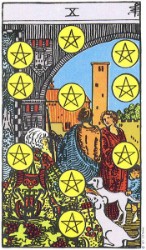
The Ten of Pentacles, Grandma Moses, and Rocking Getting Older

A closer look at the new paradigm of aging and how we can combat our own internalized ageism.

One thing that’s been apparent watching the demonstrations against the Trump regime is that there are a LOT of gray hairs in those crowds.  What in the hell are all of those old people doing out there demonstrating?  Aren’t old people supposed to sit at home in their rocking chairs with cats in their laps?

Well, what if everything we’ve been told about aging is wrong?

OLD IS THE NEW YOUNG?

Think of some of the standard images and words that come up when we discuss older people.  Words like:

Doddering;

Absent minded;

Frail;

Diminished;

Weak;

Senile

There is a cultural perception of older people as being in a period of decline, fragility, and irrelevance.  It isn’t just our societal obsession with youth; it’s an active attack on aging itself.  Ironically, of course, it’s something we all do sooner or later (if we’re lucky) so it seems like a peculiar notion on the face of it. 

Thankfully, there’s a new paradigm emerging.  It’s an entirely different way of aging that embraces it as a time of expansion, reinvention, and wisdom-driven creativity.  Before we can do that, though, we need to be mindful of the old paradigm of aging.

THE DISEASE MINDSET

Western cultures tend to treat aging as if it’s a medical problem, rather than a perfectly natural transition.  Billions of dollars are being made every year by convincing us that there’s something terribly, terribly wrong with having white hair and a few wrinkles.

There’s really no way to describe it other than as an anti-aging industry.  On the one hand, big pharma is busy programming the elderly to believe that they can’t possibly survive without a medicine cabinet full of pills.  On the other hand, the cosmetics companies are selling boatloads of product to, “restore your lost youth and vitality.”

The over-all message to anyone past the age of 60 is, “be afraid, be very afraid, because you’re useless, ugly and doomed.  You have a terminal disease called, ‘aging.’”  

But what if we learn to see aging as a form of enhancement, rather than a decline?

LATE LIFE FLOURISHING

There’s actually a term for that which is, “the Grandma Moses Effect.”

Anna Mary Robertson Moses (AKA Grandma Moses) left home at the age of 12 to go to work as a domestic for a farmer and his wife.  For the next 65 years of her life, she had a pretty grueling existence.  She and her husband were itinerant farm workers, drifting from job to job and doing back breaking field work.  She bore 10 children, five of whom died and she lived on the edge of poverty for most of her adult years.

She took up painting at the age of 78 and only because arthritis was making it painful for her to do needlework.  She initially sold her paintings out of the window of a local pharmacy for 2 dollars a piece.  By the time that she died at the age of 101, her paintings were being sold for millions of dollars, Hollywood had made a movie about her life, and she’d received a medal of honor at the White House.  

All because she picked up a paintbrush when she was obviously too old.

Now, suppose she’d been alive in our time.  What messages might she have been receiving at the age of 78?  “Let’s face it, dear, your life is over.  You’ve got one foot in the grave. I hope that you’ve got medical insurance because it’s all downhill from here.  As a matter of fact, you’re at the bottom of the hill and a boulder is about to run over you.”

Grandma Moses was the first time that millions of Americans really got it on a visceral level that being older doesn’t equate to being the walking dead.  Being older can be a magical beginning, instead of a tragic end.

REJECTING THE STEREOTYPES

Margaret Nash talks about this in her book, “Rebellious Aging.”  One of the key takeaways from that book is that we have to actively reject the stereotypes of what our culture thinks older people should be like.

The Ten of Pentacles shows one of those stereotypes.  An old man sits quietly in a corner, wrapped in a shawl, while younger people engage with each other in the light.  There are dozens of other stereotypes in our culture, of course. Perhaps we should take up knitting or learn to play shuffleboard.  Maybe move into a nice retirement community where we don’t have to cook for ourselves anymore and we can scoot around in golf carts instead of actually walking.  Maybe join a book club or take a nice cruise with other old people.  The overall emphasis with these activities is that we should find something harmless to do while we’re waiting to die.

But suppose – horror of horrors – that we don’t die?  

Suppose that Grandma Moses had bought into the perspective that her life was over at the age of 78 and she just needed to sit down and wait to die?  That would have been 23 years of sitting there twiddling her thumbs, staring out the window, and asking people, “Am I dead, yet?”  Instead, the next 23 years were the richest and most fulfilling of her life.

THE AGE OF NEW AGING

There IS a new paradigm for aging emerging in our societies.  

 – Older people are staying creative, starting businesses, exploring spirituality, and reinventing themselves.

 – Longevity science and neuroscience show that the brain remains adaptable well into later life.  Neuroplasticity is showing that the idea that old dogs can’t learn new tricks is bullshit.  We still have lots of tricks up our sleeves.

 – And, as older people begin to behave differently, we begin to reject the stereotypes of how we’re supposed to be. The cultural narratives of aging are beginning to evolve.  We’re seeing much more positive portrayals of older people which in turn provide more positive role models for all of us.

 INTERNALIZED AGEISM

Probably the most important element in rebellious aging is rejecting our own internalized ageism.  That means taking the time to really examine how we feel about aging.

* How do we, personally, feel about, “old people?”

* Do we think our, “best years,” are over?

* Do we think, deep down, that young people are somehow, “better,” than old people?

* Are we rejecting our own sexuality because we think it’s inappropriate for older people to like sex?

* Are we constantly telling ourselves things like, “I’m too old for that?”

* Are we obsessing about our high school or college years instead of fully living in our present lives?

* Are we afraid to try new, creative endeavors because we just don’t have the time left to learn to play the piano or paint or sculpt?

* Are we obsessing over our health and expecting that we’re going to get sick, simply because we’re getting older?

If some, or all, of those things ring true for you, don’t feel bad about it.  That’s what we’ve been programmed to believe.  That doesn’t mean that we have to believe any of it any longer, though.  

RECLAIMING OUR POWER

We might think of this as learning to embrace our Inner Grandma Moses.  If we’re older, try to imagine that we’re actually going to live to be 101 years old, just like she did.  What do we want to do with all of that time?  If you’re 70, for instance, do you really want to spend the next 30 years bitching about your aching joints or would you rather roll a joint and listen to some music?  If you’re 80, do you want to spend the next 20 years sitting in a rocking chair or would rather dance to some rock and roll?

As other people have said, aging is inevitable but getting old isn’t.  Aging is a transition into wisdom, creativity, and new possibilities.  Celebrate it.
The Hidden Difference: How Empathic Readers and Psychics Use Tarot Differently

A comparison between psychic and empathic tarot readers, explaining how psychics use tarot as a focus for intuitive insights, while empaths interpret emotional and energetic patterns for guidance.

If you’ve had more than a few Tarot readings, you’ve probably encountered a reader who, “pulls,” the cards for you.  They may mix or shuffle the deck a few times and then they pick some cards which are supposed to represent you and your situation.  They lay those cards out and then interpret them for you.

There’s a real question in my mind whether we can even properly call that technique a Tarot reading.  Still, it illustrates the difference between two highly different styles of reading cards:  the psychic approach and the empathic approach.

PSYCHIC TAROT READERS:  USING THE CARDS AS A FOCUS TOOL

Psychic Tarot readers tend to use the cards as a tool to focus their extrasensory abilities.  Think of the classic movie scene where a  gypsy woman is huddled over a crystal ball and utters a pronouncement like, “You are going to meet a tall dark stranger and have incredible sex in a variety of nearly impossible positions.”  There’s no suggestion that the crystal ball is talking to her or texts are appearing inside of it.  Rather, she’s using it to focus her attention on receiving messages from spirit guides or opening herself to intuitive flashes.

In the same way, a psychic reader might pull The Tower card out of the deck and say something like, “Towers are tall buildings and that’s what I’m picking up on.  I’m seeing a tall building in your future and there’s something wrong with it.  I’m getting that you’re thinking of buying a house and I’d caution you about any two story house you look at it.”

Now, that interpretation HAS ABSOLUTELY NOTHING TO DO WITH THE DEFINITION OF THE CARD.  Not even close.  That doesn’t mean that the reader is wrong, though.  If you’re dealing with a genuine psychic, she may be totally right on.  

But it’s not a Tarot reading.  It’s a psychic reading using Tarot cards as prompts.

Put another way, the knowledge is coming from the reader and not from the cards.  That’s a major clue that you’re dealing with a psychic reader – they deemphasize the actual definitions of the cards and substitute their own.  The images on the cards are actually much more important to them than the definitions because the images are what trigger their psychic flashes.

EMPATHIC TAROT READERS:  READING EMOTIONAL AND ENERGETIC PATTERNS

Empathic readers tend to take a much more traditional approach.  

First of all, they want YOU to handle the cards as much as possible, rather than simply picking out the cards for you.  This is a recognition that there is some sort of a synchronistic link between the cards and the person who’s receiving the reading.  It’s almost like the cards have to get to know the person – they need to pick up your unique vibrations and then the cards will match those vibrations and give you a reading.

An empathic reader will also rely much more heavily on structure and definitions.  He’ll use readings with predetermined positions such as past, present and future.  He’ll have a set of definitions that won’t change simply because he’s getting a different, “impression,” of what the card should mean.  In the example of drawing The Tower card, he’d tell you that some cataclysmic event is about to occur in your personal life, but he won’t mention two story houses.

In one sense, an empath’s Tarot reading might seem to be a little psychic because she will connect deeply with the emotional and energetic state of the the person receiving the reading. Rather than receiving psychic downloads, an empathic reader will sense the feelings, fears, and desires of the client and interpret the cards in a way that reflects these energies.

Because empaths absorb emotions, their interpretations of the cards mirror what the client is going through.  For instance, they might sense the client’s anxiety over drawing The Tower card and interpret it as need for an emotional breakthrough, rather than pure destruction.  In that sense, an empath’s Tarot reading might feel more like a therapy session than a psychic prediction because they’re much more heart focussed.

WHICH TAROT READER IS RIGHT FOR YOU?

Both types of readings are perfectly valid, but one or the other might be preferable for us.  It depends on what we’re looking for.

If we’re looking for guidance about what may happen in the future, then a psychic reader may be the better choice.  That’s assuming, of course, that we’re convinced that the person we’re dealing with is a genuine psychic.

We’d approach that type of a reading in precisely the same way that we’d approach a psychic reading without the Tarot cards.  After all, the cards are just there to focus the psychic’s abilities.  We might go to a psychic to try to establish communication with a loved one who’s passed over.  Or perhaps we feel a need for direction from a spirit guide or angel and can’t communicate directly with them ourselves.  The psychic is the channel and the cards are secondary, so we’re not really looking for the wisdom of the Tarot itself.

A reading with an empath, on the other hand, would be much more oriented toward trying to make sense of our daily lives using the cards and their actual definitions.  Empaths process information in patterns and so they’d be looking at all of the factors in our lives and trying to stitch them into a coherent whole.

A reading with an empath is also much more about how we feel about what’s happening to us, rather than just predicting events.  After all, that sensitivity to other people’s emotions and energy is what empaths do best.

In either case, we always need to remember that a Tarot reading is just a snap shot in time.  It’s about what MAY happen if the current circumstances continue.  Nothing in a Tarot reading is written in stone and we have the ability to change the outcome by changing our behavior.

The Two of Pentacles, Multipotentialites, and Specializing in Being a Non-Specialist

How to distinguish creativity from attention deficit disorder.

Did you ever walk into a room and then have absolutely NO clue why you did it?  We stand there for a couple of seconds, asking ourselves, “What in the hell am I doing in here?  What did I want in this room?”  Blank. And then we remember that we were looking for our car keys or we wanted to make the bed or maybe there’s a book that we left somewhere and we need to find it.

That happens to everyone, of course, and older people even joke about it.  “I wouldn’t remember where my head was if it wasn’t screwed on.  Maybe I’m getting the OldTimers Disease.”

If it KEEPS happening, though, we may start to hear a little voice inside our mind that’s sounding an alarm.  “Hey, dude, maybe you are getting Alzheimer’s.  Or maybe you shouldn’t have taken all of those recreational drugs when you were a kid.  Or – oh, my god – maybe you’ve got a brain tumor!  Or maybe you’ve got ADHD!”

ADHD-ISH

The truth of the matter is that a lot of us are feeling ADHD-ish these days.  After all, attention deficits can also spring straight out of anxiety and depression and these aren’t the most tranquil of times, are they?  Even if we don’t have personal problems, the news networks and the internet are constantly blasting out the message that the sky is falling and we’re all going to die.  Climate change, pandemics, wildfires, dead celebrities, crazy politicians, oh, my!

Huge numbers of people are feeling distracted, nervous, upset, and having trouble concentrating.  There’s an epidemic of lost car keys and many of us aren’t just keeping to-do lists, we’re keeping lists of our to-do lists.  Try an internet search on, “how to get organized,” and you’ll see how very many us are bewildered, befuddled and befucked.  

AN ALTERNATE VIEW

Now, WAY BACK in the 2010s, Emilie Wapnick noticed that there were many, many people feeling this way.  It wasn’t just that they were having trouble with their attention spans or with getting organized.  Their entire lives felt unfocussed, as if they simply couldn’t decide what they should do next.  

She gave an incredibly influential TED talk called, “Why Some of Us Don’t Have One True Calling,”  and she introduced a radical idea.  Maybe, she suggested, we’re not really ding bats who keep getting distracted by shiny objects.  Maybe we’re actually just incredibly creative people who can’t and won’t be satisfied by a single pursuit. 

The term that she uses to describe people like that is, “multipotentialite.” As she outlines in her wonderful book, “How to Be Everything: A Guide for Those Who (Still) Don’t Know What They Want to Be When They Grow Up,” there are some of us who simply aren’t wired to be single-pursuit human beings.  We may be simultaneously (and passionately) pursuing vocations in art, writing, and auto repair, all the while researching a half a dozen other fields that we’re interested in.  In the past, such a person might have been admired and even lauded for their intellectual curiosity.  Today, they’re frequently labeled as being dysfunctional or misdiagnosed as having attention deficit disorder.

HENRY FORD’S DEMON BABY

Almost from its inception, the Industrial Revolution attempted to turn human beings into mere slaves who operated the machines in the factories.  The model wasn’t really perfected, though, until Henry Ford introduced his, “rolling assembly line,” in December of 1913.  Using that model, workers stand in one place as the product rolls by on a conveyor belt.  Each worker performs one job in assembling the product, and they do that one job over and over, hundreds of times a day. This ushered in the age of specialists.

There is no question that Henry Ford was a thoroughly evil man.  He was such a rotten person that Adolph Hitler mentioned him admiringly in Mein Kampf and kept a large portrait of Ford behind his desk.  Perhaps the worst thing that he did, though, was to champion the idea that a person should specialize in only one thing and do it over and over until his soul dies from sheer boredom.

NOT BELONGING IN THE AGE OF SPECIALIZATION

That idea of specializing in only one thing has it’s advantages, of course.  For instance, if we’re having a heart valve replaced it’s comforting to know that the surgeon has performed the same operation hundreds of time before.  Still, it can have devastating effects if it’s presented as the ONLY model of functioning in our society.

To be clear, multipotentialites don’t just like to pursue multiple interests at once:  it’s what they do.  It’s wired into their brains.  Telling a multipotentialite to specialize in just one area is like telling an introvert to go to more parties or telling a cat to fetch a stick and bark.

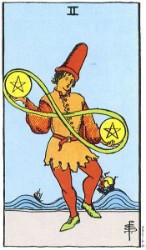
When we take that natural behavior, though – that need to pursue many different interests at once – and drop it into our linear, specialized society, it looks a lot like . . . guess what?  ADHD.  In a culture where concentrating on one task at a time is the behavior that’s rewarded and reinforced, the multipotentialite is frequently perceived as being highly dysfunctional.   Why can’t you concentrate?  Why don’t you ever get anything finished?  Why do you keep jumping from one thing to the next?  Those are questions that the multipotentialite will hear her entire life and it can leave her feeling inadequate, guilty, and shamed.  Like the figure in the Two of the Pentacles, life seems like a constant balancing act, rather than a fulfilling adventure.

STRATEGIZING FOR A HAPPY LIFE

If all of this is striking a chord with you, if you feel that you may be a multipotentialite, then rest assured, there are still ways to find happiness.  There are a few simple strategies that can make you feel like you’ve got super-powers instead of constantly feeling less than.

1. Embrace Your Identity and Fix Your Self-Image: Recognize that being a multipotentialite is a strength, not a flaw. Celebrate your curiosity and versatility instead of forcing yourself into a specialist mold.

2. Consciously Design a Portfolio Career: Instead of choosing one path, build a career that allows you to explore multiple interests. This could mean freelancing, consulting, or combining part-time roles.  If you’re an artist and a writer, for instance, you could do illustrations set off with poetry.

3. Set “Seasons” for Your Passions: Focus on specific interests for a set period, then rotate to another. This prevents burnout and keeps things fresh. This allows you to hyper-focus on a particular avocation, but use boredom as a signal for when it’s time to switch to another.

4. Create a “Renaissance Schedule”: Dedicate blocks of time to different pursuits. For example, Mondays for art, Tuesdays for coding, and so on. Structure helps manage your many passions without feeling scattered.

5. Prioritize Projects: Not every interest needs to become a lifelong commitment. Learn to distinguish between short-term fascinations and long-term passions.

6. Find Overlaps: Look for ways to combine your interests into unique projects. A multipotentialite superpower is the ability to innovate by connecting ideas from different fields.

If you’re interested in exploring more multipotentialite options for living, I’d really encourage you to visit Emilie’s website, “puttylike.   Creativity and curiosity are options that many people seem to have missed out on, so let’s take them to the max.

The Hermit, Introverted Intuitives, and Letting Our Lights Shine

How intuitives emerge from a Hermit Phase.

As an INFJ personality type, I’ve always felt a particular affinity for The Hermit card.    After all, going into Hermit mode is one of the primary defense mechanisms of intuitives and introverts.   When we feel overwhelmed or hurt, we pull up the drawbridge, slam the gate shut, and self-isolate until we heal.  Sometimes that takes a few weeks and sometimes it can turn into years.

I’ve recently begun focusing on another part of The Hermit card, though, which is the lamp that he’s holding aloft.  He isn’t just hiding out anymore – he’s illuminating a path for others to follow.

 INTUITIVES DON’T LEAD

Doing that is NOT something that highly intuitive or empathetic people are inclined to do, for a couple of reasons.  First – and most obvious – is the fact that most intuitives are also introverts.  We’re not the sort of people who want to have a great deal to do with other people, much less try to lead them anywhere. 

In a very real sense, that’s more of the path of the extrovert.  Extroverts love, love, LOVE to charge out into society, organize everything, and tell other people what they should be doing and when they should be doing it. Which is fine, because someone has to put together the Christmas parties, right?  Better them than us.

INTUITIVES AND SELF-IMAGE

Another reason that intuitives seldom assert themselves as, “leaders,” is that many of us have really rotten self-images.  We feel as if we don’t fit in, as if we’re the original square peg in a round hole.  

Some of that flows out of the fact that society is, once again, pretty much designed by extroverts.  Starting in elementary school, we’re told that daydreaming and wanting to be by ourselves is, “bad.”  How many of us received the dreaded report card that said, “Doesn’t play well with other children?”  Yikes.  

That continues into adult life, of course.  Just look at the modern work spaces, with cubicles piled on top of each other and no sense of privacy or personal space.  They’re extrovert heaven and introvert hell and if we don’t like them there must be something wrong with us.  It turns out we don’t play well with other adults, either.

INTUITIVES AND DYSFUNCTIONAL FAMILIES

There’s a further reason for intuitive introverts having terrible self-images, which is – guess what? – our families.  When I first started digging into intuitive personality types I was astounded at the number of people who reported that they had come from dysfunctional families.  And by, “dysfunctional,” I mean families where one or both parents had serious mental issues, addiction issues, or abuse issues.  

Frequently, a part and parcel of being a terrible parent is blaming the child for your bad parenting skills.  A classic example is a parent who gets drunk, beats the hell out of the kid, and then says, “You made me do that.  If you were a better child, I wouldn’t have to beat you.”  The end result is that the kid is convinced that he or she isn’t a, “good,” person and that they’re somehow to blame for the abuse.  We go into life with the basic premise that we’re flawed and unloveable.

INTUITIVES AND COGNITIVE INTELLIGENCE

So, all of these factors (and more) lead the introverted intuitive to feel that she’s in no position to lead anyone, anywhere.  After all, we’re odd balls and we’re just not quite good enough.  But is that borne out by facts?  Consider these statistics from Susan Storm’s article in PsychologyJunkie:

Of all of the personality types, INFJs have the second highest grades in high school.

INFJs have the highest first semester grades in college and some of the highest undergraduate grades.

INFJs are among the most persistent personality types in actually finishing college.

INFJs tend to score well above average in standardized IQ tests.

INFPs and INFJs read more than any other personality types.  While the average American reads 12 books per year, INFJs average 67 books per year.

INTUITIVES AND EMOTIONAL INTELLIGENCE

While some introverted intuitives are full blown empaths, ALL of them are highly empathetic.  And by empathetic, I mean that they can, “read,” another person’s emotions so deeply and so quickly that they may appear to be psychic.  

When you meet an introverted intuitive, they are instantly scanning your body language, your eyes, your facial expressions, the tone of your voice and even the clothes that you chose to wear that day.  All of this happens so rapidly that the intuitive may not even be aware that he’s doing it.  What’s more, intuitives frequently feel that everyone else must have that same level of perception, simply because it feels so natural to them.  But, no, most people don’t do that.

As Eileen McKusick, author of Tuning the Human Biofield put it, “It’s like having an antenna that goes a little higher than everyone else’s.  We pick up information that normal people don’t.”

COMING OUT OF THE HERMIT PHASE

What usually pulls introverted intuitives out of their Hermit phase is a desire to help other people.  That can manifest as personally as wanting to help a friend who’s gone through a divorce or as broadly as wanting to make some contribution to humanity as whole.  Intuitives are, after all, highly empathetic, which means that we really DO feel other people’s pain, almost as if it were our own.  

In order to help, though, we have to get rid of that old, “I’m not good enough,” self-image.  When we combine our intellectual intelligence with our emotional intelligence, we are actually extraordinarily capable of helping others heal.

It’s estimated that up to 52% of the population may fall into the introvert section of the personality types.  BUT . . . introverted intuitives are a very tiny slice of that.  Only 1 to 2% of the world population are INFJs and only 4.4% are INFPs.  We have unique gifts and unique perspectives.  We just need the self confidence to go along with those gifts. To let our lights shine on other people’s darkened paths.

Blasted Towers, Bad Ju-Ju, and the Unluckiest Card in the Tarot

A look at the five unluckiest cards in the Tarot deck.

I recently received an email from a reader who asked, “What’s the unluckiest Tarot card?”  I had to scratch my head about that one because the whole concept of good luck versus bad luck can get pretty complex.  Nonetheless, there are some Tarot cards that can always be considered harbingers of bad luck

THE WHEEL OF FORTUNE, REVERSED

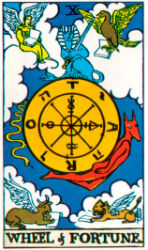
The Wheel of Fortune, Reversed, is the most obvious choice for a, “bad luck,” card.  We actually talk about luck in terms of good fortune and bad fortune and that’s what this card is all about.  It depicts life as a wheel, where sometimes our luck is ascending and expanding and sometimes it’s descending and decreasing.  When The Wheel of Fortune, Reversed, shows up in a reading it indicates that we’re in for a patch of bad luck.

The Kybalion, which is a book about Hermetic Magic, compared it to the pendulum of a clock.  The pendulum swings first in one direction and then back in the other.  Life can be seen in much the same way:  sometimes we’re swinging into really good luck and then we swing back into a period of bad luck.

The obvious underlying message is to just hang on, because things will inevitably change.  When we can stand back and look at good luck/bad luck as a rhythmic cycle, then periods of ill fortune will affect us much less severely.  We just need to stay centered and calm and wait for the cycle to reverse itself.

THE TOWER

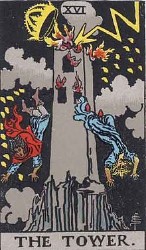
Also known as, “the lightning struck tower,” and, “the blasted tower,” The Tower would probably be my pick as THE unluckiest card in the deck.  

“Just the Tarot,” by Dan Adair – complete definitions, layouts, and instructions for reading Tarot cards, available on Amazon.

At it’s most severe level, it can indicate that everything that you’ve loved and invested in is about to be blasted right down to the ground.  The last time that I had it showing up in my personal readings, my life partner died, I lost my house, and I was involved in a horrible law suit over the probate of the estate.  It can be that bad, depending on the other cards in the reading, but it usually isn’t.

On a mundane level, The Tower is usually just a powerful warning that we’ve gone down the wrong path and the Universe is about to provide a course correction.  Perhaps we’ve been treating our fellow employees badly and – Shazam – we’re suddenly fired or demoted.  Or perhaps we’ve been emotionally abusive or neglectful of our lover and they leave us for someone else.

In my experience, there’s always a level of hubris involved with this card.  We’re not only taking things for granted, but we’re also being arrogant.  We’re assuming that everything is under our control and the Universe is going to show us that we’re not.

The most positive message in this card – which we usually fail to appreciate at the time – is that we get to completely start over.  It’s like that line from, Me and Bobby McGee:  “Freedom’s just another word for nothing left to lose.”  When our lives (or our projects or relationships, etc.) have been blasted right down to the foundations, we have the freedom to consciously design something new and better.

DEATH

Even if it isn’t the unluckiest card in the deck, Death definitely wins the award for the creepiest card in the Tarot.  In her wonderful book, “Fortune Telling by Tarot Cards,” Sasha Fenton puts it in this perfectly understated, British way:  “This card usually puts the wind up people when it appears . . .”

Yes.

Now, first of all, I have never seen the Death card appear before someone’s death.  It will pop up after someone has died, but it’s usually just a comment on what’s happened.  It’s more like, “Well, you’ve lost someone you loved, so you’re dealing with death and grief.”

What it can indicate, though, is that there’s going to be a radical, life changing turn in events in a person’s life.  The querent is suddenly going to find herself going in a completely different direction than she has in the past.  In an emotional and spiritual sense, it really is as if their previous life has died and they’re off in a completely new direction.

I knew a woman who had been happily married for 15 years, had a home, a loving husband, and 2 kids.  She woke up one morning with this thought ringing in her head:  “Shit, I’m not in love with him anymore and I hate my life.”  Within six months she’d obtained a divorce, turned custody of her children over to her ex-husband and was working as a river guide in West Texas.  That’s the kind of radical change that we’re talking about here.

Whether that kind of change is good luck or bad luck is just a matter of interpretation.  If it’s something that we consciously plan, we usually view it as good fortune.  If it was something that was forced on us by circumstance, we may think it was bad fortune.

JUSTICE, REVERSED

I’m a little hesitant to include the Justice card in this list because it has more to do with people and circumstances than luck per se.  Nonetheless, it’s frequently seen as bad luck so I’ll stick it in here.

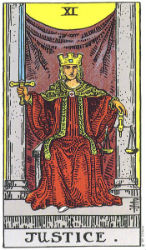
Classically, as you might guess from the image, Justice has to do with the legal system.  If we’re involved in some sort of litigation and Justice is upright, it can mean that we’ll prevail.  If it’s reversed, it can mean that we’ll lose.

On a personal level, it can mean that the people around you – your family, co-workers, boss, etc. – are making judgements about you and they’re not good if the card is reversed.  

Losing a court case can obviously be seen as bad luck.  Or it can be seen as a sign that we have a bad case, a bad lawyer, or a bad judge.  In the same way, having people we care about judging us harshly can be seen as being treated unfairly.  Or it might be that we’re being jerks and we need to clean up our acts.

Justice, Reversed, can be a sign of a bad luck to come, but it also serves as a warning.  It’s saying, “You’re about to have some bad luck, so you need to take a careful look at your own actions before that happens.”

TEN OF SWORDS

It doesn’t take but a glance at the Ten of Swords to realize that there’s some serious bad ju-ju happening here.  If we’re lying face down stuck full of swords like a human pin cushion, something’s a little wrong. This card can indicate treachery, deceit or a very, very bad ending to a relationship or a job.

The suit of Swords symbolizes our personal power.  That’s the way that we project ourselves out into the world.  There’s nothing innately wrong with that.  Whether it’s standing up to a school yard bully when we were kids or pushing hard for a project we really believe in at work, there are always times when we have to be a bit aggressive.

But . . . when we’re overly and chronically aggressive, that puts us into a power cycle. We’re trying to dominate other people and run over their emotions and desires.  We become the school yard bully instead of the person standing up to the bully.  We see this mentality frequently with primitive men who brag about being the, “alpha dog.”  It’s dominance for the sake of dominance, rather than for the sake of getting anything done.

The message of this card is the old cliche’: live by the sword, die by the sword.  If we’ve been treating other people harshly, if we’ve been abusive in our love relationships, or domineering in work relationships, we’ve got some bad karma heading our way.

So those are the top five, “bad luck,” cards in the Tarot deck.  There are, of course, other cards that may indicate bad fortune in one aspect or another of our lives, but these are the red flags.  And, of course, we should always remember that a Tarot reading is just a snap shot in time.  It tells us what’s likely to happen, but we have the free will to change it.

Animal Companions, Heart Chakras, and Learning to Love

Our pets abilities to heal our Souls.

“I’ve known several Zen Masters and they were all cats.” – Eckhart Tolle

The image in The Fool tarot card shows a person dancing with joy at the edge of a cliff.  It’s meant to portray a Soul that’s so fully in the Flow that, even if she were to dance off of the cliff into thin air, she wouldn’t fall.  It’s a beautiful card, but we seldom take much note of the little dog that dances right along with The Fool.

In her book, “Animal Soul Contracts: Sacred Agreements for Shared Evolution”, Tammy Billups addresses the idea that animals come into our lives for specific reasons and they’re often instrumental in helping us to recover and evolve.  As she puts it, we have a Soul Contract with our animals.  We heal them and they heal us.

She tells the story of a man who was living alone when a stray dog suddenly showed up on his doorstep.  He took the dog in and they formed a strong, loving bond. The one problem was that the dog developed terrible separation anxiety and suffered greatly whenever his new owner had to leave the house.

He finally contacted Ms. Billups in the hope that she could work with the dog and help it to feel more secure.  In the course of treating the dog, though, the man had a sudden epiphany:  every relationship he’d ever had ended up with his lover walking away from him.  He had severe abandonment issues of his own and so he’d attracted an abandoned dog.  He started therapy and, as he learned to deal with his own fears of abandonment, the dog healed from its separation anxieties.

She posits that animals – and particularly that class of animals that we refer to as our, “pets,” – have a very deep and ancient Soul connection with human beings.  They not only mirror who we are, as the dog did with the young man, but they also point us toward a better way of existing in the world.

One thing that they provide to us abundantly is pure, unconditional love.  Getting that kind of love as an infant is vital to the development of a healthy, well adjusted human being.  Sadly, though, we have a lot of people in our world who were beaten more than they were hugged as children.  We emerge as adults who are convinced that (a) we can’t be loved; (b) somehow it’s our fault, rather than the fault of our crazy parents; and (c) it’s never safe to reach out to other people for love.

And then a puppy or a kitten shows up in our lives and loves us unconditionally.  The dog or the cat doesn’t give a flip about how smart we are or how we dress or how much money we have or any of the other parameters we may find in human relationships.  They just love us, totally and unconditionally, for who we are.  And, yeah, we learn that lesson on a deep Soul level:  it’s safe to love and to receive love.  They fill that hole in our hearts that’s been there since we were babies.

Another example that Ms. Billups gives is that highly empathetic people (and particularly empaths) will tend to attract highly empathetic animals.  We run into that sometimes with an animal that literally seems to be peering straight into our Souls when it looks at us.  There’s a sort of a tickle in our energy systems and a voice that says, “This dog somehow understands exactly who I am and what I’m feeling.”

The common bond is that both animals and empathetic people are primarily, “feelers,” rather than just thinkers.  We exist on that energy level of emotions and almost instantly perceive the hidden vibrations in another being.  And the, “training,” that we receive from that kind of an animal is to learn to keep our own vibrations as loving and kind as possible because they’re feeling them just as much as we are.

Which brings me to the part of Ms. Billups discussion that really blew me away, which is emotional support animals.

We’ve seen a fairly substantial increase in the presence of emotional support animals as a result of the wars in Iraq and Afghanistan.  Many of the troops were returning home with severe PTSD and social anxiety.  Psychologists found that pairing them with animals – usually dogs – helped to soothe their nervous systems and allowed them to interact more peacefully in social settings.

It makes sense, even on a superficial level.  If we’re feeling extreme anxiety, the presence of a calm, loving animal would obviously settle us down.  Ms. Billups takes that a step further, though.

She says that some animals, especially emotional support animals, are able to hold what she calls a, “transformational healing presence.”  In other words, it isn’t just their presence as a trusted companion that’s calming down the person’s nervous system.  Rather, these are animals that are SO evolved that they’re able radiate calmness, serenity and love out of their very core.

We can actually see that with our own eyes.  The next time that you encounter someone with a support dog in a store, stop and look at the people around you.  Most of them will suddenly slow down, smile, and begin to radiate calmness of their own.  It isn’t just because they think the dog is cute, either.  Rather, they’re walking into that energy field of a healing presence that the dog is holding and it transforms them.

There’s a lesson in there for humans, as well.  It takes work – sometimes a lot of work – but we can become that same sort of a transformational healing presence in the world.  Through therapy, affirmations, meditation, and working with our heart chakras, we can nurture a core energy that’s calm, loving, and compassionate.

We don’t need to develop a philosophy or a method around that.  We don’t need to become gurus or convince anyone that they should behave in this way or that way.  All that we need to do is to build the love in our hearts and radiate it out into the world.

One of the neat things about that is, like the support dog in the store, we can step out of all of that judgment about who’s going to receive the love.  The dog isn’t standing there thinking, “Oh, that one’s a Republican – no love for him.”  Or, “Uh, oh, it’s a liberal, shut down the love.”  It’s there for anyone who wants to receive it, no questions asked.  And if someone doesn’t want to receive it, the dog doesn’t get upset or neurotic about it – she just keeps shining that light.

So I’m going to start paying a lot more attention to the animals in my life and begin actively looking for the messages that they’re bringing me.  Perhaps I’ll put my cat in my lap the next time I meditate and see if she has anything she’d like to add.  I’m guessing she does.

The Eight of Pentacles, Bras Burning Bright, and the Importance of Social Deviance

A look at the importance of personal and social deviance as illustrated by the war over brassieres.

Imagine a culture that was SO rigid that the people in it actually dictated what kind of underwear you had to put on in the morning.  Sounds pretty crazy, doesn’t it?

Still, that was exactly the situation that we had right here in the United States just 50 short years ago.  It’s a short tale and well worth looking at.

The modern brassiere was invented by Mary Phelps Jacob in 1910.  From that point on it was declared that, “decent,” women would wear bras and breasts would henceforth be encased in cotton cups when they were transported out in public view.

Now, in the late 1960’s, a growing group of women said, “I don’t wanna.”  It wasn’t that they were rigidly opposed to brassieres because, as any woman will tell you, bras can be comfy cosy in winter months and in cold climates.  Rather, they were making the radical assertion that any human being should have the right to decide whether they want to wear underwear on any given day.

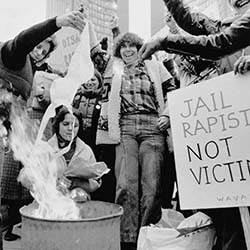
Many people in our culture were shocked and appalled at the notion of unfettered breasts.  Women who went braless were actually arrested for, “public indecency,” in some Southern states.  “Decent,” women sneered at them and, “god-fearing,” men leered at them.

Still, the revolutionary bra warriors persisted and even went so far as to hold public bra burning to make their point.

By today, of course, no one cares if a woman wears a bra or not.  Generally speaking, bras go on in the winter time and come off in the summer time, which is perfectly sensible and the way it should have been all along.

The Great Bra Culture War is a perfect illustration of what sociologists refer to as, “tolerated social deviance.”  They actually have a very precise definition of deviance, which goes like this:

Deviance is a behavior, trait, or belief that departs from a social norm and generates a negative reaction in a particular group. In other words, it is behavior that does not conform to the norms of a particular culture or society.

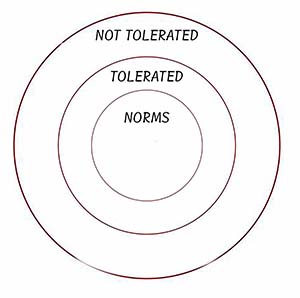
Tolerated social deviance is behavior that’s outside of the social norm, but not so far outside of it that it warrants severe punishment.  We can think of it as a series of concentric circles where the inner circle is the norm, the second circle is outside of the norm but it’s tolerated, and the outer circle is SO far outside of the norm that it will get you arrested.

In that model, during the first half of the 20th century not wearing a bra in public was in the outer circle and would result in a woman being shunned, slut-shamed, or arrested.  After the 1960s, not wearing a bra moved into the second circle of being outside the norm, but tolerated.  And by now, it’s moved into the inner circle of perfectly acceptable behavior, except in Mississippi.

The point of all of this is that freedom and creativity exist OUTSIDE of the norm.  That inner circle of social norms consists of people behaving in exactly the same way as everyone else.  The behavior is, “acceptable,” precisely because everyone else is doing it.

The world of the social norm is what Stuart Wilde was talking about when he referred to the Tick-Tock world.  As he pointed out in his book, “Affirmations: How to Expand Your Personal Power and Take Back Control of Your Life,” the Tick-Tock world involves getting up every day and doing the same things over and over and over because that’s what society expects of us and we don’t want anyone to think we’re being weird or unusual.  “I have to wear a bra because everyone else wears a bra and what would the neighbors think if I didn’t?”

To put it in terms of energy, it’s a closed system.  There’s nothing new or different flowing into it, because everyone is acting and thinking exactly the same way.  It’s like the guy in the Eight of Pentacles who’s just making the same product over and over again, but not creating anything new.

Deviance is thinking outside of that closed box.  Deviance is what allows fresh, different energy into the system.  Deviance is what makes us evolve.

We see this in cultures all across the world.  The most creative, vibrant cultures are the ones that tolerate the highest levels of diversity.  China and Russia, for instance, have extremely low tolerance for diversity and social deviance.  Are they producing any great literature?  Any amazing art?  Fabulous music?  Is anyone desperately trying to get into their countries?  Nope.

Put very simply, the best cultures are the cultures that maximize freedom and diversity.  Those are the cultures that are the most alive and evolving the fastest.

I’ve lived in both California and Texas.  I CHOOSE to live in California because California maximizes my opportunity to be just as different, weird, and unusual as I want to be.  California values social deviance and so I have a much greater opportunity to be my authentic self, to the best of my abilities.

It’s important to ponder all of this as we move into the new era of the Trump administration.  Are we going to continue to be a society that values  and encourages diversity or are we going to become a closed, intolerant  and stagnant energy system?

Make no mistake:  there ARE people out there who are so crazy that they want to tell us what kind of underwear we should put on in the morning.  They want to shrink those two outside circles into one boring inner circle where everyone looks and acts precisely like everyone else.  

Don’t let them do it.

Empaths, Elections, and Staying True to Our Own Energy

Building effective boundaries for empaths.

If you’re an empath and you’ve been feeling kind of sick to your stomach lately, believe me – you’re not alone.  Many of us have experienced the recent election in the United States as something that makes us want to curl up in a ball under a blanket for the next four years.

It’s important for us to explore how this is affecting us from a bioenergetic perspective, though, and not just from a political or emotional perspective.  What is all of this DOING to our energy and our energy fields?

What’s one of the first words that come to mind when we contemplate being an empath?  Boundaries, right?  Boundaries, boundaries, BOUNDARIES!  

Empaths have extremely porous personal boundaries and very leaky energetic boundaries.  In a way, that’s what makes us empaths.  “Normal,” people have fairly strong boundaries and a strong sense of, “I’m over here and you’re over there and we’re two separate beings.”  For a normie, what another person is feeling stays inside of the other person, unless the other person decides to share it.  For an empath, other people’s feelings are constantly flooding into us. It’s very easy for us to merge with those feelings and mistake them for our own.

That’s one of the reasons that many empaths become codependent.  We merge so totally (and so easily) with other people’s emotions that we mistake them for our own.  If someone we’re close to is having emotional or mental problems, we think that we have to manage their drama because it feels like it’s our own. We end up taking care of their lives instead of our own.

So one of the first steps to becoming a healthy empath is to learn to identify our own energy and separate it out from other people’s energies.  We learn this at an early age and many of us become socially avoidant as a result.  We realize that if we’re around people who are angry, depressed, or violent, that we just soak all of that in and it fucks us up.  One strategy we use to deal with that is to just avoid people in general: many empaths become radical introverts.  Which works, but it’s not the BEST strategy, right?  We really can’t cover our heads with the blankets for the next four years.

Can we?  Um . . . no.  I guess not.

We have to learn to separate our energy fields in better ways.

The human energy system is really quite simple to visualize.  As Alla Svirinskaya says in her book, “Own Your Energy – Develop Immunity to Toxic Energy and Preserve Your Authentic Life Force,”  we can think of it as the physical body or core, which is surrounded by a couple of other energetic layers or bodies which are the emotional body and the mental body.  Those other bodies are usually seen as egg shaped, so we end up with a picture of it that looks like this:

For a normie, those extra layers act as a wall to keep out other people’s energy. They filter out negative energies so that they never reach the core of the physical body. For an empath, though, they act as a bridge.  Instead of blocking us off from the emotional identity of people who aren’t us, they allow it to flow right into our personal energy fields which frequently overwhelms us, leaving us confused and injured.

Most empaths are dealing with those dynamics on a daily basis.  What we forget, though, is that our personal energy fields exist inside of larger energy fields.  Any time that you put a group of people together, their personal energy fields are going to merge to some extent and generate a group energy field that’s composed of the collective emotions of all of those people. And we live within those other energy fields.

In a very real sense, we could talk about the vibrations of a particular town or a county or a state.  Those vibrations are the collective energies of the people who live in those places.  Texas, for instance, has a very different vibration than California. And, yes, countries have a collective energy field, too, which is brings us back to the topic at hand:  dealing with this election.

About 72 million Americans got together and voted for a candidate who oozes hatred and anger out of every pore of his orange skin.  THAT is the collective energy that we’re dealing with right now and THAT is what’s making us feel sick.  Put simply, there’s a whole lot of hatred and anger out there in the collective energy field and it’s seeping in to our personal energy fields.  As empaths, we are especially vulnerable to this.

So what can we do about it? Well, we need to remember that the key to being a healthy empath is to be able to distinguish OUR energy from OTHER’S energy.  We need strong boundaries and we need that sense of, “this energy belongs to me and that energy doesn’t.”

Empaths are (for the most part) kind, loving, compassionate people.  That just goes with the territory.  When you really and truly understand another human being on the deepest level, it’s very difficult to stay angry with them.  Or to hate them.  Or to judge them too harshly.

Hatred, anger and judgements are NOT our energies and that’s why they make us sick.

A good strategy for us, then, is to be very conscious of those energies existing inside our personal fields. If we start to feel really, really, REALLY pissed off at the Trumpsters, we can stop and say, “This is NOT my energy.  This is their energy.  I won’t own it.”

Another strategy is to do what Chagdud Tulku called, “antidoting.”  The antidote for hatred is love and the antidote for anger is compassion.  I’m not suggesting that we turn ourselves into human doormats for the Trumpsters.  Rather, we’re just embracing our own nature.  By embracing our own nature, by being as compassionate, kind, and caring as we can, we automatically separate OUR energy from THEIR energy and – surprise, surprise! – we’ve got boundaries.  Suddenly, they’re over there and we’re over here and we don’t have to live in their hatred or let it blend into our energy.

Shazam!

Karma, Having Sex with Republicans, and Being Kind to Yaks

Seeing karma as a way to change our past.

One of my favorite internet memes says, “Karma – It’s spelled K-A-R-M-A and it’s pronounced, ‘Ha, ha, fuck you.’”  

That’s a perfect explanation of our usual understanding of karma which is basically, “If you do some shit, you get some shit.”  If we do something terrible to another person, something terrible is going to happen to us. If we do something nice, something nice is going to happen to us.

OH, WELL, IT’S KARMA

Counter-intuitively, karma is also used an explanation for why bad things happen to good people.  We may have a friend who’s a wonderful person and goes through his life supporting and nurturing others, who’s full of love and gentleness and kindness.  And then something horrendous happens to him, like he falls of a cliff or discovers his wife is having sex with a Republican.

We simply can’t understand why such a good person would have such bad luck.  Certainly, he did nothing to deserve it and, according to the Law of Karma, all of his good behavior should have been rewarded with good things happening to him.

But . . . we’re told . . . perhaps he did something really, really terrible in a previous incarnation.  Maybe he pushed someone off of a cliff or maybe he had sex with a Republican.  Maybe he actually – shudder – enjoyed having sex with a Republican.

That allows us to restore some sense of cosmic balance and we say, “Oh, well, it’s just karma.”

IT AIN’T ME, BABE

We can certainly understand that concept when something bad happens to someone else, but it’s difficult to swallow when it happens to us.

Let’s face it, most of us are NOT the Dalai Lama and we have very little memory of our past lives.  We may accept the general idea that we’ve lived other lives, but we don’t actually remember being a Yak herder in Mongolia in 40 A.D. or a courtesan in Paris during World War I. 

From our current point of view, those people who we were in our past lives were literally someone else and not us.  

The idea that I broke my wrist today because some other guy kicked a Yak 2000 years ago seems entirely capricious and cruel and unjust.  It feels like . . . how shall I put this? . . . bullshit.

KARMA AND DETERMINISM

From that perspective, karma feels very much like determinism.  Determinism is the view that every single thing that happens to us is pre-determined from the moment of birth.  There really isn’t any free will or choice in life because our lives are a result of our genetics, our cultures, the families we’re born into, and the times we live in.

We can actually make a strong case for that.  Even in the United States, where we worship the idea of free will and choosing our own destinies, the statistics say it ain’t so.  If we’re born into a dirt poor family, we’ll probably die dirt poor.  If we’re born into great wealth, we’ll probably die rich.   If our parents were conservative Catholics, we’ll probably be conservative Catholics.  If our grandfather hated socialists for no particular reason, we’ll probably hate socialists for no particular reason.

We tell ourselves that we’re making choices about those issues, but for the most part we aren’t.  It was all programmed into us before we came down the birth canal.  Life is something that happens to us, not something that we create.

Karma can feel a lot the same way.  I, me, the person who I am right now, did NOT kick that Yak 2000 years ago, so why am I being punished for it?  It’s something that’s just happening to me, not something I can control or make any choices about.

BUT KARMA’S A CHOICE

Paradoxically, being the people who we are, right here, right now, is the good news about karma.  

Determinism basically says, “You’re fucked or you’re not fucked and there’s not one damned thing you can do about it.  You have NO choice in the matter.”  It’s all predetermined.

The Law of Karma, on the other hand, says that what we do right now is what really counts.  Far from saying that we have NO choice in the matter, karma is saying that we always have a choice.  And our choices are what determine our karma.

As David Michie said in, “Buddhism for Busy People,” 

“A lot of Western people wrongly think that karma equals fate or predestination.  They think it’s something you don’t have any power to change.  This is a misunderstanding.  It is we who create our own karma and we can change it in a powerful, dynamic way. We are creating hundreds, even thousands of such causes every day of our lives.”

Put another way, we are creating our own karma ALL THE TIME.  It’s not something from the past that just pops up to bite us in the ass every once in a while.  It’s not like The Wheel of Fortune, where we have good luck for a while and then bad luck, for no apparent reason.  It’s something we personally create by either being good people or being bad people.

THE PRESENT AS PROLOGUE TO THE PAST

Now, there’s a particularly fascinating doctrine in some schools of Buddhism that says that we can actually change our past karma by how we behave in our present lives.  

Suppose, for instance, that I was a really notorious Yak kicker in Mongolia in 40 A.D.  I didn’t just kick Yaks occasionally.  No, I was a mean, nasty, evil spirited son of a bitch who got up every single morning and kicked the hell out of as many Yaks as I could reach.

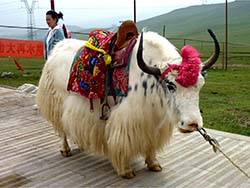
Fast forward 1985 years to my current life.  Suppose I start an, “adopt a Yak program,” and spend years rescuing and feeding homeless Yaks.  I learn to love Yaks and have great compassion for them.  Perhaps I even dress them in Yak finery for special occasions.

Under this particular doctrine, I wouldn’t JUST be creating good karma for my present self.  My good karma would go backwards through time and actually change the character and behavior of my previous self, the notorious Yak kicker. He might learn to love Yaks just as much as I do and my bad Yak karma would be erased.

IT’S NOT THAT WILD

If that sort of time traveling karma sounds a little too wild, just consider what most of us already believe about karma.

We believe that we have one Soul with many different historical identities and that what a previous identity does can travel through time to affect the life of our current identity.  So if all of these past identities are somehow in touch with our current identity, why wouldn’t our current identity be in touch with our past identities?  If they can affect us, it stands to reason that we can affect them.

KARMA AS AN ONGOING PROJECT

When we shift our perspective in that way, then karma becomes an on-going project.  We’re no longer victims of our past.  We’re actually re-creating our past through our current actions.

And if that isn’t free will and choice, I don’t know what is.

Being compassionate, decent people every day and right now is good for us and it’s good for the people around us.  And, ultimately, it’s good for the Yaks.  

Do it for the Yaks.

Just a reminder that my ebook, “Just the Tarot,” is available on Amazon for much less than a bag of Yak feed.

Lucid Choices, The Four of Swords, and Living the Dream Life

Looking at our lives as lucid dreams.

Have you ever had a dream that seemed so real, so vivid and intense, that you were actually shocked when you woke up and realized it was just an illusion?

Sometimes they’re really GOOD dreams.  Perhaps we’re making incredible love with someone or maybe we’re floating through a starry, magical sky. Sometimes they’re really BAD dreams, where we’re being chased by monsters or night terrors.  Whether they’re good or bad, the one thing they have in common is that – at the moment that we’re having them – they seem absolutely, 100% real.

LIVING THE DREAM

There’s a strong case to be made for the idea that our so-called, “waking life,” is very much like a dream, as well.

In, “The Four Agreements,” that’s the term that Don Miguel Ruiz actually uses to describe our day to day existence:  a dream.  As we grow up, we’re programmed by our parents, our religions, and our societies to see the world in particular ways.  We don’t question those view points as they’re being installed in our little brains because we don’t have the ability to judge whether they’re true at that age.  By the time that we reach adulthood, we’re thoroughly convinced that the way that we see the world is the RIGHT way to see it, perhaps the ONLY way.  But those view points are just someone else’s dreams of how the world really is.

Buddhist and Hindu philosophies approach human life in much the same way:  life as we commonly experience it is an illusion, a dream that’s made up of our emotions, ideas, desires, and aversions.  We’re essentially sleep walkers who go through life laughing, crying, eating, procreating, raising families, working, and eventually dying, with no clue as to why we’re here or what it all means.  We just know that, like our dreams, it seems absolutely 100% real. 

WAKING UP

Occasionally, some of us will wake up just a little bit from the dream that we call our lives.  Usually it’s because our pleasant dreams have turned into a nightmare.  

One of our major dreams is, “I’m going to live happily ever after and nothing bad is going to happen to me.”  We’re taught that if we’re, “good,” people and we work hard and we’re responsible, everything is supposed to work out for us.  We’re going to fall madly in love with just the right person, have 2.5 beautiful children who will be extremely well adjusted, get a nice house, a new car, and all of the material toys. And we’ll live happily ever after.  Shit happens to, “bad,” people, not to us.

And then shit happens to us.

Perhaps we find our wife or husband in bed with someone else.  Perhaps we’re in a terrible auto accident.  Perhaps one of our beautiful children gets very, very sick.  Perhaps we get fired from our jobs and lose all of our material possessions.

It’s very much like suddenly waking up.  All of the things that seemed so rock solid and dependable in our lives turn out to be built on sand.  We may feel like life has betrayed us or the whole world has gone crazy.  Eventually, though, most of will go back to our dream worlds because the dream is so comfortable and waking up hurts.

LUCID DREAMING

There’s something that happens in some dreams where we’re dreaming but we suddenly become aware of the fact that it’s a dream.  We don’t wake up from the dream, but we exist within it, knowing that it’s a dream.  It’s called lucid dreaming and, if you’re not familiar with it you might enjoy reading, “Lucid Dreaming,” by Charlie Morley.

Now, one of the things that happens in lucid dreaming is that, to a large extent, we’re able to control the dream.  If we see a wall in front of us, we can consciously decide to simply grow wings and fly over it.  Or perhaps we can visualize a really beautiful woman or man and make love to them to our heart’s content.  

It’s a dream.  We know it’s a dream. But we can choose what happens in the dream.

LUCID LIVING

In his book, “Change of Heart,” Chagdud Tulku said that very few of us will ever be enlightened.  Most of us will continue to live in a dream state, perhaps for many incarnations.  BUT . . . we can choose whether we want to have a good dream or a bad dream.

Which sounds very much like lucid dreaming, doesn’t it?

When we have one of those life experiences where our day to day dream has turned into a nightmare, when we suddenly get a peek behind the curtain of what we thought was true, we have a choice.

Most people roll over and go right back to sleep, just as quickly as they can.

Some people decide to adopt a stance of total cynicism.  Life sucks.  People are rotten.  It’s all a lie.  These are the, “life is a bitch and then you die,” people.

But a few people will say, “Huh . . . it’s all just a dream.  But it’s an interesting dream.  I wonder if I can grow wings and fly over that wall?”

IT’S NOT ENLIGHTENMENT

One of the things that it’s important to remember is that just because we realize that life may be a dream, it doesn’t mean that we’re suddenly, “enlightened.”  Like the person in the 4 of Swords, we’re still solidly asleep, but now we know that we’re asleep.  Which is an improvement.

Unfortunately, as a brief stroll through the internet will teach us, there are many, many people out there who have decided that they must be gurus, spiritual adepts and geniuses just because they woke up a little bit.  Seeing through the illusions doesn’t mean that we’ve got an answer – it just means that we see the problem.

It’s a paradox, like lucid dreaming, where we’re asleep and awake at the same time.  If we keep meditating and keep working on our personal growth, we’ll wake up a little more and a little more and a little more.

In the meantime, we can choose to have good dreams.  We can have dreams that are full of love and healing and our dreams will make other people’s dreams a little better, too.

As Bob Dylan once said, “I’ll let you be in my dream if you’ll let me be in yours.”

Remember that my ebook, “Just the Tarot,” is available dirt cheap on Amazon. It’s not just a dream. Really. I think.