Wondering if your love will really last? Tarot offers powerful clues. Here are the top 10 “yes” cards for romance — symbols of harmony, joy, and lasting connection.
While the Tarot doesn’t hand out guarantees, it does shine a light on the energies present in a relationship. And some cards are so clear, so affirming, that when they appear in a spread, they almost shout “yes!”
Why Tarot for Love Questions?
Love and relationships are the number one category of Tarot inquiries. People turn to the cards when they’re uncertain about where things stand, or when they’re weighing the long-term potential of a relationship.
Tarot won’t say, “This relationship is guaranteed to last forever.” But what it will do is highlight the dynamics at play — the emotional energy, the strengths, and the challenges that shape a partnership. And when certain cards appear, they point strongly toward harmony, mutual growth, and a lasting bond.
The Top 10 Tarot “Yes” Cards for Romance
1. The Lovers
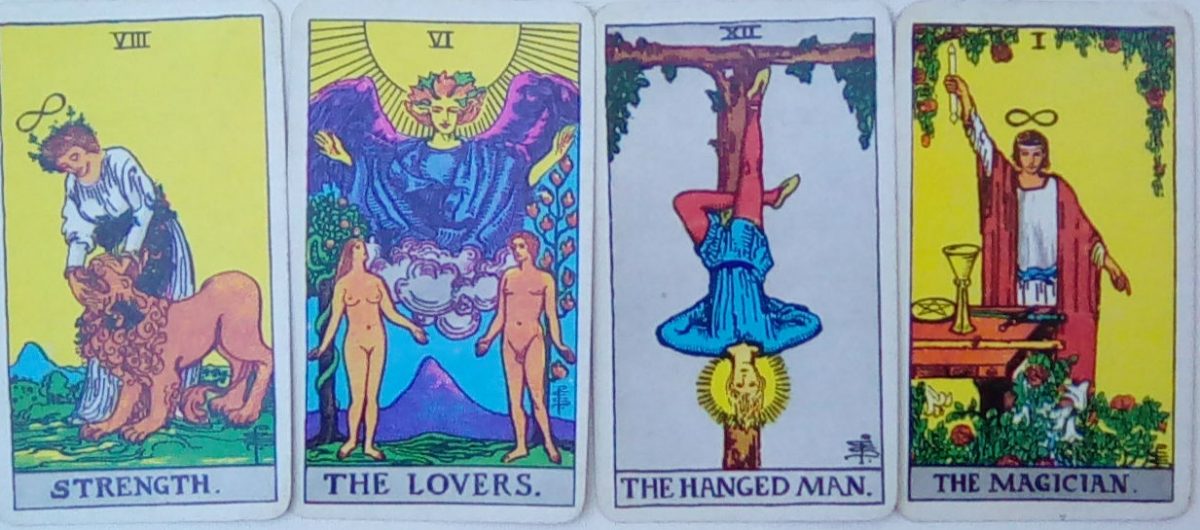
This is the archetypal card of love, union, and attraction. It represents shared values and choices that strengthen the bond. When The Lovers appear, the message is clear: the relationship is rooted in deep connection.
2. Two of Cups
The quintessential partnership card. It reflects mutual attraction, balance, and reciprocity. The Two of Cups points to a genuine soul connection where both people bring equal energy to the table.
3. Ten of Cups
This is the “happily ever after” card. It symbolizes long-term happiness, emotional fulfillment, and family harmony. If you’re asking about lasting love, the Ten of Cups is a resounding yes.
4. Four of Wands
A card of celebration, milestones, and commitment. It often shows up around engagements, weddings, or moving in together. It’s a sign that the relationship is not only joyful but ready to move into the next chapter.
5. The Empress
Abundance, nurturing, and fertility flow through this card. The Empress speaks of love that supports growth — creative partnership, deep affection, and the potential to build something lasting together.
6. The Star
The Star brings healing, inspiration, and spiritual alignment. In love, it suggests that the relationship is not only joyful but also restorative, giving both partners hope and a sense of divine timing.
7. Six of Cups
Sweetness, comfort, and sincerity. This card speaks to simple pleasures and genuine affection. Whether it’s new love or a rekindled flame, the Six of Cups highlights warmth and emotional honesty.
8. The Sun
Few cards are as positive as The Sun. It represents joy, openness, and vitality. In romance, it signals a relationship where both people feel seen, supported, and energized.
9. Ace of Cups
The overflowing chalice of love. This card signals the beginning of a new relationship or the renewal of affection in an existing one. It’s pure emotional abundance and a beautiful green light for love.
10. Two of Wands
While not strictly a “romance card,” the Two of Wands points to planning a shared future. It suggests vision, growth, and expansion — a partnership where both people are willing to build together.
What These Cards Have in Common
Look at these ten cards together, and a pattern emerges:
Union & Commitment: Lovers, Two of Cups, Four of Wands, Ten of Cups.
Emotional Fulfillment: Ace of Cups, Six of Cups, Empress.
Joy & Inspiration: Sun, Star, Two of Wands.
The common theme? Relationships that thrive on balance, mutual support, and a shared vision for the future.
A Note of Realism
Of course, not every card in the Tarot is a “yes.” Sometimes the spread brings red flags — lessons that need to be learned before love can grow strong. That doesn’t mean the relationship is doomed, but it does mean awareness and patience are needed.
Stay tuned: in a future post, we’ll explore the Top 10 “No” Cards for Love Questions.
Conclusion
Deciding if a love will last is never easy. But the Tarot provides more than predictions — it offers symbolic guidance about the energy flowing through your relationship.
When the “yes” cards appear, they suggest love that’s harmonious, joyful, and ready to grow into the future. If you see these cards in your spread, take it as the Universe’s way of saying: love is worth the leap.
Deciding whether to take a new job can feel overwhelming — but the Tarot offers surprising clarity. In this post, we explore the top 10 “yes” cards that signal opportunity, growth, and success in a new role.
There are two areas that cover 99% of what people ask in Tarot readings. And they are – guess what? – love and money.
To be more specific about the latter, a lot of people are very worried about finances right now. Younger people, older people, many of us are living just a paycheck away from destitution.
Most of the questions that revolve around finances can be broken down into two major areas: Should I keep this job? And, should I take that new job?
Unfortunately, that frequently breaks down further into, “I really, really hate my job but I’m afraid to quit it.” And, “I’m really thinking about taking this new job, but how do I know it isn’t going to be just another hell hole?”
Obviously, the Tarot can’t make those decisions for us, but it can put up some pretty clear markers one way or the other. In keeping with that, here are the top ten cards that indicate that, yes, we should take that new job.
The Top 10 Tarot “Yes” Cards for a New Job
1. The Magician
This card is all about skill and personal power. If you’re considering a new role, The Magician suggests you already have the tools and talent you need to succeed. It’s a reminder that you can create your own opportunities — and this one is ready for you to shape.
2. The Sun
Few cards are as positive as The Sun. It brings energy, confidence, and joy. In career terms, it signals that the new job will bring vitality and success — the kind of role where you can thrive, not just survive.
3. The World
The World represents completion and stepping into a bigger arena. It’s a sign that an old cycle is closing, and a new, more expansive chapter is waiting. Professionally, this card says, “Yes — you’re ready for the next level.”
4. Ace of Pentacles
The Ace of Pentacles is the clearest symbol of a new financial or career opportunity. Think of it as the seed of prosperity being handed to you. It’s a resounding “yes” that the new role holds real promise.
5. Three of Pentacles
This card highlights teamwork, recognition, and skill-sharing. If it shows up, it suggests the new job will give you the chance to collaborate with others and be appreciated for your contributions.
6. Six of Wands
The Six of Wands is about victory, advancement, and being noticed. In a career spread, it signals success in your new role and the recognition that comes with it.
7. Eight of Pentacles
This is the card of steady skill-building and mastery. If you’re entering a new field or learning new tasks, the Eight of Pentacles assures you that you’ll gain expertise and grow stronger through the work itself.
8. The Star
The Star brings inspiration, hope, and alignment with your higher purpose. In job matters, it suggests the new opportunity isn’t just a paycheck — it’s a chance to do something meaningful that feeds your spirit.
9. Two of Wands
The Two of Wands is about expansion and long-term vision. It tells you that the new job opens up possibilities for growth, planning, and future success. It’s less about a quick win and more about building something lasting.
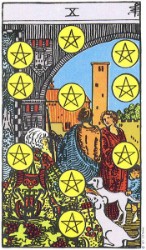
10. Ten of Pentacles
This is the card of stability, prosperity, and legacy. If it appears, it suggests the new role has the potential to provide long-term security, financial reward, and a sense of belonging within a larger structure.
What These Cards Have in Common
Looking at these ten cards together, a pattern emerges:
Material success & stability: Ace, Eight, Ten, and Three of Pentacles.
Recognition & growth: The Magician, The World, and Six of Wands.
Fulfillment & inspiration: The Sun, The Star, and Two of Wands.
When these cards appear in your spread, they point to opportunity, alignment, and security — the kind of energies that make a new job worth considering.
A Note of Balance
Of course, not every card says “yes.” It’s always sweet when we get clear yes and no cards in a reading, but sometimes they can be frustratingly ambiguous.
When that happens, the Tarot suggests waiting, rethinking, or being cautious about what’s really on offer. The future may reveal that the opportunity isn’t as golden as it first appears or maybe it will be. Things are still developing.
In a future post, we’ll explore the Top 10 “No” Cards for a New Job — the ones that raise red flags and encourage you to pause before leaping.
Conclusion
Deciding whether to take a new job is never easy. It’s a choice that can ripple out through every part of your life. While Tarot can’t choose for you, it can help reveal whether the energies surrounding a new opportunity are supportive, promising, and aligned with your bigger goals.
So the next time you’re staring at an offer letter, pull out your deck. If the “yes” cards show up, it may just be the Universe’s way of saying: step forward with confidence.
If you’d like a downloadable PDF copy of the Top Ten Job Cards, click here. When the list pops up, go to your browser menu and click on, “print file.”
The King of Wands reversed shines a light on impostor syndrome — that nagging sense of never being “good enough.” Learn how this Tarot archetype mirrors self-doubt and discover practical steps to reclaim authentic confidence, reverse the distortion, and own your rightful place at the table.
Do you never feel “good enough?”
Do you feel like, no matter how hard you try, no matter how much you do, you’re still falling short?
Does it seem as if everyone around you somehow has more talent, more luck, and is more deserving than you are?
That’s called, “Impostor Syndrome,” and it can destroy our lives.
WHAT IS IMPOSTOR SYNDROME?
Put very simply, it’s the persistent feeling that we’re a fraud, even when the evidence in our life says otherwise.
Self-doubt becomes a constant companion and we dismiss our achievements as, “a fluke,” or, “just good timing.” Even worse, there’s a chronic fear that someday we’ll be found out, that everyone else will realize that we’ve just been bullshitting our way through life and we don’t have any real substance.
It’s quite common among people who grew up in abusive households because that’s one of the primary messages that they got as kids: “you’re not good enough.” No matter what you do, you’re still not good enough.
It’s especially common among creatives, leaders, and anyone who’s stepping into a new role in life. Exactly the people who are already stretching themselves into growth and success.
THE KING ON A SHAKY THRONE
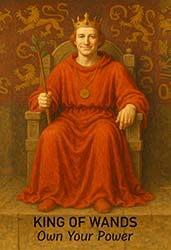
In the Tarot, the King of Wands represents the exact opposite of impostor syndrome. He radiates confident leadership. He’s the charismatic leader who can stand firmly in his own power and inspire the people around him.
But reversed? His fire dims and he hesitates. His self-belief falters and instead of leading with boldness he spirals into self-doubt.
That’s where Impostor Syndrome rears its ugly head:
Self-doubt in leadership.
Fear of being, “Found Out’ and huge anxiety that others will see through the facade.
Inconsistent Confidence and swinging between moments of brilliance and moments of total collapse.
Avoidance of responsibility and shrinking back from visibility and opportunity.
Overcompensation and burnout where we work WAY too hard to prove our worth until exhaustion sets in.
The King of Wands reversed is the perfect representation of Impostor Syndrome at work.
There’s an old joke that says that if you feel the need to ask your therapist if you’re a narcissist, you’re not one. The same thing applies to Impostor Syndrome. If you’re constantly full of self-doubt, you probably shouldn’t be.
The gift of the Tarot is that no card is fixed. The King of Wands can always be turned upright again and so can our confidence. Here are a few simple practices that can reverse Impostor Syndrome:
1 – Keep a, “proof journal.” Write down ALL of our wins, big and small, to create a counter-narrative to the voice that’s telling us that we’re, “not good enough.” And if that feels uncomfortable, it’s just proof that we really need to do it.
2 – Normalize mistakes. People with Impostor Syndrome don’t just regret it when they screw up – they beat themselves into a bloody pulp over it. Every artist, every writer, every visionary stumbles. That’s part of the growth curve. As Julia Cameron said, “In order to become a good artist, you have to first give yourself permission to be a bad artist.”
3 – Talk it out. When we share our doubts with a trusted friend or therapist we get the realistic feedback we need. When we tell someone we love that we feel like a total fuck-up they will frequently be amazed and even appalled that we could perceive ourselves that way. Basically, that’s just, “borrowing someone else’s eyes” and they may see our brilliance and talent far more clearly than we can.
THE ONLY IMPOSTOR IS OUR SELF-DOUBT
The King of Wands reversed reminds us that Impostor Syndrome isn’t the truth. It’s a distortion, an illusion that doesn’t need to define our reality.
Turn the card upright and loosen the chains of self-criticism. Step into the fiery confidence that we should have and that we deserve.
We’ve already earned our places at the table. Now own it.
Ever fallen in love with someone you couldn’t have? Psychologists call it “limerence,” but spiritually it’s more than just a crush. This post explores the difference between obsessive attraction and true love, why we sometimes fall for the “wrong” people, and how to heal by generating love from within. Featuring insights from psychology, past-life theory, Ram Dass, and the Ace of Cups, it’s a guide to shifting from longing to self-created wholeness.
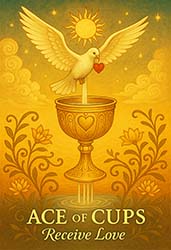
Ace of Cups – A Tarot affirmation poster available at Synergy Studio.
Did you ever fall in love with someone you shouldn’t have? Someone who was unavailable, but you still felt intensely attracted to them?
Maybe it was your next door neighbor who was happily married. Maybe it was a co-worker and you KNEW that a work place romance would be a disaster. Hell, maybe it was your 8th grade teacher who was just SO perfect in every way.
GETTING CRUSHED
We used to call that, “getting a crush,” on someone. We meet someone and we just know that we’re supposed to be together, even though everything else is saying, “No, you’re not.”
Psychologists – as psychologists tend to do – have invented a new term for it which is, “limerence.” Here’s a definition:
“Limerence is an involuntary, intense, romantic obsession characterized by intrusive thoughts and a longing for emotional reciprocation, often leading to emotional suffering due to unmet romantic needs.”
In other words, having a crush on someone you probably shouldn’t have a crush on.
IT’S ALL PERFECTLY NATURAL
Now, this has been going on ever since the world began and, of course, it’s caused a passel of trouble. Marriages end, people lose their jobs, reputations and careers are destroyed. All in the name of love.
Which is puzzling, isn’t it? Love is supposed to be this grand, wonderful adventure that lets us soar to new heights on the wings of the person we’re in love with. So why is all of this so painful and frustrating?
THE CALM, INNER VOICE
I had a teaching dream once about spirit guides and spiritual guidance. I call them, “teaching dreams,” because they’re very lucid, very clear and they usually have to do with some issue that’s really bothering me.
The subject of this dream was, “How do I distinguish true spiritual guidance from my own desires and ego?”
And the answer was that spiritual guidance is never harsh, never critical, never ominous. It’s always gentle, loving, and kind and leaves us feeling nurtured rather than criticized or beaten up.
The same principle applies to falling in love. If it feels sweet and kind, it’s probably real love. If it involves obsessive thinking, insecurity, self-doubt, or criticism . . . hey, it may be a hell of a crush, but it ain’t love.
WHY DOES IT HAPPEN?
Why do we fall in love with people who aren’t, “right,” for us?
Psychologists, philosophers and playwrights have been trying to figure that one out for hundreds of years and really haven’t made much progress.
My personal theory is that these are relationships that are, “out of time.” And I don’t mean that in the sense of, “Whoops, we’re out of time.”
Rather, what I’m talking about is old relationships from previous incarnations that have been displaced in time. The feelings are still there, but they’re no longer appropriate in their old form.
Perhaps we were married to someone or had a super, sizzling hot sexual affair with them two lifetimes ago. Because of that intense attraction, we meet them again in this lifetime.
Only – guess what? – they’re married to someone else. Or they’re our teacher or mentor. Or perhaps we’re straight, but they’re the same sex that we are.
The feelings are just as intense. The desire to be with them is just as strong. But it just ain’t happening this go-round.
WHAT SHOULD WE DO?
Well . . . nothing, in most cases. Just observe it and sit with it. Realize that you love this person but that the love has to take a different form than romantic love.
We can feel it. We can cherish it. But we don’t have to act on it. If there’s a huge internal conflict about getting romantically or sexually involved with someone, that’s not a very good way to start out, is it?
FILL YOUR HEART WITH LOVE
Ram Dass said that we frequently mistake other people as the source of love, rather than realizing that they’re just vehicles that get us to the love.
When we’re seriously crushing on someone we shouldn’t be crushing on, we feel that as a loss, as a deficit, as if we’ve got this Grand Canyon sized hole in our hearts that only they can fill.
Fortunately, we’ve got this wonderful part of our energy systems called, “the heart chakra.” It can generate an infinite amount of love because love actually IS infinite.
We can sit down at any time or place and just meditate on love, meditate on that chakra filling up with that sweet, kind essence that is love and the feeling of not being complete immediately goes away.
IT ISN’T THEM, IT’S US
We’ve been programmed into believing that love always flows out of someone else and into us. That if someone, “out there,” doesn’t love us, we won’t get the love we need.
That’s really the source of the pain in limerence. We’re convinced that without that other person’s love, we’re just going to be miserable and unfulfilled. We can’t get to the love we want and so it hurts.
Not true.
We create our own love, in our own hearts. We receive love when we open our heart centers and intentionally, consciously fill them up.
THE ACE OF CUPS
When we look at the Ace of Cups we can see this message very clearly. The cup is our heart and the love isn’t flowing out of another person into the cup. It’s flowing straight out of the Universe. Love is everywhere. It’s a Universal energy and we just need to open ourselves to receiving it. If we occasionally receive it from another person, that’s great.
But if we don’t, that’s not a tragedy and it doesn’t need to be painful. The source of love is always in our own hearts.
When you’re overwhelmed by choices but none of them inspire you, the 7 of Cups offers deep insight into emotional flatness, spiritual paralysis, and the fog of indecision. This post explores what it means to feel stuck not from a lack of options, but from a disconnection from desire — and how gentle, imperfect movement can reawaken synchronicity, clarity, and personal magic. With insights from tarot, spiritual practice, and the idea that every choice is a spell, this is a compassionate guide for anyone feeling adrift in a sea of possibility.
We all know what it feels like to be stuck in a situation that offers no way out — a dead-end job, a draining relationship, a town or routine that feels too small for who we are. In those moments, the lack of options is the problem, and we ache for even one open door.
But there’s another kind of stuckness, quieter and harder to name. It happens when you look at your life and see too many doors — job possibilities, creative paths, lifestyle shifts, spiritual practices, places you could move to, people you could become — and yet none of them stir your heart. It’s not that you don’t have options. It’s that nothing feels real enough to move toward. Every possibility feels equally vague, equally weightless. You scroll through them in your mind like a streaming menu of “meh.”
That’s where the 7 of Cups comes in — a card that doesn’t warn of limitation, but of overabundance without embodiment. When we’re caught in that state, the problem isn’t a lack of imagination. It’s that we’ve lost our connection to desire, motivation, or meaning. And that kind of emotional flatness can leave us just as frozen as having no choices at all.
In this post, I want to explore that space of spiritual paralysis — what it really means, why it happens, and how we might begin to move forward again, even when nothing calls to us.
The 7 of Cups – Castles in the Sky
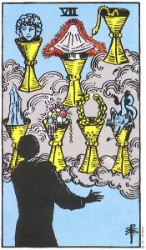
In the classic Rider-Waite tarot deck, the 7 of Cups shows a figure standing before a cloud filled with seven golden cups. Each cup holds something different — a castle, a laurel wreath, a snake, a dragon, a veiled figure, jewels, and even a head. These images float in the sky like a surreal dream, untouchable and unresolved. Some of the items represent temptation or danger. Others represent success, beauty, or mystery. Together, they evoke a kind of psychic overload: too many choices, too many desires, too many unknowns.
This card is often read as a symbol of fantasy, illusion, or indecision — a time when your head is in the clouds and your feet aren’t on the ground. You may be imagining all the things you could do, be, or have, but none of it is actually manifesting. The possibilities feel “up in the air” — compelling, maybe even glamorous, but disconnected from real life.
But the 7 of Cups doesn’t just speak to confusion. It speaks to the pain of disconnection from clarity, purpose, and desire. You might be a visionary, a dreamer, or someone with a deep well of creative imagination. And yet you feel suspended in a kind of fog — no longer trapped, but adrift.
This is the paradox: you can have a wealth of potential and still feel empty. You can imagine endless paths and still feel like you’re going nowhere.
Defining the Emotional Problem
Let’s be clear about something: this isn’t laziness. It’s not procrastination, and it’s not fear of commitment — at least, not in the way people usually frame those things.
What we’re really talking about here is a kind of emotional flatness — a sense that, no matter how many options are available, none of them feel alive. Nothing moves you. You’re not overwhelmed by too many passions; you’re stalled because nothing seems to matter. And when well-meaning people tell you to “follow your bliss” or “just pick something you’re passionate about,” you want to scream — because the truth is, you don’t feel passionate about anything.
This is a deeply misunderstood kind of stuckness. On the surface, it might look like you’re being indecisive or flaky. Underneath, there’s often a more painful story: burnout, disappointment, grief, disillusionment, even trauma. You may have spent years surviving rather than living. You may have pursued dreams in the past that led nowhere. Or you may simply be exhausted — mentally, emotionally, spiritually — and unable to summon the spark that used to drive you.
When this kind of numbness settles in, imagination alone won’t fix it. Vision boards and journaling prompts can feel like cruel jokes when you’re not connected to any real sense of desire. You become a ghost in your own life, haunting the possibility of change without feeling motivated to pursue it.
That’s where the 7 of Cups becomes not just a warning about illusion, but a mirror for a very human experience: the ache of possibility without passion.
Why We Get Frozen: The Paradox of Too Many Options
At first glance, having lots of options seems like a good thing — a sign of freedom, creativity, expansion. But if you’re not grounded in what you actually want or need, too many options can feel like a kind of psychic noise. Instead of liberating you, they overwhelm your system. Nothing feels real, and everything feels like a distraction.
This is the hidden danger of the 7 of Cups: abundance without anchoring.
You might bounce from idea to idea — start a new project, research a new career path, flirt with the idea of moving somewhere else — but none of it takes root. Each choice is hypothetical, weightless, floating just out of reach like the cups in the card. Without an emotional connection to any of them, they begin to blur together until doing nothing feels like the only viable option.
This paralysis often leads to guilt or self-blame: Why can’t I commit? Why don’t I care more? But the deeper issue isn’t about making a bad choice. It’s about the fear that no choice will lead anywhere meaningful.
And that fear can become self-fulfilling. We stop moving because we don’t feel inspired. But inspiration often follows movement — not the other way around. If we wait to feel perfectly clear before taking action, we can stay stuck for years.
The 7 of Cups teaches us that too much floating — too much dreaming without doing — eventually collapses into disconnection. The way out isn’t to find the perfect choice. It’s to ground ourselves in imperfect motion.
The Turn: A Way Out — “Three Least Sucky Choices”
So what do you do when everything feels empty? When every option seems flat, pointless, or too far away to matter?
Spiritual teacher Mike Dooley offers a surprisingly helpful piece of advice:
If all your choices suck, pick the three least sucky ones — and start moving.
It sounds irreverent, even a little cynical. But it’s actually a lifeline disguised as a joke.
Dooley isn’t saying you should build your life around mediocrity. He’s pointing to a truth that’s both practical and mystical: the universe can’t help you until you start moving. When you’re standing still, waiting for a lightning bolt of clarity, you’re not sending any clear signals. You’re broadcasting static.
But when you take even one step — toward something, anything — the whole energetic field around you begins to shift. Possibilities you couldn’t see before start to appear. A “meh” project might lead you to a person who lights you up. A half-hearted attempt at self-care might reawaken something long asleep. A seemingly random decision might become the breadcrumb trail that leads you home.
It’s not about pretending your choices feel great. It’s about trusting that momentum creates meaning, not the other way around.
And sometimes, choosing the “least sucky” option is the boldest move you can make — because it’s a choice made not from fantasy, but from faith.
The Role of Synchronicity
Synchronicity is the universe’s way of saying, “I see you.” It’s that perfect book showing up just when you need it, that person calling when you were thinking about them, that quiet nudge that leads you to an unexpected breakthrough. But synchronicity doesn’t happen in a vacuum. It happens when we’re in motion.
That’s the secret: the universe doesn’t respond to fantasy, it responds to engagement. It’s like a dance partner waiting for you to take the first step. As long as you’re frozen, the dance doesn’t begin.
You don’t need to be confident. You don’t need to be inspired. You just need to move — to start walking down the path of those three “least sucky” choices, trusting that better ones may be waiting just beyond the next curve.
This is how clarity often works. It’s not a neon sign pointing to your destiny. It’s more like a fog slowly lifting as you walk through it. You don’t get to see the whole map. You get to see the next few steps — and only after you take them.
And as you move, something begins to awaken. You start to feel little sparks again — a flicker of interest here, a glimpse of meaning there. What once felt flat starts to feel possible. New paths begin to emerge, and those dreamlike cups that once floated far above your head start to descend, one by one, into your hands.
Magical Reframing: Choice as a Spell
Here’s a radical way to reframe this moment of stuckness:
Every choice is a spell.
Not a perfect choice. Not a destined choice. Just… a choice. Made with intention. Infused with energy. Cast like a stone into the unknown.
In magic, we don’t wait until we feel certain. We gather what we have — some herbs, a candle, a whisper of desire — and we act. We claim. We declare. And the ritual itself becomes the spark that transforms the ordinary into the sacred.
In the same way, when you make a choice — even a small, imperfect one — you send a ripple out into the unseen. You say, “I’m willing to engage. I’m willing to participate in the mystery of my own life.” That willingness alone shifts the vibration.
This is where the 7 of Cups becomes not a warning, but an initiation.
It says: You are standing before a cloud of dreams. You may not know which one is right. But your power lies not in the picking — it lies in the choosing.
By choosing, you collapse the infinite into the actual. You call energy down from the clouds and into the body of your life.
That is magic.
From Fog to Flow
The 7 of Cups reminds us that too many possibilities can be just as paralyzing as none at all — especially when we’re cut off from desire, drained of motivation, or unsure whether anything really matters. But emotional flatness is not a failure. It’s a signal. A season. A sacred pause.
And the way through it is not to wait for perfect clarity, or for passion to descend from the heavens. The way through is to begin — gently, imperfectly, even skeptically.
Pick the three least sucky choices. Make one small move. Cast one little spell. Not because you know where it leads, but because motion creates magic. Choice calls energy into form. The fog doesn’t lift before we move — it lifts because we move.
As you walk, the air clears. The heart flickers back to life. The cups begin to settle, and one of them — maybe one you never expected — begins to shine a little brighter than the rest.
And in that moment, you remember:
You’re not lost.
You’re just in the in-between.
And you are, in fact, already on your way.
The Alchemy of the Mind: Transforming Your Life With the 7 Principles of the Kybalion, by Dan Adair
What if everything you’ve been taught about hard work is backward? This post reimagines the 8 of Pentacles and explores Susanne Koss’s idea from Super Synchronicity — that visualizing your goals may be more powerful than grinding for them. A fresh look at work, time, and creative flow.
The 8 of Pentacles in the tarot is traditionally associated with craftsmanship, diligence, and focused effort. We see a solitary figure at his bench, hammering away with precision and care. It’s often read as a call to roll up your sleeves, master your craft, and devote yourself to the grind.
This image resonates with one of our most deeply rooted cultural beliefs: that success comes from hard, often relentless work. Thomas Edison famously declared, “Genius is 1% inspiration and 99% perspiration.” For generations, this formula has been the gold standard — a kind of sacred math of success.
This is basically what gets drummed into us from the time that we’re small children. We have to work very hard in elementary school, so that we’ll be ready to work very hard in high school, so that we’ll be ready to work very hard in college, so that we’ll be fully prepared to work very hard when we finally graduate.
Very, very hard work is the key to success in life. We all know that.
But what if that equation is upside down?
Enter the Field of Synchronicity
In her book Super Synchronicity, Susanne Koss offers a radically different perspective. She proposes that when we shift into the realm of synchronicity — that mysterious field where events line up with uncanny precision — the rules of time, effort, and productivity get rewritten.
Instead of spending 90% of our time grinding and 10% dreaming, Koss suggests we reverse the ratio:
“Spend 90% of your time visualizing what you want to accomplish, and only 10% in actual physical labor.”
It’s not about being lazy. It’s about learning to work with the flow rather than against it. When we align with this deeper field of meaning and connection, effort begins to take on a different quality. Things that once seemed far off can suddenly show up in our lives with surprising speed.
As she writes:
“Your old inner identity operates along a time line that aligns with the general assumption of how long things, ‘usually,’ take… But if you want to achieve your goals faster, you need to let go of your old concept of time.”
Visualize It, Don’t Build It
All of this actually makes a great deal of sense when we think about the basic process of visualizing and manifestation. As Mike Dooley likes to describe that process, “Thoughts become things.” Not, “Things become thoughts.”
When we manifest something through visualization, we’re taking our thoughts and investing them with huge amounts of our personal energy. As we continue to imagine all of the delicious details of our visualizations, we’re adding more and more energy until they finally achieve critical mass and manifest in the physical world.
With that basic formula, it obviously makes sense to spend more time visualizing and less time working. Actually, if working is taking away from our time visualizing, we’re going at it ass-backwards.
The Invention of Free Time
Another myth that we have about work is that the result is measured by the time that we put into it. If we only put a little bit of time into a project, then we can’t expect to get much out of it. And if it’s a really BIG project, like writing a book or starting our own business, then we HAVE to invest massive amounts of time in order to make it happen.
But something strange and wonderful happens when we enter into the field of synchronicity. Suddenly we’re showered with serendipity. Everything lines up just perfectly and totally unexpected opportunities pop up out of nowhere. What might have taken six months is suddenly accomplished in six weeks. What we expected to spend a year on comes to fruition in half that time.
Koss even jokes that she’s “the inventor of free time.” Behind the humor is a profound truth: we’ve been conditioned to equate time with toil, as if doing less invalidates our worth. But Koss has flipped that script. She shares that she often goes weeks or months doing “absolutely nothing” — simply enjoying life — until inspiration strikes and the next project emerges fully formed.
This isn’t procrastination. It’s alignment. It’s honoring the cycle of rest, gestation, and flow.
Reinterpreting the 8 of Pentacles
What if the 8 of Pentacles doesn’t just represent effort — but focused alignment? What if that solitary figure is absorbed not in laborious repetition, but in a meditative state of creation — following an inner spark rather than an external demand?
Maybe the card isn’t telling us to work harder. Maybe it’s inviting us to devote ourselves to what feels right, and to let go of the cultural pressure to earn our worth through exhaustion.
A New Work Ethic
In the magical, new work ethic of synchronicity, we’d be taught to spend a lot more time dreaming and a lot less time doing. We’d be taught that banging our heads against a brick wall when a project isn’t working out is stupid and that we should drop it and come back to it later. We’d be taught that working ourselves into a state of exhaustion is nothing more than a sign that we’re completely out of alignment with the Flow.
The myth of workaholism is exactly that — a myth. And like many myths, it contains a seed of truth but has grown into something unbalanced. The emerging paradigm — one that blends visualization, intention, and synchronicity — offers a kinder, faster, and more creative path forward.
It’s time to short-circuit the grind and reclaim our power as conscious co-creators with the Universe. Not by doing more — but by aligning more deeply with what truly moves us.
A closer look at the new paradigm of aging and how we can combat our own internalized ageism.
One thing that’s been apparent watching the demonstrations against the Trump regime is that there are a LOT of gray hairs in those crowds. What in the hell are all of those old people doing out there demonstrating? Aren’t old people supposed to sit at home in their rocking chairs with cats in their laps?
Well, what if everything we’ve been told about aging is wrong?
OLD IS THE NEW YOUNG?
Think of some of the standard images and words that come up when we discuss older people. Words like:
Doddering;
Absent minded;
Frail;
Diminished;
Weak;
Senile
There is a cultural perception of older people as being in a period of decline, fragility, and irrelevance. It isn’t just our societal obsession with youth; it’s an active attack on aging itself. Ironically, of course, it’s something we all do sooner or later (if we’re lucky) so it seems like a peculiar notion on the face of it.
Thankfully, there’s a new paradigm emerging. It’s an entirely different way of aging that embraces it as a time of expansion, reinvention, and wisdom-driven creativity. Before we can do that, though, we need to be mindful of the old paradigm of aging.
THE DISEASE MINDSET
Western cultures tend to treat aging as if it’s a medical problem, rather than a perfectly natural transition. Billions of dollars are being made every year by convincing us that there’s something terribly, terribly wrong with having white hair and a few wrinkles.
There’s really no way to describe it other than as an anti-aging industry. On the one hand, big pharma is busy programming the elderly to believe that they can’t possibly survive without a medicine cabinet full of pills. On the other hand, the cosmetics companies are selling boatloads of product to, “restore your lost youth and vitality.”
The over-all message to anyone past the age of 60 is, “be afraid, be very afraid, because you’re useless, ugly and doomed. You have a terminal disease called, ‘aging.’”
But what if we learn to see aging as a form of enhancement, rather than a decline?
LATE LIFE FLOURISHING
There’s actually a term for that which is, “the Grandma Moses Effect.”
Anna Mary Robertson Moses (AKA Grandma Moses) left home at the age of 12 to go to work as a domestic for a farmer and his wife. For the next 65 years of her life, she had a pretty grueling existence. She and her husband were itinerant farm workers, drifting from job to job and doing back breaking field work. She bore 10 children, five of whom died and she lived on the edge of poverty for most of her adult years.
She took up painting at the age of 78 and only because arthritis was making it painful for her to do needlework. She initially sold her paintings out of the window of a local pharmacy for 2 dollars a piece. By the time that she died at the age of 101, her paintings were being sold for millions of dollars, Hollywood had made a movie about her life, and she’d received a medal of honor at the White House.
All because she picked up a paintbrush when she was obviously too old.
Now, suppose she’d been alive in our time. What messages might she have been receiving at the age of 78? “Let’s face it, dear, your life is over. You’ve got one foot in the grave. I hope that you’ve got medical insurance because it’s all downhill from here. As a matter of fact, you’re at the bottom of the hill and a boulder is about to run over you.”
Grandma Moses was the first time that millions of Americans really got it on a visceral level that being older doesn’t equate to being the walking dead. Being older can be a magical beginning, instead of a tragic end.
REJECTING THE STEREOTYPES
Margaret Nash talks about this in her book, “Rebellious Aging.” One of the key takeaways from that book is that we have to actively reject the stereotypes of what our culture thinks older people should be like.
The Ten of Pentacles shows one of those stereotypes. An old man sits quietly in a corner, wrapped in a shawl, while younger people engage with each other in the light. There are dozens of other stereotypes in our culture, of course. Perhaps we should take up knitting or learn to play shuffleboard. Maybe move into a nice retirement community where we don’t have to cook for ourselves anymore and we can scoot around in golf carts instead of actually walking. Maybe join a book club or take a nice cruise with other old people. The overall emphasis with these activities is that we should find something harmless to do while we’re waiting to die.
But suppose – horror of horrors – that we don’t die?
Suppose that Grandma Moses had bought into the perspective that her life was over at the age of 78 and she just needed to sit down and wait to die? That would have been 23 years of sitting there twiddling her thumbs, staring out the window, and asking people, “Am I dead, yet?” Instead, the next 23 years were the richest and most fulfilling of her life.
THE AGE OF NEW AGING
There IS a new paradigm for aging emerging in our societies.
– Older people are staying creative, starting businesses, exploring spirituality, and reinventing themselves.
– Longevity science and neuroscience show that the brain remains adaptable well into later life. Neuroplasticity is showing that the idea that old dogs can’t learn new tricks is bullshit. We still have lots of tricks up our sleeves.
– And, as older people begin to behave differently, we begin to reject the stereotypes of how we’re supposed to be. The cultural narratives of aging are beginning to evolve. We’re seeing much more positive portrayals of older people which in turn provide more positive role models for all of us.
INTERNALIZED AGEISM
Probably the most important element in rebellious aging is rejecting our own internalized ageism. That means taking the time to really examine how we feel about aging.
* How do we, personally, feel about, “old people?”
* Do we think our, “best years,” are over?
* Do we think, deep down, that young people are somehow, “better,” than old people?
* Are we rejecting our own sexuality because we think it’s inappropriate for older people to like sex?
* Are we constantly telling ourselves things like, “I’m too old for that?”
* Are we obsessing about our high school or college years instead of fully living in our present lives?
* Are we afraid to try new, creative endeavors because we just don’t have the time left to learn to play the piano or paint or sculpt?
* Are we obsessing over our health and expecting that we’re going to get sick, simply because we’re getting older?
If some, or all, of those things ring true for you, don’t feel bad about it. That’s what we’ve been programmed to believe. That doesn’t mean that we have to believe any of it any longer, though.
RECLAIMING OUR POWER
We might think of this as learning to embrace our Inner Grandma Moses. If we’re older, try to imagine that we’re actually going to live to be 101 years old, just like she did. What do we want to do with all of that time? If you’re 70, for instance, do you really want to spend the next 30 years bitching about your aching joints or would you rather roll a joint and listen to some music? If you’re 80, do you want to spend the next 20 years sitting in a rocking chair or would rather dance to some rock and roll?
As other people have said, aging is inevitable but getting old isn’t. Aging is a transition into wisdom, creativity, and new possibilities. Celebrate it.
How to distinguish creativity from attention deficit disorder.
Did you ever walk into a room and then have absolutely NO clue why you did it? We stand there for a couple of seconds, asking ourselves, “What in the hell am I doing in here? What did I want in this room?” Blank. And then we remember that we were looking for our car keys or we wanted to make the bed or maybe there’s a book that we left somewhere and we need to find it.
That happens to everyone, of course, and older people even joke about it. “I wouldn’t remember where my head was if it wasn’t screwed on. Maybe I’m getting the OldTimers Disease.”
If it KEEPS happening, though, we may start to hear a little voice inside our mind that’s sounding an alarm. “Hey, dude, maybe you are getting Alzheimer’s. Or maybe you shouldn’t have taken all of those recreational drugs when you were a kid. Or – oh, my god – maybe you’ve got a brain tumor! Or maybe you’ve got ADHD!”
ADHD-ISH
The truth of the matter is that a lot of us are feeling ADHD-ish these days. After all, attention deficits can also spring straight out of anxiety and depression and these aren’t the most tranquil of times, are they? Even if we don’t have personal problems, the news networks and the internet are constantly blasting out the message that the sky is falling and we’re all going to die. Climate change, pandemics, wildfires, dead celebrities, crazy politicians, oh, my!
Huge numbers of people are feeling distracted, nervous, upset, and having trouble concentrating. There’s an epidemic of lost car keys and many of us aren’t just keeping to-do lists, we’re keeping lists of our to-do lists. Try an internet search on, “how to get organized,” and you’ll see how very many us are bewildered, befuddled and befucked.
AN ALTERNATE VIEW
Now, WAY BACK in the 2010s, Emilie Wapnick noticed that there were many, many people feeling this way. It wasn’t just that they were having trouble with their attention spans or with getting organized. Their entire lives felt unfocussed, as if they simply couldn’t decide what they should do next.
She gave an incredibly influential TED talk called, “Why Some of Us Don’t Have One True Calling,” and she introduced a radical idea. Maybe, she suggested, we’re not really ding bats who keep getting distracted by shiny objects. Maybe we’re actually just incredibly creative people who can’t and won’t be satisfied by a single pursuit.
The term that she uses to describe people like that is, “multipotentialite.” As she outlines in her wonderful book, “How to Be Everything: A Guide for Those Who (Still) Don’t Know What They Want to Be When They Grow Up,” there are some of us who simply aren’t wired to be single-pursuit human beings. We may be simultaneously (and passionately) pursuing vocations in art, writing, and auto repair, all the while researching a half a dozen other fields that we’re interested in. In the past, such a person might have been admired and even lauded for their intellectual curiosity. Today, they’re frequently labeled as being dysfunctional or misdiagnosed as having attention deficit disorder.
HENRY FORD’S DEMON BABY
Almost from its inception, the Industrial Revolution attempted to turn human beings into mere slaves who operated the machines in the factories. The model wasn’t really perfected, though, until Henry Ford introduced his, “rolling assembly line,” in December of 1913. Using that model, workers stand in one place as the product rolls by on a conveyor belt. Each worker performs one job in assembling the product, and they do that one job over and over, hundreds of times a day. This ushered in the age of specialists.
That idea of specializing in only one thing has it’s advantages, of course. For instance, if we’re having a heart valve replaced it’s comforting to know that the surgeon has performed the same operation hundreds of time before. Still, it can have devastating effects if it’s presented as the ONLY model of functioning in our society.
To be clear, multipotentialites don’t just like to pursue multiple interests at once: it’s what they do. It’s wired into their brains. Telling a multipotentialite to specialize in just one area is like telling an introvert to go to more parties or telling a cat to fetch a stick and bark.
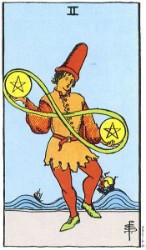
When we take that natural behavior, though – that need to pursue many different interests at once – and drop it into our linear, specialized society, it looks a lot like . . . guess what? ADHD. In a culture where concentrating on one task at a time is the behavior that’s rewarded and reinforced, the multipotentialite is frequently perceived as being highly dysfunctional. Why can’t you concentrate? Why don’t you ever get anything finished? Why do you keep jumping from one thing to the next? Those are questions that the multipotentialite will hear her entire life and it can leave her feeling inadequate, guilty, and shamed. Like the figure in the Two of the Pentacles, life seems like a constant balancing act, rather than a fulfilling adventure.
STRATEGIZING FOR A HAPPY LIFE
If all of this is striking a chord with you, if you feel that you may be a multipotentialite, then rest assured, there are still ways to find happiness. There are a few simple strategies that can make you feel like you’ve got super-powers instead of constantly feeling less than.
1. Embrace Your Identity and Fix Your Self-Image: Recognize that being a multipotentialite is a strength, not a flaw. Celebrate your curiosity and versatility instead of forcing yourself into a specialist mold.
2. Consciously Design a Portfolio Career: Instead of choosing one path, build a career that allows you to explore multiple interests. This could mean freelancing, consulting, or combining part-time roles. If you’re an artist and a writer, for instance, you could do illustrations set off with poetry.
3. Set “Seasons” for Your Passions: Focus on specific interests for a set period, then rotate to another. This prevents burnout and keeps things fresh. This allows you to hyper-focus on a particular avocation, but use boredom as a signal for when it’s time to switch to another.
4. Create a “Renaissance Schedule”: Dedicate blocks of time to different pursuits. For example, Mondays for art, Tuesdays for coding, and so on. Structure helps manage your many passions without feeling scattered.
5. Prioritize Projects: Not every interest needs to become a lifelong commitment. Learn to distinguish between short-term fascinations and long-term passions.
6. Find Overlaps: Look for ways to combine your interests into unique projects. A multipotentialite superpower is the ability to innovate by connecting ideas from different fields.
If you’re interested in exploring more multipotentialite options for living, I’d really encourage you to visit Emilie’s website, “puttylike. Creativity and curiosity are options that many people seem to have missed out on, so let’s take them to the max.
A look at the importance of personal and social deviance as illustrated by the war over brassieres.
Imagine a culture that was SO rigid that the people in it actually dictated what kind of underwear you had to put on in the morning. Sounds pretty crazy, doesn’t it?
Still, that was exactly the situation that we had right here in the United States just 50 short years ago. It’s a short tale and well worth looking at.
The modern brassiere was invented by Mary Phelps Jacob in 1910. From that point on it was declared that, “decent,” women would wear bras and breasts would henceforth be encased in cotton cups when they were transported out in public view.
Now, in the late 1960’s, a growing group of women said, “I don’t wanna.” It wasn’t that they were rigidly opposed to brassieres because, as any woman will tell you, bras can be comfy cosy in winter months and in cold climates. Rather, they were making the radical assertion that any human being should have the right to decide whether they want to wear underwear on any given day.
Many people in our culture were shocked and appalled at the notion of unfettered breasts. Women who went braless were actually arrested for, “public indecency,” in some Southern states. “Decent,” women sneered at them and, “god-fearing,” men leered at them.
Still, the revolutionary bra warriors persisted and even went so far as to hold public bra burning to make their point.
By today, of course, no one cares if a woman wears a bra or not. Generally speaking, bras go on in the winter time and come off in the summer time, which is perfectly sensible and the way it should have been all along.
The Great Bra Culture War is a perfect illustration of what sociologists refer to as, “tolerated social deviance.” They actually have a very precise definition of deviance, which goes like this:
Deviance is a behavior, trait, or belief that departs from a social norm and generates a negative reaction in a particular group. In other words, it is behavior that does not conform to the norms of a particular culture or society.
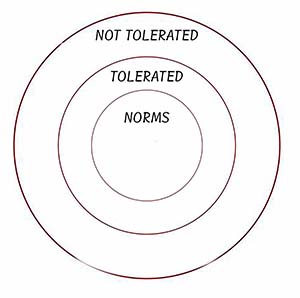
Tolerated social deviance is behavior that’s outside of the social norm, but not so far outside of it that it warrants severe punishment. We can think of it as a series of concentric circles where the inner circle is the norm, the second circle is outside of the norm but it’s tolerated, and the outer circle is SO far outside of the norm that it will get you arrested.
In that model, during the first half of the 20th century not wearing a bra in public was in the outer circle and would result in a woman being shunned, slut-shamed, or arrested. After the 1960s, not wearing a bra moved into the second circle of being outside the norm, but tolerated. And by now, it’s moved into the inner circle of perfectly acceptable behavior, except in Mississippi.
The point of all of this is that freedom and creativity exist OUTSIDE of the norm. That inner circle of social norms consists of people behaving in exactly the same way as everyone else. The behavior is, “acceptable,” precisely because everyone else is doing it.
The world of the social norm is what Stuart Wilde was talking about when he referred to the Tick-Tock world. As he pointed out in his book, “Affirmations: How to Expand Your Personal Power and Take Back Control of Your Life,” the Tick-Tock world involves getting up every day and doing the same things over and over and over because that’s what society expects of us and we don’t want anyone to think we’re being weird or unusual. “I have to wear a bra because everyone else wears a bra and what would the neighbors think if I didn’t?”
To put it in terms of energy, it’s a closed system. There’s nothing new or different flowing into it, because everyone is acting and thinking exactly the same way. It’s like the guy in the Eight of Pentacles who’s just making the same product over and over again, but not creating anything new.
Deviance is thinking outside of that closed box. Deviance is what allows fresh, different energy into the system. Deviance is what makes us evolve.
We see this in cultures all across the world. The most creative, vibrant cultures are the ones that tolerate the highest levels of diversity. China and Russia, for instance, have extremely low tolerance for diversity and social deviance. Are they producing any great literature? Any amazing art? Fabulous music? Is anyone desperately trying to get into their countries? Nope.
Put very simply, the best cultures are the cultures that maximize freedom and diversity. Those are the cultures that are the most alive and evolving the fastest.
I’ve lived in both California and Texas. I CHOOSE to live in California because California maximizes my opportunity to be just as different, weird, and unusual as I want to be. California values social deviance and so I have a much greater opportunity to be my authentic self, to the best of my abilities.
It’s important to ponder all of this as we move into the new era of the Trump administration. Are we going to continue to be a society that values and encourages diversity or are we going to become a closed, intolerant and stagnant energy system?
Make no mistake: there ARE people out there who are so crazy that they want to tell us what kind of underwear we should put on in the morning. They want to shrink those two outside circles into one boring inner circle where everyone looks and acts precisely like everyone else.
Have you ever had a dream that seemed so real, so vivid and intense, that you were actually shocked when you woke up and realized it was just an illusion?
Sometimes they’re really GOOD dreams. Perhaps we’re making incredible love with someone or maybe we’re floating through a starry, magical sky. Sometimes they’re really BAD dreams, where we’re being chased by monsters or night terrors. Whether they’re good or bad, the one thing they have in common is that – at the moment that we’re having them – they seem absolutely, 100% real.
LIVING THE DREAM
There’s a strong case to be made for the idea that our so-called, “waking life,” is very much like a dream, as well.
In, “The Four Agreements,” that’s the term that Don Miguel Ruiz actually uses to describe our day to day existence: a dream. As we grow up, we’re programmed by our parents, our religions, and our societies to see the world in particular ways. We don’t question those view points as they’re being installed in our little brains because we don’t have the ability to judge whether they’re true at that age. By the time that we reach adulthood, we’re thoroughly convinced that the way that we see the world is the RIGHT way to see it, perhaps the ONLY way. But those view points are just someone else’s dreams of how the world really is.
Buddhist and Hindu philosophies approach human life in much the same way: life as we commonly experience it is an illusion, a dream that’s made up of our emotions, ideas, desires, and aversions. We’re essentially sleep walkers who go through life laughing, crying, eating, procreating, raising families, working, and eventually dying, with no clue as to why we’re here or what it all means. We just know that, like our dreams, it seems absolutely 100% real.
WAKING UP
Occasionally, some of us will wake up just a little bit from the dream that we call our lives. Usually it’s because our pleasant dreams have turned into a nightmare.
One of our major dreams is, “I’m going to live happily ever after and nothing bad is going to happen to me.” We’re taught that if we’re, “good,” people and we work hard and we’re responsible, everything is supposed to work out for us. We’re going to fall madly in love with just the right person, have 2.5 beautiful children who will be extremely well adjusted, get a nice house, a new car, and all of the material toys. And we’ll live happily ever after. Shit happens to, “bad,” people, not to us.
And then shit happens to us.
Perhaps we find our wife or husband in bed with someone else. Perhaps we’re in a terrible auto accident. Perhaps one of our beautiful children gets very, very sick. Perhaps we get fired from our jobs and lose all of our material possessions.
It’s very much like suddenly waking up. All of the things that seemed so rock solid and dependable in our lives turn out to be built on sand. We may feel like life has betrayed us or the whole world has gone crazy. Eventually, though, most of will go back to our dream worlds because the dream is so comfortable and waking up hurts.
LUCID DREAMING
There’s something that happens in some dreams where we’re dreaming but we suddenly become aware of the fact that it’s a dream. We don’t wake up from the dream, but we exist within it, knowing that it’s a dream. It’s called lucid dreaming and, if you’re not familiar with it you might enjoy reading, “Lucid Dreaming,” by Charlie Morley.
Now, one of the things that happens in lucid dreaming is that, to a large extent, we’re able to control the dream. If we see a wall in front of us, we can consciously decide to simply grow wings and fly over it. Or perhaps we can visualize a really beautiful woman or man and make love to them to our heart’s content.
It’s a dream. We know it’s a dream. But we can choose what happens in the dream.
LUCID LIVING
In his book, “Change of Heart,” Chagdud Tulku said that very few of us will ever be enlightened. Most of us will continue to live in a dream state, perhaps for many incarnations. BUT . . . we can choose whether we want to have a good dream or a bad dream.
Which sounds very much like lucid dreaming, doesn’t it?
When we have one of those life experiences where our day to day dream has turned into a nightmare, when we suddenly get a peek behind the curtain of what we thought was true, we have a choice.
Most people roll over and go right back to sleep, just as quickly as they can.
Some people decide to adopt a stance of total cynicism. Life sucks. People are rotten. It’s all a lie. These are the, “life is a bitch and then you die,” people.
But a few people will say, “Huh . . . it’s all just a dream. But it’s an interesting dream. I wonder if I can grow wings and fly over that wall?”
IT’S NOT ENLIGHTENMENT
One of the things that it’s important to remember is that just because we realize that life may be a dream, it doesn’t mean that we’re suddenly, “enlightened.” Like the person in the 4 of Swords, we’re still solidly asleep, but now we know that we’re asleep. Which is an improvement.
Unfortunately, as a brief stroll through the internet will teach us, there are many, many people out there who have decided that they must be gurus, spiritual adepts and geniuses just because they woke up a little bit. Seeing through the illusions doesn’t mean that we’ve got an answer – it just means that we see the problem.
It’s a paradox, like lucid dreaming, where we’re asleep and awake at the same time. If we keep meditating and keep working on our personal growth, we’ll wake up a little more and a little more and a little more.
In the meantime, we can choose to have good dreams. We can have dreams that are full of love and healing and our dreams will make other people’s dreams a little better, too.
As Bob Dylan once said, “I’ll let you be in my dream if you’ll let me be in yours.”
Remember that my ebook, “Just the Tarot,” is available dirt cheap on Amazon. It’s not just a dream. Really. I think.