
The Strength Card, Ahimsa, and Your Magical Anti Shit-Head Cloak

Rebuilding trust in relationships using the doctrine of Ahimsa

Have you ever been deeply, deeply hurt by another human being?

I’m not talking about someone, “hurting your feelings,” a phrase that we all use to describe occasional, usually minor, pain or unhappiness.  I’m talking about a deep, horrible, traumatic pain that feels like you may never recover from it. 

For example, finding out your lover is cheating on you and has been lying to you about it for some time.  Or, perhaps, your partner suddenly leaving you without even affording you a chance to process it.  Or realizing that the person you’re still madly in love with has fallen out of love with you.

There are really two elements there:  the first is the pain that you’re going through;  the second is a profound sense of betrayal, a feeling that your deepest trust has been violated.  Of the two, the sense of betrayal can be much, much harder to recover from.  The betrayal of trust can be world changing for us, in a very dark way.

It’s not at all unusual for people to withdraw from intimate connections with other humans after something like that.  Younger people may declare a hiatus on dating and say that they only want to be, “friends,” for a while.  Older people may pull into a thick, impenetrable shell and become totally socially isolated.

And there’s nothing wrong with that.  That’s our Deeper Self taking care of us.  That’s our Inner Wisdom saying, “You’ve been badly wounded.  You need to rest and cry and heal.”

There comes a time, though, when we may realize that we need to reconnect with the world.  Getting back out there can be scary and intimidating.  There are, after all, no guarantees that it won’t happen again.  If we loved someone with all of our heart, if we trusted someone with all of our being, and they betrayed us, how do we know that our trust and love won’t be misplaced again?  And if our judgement was so flawed, so . . . totally wrong . . . about the person we loved, how can we know that we won’t just make the same stupid mistakes with the next person?

We might find at least a partial solution in the Yogic doctrine of Ahimsa.  Ahimsa is the idea of total, complete, harmlessness.  It’s the idea that if we emanate a vibration of nothing but love, we can attract nothing but love.  We literally CANNOT attract aggression because we HAVE no aggression.

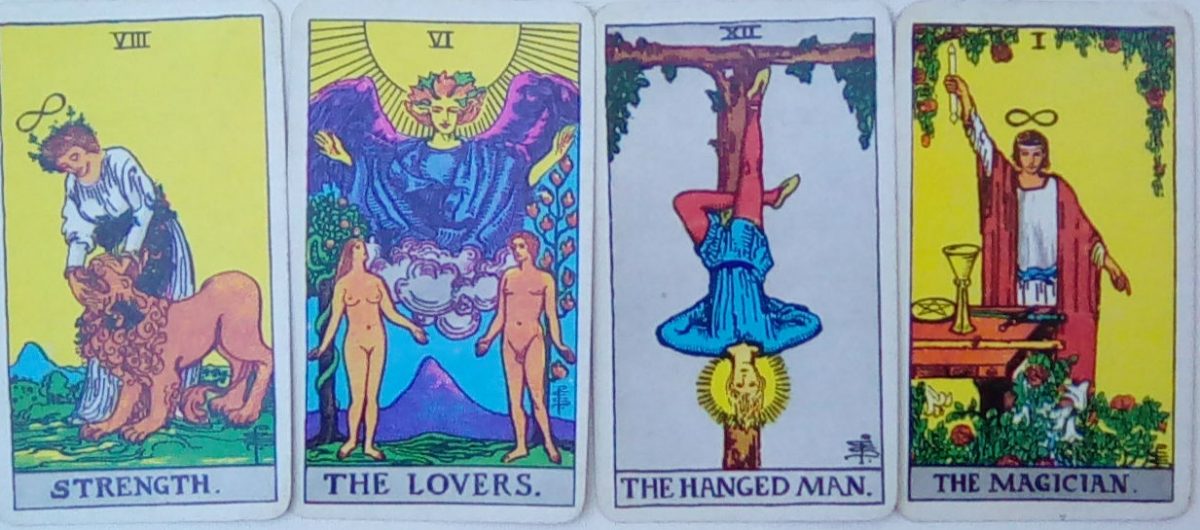
The Strength card from the Tarot is a wonderful image of this.  The woman in the card is gently closing the mouth of one of the most ferocious predators on the planet.  She’s almost caressing the lion, rather than trying to overpower it or force it in any way.  The lion is calm and peaceful because she’s living in the vibration of love and he’s responding on exactly the same vibration.

So what the fuck does that have to do with your lover ripping your heart out of your chest, stomping on it with hobnailed boots, and serving it to you on a Ritz cracker?  You might ask . . .

Part of the answer lies in the quality of the love that’s involved in Ahimsa.  Ahimsa involves absolute unconditional love.  In other words, there are no strings attached.  We’re not loving people because we expect to get something back.  We’re just loving them.  And that’s very unusual in our society.  Most of what we call, “love,” involves a definite quid pro quo.

If you don’t believe that, try telling people who are just acquaintances that you love them.  You’ll find that the usual reaction is something along the lines of, “Uh, huh . . . what do you want?”  I mean, if you’re saying you love me, you must want something, right?

When I look back on my deepest emotional wounds, I have to admit that a large part of the pain was based on the idea that I hadn’t been treated fairly.  I loved someone with everything I had and she walked away from that love and that JUST WASN’T RIGHT!  In other words, I had strings attached to my love.  Yes, I love you deeply THEREFORE you are supposed to love me back just as deeply and, if you don’t, you’ve betrayed my love.

All of that’s perfectly human.  Most of us are not Ram Dass or Mother Theresa or Saint Francis and we don’t just walk around with huge amounts of unconditional love bubbling out of us.  Most of us expect that if we make a deep emotional commitment to someone, it will be reciprocated.  And it hurts like hell when it isn’t.  Conditional love seems almost hard-wired into us and – if it isn’t – it’s sure as hell soft-wired with some big, thick cables.

The funny thing is, though, that unconditional love can be terrifically liberating.  If we go into relationships with the idea of, “I don’t want ANYTHING from you,”  it frees us from that whole expectation that we should be getting something back.  It frees us from constantly worrying about whether we’re being treated fairly or if the relationship is equitable or if the other person loves us just as much as we love them.

And it frees us of the probability of being hurt again, which is what this post is all about.

Sticking our toes back in the relationship water can be scary as hell if we’ve been deeply, deeply hurt in the past.  But if we can consciously remove that idea that we’re always supposed to get some sort of an emotional payoff from our relationships,  if we can consciously stay in that state of openness and love WITHOUT WANTING ANYTHING BACK, we effectively remove the other person’s power to hurt us.

That’s a hard concept to grasp.  I know it’s been hard for me, but it works.

Now, if all of that doesn’t work for you, if all of the reasons for unconditional love I just talked about don’t ring your chimes, then just think of it as a Magical Shield to protect you when you’re moving out into the relationship world again.  The more you can keep your heart in unconditional love, the more likely you are to attract people who are in the same vibration.

Put another way, the more you can live in unconditional love, the less likely you are to attract shit-heads and narcissists.

You remember the Invisibility Cloak in Harry Potter?  When he put it on, he could walk right past people without being seen.  In the same sense, if you’re living in Ahimsa, if you’re keeping that no-strings-attached love in your heart, you can walk right past the shit-heads and THEY WON’T EVEN KNOW YOU’RE THERE because you’re wearing your Magical Anti Shit-Head Cloak.

“All you need is love,”  – The Beatles.

Psychic Empathy, Boundary Violations, and Deep Sadness

I have struggled with being a psychic empath for most of my adult life and probably a good portion of my childhood.  I don’t much discuss it with other people because most people can’t comprehend the sensations that psychic empaths deal with on a daily basis.  There’s just no point in it.

Now, just to be clear, most of the ideas that people have about psychic empaths are garbage.  There’s a Hollywood image of someone, “picking up,” crystal clear messages out of the ether, making astonishing predictions about the future, or having amazing insights about other people’s thoughts.  The truth of the matter is that living with those, “gifts,” frequently feels like pure chaos. 

INSIDE AND OUTSIDE

As near as I can tell, most people have a very clearly defined sense of inside versus outside, both in terms of their bodies and their emotions.  In other words, they have an innate sense of, “I’m in here, and you’re over there.”

To a large extent, that sense of differentiation doesn’t exist for psychic empaths.  We can, “feel,” other people’s energy, their moods, their emotions, their private thoughts just as if they were expressing them out loud.  Sometimes – especially with people we love or have some other strong bond with – we can feel their energy from a very great distance.  We somehow know when people we care about are upset, depressed, or in trouble.  We also know when they’re happy, joyful.

That’s not unheard of, even for normal people.  Many people have had the experience of thinking of someone that they haven’t heard from for years, when suddenly the phone rings and it’s that person.  It happens.  Now try to imagine if it happened to you every single day.  At a certain point, the psychic empath will begin to feel like a sponge, like we don’t know which energy is ours and which energy belongs to other people.  It can be very confusing:  why am I suddenly terribly depressed?  Is it me or is it that someone else’s energy?

EMPATHS VERSUS PSYCHIC EMPATHS

Claiming to be an, “empath,” has gotten to be kind of trendy.  There are articles about it all over the internet and I guess it’s a way of saying, “Hey, I’m a really sensitive, caring person.”  Which is cool.  We LIKE sensitive caring people.  But there is a major difference between empaths and psychic empaths.  It all exists on a spectrum, so imagine a straight line with different points on it.

A ———-B———C———D

At point A you find people with NO empathy at all:  sociopaths, narcissists, psychopaths.  At point B, you find, “normal,” people with some empathy but clearly defined and sometimes rigid boundaries between themselves and other people.  At point C, you’d find emotional empaths, who are people who can STRONGLY (and emotionally) identify with other people’s feelings.  At point D, you’d find psychic empaths who actually experience other people’s emotional energy as being mixed in with their own, frequently on an involuntary basis.

And, “involuntary,” is the salient word.  Contrary to the fictionalized image of the psychic, most psychics don’t intentionally, consciously, “tune into,” other people’s emotions and thoughts.  It’s just something that happens as a part of our innate make up.  It’s what we do, whether we like it or not.

BEING PSYCHIC VERSUS BEING HYPER-VIGILANT

People who grew up in highly abusive households, people who have suffered spousal abuse, people who have been in combat, and people who have extremely high stress jobs tend to become hyper-vigilant.  What that means is that they are in a nearly constant, “fight or flight,” reaction.  They have become so habituated to living in a dangerous environment that they are constantly, “scanning,” for any signs of threats.  They are in a constant reactive mode. 

Hyper-vigilance – that scanning for danger – can occur at such an amazingly rapid rate that it almost appears to be psychic.  People who are hyper-vigilant are taking in and processing cues from their environment at a speed that’s nearly incomprehensible to a, “normal,” person.  That’s how they survived in surroundings that were fraught with danger, by being extremely sensitive to the slightest nuances of what’s going on around them.

The difference between being hyper-vigilant behavior and psychic behavior may actually look blurry to an outsider.  Hyper-vigilant behavior, though, is learned, adaptive, behavior and psychic behavior is something that you’re born with.  The difference can get even blurrier because people who are psychic will frequently become hyper-vigilant as a result of being so open to other people’s energy.

BOUNDARIES:  BEING VIOLATED AND VIOLATING

If you do a quick survey of articles on the internet about empaths you’ll find that boundaries are a big issue.  Most of the articles and books out there are oriented toward helping empaths have stronger personal boundaries.  If you’re highly empathic – much less psychically empathic – keeping your energy and your emotions separated from other people’s energies and emotions can be a huge challenge.

I’ve recently become aware of a different aspect of that, though, which is that, “normal,” people frequently feel that their boundaries are being violated by psychic empaths.  And I don’t really know why it hadn’t occurred to me before.

To a large extent, all I can do is to describe it from my side of the experience.  When I sit down across from someone, I feel almost bombarded with energetic and emotional impressions.  I’m not just listening to their words and reading their body language and facial expressions, I’m processing – frequently on a subconscious level – a whole array of vibrations that they’re emanating.

While I’m doing that, it can be difficult to keep what I’m picking up on a psychic level separate from what the person is telling me verbally.  And inadvertently responding to the unspoken psychic content can make the other person feel personally violated.

Let me give you an example.  Suppose a psychic empath is sitting down having a nice chat with a stranger about the weather.  Unbeknownst to the empath, the person they’re chatting with has been having a lot of emotional issues with a romantic relationship she’s involved in.  So the conversation might go something like:

“Nice weather we’re having.”

“Yes, but they say it might rain.”

“You never can tell this time of the year.”

“Yeah, the weatherman always seems to get it wrong.  What’s up with your boyfriend yelling at you?”

And, NO, the stranger is NOT going to say, “Oh, gee, you must be psychic!”  They’re going to say, “That’s personal and it’s none of your damned business.” And then they’re going to feel creeped out.

The point is that the psychic empath wasn’t trying to intrude.  He wasn’t meaning to pick up on something that’s a deeply private issue to the other person – it just happens.  Psychics pick it up and it pops out of our mouths. And, yes, it can feel very much like a boundary violation to the person who just got, “read.”  (Interestingly, I’ve only been able to find one article that addresses this issue.  It’s called, “Hey, Don’t Read My Mind,” though it might as well be called, “Don’t Read My Mind, Goddamnit!”)

BEING PSYCHIC AND BEING ALIENATED

I realized as I was writing this post that I was feeling an immense sense of sadness.  There are virtually no people out there that psychic empaths can talk to about these issues.  It’s paradoxical:  being highly empathetic almost always leads to a sense of being highly alienated.  The longer you live, the more aware you become of the fact that you are fundamentally different from the majority of people you will encounter in life.  The more that you authentically honor your own nature – the very way that you were born – the less you feel that you will ever belong.

I’m not offering this little post in the hope that most people will understand what I’m trying to say.  Rather, I’m putting it out there for other people who are dealing with the same experiences and feel that no one understands.

You are not alone.

The Five of Wands, Compassion, and the Invasion of The Trumpster Amygdaloids

Developing compassion for Trump supporters based on their inflamed amygdalas.

I’ve been trying to reach a space of compassion in my heart for rabid Trump supporters and it hasn’t been easy.  Any time that we see pictures of them, they seem to exist in a sea of snarling, angry, hate-filled faces.  Their social media posts are contemptuous, bigoted, ill-informed diatribes that frequently feature images of people with guns, swastikas, and confederate flags.

They, “feel,” very much like the Five of Wands.  A group of people swinging clubs as fast and as hard as they possibly can and rarely connecting with anything useful.  

There’s not much there to love or empathize with. It became much, much harder to feel a sense of common humanity with them after they stormed the Capitol Building on January the Sixth.  They exhibited all of the rage, fury, and mindlessness of a lynch mob and it’s plain that people would have been seriously injured or killed if the Trumpsters had been able to reach them.

I DO have a need and a perceived duty to feel compassion for my fellow humans.  If we believe, as I do, that we are ALL Souls at our core – small sparks from the Sacred Fire of the universe –  then we need to treat one another with the same respect that we would show for the origin of the Sacred and the Divine.  The rabid Trumpsters, then, could be perceived as wandering, confused, temporarily misguided human Souls.

But they’re such assholes.

I mean, they’re really, really REALLY hard to like.  I don’t like their politics, I don’t like their snotty, condescending attitudes, I don’t like their hatred or their guns or their racism.  So I was having an extremely hard time trying to come up with one thing, just one thing, where I could find some common ground and tell myself, “Yeah . . . THERE’S something we have in common!  There’s a basis for some empathy and compassion.”

And I finally settled on their amygdalas.

The amygdala, in case you’re not familiar with it, is a walnut shaped organ at the base of our brains.  It’s probably the most ancient part of our brains which is why it’s referred to as, “the crocodile brain,” meaning that it’s on about the same primitive evolutionary level as a crocodile.  

It’s also in charge of the fight, flight, or freeze reaction.  If we’re confronted with danger, the amygdala fires off and our brains and bodies are flooded with stress hormones like cortisol and adrenaline.  We’re on full alert and we’re instantly ready to fight like hell, run like hell, or freeze in place.

Also – and this is VERY important with understanding the Trumpsters – when the amygdala is fully activated the prefrontal cortex, which is the THINKING part of the brain, the RATIONAL part of the brain, shuts down.  Turns off.  Quits working.

One other curious fact about the amygdala is that the more it’s activated, the more dominant it becomes.  When we’re constantly frightened or angry, the amygdala actually GROWS in size and our bodies become like a sea of stress hormones.

Even to a rational, normal person, the last four years have been extremely irritating.  Until they took Trump’s Twitter account away from him, there was a constant, never-ending barrage of Twisted Trump Tweets.  Many times a day there were messages that basically said, “Be afraid!  Be very, very afraid!”

The Socialists are coming for you!

The Communists are coming for you!

The Chinese are coming for you!

The Mexican rapists are coming for you!

The Anitifas are coming for you!

The Democrats are coming for you!

The liberals are coming for you!

Toilets that you have to flush twice are coming for you!

Be afraid!   And – also –  be very, very, very ANGRY!

For most of us the tweets went from being stupid to being annoying to, “Doesn’t that guy EVER shut the fuck up?”

But now imagine what those tweets must have been doing to the rabid Trumpsters.  These were people whose amygdalas must have already been pretty active since they voted for Trump and his fear and his anger to begin with.  Then add a four year stream of poisonous messages from the Tangerine Troll and they had to have gone totally into Tilt.

If the amygdala actually grows every time we get angry or become frightened, they must have amygdalas the size of freaking watermelons.  And if the prefrontal cortex shuts down every time the amygdala fires off, well shit, they haven’t had a rational thought in years.

Bless their little hearts.

So I’m using that as my basis for compassion.  These people aren’t just assholes.  They’re actually suffering from extremely inflamed amygdalas, aggravated by shrivelled prefrontal cortexes.  I’m even beginning to think of them less as rabid Trump supporters and more as Amygdaloids.

“Yes, it was tragic.  When he was born he seemed perfectly normal, but sometime in his later development turned into an Amygdaloid.  No known treatment for it, you know.  Just . . . tragic.”

There now.  I feel better already.

The Nine of Wands, Spiritual Post-It-Notes, and Being Okay With Not Being Okay

I was recently watching an interview with Brad Yates, author of A Garden of Emotions: Cultivating Peace through EFT Tapping, and he made the point that social media can have the inadvertent effect of making us feel pretty inadequate.  It can slide us right into the, “comparison trap,” and we start to think that there must be something really wrong with us and our way of thinking.   I sat right up and took notice when he said that, because it rang a major, huge, giant brass bell in my head.

What he was talking about was FaceBook, “positivity.”  If we’re involved with the New Age or New Thought movements at all, we run into a LOT of positivity with our on-line friends.  We get up in the morning, crank up our Internet Machines, and there’s a virtual blizzard of Spiritual Post-It-Notes.  Things like, “I am SO grateful for this beautiful morning!”

Or, “I count my blessings with every breath!”

Or, “Healthy boundaries make for healthy relationships!”

Or, “Always live in an attitude of gratitude!”

And –  as actual human beings – sometimes we feel like shit.  In fact, sometimes we feel like shit a lot of the time.  But we’re looking at all of these bright, shiny thoughts from all of these bright, shiny people and THEY don’t seem to feel like shit all of the time, or even some of the time, or even, for god’s sake, EVER.  

Almost inevitably we slide into comparing ourselves to them and start thinking that there must be something really wrong with US.  How come I don’t feel like a million dollars every single goddamned day the way that they do?  I must be a really low-vibes, depressing/depressed human being because a lot of the time I hurt and I don’t feel very freaking grateful.

Of course, the truth of the matter is that if someone says that they’re grateful, happy, joyous and free EVERY SINGLE DAY, they’re either shallow or they’re a saint or they’re in denial or they’ve got some really, really good weed.

All right, granted, there are some people out there who really are happy most of the time and more power to them.  Some of them were born with a basically happy disposition.  Some of them have worked very, very hard to get into a place of grace and joy.  I’m not denigrating or diminishing that at all.  

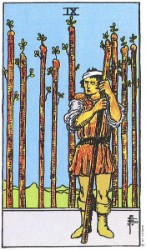
Most of us, though,  don’t wake up grinning every single freaking morning. For some of us life feels very much like the Nine of Wands tarot card:  we’re still standing, we’re still upright and strong, but we’ve had the crap beaten out of us by life and we’re pretty wounded.

And that’s okay.  

That’s where we’re at.  That’s our starting point on the map for the rest of our journey.

Mike Dooley, who has done such wonderful teaching about manifesting and visualizations, often compares reaching our goals to setting a GPS in our cars.  We feed in the information about where we want to go and then the gizmo just takes it from there.  We don’t argue with it or second guess it – we just follow the directions.  In the same sense, he says, we can just set our goals and then let the Universe take it from there.  We don’t need to constantly obsess about the details (what he calls, “the poisoned hows,”) because the Universe will keep popping up new road signs and different paths to get us there.

Implicit in that, though, is the idea that we KNOW where we’re located at the beginning of the journey and we’re HONEST about it.  If I’m in San Jose and I want to get to Phoenix, but I tell my GPS that I’m in Dallas, it ain’t gonna work out too well.

And, in just the same way, if I’m beat up, knocked down, drug around, and life has beaten the stuffing right out of my meditation pillow, putting up Spiritual Post-It-Notes about how grateful I am ain’t gonna work out too well.

Unfortunately, social media sites are generally piss-poor places to be honest about what we’re really feeling.  It’s difficult to admit publicly that we’re NOT the Great and Mighty Wizard of Oz and there may be a lonely, sometimes sad, sometimes frightened person behind the curtain who’s just pulling levers.  It’s especially difficult when so many other people seem to be doing so well.  At least, all of their posts say they’re doing so well.

In a way – and perhaps a healthy way – this impossibly cheerful positivity has intensified since the start of the pandemic.  People really ARE struggling with depression and fear and loneliness and we’re trying to encourage each other to stay in healthy, positive frames of mind as much as we can.

So it may be a good, temporary coping mechanism.  Maybe we DO need to be as optimistic and up-beat as we can be, until we find our way out of this weird, scary virus maze.  It’s what we used to call, “whistling past the graveyard,” and in this case the graveyard is very real and it’s got a half a million Americans in it.

Long term, though, simply pretending that everything is alright when it’s not, doesn’t really work.  It doesn’t get us to our destinations because we’re not being honest about where we’re starting from.

Brad Yates went on to say that there are no such things as negative emotions.  WOW!  But . . . but . . . but . . . I thought I was supposed to be happy all of the time!

Not.  

Repeat – there are no such things as negative emotions.  There are no BAD emotions. 

There are emotions that are uncomfortable.  There are emotions that feel sad or that arise out of situations that are depressing or painful.  But they are all our emotions, they are all part of our story, and they serve to tell us where we are before we take the next step in our journeys.

In 1967, Thomas Harris published a wonderfully cheery book entitled, “I’m Okay, You’re Okay.”  In a nutshell, it promulgated the idea that we’re all just fine, we just misunderstand one another sometimes, and we should always remember that you and I and – gee whiz! –  pretty much everyone is . . . well . . . okay.

To which Elisabeth Kubler-Ross, that amazing wizardess who spent a lifetime studying death and dying, replied:

“I’m Not Okay.

You’re Not Okay.

And That’s Okay.”

And it really IS okay.  It’s right where we’re supposed to be when we take our next step on the journey.

The Ace of Cups, Heart Chakras, and Flounders in Rayon Golf Shirts

Opening our heart chakras to find love when our relationships aren’t working out.

I’ve been thinking a lot about broken hearts.  LOL – Again.

 At one point or another, whether it was the result of an adolescent crush gone awry or a mid-life divorce, most of us have gone through the experience that we tag as, “a broken heart.”  We fall deeply in love with someone and they don’t love us back.  Or they love us and leave us.  Or they, “love us,” in such destructive ways that we end up in shreds.

It hurts like hell.  Jeeeeezus, it hurts.

The 3 of Swords shows the classic broken heart scenario where two people were in love and one of them fell in love (or lust) with someone else.  The heart is pierced with swords and the person who was betrayed is so deeply wounded that he feels that he may never heal from the pain.

So what do we do with our poor broken hearts after someone stomped them into a jelly with their hobnail boots?

One popular solution is to just jump right back into another relationship.  “There are lots of fish in the sea,” we tell ourselves, “and I’m gonna hook me a big old flounder.”

Sometimes that works but a lot of times it doesn’t.  The divorce rate in the U.S. regularly hovers between 45 and 50 percent, which means that an awful lot of serious relationships end up as flaming disasters.

One of the big problems with just catching another fish is that, “life is a mirror,” as Louise Hay says in You Can Heal Your Life, and we tend to catch the same damned flounder over and over and over.  Whatever energy we’re radiating out into the Universe is the energy that’s going to come right back at us, in this case in the form of a lover. 

 If we’re really emotionally needy, clinging people, then we’ll probably attract other emotionally needy, clinging people and then – JOY OF JOYS – we can be needy and clinging together!  Or, if you really hate yourself and you’re constantly treating yourself like shit, you’ll probably attract an abuser to do the job FOR you.

So, basically, unless we change our energy patterns, unless we change what we’re radiating out to others, we’re going to continue to attract the same kinds of people, the same lovers who broke our hearts, only in different clothing.  (Hopefully stylish clothing, at least.  It’s doubly tragic when your new flounder shows up in a rayon golf shirt.)

That can even happen to kind, loving people who’ve gotten therapy, who’ve done the spiritual work, and are really, sincerely looking for a healthy, compassionate partner.  In some ways, people who are truly loving and on a sincere quest for genuine love may be even more vulnerable.  Just take a moment or two to listen to this video from the wonderful Doctor Ramani about malignant narcissists and, “love bombing.”

Remember what it’s like when you’re really, really, REALLY in love with someone?  You feel like – to use an old Southern expression – they hung the moon.  Everything they do is perfect, everything they say is a glittering gem of wisdom, and just being around them makes you ecstatic.

The malignant narcissist gets to us because they can perfectly mimic that feeling of being in love.  They praise us, they flatter us, they tell us that we’re smart and sexy and funny.  Just like someone who really loved us would do.  And then they destroy us.

Oops.  Another goddamned flounder.

Hopefully, we go BACK to our therapist and he or she teaches us about malignant narcissists and how to spot them and how to build healthy boundaries.  It’s all very complicated and it can take a lot of time along with a lot of emotional work and commitment.

In the meantime, in between time, we’re just hanging there with no love in our lives.  I mean, we KNOW that if we just go back out fishing without cleaning up our own emotional messes, we’re just going to get the same fish again.  And that’s not a good thing.  Living without love is NOT a good idea.  We NEED love.  It nurtures us.  It heals us.  It grows us.  So what do we do?

We can find at least a partial answer in the Ace of Cups.  It shows love – pure, undifferentiated, unattached, unconditional love – pouring into the world.

Believe it or not, we can manifest that love in our hearts and in our lives without a relationship and without a mate.  We all have a very special place in our energy systems called, “the heart chakra.”  This is the place where we receive, store, and generate love.

We can sit down at any time that we choose, do a heart chakra meditation, and, “grow,” the love that is in our hearts.  It’s not hard, it’s not complicated, and we don’t have to be spiritual masters to do it.  There are heart chakra meditations all over the internet, so you can start loving TODAY, if you want to.  (Here’s a nice one to get you started.)

The thing we frequently miss is that love exists.  It’s a force in the Universe that’s out there, independent of people, and we can let it into our lives and our being anytime that we want to.  Hell, we can set aside an afternoon for meditation and just BATHE in that energy if we want to.  All we have to do is open our heart chakras.

That’s not to put down loving another person at all.  Being in love can be one of the most magical, wonder-FULL things that ever happens to us.  It’s really hard to beat snuggling up against your partners back on a cold, snowy night, right?  (Well . . . neck kisses.  Neck kisses might beat it.  Of course, you could do both.)

Until that happens, though, until we can untie all of the weird, dysfunctional emotional knots that keep us from finding that relationship, we can remember that our lovers aren’t love itself.  They are vehicles that get us to love, but we can still experience love without a relationship.

It’s right there in our hearts.

Disclaimer: “As an Amazon Associate I earn from qualifying purchases.”

The Ten of Swords, the Death Card, Child Abuse and Forgiveness

It’s hard to put an exact figure on it because child abuse tends to operate in the darkness, but most statistics indicate that about one in five people were abused as children. That abuse can, of course, be a broad spectrum of behaviors from physical abuse to emotional and social abuse to sexual abuse, or a combination of all of those. And therapists will take different approaches in treating those abuses, depending upon the type and severity.

We can simplify that by just lumping it all under one word: trauma. Victims of child abuse suffered severe trauma at a point in their lives when they were totally ill-equipped to process it intellectually or psychologically. Child abuse is normally committed by those who are closest to us – our parents, siblings, uncles, teachers, priests, pastors – and so it involves a deep betrayal of the most basic sense of trust. It leaves its victims with an enduring, often unconscious, feeling that the world is NOT a safe place and that we can never feel secure or at peace, even in our own homes. To use a current phrase, we suffer from Post Traumatic Stress Disorder, just like people who have been in combat for extended periods of time.

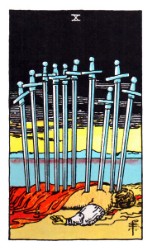
Eventually, that lack of trust in life, that basic inability to ever really relax into safety, will cause us to build impenetrable walls that destroy the quality of life. We are so wounded that we just can’t let other people all the way into our lives because they might hurt us, too. Very much like the figure in the Ten of Swords, the battle is over and we lost. And how could we not? We were just children when the battle took place.

We may seek help through therapy or spiritual resources in an attempt to remove the toxins, to tear down the walls of distrust and fear. If we’re blessed with a really good therapist or a wonderful teacher, we may actually make progress with our issues and begin to engage in life in a more open, loving way. We still feel wounded, though, pierced with countless swords of pain when we recall what happened to us as children.

And then an odd thing happens somewhere along the journey: our abusers die. Abusers, like everyone else, are ultimately mortal and they age and die like everyone else.

When that happens it can be a very odd time in our lives. There may initially be a real feeling of catharsis, a sort of a joyful crying out into the world: “I’m still here and you’re not, you son of a bitch.” Or there may be a total numbness and lack of grief. After all, they taught us the value of learning to feel nothing again and again and again while they beat us. Later, if we go into therapy, there may be a deep regret: “Why didn’t I confront him when he was still alive? Why didn’t I ever ask her why she couldn’t love me?”

At the end of the day, though, they’re dead. As the coroner in Wizard of Oz put it, “She isn’t simply merely dead, she’s really most sincerely dead.”

Or is she?

The terrible truth of the matter is that, for most of us, they go on living in our own heads and hearts long, long after they’re physically dead. There are constant inner dialogues with them, sometimes dozens a day, that we carry on as if they were right there in the room with us, instead of lying in a grave. There are the critical, shaming voices that intrude on our every activity.

“That was stupid.”

“Can’t you do anything right?”

“Well, THAT was typical. You screwed up again.”

Many times these inner critics have become so natural to us, so much a part of our existences, that we don’t even realize that they aren’t us. They’re the disembodied voices of our dead abusers.

So how do we ever get rid of them? How do we ever get to a point where we can say, “You know what? You’re dead. Go away now?” The answer for me came in the form of forgiveness, but not forgiveness in the normal sense of the word. At least not the way I’d ever thought about it.

At first, the idea of forgiving your abusers feels grotesque, even outrageous. “Wait a minute . . . I was a little tiny, helpless kid and this person beat me (fucked me, fondled me, burned me, shamed me – fill in the blank with your particular form of abuse.) Why in hell should I forgive them? Just because they’re dead?”

Well, there are two reasons and, oddly, neither one of them has a thing to do with the abuser.

First of all, yes, they’re dead. Yes, in a physical sense, they really ARE most sincerely dead. Whatever they are now, they aren’t any longer the specific person who abused us.

And that means that, as Louise Hay pointed out, all that they are right now is thought constructs in our heads. That’s it: they are literally just our memories now and they have no existence beyond that. When that really hit me, when I finally GOT that, my first thought was, “Wow! I’m CHOOSING to live with my abusers. All they are is my thoughts and I’m in charge of my thoughts. This is a choice to continue the abuse.”

And once I got that, I realized that if I continued to keep those thought patterns alive, it was a CONSCIOUS choice to live with abuse.

That’s where forgiveness comes in. Louise Haye also pointed out that forgiveness is, ultimately, an act that takes place in our own minds. We don’t tend to think of it that way. We tend to think of it as always involving another person and it usually has a lot of drama attached. It goes something like this:

“I forgive you for the fact that – even though I was deeply in love with you, had your three children, and was a good and faithful wife who adored you with all of her heart – you just couldn’t keep your dick in your pants and you screwed my best friend. That slut.”

In other words, we’re SAYING that we’re forgiving the other person, but we’re really not. What we’re really doing is pointing out what a total piece of shit the other person is and saying that we’ll live with that, as long as they feel good and guilty about what they did wrong. It’s a power thing disguised as a kindness thing.

Real forgiveness, though, is truly letting it go, not choosing to live in it, and that’s why it’s so important in healing the wounds of abuse. It means recognizing that we’re keeping the abusers alive in our own minds, acknowledging what they did to us and honoring ourselves as survivors, and then just . . . letting them go . . . for once and for all . . . back into Universe. “If hating you means I’m keeping you alive, then I can let go of that hatred. I forgive you, I bless you, I release you.” And in doing that, we’re really blessing ourselves. We’re really releasing ourselves from the prisons they built in our minds.

You can invent your own rituals for doing that. I like to use Nick Ortner’s Meridian Tapping with three rounds of what they did to me and three rounds of letting them go. You might prefer to build a Day of the Dead Altar with their picture on it. Talk to the picture, tell them what they did and how it felt, and then throw the picture away.

Light a candle, meditate on the abuser and then release him or her as you blow out the flame.

Do a Buddhist Sur Ceremony and release them with love and compassion.

They don’t exist anymore. We’re free.

The Lovers, The Goddess, and The Monogamy Model

Did you ever have a good friend just disappear on you when they became romantically involved with someone?  You know:  a friend you loved to hang out with, a person who was your go-to buddy for a cup of coffee or a drink, the first person you’d call when something really good (or really bad) happened to you?

And then they fall in love and suddenly you can’t reach them.  You ask if they’d like to have a cup of coffee and they reply, “I don’t know;  I’ll have to see what WE’RE doing.”  On the one hand, you’re happy for them to be in love, but on the other hand, you really kind of feel like you just got dumped.

The bottom line on it is that romantic love, as we currently practice it, tends to be very exclusionary.  We’re a decidedly monogamist society, so 99% of the time falling in love involves two people, period.  And, yes, there is a strong expectation that those two people will devote the majority of their loving and caring to each other and not to people who are outside of the relationship.  It’s very much as if your former best friend is saying, “Well, yeah, I loved you but that was what I was doing until I could find someone to fall IN love with and now I’m busy.  Bye!”

The Lovers tarot card beautifully illustrates the romantic model of love that the Victorians positively adored.  A man and a woman stand beside each other, nude, but not touching, not even making eye contact, while an angel hovers overhead, its wings spread protectively over the couple.  The message is loud and clear:  romantic love is holy and ethereal and, yes, we have bodies, but REAL love is about those heavenly emotions and not about . . . you know . . . S-E-X.

And, yes, it’s about two people and two people only.  You don’t see any best friends hanging out in this card.

Thic Nhat Hanh says that true love, as opposed to our normal idea of romantic love, includes four elements:  (1) loving/kindness which is the ability to offer happiness to the other person; (2) the energy of compassion, which removes suffering from you and the other person; (3) joy in loving; and (4) inclusiveness, which is removing the barriers between you and the other person.  BUT – and this is the kicker with our western concept of love – if it’s really true love then those energies will continue to expand, particularly the energy of inclusiveness. 

 In our romantic love model we draw a circle around ourselves and our partners and say, “Okay, we’re in love – go away.”  In this alternate model, romantic love becomes a spiritual practice that expands to include, rather than exclude, others. In other words, if it’s real love it grows your circle, it doesn’t contract it.

Which leads to a very sensitive and perhaps painful question:  Is monogamy really a healthy model for growing love in our lives?  

Unfortunately, the very question comes packed with a lot of poisonous images.  We think of the middle aged man cheating on his wife with the babysitter.  Or unhappy housewives having miserable affairs with the next door neighbor.  Or swingers, who basically just want to fuck anything that moves, proclaiming that they have, “an open marriage.”

In other words, there’s a large, built in, “Yuck,” factor when we try to visualize a model of love that doesn’t involve exclusive monogamy.  All of those images, though, are operating WITHIN the framework of a monogamist society.  Screwing around on your wife or husband is yucky because it involves lying, cheating, and deeply hurting people who love you, trust you, and expect that you’re going to be, “faithful.”   Sexual swingers probably have inordinately high sex drives and are non-monogamous by nature.  They just get yucky when they try to disguise their true nature within the framework of a traditional marriage.

It may help to think about this issue if we can actually step back a bit and ask ourselves, “Is monogamy natural?  Is this the natural state of human love or is this something that’s been imposed by society over many thousands of years?”

As Leonard Schlain points out in, “The Alphabet Versus the Goddess,”  the evidence is strong that most human societies were originally matriarchal.  And there are actually a few truly matriarchal societies left in the world.  So where do they stand on the issue of monogamy?  

The Mosuo women are China’s last surviving matriarchy.  They don’t marry.  The women choose and change partners as they wish, whenever they wish.

The Minangkabau people practice marriage to a limited extent but the women and children live in their own houses and the men live elsewhere.  

In the Khasi society, a matrilineal and matrilocal culture in the northeastern part of India, monogamy is the norm but women are free to divorce and remarry as frequently as they want to, with no social or economic consequences.

So, if the most ancient form of human society was the matriarchy, and if the current surviving matriarchies are examples of how those societies functioned, then we can conclude that monogamy is NOT a, “natural,” human norm.

Even more fascinating is the fact that these are WOMEN who are rejecting the monogamist model.  Remember, a large element of the argument for monogamy is that women, especially when they’re pregnant, are weak, helpless, and badly in need of male protection.  Apparently these societies think otherwise.

Is monogamy simply an artificial social construct that was foisted on humans by patriarchal societies that viewed women as property, as, “belonging,” to men?  And, as the Goddess archetype reemerges in the world, will we see a breakdown of the monogamistic model?

There may be signs of that, especially among older people.  Sociologists have already noted a new form of family structure they call, “living apart together,”  in which people who describe themselves as being in love still choose to maintain separate households.  Women in these relationships are very much maintaining their own individual identities rather than merging into a shared identity.

It’s fascinating to think of what new forms of romantic relationships may emerge in the coming few years.  Communes?  Group marriages?  Matriarchies?  The Lovers card may need to be a lot larger before it’s all over.

The Fool, The Buddha, and the Corona Virus

Some Tarot interpretations say that the bag or satchel that dangles from the end of the pole on The Fool card is his karma. That he is a new born soul dancing into life and the memories of his experiences and actions – both good and bad – are carried with him into his next incarnation in that little bag.

And that’s a good question for all of us as we face this very profound experience of a world wide pandemic: What will we carry with us when it’s finally over?

Shit happens. We all know that. A lot of the time we experience life less as the Captains of our Fates and more as the silver ball in an old fashioned pin ball machine. We aren’t thinking, we aren’t planning, we aren’t really conscious of what’s happening to us or why. We just keep hitting and being hit by those paddles, bouncing around from one place to the next until a bright, neon sign lights up and says, “GAME OVER.”

And then we’re dead.

Did it make any sense? Did our journey through all of the joys and pains, the triumphs and shit sandwiches actually MEAN anything? Or was it just a random series of events that left us bruised and battered and ultimately puzzled over why it all happened?

A large component in that equation is consciousness. Actually being aware of what’s happening to you right now, right this moment and actively SEEKING for meaning.

Let me give you an example from personal experience. My life partner, Carol, died a couple of years ago and eventually I joined a bereavement support group, also known as a Grief Group. Basically, it’s a small group of people who have lost a loved one and we sit down together once a week and talk about that experience. In other words, we’re trying to find some meaning, some understanding of what we’ve gone through and where we go from here.

One of the most positive things I’ve carried out of that group is the realization of how very much alike we all are in the face of something that is as monumentally dreadful as death. It doesn’t matter if you’re an 81 year old great grandmother or a 25 year old newly wed; death is experienced in much the same way. There are periods of shock, then numbing, then panic and horrible anxiety, overwhelming sadness, and the feeling of being totally lost in the world. There can be great nobility and growth in that process if you can somehow stay connected to your feelings and look for answers. What does it mean? Why did they die? Why am I still here? What am I supposed to do with my life now?

And, sadly, there are other people who experience very little growth and get no spiritual or emotional insights from the process. They throw themselves into a flurry of social activities right after the funeral and, when they have to be home, they turn the t.v. up as loud as it can go and stay on the phone as much as they can. They spend as little time as possible in that Sacred Silence that follows death and they think as little as possible about what it means. In a phrase, “they move on,” from the grieving period as fast as they can. If they’ve lost a husband or a wife, they remarry or re-partner within a year, as if their loved one was an interchangeable part rather than a precious human soul who intermingled with their life stream.

In other words, they don’t carry anything out of it.

Perhaps that’s a form of basic, animal wisdom. As the Buddha said, all sentient beings seek to be happy and to avoid suffering, so there’s nothing unusual about not wanting to hurt. But he also said that suffering is inevitable. No matter how much we might wish otherwise, we each have our portion of pain and how we deal with that suffering – IF we deal with that suffering – that moment in time is the anvil on which we forge our karma. It isn’t just what we go through – it’s how we consciously integrate what we go through. Did we learn anything from the experience? Did we grow and evolve as human beings? Did our compassion and ability to love others increase or diminish? Did we make what happened to us MEAN something in our lives?

So . . . here we sit in the midst of a major historical event. And none of want to be in it. I haven’t met one single person who has said, “Damn, this is exciting! I’m so glad I’m here to see this happen!” But, we’re still here, like it or not. A lot of people are going to die before this all over. Many more will lose people they love with all of their hearts and souls. There’s going to be suffering and we know that.

Right now, millions of us are locked away in our houses and apartments, waiting for the storm to blow through, hoping we won’t be one of the people who are swept out into eternity by this goddamned virus. I guarantee you that many of us are spending this time with the television turned up as loud as it will go, constantly on the phone, constantly on the internet, constantly trying to be too busy to think or feel. They can’t wait to, “move on,” and, “get back to normal.”

In other words, they won’t carry anything out of it.

Right now, we are ALL fools dancing on the edge of a cliff. We can take the time to sit down and meditate, to read, to journal, to REALLY talk with people we love, or . . . we can turn up the volume on the t.v. If there’s one thing we should all know right now it’s that life is precious, time is precious. We can fill that little bag The Fool carries with some new found wisdom, compassion, and meaning. We can actually ask what all of this means, why we’re here, and what we’re supposed to do next.

Or not.

Valentine’s Day, The Lovers Tarot Card, Ram Dass, and Snakes in a Tree.

Uh, oh . . . Valentine’s Day is just around the corner.  The Lovers tarot card could almost be an emblem for it. 

 The Waite tarot deck portrays it as a pretty little scene from the Garden of Eden:  a nude man and woman are posed in the foreground while an angel with flaming wings floats protectively overhead.  Their love is pristine and pure and heavenly. Don’t look at the snake climbing up the tree.

I said, DON’T LOOK.  They’re in love. No snakes, goddamnit.

Well, okay.  Probably we can get a better picture from an earlier Tarot deck.

In the Swiss deck, we see a couple who are actually touching each other.  An old hag of a witch has obviously just whomped them with a love spell and – just in case that’s not enough – an angel is about to shoot a Love Arrow right THROUGH that girls head.  

They’re thunderbolted and flabbergasted, glimmered and glamored.  They’re in Love, L-U-V!

And it’s wonderful and it’s fabulous and it’s the best thing in the world.  But . . . what IS it, exactly? What is it that makes our brains pump out floods of endorphins, walk around with silly grins on our faces, and talk about our partners to a point where our friends want to strangle us?

A reductionist would tell you that it’s just chemicals in the body.  Hormones. Random encounters in the process of looking for a mate that somehow become permanent relationships.  Ultimately it’s all driven by the need to fuck and reproduce and then we . . . sort of . . . get fond of each other after we’ve had our orgasms and THAT, by golly, is love.

Ram Dass spoke of it quite differently.  He said that sometimes another person is the key that unlocks us and we’re the key that unlocks them and we exist in love.  That the other person is the vehicle for us to get to love.  And, when the other person dies or leaves, it feels like all of the juice, all of the magic, all of the love has gone out of our lives.

Think about that:  the vehicle that gets us to love.

One of the more interesting meditation exercises we can do is to just sit with the feeling of love.  Open our heart chakras and let ourselves relax into love. It may be that when we start that kind of meditation we need something to refer to in order to start the flow of love.  Perhaps we think of a person we love deeply or a place that brings us great peace or even a dog or a cat or a horse. The thought of the beloved starts the flow of loving energy. The beloved is the vehicle that takes us to love.

As we continue to practice that meditation, though, the need for an outside reference, for a thought, memory, or person to take us to that place of love lessens.  Our heart chakras become stronger and clearer and more open and we find that we can enter into loving feelings spontaneously.

We can just exist in, just float in, a sea of love.  And it feels SO good. At that point we’ve gone from needing something outside of us to, “cause,” love to just being love.

Here’s another way to look at it:  the Buddhists teach us that clinging and desire bring suffering.  We feel miserable and we tell ourselves, “If I just had that ___________ (fill in the blank with new car, new computer, iphone, house, dress, shoes, degree, etc.) then I’d be really happy.”  

And so we torture ourselves with what we don’t have, that thing that will finally make us happy, and the more we lust after it, the more miserable it’s absence makes us feel.  Maybe we get two jobs so we can afford it. Maybe we eat rice and beans for a year so we can scrimp and save and FINALLY we can buy the thing that will make us happy.

And it does!  For a while. But it’s a total sugar rush and after a very short period of time we don’t feel so happy anymore.

And then we start thinking about the NEXT one thing that will finally make us happy and we feel miserable because we don’t have it.

That’s really the basis of capitalist society and advertising:  convincing us that there is some THING outside of us that’s going to make us happy.  And, by golly, when that happiness wears off, we’ve got some other neat stuff to sell you that will make you REALLY happy.  For a while.

Or . . . we can just short circuit all of that process and say, “I’m happy.”  We really can. Like the love meditation, we can start out just thinking about things or places or people that make us happy.  We don’t have to buy them or worry about losing them because they’re our thoughts.

The trees make me happy, the clouds make me happy, my lover makes me happy, my vibrator makes me happy, a stream, or a river, or a lake, or the ocean . . . those thoughts make me happy.  And, as we continue that process, we can eventually move straight into BEING happy, without having to possess anything external to us to MAKE us happy. 

Walmart hates that, but it’s one of the most important lessons we can learn.  Happiness exists independent of things.

And it’s the same dynamic with love.  When our lover leaves us or dies we feel crushed because it feels like we’ve lost all of the magic of love.  But love exists independent of people. We’ve lost the vehicle that brought us to love, but we haven’t lost the love.  It’s always right there waiting for our hearts to open and return to it’s embrace.

And there’s no snake climbing up a tree.  Just love, L-U-V!

The Judgement Card – Lay It Down and Shut the Door

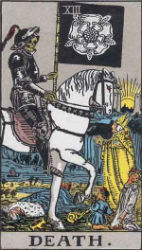
To my mind, Judgement is a lot creepier looking card than the Death card.  Coffins bobbing around in the sea while gray corpses pop out of them like zombies.  Of course, the Angel with the Trumpet hovers overhead calling them back to life and that’s nice but it’s still a disturbing card on the face of it.

Despite that, it’s still a hopeful card because it’s the card of endings and where there are endings there can be beginnings.  Judgement isn’t just about endings, though; it’s about the end of long cycles that occur in our lives. Often it shows up in our readings as a sign that we can finally lay our burdens down.

We all have seasons and cycles in our lives, though we frequently fail to recognize them as distinct and separate chapters.  Some of the more obvious cycles are birth through adolescence, puberty through adulthood, perhaps going to college or doing a hitch in the military after high school.  Our children growing up and moving out on their own. These are all periods of time that stand apart in our memories and experiences as being unique times in our lives.

And Judgement is about the ends of these cycles.  It’s about the personal judgements that we make about these periods of time, what they meant to us, and how we performed in dealing with them.

To use another common example, think of marriage or partnership as a cycle in our lives.  We meet someone, we fall in love, we decide that he or she is the person with whom we want to spend our lives.  The relationship may last for many years or just a few. Sooner or later, though, whether as a result of, “until death do us part,” or a divorce/separation, that bonding with another, that cycle of our lives, will be over.

And when it’s over, we have to make a judgement about it.  How did I do? Could I have done more? Could I have loved more or shown more feelings or compassion?

A divorce is probably a pretty good example of that process.  Unless you accidentally married a psychopath or an angel, the odds are that BOTH parties contributed to the divorce.  Both parties might have tried to be a little more caring or supportive or understanding or sensual or whatever the missing ingredients were that caused it all to fall apart.

Even if you’re actually an incredibly good, loving person you may have contributed to the divorce just by marrying an asshole to begin with.  The question is, “What did I do in this cycle that was good, bad, or indifferent?”

So Judgement is about the ends of these cycles in our lives and about the judgements we have to make when the cycles end.  And they’re not judgements about the other party or circumstances – they’re judgements about ourselves and our own behaviors.  With those judgements come – hopefully – growth. It can be something as simple as, “I’m a really good, loving person so why do I keep getting involved with assholes?”  Or as complex as, “I was really abused as a child so how do I learn how to really love and trust people?” The judgements are always geared toward being and doing better.

The second element in Judgement, though, is laying that burden down and starting a new phase and that’s where many of us trip ourselves up.  We need to be able to firmly close the door on that chapter of our lives and say, “That’s over. Time to move on.”

Taking the time to make thorough judgements about ourselves and about our behavior is the key to doing that.  We don’t just leave a marriage or experience a death or fight our ways through serious illnesses and then go on with life as as the Walking Wounded.  We take a good long look at ourselves and we thoroughly decide, “I did the best I could.”

Or, “I could have done better.”

Or, “I need to work on being a better person/listener/partner/lover and here’s how I’m going to do that.”

And, once we can honestly say to ourselves that we’ve learned the lessons we were supposed to learn, we forgive (or congratulate) ourselves and MOVE ON.  We don’t whip ourselves over not doing enough or continue to live in the past. We shut the door firmly and step out into our new world.

It’s over.

And it’s beginning.

Just the Tarot, by Dan Adair – a kindle ebook available on Amazon