
Understanding the Root Chakra More Deeply: Safety, Survival, and the Foundations of Self

Exploring the causes of root chakra issues, the second in a three part series on Tarot and the root chakra.

In my previous post, “10 Tarot Cards That May Indicate a Blocked Root Chakra,” we explored how Tarot can reveal energetic patterns related to fear, insecurity, survival struggles, and grounding issues. Those are all first chakra issues.

So now, let’s look at the Root Chakra in a little more depth.

The Root Chakra, or Muladhara, is located at the base of the spine and is traditionally associated with the color red. It serves as the energetic foundation of the chakra system, governing our sense of safety, survival, stability, and belonging.

Its symbol is a four-petaled lotus, often interpreted as representing the four directions—north, south, east, and west—symbolizing our connection to the physical world and our grounded presence within it.

Its seed syllable, or bija mantra, is LAM, a sound traditionally used in meditation to strengthen and activate Root Chakra energy.

When balanced, this chakra allows us to feel safe in our bodies and secure in the world. When blocked, however, it can create profound ripple effects throughout every other area of life.

CHAKRAS AND DEVELOPMENTAL PSYCHOLOGY

One of the most interesting things about chakra work is that it’s really a method of developmental psychology.  

What do we mean by that?  

Developmental psychology posits that there are certain, “goals,” that we have to achieve as we develop into complete human beings and achieving one goal helps us to achieve the next goal.  

To use a really simple example that’s become a cliche’, we have to learn how to walk before we run.  When we look at an infant, we can see that that’s literally true:  the child’s body has to develop the muscular strength  to walk before she can run.

In the same sense, the child has to learn to make sounds before he can make words and has to learn what words mean before he can make sentences.  Each developmental step leads into the next.

The important point here is that if we don’t fully achieve the first step, it makes it more difficult to achieve the next step.

While all of that is going on with our physical bodies, there’s a similar development happening with our energetic bodies, i.e. the chakra system. 

 Each chakra actually develops at a particular phase of our lives and – if it doesn’t develop right – that causes problems in the next chakra, which causes problems in the next chakra, and so on.

LOWER CHAKRA DEVELOPMENTAL STAGES

Chakra One (Root Chakra)

Womb to 12 months

Develops our sense of safety, security, and trust in life.

Chakra Two (Sacral Chakra)

6 months to 2 years

Develops personal identity, emotional experience, and selfhood.

Chakra Three (Solar Plexus Chakra)

18 months to 3.5 years

Develops ego strength, confidence, and our ability to project ourselves into the world.

Chakra Four (Heart Chakra)

3.5 years to 7 years

Develops our ability to form loving, healthy relationships.

Here’s how that looks in the lower chakras:

So, if the first chakra doesn’t develop correctly, then we don’t feel safe in the world.  

If we don’t feel safe in the world, then we’ll try to hide who we really are, so the second chakra won’t develop well.  

If we try to hide who we really are, then we’ll never have the confidence to project ourselves into the world in a healthy way, so the third chakra won’t develop.  

And if we don’t have a strong ego structure, then we can’t develop healthy relationships, so the fourth chakra becomes stunted.

Each step leads to the next, right?

FIRST CHAKRA ISSUES

In her powerful book: “Unblocked: A Revolutionary Approach to Tapping into Your Chakra Empowerment Energy to Reclaim Your Passion, Joy, and Confidence”, Margaret Lynch Raniere suggests that the Inner Child essentially lives within the Root Chakra.

This is a profound concept because it means the first chakra contains the earliest energetic blueprint for:

* Safety

* Security

* Trust

* Survival

* Worthiness of care

According to this model, Root Chakra healing often comes down to two essential early-life questions:

1. Did we feel safe?

2. Were our needs met?

The answers to these questions become deeply wired into both our nervous systems and our energetic systems.

“Just the Tarot,” by Dan Adair – Available on Amazon

DID WE FEEL SAFE?

That’s actually a fairly complex question.  If we were born into extremely abusive or dysfunctional families, it’s fairly easy to surmise that we didn’t feel safe.  If we were being slapped around or screamed at as a helpless infant, obviously we wouldn’t feel safe.  

Remember, though, that the first chakra forms – not just in our first year – but also in the womb.  During that period when we were gestating inside of our mother’s bodies, we were basically immersed in whatever chemicals and hormones SHE was feeling.  

And so the second part of this question is, “Did our mothers feel safe?”  

Because, for that period that we were in the womb, her nervous system was our nervous system.

For instance, if our family was going through a period of extreme stress during the time that we were gestating, we can reasonably conclude that our mothers were producing really high levels of cortisol and adrenaline in their bodies.  If they were depressed, they may have had chronically low levels of serotonin. And so did we.

Put another way, if our mothers didn’t feel safe, then we didn’t feel safe.  

Whatever they were feeling is the emotional set point that we had when we entered the world.  If they were extremely anxious, then we were extremely anxious.  If they were depressed, then we were depressed.

And we carry that forward into the rest of our lives.  If we felt unsafe as infants, we’ll be in chronic low level fight or flight reactions as adults.  We’ll be hyper-vigilant, always looking for the next threat.  

We may be ungrounded and unfocused because it’s literally painful to be in our own bodies.  

We may even be attracted to people who MAKE us feel unsafe as a way to validate our feelings.

WERE OUR NEEDS BEING MET?

As Raniere pointed out, we might think of the needs of an infant as a continuing series of irritations followed by being soothed.  

In a healthy family, that runs like this:

 Irritation:  I’m hungry.  Soothing:  someone fed me.

Irritation:  I’m cold.  Soothing:  someone covers me.

Irritation:  I’m scared.  Soothing: someone holds me.

That sets up a pattern in the nervous system whereby we feel that our needs will always be met.  And if our needs are met, then we feel safe and secure in the world.

Now, again, we may think of an infant’s needs not being met in terms of the extremes of child neglect.  If a child isn’t held and loved they can actually die from failure to thrive.  But not having your needs met can exist over a broad spectrum.

We may, for instance, have good, loving parents who simply have too many kids.  Raniere touches on this with the fact that she had 8 siblings who also needed to be taken care of by her parents.  

As we were talking about in the preceding section, we may have had a mother who was suffering from deep depression or a physical illness and simply couldn’t provide the care that we needed.

And as Gabor Mate’ has pointed out, it’s possible that our parents adopted a child-rearing philosophy where they thought it was actually good for the infant to ignore her needs.  If you just let the baby sit its crib and cry, they’ll learn patience, right?  

Whatever the reasons, if our needs weren’t being met as infants, that sets up in our first chakra as the expectation that our needs won’t be met as adults.  

We can drift into codependent relationships where we’re constantly over-giving in the hopes that our partners will at least meet some of our needs.  

We can intentionally seek out partners who aren’t capable of meeting our needs in order to validate our expectations.

Even worse, we may learn to ignore our needs and fail to take care of ourselves as adults.  The pattern we learned was, “Something is irritating me and I’m not going to be soothed, so I have to just live with it.”  Our levels of self-care, self-love, and self-compassion may be almost non-existent.

MOVING ON TO SOME SOLUTIONS

So in the first post in this series, we looked at some Tarot cards that may indicate that we have a blocked first chakra.  In this post, we looked at how that happens.  In the next post, I’ll gather together a list of really good resources to help us heal the root chakra and regain a sense of safety in our lives.

Because when we reclaim our foundation, we reclaim the possibility of building a life rooted not in fear—but in genuine security.
Bundles of Sticks, Ajahn Brahm, and the Ten of Wands

Finding closure on experiences that don’t make any sense.

Should we carry our past with us or just throw it away?

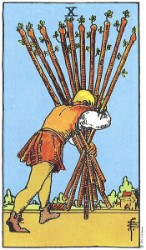
The Ten of Wands shows a person plodding along, carrying a large bundle of sticks.  The, “sticks,” are wands, the suit of the Tarot that represents ideas, so he’s actually carrying a massive number of ideas.  

If we take a little closer look at the card we notice a few odd things about it.  First, he’s not at all carrying the sticks the way that we’d expect.  If we pick up a big old honker of a load of sticks, we’d throw them over our shoulder, right?  Instead,  he’s carrying them in front of himself, with his head pressed into the bundle. 

Second, the sticks are all crossed up at the bottom and going in different directions at the top.  If someone asked us to lug a large pile of sticks across the yard, we’d probably throw a rope around them and tie them together, not carry them in a loose, unwieldy mess.

Third, he’s definitely not watching where he’s going.  His head is tilted down, as if he’s watching each step he’s taking, rather than keeping his eyes on his destination.

So just by looking at the face of the card, we can deduce quite a few things about it.  This guy is probably an intellectual, or at least someone who thinks a great deal, because he has many, many ideas that he’s carrying around.  His ideas don’t really, “fit,” together, and they’ve become quite a burden for him.  In fact, he’s so involved with carrying his ideas that he really has no idea where he’s going.  He’s so lost in his ideas that he has no perspective on his life.

The Australian Buddhist monk, Ajahn Brahm, tells a funny story about sticks.  When he was a novice monk he was strolling through the forest with his teacher, the head monk at the monastery where he was studying.  The master suddenly picked up a stick from the forest floor and asked, “How heavy is this stick, Ajahn Brahm?”  And then he threw it away and asked, “How heavy is it now?”

The point, of course, is that something is, “heavy,” only when we hold on to it.  It’s the act of PICKING IT UP AND CARRYING IT that makes it heavy.  We don’t look at a stick on the ground and say, “Oh, crap, that’s heavy.”  We only say it when we try to pick it up.  It’s our act of grasping something that makes it seem heavy, not the thing itself.

Human beings are natural storytellers.  We all reflexively try to make sense out of our lives and weave the events we experience into a coherent, sensible narrative.  We have an innate drive to try to make sense out of what happens to us and so we’re constantly reviewing our pasts and rearranging the puzzle pieces of our lives into some sort of a rational structure.

We don’t just say, “Well, I lost my fucking mind and decided to quit my job, leave my husband, and move to Montana to grow dental floss.  Just for no particular reason.”  Instead, we say, “After several years of marriage I felt a yearning for solitude and spiritual growth that could only be satisfied by disconnecting from social obligations that had become increasingly mundane.”  

That feels ever so much better.

We need to feel that it all makes sense, somehow.

From a Buddhist perspective, constantly trying to make sense out of our pasts is tantamount to picking up that stick.  It only becomes heavy, it only becomes a burden, when we grasp it and carry it around with us.  In fact, Ajahn Brahm actually recommends writing, “this is my past,” on a stick and throwing it as far away as we can.  Just let it go.  When we’re not carrying it, it’s not heavy.

Now, modern psychology has a different take on it.  Therapists tell us that it IS important to try to make sense out of what’s happened to us and to strive for a sense of meaningfulness in our lives.  Bottom lining it, that’s why we go to therapists:  because our lives aren’t making any sense and we need someone to help us sort it all out.

I suspect that for most of us, the truth lies somewhere in the middle.  If we wake up one morning and have no past, we may have suffered a psychotic break.  Or, in the case of people like Eckhart Tolle, perhaps we’ve had a massive revelation, a huge psychic shift that made us realize how absurd our previous thinking was.

For those of us who are neither psychotics nor enlightened spiritual masters, though, just tossing our pasts out the window isn’t an option.  It seems we can’t just NOT think about it.

Which brings us to that tired, but still valid, word:  closure.

We think of closure as having worked through a problem or a process in life until we’ve made sense of it, until it fits logically into our coherent narrative of what our lives mean.  If we go through a divorce, for instance, we may go to a therapist and try to figure out why it happened.  What was our role in the relationship breaking apart?  What was our spouses role?  What did we do wrong?  What did we do right?  What can we learn from it to make our future relationships better?  Eventually, when we’ve talked through all of those issues, we start to achieve closure and we’re ready to move on from it.  We haven’t necessarily thrown the stick away, but we’ve made it a hell of a lot lighter to carry.

There are other issues, though, that we can never seem to make any sense out of.

– If you were badly abused as a child, that doesn’t make any sense.  You didn’t do anything to deserve it and there’s no logical or emotional reason it should have happened to you.

-If you’re an open and loving person and you got chewed up and spit out by a malignant narcissist, that doesn’t make any sense.  You didn’t ask for it, you didn’t deserve it, and it shouldn’t have happened.

-If the new boss from hell fires you from your dream job because he’s a sexist or a sadist, that doesn’t make any sense.  You were a great employee, there’s no justice in it, and it shouldn’t have happened.

So there’s a kind of a subclass of experiences that we all have that we could call, “doesn’t make any sense,” experiences.  Those are the experiences that get really, “sticky.”  Those are the experiences that we pick up and carry with us.  We go over and over and over them, trying to figure them out, trying to make them somehow fit into our narratives, our story.  But they never do.

“Doesn’t make any sense,” experiences are the ones that are most likely to wound us spiritually and emotionally.  They keep us stuck.  They keep us wounded.  They keep us living in pain.

Oddly, though, they’re also the experiences that are easiest to let go of, if we think of them in the right way.  If we’ve honestly, sincerely, conscientiously tried to figure them out and we can’t do it, we can just say, “Well, fuck it.  This doesn’t make any sense.”  And then we can put that experience in a nice, “doesn’t make any sense,” box, tie a brightly colored, “doesn’t make any sense,” ribbon around it, and toss it in the nearest river.

Maybe we’re not enlightened or smart enough to throw all of our, “sticks,” away, but we can throw some of them away.  We can consciously choose which parts are valuable and which parts are worthless.  We can drop some of the burden and make it a little easier to move forward in our lives.  

And that’s a good start.

The Ten of Swords, the Death Card, Child Abuse and Forgiveness

It’s hard to put an exact figure on it because child abuse tends to operate in the darkness, but most statistics indicate that about one in five people were abused as children. That abuse can, of course, be a broad spectrum of behaviors from physical abuse to emotional and social abuse to sexual abuse, or a combination of all of those. And therapists will take different approaches in treating those abuses, depending upon the type and severity.

We can simplify that by just lumping it all under one word: trauma. Victims of child abuse suffered severe trauma at a point in their lives when they were totally ill-equipped to process it intellectually or psychologically. Child abuse is normally committed by those who are closest to us – our parents, siblings, uncles, teachers, priests, pastors – and so it involves a deep betrayal of the most basic sense of trust. It leaves its victims with an enduring, often unconscious, feeling that the world is NOT a safe place and that we can never feel secure or at peace, even in our own homes. To use a current phrase, we suffer from Post Traumatic Stress Disorder, just like people who have been in combat for extended periods of time.

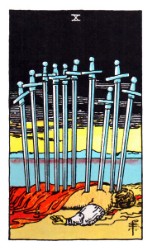
Eventually, that lack of trust in life, that basic inability to ever really relax into safety, will cause us to build impenetrable walls that destroy the quality of life. We are so wounded that we just can’t let other people all the way into our lives because they might hurt us, too. Very much like the figure in the Ten of Swords, the battle is over and we lost. And how could we not? We were just children when the battle took place.

We may seek help through therapy or spiritual resources in an attempt to remove the toxins, to tear down the walls of distrust and fear. If we’re blessed with a really good therapist or a wonderful teacher, we may actually make progress with our issues and begin to engage in life in a more open, loving way. We still feel wounded, though, pierced with countless swords of pain when we recall what happened to us as children.

And then an odd thing happens somewhere along the journey: our abusers die. Abusers, like everyone else, are ultimately mortal and they age and die like everyone else.

When that happens it can be a very odd time in our lives. There may initially be a real feeling of catharsis, a sort of a joyful crying out into the world: “I’m still here and you’re not, you son of a bitch.” Or there may be a total numbness and lack of grief. After all, they taught us the value of learning to feel nothing again and again and again while they beat us. Later, if we go into therapy, there may be a deep regret: “Why didn’t I confront him when he was still alive? Why didn’t I ever ask her why she couldn’t love me?”

At the end of the day, though, they’re dead. As the coroner in Wizard of Oz put it, “She isn’t simply merely dead, she’s really most sincerely dead.”

Or is she?

The terrible truth of the matter is that, for most of us, they go on living in our own heads and hearts long, long after they’re physically dead. There are constant inner dialogues with them, sometimes dozens a day, that we carry on as if they were right there in the room with us, instead of lying in a grave. There are the critical, shaming voices that intrude on our every activity.

“That was stupid.”

“Can’t you do anything right?”

“Well, THAT was typical. You screwed up again.”

Many times these inner critics have become so natural to us, so much a part of our existences, that we don’t even realize that they aren’t us. They’re the disembodied voices of our dead abusers.

So how do we ever get rid of them? How do we ever get to a point where we can say, “You know what? You’re dead. Go away now?” The answer for me came in the form of forgiveness, but not forgiveness in the normal sense of the word. At least not the way I’d ever thought about it.

At first, the idea of forgiving your abusers feels grotesque, even outrageous. “Wait a minute . . . I was a little tiny, helpless kid and this person beat me (fucked me, fondled me, burned me, shamed me – fill in the blank with your particular form of abuse.) Why in hell should I forgive them? Just because they’re dead?”

Well, there are two reasons and, oddly, neither one of them has a thing to do with the abuser.

First of all, yes, they’re dead. Yes, in a physical sense, they really ARE most sincerely dead. Whatever they are now, they aren’t any longer the specific person who abused us.

And that means that, as Louise Hay pointed out, all that they are right now is thought constructs in our heads. That’s it: they are literally just our memories now and they have no existence beyond that. When that really hit me, when I finally GOT that, my first thought was, “Wow! I’m CHOOSING to live with my abusers. All they are is my thoughts and I’m in charge of my thoughts. This is a choice to continue the abuse.”

And once I got that, I realized that if I continued to keep those thought patterns alive, it was a CONSCIOUS choice to live with abuse.

That’s where forgiveness comes in. Louise Haye also pointed out that forgiveness is, ultimately, an act that takes place in our own minds. We don’t tend to think of it that way. We tend to think of it as always involving another person and it usually has a lot of drama attached. It goes something like this:

“I forgive you for the fact that – even though I was deeply in love with you, had your three children, and was a good and faithful wife who adored you with all of her heart – you just couldn’t keep your dick in your pants and you screwed my best friend. That slut.”

In other words, we’re SAYING that we’re forgiving the other person, but we’re really not. What we’re really doing is pointing out what a total piece of shit the other person is and saying that we’ll live with that, as long as they feel good and guilty about what they did wrong. It’s a power thing disguised as a kindness thing.

Real forgiveness, though, is truly letting it go, not choosing to live in it, and that’s why it’s so important in healing the wounds of abuse. It means recognizing that we’re keeping the abusers alive in our own minds, acknowledging what they did to us and honoring ourselves as survivors, and then just . . . letting them go . . . for once and for all . . . back into Universe. “If hating you means I’m keeping you alive, then I can let go of that hatred. I forgive you, I bless you, I release you.” And in doing that, we’re really blessing ourselves. We’re really releasing ourselves from the prisons they built in our minds.

You can invent your own rituals for doing that. I like to use Nick Ortner’s Meridian Tapping with three rounds of what they did to me and three rounds of letting them go. You might prefer to build a Day of the Dead Altar with their picture on it. Talk to the picture, tell them what they did and how it felt, and then throw the picture away.

Light a candle, meditate on the abuser and then release him or her as you blow out the flame.

Do a Buddhist Sur Ceremony and release them with love and compassion.

They don’t exist anymore. We’re free.