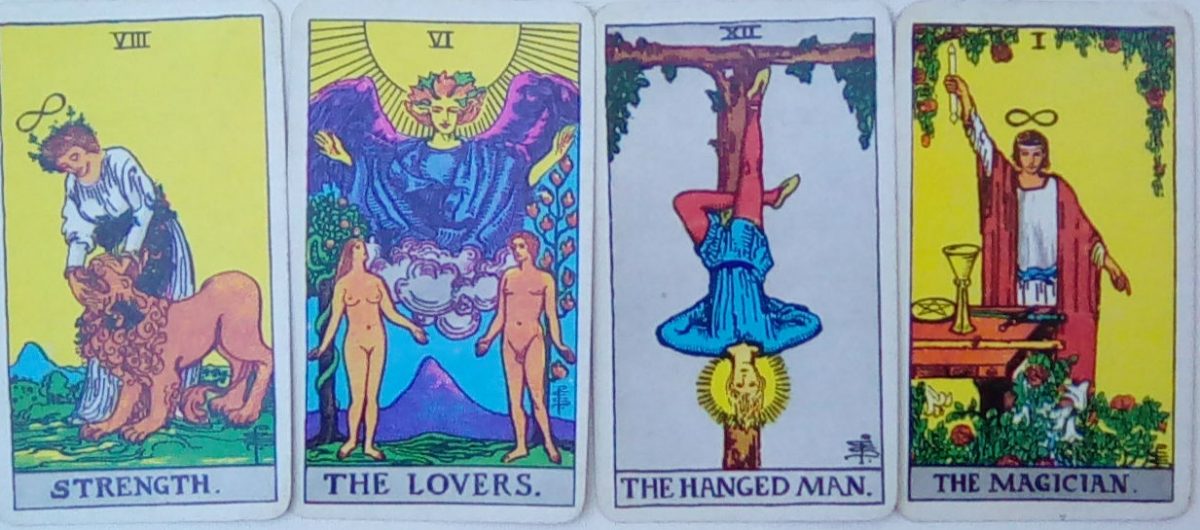
The Influence of The Empress Card

The Empress in Tarot embodies creativity, abundance, and nurturing energy. When paired with the other Major Arcana, her influence reveals how growth, harmony, and fertility play out in every area of life—from relationships and intuition to cycles of transformation. This chart offers quick interpretations of The Empress in combination with all 22 Major cards, including reversed meanings. Perfect for Tarot readers seeking deeper insights or printable reference material.

In the absence of a regular blog post for today, I would like to offer a chart detailing the influence of The Empress Tarot card when paired with the other cards of the Major Arcana. Please feel free to print this and use it for reference in your readings.

Or, if you’d prefer, you can download a PDF version here. Just click on the link and when it comes up, go to your browser menu and click on print.

The Empress + The Fool – Nurturing new beginnings. Creative innocence finds fertile ground.

Reversed: Overprotection stifles growth; immaturity in creativity.

The Empress + The Magician – Manifesting abundance through intention and artistry.

Reversed: Manipulating creativity; false appearances of growth.

The Empress + The High Priestess – Balance of intuition and creativity; inner wisdom flowering into expression.

Reversed: Repressed intuition blocks creativity; confusion in nurturing roles.

The Empress + The Emperor – Harmony between creation and structure; nurturing power within order.

Reversed: Domination suppresses creativity; imbalance between control and flow.

The Empress + The Hierophant – Sacred traditions inspire fertile creativity; nurturing spiritual communities.

Reversed: Stagnation within rigid traditions; blocked feminine wisdom.

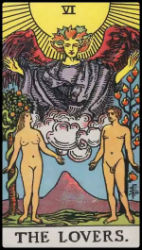
The Empress + The Lovers – Love as a fertile union; creativity fueled by harmony and relationship.

Reversed: Codependency; love smothered rather than nurtured.

The Empress + The Chariot – Creative direction with determination; abundance set into motion.

Reversed: Lack of discipline wastes creative potential; scattered nurturing energy.

The Empress + Strength – Gentle power; nurturing builds resilience.

Reversed: Overindulgence weakens; misplaced compassion.

The Empress + The Hermit – Creativity drawn from solitude; nurturing wisdom within.

Reversed: Isolation stifles growth; withdrawal from fertile opportunities.

The Empress + Wheel of Fortune – Cycles of abundance; harvests following seasons of sowing.

Reversed: Bad luck in creativity; loss of balance in life’s rhythms.

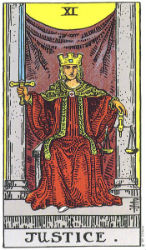
The Empress + Justice – Fairness in nurturing roles; creativity guided by truth.

Reversed: Biased nurturing; injustice in relationships or creative endeavors.

The Empress + The Hanged Man – Creative surrender; new perspectives nurture growth.

Reversed: Stagnation, unwillingness to release control in nurturing.

The Empress + Death – Transformation gives birth to new creation; fertile endings.

Reversed: Resistance to endings; clinging smothers growth.

The Empress + Temperance – Harmony in creativity; nurturing balance and wholeness.

Reversed: Excess stifles balance; nurturing turns to enabling.

The Empress + The Devil – Passionate creativity; fertility bound to desire.

Reversed: Enslavement by overindulgence; blocked nurturing energy.

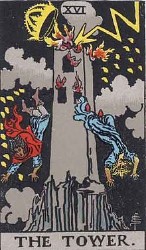
The Empress + The Tower – Creative breakthroughs; fertile destruction clearing ground for new growth.

Reversed: Suppression of necessary change; smothering collapse.

The Empress + The Star – Hope renewed through nurturing; creativity as healing.

Reversed: Disappointment in creative outcomes; blocked inspiration.

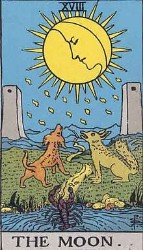
The Empress + The Moon – Intuitive creativity; fertile imagination guided by dreams.

Reversed: Illusion clouds nurturing; confusion in creative flow.

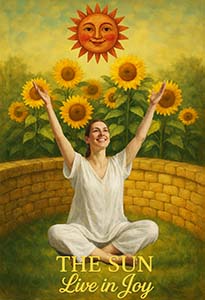
The Empress + The Sun – Joyful abundance; creativity flourishing in light.

Reversed: Overexposure or lack of clarity in nurturing roles.

The Empress + Judgment – Rebirth through nurturing; creativity aligned with higher calling.

Reversed: Misuse of nurturing power; denial of creative responsibility.

The Empress + The World – Completion of cycles; fulfillment through creation and nurture.

Reversed: Lack of closure; unfulfilled creative potential.

“Just the Tarot,” by Dan Adair – A kindle ebook available on Amazon

What To Do When Our Lives Turn Into Crap – Wheel of Fortune Reversed

How to deal with it when you hit a period of bad luck

I recently got The Wheel of Fortune reversed in one of my personal readings and we all know where that’s at:  a period of bad luck coming.  Get ready, because things are NOT going to go the way that you want them to, at least not for a while.

And, since I’m an intuitive, I started thinking about exactly what, “luck,” is.  When we say we’re lucky or we’re unlucky, just what exactly are we talking about?

KARMA

Some of it can be karma, of course.  We’ve all met those people who seem to be blessed with nothing but good fortune.  They were born into families that loved and nurtured them, they were the beauty queens and football heroes in their high schools, and they went on to have wonderful careers, lots of money, and 2.5 semi-perfect children.  Into every life a little rain must fall, but they seem to live under giant umbrellas.

And then there are people who just can’t buy a fucking break.  No matter how hard they try, no matter how they struggle and strive, nothing goes right for them.  They’re always at the right place at the wrong time and money and love evade them like a bunny rabbit on speed.

Many of the people who are blessed with Hallmark Card lives have done little to deserve those lives, and many of the people who are cursed with disastrous existences have done little to deserve THAT fate.  

So all we can do is to shake our heads and say, “Well, it must be karma.  They must have been very, very good or very, very bad in a previous incarnation and now they’re getting what they deserve.”

Because if we DON’T say that, there’s no real justice or balance in it. Then life becomes this sort of an insane lottery where it’s all just a matter of . . . luck.

TIME AND TIDE

Another approach to dealing with bad luck is the Principle of Rhythm that’s discussed in books like The Kybalion.  The idea here is that there’s a natural rhythm to life where sometimes everything’s coming up rainbows and sometimes it all turns to shit.  

The way that the Kybalion explains it is that life is very much like the pendulum of a clock.  It swings first in one direction and then in the opposite direction and each swing is equal to the other.  We may have a period of great good fortune but it will be followed by a period of bad luck and vice versa.  

They reinforced that idea by looking at nature.  The moon waxes and then wanes.  The tides rise and then fall.  People are born, spring into maturity and then die.  Our emotions may be ecstatic one day and really depressed the next.  

There seems to be a natural rhythm where we swing from one extreme to the next on a regular basis but spend most of our time somewhere in the middle.

Of course, the problem with that theory is that it ends up being one-step-forward and one-step-back.  If our bad luck is always equal to our good luck, then we ain’t got no luck at all, brothers and sisters.

The way that they solved it was to say that life TENDS toward the positive.  That even if we have swings between good and bad luck, we have a little more good luck than bad.  So we’re actually making progress even if it feels like our feet are stuck in concrete.

And, yes, they turned to reincarnation to explain why some people have nothing but good luck and some people have nothing but bad luck.  Even if it seems like the clock’’s pendulum got permanently stuck on one side, it’s really just swinging very slowly because we can’t remember our past lives.

Okay . . .

WHO THE HELL KNOWS?

Humans have been trying to explain luck since the beginning of time.  There are a million different theories and formulas about it and they really just boil down to, “How do I get me some of that GOOD luck?”  Or, “How do I avoid that BAD ju-ju?”

A lot of the advice has involved figuring out ways to bribe the crazy gods that we’ve invented.  The Old Testament tells us to burn a fatted calf, because god likes a good barbecue.  The Taoist religions burn fake money because apparently that’s a way of making a deposit in their god’s bank accounts (yes, even gods need a little pocket change.). And, of course, many modern day Christians go to church every Sunday to sort of hedge their bets.  “Hey, Lord, I just put a twenty in the collection plate, and I could use a really lucky week.”

All we really know is that there seems to be something out there that we call, “luck.”  It’s some sort of a force or energy that brings good fortunes into the lives of some people. Its absence brings bad fortunes into the lives of others.  No matter how much we may want to, we can’t buy it or cajole it into our lives or pay a priest or pastor to make it go away when it turns bad.

SO WHAT DO WE DO?

So what do we do when we’re going through a patch of really bad luck?  When we flip over the card and it’s The Wheel of Fortune reversed?  

One solution is to just hunker down and ride it out.  Bad luck can feel like a huge storm that’s raging through our lives and we just need to get into the tornado shelter.  Try to turn off our emotions, grit our teeth, and wait for it to pass.

The Kybalion suggests trying to, “rise above it.”  In other words, there’s not a goddamned thing we can do about that clock pendulum swinging, but we can try to raise our vibrations to a point where it affects us less than it would otherwise.  Eventually the pendulum will swing back in the other direction.  If we stay calm, try to stay positive, and remember that this too shall pass, it will lessen the effects.

BEEN DOWN SO LONG IT LOOKS LIKE UP TO ME

Of course, if we ARE one of those people who seem to have been born under a bad moon, that’s a different kettle of fish.  If there’s been nothing but bad luck for a very long time, then we need to learn to adjust to that, too.

And the only solutions I can come up with there are to try a little harder than the Hallmark Card people and build in the fact that we’re not luck magnets.  We actually need to take the time to write the affirmations, do the visualizations, make the vision boards, and feng shui our houses until they shine like newly minted dimes.  Because it’s NOT going to come naturally to us.  

Maybe we were terrible people in a past life.  Maybe our clock pendulums broke when we were born.  Who knows?  What we do know is that we’ve got to put in a little more effort.  

Ultimately, good luck or bad luck, we make our own lives.

“Just the Tarot,” by Dan Adair – a kindle ebook available on Amazon

How to Shine Your Star and NOT Be a Good Codependent

Do you ever feel invisible, like you’ve disappeared into someone else’s needs? The Star reversed shows how codependency drains us — and how to take back your light.

Of all of the forms of codependency, perhaps the most insidious is the, “good,” kind.  The kind where we’re actually making ourselves less, because it’s the right thing to do.  

Or so we think.  

Our personal light, our Spirit becomes dimmed because we’re trying to make someone else’s shine a little brighter.  If it goes on for too long, we can even forget who we really are.

WHAT CODEPENDENCY REALLY MEANS

When we hear the word, “codependency,” most of us think of the classic scenario involving an alcoholic/addict and the person taking care of him.  In that sort of a relationship, the alcoholic may have the money, but he’s too screwed up to really take care of himself.  The codependent takes care of him – sees that the bills are paid on time, buys the groceries, cleans the house, defends him from criticism, but doesn’t have any personal funds.  

The result, of course, is that neither party is able to survive on their own.  They are mutually dependent on the other for survival and they may hate each other but they also need each other.

At its root, though, codependency is any relationship where we chronically subordinate our own needs and desires to someone else’s.  

That can actually take the form of a noble pursuit.  In a very real sense, good parents subordinate their own needs and desires to rearing their children until the children can fly on their own.  We can also see it in home healthcare situations, where one partner in the relationship is literally too ill to care for herself and the other partner becomes a full-time caretaker.

These are the, “good,” forms of codependency where we’re basically just doing what’s right and what’s loving.  But they can still destroy us over the long haul.

MAKING OURSELVES SMALLER

One of the hallmarks of codependency is shrinking ourselves while inflating someone else.

In the home healthcare situation that I just mentioned, the partner who is healthy may be devoting her entire life to taking care of the partner who is ill, yet insisting that, “it’s no big deal.”  She may sacrifice her social life, her hobbies, her time for herself to an endless round of cooking, cleaning, medications, and taking her partner to medical appointments.  She may have completely given up her own life in order to preserve his.

Because the other person’s light is so dimmed, we do everything we can to make it shine a little brighter.  We praise them, we prop them up, we take care of their every need and we never, ever, let them feel that they are, “less than,” because of their illness.

Over time, this creates an energy imbalance that leaves us feeling like invisible ghosts, like we never had the chance to live as our fullest, most authentic selves because we’ve disappeared into someone else’s needs.

The real tragedy of codependency isn’t just exhaustion – it’s the slow erosion of Self.

THE STAR REVERSED

In the Tarot, the exemplar of codependency is The Star reversed.  When it’s upright, The Star is a beacon of hope, inspiration, and healing.  It’s someone who is fully shining his light into the world.

When it’s reversed, it can point directly to codependent patterns such as:

• Outsourcing your self-worth to another person.

• Over-giving and self-sacrifice until your own cup is bone dry.

• Healing others while neglecting your own healing.

• Depending on someone’s approval to feel hopeful.

• Pretending everything’s fine just to keep the relationship intact.

The Star reversed doesn’t mean you’ve lost your light, though. It means you’ve been dimming it.

THE ANTIDOTE IS RECLAIMING YOUR OWN LIGHT

The medicine for The Star reversed is to consciously reclaim your own radiance:

• Affirm your intrinsic value through affirmations, creative expression, and celebrating small achievements.  That can be as easy as taking a few moments to journal every morning and write about what YOUR dreams are.

• Set boundaries and practice saying “no” without guilt. That can be as simple as saying, “No, I don’t watch that television show,” or, “I’d rather listen to MY music.”

• Shift your focus from “I’ll fix them” to “I’ll care for myself first.” You DO have a right to savor your morning coffee before you make their breakfast.

• Anchor hope internally by nurturing personal goals, spiritual practices, or creative outlets.  Do you love to paint or write or garden?  Insist on taking some time for that every week.  No excuses and no interruptions.  Even if it’s only an hour, that’s your sacred space.

• Practice radical honesty — with yourself and others.  If you hate what you’re doing, you’ve got a right to express that.  If you think you deserve some extra praise and kindness instead of being taken for granted, you’ve got a right to that, too.

• Cultivate interdependence, where two whole people choose connection rather than two halves clinging to each other.  Especially if there’s an imbalance in money, remind your partner frequently of all of the things that you do and how much he’d have to pay to have someone other than you do them.  

Each of these steps helps you pour back into your own cup — and when you shine, you inspire others to shine too.

THE PARADOX OF HEALING

The paradox of this type of codependency is that we usually take it on precisely because we ARE good, loving, kind people. If we see someone who needs help, we help them.  If our child is troubled, we’re there for them 200%.  If our partners are ill, of COURSE we’re going to move heaven and earth to take care of them.

But as it goes on . . . and on . . . and on . . . that good, loving person who is our core being begins to erode.  It isn’t that we become bad people or quit caring – it’s that we simply begin to disappear.  We become nothing but appendages to the needs of the people that we’re caring for.

The lesson of The Star is to let our light shine again.  That core of ourselves that we’re losing through the codependency is what was healing the other person to begin with.  When we lose it, we lose our ability to heal, not just them, but ourselves.

We have to let our lights shine.

“The Star,” a personal affirmation poster available on my etsy site

Will This Love Really Last? 10 Tarot Cards That Say “Yes”

Wondering if your love will really last? Tarot offers powerful clues. Here are the top 10 “yes” cards for romance — symbols of harmony, joy, and lasting connection.

While the Tarot doesn’t hand out guarantees, it does shine a light on the energies present in a relationship. And some cards are so clear, so affirming, that when they appear in a spread, they almost shout “yes!”

Why Tarot for Love Questions?

Love and relationships are the number one category of Tarot inquiries. People turn to the cards when they’re uncertain about where things stand, or when they’re weighing the long-term potential of a relationship.

Tarot won’t say, “This relationship is guaranteed to last forever.” But what it will do is highlight the dynamics at play — the emotional energy, the strengths, and the challenges that shape a partnership. And when certain cards appear, they point strongly toward harmony, mutual growth, and a lasting bond.

The Top 10 Tarot “Yes” Cards for Romance

1. The Lovers

This is the archetypal card of love, union, and attraction. It represents shared values and choices that strengthen the bond. When The Lovers appear, the message is clear: the relationship is rooted in deep connection.

2. Two of Cups

The quintessential partnership card. It reflects mutual attraction, balance, and reciprocity. The Two of Cups points to a genuine soul connection where both people bring equal energy to the table.

3. Ten of Cups

This is the “happily ever after” card. It symbolizes long-term happiness, emotional fulfillment, and family harmony. If you’re asking about lasting love, the Ten of Cups is a resounding yes.

4. Four of Wands

A card of celebration, milestones, and commitment. It often shows up around engagements, weddings, or moving in together. It’s a sign that the relationship is not only joyful but ready to move into the next chapter.

5. The Empress

Abundance, nurturing, and fertility flow through this card. The Empress speaks of love that supports growth — creative partnership, deep affection, and the potential to build something lasting together.

6. The Star

The Star brings healing, inspiration, and spiritual alignment. In love, it suggests that the relationship is not only joyful but also restorative, giving both partners hope and a sense of divine timing.

7. Six of Cups

Sweetness, comfort, and sincerity. This card speaks to simple pleasures and genuine affection. Whether it’s new love or a rekindled flame, the Six of Cups highlights warmth and emotional honesty.

8. The Sun

Few cards are as positive as The Sun. It represents joy, openness, and vitality. In romance, it signals a relationship where both people feel seen, supported, and energized.

9. Ace of Cups

The overflowing chalice of love. This card signals the beginning of a new relationship or the renewal of affection in an existing one. It’s pure emotional abundance and a beautiful green light for love.

10. Two of Wands

While not strictly a “romance card,” the Two of Wands points to planning a shared future. It suggests vision, growth, and expansion — a partnership where both people are willing to build together.


What These Cards Have in Common

Look at these ten cards together, and a pattern emerges:

  • Union & Commitment: Lovers, Two of Cups, Four of Wands, Ten of Cups.
  • Emotional Fulfillment: Ace of Cups, Six of Cups, Empress.
  • Joy & Inspiration: Sun, Star, Two of Wands.

The common theme? Relationships that thrive on balance, mutual support, and a shared vision for the future.

A Note of Realism

Of course, not every card in the Tarot is a “yes.” Sometimes the spread brings red flags — lessons that need to be learned before love can grow strong. That doesn’t mean the relationship is doomed, but it does mean awareness and patience are needed.

Stay tuned: in a future post, we’ll explore the Top 10 “No” Cards for Love Questions.

Conclusion

Deciding if a love will last is never easy. But the Tarot provides more than predictions — it offers symbolic guidance about the energy flowing through your relationship.

When the “yes” cards appear, they suggest love that’s harmonious, joyful, and ready to grow into the future. If you see these cards in your spread, take it as the Universe’s way of saying: love is worth the leap.

“Just the Tarot,” by Dan Adair – A kindle ebook available on Amazon

The Top Ten, “Yes,” Cards for Taking a New Job

Deciding whether to take a new job can feel overwhelming — but the Tarot offers surprising clarity. In this post, we explore the top 10 “yes” cards that signal opportunity, growth, and success in a new role.

There are two areas that cover 99% of what people ask in Tarot readings.  And they are – guess what? – love and money.

To be more specific about the latter, a lot of people are very worried about finances right now.  Younger people, older people, many of us are living just a paycheck away from destitution.

Most of the questions that revolve around finances can be broken down into two major areas:  Should I keep this job?  And, should I take that new job?

Unfortunately, that frequently breaks down further into, “I really, really hate my job but I’m afraid to quit it.”    And, “I’m really thinking about taking this new job, but how do I know it isn’t going to be just another hell hole?”

Obviously, the Tarot can’t make those decisions for us, but it can put up some pretty clear markers one way or the other.  In keeping with that, here are the top ten cards that indicate that, yes, we should take that new job.

The Top 10 Tarot “Yes” Cards for a New Job

1. The Magician

This card is all about skill and personal power. If you’re considering a new role, The Magician suggests you already have the tools and talent you need to succeed. It’s a reminder that you can create your own opportunities — and this one is ready for you to shape.

2. The Sun

Few cards are as positive as The Sun. It brings energy, confidence, and joy. In career terms, it signals that the new job will bring vitality and success — the kind of role where you can thrive, not just survive.

3. The World

The World represents completion and stepping into a bigger arena. It’s a sign that an old cycle is closing, and a new, more expansive chapter is waiting. Professionally, this card says, “Yes — you’re ready for the next level.”

4. Ace of Pentacles

The Ace of Pentacles is the clearest symbol of a new financial or career opportunity. Think of it as the seed of prosperity being handed to you. It’s a resounding “yes” that the new role holds real promise.

5. Three of Pentacles

This card highlights teamwork, recognition, and skill-sharing. If it shows up, it suggests the new job will give you the chance to collaborate with others and be appreciated for your contributions.

6. Six of Wands

The Six of Wands is about victory, advancement, and being noticed. In a career spread, it signals success in your new role and the recognition that comes with it.

7. Eight of Pentacles

This is the card of steady skill-building and mastery. If you’re entering a new field or learning new tasks, the Eight of Pentacles assures you that you’ll gain expertise and grow stronger through the work itself.

8. The Star

The Star brings inspiration, hope, and alignment with your higher purpose. In job matters, it suggests the new opportunity isn’t just a paycheck — it’s a chance to do something meaningful that feeds your spirit.

9. Two of Wands

The Two of Wands is about expansion and long-term vision. It tells you that the new job opens up possibilities for growth, planning, and future success. It’s less about a quick win and more about building something lasting.

10. Ten of Pentacles

This is the card of stability, prosperity, and legacy. If it appears, it suggests the new role has the potential to provide long-term security, financial reward, and a sense of belonging within a larger structure.

What These Cards Have in Common

Looking at these ten cards together, a pattern emerges:

Material success & stability: Ace, Eight, Ten, and Three of Pentacles.

Recognition & growth: The Magician, The World, and Six of Wands.

Fulfillment & inspiration: The Sun, The Star, and Two of Wands.

When these cards appear in your spread, they point to opportunity, alignment, and security — the kind of energies that make a new job worth considering.

A Note of Balance

Of course, not every card says “yes.” It’s always sweet when we get clear yes and no cards in a reading, but sometimes they can be frustratingly ambiguous.

When that happens,  the Tarot suggests waiting, rethinking, or being cautious about what’s really on offer. The future may reveal that the opportunity isn’t as golden as it first appears or maybe it will be.  Things are still developing.

In a future post, we’ll explore the Top 10 “No” Cards for a New Job — the ones that raise red flags and encourage you to pause before leaping.

Conclusion

Deciding whether to take a new job is never easy. It’s a choice that can ripple out through every part of your life. While Tarot can’t choose for you, it can help reveal whether the energies surrounding a new opportunity are supportive, promising, and aligned with your bigger goals.

So the next time you’re staring at an offer letter, pull out your deck. If the “yes” cards show up, it may just be the Universe’s way of saying: step forward with confidence.

If you’d like a downloadable PDF copy of the Top Ten Job Cards, click here.  When the list pops up, go to your browser menu and click on, “print file.”

“Just the Tarot,” a kindle ebook by Dan Adair available on Amazon

Recovery, Shame, and The World Card

In therapy or recovery but still haunted by your past? This post explores how The World card can help transform shame and regret into growth. By embracing even painful histories, we can find “closure without a bow” — turning painful memories into guides instead of burdens.

Are you in recovery from alcoholism or addiction but still feel really deep shame about your past?

Are you in therapy but just can’t seem to shake off the depression and anxiety that springs from old beliefs and the ghosts of trauma?

Believe me – you’re not alone.  Many of us can stay sober or work our asses off in counseling, but still feel like we’re going through it with a cinder block chained around our necks.  Guilt, shame, and memories of what we were can weigh us down to a point where we’re almost paralyzed.

The World card from the Tarot can offer a powerful lens for looking at this struggle and finding a way forward.

A SYMBOL OF COMPLETION

In its traditional meaning, The World card celebrates the completion of one cycle and moving onto the next one.  It’s the, “and they lived happily ever after,” card for, “normal,” people

For instance, a person might leave their job after many successful years and move on to another one that presents new challenges.

Or perhaps a parent has spent 18 years raising a child and when the kid goes off to college, the parent finally has time for her own dreams.

Or maybe a writer has spent 2 years putting a book together, it’s finally been published, and now they’re moving on to a new project.

The common theme there is that all of these people can look back and honestly say, “Well done.”

But what happens when we look back at our past and all we can say is, “Oh, christ, what a freaking mess.”

WHEN SATISFACTION ISN’T POSSIBLE

For many of us, the past doesn’t exactly sparkle with bright and cheery accomplishments.  Instead, it can feel like an extended disaster zone.

Maybe we worked at the same job for years and got fired because of poor performance.

Perhaps we wasted many years in a toxic, codependent relationship.

Or we might have been so drunk or drugged up that we destroyed everything and everyone we touched.

Trying to get into a sustained recovery can seem almost impossible under the weight of regret.  The question is:  How do we process all of this and move on to a new life?

WHAT DOES AA SAY ABOUT IT?

When I was trying to help a relative get into recovery, I sat through literally hundreds of Alcoholics Anonymous meetings with her.

Let me hasten to say, I’m not trying to push an AA agenda or wave a Big Book in your face.  It works for some people, it doesn’t work for others, and it’s not everyone’s cup of tea.

What really struck me in those meetings, though, was that some of their members had figured out a way to do this.  They’d sit there and calmly tell the most horrific stories imaginable about their drinking careers and then talk about how happy they were now.

The phrase that was always repeated was, “We will not regret the past nor wish to shut the door on it.”  There are two powerful statements in that:

1 – Even if we totally screwed up, we can CHOOSE not to regret it.

2 – We don’t slam the door on it or pretend that it never happened.

It’s not about denying the past.  It’s about reclaiming it.

FACING THE PAST WITH COURAGE

Facing what we’d rather forget requires a lot of courage, and we need to give ourselves credit for that struggle.  It can also mean that we can mine a few diamonds out of the sewage and become better human beings.

The heartbreak of being totally broken can teach us greater compassion for those who are still struggling.

The mistakes that we made can teach us humility.  It’s mighty hard to look down on someone else when you’re lying in a gutter.

The chaos that we endured can teach us resilience and we can realize how strong we truly are to have survived it.

True courage isn’t erasing our story but owning it without shame.

LESSONS FROM NOT SHUTTING THE DOOR

When we keep our past in view – without wallowing in it – we transform it into guidance.  Painful memories can evolve into teachers, showing us what to avoid and what truly matters.

Even more, our honesty can become a gift.  By sharing our experiences, we offer others a road map through their own dark terrain.

We can look at a friend, a lover, or a neighbor and honestly say, “Oh, man, I know what you’re going through.”  Because we do.

The World Affirmation Poster available on my etsy site

CLOSURE WITHOUT TAKING A BOW

I guess that there are, “normal,” people who live more or less all of the time in Happy Land.  They move from one wonderful accomplishment to the next and life comes at them with ease and grace.  That’s what The World card is all about.

For the rest of us, closure means accepting the whole mess that we may have made of things and integrating it, rather than forgetting it.  We accept the fact that we’ve had a lot heavier karma to deal with than most people.  

And we remind ourselves that wholeness isn’t about perfection.  It’s about embracing all that we are as human beings – our triumphs, our failures, and the courage it takes to live through them.

The Influence of The High Priestess Card

Explore how the High Priestess shapes and transforms the meaning of every other Major Arcana card. This reference chart reveals the deep wisdom, mysteries, and hidden truths that emerge when intuition meets archetypal power — upright and reversed. Perfect for adding depth to your Tarot readings.

The High Priestess

In the absence of a regular blog post for today, I would like to offer a chart detailing the influence of The High Priestess Tarot card when paired with the other cards of the Major Arcana. Please feel free to print this and use it for reference in your readings.

Or, if you’d prefer, you can download a PDF version here. Just click on the link and when it comes up go to your browser menu and click on print.

The High Priestess + The Fool – Intuitive trust in the unknown. Wisdom arising from innocence and openness.

Reversed: Naïveté manipulated by hidden influences; confusion or misplaced faith.

The High Priestess + The Magician – Balance of inner knowing with outer mastery. Intuition guiding skillful action.

Reversed: Secrets distort manifestation; misuse of hidden knowledge.

The High Priestess + The Empress – Deep feminine wisdom united with creative abundance. Sacred nurturing.

Reversed: Overprotectiveness; repressed creativity due to secrecy or fear.

The High Priestess + The Emperor – Inner wisdom balancing outer authority. Guidance for leadership through intuition.

Reversed: Tyranny concealed; intuition ignored in favor of rigid control.

The High Priestess + The Hierophant – Mystical insight blended with tradition. Inner guidance within spiritual frameworks.

Reversed: Dogma eclipses truth; manipulation behind spiritual authority.

The High Priestess + The Lovers – Soul-level connection, intuitive bonds, psychic resonance between partners.

Reversed: Illusions in love; hidden agendas or unspoken truths damage trust.

The High Priestess + The Chariot – Intuition steering the will. Success through inner guidance.

Reversed: Conflicting inner voices cause misdirection; lack of clarity in goals.

The High Priestess + Strength – Inner calm directing outer power. Spiritual strength with compassion.

Reversed: Emotional repression; inner fears undermine courage.

The High Priestess + The Hermit – Solitary wisdom, deep meditation, spiritual revelation.

Reversed: Isolation becomes unhealthy withdrawal; secret knowledge withheld.

The High Priestess + Wheel of Fortune – Insight into cycles of fate; intuition aligned with destiny.

Reversed: Resistance to change; blindness to repeating karmic patterns.

The High Priestess + Justice – Inner knowing matched with outer fairness. Truth revealed through intuition.

Reversed: Hidden biases; manipulation of facts; truth obscured.

The High Priestess + The Hanged Man – Surrender leading to spiritual insight. Seeing beyond the veil.

Reversed: Confusion in sacrifice; intuition clouded by fear or denial.

The High Priestess + Death – Transformation through hidden wisdom. Endings guided by spiritual truth.

Reversed: Fear of letting go; clinging to secrets prevents rebirth.

The High Priestess + Temperance – Inner balance, harmony of opposites through intuitive blending.

Reversed: Hidden imbalance; secrets create disharmony.

The High Priestess + The Devil – Hidden desires revealed. Intuition exposing bondage and illusions.

Reversed: Self-deception; denial of unhealthy attachments.

The High Priestess + The Tower – Sudden revelation; secrets exposed; truth shattering illusions.

Reversed: Suppressed intuition leading to collapse; denial of truth.

The High Priestess + The Star – Spiritual guidance, faith in inner wisdom, luminous inspiration.

Reversed: False hopes; ignoring the quiet voice of intuition.

The High Priestess + The Moon – Psychic depth, mystery, profound subconscious revelations.

Reversed: Illusions intensified; deception and confusion dominate.

The High Priestess + The Sun – Hidden wisdom revealed in clarity. Intuition illuminated by joy.

Reversed: Suppressed intuition causes superficial happiness; denial of truth.

The High Priestess + Judgment – Awakening guided by spiritual truth. Intuitive calling to higher purpose.

Reversed: Ignoring the call; secrets prevent healing or rebirth.

The High Priestess + The World – Completion through hidden wisdom; mastery of inner and outer realms.

Reversed: Incompletion; spiritual lessons unlearned; hidden knowledge unintegrated.

“Just the Tarot,” by Daniel Adair – a kindle ebook available on Amazon

Taking Religion Out of the Tarot – A Look at the Real Tarot Deck

For centuries, Christianity condemned Tarot as witchcraft — yet hidden Christian symbols helped the cards survive the Inquisition. This post uncovers how those overlays disguised the deck’s true archetypal roots.

“Are Tarot cards evil?”

That’s one of the most common Google searches on the Tarot and I assume it comes from people who were raised as, “good Christian folks.”  After all, for centuries Christianity has railed against the Tarot.  Preachers and pastors are still screaming that the cards are the gateways to the Devil and dangerous tools of shadowy occultists.

One of the weird things about that is the Tarot actually contains a strong Christian thread that was intentionally stitched into the deck as camouflage.  It’s chock full of angels and not so subtle allusions to the Bible.  Without them, the Tarot would never have survived the Inquisition.

So let’s take a little closer look at how the Church’s iron grip shaped the early Tarot, what Christian symbols were embedded to disguise it, and what the cards may have actually looked like before that clever cover was sewn in.

TAROT WAS BORN IN DANGEROUS TIMES

The first historical references to the Tarot are in Europe in the 1450s.  Right in the middle of one of history’s most brutal religious crackdowns:  the Inquisition.  It’s hard for us to imagine it today, but ANY sort of fortune telling or divination could mean an automatic death sentence.

The Bible was explicit in its warnings. Leviticus 19:31 commands: “Do not turn to mediums or necromancers; do not seek them out, and so make yourselves unclean by them.”

We may casually lay out a reading today, curious as to what the cards can tell us.  To the Church, though, there was nothing casual about it.  It was witchcraft.  And witchcraft meant torture, trials, and being put to a horrible death.

The death toll from the Inquisition is still debated.  Some historians estimate the death toll from the Catholic Church’s witch hunts as, “low” as 30,000 victims.  Others, like Leonard Shlain in, “The Alphabet Versus the Goddess” place the number as high as 10 million.

Whatever the numbers actually were, the climate of terror was real, daily, and all pervasive.  So how did the Tarot survive?

HOW THE TAROT HID IN PLAIN SIGHT

The disguise of what the Tarot actually is was quite brilliant.

First, the makers announced that it was a card game, plain and simple.  Nothing to see here.   It’s just poker, only with archetypes.

 And then they wove Christian symbols directly into the deck.

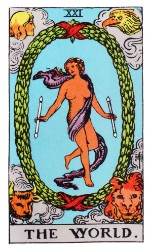
Take The World card.  It’s four corner symbols – lion, ox, eagle, and angel – aren’t just random.  They’re the traditional symbols of the four evangelists:  Matthew, Mark, Luke, and John.

Even more striking are the Four Cardinal Virtues, lifted straight out of Catholic theology:

Justice

Temperance

Fortitude (Strength)

Prudence

By embedding these virtues, the creators of the deck could claim that the Tarot promoted Christian morality rather than undermining it.  It was a survival tactic:  “See – these aren’t pagan symbols.  Ripping up a Tarot deck is just like ripping up a Bible.”

Prudence eventually vanished from the deck (see my previous post, “Dear Prudence – The Mysterious Case of the Missing Tarot Card”), but the other three virtues remain mainstays of the Major Arcana to this day.

WHAT DID THE ORIGINAL DECK LOOK LIKE?

So what happens if we get rid of the Christian overlays, the cards that don’t really belong in the deck?

What remains are the raw archetypes.  Timeless figures like The Fool, The Magician, The Lovers, The Devil, The Wheel of Fortune and Death.  Those cards pulse with universal energies that transcend any single religion.

A question that arises naturally out of this is:  if we’re getting rid of the Virtue cards, why not get rid of The Hierophant, too?  After all, it was originally known as, “The Pope,” and what could be more Catholic than that?  The answer is The Hierophant is nothing but The High Priest in disguise and is the partner card to The High Priestess in the same way that the Emperor is linked to The Empress.

Beneath the Christian veneer lies a much older symbolic system, one that might have looked very different if it hadn’t been forced to wear this mask.

WHERE DID THE TAROT REALLY COME FROM?

Contrary to many modern assumptions, the Tarot did NOT evolve out of Christianity.  

Instead, it seems to have appeared fully formed in the mid-1400s, as though it had been carried forward from some older source.  What that source was – Ancient Egypt or an even older, lost esoteric tradition – remains a mystery.

What’s clear is this:  the Christian layer was camouflage, not origin.  It was a survival strategy, not a birthing.

SEEING THE REAL DECK

The, ‘Christian Themes’ in the Tarot were never a part of the original deck.  They were just part of a clever disguise to get past the censors of the Inquisition.

When we peel back that layer, what we find is a universal language of archetypes.  The Fool, Magician, Death, The Star – these are symbols that speak to something much deeper than mere religious dogma.

And so the question remains:  when we lay the cards out today, are we seeing the archetypes themselves?  Or the clever veil that once kept them alive?

“Just the Tarot” by Daniel Adair – a kindle ebook available on amazon.

Sex and The Devil Card – Time for a New Definition?

This is an exploration of the meaning and definition of The Devil tarot card. Is it time to de-sexualize it?

It may be time to take the sex out of The Devil card, or at least scale it way back.

When we look at the traditional definitions of The Devil, he’s a pretty horny guy.  He’s linked with illicit affairs, cheating on your spouse, sexual “perversions,” and a variety of scandalous behaviors that good, decent folks just don’t do!

But maybe he’s been typecast.

THE LOVERS AND THE DEVIL – SAME COUPLE ON A DIFFERENT DATE

If you hold up The Lovers and The Devil side by side, you can’t help but notice that they’re the same couple.  

In The Lovers, they’re radiant and glowing.  They even have an angel hovering over them to let us know that their love is blessed by heaven above.

Fast forward to The Devil and we see them with chains, horns, and flaming tails.  There’s a serious, “We may have made some questionable choices,” vibe.

Which begs the question:  what happened to these two?  Did they skip couples therapy and just dive straight into the underworld?  Did he leave the toilet seat up one too many times?

A QUICK HISTORY LESSON

The Tarot as we know it shows up in the 1450s – prime time for the Catholic Inquisition.  This was NOT an era noted for swingers or free love.  Sexual morality was tightly policed:  adultery, premarital affairs, straying outside of monogamy, even masturbation could get you killed by the Bible Police.

So when Tarot artists painted two nude figures on a card, everyone knew what that meant.  It meant . . . you know . . . S – E – X.  But, nude figures with angel = good, approved sex and nude figures with devil = bad, nasty sex.  

Boom – association locked in.

FAST FORWARD TO MODERN TIMES

But here we are in the 21st Century and, my oh my, how things have changed.

Remember just a few years ago when people were totally titillated by the book (and movie) “Fifty Shades of Gray?”  It’s nothing but an exploration of bondage and domination dressed up as a novel and – despite the fact that it may have been one of the worst written books in history – it sold over 150 million copies.

We know that people were doing a lot more than just reading it, too, because emergency room visits related to sex toys jumped up by over 50%.  They were actively checking out those techniques, not just reading about them.

We also know that over a third of Americans admit to cheating on their spouses.  And there’s no doubt that THOSE stats are way under reported.

Only about 5% of Americans report being virgins on their wedding nights.  What was once mandatory is now more of a museum exhibit.

And monogamy?  Still popular but VERY flexible in its applications.  Given the divorce rates, it’s obvious that we’re more into serial monogamy than actual this-is-for-life monogamy.

In a nutshell, we’ve outgrown the black-and-white, “good sex versus bad sex” binary thinking.  The Devil’s definition is starting to feel more than a little outdated.

SO WHAT DOES THE DEVIL REALLY MEAN?

Here’s a thought:  maybe The Devil isn’t about sex gone wrong.  Maybe it’s about love gone wrong.

Look closely at the card:  the chains around the couple’s necks are so loose that they could slip them off at any time.  Which means that they’re staying bound by choice.  Or by fear.

That’s the real Devil.  The loveless marriage that drags on because it’s easier to stay than to leave.  The codependent relationship that’s fueled more by desperation than devotion.  The romantic partnership that’s built on money, appearances or habit instead of love.

Those are the heavy chains that we put on ourselves.  Not fiery lust, but destructive attachments that slowly erode our joy.

FINAL WORD: TIME TO RETIRE THE SCANDAL?

Maybe it’s time to let The Devil out of the dungeon of outdated sexual shame.  He’s got bigger (and scarier) fish to fry.  The next time this card lands in a spread, don’t ask, “Who’s cheating on who?”  Instead, ask:  “Where in my life am I bound by something that no longer serves me?”

That’s The Devil’s true temptation: not passion or sex, but the CHOICE to stay stuck in a loveless relationship when freedom is only a tug away.

“Just the Tarot,” by Daniel Adair – a kindle ebook available on Amazon

Dear Prudence – The Mysterious Case of the Missing Tarot Card

An examination of the mysterious Prudence Card that vanished from the original Tarot decks.

The Prudence Tarot Card

Did you know that there was a card that simply vanished out of the Tarot deck?  Poof!  Like it never existed, and its existence isn’t even known, except to a few historians and Tarot scholars.

THE PRUDENCE CARD

The card was known as, “Prudence,” and – as you can see – it depicted a woman looking into a mirror while a snake keeps her company.  A very strange image, indeed.

It appeared in one of the first known Tarot decks, known as the Visconti-Sforza deck.  This was about the year 1450 and, although the images were crude by today’s standards, for the most part they represent the same themes we see in our modern Tarot decks.  Except for Prudence.  What in the hell is SHE doing in there?

WHY PRUDENCE WAS INCLUDED

To understand why Prudence made her way into the Tarot, we really have to look at what was happening in Europe in the 1400s.

Can you say, “Inquisition?”  Sure you can.  

This was a time when the Catholic Inquisition was in full swing and even the hint of fortune telling could get you burned at the stake as a witch.  The Tarot is – quite obviously – a tool for divination and so they needed to disguise what it really was.

The first ploy was to say that it was just a simple card game.  You know . . . it’s just poker, only with archetypes.  Nothing to see here.

The second trick was to include so much Christian imagery that the priests and torturers would be thrown off of the scent.  In order to do that, they included the ‘four cardinal virtues’ of the Catholic Church.  They are:

JUSTICE

TEMPERANCE

FORTITUDE (AKA Strength)

PRUDENCE

Put quite simply, these cards are nothing but camouflage for the real, original Tarot deck.  

SO WHAT HAPPENED TO HER?

The obvious question here is, “Why did Prudence disappear?”  Why did the other, “virtue cards,” remain while she went away to wherever ex-Tarot-cards live?

Most scholars suggest that the messages she was meant to convey – reflection, wisdom, self-knowledge – were simply absorbed by other cards.   They feel that The Hermit card in particular had all of those qualities, so perhaps Prudence simply wasn’t necessary.  

In modern terms, we could say that her job description was eliminated.  Which sounds like bullshit, doesn’t it?

My personal theory is that Prudence may have been just a little too Pagan for their purposes.  It’s a very strange card. The image of a woman, a snake and a mirror conjure up memories of mythological creatures like Medusa or Hathor.  Perhaps the artist who created the Visconti-Sforza deck was tipping his hand a little too much with this depiction and they needed to hide her.

Whatever the reason, Prudence faded into obscurity, leaving the Tarot a little leaner, but much more mysterious.

PROBLEMS FOR THE OCCULTISTS

The presence of Prudence would have created a major problem for the Victorian occultists – who really brought the Tarot back to life – had they known about her.

They were bound and determined that there was some secret, ancient path hidden away in the Tarot cards and – by god – they were going to find it.  In the 19th century, Eliphas Levi had correlated the 22 cards of the Major Arcana with the 22 letters of the Hebrew alphabet.  He went on to create an elaborate system where he divided the 22 cards into three groups of 7, which echoed the Kabbalistic Tree of Life.

Arthur Edward Waite, who published the Waite deck that we’re all so familiar with, was so determined to make the deck fit into a numerology scheme that he actually changed the order of the cards.  He flipped the numbers so that Strength took the place of Justice and Justice became Strength.  Who cares about history, right?

And, after all of the many years they put into organizing the 22 cards of the Major Arcanum into tidy systems, it turns out there were actually 23 cards.

Well, hell.

CLOSING THOUGHTS

The disappearance of Prudence is more than just a historical footnote.  It reminds us that our knowledge of the Tarot is constantly evolving and it leaves some tantalizing questions.

Why did this ONE card disappear, and not the other virtue cards?

Was the Tarot truly designed as a mystical system disguised as a game?

Does it carry Egyptian or even Atlantean symbols that were concealed from the religious authorities?

The mystery endures and the Tarot invites us to keep looking.

“Just the Tarot,” by Daniel Adair – A kindle ebook available on Amazon