
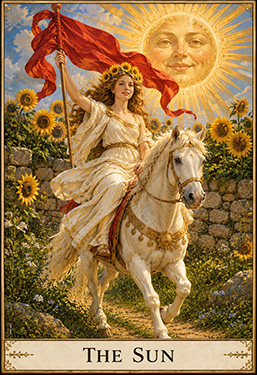
The Sun is one of the most immediately joyful cards in the Tarot.
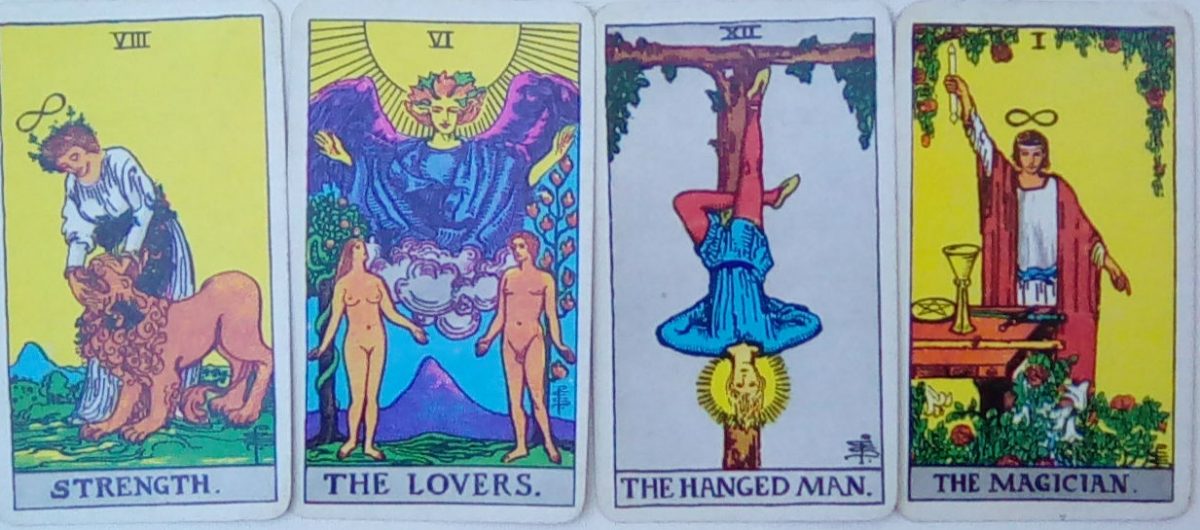
Everything about it seems to announce happiness. A brilliant sun fills the sky. Sunflowers rise above a stone wall. A white horse moves peacefully through the scene, carrying a laughing child who waves an enormous red banner.
Traditionally, The Sun is associated with happiness, vitality, success, clarity, and optimism. All of those meanings are perfectly valid. But they don’t really explain the picture.
Why is the central figure a naked child? Why is the child riding without reins? Why does Pamela Colman Smith give this tiny figure a banner far larger than any child could reasonably carry? And why is a stone wall standing in the middle of this otherwise exuberant landscape?
Perhaps Smith is showing us something much more profound than happiness.
Perhaps The Sun depicts what happens when we finally stop struggling against ourselves.
THE CHILD WHO COMES AT THE END OF THE JOURNEY
It is tempting to look at the child in The Sun and think immediately of the modern concept of the inner child. There is certainly some resonance there, but the placement of The Sun within the Major Arcana suggests something deeper.
This child appears very late in the Tarot journey. We have already passed through The Devil, confronted The Tower, stood naked beneath The Star, and traveled through the strange nocturnal landscape of The Moon.
This is therefore not the innocence of someone who has never encountered darkness. It is innocence recovered after encountering it.
That distinction is important.
The Fool is innocent because the journey has barely begun. The figure in The Sun has traveled through nearly the entire Major Arcana.
This is not naïveté. It is simplicity on the other side of complexity.
The child can therefore be understood as something closer to the ancient archetype of the Divine Child: something newly born within us that appears small and vulnerable while possessing extraordinary power.
The personality has not returned to childhood. It has rediscovered something child-like.
Naturalness.
Spontaneity.
Trust.
Wonder.
Joy.
NAKED IN THE SUNLIGHT
The child’s nudity reinforces the idea.
There is nothing to hide.
Throughout the Tarot, people wear costumes that tell us who they are. Kings have crowns. Priests have robes. Warriors wear armor. The Emperor sits dressed in the symbols of authority.
The child in The Sun has none of them. No rank. No profession. No armor. No social identity.
Nothing stands between the child and the world.
This is especially striking after The Moon.
Under moonlight, appearances become uncertain. A rope can look like a snake. The familiar becomes strange. Material rises from the unconscious in dreams, fears, fantasies, intuitions, and projections.
The Sun changes the light.
Nothing needs to remain hidden because everything can now be seen clearly. And the figure who emerges into that illumination has nothing left to conceal.
WHO IS RIDING WHOM?
Then there is the horse.
At first glance, we naturally say that the child is riding it.
But look again.
There are no reins. The child isn’t gripping the horse with her legs. In fact, her legs kick exuberantly outward. She isn’t clutching the mane or concentrating on maintaining control. She appears almost unconcerned with the mechanics of riding.
Perhaps the child isn’t controlling the horse at all. Perhaps the horse is carrying the child.
That gives us an entirely different image of power.
The horse can represent the animal nature—the body, instinct, appetite, physical energy, and all those parts of ourselves that conscious thought so often tries to control.
The Sun offers another possibility.
The child doesn’t dominate instinct. She trusts it. Horse and rider are in balance without visible control.
There is no struggle between the conscious and instinctive self because they are no longer trying to go in different directions.
POWER WITHOUT FORCE
This brings The Sun surprisingly close to the Taoist concept of wu wei—often translated as effortless action or action without forcing.
The child accomplishes everything without apparent effort.
And nowhere is that more obvious than in the enormous red banner. Look at its size. It is absurdly large.
The artist understood human proportions perfectly well. A child that size should struggle even to keep such a large flag upright, particularly while sitting unsecured on a moving horse.
Instead, the child casually holds it aloft with one hand while it billows dramatically across the sky. This tiny figure possesses outsized power.
But there is no evidence of effort. No straining muscles. No grim determination. No attempt to demonstrate strength.
The child doesn’t act powerful. She simply is.
Perhaps this is one of the central mysteries of The Sun: The Sun is not the power of forcing things to happen. It is the power that becomes available when we stop fighting ourselves.
THE RED BANNER
The banner itself deserves attention.
Its brilliant red is almost discordant against the yellows, whites, blues, and grays dominating the rest of the card. It demands to be noticed.
Red is the color of blood, heat, passion, vitality, and physical existence. It is the color of life.
And the child doesn’t hide that vitality. She raises it above her head and lets it unfurl across the sky.
The gesture is almost declarative. I am here.
After the uncertainty and ambiguity of The Moon, there is no hesitation about existence in The Sun. Life announces itself.
THE WALL
And then we come to that peculiar stone wall.
Why place a wall in this scene at all?
Walls divide. They establish boundaries between what is inside and what is outside, what is permitted and what is excluded, what is protected and what is kept away.
Behind the wall are the sunflowers. In front of it are the child and horse.
Something has crossed a boundary. She has simply emerged beyond it.
We might think of that wall as all the things that have separated us from our natural selves: conditioning, fear, social expectations, defensive structures, old beliefs, and identities we once needed but eventually outgrew.
The Sun doesn’t necessarily destroy them. It illuminates them and moves beyond them.
THE FLOWERS THAT SEEK THE LIGHT
Behind the wall are four enormous sunflowers. Their symbolism could hardly be more appropriate.
Sunflowers turn toward the light. They suggest the natural movement of life toward illumination—not because someone commands it, but because that is simply what the organism does.
And perhaps that is another clue to the entire card. Nothing in The Sun seems to be trying very hard.
The sun shines because that is its nature.
The flowers turn toward it because that is their nature.
The horse carries the child because horse and rider are moving together.
The banner flies because the wind catches it.
And the child rejoices because joy has become natural.
Everything is doing what it does without struggling to become something else.
JOY WITHOUT A REASON
This also helps explain the extraordinary joy of The Sun.
We often think of happiness as something caused by circumstances.
We will be happy when we get the job. When we find the relationship. When the money arrives. When the problem disappears.
But nothing identifiable has happened to make this child happy. There is no treasure chest. No victorious army. No palace. No admiring crowd.
She is simply alive beneath the Sun. Her joy seems to arise from being completely at home in herself.
That may be why the card feels so different from ordinary images of success.
The child isn’t celebrating an achievement.
She is celebrating existence.
WHEN THE SUN APPEARS IN YOUR READING
The Sun can certainly indicate the traditional qualities associated with it: happiness, success, vitality, confidence, clarity, and favorable circumstances.
But on a deeper level, it may ask a more interesting question:
What would happen if you stopped fighting yourself?
Perhaps you don’t need another layer of control. Perhaps you don’t need more armor. Perhaps you don’t need to force the horse to go where it already knows how to go.
The Sun can appear when something authentic is ready to emerge from behind the walls that have contained it.
It encourages trust in your own nature. It asks you to allow yourself to be seen.
And it reminds you that genuine power does not always announce itself through effort, dominance, or control.
Sometimes power looks like a tiny naked child carrying an impossibly enormous banner while a horse gently carries her into the sunlight.
She is small without being weak. She is vulnerable without being afraid. She is powerful without exerting force. She is balanced without needing control.
And she is joyful without needing a reason.
That is the illumination of The Sun.

