
To paraphrase a wonderful movie:
“What does a star do? It shines.”
And that is precisely what The Star in the Tarot portrays: our ability to shine our light into the world around us.
Through a Jungian lens, the Tarot can be read as a visual map of individuation—the lifelong process of bringing the conscious and unconscious parts of ourselves into a more complete and integrated whole.
The Star represents an important moment in that journey. Something inside us has come together. Mind, spirit, emotion, and instinct are no longer fighting one another quite so fiercely. We have begun to understand who we are.
And now we’re ready to share it.
The Star isn’t searching for her light. She is the light.
THE STAR AND THE TOWER
The Star appears immediately after The Tower. There is no coincidence in that sequence.
As we recently discussed, The Tower can depict not merely the destruction of circumstances in our outer world, but the collapse of the psychological structures we have built around ourselves.
The Tower takes everything false, everything unsustainable, everything inauthentic—and burns it right to the ground.
But inherent in that destruction is the possibility of rebirth. When there is nothing left, we have to start over. And when we start over, we have the opportunity to rebuild our lives on something more authentic.
To quote the old Kris Kristofferson line made famous by Janis Joplin:
“Freedom’s just another word for nothing left to lose.”
That is precisely where The Star enters the story. The Tower has stripped away the false structure. The crown has fallen. The walls have collapsed. The old identity has been shattered.
And yet—we’re still here.
Perhaps for the first time, we are free to become something closer to our authentic self.
The Tower says: This is what you are not. The Star answers: Then let me show you what you are.
THE STAR AND THE HERMIT
Another way to understand The Star is to compare her with The Hermit, because in some respects they represent almost opposite energies.

Psychologically, The Hermit represents deliberate introversion. He steps away from the collective noise of society to enter the inner world alone. He is searching for something that cannot be found amid the chatter and expectations of everyone around him.
Visually, his heavy gray cloak creates a boundary between himself and the world. He stands alone on his snowy mountain peak, carrying only his staff and lantern. The lantern represents consciousness illuminating the darkness—the small light with which he explores the unknown territories within himself.
The Hermit isn’t simply alone.
He wants to be alone.
He isn’t trying to share something. He’s trying to find something.
The Star is different.
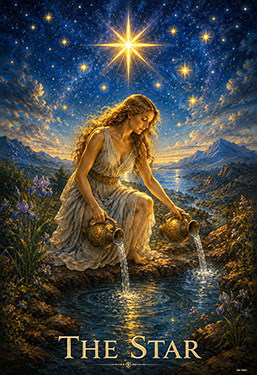
She has emerged from that inward journey. She stands naked beneath the stars, without armor, cloak, crown, fortress, or disguise. There is nothing separating her from the world around her.
She isn’t searching for another source of energy. She has become a source.
She pours her water—her energy, creativity, compassion, wisdom, and essential self—back into the world.
Some goes into the pool, the realm of emotion and the unconscious. Some goes onto the earth, nourishing ordinary life.
She isn’t hiding. She’s nourishing. And perhaps most importantly, she isn’t diminished by giving. Her vessels don’t seem to run dry.
That is one of the profound lessons of The Star: when what we give comes from the authentic self rather than from obligation, fear, or the desperate need for approval, sharing ourselves does not necessarily empty us.
Sometimes it makes us more fully ourselves.
THE GUIDING STAR
Jung used the ancient term psychopomp for an archetypal figure that mediates between different realms of experience—particularly between consciousness and the unconscious. The psychopomp is a guide who leads us from one realm into the next.
The Star can be understood as such a guide. She is leading us from the destruction of The Tower into our own light.
But whatever psychological language we use, the message of The Star is remarkably simple.
We are meant to shine.
We are supposed to shine.
And for many people, that is much more difficult than it sounds.
Psychologist Brené Brown has described shame as the intensely painful experience of believing that we are flawed and therefore unworthy of love, belonging, and connection.
That belief can become one of the most powerful forces keeping us from fully participating in our own lives. We don’t show people what we’ve created because perhaps it isn’t good enough.
We don’t speak because perhaps what we have to say isn’t important.
We don’t pursue the thing we desperately want because perhaps we aren’t talented enough, attractive enough, intelligent enough, young enough, educated enough—or simply enough.
So we hide.
We become smaller. We cover ourselves in the Hermit’s cloak long after the period of solitude has served its purpose.
The Star has moved beyond that shame.
Look at her. She is completely exposed beneath an enormous night sky, yet there is nothing defensive about her.
She isn’t comparing herself with the other stars. She isn’t wondering whether Sirius is brighter. She isn’t asking whether someone else deserves to shine more than she does.
She simply shines.
And by doing so, she becomes a guide for everyone still standing in the darkness.
She seems to be saying: This is how you do it.
This is how you shine.
WHEN THE STAR SHOWS UP IN YOUR READING
When The Star appears in a reading, it often signals healing, renewal, authenticity, and the return of hope after a difficult period.
But I think its message goes considerably deeper than simply, “Things are going to get better.”
The Star asks you to stop hiding.
If you’ve recently experienced your own Tower—a loss, upheaval, disappointment, failure, or profound change—The Star suggests that the destruction may have cleared away something that was preventing you from becoming more completely yourself.
The question now is not simply: How do I get my old life back?
The better question may be: Who am I now that the old life is gone?
The Star can also appear when you have something that needs to be shared.
An idea. A talent. A piece of art. A book. A truth. A kindness.
A way of seeing the world that belongs uniquely to you.
You may still hear the old voice whispering that nobody wants it, that somebody else could do it better, or that you have no business putting yourself forward.
The Star says otherwise.
She doesn’t promise applause. She doesn’t promise success. She doesn’t even promise that everyone will understand what you have to offer.
She simply reminds you that your light cannot illuminate anything while you are hiding it.
So when The Star appears, ask yourself:
Where am I still making myself smaller than I need to be?
What part of myself am I finally ready to reveal?
What do I have that could nourish someone else?
And perhaps the most important question of all:
What would happen if I simply gave myself permission to shine?
Because what does a star do?
It shines.