The Empress and the Courage to Be “Unproductive”

The Empress Archetype and Relaxation as a Way to Nurture Creativity.

In my Empress affirmation poster, I paired her image with the words:

Nurture Creativity

This may be one of the most misunderstood instructions in the entire Tarot.
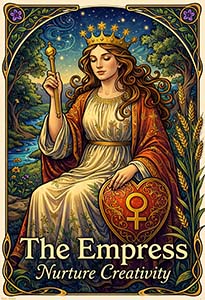
  Empress Affirmation Poster – Available on Etsy

Because most of us have been trained to believe that creativity comes from effort. From discipline. From pushing harder. From sitting at the desk and refusing to get up until something happens.

That approach belongs to The Emperor.

The Empress operates differently.

She does not force growth.

She allows it.

She creates the conditions in which growth becomes inevitable.

Creativity Cannot Be Forced

Every creative person eventually encounters this paradox.

The harder you try to force creativity, the more it retreats.

You sit at your desk, determined to produce something brilliant. Hours pass. Nothing happens. Your mind feels like dry soil.

And then, days later—while taking a walk, washing dishes, or doing something completely unrelated—an idea appears effortlessly.

It arrives whole.

Not constructed, but received.

Albert Einstein understood this phenomenon. When asked how he discovered the theory of relativity, he didn’t describe grinding intellectual labor. He said simply:

“It just dropped in while I was playing the piano.”

He wasn’t forcing the insight.

He was allowing it.

This is Empress energy.

The Forgotten Value of Leisure

The philosopher Josef Pieper wrote a remarkable book titled Leisure as the Basis of Culture. In it, he argues that leisure is not the absence of productivity, but its foundation.

Leisure, in its true sense, is not laziness in the modern, pejorative sense. It is a state of receptive openness.

It is the willingness to stop forcing.

Pieper observed that culture itself—art, philosophy, music, science—arises not from frantic effort, but from spaces of inward stillness.

When we allow ourselves to be idle, something deeper begins to move.

The soil replenishes itself.

Modern society often treats leisure as wasteful. We are taught that our worth is tied to constant activity. But creativity obeys older, quieter laws.

Seeds do not grow faster because you stare at them.

They grow because the conditions are right.

“Just the Tarot,” by Dan Adair – available on Amazon

Julia Cameron and the Act of Creative Nurturing

Julia Cameron’s The Artist’s Way remains one of the most practical and psychologically accurate guides to creativity ever written.

Her central insight is simple: creativity must be nurtured.

Not commanded.

She encourages practices like morning pages and artist dates—not to produce finished work, but to create space for the creative self to emerge naturally.

These practices are Empress practices.

They say to the creative mind:

You are safe here.

You are allowed to emerge in your own time.

And when that safety is present, creativity begins to flow again.

The Courage to Be “Lazy”

This is perhaps the most radical lesson of The Empress.

You must allow yourself to be, at times, unproductive.

Not because you are weak.

But because you are cultivating fertility.

What appears to be inactivity is often incubation.

Beneath the surface, ideas are forming. Connections are being made. Your subconscious is doing its work.

If you constantly demand output, you exhaust the system that produces it.

The Empress reminds us that rest is not the opposite of creation.

It is part of creation.

Nurture Creativity

The Empress does not shout. She does not command. She invites.

She reminds us that creativity is not a machine, but a living process.

It responds to kindness.

It responds to patience.

It responds to nourishment.

When you stop trying to force creativity and begin nurturing it instead, something remarkable happens.

Ideas begin to arrive again.

Quietly.

Effortlessly.

Like seeds finding their way toward the light.

So when The Empress appears in your readings—or quietly makes herself known in your life—it is not a signal to push harder. It is an invitation to soften. She asks you to step out of the mentality of force and into the rhythm of cultivation. To rest without guilt. To follow your curiosity. To trust that creativity, like all living things, emerges when it is nourished rather than commanded.

 She reminds you that you are not a machine designed for constant output, but a garden capable of extraordinary growth. Your task is not to force the flowers to bloom, but to tend the soil and allow them to emerge in their own time.

The Influence of The Hierophant

The Influence of The Hierophant Card When Paired With Other Major Arcana, Including Definitions for Each Pairing.

In the absence of a regular blog post for today, I’d like to offer a reference chart detailing the influence of The Hierophant when paired with the other cards of the Major Arcana.

The Hierophant represents tradition, spiritual authority, teaching, sacred structures, and shared belief systems. When this card appears, it often asks:

• What do you believe?

• Where did those beliefs come from?

• Are you conforming… or consciously committing?

Please feel free to print this and use it as a quick reference in your readings. Or, if you prefer, you can download a PDF version here. Just click the link and, when it opens, select Print from your browser menu.

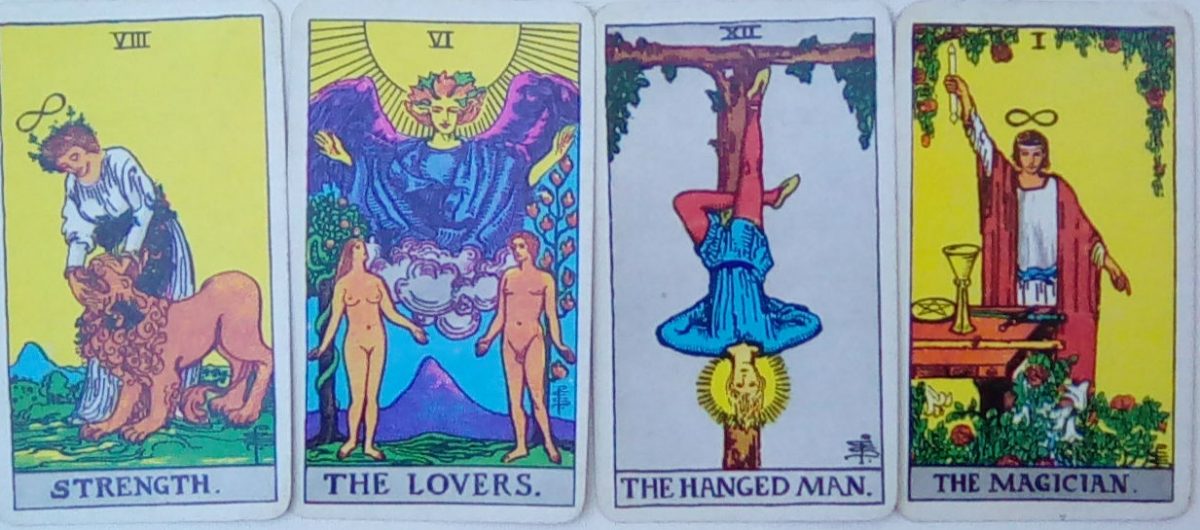
The Hierophant + The Fool

A new spiritual path begins; stepping into tradition with fresh eyes.

Reversed: Rebellion without reflection; rejecting structure simply to avoid commitment.

The Hierophant + The Magician

Teaching what you know; manifesting through spiritual principles.

Reversed: Manipulating belief systems; using doctrine for personal gain.

“Just the Tarot,” by Dan Adair – Available on Amazon

The Hierophant + The High Priestess

Outer tradition meets inner knowing; balancing doctrine with intuition.

Reversed: Conflict between personal truth and institutional belief.

The Hierophant + The Empress

Sacred nurturing; honoring family or cultural traditions around love and creativity.

Reversed: Restrictive roles around gender, parenting, or creative expression.

The Hierophant + The Emperor

Institutional authority; law, governance, or structured religion.

Reversed: Oppressive systems; authoritarian belief structures.

The Hierophant + The Lovers

Commitment blessed by tradition; marriage, vows, sacred partnership.

Reversed: Choosing love outside of conventional expectations.

The Hierophant + The Chariot

Driving forward with faith; disciplined spiritual progress.

Reversed: Dogmatic certainty; forcing beliefs onto others.

The Hierophant + Strength

Moral courage; gentle adherence to deeply held values.

Reversed: Internal conflict between instinct and conditioning.

The Hierophant + The Hermit

Spiritual teacher and spiritual seeker; mentorship or formal study.

Reversed: Breaking away from tradition to seek personal truth.

The Hierophant + Wheel of Fortune

Destined encounters with teachers or belief systems.

Reversed: Clinging to outdated doctrines during change.

The Hierophant + Justice

Ethical accountability; living in alignment with stated values.

Reversed: Hypocrisy; preaching principles not practiced.

The Hierophant + The Hanged Man

Spiritual surrender; re-evaluating long-held beliefs.

Reversed: Martyrdom rooted in rigid ideology.

The Hierophant + Death

Transformation of belief systems; shedding old doctrines.

Reversed: Fear of spiritual evolution; resisting theological change.

The Hierophant + Temperance

Balanced faith; integrating different traditions harmoniously.

Reversed: Spiritual confusion; incompatible belief blending.

The Hierophant + The Devil

Religious guilt; toxic conditioning; spiritual bondage.

Reversed: Breaking free from oppressive belief systems.

The Hierophant + The Tower

Collapse of institutional structures; crisis of faith.

Reversed: Quiet deconstruction of long-held doctrines.

The Hierophant + The Star

Renewed faith; spiritual hope; inspired teaching.

Reversed: Disillusionment with organized belief systems.

The Hierophant + The Moon

Hidden doctrines; subconscious conditioning; fear-based teachings.

Reversed: Seeing through illusion; questioning inherited fears.

The Hierophant + The Sun

Joyful faith; spiritual clarity; enlightened tradition.

Reversed: Childlike rebellion against structure without understanding.

The Hierophant + Judgment

Spiritual awakening; answering a higher calling within tradition.

Reversed: Rejecting external authority to follow inner calling.

The Hierophant + The World

Completion of a spiritual cycle; mastery within a tradition.

Reversed: Feeling confined by cultural or institutional identity.

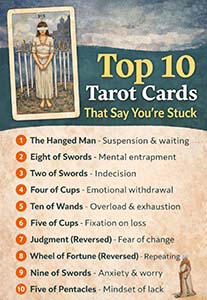
The Top Ten Tarot Cards That Indicate You’re Stuck

A concise, Tarot-based guide to the ten cards that most often indicate feeling stuck, stalled, or unable to move forward — and what each one reveals about the deeper source of that stuckness.

Being “stuck” in Tarot rarely means something is broken or hopeless. It usually means energy is stalled, attention is misdirected, or a transition is incomplete. These cards point to places where movement is paused — and where a shift is quietly waiting to happen.

Here are the ten cards that most often signal that kind of stuckness.

1. The Hanged Man

Stuck because of suspension or waiting.

This card indicates a pause imposed by timing, perspective, or the need for surrender. Progress isn’t possible yet because something deeper is still rearranging.

2. Eight of Swords

Stuck because of limiting beliefs or mental loops.

You feel trapped, restricted, or powerless — but the restriction is largely internal. The situation may not be as closed as it feels.

3. Two of Swords

Stuck because of indecision or avoidance.

Movement is blocked by a refusal to choose, usually because neither option feels safe or pleasant.

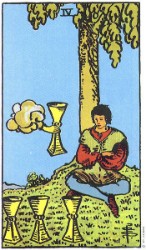
4. Four of Cups

Stuck because of emotional disengagement.

Nothing feels interesting or meaningful enough to respond to. Opportunities may exist, but the heart isn’t open to them yet.

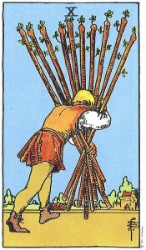
5. Ten of Wands

Stuck because of overload or exhaustion.

You’re carrying too much. Forward motion is technically possible, but not sustainable in the current state.

6. Five of Cups

Stuck because of grief or fixation on loss.

Attention is anchored in what’s gone wrong, making it hard to see what remains or what could still grow.

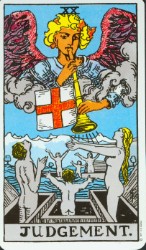
7. Judgment (Reversed)

Stuck because of self-doubt or fear of stepping into a new identity.

The call to change is present, but something inside is resisting answering it.

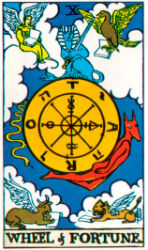
8. Wheel of Fortune (Reversed)

Stuck because of repeating patterns or feeling caught in cycles.

Life feels like it’s looping instead of evolving. This often points to unconscious habits or unresolved lessons.

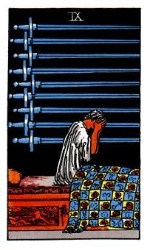
9. Nine of Swords

Stuck because of anxiety, rumination, or worry.

The mind is so busy anticipating problems that it can’t access solutions or rest.

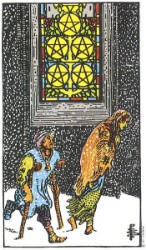
10. Five of Pentacles

Stuck because of a mindset of lack or survival.

Fear around resources, support, or worthiness makes it difficult to imagine improvement or receive help.

A Note on “Stuckness” in Tarot

In Tarot, being stuck is rarely a punishment or a failure. It’s usually a sign that:

• something internal needs to shift before something external can move,

• a lesson is still integrating,

• or attention needs to be redirected.

These cards don’t say “nothing will ever change.”

They say: this is the part of the story where motion pauses and meaning is being formed.

That’s often where the most important change begins.

And if you’re wondering when you’re going to get unstuck, then check out my other post:  The Top Ten Tarot Cards Indicating Something is About to Change.

“Just the Tarot,” by Dan Adair – available on Amazon