Veiled Wisdom: How to Live Intuitively in a Linear World — Lessons from the High Priestess

Learn how to live intuitively in a fast-paced, logic-driven world through the symbolism of the High Priestess Tarot card. Discover practical tools, ancient wisdom, and insights for intuitives and spiritual seekers.

In a world obsessed with logic, speed, and quantifiable results, living intuitively can feel like trying to speak a forgotten language. For those who rely on inner knowing, symbolism, and emotional depth to navigate life this can be truly disorienting. You may feel unseen, misunderstood, or even accused of being irrational.

Fortunately, there is an archetype that understands you perfectly: The High Priestess of the Tarot. She doesn’t live by surface appearances or external systems. She lives behind the veil, where symbols, patterns, and quiet truths guide her every move. If you’ve ever felt like your way of knowing doesn’t fit the world you live in, the High Priestess is your ally.

This post explores how her symbolism offers powerful guidance for anyone trying to live more intuitively in a linear, left-brain world.

The Veil: Honor the Unseen

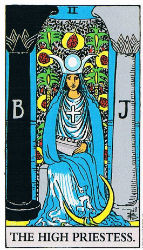
Behind the High Priestess is a veil covered in pomegranates—a symbol of mystery, fertility, and hidden truth. The veil marks the threshold between the seen and the unseen, the conscious and the unconscious.

In daily life, this reminds us to respect what can’t be measured: feelings, dreams, body language, synchronicities. Not everything real can be proven. Living intuitively means acknowledging the unseen world as just as valid as the visible one.  In fact, if you’re an intuitive, your inner world may frequently seem more important than your outer world.

The Moon: Trust Emotional Cycles

The crescent moon at the Priestess’s feet is a classic symbol of intuition, emotion, and cycles. In contrast to the linear, upward march of modern life, the moon reminds us that all things move in rhythms—inner and outer.

This is actually one of the oldest principles of occultism and is discussed extensively in The Kybalion.  Everything on the Earth Plane – everything – moves in cycles.  The tides go in and out.  The Moon waxes and wanes.  Spring gives way to winter.  Even great nations spring up and then fade away.

To live intuitively is to trust your emotional tides. Some days are for action; others for withdrawal, reflection, or stillness. Honoring this inner rhythm—even when it defies external expectations—is a revolutionary act.

The Scroll: Keep Inner Wisdom Sacred

The scroll in the Priestess’s lap is partially hidden and marked “TORA,” suggesting sacred knowledge that isn’t meant for everyone—or even always fully for yourself. This teaches a key lesson of intuitive living: you don’t have to explain yourself.

In a linear world, people often want justification, proof, or evidence. But intuition doesn’t always offer that. Like the scroll, your inner knowing may be incomplete, symbolic, or private. Protect it. Don’t feel pressured to decode everything aloud.

Intuition is frequently about knowing that you know something without knowing how you know it.  You don’t have to defend that to anyone who wants to pick it apart with linear logic.  Sonia Choquette offers a wonderful tip for dealing with it when someone is attacking your intuition:  just smile at them and say, “It works for me.”

The Pillars: Balance Inner and Outer Worlds

The High Priestess sits between two pillars marked B and J (Boaz and Jachin), drawn from the ancient Temple of Solomon. They symbolize polarity—light and dark, masculine and feminine, logic and intuition.

To live intuitively in a linear world, you must balance both forces. Intuition doesn’t reject logic; it expands it. Learn to speak the world’s language when needed, but stay rooted in your own. The magic is in integration.

The Solar Cross: Stay Centered

On the High Priestess’s chest is a solar cross—an ancient symbol of wholeness, representing the four directions, seasons, and elements. Unlike the Christian cross, this symbol is universal. It tells us to stay centered within the circle of life, grounded in your own compass.

Living intuitively means checking inward before reacting outward. It means making decisions from alignment, not anxiety. The solar cross reminds you: you carry your center within you.

It’s also worth noting that the cross is centered over her heart chakra, the energetic mid-point between the lower chakras and the upper.  Intuition pulls in insights from the universe but grounds them in daily life.

Practical Ways to Live Intuitively

Create space for silence and solitude: That’s where intuitive messages come through.  Remember to be patient with that, too.  Intuition speaks in symbols, not type-written messages.  When we sit down to meditate we probably won’t get a telegram from the Universe telling us what to do.  But . . . a particular book that we need to read may fall off of a shelf or a friend may casually say the perfect word to trigger insights.

Journal or use symbols: Tarot, dreamwork, or creative writing can help you listen inward.  The Major Arcana of the Tarot in particular is crammed with archetypal symbols.  Every one of those speaks to Deep Mind and starts a dialog with intuition.

Let go of constant justification: Trust what you know, even if you can’t explain it.  If other people don’t understand what you plainly see, then fuck them.  You’re not the extrovert-whisperer and you don’t need to explain your inner vision to someone who’s blind.

Honor emotional and energetic cycles: Don’t force productivity; honor your timing.  Despite the many New Age gadgets and programs that we may encounter now days, there is NO way to force intuition.  In fact, quite the opposite:  the more relaxed we are, the more likely we are to have a free flow of intuitive insights.  The more we force it, the more it flits away.

Balance logic with knowing: Use your left brain to support your right-brain insights—not to silence them.  Think of left-brain logic as a sort of an editor that connects the dots for you.  The first thing that comes is the intuitive flash:  “Hmmm . . .  I think this is how it actually is, even though it looks differently.”  Then we can use logic to figure out where the insight came from or to explain it to others, but we should never, ever, let logic tell us that our intuition is wrong, simply because we can’t justify it.

It’s Not Impractical – It’s Sacred

The High Priestess doesn’t offer quick answers. She teaches us to dwell in questions, to honor mystery, and to trust the quiet voice within. In a culture addicted to speed and clarity, living intuitively is a radical form of wisdom.

If you feel like you see through the veil or live just outside the edges of ordinary awareness, you’re not lost. You’re listening. And you’re not alone.

Let the High Priestess be your reminder: intuitive living isn’t impractical—it’s sacred.

My new ebook, “The Alchemy of the Mind: Transforming Your Life With the 7 Principles of The Kybalion,” is now available on Amazon.

The Hidden Difference: How Empathic Readers and Psychics Use Tarot Differently

A comparison between psychic and empathic tarot readers, explaining how psychics use tarot as a focus for intuitive insights, while empaths interpret emotional and energetic patterns for guidance.

If you’ve had more than a few Tarot readings, you’ve probably encountered a reader who, “pulls,” the cards for you.  They may mix or shuffle the deck a few times and then they pick some cards which are supposed to represent you and your situation.  They lay those cards out and then interpret them for you.

There’s a real question in my mind whether we can even properly call that technique a Tarot reading.  Still, it illustrates the difference between two highly different styles of reading cards:  the psychic approach and the empathic approach.

PSYCHIC TAROT READERS:  USING THE CARDS AS A FOCUS TOOL

Psychic Tarot readers tend to use the cards as a tool to focus their extrasensory abilities.  Think of the classic movie scene where a  gypsy woman is huddled over a crystal ball and utters a pronouncement like, “You are going to meet a tall dark stranger and have incredible sex in a variety of nearly impossible positions.”  There’s no suggestion that the crystal ball is talking to her or texts are appearing inside of it.  Rather, she’s using it to focus her attention on receiving messages from spirit guides or opening herself to intuitive flashes.

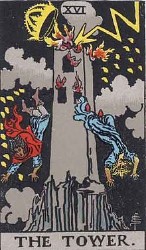
In the same way, a psychic reader might pull The Tower card out of the deck and say something like, “Towers are tall buildings and that’s what I’m picking up on.  I’m seeing a tall building in your future and there’s something wrong with it.  I’m getting that you’re thinking of buying a house and I’d caution you about any two story house you look at it.”

Now, that interpretation HAS ABSOLUTELY NOTHING TO DO WITH THE DEFINITION OF THE CARD.  Not even close.  That doesn’t mean that the reader is wrong, though.  If you’re dealing with a genuine psychic, she may be totally right on.  

But it’s not a Tarot reading.  It’s a psychic reading using Tarot cards as prompts.

Put another way, the knowledge is coming from the reader and not from the cards.  That’s a major clue that you’re dealing with a psychic reader – they deemphasize the actual definitions of the cards and substitute their own.  The images on the cards are actually much more important to them than the definitions because the images are what trigger their psychic flashes.

EMPATHIC TAROT READERS:  READING EMOTIONAL AND ENERGETIC PATTERNS

Empathic readers tend to take a much more traditional approach.  

First of all, they want YOU to handle the cards as much as possible, rather than simply picking out the cards for you.  This is a recognition that there is some sort of a synchronistic link between the cards and the person who’s receiving the reading.  It’s almost like the cards have to get to know the person – they need to pick up your unique vibrations and then the cards will match those vibrations and give you a reading.

An empathic reader will also rely much more heavily on structure and definitions.  He’ll use readings with predetermined positions such as past, present and future.  He’ll have a set of definitions that won’t change simply because he’s getting a different, “impression,” of what the card should mean.  In the example of drawing The Tower card, he’d tell you that some cataclysmic event is about to occur in your personal life, but he won’t mention two story houses.

In one sense, an empath’s Tarot reading might seem to be a little psychic because she will connect deeply with the emotional and energetic state of the the person receiving the reading. Rather than receiving psychic downloads, an empathic reader will sense the feelings, fears, and desires of the client and interpret the cards in a way that reflects these energies.

Because empaths absorb emotions, their interpretations of the cards mirror what the client is going through.  For instance, they might sense the client’s anxiety over drawing The Tower card and interpret it as need for an emotional breakthrough, rather than pure destruction.  In that sense, an empath’s Tarot reading might feel more like a therapy session than a psychic prediction because they’re much more heart focussed.

WHICH TAROT READER IS RIGHT FOR YOU?

Both types of readings are perfectly valid, but one or the other might be preferable for us.  It depends on what we’re looking for.

If we’re looking for guidance about what may happen in the future, then a psychic reader may be the better choice.  That’s assuming, of course, that we’re convinced that the person we’re dealing with is a genuine psychic.

We’d approach that type of a reading in precisely the same way that we’d approach a psychic reading without the Tarot cards.  After all, the cards are just there to focus the psychic’s abilities.  We might go to a psychic to try to establish communication with a loved one who’s passed over.  Or perhaps we feel a need for direction from a spirit guide or angel and can’t communicate directly with them ourselves.  The psychic is the channel and the cards are secondary, so we’re not really looking for the wisdom of the Tarot itself.

A reading with an empath, on the other hand, would be much more oriented toward trying to make sense of our daily lives using the cards and their actual definitions.  Empaths process information in patterns and so they’d be looking at all of the factors in our lives and trying to stitch them into a coherent whole.

A reading with an empath is also much more about how we feel about what’s happening to us, rather than just predicting events.  After all, that sensitivity to other people’s emotions and energy is what empaths do best.

In either case, we always need to remember that a Tarot reading is just a snap shot in time.  It’s about what MAY happen if the current circumstances continue.  Nothing in a Tarot reading is written in stone and we have the ability to change the outcome by changing our behavior.

Blasted Towers, Bad Ju-Ju, and the Unluckiest Card in the Tarot

A look at the five unluckiest cards in the Tarot deck.

I recently received an email from a reader who asked, “What’s the unluckiest Tarot card?”  I had to scratch my head about that one because the whole concept of good luck versus bad luck can get pretty complex.  Nonetheless, there are some Tarot cards that can always be considered harbingers of bad luck

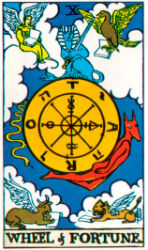
THE WHEEL OF FORTUNE, REVERSED

The Wheel of Fortune, Reversed, is the most obvious choice for a, “bad luck,” card.  We actually talk about luck in terms of good fortune and bad fortune and that’s what this card is all about.  It depicts life as a wheel, where sometimes our luck is ascending and expanding and sometimes it’s descending and decreasing.  When The Wheel of Fortune, Reversed, shows up in a reading it indicates that we’re in for a patch of bad luck.

The Kybalion, which is a book about Hermetic Magic, compared it to the pendulum of a clock.  The pendulum swings first in one direction and then back in the other.  Life can be seen in much the same way:  sometimes we’re swinging into really good luck and then we swing back into a period of bad luck.

The obvious underlying message is to just hang on, because things will inevitably change.  When we can stand back and look at good luck/bad luck as a rhythmic cycle, then periods of ill fortune will affect us much less severely.  We just need to stay centered and calm and wait for the cycle to reverse itself.

THE TOWER

Also known as, “the lightning struck tower,” and, “the blasted tower,” The Tower would probably be my pick as THE unluckiest card in the deck.  

“Just the Tarot,” by Dan Adair – complete definitions, layouts, and instructions for reading Tarot cards, available on Amazon.

At it’s most severe level, it can indicate that everything that you’ve loved and invested in is about to be blasted right down to the ground.  The last time that I had it showing up in my personal readings, my life partner died, I lost my house, and I was involved in a horrible law suit over the probate of the estate.  It can be that bad, depending on the other cards in the reading, but it usually isn’t.

On a mundane level, The Tower is usually just a powerful warning that we’ve gone down the wrong path and the Universe is about to provide a course correction.  Perhaps we’ve been treating our fellow employees badly and – Shazam – we’re suddenly fired or demoted.  Or perhaps we’ve been emotionally abusive or neglectful of our lover and they leave us for someone else.

In my experience, there’s always a level of hubris involved with this card.  We’re not only taking things for granted, but we’re also being arrogant.  We’re assuming that everything is under our control and the Universe is going to show us that we’re not.

The most positive message in this card – which we usually fail to appreciate at the time – is that we get to completely start over.  It’s like that line from, Me and Bobby McGee:  “Freedom’s just another word for nothing left to lose.”  When our lives (or our projects or relationships, etc.) have been blasted right down to the foundations, we have the freedom to consciously design something new and better.

DEATH

Even if it isn’t the unluckiest card in the deck, Death definitely wins the award for the creepiest card in the Tarot.  In her wonderful book, “Fortune Telling by Tarot Cards,” Sasha Fenton puts it in this perfectly understated, British way:  “This card usually puts the wind up people when it appears . . .”

Yes.

Now, first of all, I have never seen the Death card appear before someone’s death.  It will pop up after someone has died, but it’s usually just a comment on what’s happened.  It’s more like, “Well, you’ve lost someone you loved, so you’re dealing with death and grief.”

What it can indicate, though, is that there’s going to be a radical, life changing turn in events in a person’s life.  The querent is suddenly going to find herself going in a completely different direction than she has in the past.  In an emotional and spiritual sense, it really is as if their previous life has died and they’re off in a completely new direction.

I knew a woman who had been happily married for 15 years, had a home, a loving husband, and 2 kids.  She woke up one morning with this thought ringing in her head:  “Shit, I’m not in love with him anymore and I hate my life.”  Within six months she’d obtained a divorce, turned custody of her children over to her ex-husband and was working as a river guide in West Texas.  That’s the kind of radical change that we’re talking about here.

Whether that kind of change is good luck or bad luck is just a matter of interpretation.  If it’s something that we consciously plan, we usually view it as good fortune.  If it was something that was forced on us by circumstance, we may think it was bad fortune.

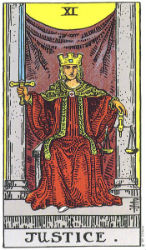
JUSTICE, REVERSED

I’m a little hesitant to include the Justice card in this list because it has more to do with people and circumstances than luck per se.  Nonetheless, it’s frequently seen as bad luck so I’ll stick it in here.

Classically, as you might guess from the image, Justice has to do with the legal system.  If we’re involved in some sort of litigation and Justice is upright, it can mean that we’ll prevail.  If it’s reversed, it can mean that we’ll lose.

On a personal level, it can mean that the people around you – your family, co-workers, boss, etc. – are making judgements about you and they’re not good if the card is reversed.  

Losing a court case can obviously be seen as bad luck.  Or it can be seen as a sign that we have a bad case, a bad lawyer, or a bad judge.  In the same way, having people we care about judging us harshly can be seen as being treated unfairly.  Or it might be that we’re being jerks and we need to clean up our acts.

Justice, Reversed, can be a sign of a bad luck to come, but it also serves as a warning.  It’s saying, “You’re about to have some bad luck, so you need to take a careful look at your own actions before that happens.”

TEN OF SWORDS

It doesn’t take but a glance at the Ten of Swords to realize that there’s some serious bad ju-ju happening here.  If we’re lying face down stuck full of swords like a human pin cushion, something’s a little wrong. This card can indicate treachery, deceit or a very, very bad ending to a relationship or a job.

The suit of Swords symbolizes our personal power.  That’s the way that we project ourselves out into the world.  There’s nothing innately wrong with that.  Whether it’s standing up to a school yard bully when we were kids or pushing hard for a project we really believe in at work, there are always times when we have to be a bit aggressive.

But . . . when we’re overly and chronically aggressive, that puts us into a power cycle. We’re trying to dominate other people and run over their emotions and desires.  We become the school yard bully instead of the person standing up to the bully.  We see this mentality frequently with primitive men who brag about being the, “alpha dog.”  It’s dominance for the sake of dominance, rather than for the sake of getting anything done.

The message of this card is the old cliche’: live by the sword, die by the sword.  If we’ve been treating other people harshly, if we’ve been abusive in our love relationships, or domineering in work relationships, we’ve got some bad karma heading our way.

So those are the top five, “bad luck,” cards in the Tarot deck.  There are, of course, other cards that may indicate bad fortune in one aspect or another of our lives, but these are the red flags.  And, of course, we should always remember that a Tarot reading is just a snap shot in time.  It tells us what’s likely to happen, but we have the free will to change it.

How to Choose an Oracle Deck

Factors to consider in choosing an Oracle deck.

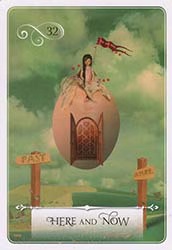
I’ve been having a lot of fun playing with Colette Baron-Reid’s Wisdom of the Oracle deck lately.  They seem to be highly accurate and the illustrations are really magical.

There are, of course, about 80 kazillion different decks out there by now, so it can be difficult to decide which one to get.  On average, they’re about 20 bucks a pop, so it’s not like most people can order a dozen of them and figure it out later.    If you’re in the market for a new deck, here are a few things to consider.  

ARE THEY REALLY ORACLE DECKS?

That’s not as silly as it sounds.  There are quite a few decks that really have nothing to do with, “fortune telling.”  For instance, Louise Hay has several decks like, “Heart Thoughts Cards: A Deck of 64 Affirmations,” which are collections of affirmations printed on separate cards.  They’re lovely, inspiring thoughts, but they have nothing to do with predicting the future or understanding the past.

“Healing the Inner Child Oracle: A Transformative Quest,” is another example.  It’s a charming deck that offers words of solace for anyone with a wounded Inner Child, but it isn’t in any sense, “oracular.”  Basically, what we’re looking for in an oracle deck is one that’s capable of saying, “You are here.  This is how you got here.  This is what’s going to happen if you keep on your present course.”  If it can’t fulfill those simple parameters, it’s not an oracle deck.

DO YOU TRUST THE AUTHOR?

A little bit of research can tell us a lot about the author of a deck.  Some basic questions we can ask are:  is the author experienced?  Does the author have some sort of psychic ability that would lend her credence in designing a deck of cards?  Is the author in a positive flow of energy?

Colette Baron Reid, for instance, is a psychic and has been reading cards professionally for 25 years. (Check out her web site here:  https://www.colettebaronreid.com/)\].  For me, personally, the fact that she’s gone through some serious shit in her life and emerged with a positive message and positive energy adds greatly to her credibility.

We can contrast that with Aleister Crowley’s Thoth Tarot deck.  It’s a well designed deck and Crowley had a deep knowledge of occultism.  He was also deeply involved with black magic, sacrificed animals in his rituals, and was a heroin addict.  I wouldn’t want his deck or his energy anywhere near my house.

IS THE DECK MAGICAL?

This is obviously highly subjective.  The question here is, “Does the deck call out to your Deep Mind?”  Does it stir something inside of you that resonates and feels magical?

I would answer, “absolutely,” with Baron-Reid’s deck.  The illustrations are by Jenna DellaGrottaglia and her art is like something channeled from another world.  The second I picked up the deck I could almost feel it vibrating in my hands. 

They’re whimsical, thought provoking, and perfect illustrations of the situations we find ourselves in on a daily basis.  You can see more of her art here.

On the other hand, we can look at cards like those from Doreen Virtue’s original angel decks and feel a resounding, “Blechhh.”  They’re really just Hallmark greeting cards compiled into a deck.  Despite the fact that they sold in the hundreds of thousands, they’re flat and low vibration.

ARE THEY ACCURATE?

Although this is, of course, the most important question, it’s hard to ascertain without actually buying one of the decks and trying them.  We can try to get a, “feel,” for them by reading the reviews on sites like Amazon, but even those can be highly suspect.  

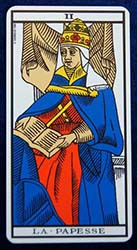
If you’re just starting out on your card reading adventure, one indicator you might use is how long the deck has been around.  Decks that don’t work tend to disappear fairly quickly. The Waite Tarot deck, for instance, is pretty much the gold standard for accuracy and was first published in 1909.  The much, much older Marseilles deck has been used for centuries, but is a little more difficult for beginners to work with.

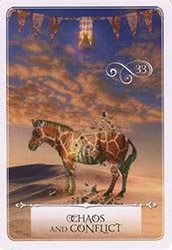
In the limited period of time that I’ve been using Baron-Reid’s deck, I’ve found it to be highly accurate.  I inquired, for instance, about the outcome of the presidential election here in the U.S. and drew a card titled Conflict and Chaos.  Perfect.

WHAT ARE YOU USING THEM FOR?

Finally, it’s good to consider how we’ll actually be using the cards.  If we’re deeply into metaphysical inquiries and are looking for the underlying currents in life, we might want to go for a deck that relies heavily on archetypes.  One example is Baron-Reid’s Goddess deck.  Or we might want to go straight to the source and use an archetype deck like this one from Caroline Myss.

I tend to use my cards much more for mundane inquiries than for metaphysical explorations.  In other words, my questions are more like, “What in the hell am I supposed to be doing this week?” And less like, “What is the meaning of life?”

Which is another reason why I particularly like this deck.  The cards are mainly flat out, practical, day to day advice, like, “You need to get more rest.”  Or, “this venture isn’t going to work so make a u-turn.”  Or, “use your imagination, not your logic.”

We can achieve much the same result by taking a classic Tarot deck like the Waite deck and simply removing all of the Major Arcana (archetype) cards.  When we use only the Minor Arcana, we’re only looking at the mundane, practical factors in life.  That’s kind of a hassle but it works.

Ultimately, the deck you choose will be all about you.  If it calls out to you, if it resonates with your vibrations, if you trust it, that’s your deck.

The Moon, Processing the Election, and Summoning a New Reality

Processing the craziness of the U.S. election and waiting for a new world to manifest.

MORE THAN JUST THE BLUES

So how are you doing out there after this crazy election?  If you’re a liberal, an empath, or an intuitive, you’re probably feeling puzzled, sad, angry, depressed, and – to a certain extent – scared.

And, unless you’ve just sworn off rationality (like the other half of the country) you’re probably trying to figure this out.  What in the HELL just happened?  It’s more than just a normal case of post-election blues.  It’s a need to restore some sense of sanity to our daily lives.

YES, THEY REALLY ARE CRAZY

The first thing to acknowledge is that, yes, the Trumpsters really ARE crazy.  There’s an old argument that says, “A million people can’t be wrong.”  But they can be and frequently are.  Millions of people supported Hitler and Stalin.  Millions of people supported the Catholic church raping and burning and murdering it’s way across several centuries.  Not only is there not truth in numbers, there’s frequently collective insanity.

DEFINING CRAZY

If you joyously embrace something that’s going to fuck you up, you’re crazy.  We recognize that fact with addicts who stick the needle in their arms one more time or alcoholics who pick up a bottle again.  Bi-polars who quit taking their meds.  Abused spouses who go back to their abusers.  If we choose self-destruction, we’ve left the realm of sanity.

In my lifetime, there has never been an election where more people voted against their own self-interest.  Women voted for a man who wants to end their control over their own bodies.  Latinos voted for a candidate who calls them murderers and rapists.  So-called Christians voted for a serial adulterer who’s violated nearly everything that Jesus ever taught.  And on and on.  They’ve chosen someone who is going to destroy their lives, therefore they’re crazy.

TRYING TO RESTORE BALANCE

One of the first things that we do when we’re confronted with a whole lot of crazy is to try to restore a sense of balance and sanity.  There must be some reason why they acted so crazy, right?

That’s our rational, left-brain, linear thinking trying to understand why they acted as they did.  A sense of sanity is very important to human beings.  It makes our environments predictable, it makes our lives orderly and meaningful.  More than anything else, it gives us a sense of safety and we need a sense of safety to function.

This is why we’re seeing all of the post-election analysis.  “What is it that women really wanted?  What issues are really important to minorities?  What message was rural America really trying to send?”

PROCESSING CRAZY

The sad truth, though, is that if we try to process non-rational behavior from a rational perspective, it just makes us crazy.  There are million reasons out there for why different people voted for Trump.

I couldn’t bring myself to vote for a woman.

I didn’t like her laugh.

I’m paying too much for groceries.

I’m worried about immigrants.

I’ve always voted for Republicans.

I hate liberals.

He didn’t REALLY mean all of those things he said.

Any and all of those reasons pale in comparison to the reality of voting for a senile, hateful, con artist who announced that he intends to be a dictator and end democracy as we know it.  When we put the reasons next to the results, they’re all crazy.

THE MOON CARD AND CRAZY

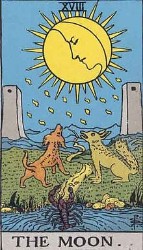
The Tarot card, The Moon, is all about crazy.  It shows a dog and a wolf baying at the Moon, while a crustacean crawls out of a dark pool.  It illustrates that even our domesticated dogs still contain the genes of the wild wolf and our brains still contain the primitive, crocodile brain that motivates hatred and fear.  The light of the Moon illuminates but doesn’t delineate.  We see a shape on the ground and we don’t know if it’s a snake or a rope.

What happened in our last election was all about illusions, delusions, and trickery.  It was the wolf snapping it’s ravenous jaws at our doors and the crocodile gnashing it’s teeth.  It was a cultural and spiritual disaster.  It was crazy to the max.

CREATING ALTERNATIVE REALITIES

So if we can’t use our rational minds to really understand what just happened, what do we do?  Well, we ask for answers and wait for alternative realities to emerge.

We need to give our subconscious minds – which are also our links to our higher selves – time to process all of this craziness.  What we just got was the equivalent of a massive data dump.  We just now found out that over half the country supports a very evil (yep, I’m going to use that word) agenda.  It contains racism, sexism, homophobia, xenophobia, and fascism.  We simply can’t assimilate all of that data at once.

What we CAN do is to actively engage with our subconscious minds (and thus our higher selves), ask for answers, and wait for them to emerge.  That means doubling down on meditating, prayer, lucid dreaming, reading Tarot cards – whatever our particular means is of creating a dialogue with our subconscious and higher selves.  That means actively asking for answers.

IT TAKES A LITTLE WHILE

As we know, the subconscious mind doesn’t have a drive-through window.  We can’t just cruise up and order an answer to all of this with a side of onion rings or fries.

We also know, though, that our subconscious minds, our higher selves, and our guides and helpers are infinitely creative.  Right now, at this very moment, they are weaving together a tapestry that will contain the answers we need.  As spiritual seekers we don’t drive out the darkness – we bring in the light.  The light will start to emerge over the next couple of months and it will emerge through us.

How to Lighten the Fuck Up by Fooling Around with Magic

A Quick Look at the Playful Nature of Magic.

Magic.  

What is it, anyway?  We talk about magic a fair amount.  We say that something, “felt really magical,”  or we, “feel a lot of magic,” when we’re with another person,”  or a solution to a problem appeared, “just like magic.”  But what, exactly, is it?  Is it just a feeling, or is it a real thing that exists in the world independent of our feelings?

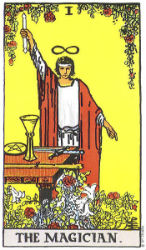
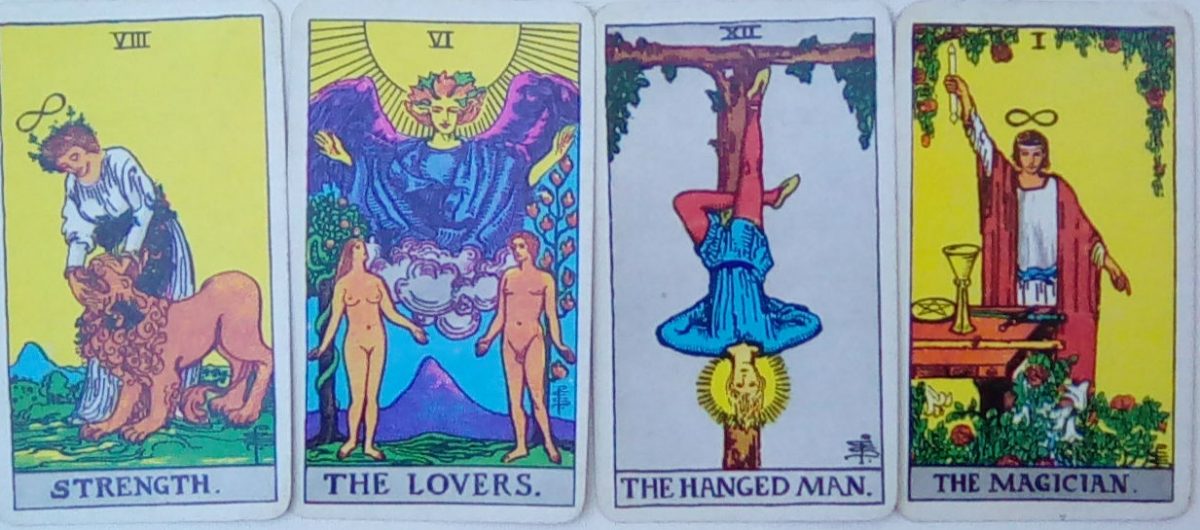
In The Magician card, we see a person channeling magical energy from, “above,” into the material plane.  He’s using his concentration, his will power, and his skills to pull that energy into what he wants to manifest.

Which, of course, is a major clue.  Magic is an energy, just like light, sound, radio waves, or solar flares.  What’s more, it is it’s own energy, meaning that it’s distinct from other energies.

We tend to get it mixed up with other energies, because it appears coincident with them.  When we’re madly in love with someone, it feels magical, and so we tend to mix magical energy up with being in love.  When we’re joyous, it feels magical, and so we tend to mix magic up with great happiness.  But magic is it’s own energy that appears with joy and love, but isn’t just joy and love.

We can see an analog of this with emotions and brain chemicals.  When we have a lot of serotonin in our bodies, we feel happier.  When we have a lot of cortisol and adrenaline in our bodies, we feel more stressed and anxious.  But . . . happiness causes serotonin to appear and serotonin causes happiness to appear, so it’s a definite, “which came first, the chicken or the egg?” situation.  They’re not equivalent – they just appear at the same time.

Reductionists would have us believe that serotonin = happiness, but it’s not true.  Antidepressants, which increase serotonin levels, can be a very effective band aid for depression, but they pretty much have to go along with good therapy to deal with the underlying problems.  If we don’t build in the therapy, the happiness goes away when we stop taking the antidepressants because – guess what? – the things that were making us unhappy are still there.

In very much the same way, magic appears in our lives coincident with love and and joy, but the love and joy don’t cause the magic.  Nor does the magic cause the love and joy.  They just appear at the same time.

There are some other clues we can find that point to what magic actually is.  Two major markers that appear in our lives when we’ve got magical energy flowing through us are synchronicity and serendipity.  Synchronicity and serendipity are really just short hand for, “life is easy.”  Solutions to our problems appear out of nowhere.  People, places and things that feel like gifts from the universe manifest with no effort at all.  

And, “life is easy,” is really just short hand for, “life is light.  Life is playful. Life is fun.”

Which are some more major clues about what magical energy really is.  In the same way that magic tends to appear when we’re joyous or in love, magic tends to appear when we’re happy and playful.  It’s almost as if the universe is saying, “You know, you really need to lighten the fuck up if you want me to play with you.  I get that you’re all sad and dour, but it’s a drag and I can find someone else to hang out with.”

So magic is an energy that tends to appear in our lives when we’re loving, joyous, happy and playful.  It doesn’t cause them and they don’t cause magic, but they definitely appear at the same time.

Which brings us to another card, The Fool.

The Fool is FULL of magic.  He’s dancing along at the edge of a cliff and he really doesn’t give a fuck about the danger because he’ll just float right off into the air and keep dancing.  His little dog is picking up on his joy and dancing right along with him, in just the way that dogs always will.

Now, the interesting thing about The Fool is that he’s the Zero card in the Tarot deck.  Every other card has a number, but The Fool is Zero.  Which means that he doesn’t belong anywhere and he belongs everywhere.  We can literally take any card in the Tarot deck, drop The Fool on top of it and things will start to get better.  Even extremely bad cards like Death and The Tower start to improve the second that we bring in magical energy.  

There are people in the world who will tell us that life is insane, tragic, and brutal and that there’s very little to be optimistic about.  And, when we look at the daily news, it can be hard to argue with that view.  Believing in love, joy, playfulness, happiness and lightness can seem downright . . . Foolish.   

But that’s the point.  No matter how bad the situation may be, if we start to drop The Fool on it, if we start to increase the magic in our lives, it will get better.  

Magic brings love, joy, happiness, playfulness, easiness, and lightness with it.

Yes, please.  I’ll have some of that.

My e-book, Just the Tarot, is still available on Amazon at a price that’s SO reasonable that it would be downright Foolish not to buy a copy.