The Most Powerful Card in the Tarot – Getting Downright Foolish

An explanation of why The Fool is the most powerful card in the Tarot.

There’s an ongoing debate among Tarot aficionados about which card is THE strongest card in the deck.  The most prominent candidates are usually the first two cards of the Major Arcanum:  The Fool and The Magician.  I tend to lean toward The Fool, for reasons which I’ll explain, but the truth is that we need both of their energies in our personal and spiritual growth.  The Fool is pure potential, whereas The Magician is pure mastery.  Growth occurs when those two energies intersect.

LOOKING AT THE SYMBOLISM

In The Fool, we see a young, ambisexual person dancing along at the edge of a cliff.  He lightly holds a rose in one hand, and his meager possessions are contained in a satchel hanging from a pole that he carries over his shoulder.  A small dog joyously cavorts at his feet, despite the fact that The Fool appears to be about to walk straight off of the cliff.

If we had to select a couple of words to describe the image, they would probably be, “happy,” and, “unfocused.”  The person in the card seems to not have a care in the world.  He’s to telling us to stop and smell the roses, to trust in the present moment. The message is that if he walks off of the cliff, he’ll just keep strolling along on thin air.

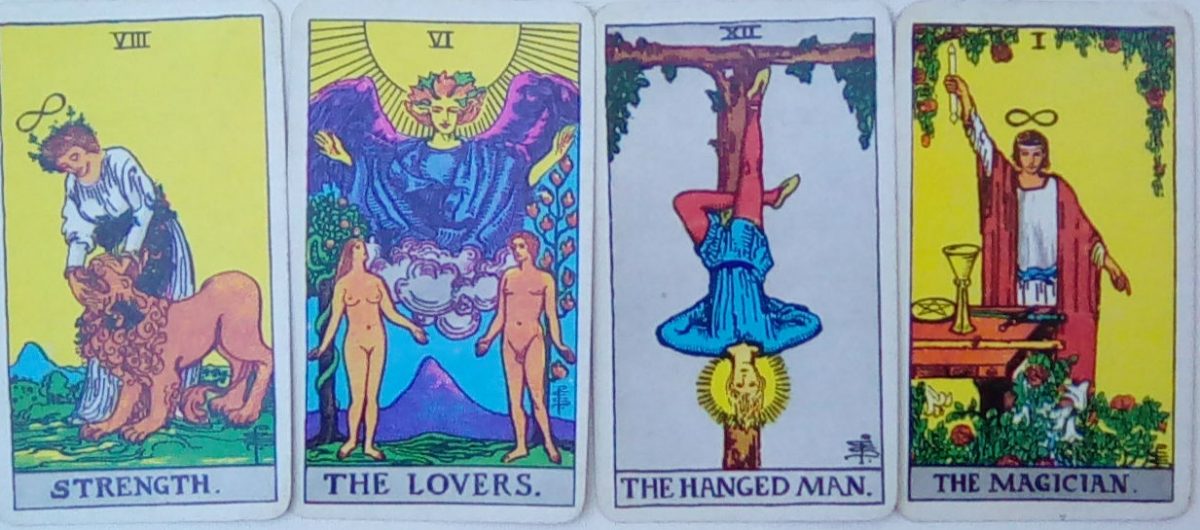
The Magician card, on the other hand, is an image of total concentration and focus.  He’s dressed in the formal robes of a ceremonial magician and looking very serious.  One hand, holding a wand with two points, is pointed toward the sky and the other is pointed at the ground.  His robe is belted with the ouroboros symbol of eternity, a snake eating it’s own tail, and that message is reinforced by the eternity symbol floating over his head.  The four symbols of earthly existence, the wand, pentacle, cup, and sword, lie on his altar.

“Just the Tarot” by Dan Adair – A complete set of definitions, layouts and instructions for reading Tarot cards.

The Magician is channeling the divine energy into the Earth Plane.  He’s using it to control the four elements and manifest his desires through the use of his will power.  If we had to select a couple of words to describe this image, they would be, “control,” and, “focus.”

THE MAGICIAN AS THE WESTERN PARADIGM OF POWER

The Magician is very much the Western paradigm of power.  We use phrases like, “He’s a take-charge sort of a guy,” or, “She’s always in control,” to describe this kind of power, and we tend to admire it.

The Magician is the type of a person who is very conscious of what she wants to accomplish, has a detailed plan for doing it, has the necessary skills to make it happen, and works the plan until she reaches her goals.

This is the type of linear, step-by-step thinking that Westerners have traditionally employed, and it can be very effective.  

It’s also very much an ego-based sort of a power.  It’s saying, “This is what I want and I’m going to use all of my abilities and will to make it manifest.”

THE FOOL AS THE EASTERN PARADIGM OF POWER

The Fool’s energy is much more in keeping with the Eastern paradigm of power.  It has more to do with aligning ourselves with a deeper, universal  power, rather than trying to run the whole show with our egos.

There’s a basic trust implicit in The Fool.  It’s a trust that, as the Desiderata put it, “whether or not it is clear to you, no doubt the universe is unfolding as it should.”  The idea is that there IS an underlying force in the Universe and that it’s a loving, compassionate force.  When we’re in alignment with that force, then we’re in The Flow, or the Tao, and our lives are much easier and happier because of it.  And, paradoxically, the more that we try to control that Flow, as the Magician does, the less in alignment we are and the harder life becomes.

VISUALIZING AND MANIFESTATION

We can see this sort of tension between The Magician energy and The Fool energy when we begin to delve into visualization and manifestation.  

Most of the books and seminars on the subject run pretty close to The Magician model of power. (A) We figure out what we want (the usual example being a million dollars.)  (B) We concentrate all of our will power on that goal by visualizing it, writing affirmations, and making vision boards.  (C) We cause that goal to manifest in our lives through repetition and the sheer power of our wills.  The Magician model is also very one-pointed and specific, as in, “I want a million bucks by September the first and I want it to be in unmarked hundred dollar bills.”

Of course, that frequently doesn’t work, as evidenced by the fact that most of us aren’t millionaires.  This is the point where many teachers will bring in the concept of The Fool energy.  The idea here is to relax, stay in the present moment, and quit telling the Universe how it’s supposed to behave.  Instead of setting a specific goal, right down to every detail, we set a general goal, but let the Universe work out the details.

Mike Dooley, in particular, works with this concept in many of his books like, “Manifesting Change.”  He refers to our trying to control all of the details (Magician energy) as, “the cursed hows.”  In other words, “I want a million bucks, Universe, and this is exactly HOW I want you to manifest it.”  The point that he’s making is that we may think we’re opening one door to financial abundance, but in reality we’re slamming shut a thousand other doors.  The Universe is infinite and it has an infinite number of ways of delivering what we want to manifest, unless we get too specific about how we want it done.

So, we bring in Fool energy.  We use a general statement like, “I’d like to manifest happiness and abundance in my life, Universe, and I’m sure you can work out the details.  After all, you make stars and solar systems, so this shouldn’t be much of a challenge for you.” And then we butt out and let it happen, while we stay happy and in the present moment.

CONSCIOUS AND SUBCONSCIOUS MINDS

The Kybalion – a discussion of Hermetic magic – talks about this dance between Magician energy and Fool energy in terms of the conscious and subconscious minds.

Our conscious mind is our everyday mind, which is the mind that we mostly identify with.  It’s ego based, logical, and linear and it’s very clever at performing mundane tasks.  It’s the mind that balances our budgets, pays the rent, buys groceries, and gets the kids to school on time.  We could call it Magician energy but it’s really just a tiny part of our larger mind.

The subconscious mind, on the other hand, comprises the majority of our minds.  Unlike the conscious mind, it never needs to sleep and it’s working 24/7, processing information, calculating what the future may look like and telling us when something’s wrong.

The most important thing about the subconscious mind, though, is that it’s our connection to the super-conscious mind, AKA the Universe.  Though that connection, it has almost infinite power to manifest anything that we truly desire.  That’s Fool energy.

Those two minds – conscious and subconscious – need to work together.  Although the subconscious mind is infinitely powerful, it just drifts without direction from the conscious mind.  Even worse, it can construct our reality based on the crap that flows through the internet, our televisions, our cultures and our religions, which may have very little to do with what we really want to manifest.

So we need to use that Magician energy – the conscious mind – to sort through our options and figure out where we want to actually go with our lives.  Do I want to be rich?  Do I want to be an artist?  Do I want more love in my life?  Once we determine what our overall goals and desires are, then we say, “Hey, subconscious mind/Universe – this is what I’d like to see happen.  Please get to work on that.”

THE FOOL DOES THE HEAVY LIFTING

Here’s the most important thing about all of that:  The Fool does the heavy lifting.  The SOLE PURPOSE of the conscious mind is to figure out where we want to go and turn it over to the subconscious mind/Universe.  

The conscious mind has a terrible time accepting that notion, because it’s ego based.  It wants to control every little detail of the manifestation process, and so it keeps snatching it back from the Universe and imposing more and more cursed hows on the process.  Every single time that we do that, we’re slamming doors shut instead of letting the subconscious mind open more doors.

And so, yes, in my opinion there can be no doubt that the most powerful card in the Tarot deck is The Fool.  It’s the primal energy that makes good things manifest in our lives.  The Magician can guide that energy but, by itself, it’s nothing but a control freak in a red robe.

Blasted Towers, Bad Ju-Ju, and the Unluckiest Card in the Tarot

A look at the five unluckiest cards in the Tarot deck.

I recently received an email from a reader who asked, “What’s the unluckiest Tarot card?”  I had to scratch my head about that one because the whole concept of good luck versus bad luck can get pretty complex.  Nonetheless, there are some Tarot cards that can always be considered harbingers of bad luck

THE WHEEL OF FORTUNE, REVERSED

The Wheel of Fortune, Reversed, is the most obvious choice for a, “bad luck,” card.  We actually talk about luck in terms of good fortune and bad fortune and that’s what this card is all about.  It depicts life as a wheel, where sometimes our luck is ascending and expanding and sometimes it’s descending and decreasing.  When The Wheel of Fortune, Reversed, shows up in a reading it indicates that we’re in for a patch of bad luck.

The Kybalion, which is a book about Hermetic Magic, compared it to the pendulum of a clock.  The pendulum swings first in one direction and then back in the other.  Life can be seen in much the same way:  sometimes we’re swinging into really good luck and then we swing back into a period of bad luck.

The obvious underlying message is to just hang on, because things will inevitably change.  When we can stand back and look at good luck/bad luck as a rhythmic cycle, then periods of ill fortune will affect us much less severely.  We just need to stay centered and calm and wait for the cycle to reverse itself.

THE TOWER

Also known as, “the lightning struck tower,” and, “the blasted tower,” The Tower would probably be my pick as THE unluckiest card in the deck.  

“Just the Tarot,” by Dan Adair – complete definitions, layouts, and instructions for reading Tarot cards, available on Amazon.

At it’s most severe level, it can indicate that everything that you’ve loved and invested in is about to be blasted right down to the ground.  The last time that I had it showing up in my personal readings, my life partner died, I lost my house, and I was involved in a horrible law suit over the probate of the estate.  It can be that bad, depending on the other cards in the reading, but it usually isn’t.

On a mundane level, The Tower is usually just a powerful warning that we’ve gone down the wrong path and the Universe is about to provide a course correction.  Perhaps we’ve been treating our fellow employees badly and – Shazam – we’re suddenly fired or demoted.  Or perhaps we’ve been emotionally abusive or neglectful of our lover and they leave us for someone else.

In my experience, there’s always a level of hubris involved with this card.  We’re not only taking things for granted, but we’re also being arrogant.  We’re assuming that everything is under our control and the Universe is going to show us that we’re not.

The most positive message in this card – which we usually fail to appreciate at the time – is that we get to completely start over.  It’s like that line from, Me and Bobby McGee:  “Freedom’s just another word for nothing left to lose.”  When our lives (or our projects or relationships, etc.) have been blasted right down to the foundations, we have the freedom to consciously design something new and better.

DEATH

Even if it isn’t the unluckiest card in the deck, Death definitely wins the award for the creepiest card in the Tarot.  In her wonderful book, “Fortune Telling by Tarot Cards,” Sasha Fenton puts it in this perfectly understated, British way:  “This card usually puts the wind up people when it appears . . .”

Yes.

Now, first of all, I have never seen the Death card appear before someone’s death.  It will pop up after someone has died, but it’s usually just a comment on what’s happened.  It’s more like, “Well, you’ve lost someone you loved, so you’re dealing with death and grief.”

What it can indicate, though, is that there’s going to be a radical, life changing turn in events in a person’s life.  The querent is suddenly going to find herself going in a completely different direction than she has in the past.  In an emotional and spiritual sense, it really is as if their previous life has died and they’re off in a completely new direction.

I knew a woman who had been happily married for 15 years, had a home, a loving husband, and 2 kids.  She woke up one morning with this thought ringing in her head:  “Shit, I’m not in love with him anymore and I hate my life.”  Within six months she’d obtained a divorce, turned custody of her children over to her ex-husband and was working as a river guide in West Texas.  That’s the kind of radical change that we’re talking about here.

Whether that kind of change is good luck or bad luck is just a matter of interpretation.  If it’s something that we consciously plan, we usually view it as good fortune.  If it was something that was forced on us by circumstance, we may think it was bad fortune.

JUSTICE, REVERSED

I’m a little hesitant to include the Justice card in this list because it has more to do with people and circumstances than luck per se.  Nonetheless, it’s frequently seen as bad luck so I’ll stick it in here.

Classically, as you might guess from the image, Justice has to do with the legal system.  If we’re involved in some sort of litigation and Justice is upright, it can mean that we’ll prevail.  If it’s reversed, it can mean that we’ll lose.

On a personal level, it can mean that the people around you – your family, co-workers, boss, etc. – are making judgements about you and they’re not good if the card is reversed.  

Losing a court case can obviously be seen as bad luck.  Or it can be seen as a sign that we have a bad case, a bad lawyer, or a bad judge.  In the same way, having people we care about judging us harshly can be seen as being treated unfairly.  Or it might be that we’re being jerks and we need to clean up our acts.

Justice, Reversed, can be a sign of a bad luck to come, but it also serves as a warning.  It’s saying, “You’re about to have some bad luck, so you need to take a careful look at your own actions before that happens.”

TEN OF SWORDS

It doesn’t take but a glance at the Ten of Swords to realize that there’s some serious bad ju-ju happening here.  If we’re lying face down stuck full of swords like a human pin cushion, something’s a little wrong. This card can indicate treachery, deceit or a very, very bad ending to a relationship or a job.

The suit of Swords symbolizes our personal power.  That’s the way that we project ourselves out into the world.  There’s nothing innately wrong with that.  Whether it’s standing up to a school yard bully when we were kids or pushing hard for a project we really believe in at work, there are always times when we have to be a bit aggressive.

But . . . when we’re overly and chronically aggressive, that puts us into a power cycle. We’re trying to dominate other people and run over their emotions and desires.  We become the school yard bully instead of the person standing up to the bully.  We see this mentality frequently with primitive men who brag about being the, “alpha dog.”  It’s dominance for the sake of dominance, rather than for the sake of getting anything done.

The message of this card is the old cliche’: live by the sword, die by the sword.  If we’ve been treating other people harshly, if we’ve been abusive in our love relationships, or domineering in work relationships, we’ve got some bad karma heading our way.

So those are the top five, “bad luck,” cards in the Tarot deck.  There are, of course, other cards that may indicate bad fortune in one aspect or another of our lives, but these are the red flags.  And, of course, we should always remember that a Tarot reading is just a snap shot in time.  It tells us what’s likely to happen, but we have the free will to change it.

Karma, Having Sex with Republicans, and Being Kind to Yaks

Seeing karma as a way to change our past.

One of my favorite internet memes says, “Karma – It’s spelled K-A-R-M-A and it’s pronounced, ‘Ha, ha, fuck you.’”  

That’s a perfect explanation of our usual understanding of karma which is basically, “If you do some shit, you get some shit.”  If we do something terrible to another person, something terrible is going to happen to us. If we do something nice, something nice is going to happen to us.

OH, WELL, IT’S KARMA

Counter-intuitively, karma is also used an explanation for why bad things happen to good people.  We may have a friend who’s a wonderful person and goes through his life supporting and nurturing others, who’s full of love and gentleness and kindness.  And then something horrendous happens to him, like he falls of a cliff or discovers his wife is having sex with a Republican.

We simply can’t understand why such a good person would have such bad luck.  Certainly, he did nothing to deserve it and, according to the Law of Karma, all of his good behavior should have been rewarded with good things happening to him.

But . . . we’re told . . . perhaps he did something really, really terrible in a previous incarnation.  Maybe he pushed someone off of a cliff or maybe he had sex with a Republican.  Maybe he actually – shudder – enjoyed having sex with a Republican.

That allows us to restore some sense of cosmic balance and we say, “Oh, well, it’s just karma.”

IT AIN’T ME, BABE

We can certainly understand that concept when something bad happens to someone else, but it’s difficult to swallow when it happens to us.

Let’s face it, most of us are NOT the Dalai Lama and we have very little memory of our past lives.  We may accept the general idea that we’ve lived other lives, but we don’t actually remember being a Yak herder in Mongolia in 40 A.D. or a courtesan in Paris during World War I. 

From our current point of view, those people who we were in our past lives were literally someone else and not us.  

The idea that I broke my wrist today because some other guy kicked a Yak 2000 years ago seems entirely capricious and cruel and unjust.  It feels like . . . how shall I put this? . . . bullshit.

KARMA AND DETERMINISM

From that perspective, karma feels very much like determinism.  Determinism is the view that every single thing that happens to us is pre-determined from the moment of birth.  There really isn’t any free will or choice in life because our lives are a result of our genetics, our cultures, the families we’re born into, and the times we live in.

We can actually make a strong case for that.  Even in the United States, where we worship the idea of free will and choosing our own destinies, the statistics say it ain’t so.  If we’re born into a dirt poor family, we’ll probably die dirt poor.  If we’re born into great wealth, we’ll probably die rich.   If our parents were conservative Catholics, we’ll probably be conservative Catholics.  If our grandfather hated socialists for no particular reason, we’ll probably hate socialists for no particular reason.

We tell ourselves that we’re making choices about those issues, but for the most part we aren’t.  It was all programmed into us before we came down the birth canal.  Life is something that happens to us, not something that we create.

Karma can feel a lot the same way.  I, me, the person who I am right now, did NOT kick that Yak 2000 years ago, so why am I being punished for it?  It’s something that’s just happening to me, not something I can control or make any choices about.

BUT KARMA’S A CHOICE

Paradoxically, being the people who we are, right here, right now, is the good news about karma.  

Determinism basically says, “You’re fucked or you’re not fucked and there’s not one damned thing you can do about it.  You have NO choice in the matter.”  It’s all predetermined.

The Law of Karma, on the other hand, says that what we do right now is what really counts.  Far from saying that we have NO choice in the matter, karma is saying that we always have a choice.  And our choices are what determine our karma.

As David Michie said in, “Buddhism for Busy People,” 

“A lot of Western people wrongly think that karma equals fate or predestination.  They think it’s something you don’t have any power to change.  This is a misunderstanding.  It is we who create our own karma and we can change it in a powerful, dynamic way. We are creating hundreds, even thousands of such causes every day of our lives.”

Put another way, we are creating our own karma ALL THE TIME.  It’s not something from the past that just pops up to bite us in the ass every once in a while.  It’s not like The Wheel of Fortune, where we have good luck for a while and then bad luck, for no apparent reason.  It’s something we personally create by either being good people or being bad people.

THE PRESENT AS PROLOGUE TO THE PAST

Now, there’s a particularly fascinating doctrine in some schools of Buddhism that says that we can actually change our past karma by how we behave in our present lives.  

Suppose, for instance, that I was a really notorious Yak kicker in Mongolia in 40 A.D.  I didn’t just kick Yaks occasionally.  No, I was a mean, nasty, evil spirited son of a bitch who got up every single morning and kicked the hell out of as many Yaks as I could reach.

Fast forward 1985 years to my current life.  Suppose I start an, “adopt a Yak program,” and spend years rescuing and feeding homeless Yaks.  I learn to love Yaks and have great compassion for them.  Perhaps I even dress them in Yak finery for special occasions.

Under this particular doctrine, I wouldn’t JUST be creating good karma for my present self.  My good karma would go backwards through time and actually change the character and behavior of my previous self, the notorious Yak kicker. He might learn to love Yaks just as much as I do and my bad Yak karma would be erased.

IT’S NOT THAT WILD

If that sort of time traveling karma sounds a little too wild, just consider what most of us already believe about karma.

We believe that we have one Soul with many different historical identities and that what a previous identity does can travel through time to affect the life of our current identity.  So if all of these past identities are somehow in touch with our current identity, why wouldn’t our current identity be in touch with our past identities?  If they can affect us, it stands to reason that we can affect them.

KARMA AS AN ONGOING PROJECT

When we shift our perspective in that way, then karma becomes an on-going project.  We’re no longer victims of our past.  We’re actually re-creating our past through our current actions.

And if that isn’t free will and choice, I don’t know what is.

Being compassionate, decent people every day and right now is good for us and it’s good for the people around us.  And, ultimately, it’s good for the Yaks.  

Do it for the Yaks.

Just a reminder that my ebook, “Just the Tarot,” is available on Amazon for much less than a bag of Yak feed.

How to Choose an Oracle Deck

Factors to consider in choosing an Oracle deck.

I’ve been having a lot of fun playing with Colette Baron-Reid’s Wisdom of the Oracle deck lately.  They seem to be highly accurate and the illustrations are really magical.

There are, of course, about 80 kazillion different decks out there by now, so it can be difficult to decide which one to get.  On average, they’re about 20 bucks a pop, so it’s not like most people can order a dozen of them and figure it out later.    If you’re in the market for a new deck, here are a few things to consider.  

ARE THEY REALLY ORACLE DECKS?

That’s not as silly as it sounds.  There are quite a few decks that really have nothing to do with, “fortune telling.”  For instance, Louise Hay has several decks like, “Heart Thoughts Cards: A Deck of 64 Affirmations,” which are collections of affirmations printed on separate cards.  They’re lovely, inspiring thoughts, but they have nothing to do with predicting the future or understanding the past.

“Healing the Inner Child Oracle: A Transformative Quest,” is another example.  It’s a charming deck that offers words of solace for anyone with a wounded Inner Child, but it isn’t in any sense, “oracular.”  Basically, what we’re looking for in an oracle deck is one that’s capable of saying, “You are here.  This is how you got here.  This is what’s going to happen if you keep on your present course.”  If it can’t fulfill those simple parameters, it’s not an oracle deck.

DO YOU TRUST THE AUTHOR?

A little bit of research can tell us a lot about the author of a deck.  Some basic questions we can ask are:  is the author experienced?  Does the author have some sort of psychic ability that would lend her credence in designing a deck of cards?  Is the author in a positive flow of energy?

Colette Baron Reid, for instance, is a psychic and has been reading cards professionally for 25 years. (Check out her web site here:  https://www.colettebaronreid.com/)\].  For me, personally, the fact that she’s gone through some serious shit in her life and emerged with a positive message and positive energy adds greatly to her credibility.

We can contrast that with Aleister Crowley’s Thoth Tarot deck.  It’s a well designed deck and Crowley had a deep knowledge of occultism.  He was also deeply involved with black magic, sacrificed animals in his rituals, and was a heroin addict.  I wouldn’t want his deck or his energy anywhere near my house.

IS THE DECK MAGICAL?

This is obviously highly subjective.  The question here is, “Does the deck call out to your Deep Mind?”  Does it stir something inside of you that resonates and feels magical?

I would answer, “absolutely,” with Baron-Reid’s deck.  The illustrations are by Jenna DellaGrottaglia and her art is like something channeled from another world.  The second I picked up the deck I could almost feel it vibrating in my hands. 

They’re whimsical, thought provoking, and perfect illustrations of the situations we find ourselves in on a daily basis.  You can see more of her art here.

On the other hand, we can look at cards like those from Doreen Virtue’s original angel decks and feel a resounding, “Blechhh.”  They’re really just Hallmark greeting cards compiled into a deck.  Despite the fact that they sold in the hundreds of thousands, they’re flat and low vibration.

ARE THEY ACCURATE?

Although this is, of course, the most important question, it’s hard to ascertain without actually buying one of the decks and trying them.  We can try to get a, “feel,” for them by reading the reviews on sites like Amazon, but even those can be highly suspect.  

If you’re just starting out on your card reading adventure, one indicator you might use is how long the deck has been around.  Decks that don’t work tend to disappear fairly quickly. The Waite Tarot deck, for instance, is pretty much the gold standard for accuracy and was first published in 1909.  The much, much older Marseilles deck has been used for centuries, but is a little more difficult for beginners to work with.

In the limited period of time that I’ve been using Baron-Reid’s deck, I’ve found it to be highly accurate.  I inquired, for instance, about the outcome of the presidential election here in the U.S. and drew a card titled Conflict and Chaos.  Perfect.

WHAT ARE YOU USING THEM FOR?

Finally, it’s good to consider how we’ll actually be using the cards.  If we’re deeply into metaphysical inquiries and are looking for the underlying currents in life, we might want to go for a deck that relies heavily on archetypes.  One example is Baron-Reid’s Goddess deck.  Or we might want to go straight to the source and use an archetype deck like this one from Caroline Myss.

I tend to use my cards much more for mundane inquiries than for metaphysical explorations.  In other words, my questions are more like, “What in the hell am I supposed to be doing this week?” And less like, “What is the meaning of life?”

Which is another reason why I particularly like this deck.  The cards are mainly flat out, practical, day to day advice, like, “You need to get more rest.”  Or, “this venture isn’t going to work so make a u-turn.”  Or, “use your imagination, not your logic.”

We can achieve much the same result by taking a classic Tarot deck like the Waite deck and simply removing all of the Major Arcana (archetype) cards.  When we use only the Minor Arcana, we’re only looking at the mundane, practical factors in life.  That’s kind of a hassle but it works.

Ultimately, the deck you choose will be all about you.  If it calls out to you, if it resonates with your vibrations, if you trust it, that’s your deck.

The Moon, Processing the Election, and Summoning a New Reality

Processing the craziness of the U.S. election and waiting for a new world to manifest.

MORE THAN JUST THE BLUES

So how are you doing out there after this crazy election?  If you’re a liberal, an empath, or an intuitive, you’re probably feeling puzzled, sad, angry, depressed, and – to a certain extent – scared.

And, unless you’ve just sworn off rationality (like the other half of the country) you’re probably trying to figure this out.  What in the HELL just happened?  It’s more than just a normal case of post-election blues.  It’s a need to restore some sense of sanity to our daily lives.

YES, THEY REALLY ARE CRAZY

The first thing to acknowledge is that, yes, the Trumpsters really ARE crazy.  There’s an old argument that says, “A million people can’t be wrong.”  But they can be and frequently are.  Millions of people supported Hitler and Stalin.  Millions of people supported the Catholic church raping and burning and murdering it’s way across several centuries.  Not only is there not truth in numbers, there’s frequently collective insanity.

DEFINING CRAZY

If you joyously embrace something that’s going to fuck you up, you’re crazy.  We recognize that fact with addicts who stick the needle in their arms one more time or alcoholics who pick up a bottle again.  Bi-polars who quit taking their meds.  Abused spouses who go back to their abusers.  If we choose self-destruction, we’ve left the realm of sanity.

In my lifetime, there has never been an election where more people voted against their own self-interest.  Women voted for a man who wants to end their control over their own bodies.  Latinos voted for a candidate who calls them murderers and rapists.  So-called Christians voted for a serial adulterer who’s violated nearly everything that Jesus ever taught.  And on and on.  They’ve chosen someone who is going to destroy their lives, therefore they’re crazy.

TRYING TO RESTORE BALANCE

One of the first things that we do when we’re confronted with a whole lot of crazy is to try to restore a sense of balance and sanity.  There must be some reason why they acted so crazy, right?

That’s our rational, left-brain, linear thinking trying to understand why they acted as they did.  A sense of sanity is very important to human beings.  It makes our environments predictable, it makes our lives orderly and meaningful.  More than anything else, it gives us a sense of safety and we need a sense of safety to function.

This is why we’re seeing all of the post-election analysis.  “What is it that women really wanted?  What issues are really important to minorities?  What message was rural America really trying to send?”

PROCESSING CRAZY

The sad truth, though, is that if we try to process non-rational behavior from a rational perspective, it just makes us crazy.  There are million reasons out there for why different people voted for Trump.

I couldn’t bring myself to vote for a woman.

I didn’t like her laugh.

I’m paying too much for groceries.

I’m worried about immigrants.

I’ve always voted for Republicans.

I hate liberals.

He didn’t REALLY mean all of those things he said.

Any and all of those reasons pale in comparison to the reality of voting for a senile, hateful, con artist who announced that he intends to be a dictator and end democracy as we know it.  When we put the reasons next to the results, they’re all crazy.

THE MOON CARD AND CRAZY

The Tarot card, The Moon, is all about crazy.  It shows a dog and a wolf baying at the Moon, while a crustacean crawls out of a dark pool.  It illustrates that even our domesticated dogs still contain the genes of the wild wolf and our brains still contain the primitive, crocodile brain that motivates hatred and fear.  The light of the Moon illuminates but doesn’t delineate.  We see a shape on the ground and we don’t know if it’s a snake or a rope.

What happened in our last election was all about illusions, delusions, and trickery.  It was the wolf snapping it’s ravenous jaws at our doors and the crocodile gnashing it’s teeth.  It was a cultural and spiritual disaster.  It was crazy to the max.

CREATING ALTERNATIVE REALITIES

So if we can’t use our rational minds to really understand what just happened, what do we do?  Well, we ask for answers and wait for alternative realities to emerge.

We need to give our subconscious minds – which are also our links to our higher selves – time to process all of this craziness.  What we just got was the equivalent of a massive data dump.  We just now found out that over half the country supports a very evil (yep, I’m going to use that word) agenda.  It contains racism, sexism, homophobia, xenophobia, and fascism.  We simply can’t assimilate all of that data at once.

What we CAN do is to actively engage with our subconscious minds (and thus our higher selves), ask for answers, and wait for them to emerge.  That means doubling down on meditating, prayer, lucid dreaming, reading Tarot cards – whatever our particular means is of creating a dialogue with our subconscious and higher selves.  That means actively asking for answers.

IT TAKES A LITTLE WHILE

As we know, the subconscious mind doesn’t have a drive-through window.  We can’t just cruise up and order an answer to all of this with a side of onion rings or fries.

We also know, though, that our subconscious minds, our higher selves, and our guides and helpers are infinitely creative.  Right now, at this very moment, they are weaving together a tapestry that will contain the answers we need.  As spiritual seekers we don’t drive out the darkness – we bring in the light.  The light will start to emerge over the next couple of months and it will emerge through us.

Thought-Forms, Astral Pornography, and The Ace of Wands

Are our thoughts actually energy forms?

A few years ago I was reading a fascinating book called, “You Are Not Your Brain,” and the authors made a statement that was positively shocking to me:  “To this day, scientists and psychologists cannot agree on exactly what a thought is.”

At first blush, that sounds completely ridiculous because we all know what thoughts are.  They’re . . . um . . . they’re like . . . these little things that jump up in our heads and live in our brains, right?  

There . . . I solved that one.  You’re welcome.

Seriously, though, there really isn’t a good working definition of what a thought actually is.  There’s a sort of reductionist explanation of how our nervous systems and brains produce thoughts.  We can hook someone up to a brain monitor and see which parts of their brains light up with activity when they’re thinking about a particular subject.  Perhaps their fear center – the amygdala – lights up because they’re thinking of something really scary.  Or their prefrontal cortex – the thinking brain – lights up because they’re doing some heavy problem solving.  

That doesn’t really do anything but describe the process of making the idea, though.  It doesn’t tell us what the finished product is.  That theory – that the brain makes ideas – exists cheek by jowl with the stimulus/response model where something in our environment makes us think certain things.  Perhaps we see a picture of Donald Trump and we think, “Ohhh, scary clown,” which makes us think of circuses which makes us think of Stephen King horror novels about murderous clowns which makes us think about our overdue library book.

That concept seems to be counter-intuitive when we think about . . . well . . . intuition.  When we have  intuitions or  flashes of insight, it feels as if they’ve popped right up in our brains without anything else making them happen.  When someone asked Einstein how he invented the theory of relativity he said, “Oh, it just dropped in while I was playing the piano.”

For centuries, human beings viewed some types of ideas in just that way:  as something that came into our minds from an outside source.  That’s why the word, “inspire,” means to have something breathed into you.  The notion was that something out there – perhaps the Universe or the Gods or the fairies – inserted the idea into your mind.

That’s what’s portrayed in the Tarot card, The Ace of Wands.  Wands represent ideas and this is an idea or thought coming into the world in its purest form of mental energy.  It’s, “divinely inspired.”

That STILL doesn’t tell us exactly what an idea IS, though.  It’s just talking about it’s source, rather than it’s contents.

Now, the Theosophists and Victorian occultists had very specific ideas of exactly what an idea is.  They viewed ideas as thought-forms, which is to say, individual little packets of energy produced by our brains and emotions and auric fields.  And – important point – they felt that they were independent of the human being once they were produced.

We’ve all seen those cartoons where there’s a person having a thought that appears as a bubble with text in it, hovering over the character’s head.  That’s a convenient way to visualize what the Theosophists were talking about.  Every time that we have a thought, it’s like our bio-field – our brains, emotional energies, energy bodies – are extruding a little, tiny thought-form bubbles that exists outside of us.

Most of the bubbles don’t last very long because they don’t contain much energy.  Let’s face it, many of us are NOT thinking about the theory of relativity while we play the piano.  Instead, we’re having really profound thoughts like, “Where’d I put my car keys?  Need a cup of coffee.  Gotta walk the dog.  Did I do the laundry?”   So these are little bubbles that appear for a moment, pop, and disappear.

When the thought forms are really heavily charged with energy, though, they stick around.  How do they get charged?  Well, through emotions and through repetition.

Suppose you just went to bed with someone and you had a super-duper, unbelievable, I-think-my-ears-just-fell-off orgasm at the exact moment that you thought, “I love you.”  That, “I love you,” thought is super-charged with energy and it will last.  Ditto, if you’ve been badly shocked or frightened by something.  The more intense the emotion, the more of an energetic charge the thought-form has and the longer it will exist.

We can also charge the thought-forms with energy by thinking of them over and over and over.  On a positive note, we can see that happen when someone thinks of their lover constantly, as we tend to do in the early stages of falling in love.  The obsessive thinking keeps adding energy to that same, “I love you,” thought-form and makes it’s last.  On a negative note, we can see the same pattern with chronic anxiety and depression.  Constantly thinking of things that frighten us or make us sad just increases the charge in the thought-forms and so the depression will linger long after the original cause.

Two of the early Theosophists, Annie Besant and Charles Leadbeater, published a book called, “Thought Forms.” It had illustrations of the forms as they emerged from people’s auras, as seen by psychic mediums.  Here’s one of a peaceful thought:

And here’s one of an angry thought.

I would have liked to have seen one of a horny thought – sort of astral pornography, I guess – but the Victorians didn’t roll that way.

So is all of this true?  Maybe.  It certainly forms the basis for much of what we call visualization and manifestation, as well as the concepts of either cursing or blessing someone.  I’ll be writing more about that in the immediate future but for the time being it’s a fun concept to play with.  What if our thoughts are actual things that exist in our personal energy space and exert an influence on us and those around us?  How can we change the negative thought-forms and increase the positive-forms?  Can we pick up someone else’s thought-forms, much like a virus?

Before you dismiss the idea out of hand, remember what we started off with here: the most preeminent psychologists and scientists in the world have absolutely no idea what a thought is.  The theory of thought-forms is just as good – and maybe better – than most of their theories.

Remember that my e-book, “Just the Tarot,” is still available – dirt cheap! – on Amazon. In fact, I’m sending thought-forms at you right now. You should buy this book . . . you should buy this book . . . you should buy this book . . .

How to Lighten the Fuck Up by Fooling Around with Magic

A Quick Look at the Playful Nature of Magic.

Magic.  

What is it, anyway?  We talk about magic a fair amount.  We say that something, “felt really magical,”  or we, “feel a lot of magic,” when we’re with another person,”  or a solution to a problem appeared, “just like magic.”  But what, exactly, is it?  Is it just a feeling, or is it a real thing that exists in the world independent of our feelings?

In The Magician card, we see a person channeling magical energy from, “above,” into the material plane.  He’s using his concentration, his will power, and his skills to pull that energy into what he wants to manifest.

Which, of course, is a major clue.  Magic is an energy, just like light, sound, radio waves, or solar flares.  What’s more, it is it’s own energy, meaning that it’s distinct from other energies.

We tend to get it mixed up with other energies, because it appears coincident with them.  When we’re madly in love with someone, it feels magical, and so we tend to mix magical energy up with being in love.  When we’re joyous, it feels magical, and so we tend to mix magic up with great happiness.  But magic is it’s own energy that appears with joy and love, but isn’t just joy and love.

We can see an analog of this with emotions and brain chemicals.  When we have a lot of serotonin in our bodies, we feel happier.  When we have a lot of cortisol and adrenaline in our bodies, we feel more stressed and anxious.  But . . . happiness causes serotonin to appear and serotonin causes happiness to appear, so it’s a definite, “which came first, the chicken or the egg?” situation.  They’re not equivalent – they just appear at the same time.

Reductionists would have us believe that serotonin = happiness, but it’s not true.  Antidepressants, which increase serotonin levels, can be a very effective band aid for depression, but they pretty much have to go along with good therapy to deal with the underlying problems.  If we don’t build in the therapy, the happiness goes away when we stop taking the antidepressants because – guess what? – the things that were making us unhappy are still there.

In very much the same way, magic appears in our lives coincident with love and and joy, but the love and joy don’t cause the magic.  Nor does the magic cause the love and joy.  They just appear at the same time.

There are some other clues we can find that point to what magic actually is.  Two major markers that appear in our lives when we’ve got magical energy flowing through us are synchronicity and serendipity.  Synchronicity and serendipity are really just short hand for, “life is easy.”  Solutions to our problems appear out of nowhere.  People, places and things that feel like gifts from the universe manifest with no effort at all.  

And, “life is easy,” is really just short hand for, “life is light.  Life is playful. Life is fun.”

Which are some more major clues about what magical energy really is.  In the same way that magic tends to appear when we’re joyous or in love, magic tends to appear when we’re happy and playful.  It’s almost as if the universe is saying, “You know, you really need to lighten the fuck up if you want me to play with you.  I get that you’re all sad and dour, but it’s a drag and I can find someone else to hang out with.”

So magic is an energy that tends to appear in our lives when we’re loving, joyous, happy and playful.  It doesn’t cause them and they don’t cause magic, but they definitely appear at the same time.

Which brings us to another card, The Fool.

The Fool is FULL of magic.  He’s dancing along at the edge of a cliff and he really doesn’t give a fuck about the danger because he’ll just float right off into the air and keep dancing.  His little dog is picking up on his joy and dancing right along with him, in just the way that dogs always will.

Now, the interesting thing about The Fool is that he’s the Zero card in the Tarot deck.  Every other card has a number, but The Fool is Zero.  Which means that he doesn’t belong anywhere and he belongs everywhere.  We can literally take any card in the Tarot deck, drop The Fool on top of it and things will start to get better.  Even extremely bad cards like Death and The Tower start to improve the second that we bring in magical energy.  

There are people in the world who will tell us that life is insane, tragic, and brutal and that there’s very little to be optimistic about.  And, when we look at the daily news, it can be hard to argue with that view.  Believing in love, joy, playfulness, happiness and lightness can seem downright . . . Foolish.   

But that’s the point.  No matter how bad the situation may be, if we start to drop The Fool on it, if we start to increase the magic in our lives, it will get better.  

Magic brings love, joy, happiness, playfulness, easiness, and lightness with it.

Yes, please.  I’ll have some of that.

My e-book, Just the Tarot, is still available on Amazon at a price that’s SO reasonable that it would be downright Foolish not to buy a copy.

Toxic Masculinity, The Inner Marriage, and Percolating Testicles

On the exterior level, the Two of Cups obviously represents two people who are falling in love.  On a deeper level, though, it represents the Inner Marriage, the harmonious joining of the Divine Feminine and the Sacred Masculine in one person’s Soul.  In a sense, it represents learning to fall in love with yourself.  Or maybe your Self.

I was watching an interview about that the other day and I got plumb confused.  The speaker was discussing the way that her Tantric Tradition deals with the Yin/Feminine and Yang/Masculine energies that we all contain.  I followed the beginning of it with no great problem.  Obviously, every human being incorporates both Yin and Yang and we give greater or lesser expressions to those energies at different times in our lives.

Then she got off into some territory where I felt like I needed to make a chart to keep track of it all.  She said that every person has a Yin and a Yang, but women’s Yin have a Yang within the Yin and men’s Yang have a Yin within the Yang.   The Yang in women’s Yin is apparently centered at  the birth canal, because that’s where they project their being into the world.  The Yin in men’s Yang is located in their testicles because that’s where they hold life and sort of . . . . um . . . percolate it.

It all just seemed really complicated.

Now, I want to be clear that I’m not in any way making fun of that tradition or denigrating it.  In fact, I was really impressed that someone had invested that much time and effort thinking about testicles because most of us are perfectly happy to let them just hang around without analyzing them too much.  Men, in particular, consider their testicles as really good buddies, despite the fact that they seem to cause a lot of problems in the world.

What came through to me, though, is how much more women have advanced than men in thinking about all of this.  Despite the recent legal set-backs in reproductive rights, the women’s movement remains relatively robust.  Women continue to question and examine their roles in society and try to sort out their emotional energies.  The men’s movement on the other hand . . . um . . . oh, that’s right . . . there IS no men’s movement.

Well, there IS a sort of a men’s movement, but it’s pretty horrifying.  It seems to be based on the idea that men have a divine right to be belching, farting, weight lifting, muscle car driving, gun toting swine and that anyone who questions that is a bitch or a fairy.  If you type, “Toxic Masculinity,” into the YouTube search bar, here are a few of the videos that come up:

THE WAR ON MEN

START INCREASING TOXIC MASCULINITY LIKE A REAL MAN

THE RISE OF WEAK MEN: BREAKING DOWN TOXIC MASCULINITY IN AMERICA TODAY

THE INSIDIOUS TOXIC MASCULINITY MYTH IS HARMING HUMANITY

Here’s a screen shot from one of them that kind of says it all:

Ironically, there’s a female side to that story, as well.   Under the same topic we find vids (by women) with titles like:

DON’T BE A SIMP:  WOMEN LIKE BAD BOYS

WOMEN HATE MEN WHO ARE IN TOUCH WITH THEIR, “FEMININE

SIDE”

WHY WOMEN CRAVE DOMINANCE

and my personal favorite:  MEN TRY TO GUILT US BY BEING, 

“NICE.”

So there seem to be a fair number of women who don’t want any Yin in their Yangs.  Men, of course, take note of that and process it as, “Yeah, I know they SAY they want sensitive men but I’ll never get laid by being evolved.”  And, really, we even see quite a few, “feminists,” who are still dating knuckle draggers because it, “just feels right.”

Despite all of that, I still see a fair amount of hope on the sexual horizon.  For one thing, we virtually never see a debate over what it means to be a REAL woman.  Women seem to be pretty accepting of each other’s life choices now days and career women and lesbians are just as welcome in the tribe as homemakers and mommies. 

Kansas City Chiefs football player Harrison Butker recently got into some serious trouble by suggesting that women are much more fulfilled by having babies than they are by having careers.  A lot of Yins suggested cutting his Yang off, but it really hasn’t been that long since that would have been considered normal speech.

Up until the late 1960s, it was commonly accepted that the only, “natural,” role for women was producing babies until their uteruses fell out.  A corollary to that was the widely held stereotype that only women who had large breasts were truly sexy, a belief that must have made most women feel fairly uncomfortable. 

Thankfully, a huge amount of the sexual stereotyping around women has fallen away.  Unfortunately, men seem to still be stuck at first base, he said, using a very masculine, butch sports metaphor.  So what is it going to take for men to dribble their balls down the court and kick one over the goal posts for a home run?

Well, first and foremost, it’s going to involve men actually claiming that Yin side of their nature and saying, “Yes, REAL men have sensitivities and emotions and needs and men who don’t have them aren’t real in any human sense of the word.”

And, second, it going to involve more women letting go of that toxic stereotype, as well.  As long as women continue to have sex with emotionally primitive men, men will continue to be emotionally primitive.

I mean, why wouldn’t they?

The Ten of Wands, Energy Healing, and Over-Thinking Enchiladas

Using energy healing to overcome overthinking.

I find myself understanding the poor dude in the 10 of Wands more and more as time goes by.

In the Tarot, the four suits of cards represent different realms of the human experience.  Swords = personal power.  Cups = emotions. Pentacles = material possessions.  And wands = ideas.

So we see this guy in the 10 of Wands who has SO MANY ideas that he can barely stagger along under the weight of them.  His head is pressed firmly into the bundle of wands and he can’t even see what’s going on around him.  He’s just trudging toward a distant destination, hoping he’s going in the right direction and trying to put one foot in front of the other.  His ideas own him, not the other way around.

I was watching an interview with Eileen McKusick, author of, “Electric Body, Electric Health,” and she flat out said, “Overthinking is a cultural brain virus.  Overthinking never, ever solves anything.”  Naturally, my reaction was, “I’ll need to overthink that statement.”

She’s right, though.  What we refer to as, “thinking,” usually means shuffling around a lot of different concepts, trying to make them fit some sort of a coherent pattern.  It’s like a Rubik’s Cube that we keep flipping and flipping and flipping, hoping that all of the squares will line up. 

But conceptualizing is just one part of a much larger process and when we get stuck in that one part, it doesn’t work.  We can never, ever solve anything by just thinking at it.

Somewhere along the line in human evolution -probably about the time we began to develop alphabets and writing – we started to pull out of our bodies and into our heads.  Which is to say that we started to think of our heads, our brains and thoughts, as being somehow separate from our bodies.  Philosopher Gilbert Ryle referred to that as, “the ghost in the machine.”

That name is so apt because most of us suffer from this incredible, mass hallucination that there’s some separate, non-material, “self,” much like a ghost, that sort of rides around in our bodies, as if they were machines that we’re driving.  The ghost, of course, lives in our heads and we peer out at the world through our eyes, just as if they were windshields.

We call the ghost in our heads our, “selves,” or our, “personalities,” or even our, “souls.”  So there’s a ghost that’s our REAL self and then there’s the body, which we’re sort of temporarily driving around in.  That scene is very much like our real self landed at the Earth Airport and went straight to the Hertz Rent a Body so that we’d have a cool ride to tool around in.  “Hey, I’ll take something with fins and a lot of chrome.  Bucket seats.”

We even see that dualism in New Age philosophy, right?  How often have we heard that expression, “You’re not a body that has a Soul;  you’re a Soul that has a body?”  Which is a nice shift toward the spiritual, but it still maintains that strange hallucination that our bodies are somehow NOT our real selves. 

Which is exactly what McKusick was getting at:  we’re not just our brains and we’re not just our bodies – we’re our body/brains/nervous systems/emotions/thoughts/memories, Soul – the whole enchilada.

Or perhaps I should say, “the Soul Enchilada.”

She’s an energy worker who uses the energy of sound to heal us.  Like most energy workers, she heals from the outside in, which is contrary to some New Age thinking.  The basic New Age formula for life runs like this:

Our beliefs create our thoughts.

Our thoughts create our emotions.

Our emotions create our vibrations.

Our vibrations create what we draw into our lives.

New Agers have tended to jump in at the level of thought and say, “Well, if we change our thoughts, we change our emotions, which changes our vibrations, which changes our lives.”  Also known as the power of positive thinking and it’s true.

Energy healers like McKusick, though, are flipping the script on that.  They’re saying, “If we change our vibrations, we change our emotions, which changes our thoughts.”  She’s taking the same holistic approach – we’re all one great big electromagnetic vibration and if you change one thing, you change all of it – but she’s working from the vibration inward to the thoughts.

Her idea is that sound is a form of energy and so are we.  When we listen to certain sound frequencies that are coherent, solid frequencies, it reorganizes the energy in our bioelectric field into a solid, coherent vibration.  As our vibrations become more coherent, so do our emotions and our thoughts.

Does it work?  I don’t know, yet.  I’m spending a significant part of my day banging away on my Tibetan meditation bowl and grooving on the rising and falling of the sounds.  It does seem to be very soothing and it does take me out of my head and into my body.

And now that I’ve over-thought it, I like it.  I really do.

Please remember that my amazing e-book, Just the Tarot, is still available on Amazon for MUCH less than an order of enchiladas. Hell, it’s less than a side of refried beans. What an incredible bargain!

The Four of Pentacles, New Age Capitalists, and Buddha in an F-150 Pickup Truck

A look at the New Age fascination with money.

“I wanted to be able to help people financially.  If you have enough money, you can buy health.  A rich man can always find a woman.  If you have enough money, you can buy almost anything.” – Jerry Hicks

There is a very peculiar – and very strong – connection between the New Age/New Thought movement and good old American capitalism.

The Four of Pentacles shows a guy with his feet on money, holding money, and money on his mind, and that’s a LOT of the New Age movement and its leaders.

Mike Dooley, who is best known for his credo, “Thoughts become things,” was an international tax specialist for Price Waterhouse and his primary client was Saudi Freaking Arabia.

Prior to channeling Abraham, Esther Hicks was a business accountant and Jerry Hicks was THE leading Amway salesman in the United States.

Stuart Wilde made a fortune selling Mod clothing on Carnaby Street before he took up Taoism and made another fortune selling books about how spiritual it is to make a fortune.

Even the much beloved Ram Dass was born into a very wealthy family, never experienced a day of poverty or want, franchised his spirituality very successfully and died on his massive estate in Hawaii.

I have to admit that I was somewhat puzzled by the extreme emphasis on money and material possessions when I first stumbled into the New Age movement.  I started my spiritual journey as a young kid in a midwestern state, taking LARGE amounts of LSD, reading Tarot cards, and convinced that it really was the Dawning of the Age of Aquarius.

Racism, war and poverty would be eliminated.  We’d all live in peace and harmony and people would really and truly realize that love is all that matters.  Those were my dreams when I was a young man.

Duh.  I know.  It didn’t exactly turn out that way, did it?  Still, there was a nobility and a grandeur to the dreams that I think all young people should have. 

And so, when Mike Dooley talked about his dreams as a young man, I was a bit mystified.  “I wanted to make a million bucks, own my own private plane and travel internationally with a beautiful woman by my side.”

Or Stuart Wilde’s statement that, “Money doesn’t imply that rich people are spiritual but it does infer that poor people probably are not.”

Or the (I’m sure inadvertent but telling) juxtaposition in Jerry Hicks statement, “A rich man can always find a woman.  If you have enough money, you can buy almost anything.”

Esther and Jerry Hicks probably took the wedding of capitalism to spirituality further than anyone else.  Their basic position is that our desire for material goods – for the goodies in life – is what drives us into greater and greater spiritual growth.  In their view, we have a sort of an internal wish list that’s composed of things like boats, cars, money, houses. As we tell the Universe what we want, the Universe provides all of those things on the wish list.

BUT . . . as we fulfill one wish list, another list spontaneously arises and we want even more, which the Universe provides and then we want even more, and so on. 

Oddly, that very process is exactly what the Buddha described as the source of all suffering.  It’s the constant desire for more and more and more, without the realization that more is never enough to make us happy. One wish list will always be replaced by another.

What I eventually realized is that these people – despite being rampant, unapologetic capitalists – ARE spreading a lot of spirituality through the world, no matter how paradoxical that might sound. 

Here’s the thing:  American capitalism is the dominant force in the world right now.  And the lingua franca of capitalism is M-O-N-E-Y.  

Who are the people who are going to all of the seminars and retreats of the New Age gurus and buying all of the millions of books they produce every year?  They sure as hell aren’t Buddhist monks or old hippies.  

They’re business people.  Amway salesmen.  Used car dealers.  Advertising guys.  Executive secretaries and career women.  Their dreams aren’t about world peace or brotherhood; their dreams are composed of F-150 pick up trucks, big houses, ski boats, and, yes, all the women they can buy with their fabulous wealth.

The ironic thing about it is that as they’re attending the Let’s-All-Get-Rich rallies, they’re also getting a HUGE dose of spirituality.  What’s really behind the idea of visualization and manifestation is that the physical world is not at ALL what it looks like.  We really CAN manifest whatever we want, seemingly out of nothing.  Magic really DOES exist.  There IS huge abundance in the world and we can tap into it with the power of attraction.

These are exactly the same people who love to mock California woo-woos and think that psychics and sensitives are crack pots.  But there they are, hunkered down in their split level homes in Nebraska, Utah, and Kentucky, pasting together vision boards and writing out affirmations.

LOL – which is doing magic.  Plain and simple.  If you’re trying to make something appear out of nothing using the power of your mind, you’re casting a magic spell.  Surprise!

It’s all very bizarre and puzzling, but it’s an improvement.  It’s a definite improvement.