The Most Powerful Card in the Tarot – Getting Downright Foolish

An explanation of why The Fool is the most powerful card in the Tarot.

There’s an ongoing debate among Tarot aficionados about which card is THE strongest card in the deck.  The most prominent candidates are usually the first two cards of the Major Arcanum:  The Fool and The Magician.  I tend to lean toward The Fool, for reasons which I’ll explain, but the truth is that we need both of their energies in our personal and spiritual growth.  The Fool is pure potential, whereas The Magician is pure mastery.  Growth occurs when those two energies intersect.

LOOKING AT THE SYMBOLISM

In The Fool, we see a young, ambisexual person dancing along at the edge of a cliff.  He lightly holds a rose in one hand, and his meager possessions are contained in a satchel hanging from a pole that he carries over his shoulder.  A small dog joyously cavorts at his feet, despite the fact that The Fool appears to be about to walk straight off of the cliff.

If we had to select a couple of words to describe the image, they would probably be, “happy,” and, “unfocused.”  The person in the card seems to not have a care in the world.  He’s to telling us to stop and smell the roses, to trust in the present moment. The message is that if he walks off of the cliff, he’ll just keep strolling along on thin air.

The Magician card, on the other hand, is an image of total concentration and focus.  He’s dressed in the formal robes of a ceremonial magician and looking very serious.  One hand, holding a wand with two points, is pointed toward the sky and the other is pointed at the ground.  His robe is belted with the ouroboros symbol of eternity, a snake eating it’s own tail, and that message is reinforced by the eternity symbol floating over his head.  The four symbols of earthly existence, the wand, pentacle, cup, and sword, lie on his altar.

“Just the Tarot” by Dan Adair – A complete set of definitions, layouts and instructions for reading Tarot cards.

The Magician is channeling the divine energy into the Earth Plane.  He’s using it to control the four elements and manifest his desires through the use of his will power.  If we had to select a couple of words to describe this image, they would be, “control,” and, “focus.”

THE MAGICIAN AS THE WESTERN PARADIGM OF POWER

The Magician is very much the Western paradigm of power.  We use phrases like, “He’s a take-charge sort of a guy,” or, “She’s always in control,” to describe this kind of power, and we tend to admire it.

The Magician is the type of a person who is very conscious of what she wants to accomplish, has a detailed plan for doing it, has the necessary skills to make it happen, and works the plan until she reaches her goals.

This is the type of linear, step-by-step thinking that Westerners have traditionally employed, and it can be very effective.  

It’s also very much an ego-based sort of a power.  It’s saying, “This is what I want and I’m going to use all of my abilities and will to make it manifest.”

THE FOOL AS THE EASTERN PARADIGM OF POWER

The Fool’s energy is much more in keeping with the Eastern paradigm of power.  It has more to do with aligning ourselves with a deeper, universal  power, rather than trying to run the whole show with our egos.

There’s a basic trust implicit in The Fool.  It’s a trust that, as the Desiderata put it, “whether or not it is clear to you, no doubt the universe is unfolding as it should.”  The idea is that there IS an underlying force in the Universe and that it’s a loving, compassionate force.  When we’re in alignment with that force, then we’re in The Flow, or the Tao, and our lives are much easier and happier because of it.  And, paradoxically, the more that we try to control that Flow, as the Magician does, the less in alignment we are and the harder life becomes.

VISUALIZING AND MANIFESTATION

We can see this sort of tension between The Magician energy and The Fool energy when we begin to delve into visualization and manifestation.  

Most of the books and seminars on the subject run pretty close to The Magician model of power. (A) We figure out what we want (the usual example being a million dollars.)  (B) We concentrate all of our will power on that goal by visualizing it, writing affirmations, and making vision boards.  (C) We cause that goal to manifest in our lives through repetition and the sheer power of our wills.  The Magician model is also very one-pointed and specific, as in, “I want a million bucks by September the first and I want it to be in unmarked hundred dollar bills.”

Of course, that frequently doesn’t work, as evidenced by the fact that most of us aren’t millionaires.  This is the point where many teachers will bring in the concept of The Fool energy.  The idea here is to relax, stay in the present moment, and quit telling the Universe how it’s supposed to behave.  Instead of setting a specific goal, right down to every detail, we set a general goal, but let the Universe work out the details.

Mike Dooley, in particular, works with this concept in many of his books like, “Manifesting Change.”  He refers to our trying to control all of the details (Magician energy) as, “the cursed hows.”  In other words, “I want a million bucks, Universe, and this is exactly HOW I want you to manifest it.”  The point that he’s making is that we may think we’re opening one door to financial abundance, but in reality we’re slamming shut a thousand other doors.  The Universe is infinite and it has an infinite number of ways of delivering what we want to manifest, unless we get too specific about how we want it done.

So, we bring in Fool energy.  We use a general statement like, “I’d like to manifest happiness and abundance in my life, Universe, and I’m sure you can work out the details.  After all, you make stars and solar systems, so this shouldn’t be much of a challenge for you.” And then we butt out and let it happen, while we stay happy and in the present moment.

CONSCIOUS AND SUBCONSCIOUS MINDS

The Kybalion – a discussion of Hermetic magic – talks about this dance between Magician energy and Fool energy in terms of the conscious and subconscious minds.

Our conscious mind is our everyday mind, which is the mind that we mostly identify with.  It’s ego based, logical, and linear and it’s very clever at performing mundane tasks.  It’s the mind that balances our budgets, pays the rent, buys groceries, and gets the kids to school on time.  We could call it Magician energy but it’s really just a tiny part of our larger mind.

The subconscious mind, on the other hand, comprises the majority of our minds.  Unlike the conscious mind, it never needs to sleep and it’s working 24/7, processing information, calculating what the future may look like and telling us when something’s wrong.

The most important thing about the subconscious mind, though, is that it’s our connection to the super-conscious mind, AKA the Universe.  Though that connection, it has almost infinite power to manifest anything that we truly desire.  That’s Fool energy.

Those two minds – conscious and subconscious – need to work together.  Although the subconscious mind is infinitely powerful, it just drifts without direction from the conscious mind.  Even worse, it can construct our reality based on the crap that flows through the internet, our televisions, our cultures and our religions, which may have very little to do with what we really want to manifest.

So we need to use that Magician energy – the conscious mind – to sort through our options and figure out where we want to actually go with our lives.  Do I want to be rich?  Do I want to be an artist?  Do I want more love in my life?  Once we determine what our overall goals and desires are, then we say, “Hey, subconscious mind/Universe – this is what I’d like to see happen.  Please get to work on that.”

THE FOOL DOES THE HEAVY LIFTING

Here’s the most important thing about all of that:  The Fool does the heavy lifting.  The SOLE PURPOSE of the conscious mind is to figure out where we want to go and turn it over to the subconscious mind/Universe.  

The conscious mind has a terrible time accepting that notion, because it’s ego based.  It wants to control every little detail of the manifestation process, and so it keeps snatching it back from the Universe and imposing more and more cursed hows on the process.  Every single time that we do that, we’re slamming doors shut instead of letting the subconscious mind open more doors.

And so, yes, in my opinion there can be no doubt that the most powerful card in the Tarot deck is The Fool.  It’s the primal energy that makes good things manifest in our lives.  The Magician can guide that energy but, by itself, it’s nothing but a control freak in a red robe.


The Fool, Flowing into Fun, and Making Wu Wei Our Woo Hoo

A look at Flow State as a spiritual practice.

Most people know about being, “in the Flow,” also known as being, “in the Zone.”  It’s that feeling of engaging in an activity with such concentration and perfection that it’s as if we somehow become the activity and the activity becomes us.

Dancers and athletes talk about being in the Flow when they turn in a performance that’s absolutely flawless and they somehow go far beyond what they’ve ever been able to do before.  Artists and writers have the same sort of an experience when they plunge so deeply into their work that it’s almost as if the painting is painting itself, or the page is filling itself with beautiful images.

One of the fascinating things about Flow state is that the world seems to disappear for a while.  There’s nothing in our consciousness except the activity that we’re engaging in.  It’s like a trance. Painters will frequently start a painting and then, “wake up,” six hours later, having lost all track of time, their environment, and anything else but the surface of the canvas.

Oddly, we see very much the same phenomenon with people who are plagued by ADHD.  They may spend most of their lives jumping from one activity to another, unable to focus or stay on task for more than a few minutes.  When we take those same people, though, and sit them down in front of a video game, it’s a very different story.  They go into a state of hyper-focus and will frequently become so immersed in the game, so ultra-concentrated, that they may not leave it for hours.  They’re in a trance and the world has disappeared.  They’re in the Flow.

Hungarian psychologist Mihal Csikszentmihalyi first noted the Flow state in 1975, but Taoism pegged it centuries ago and calls it, “Wu Wei.”  Wu Wei can be translated as, “inaction,” or, “doing nothing,”  but a closer definition is, “effortless action.” Which is exactly how we feel when we’re in the Flow.  We feel that we’re completely in synch, in the groove, in harmony with whatever activity we’re engaged in and it becomes totally effortless.

Now, a lot of Westerners have had trouble with the idea of Wu Wei, because they glom onto the idea of just doing nothing, rather than doing something effortlessly. As lovely as it can be, sitting on a beach dangling our toes in the water is NOT Wu Wei.  

We are in the Flow state when we are involved in an activity for which we have some skill.  When we’re doing something completely. Somehow in that process our ego disappears, our environment disappears, and our sense of time disappears, which is pretty much the definition of a transcendent spiritual experience.

To put it another way, we’re co-creating with the Universe.

Mike Dooley hints at that process when he’s talking about the art of visualizing and manifestation.  He says that the Universe acts as a sort of a GPS system that guides us to our goals, constantly popping up directions and resources to get us where we want to go.  BUT . . . we have to actually start the car before the GPS system starts to work.  We have to get our asses in gear and move before the Flow state happens.

The closest that the Tarot gets to portraying that state is The Fool.  The Fool is dancing along at the edge of a cliff, so absorbed in his joy that he really doesn’t even see the precipice.  The message of the card is that even if he dances off of the edge he’ll just go on dancing on air.  He’s in the Flow.

The neat thing about all of this is that, when we look at being in the Flow AS an act of co-creating with the Universe, then it becomes a spiritual practice.  It becomes a way of communing with our higher powers or spirit guides or angels or whatever we want to call them.

All we have to do is to figure out what gets us into that state of Flow and DO IT.  It can be almost anything.  It can be painting or writing or dancing or gardening or cooking or having incredible, mind-blowing sex.  It’s just a matter of thinking about what activities come the closest to putting us into that trance state.  What is it that, when we do it, the world disappears for a while, time stops, and we completely forget our egos?

Once we identify the activity – and we all have at least one – then we build it into our lives more and more.  Every time that we engage in our particular Flow activity, we form a stronger and stronger bond with our higher powers and our higher selves.

And it’s fun.  It’s lots and lots of fun.

The Four of Pentacles, New Age Capitalists, and Buddha in an F-150 Pickup Truck

A look at the New Age fascination with money.

“I wanted to be able to help people financially.  If you have enough money, you can buy health.  A rich man can always find a woman.  If you have enough money, you can buy almost anything.” – Jerry Hicks

There is a very peculiar – and very strong – connection between the New Age/New Thought movement and good old American capitalism.

The Four of Pentacles shows a guy with his feet on money, holding money, and money on his mind, and that’s a LOT of the New Age movement and its leaders.

Mike Dooley, who is best known for his credo, “Thoughts become things,” was an international tax specialist for Price Waterhouse and his primary client was Saudi Freaking Arabia.

Prior to channeling Abraham, Esther Hicks was a business accountant and Jerry Hicks was THE leading Amway salesman in the United States.

Stuart Wilde made a fortune selling Mod clothing on Carnaby Street before he took up Taoism and made another fortune selling books about how spiritual it is to make a fortune.

Even the much beloved Ram Dass was born into a very wealthy family, never experienced a day of poverty or want, franchised his spirituality very successfully and died on his massive estate in Hawaii.

I have to admit that I was somewhat puzzled by the extreme emphasis on money and material possessions when I first stumbled into the New Age movement.  I started my spiritual journey as a young kid in a midwestern state, taking LARGE amounts of LSD, reading Tarot cards, and convinced that it really was the Dawning of the Age of Aquarius.

Racism, war and poverty would be eliminated.  We’d all live in peace and harmony and people would really and truly realize that love is all that matters.  Those were my dreams when I was a young man.

Duh.  I know.  It didn’t exactly turn out that way, did it?  Still, there was a nobility and a grandeur to the dreams that I think all young people should have. 

And so, when Mike Dooley talked about his dreams as a young man, I was a bit mystified.  “I wanted to make a million bucks, own my own private plane and travel internationally with a beautiful woman by my side.”

Or Stuart Wilde’s statement that, “Money doesn’t imply that rich people are spiritual but it does infer that poor people probably are not.”

Or the (I’m sure inadvertent but telling) juxtaposition in Jerry Hicks statement, “A rich man can always find a woman.  If you have enough money, you can buy almost anything.”

Esther and Jerry Hicks probably took the wedding of capitalism to spirituality further than anyone else.  Their basic position is that our desire for material goods – for the goodies in life – is what drives us into greater and greater spiritual growth.  In their view, we have a sort of an internal wish list that’s composed of things like boats, cars, money, houses. As we tell the Universe what we want, the Universe provides all of those things on the wish list.

BUT . . . as we fulfill one wish list, another list spontaneously arises and we want even more, which the Universe provides and then we want even more, and so on. 

Oddly, that very process is exactly what the Buddha described as the source of all suffering.  It’s the constant desire for more and more and more, without the realization that more is never enough to make us happy. One wish list will always be replaced by another.

What I eventually realized is that these people – despite being rampant, unapologetic capitalists – ARE spreading a lot of spirituality through the world, no matter how paradoxical that might sound. 

Here’s the thing:  American capitalism is the dominant force in the world right now.  And the lingua franca of capitalism is M-O-N-E-Y.  

Who are the people who are going to all of the seminars and retreats of the New Age gurus and buying all of the millions of books they produce every year?  They sure as hell aren’t Buddhist monks or old hippies.  

They’re business people.  Amway salesmen.  Used car dealers.  Advertising guys.  Executive secretaries and career women.  Their dreams aren’t about world peace or brotherhood; their dreams are composed of F-150 pick up trucks, big houses, ski boats, and, yes, all the women they can buy with their fabulous wealth.

The ironic thing about it is that as they’re attending the Let’s-All-Get-Rich rallies, they’re also getting a HUGE dose of spirituality.  What’s really behind the idea of visualization and manifestation is that the physical world is not at ALL what it looks like.  We really CAN manifest whatever we want, seemingly out of nothing.  Magic really DOES exist.  There IS huge abundance in the world and we can tap into it with the power of attraction.

These are exactly the same people who love to mock California woo-woos and think that psychics and sensitives are crack pots.  But there they are, hunkered down in their split level homes in Nebraska, Utah, and Kentucky, pasting together vision boards and writing out affirmations.

LOL – which is doing magic.  Plain and simple.  If you’re trying to make something appear out of nothing using the power of your mind, you’re casting a magic spell.  Surprise!

It’s all very bizarre and puzzling, but it’s an improvement.  It’s a definite improvement.

Judgments, The Dalai Lama, and Putting Your Hat on the Table

How our belief systems affect our lives.

There’s an old saying that the reason our parents can push our buttons is that they installed the control panel. And there is so much truth in that.

I was watching a presentation from Mike Dooley the other day and he was talking about the importance of our belief systems. For those of you who aren’t familiar with Dooley’s work, he’s a strong advocate of the idea that, “thoughts become things,” and teaches visualization and manifestation techniques. His take on belief systems is that they act as, “regulators,” for what we allow ourselves to think, and since thoughts become things, our beliefs determine what we’re going to think and, therefore, what’s going to manifest in our lives. Our beliefs determine the Judgments that we make about life, which determine the course that our life takes.

For instance, if we have a strong, unconscious belief that we’re unattractive it’s very unlikely that we’ll be able to visualize ourselves with a good, loving partner. We can’t even THINK of that happening, and so it doesn’t. If we have a strongly held belief that rich people are evil, we’re not going to be able to attract money into our lives because we don’t want to see ourselves as evil.

Those are belief systems on a personal level. There are also what we might call, “meta belief systems,” that operate on a more elevated basis. These are systems like religions and politics and they interact with our personal belief systems. Most people in the United States are Christians and an inherent element in that religion is that people are, “sinners,” that life is suffering, and that there’s a loony tunes god in charge who might just throw you into a pit of eternal flames because you masturbated last night.

We can contrast that world view with this statement from the Dalai Lama: “I believe that the purpose of life is to be happy. From the moment of birth, every human being wants happiness and does not want suffering. . . From the very core of our being, we simply desire contentment. I don’t know whether the universe, with its countless galaxies, stars and planets, has a deeper meaning or not, but at the very least, it is clear that we humans who live on this earth face the task of making a happy life for ourselves.

If we believe in the so-called Law of Attraction – the idea that we draw into our lives people and events that are a match with our energy, emotions, and ideas – then we can see where these two belief systems would have massive implications in our personal lives. If we accept the classic Christian view that people are basically evil and life is shit because we got, “thrown out of the garden,” what are we going to attract into our lives? Evil people and shitty experiences. If we listen to the Dalai Lama and believe that the purpose of life is to be happy, we’ll automatically seek out happy people and create positive experiences in our lives.

All of this operates on an unconscious level, of course. If you were to ask the average Christian if she believes that people are rotten and life is meant to be suffering, she would very likely say no. But that’s exactly what we were taught in Sunday schools and church services when we were forming our views of life and were too young to make realistic assessments. All of those buttons – guilt, sin, life hurts – were installed on our control panels and they’re just waiting to be pushed.

Don Miguel Ruiz talks a lot about this in The Four Agreements. As he put it, most of our belief systems are just, “dreams,” illusions passed down from one generation to the next or forced onto us by our society and they remain largely unexamined. Democrats (or Republicans) are evil. People are no damned good. America loves peace (even though we sell more weapons than any other country in the world.) Monogamy works (even though about half of the people who try it get divorced.) Liberals are socialists. Conservatives are fascists. God’s a male. There is no God. We all have tons and tons of opinions and viewpoints that we live by, that we design our lives around, and, for the most part, we haven’t thought about them very much.

I once read about a woman who went into an absolute fury every time that her husband would put his cap on the kitchen table. When he questioned her about it, the only thing she could say was, “It’s just wrong.” She realized that her mother had taught her that lesson, so she asked her mother why it was wrong. Her mother’s response was that her mother had taught her that it was a terrible offense. She finally worked her way back to her great grandmother who started laughing and said, “Oh, lord, child, when I was young everyone had head lice. That’s why it was wrong to put your hat on the table.”

So three generations of her family had passed down a very strong belief and reaction about a simple behavior like putting a hat on a table. And none of them, until her, had ever questioned the belief or wondered what was behind it.

The sad part of this is that so many of our beliefs and judgements are just like that: totally unconscious ways of judging the world and ourselves that were passed down to us by people who weren’t thinking about them and accepted by us without thinking about them.

That’s also the good news.

Once we accept the idea that a lot of our most cherished beliefs – if not most of them – are constructed on total bullshit, then we can just get rid of them. It sounds like a really radical idea when we first encounter it but why not? Why not just get rid of beliefs that limit us and restrict us, and adopt beliefs that serve us better and allow us to expand our lives?

For instance, the belief that I’ll NEVER have enough money, shuts me down and keeps me frozen in place. The belief that the Universe is filled with abundance and I deserve my share opens me up to expanding and receiving. The belief that I have a RIGHT to be angry keeps me upset and repels positive people. The belief that I have a RIGHT to be a loving person attracts positive, loving people into my life and reinforces the idea that I’m lovable.

The Tibetan Buddhist teacher Chagdud Tulku Rinpoche said that most of us will never become enlightened in this life and that we’ll continue to live in the dream of illusion. But he also said that we CAN decide whether we want to have a good dream or a bad dream. And the road to a good dream starts with our beliefs about that dream.

The Nine of Wands, Spiritual Post-It-Notes, and Being Okay With Not Being Okay

I was recently watching an interview with Brad Yates, author of A Garden of Emotions: Cultivating Peace through EFT Tapping, and he made the point that social media can have the inadvertent effect of making us feel pretty inadequate.  It can slide us right into the, “comparison trap,” and we start to think that there must be something really wrong with us and our way of thinking.   I sat right up and took notice when he said that, because it rang a major, huge, giant brass bell in my head.

What he was talking about was FaceBook, “positivity.”  If we’re involved with the New Age or New Thought movements at all, we run into a LOT of positivity with our on-line friends.  We get up in the morning, crank up our Internet Machines, and there’s a virtual blizzard of Spiritual Post-It-Notes.  Things like, “I am SO grateful for this beautiful morning!”

Or, “I count my blessings with every breath!”

Or, “Healthy boundaries make for healthy relationships!”

Or, “Always live in an attitude of gratitude!”

And –  as actual human beings – sometimes we feel like shit.  In fact, sometimes we feel like shit a lot of the time.  But we’re looking at all of these bright, shiny thoughts from all of these bright, shiny people and THEY don’t seem to feel like shit all of the time, or even some of the time, or even, for god’s sake, EVER.  

Almost inevitably we slide into comparing ourselves to them and start thinking that there must be something really wrong with US.  How come I don’t feel like a million dollars every single goddamned day the way that they do?  I must be a really low-vibes, depressing/depressed human being because a lot of the time I hurt and I don’t feel very freaking grateful.

Of course, the truth of the matter is that if someone says that they’re grateful, happy, joyous and free EVERY SINGLE DAY, they’re either shallow or they’re a saint or they’re in denial or they’ve got some really, really good weed.

All right, granted, there are some people out there who really are happy most of the time and more power to them.  Some of them were born with a basically happy disposition.  Some of them have worked very, very hard to get into a place of grace and joy.  I’m not denigrating or diminishing that at all.  

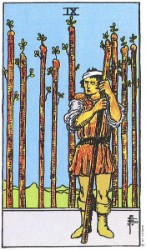
Most of us, though,  don’t wake up grinning every single freaking morning. For some of us life feels very much like the Nine of Wands tarot card:  we’re still standing, we’re still upright and strong, but we’ve had the crap beaten out of us by life and we’re pretty wounded.

And that’s okay.  

That’s where we’re at.  That’s our starting point on the map for the rest of our journey.

Mike Dooley, who has done such wonderful teaching about manifesting and visualizations, often compares reaching our goals to setting a GPS in our cars.  We feed in the information about where we want to go and then the gizmo just takes it from there.  We don’t argue with it or second guess it – we just follow the directions.  In the same sense, he says, we can just set our goals and then let the Universe take it from there.  We don’t need to constantly obsess about the details (what he calls, “the poisoned hows,”) because the Universe will keep popping up new road signs and different paths to get us there.

Implicit in that, though, is the idea that we KNOW where we’re located at the beginning of the journey and we’re HONEST about it.  If I’m in San Jose and I want to get to Phoenix, but I tell my GPS that I’m in Dallas, it ain’t gonna work out too well.

And, in just the same way, if I’m beat up, knocked down, drug around, and life has beaten the stuffing right out of my meditation pillow, putting up Spiritual Post-It-Notes about how grateful I am ain’t gonna work out too well.

Unfortunately, social media sites are generally piss-poor places to be honest about what we’re really feeling.  It’s difficult to admit publicly that we’re NOT the Great and Mighty Wizard of Oz and there may be a lonely, sometimes sad, sometimes frightened person behind the curtain who’s just pulling levers.  It’s especially difficult when so many other people seem to be doing so well.  At least, all of their posts say they’re doing so well.

In a way – and perhaps a healthy way – this impossibly cheerful positivity has intensified since the start of the pandemic.  People really ARE struggling with depression and fear and loneliness and we’re trying to encourage each other to stay in healthy, positive frames of mind as much as we can.

So it may be a good, temporary coping mechanism.  Maybe we DO need to be as optimistic and up-beat as we can be, until we find our way out of this weird, scary virus maze.  It’s what we used to call, “whistling past the graveyard,” and in this case the graveyard is very real and it’s got a half a million Americans in it.

Long term, though, simply pretending that everything is alright when it’s not, doesn’t really work.  It doesn’t get us to our destinations because we’re not being honest about where we’re starting from.

Brad Yates went on to say that there are no such things as negative emotions.  WOW!  But . . . but . . . but . . . I thought I was supposed to be happy all of the time!

Not.  

Repeat – there are no such things as negative emotions.  There are no BAD emotions. 

There are emotions that are uncomfortable.  There are emotions that feel sad or that arise out of situations that are depressing or painful.  But they are all our emotions, they are all part of our story, and they serve to tell us where we are before we take the next step in our journeys.

In 1967, Thomas Harris published a wonderfully cheery book entitled, “I’m Okay, You’re Okay.”  In a nutshell, it promulgated the idea that we’re all just fine, we just misunderstand one another sometimes, and we should always remember that you and I and – gee whiz! –  pretty much everyone is . . . well . . . okay.

To which Elisabeth Kubler-Ross, that amazing wizardess who spent a lifetime studying death and dying, replied:

“I’m Not Okay.

You’re Not Okay.

And That’s Okay.”

And it really IS okay.  It’s right where we’re supposed to be when we take our next step on the journey.

The Fool, Wu Wei, and Touching Your Woo Hoo

Exploring the concept of Wu Wei and the work ethic of drifting.

We all know how to be a success in life, right?  We set our alarms so that we can get up before the sun rises and we work our asses off all day.  We do twice as much as everyone else, put in lots of overtime, and keep working right up until we go to bed.  And some of us actually keep working in our dreams, mulling over the day while we sleep, running through scenarios for when we go back to work tomorrow.  We even have lots of inspirational sayings to reinforce our work-a-holic thinking.

“The early bird catches the worm.”

“Genius is one percent inspiration and ninety-nine percent perspiration.”

“Stay positive, work hard, and make it happen.”

Yay!  Let’s get out there and WORK!

But what if all of that is wrong?  In fact, what if most of it is bullshit?

The Taoists have an interesting concept called Wu Wei, which can be loosely translated as, “doing nothing,” and they say that it’s a major key to success.  A more accurate translation might be, “purposeful inaction,” and the basic idea is that the harder we work, the behinder we get. Taoists love to use rivers and lakes and water in general as metaphors, so we can do that to explain Wu Wei.

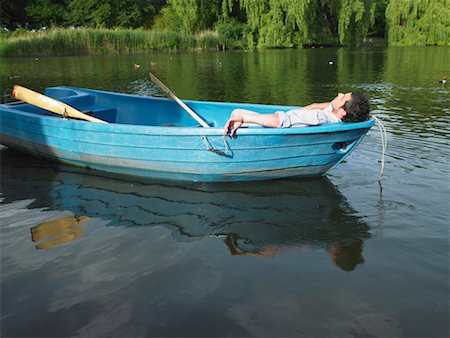
Suppose that you’re floating down a beautiful, green river in your little Rowboat of Life.  There’s a gentle current that’s carrying you along nicely and you’re making good forward progress.  It’s so quiet and peaceful and you can feel the sun warming your face and body.  Perhaps you let one hand trail behind you in the crystal clear water and for just a moment it feels like everything is absolutely perfect.  

BUT . . . you suddenly decide that you want to go faster, because faster must be better, so you grab your oars and you row like hell until you’re exhausted.  And you really haven’t gotten much further down the river.  All you’ve accomplished is to wear yourself out when you could have been just drifting along, enjoying the ride.

But WAIT!  You remind yourself that drifting is wrong!  Drifting is bad!  We need to be GOAL ORIENTED and MOVING FORWARD with MAXIMUM ENERGY AND MOTIVATION at all times.  By now, you know that rowing forward didn’t accomplish much, so you start paddling your Rowboat of Life from one side of the river to the other, just to be doing SOMETHING.  After all, you’re the Captain of your Rowboat!  YOU determine where you’re going and YOU’RE in charge of your destiny!  

 Eventually you realize that you’re making even less forward progress and after a while you get discouraged and put your paddles back in the boat.  You drift along thinking about it and beating yourself up for not making more effort.  Maybe a dragonfly lands on your nose while you’re cogitating.  “Am I lazy?” you ask the dragonfly.  “Do I just not have what it takes to be a winner?”

As you work it all out in your head, you realize that WINNERS KEEP GOING, no matter what the odds are against them.  Real winners are willing to work as hard as they can and then DIG DEEP to find that last reserve of energy to carry them across the finish line!  The harder you work, the more it proves that you’ve GOT WHAT IT TAKES, by god!

So just to prove how hard you work and how inspired you are, you turn your Rowboat of Life around and start paddling AGAINST the current.  You struggle and you strain and at a certain point you have a massive coronary and die, but at least you died a winner, right?

The whole point of this, of course, is that there are underlying currents of energy in the Universe.  They actually help us get to our goals if we just surrender to them and go with the flow.  Life isn’t an enemy.  Life isn’t something we have to fight.  Nature isn’t something we’re supposed to conquer.  We are meant to float as gently on the currents of life as a blossom drifting down a broad, quiet river.

Most of the New Thought writers and speakers have this concept as a central pillar of their philosophy.  In Choose Them Wisely: Thoughts Become Things! Mike Dooley talks about visualizing your goal in general terms and then moving toward it.  BUT he emphasizes very strongly that we don’t need to sweat the details about how we’re going to get there.  The Universe will provide the means and the ways and the paths once we get in harmony with the flow.

Louise Hay, in You Can Heal Your Life writes, “I believe in a power far greater than I am that flows through me every moment of every day . . . Out of this One Intelligence comes all the answers, all the solutions, all the healings, all the new creations.”

In Ask and It Is Given: Learning to Manifest Your Desires Esther Hicks/Abraham, says, “Well-Being is the basis of the Universe.  Well-Being is the basis of All-That-Is.  It flows to you and through you.  You have only to allow it.  Like the air you breathe, you have only to open, relax, and draw it into your being.”

In other words, there is a current of energy, of love, that underlies the entire Universe and our, “job,” our only true, “work,” is to align ourselves with that energy current and drift along on it, knowing that it will take us where we want to go.

The Fool Tarot card is the perfect illustration of this.  She dances along on the edge of a cliff, filled with the energy of love, totally unconcerned about where she’s going or how.  She’s in the flow.  She’s dancing with the energy and if she walks off of the cliff, she’ll just walk on air.

So . . . how do we get to the Flow and how do we know when we’re out of it?  How do we know when we’re paddling up the river, instead of riding the current?

According to Esther Hicks/Abraham, we actually have a compass in our little Rowboat of Life.  It’s called emotions.  And we can check that compass anytime that we want to.  HOW DO YOU FEEL?  If you feel crappy, angry, sad, or resentful, you’re paddling upstream.  If you feel happy, joyous, free, and content, then you’re floating down the river with a dragonfly perched on your nose.  If you’re not feeling anything at all, if you’re emotionally flat and apathetic, then your Rowboat is stuck on a freaking sandbar.  So the key is to get up every morning and say, “Woo Hoo!  I’m alive and I love it!”

We all need to stay in touch with our Woo Hoos a lot more than we are.  We can do that.

Of course, all of this is totally un-American.  Hard work and a lot of sweat are the answers.  Anyone who says different is plain Fool-ish.

Disclaimer: “As an Amazon Associate I earn from qualifying purchases.”

The Ten of Wands, Mike Dooley, and Becoming a Topless Cellist

This is a post about Mike Dooley’s concepts of choosing our goals, visualizing them, and manifesting them. It discusses the Ten of Wands tarot card as a representation of someone who has too many goals and needs to narrow her focus while remaining open to all possibilities.

If you’re a Great Thinker – and most of us at least believe that we are – you probably have a lot of Great Ideas.  In fact, you may have too many.  Way too many.  Let’s talk about that a little bit.

Mike Dooley has a wonderful book called Choose Them Wisely: Thoughts Become Things! As the title implies, what we think will inevitably manifest in our physical lives, sometimes more quickly, sometimes more slowly, but what we think will become our physical realities.  

Now, the Tarot slices our everyday lives into four quarters represented by the Minor Arcana.  The suit of Cups represent our emotions, Pentacles represent our relationship with physical possessions, Swords represent our physical drives and aggressions, and Wands represent our ideas, our thoughts.

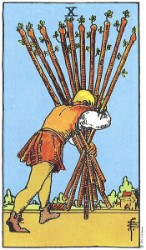
The Ten of Wands is a wonderful representation of someone who has way too many Great Ideas.  Each wand represents a thought and this poor son of a bitch has SO many thoughts going on in his head that he can barely stagger along his path.  He’s literally weighted down with all of his wonderful, fabulous, potentially AMAZING thoughts.  So much so that he can’t even lift up his head and look at the world around him.  All he can do is carry the burden of his thoughts and stare at the path that he’s on, hoping he doesn’t stumble and fall and – goddess forbid – lose his stupefying collection of Great Ideas.

The bad thing about having too many Great Ideas is that it can be just as discouraging as having too few Great Ideas.  It can paralyze us.  We have so many options swimming around in our heads that we just really can’t decide which direction to go in – so we go nowhere.  It’s like we’re saying to ourselves, “Well, I could be a Great Artist, but if I put all of that time and energy into being a Great Artist then I won’t have any time and energy to put into being a Great Writer.”

So we sit around on our asses and worry about that and – in the meantime – we don’t write and we don’t paint.  We’re stuck.  

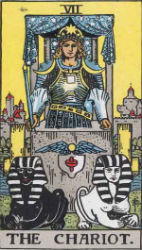
We can actually see a pretty good representation of this with The Chariot card.  You can take one look at this guy and tell that he has some Great Ideas.  I mean, look at those shoulder pads!  Who wouldn’t want a jacket with Moon shoulders?  He’s glorious!  But if you take a little closer look, you see that the Sphinxes aren’t harnessed to anything and he doesn’t have any reins in his hands.  He looks fabulous, but he’s not going anywhere because he doesn’t have any direction, he doesn’t have any focus.  He just can’t decide which way to go.

One of Dooley’s ideas about getting out of the trap of having too few options can also be useful in dealing with having too many options.  Make up a list of your options, of all of the things that you could possibly do to move forward in your life, and then choose the three LEAST SUCKY options and move forward with those.

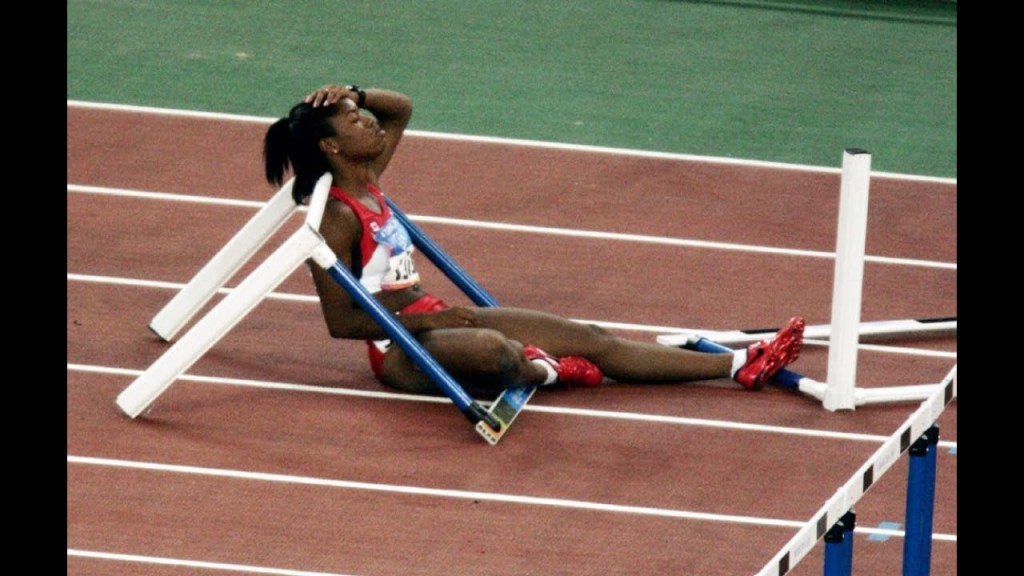
If you have too many Great Ideas, that may sound like a daunting task, but it really isn’t.  My experience is that a lot of my Great Ideas can be slotted under the category of, “Probably Ain’t Gonna Happen.”  For instance, when I was in Junior High School, I got it into my head that I wanted to jump hurdles on the track team.  And I would have been absolutely amazing at it except for the fact that everyone in my family has short legs and I kept jumping into the hurdles instead of over them. 

In the same sense, if you’ve always dreamed of being a porn star and you have a small penis, that, “Probably Ain’t Gonna Happen.”  It doesn’t mean that there’s anything wrong with my short legs or your small penis, it’s just not a good fit.  So to speak.

So we can winnow out a lot of our Great Ideas from the get-go.  And, as we do that, we find that a lot of them are actually pretty Sucky Ideas.  Eventually, as we continue to work on our lists of Great and Sucky Ideas, we’ll come down to the three that are the least Sucky and we can move forward with those.

This is the point where a lot of us get paralyzed again.  Should I really give up on my life-long dream of being a world famous Juggler on the Ed Sullivan Show, just because Ed Sullivan is dead?  Am I making a dreadful mistake in abandoning my idea of being a Topless Cellist at Carnegie Hall?

This is also where Mike Dooley came up with a genius concept:  IT DOESN’T MATTER.  

No matter what we choose, it doesn’t matter.  The main thing is to choose something and then start moving forward with it.  That’s probably the single most important thing that we can do:  get off of our asses and start moving.  And, as we begin to move forward – with ANYTHING – the Universe will provide the next step and then the next step and then the next step and eventually we end up exactly where we want to be.

That takes a tremendous load off of our shoulders, especially if we’re Great Thinkers with lots of Great Ideas.  We really don’t have to decide too much.  We don’t have to spend endless hours analyzing our options, playing scenario tapes in our heads, and fretting over possible disasters.  All we have to do is figure out a couple of our least sucky options and start moving toward them.  We provide the moving feet and the Universe provides the path to walk on.

As Dooley put it, “Do WHAT you can, with WHAT you’ve got, from WHERE you are, and it will ALWAYS be enough.”

And we can overcome any hurdles.  Or, if we’ve got short legs,  we can learn to run sprints.  It’s all good.  It’s all just right.

Disclaimer: “As an Amazon Associate I earn from qualifying purchases.”