The Two of Pentacles, Multipotentialites, and Specializing in Being a Non-Specialist

How to distinguish creativity from attention deficit disorder.

Did you ever walk into a room and then have absolutely NO clue why you did it?  We stand there for a couple of seconds, asking ourselves, “What in the hell am I doing in here?  What did I want in this room?”  Blank. And then we remember that we were looking for our car keys or we wanted to make the bed or maybe there’s a book that we left somewhere and we need to find it.

That happens to everyone, of course, and older people even joke about it.  “I wouldn’t remember where my head was if it wasn’t screwed on.  Maybe I’m getting the OldTimers Disease.”

If it KEEPS happening, though, we may start to hear a little voice inside our mind that’s sounding an alarm.  “Hey, dude, maybe you are getting Alzheimer’s.  Or maybe you shouldn’t have taken all of those recreational drugs when you were a kid.  Or – oh, my god – maybe you’ve got a brain tumor!  Or maybe you’ve got ADHD!”

ADHD-ISH

The truth of the matter is that a lot of us are feeling ADHD-ish these days.  After all, attention deficits can also spring straight out of anxiety and depression and these aren’t the most tranquil of times, are they?  Even if we don’t have personal problems, the news networks and the internet are constantly blasting out the message that the sky is falling and we’re all going to die.  Climate change, pandemics, wildfires, dead celebrities, crazy politicians, oh, my!

Huge numbers of people are feeling distracted, nervous, upset, and having trouble concentrating.  There’s an epidemic of lost car keys and many of us aren’t just keeping to-do lists, we’re keeping lists of our to-do lists.  Try an internet search on, “how to get organized,” and you’ll see how very many us are bewildered, befuddled and befucked.  

AN ALTERNATE VIEW

Now, WAY BACK in the 2010s, Emilie Wapnick noticed that there were many, many people feeling this way.  It wasn’t just that they were having trouble with their attention spans or with getting organized.  Their entire lives felt unfocussed, as if they simply couldn’t decide what they should do next.  

She gave an incredibly influential TED talk called, “Why Some of Us Don’t Have One True Calling,”  and she introduced a radical idea.  Maybe, she suggested, we’re not really ding bats who keep getting distracted by shiny objects.  Maybe we’re actually just incredibly creative people who can’t and won’t be satisfied by a single pursuit. 

The term that she uses to describe people like that is, “multipotentialite.” As she outlines in her wonderful book, “How to Be Everything: A Guide for Those Who (Still) Don’t Know What They Want to Be When They Grow Up,” there are some of us who simply aren’t wired to be single-pursuit human beings.  We may be simultaneously (and passionately) pursuing vocations in art, writing, and auto repair, all the while researching a half a dozen other fields that we’re interested in.  In the past, such a person might have been admired and even lauded for their intellectual curiosity.  Today, they’re frequently labeled as being dysfunctional or misdiagnosed as having attention deficit disorder.

HENRY FORD’S DEMON BABY

Almost from its inception, the Industrial Revolution attempted to turn human beings into mere slaves who operated the machines in the factories.  The model wasn’t really perfected, though, until Henry Ford introduced his, “rolling assembly line,” in December of 1913.  Using that model, workers stand in one place as the product rolls by on a conveyor belt.  Each worker performs one job in assembling the product, and they do that one job over and over, hundreds of times a day. This ushered in the age of specialists.

There is no question that Henry Ford was a thoroughly evil man.  He was such a rotten person that Adolph Hitler mentioned him admiringly in Mein Kampf and kept a large portrait of Ford behind his desk.  Perhaps the worst thing that he did, though, was to champion the idea that a person should specialize in only one thing and do it over and over until his soul dies from sheer boredom.

NOT BELONGING IN THE AGE OF SPECIALIZATION

That idea of specializing in only one thing has it’s advantages, of course.  For instance, if we’re having a heart valve replaced it’s comforting to know that the surgeon has performed the same operation hundreds of time before.  Still, it can have devastating effects if it’s presented as the ONLY model of functioning in our society.

To be clear, multipotentialites don’t just like to pursue multiple interests at once:  it’s what they do.  It’s wired into their brains.  Telling a multipotentialite to specialize in just one area is like telling an introvert to go to more parties or telling a cat to fetch a stick and bark.

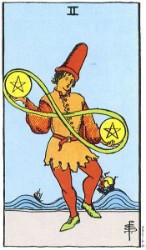
When we take that natural behavior, though – that need to pursue many different interests at once – and drop it into our linear, specialized society, it looks a lot like . . . guess what?  ADHD.  In a culture where concentrating on one task at a time is the behavior that’s rewarded and reinforced, the multipotentialite is frequently perceived as being highly dysfunctional.   Why can’t you concentrate?  Why don’t you ever get anything finished?  Why do you keep jumping from one thing to the next?  Those are questions that the multipotentialite will hear her entire life and it can leave her feeling inadequate, guilty, and shamed.  Like the figure in the Two of the Pentacles, life seems like a constant balancing act, rather than a fulfilling adventure.

STRATEGIZING FOR A HAPPY LIFE

If all of this is striking a chord with you, if you feel that you may be a multipotentialite, then rest assured, there are still ways to find happiness.  There are a few simple strategies that can make you feel like you’ve got super-powers instead of constantly feeling less than.

1. Embrace Your Identity and Fix Your Self-Image: Recognize that being a multipotentialite is a strength, not a flaw. Celebrate your curiosity and versatility instead of forcing yourself into a specialist mold.

2. Consciously Design a Portfolio Career: Instead of choosing one path, build a career that allows you to explore multiple interests. This could mean freelancing, consulting, or combining part-time roles.  If you’re an artist and a writer, for instance, you could do illustrations set off with poetry.

3. Set “Seasons” for Your Passions: Focus on specific interests for a set period, then rotate to another. This prevents burnout and keeps things fresh. This allows you to hyper-focus on a particular avocation, but use boredom as a signal for when it’s time to switch to another.

4. Create a “Renaissance Schedule”: Dedicate blocks of time to different pursuits. For example, Mondays for art, Tuesdays for coding, and so on. Structure helps manage your many passions without feeling scattered.

5. Prioritize Projects: Not every interest needs to become a lifelong commitment. Learn to distinguish between short-term fascinations and long-term passions.

6. Find Overlaps: Look for ways to combine your interests into unique projects. A multipotentialite superpower is the ability to innovate by connecting ideas from different fields.

If you’re interested in exploring more multipotentialite options for living, I’d really encourage you to visit Emilie’s website, “puttylike.   Creativity and curiosity are options that many people seem to have missed out on, so let’s take them to the max.

The Eight of Pentacles, Bras Burning Bright, and the Importance of Social Deviance

A look at the importance of personal and social deviance as illustrated by the war over brassieres.

Imagine a culture that was SO rigid that the people in it actually dictated what kind of underwear you had to put on in the morning.  Sounds pretty crazy, doesn’t it?

Still, that was exactly the situation that we had right here in the United States just 50 short years ago.  It’s a short tale and well worth looking at.

The modern brassiere was invented by Mary Phelps Jacob in 1910.  From that point on it was declared that, “decent,” women would wear bras and breasts would henceforth be encased in cotton cups when they were transported out in public view.

Now, in the late 1960’s, a growing group of women said, “I don’t wanna.”  It wasn’t that they were rigidly opposed to brassieres because, as any woman will tell you, bras can be comfy cosy in winter months and in cold climates.  Rather, they were making the radical assertion that any human being should have the right to decide whether they want to wear underwear on any given day.

Many people in our culture were shocked and appalled at the notion of unfettered breasts.  Women who went braless were actually arrested for, “public indecency,” in some Southern states.  “Decent,” women sneered at them and, “god-fearing,” men leered at them.

Still, the revolutionary bra warriors persisted and even went so far as to hold public bra burning to make their point.

By today, of course, no one cares if a woman wears a bra or not.  Generally speaking, bras go on in the winter time and come off in the summer time, which is perfectly sensible and the way it should have been all along.

The Great Bra Culture War is a perfect illustration of what sociologists refer to as, “tolerated social deviance.”  They actually have a very precise definition of deviance, which goes like this:

Deviance is a behavior, trait, or belief that departs from a social norm and generates a negative reaction in a particular group. In other words, it is behavior that does not conform to the norms of a particular culture or society.

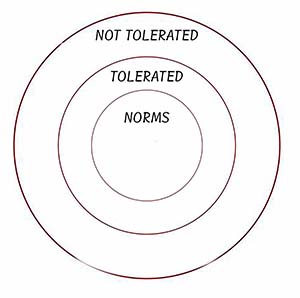
Tolerated social deviance is behavior that’s outside of the social norm, but not so far outside of it that it warrants severe punishment.  We can think of it as a series of concentric circles where the inner circle is the norm, the second circle is outside of the norm but it’s tolerated, and the outer circle is SO far outside of the norm that it will get you arrested.

In that model, during the first half of the 20th century not wearing a bra in public was in the outer circle and would result in a woman being shunned, slut-shamed, or arrested.  After the 1960s, not wearing a bra moved into the second circle of being outside the norm, but tolerated.  And by now, it’s moved into the inner circle of perfectly acceptable behavior, except in Mississippi.

The point of all of this is that freedom and creativity exist OUTSIDE of the norm.  That inner circle of social norms consists of people behaving in exactly the same way as everyone else.  The behavior is, “acceptable,” precisely because everyone else is doing it.

The world of the social norm is what Stuart Wilde was talking about when he referred to the Tick-Tock world.  As he pointed out in his book, “Affirmations: How to Expand Your Personal Power and Take Back Control of Your Life,” the Tick-Tock world involves getting up every day and doing the same things over and over and over because that’s what society expects of us and we don’t want anyone to think we’re being weird or unusual.  “I have to wear a bra because everyone else wears a bra and what would the neighbors think if I didn’t?”

To put it in terms of energy, it’s a closed system.  There’s nothing new or different flowing into it, because everyone is acting and thinking exactly the same way.  It’s like the guy in the Eight of Pentacles who’s just making the same product over and over again, but not creating anything new.

Deviance is thinking outside of that closed box.  Deviance is what allows fresh, different energy into the system.  Deviance is what makes us evolve.

We see this in cultures all across the world.  The most creative, vibrant cultures are the ones that tolerate the highest levels of diversity.  China and Russia, for instance, have extremely low tolerance for diversity and social deviance.  Are they producing any great literature?  Any amazing art?  Fabulous music?  Is anyone desperately trying to get into their countries?  Nope.

Put very simply, the best cultures are the cultures that maximize freedom and diversity.  Those are the cultures that are the most alive and evolving the fastest.

I’ve lived in both California and Texas.  I CHOOSE to live in California because California maximizes my opportunity to be just as different, weird, and unusual as I want to be.  California values social deviance and so I have a much greater opportunity to be my authentic self, to the best of my abilities.

It’s important to ponder all of this as we move into the new era of the Trump administration.  Are we going to continue to be a society that values  and encourages diversity or are we going to become a closed, intolerant  and stagnant energy system?

Make no mistake:  there ARE people out there who are so crazy that they want to tell us what kind of underwear we should put on in the morning.  They want to shrink those two outside circles into one boring inner circle where everyone looks and acts precisely like everyone else.  

Don’t let them do it.

Empaths, Elections, and Staying True to Our Own Energy

Building effective boundaries for empaths.

If you’re an empath and you’ve been feeling kind of sick to your stomach lately, believe me – you’re not alone.  Many of us have experienced the recent election in the United States as something that makes us want to curl up in a ball under a blanket for the next four years.

It’s important for us to explore how this is affecting us from a bioenergetic perspective, though, and not just from a political or emotional perspective.  What is all of this DOING to our energy and our energy fields?

What’s one of the first words that come to mind when we contemplate being an empath?  Boundaries, right?  Boundaries, boundaries, BOUNDARIES!  

Empaths have extremely porous personal boundaries and very leaky energetic boundaries.  In a way, that’s what makes us empaths.  “Normal,” people have fairly strong boundaries and a strong sense of, “I’m over here and you’re over there and we’re two separate beings.”  For a normie, what another person is feeling stays inside of the other person, unless the other person decides to share it.  For an empath, other people’s feelings are constantly flooding into us. It’s very easy for us to merge with those feelings and mistake them for our own.

That’s one of the reasons that many empaths become codependent.  We merge so totally (and so easily) with other people’s emotions that we mistake them for our own.  If someone we’re close to is having emotional or mental problems, we think that we have to manage their drama because it feels like it’s our own. We end up taking care of their lives instead of our own.

So one of the first steps to becoming a healthy empath is to learn to identify our own energy and separate it out from other people’s energies.  We learn this at an early age and many of us become socially avoidant as a result.  We realize that if we’re around people who are angry, depressed, or violent, that we just soak all of that in and it fucks us up.  One strategy we use to deal with that is to just avoid people in general: many empaths become radical introverts.  Which works, but it’s not the BEST strategy, right?  We really can’t cover our heads with the blankets for the next four years.

Can we?  Um . . . no.  I guess not.

We have to learn to separate our energy fields in better ways.

The human energy system is really quite simple to visualize.  As Alla Svirinskaya says in her book, “Own Your Energy – Develop Immunity to Toxic Energy and Preserve Your Authentic Life Force,”  we can think of it as the physical body or core, which is surrounded by a couple of other energetic layers or bodies which are the emotional body and the mental body.  Those other bodies are usually seen as egg shaped, so we end up with a picture of it that looks like this:

For a normie, those extra layers act as a wall to keep out other people’s energy. They filter out negative energies so that they never reach the core of the physical body. For an empath, though, they act as a bridge.  Instead of blocking us off from the emotional identity of people who aren’t us, they allow it to flow right into our personal energy fields which frequently overwhelms us, leaving us confused and injured.

Most empaths are dealing with those dynamics on a daily basis.  What we forget, though, is that our personal energy fields exist inside of larger energy fields.  Any time that you put a group of people together, their personal energy fields are going to merge to some extent and generate a group energy field that’s composed of the collective emotions of all of those people. And we live within those other energy fields.

In a very real sense, we could talk about the vibrations of a particular town or a county or a state.  Those vibrations are the collective energies of the people who live in those places.  Texas, for instance, has a very different vibration than California. And, yes, countries have a collective energy field, too, which is brings us back to the topic at hand:  dealing with this election.

About 72 million Americans got together and voted for a candidate who oozes hatred and anger out of every pore of his orange skin.  THAT is the collective energy that we’re dealing with right now and THAT is what’s making us feel sick.  Put simply, there’s a whole lot of hatred and anger out there in the collective energy field and it’s seeping in to our personal energy fields.  As empaths, we are especially vulnerable to this.

So what can we do about it? Well, we need to remember that the key to being a healthy empath is to be able to distinguish OUR energy from OTHER’S energy.  We need strong boundaries and we need that sense of, “this energy belongs to me and that energy doesn’t.”

Empaths are (for the most part) kind, loving, compassionate people.  That just goes with the territory.  When you really and truly understand another human being on the deepest level, it’s very difficult to stay angry with them.  Or to hate them.  Or to judge them too harshly.

Hatred, anger and judgements are NOT our energies and that’s why they make us sick.

A good strategy for us, then, is to be very conscious of those energies existing inside our personal fields. If we start to feel really, really, REALLY pissed off at the Trumpsters, we can stop and say, “This is NOT my energy.  This is their energy.  I won’t own it.”

Another strategy is to do what Chagdud Tulku called, “antidoting.”  The antidote for hatred is love and the antidote for anger is compassion.  I’m not suggesting that we turn ourselves into human doormats for the Trumpsters.  Rather, we’re just embracing our own nature.  By embracing our own nature, by being as compassionate, kind, and caring as we can, we automatically separate OUR energy from THEIR energy and – surprise, surprise! – we’ve got boundaries.  Suddenly, they’re over there and we’re over here and we don’t have to live in their hatred or let it blend into our energy.

Shazam!

The Moon, Processing the Election, and Summoning a New Reality

Processing the craziness of the U.S. election and waiting for a new world to manifest.

MORE THAN JUST THE BLUES

So how are you doing out there after this crazy election?  If you’re a liberal, an empath, or an intuitive, you’re probably feeling puzzled, sad, angry, depressed, and – to a certain extent – scared.

And, unless you’ve just sworn off rationality (like the other half of the country) you’re probably trying to figure this out.  What in the HELL just happened?  It’s more than just a normal case of post-election blues.  It’s a need to restore some sense of sanity to our daily lives.

YES, THEY REALLY ARE CRAZY

The first thing to acknowledge is that, yes, the Trumpsters really ARE crazy.  There’s an old argument that says, “A million people can’t be wrong.”  But they can be and frequently are.  Millions of people supported Hitler and Stalin.  Millions of people supported the Catholic church raping and burning and murdering it’s way across several centuries.  Not only is there not truth in numbers, there’s frequently collective insanity.

DEFINING CRAZY

If you joyously embrace something that’s going to fuck you up, you’re crazy.  We recognize that fact with addicts who stick the needle in their arms one more time or alcoholics who pick up a bottle again.  Bi-polars who quit taking their meds.  Abused spouses who go back to their abusers.  If we choose self-destruction, we’ve left the realm of sanity.

In my lifetime, there has never been an election where more people voted against their own self-interest.  Women voted for a man who wants to end their control over their own bodies.  Latinos voted for a candidate who calls them murderers and rapists.  So-called Christians voted for a serial adulterer who’s violated nearly everything that Jesus ever taught.  And on and on.  They’ve chosen someone who is going to destroy their lives, therefore they’re crazy.

TRYING TO RESTORE BALANCE

One of the first things that we do when we’re confronted with a whole lot of crazy is to try to restore a sense of balance and sanity.  There must be some reason why they acted so crazy, right?

That’s our rational, left-brain, linear thinking trying to understand why they acted as they did.  A sense of sanity is very important to human beings.  It makes our environments predictable, it makes our lives orderly and meaningful.  More than anything else, it gives us a sense of safety and we need a sense of safety to function.

This is why we’re seeing all of the post-election analysis.  “What is it that women really wanted?  What issues are really important to minorities?  What message was rural America really trying to send?”

PROCESSING CRAZY

The sad truth, though, is that if we try to process non-rational behavior from a rational perspective, it just makes us crazy.  There are million reasons out there for why different people voted for Trump.

I couldn’t bring myself to vote for a woman.

I didn’t like her laugh.

I’m paying too much for groceries.

I’m worried about immigrants.

I’ve always voted for Republicans.

I hate liberals.

He didn’t REALLY mean all of those things he said.

Any and all of those reasons pale in comparison to the reality of voting for a senile, hateful, con artist who announced that he intends to be a dictator and end democracy as we know it.  When we put the reasons next to the results, they’re all crazy.

THE MOON CARD AND CRAZY

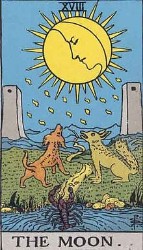
The Tarot card, The Moon, is all about crazy.  It shows a dog and a wolf baying at the Moon, while a crustacean crawls out of a dark pool.  It illustrates that even our domesticated dogs still contain the genes of the wild wolf and our brains still contain the primitive, crocodile brain that motivates hatred and fear.  The light of the Moon illuminates but doesn’t delineate.  We see a shape on the ground and we don’t know if it’s a snake or a rope.

What happened in our last election was all about illusions, delusions, and trickery.  It was the wolf snapping it’s ravenous jaws at our doors and the crocodile gnashing it’s teeth.  It was a cultural and spiritual disaster.  It was crazy to the max.

CREATING ALTERNATIVE REALITIES

So if we can’t use our rational minds to really understand what just happened, what do we do?  Well, we ask for answers and wait for alternative realities to emerge.

We need to give our subconscious minds – which are also our links to our higher selves – time to process all of this craziness.  What we just got was the equivalent of a massive data dump.  We just now found out that over half the country supports a very evil (yep, I’m going to use that word) agenda.  It contains racism, sexism, homophobia, xenophobia, and fascism.  We simply can’t assimilate all of that data at once.

What we CAN do is to actively engage with our subconscious minds (and thus our higher selves), ask for answers, and wait for them to emerge.  That means doubling down on meditating, prayer, lucid dreaming, reading Tarot cards – whatever our particular means is of creating a dialogue with our subconscious and higher selves.  That means actively asking for answers.

IT TAKES A LITTLE WHILE

As we know, the subconscious mind doesn’t have a drive-through window.  We can’t just cruise up and order an answer to all of this with a side of onion rings or fries.

We also know, though, that our subconscious minds, our higher selves, and our guides and helpers are infinitely creative.  Right now, at this very moment, they are weaving together a tapestry that will contain the answers we need.  As spiritual seekers we don’t drive out the darkness – we bring in the light.  The light will start to emerge over the next couple of months and it will emerge through us.

The Five of Wands, Louise Hay, and Becoming the Grown Up Who Lives in Our Heads.

A look at childhood programming and using affirmations.

If I were to say, “Your thoughts are total bullshit,” you’d probably feel highly insulted.  On the other hand, if I were to say, “My thoughts are total bullshit,”  you might agree with me or you might tell me that’s not true and wonder where I got such a terrible self-image.

But if I were to say, “A lot of OUR thoughts, as human beings, are total bullshit,” that’s a more fertile ground for discussion simply because it depersonalizes it and takes us out of a fight-or-flight reaction.  We don’t have to defend anything or run away from being criticized.

In, “You Can Heal Your Life,” Louise Hay made the point that, at their base, our thoughts really mean nothing at all.  They’re just words that we string together and they don’t take on any meaning by themselves.  We have to ASSIGN meaning to them.  We have to say, “I believe these thoughts are true.”

And, oddly, our beliefs are nothing more than thoughts that we’ve repeated over and over and over until we believe that they’re true.  When we take a little closer look at those thoughts we can understand exactly why so many of them really are bullshit.

First of all, a lot of our thoughts were, “installed,” in our little brains when we were far, far too young to make any rational judgements about their validity.  By the time that we reach late adolescence most of us have been thoroughly programmed with unexamined thoughts that we believe to be true.  The richest source of the programming is our families, of course, but we get a hefty dose of it from our teachers and peers, as well.  Some of those thoughts might be things like:

I’m no good at math.

I can’t dance.

I’m a terrible athlete.

I’m not very good looking.

I’m too fat or too skinny or too tall or too short.

I don’t fit in.

Nobody likes me.

Or the thoughts might be something like:

Democrats are communists.

Republicans are fascists.

Rich people are heartless.

People who don’t practice my religion are evil.

Black people are scary or white people are arrogant honkies.

Immigrants are too lazy to work AND they’re going to steal my job.

These are all just words, strung together to make thoughts, which were repeated over and over when we were young until we came to believe that they must be true.

The truth of these beliefs were totally unexamined when we were kids because we didn’t have the mental capacity to evaluate them.  If our parents or teachers told us they were true, well then – hey –  they must be true because that’s what the grownups said. For the most part, though, they remain unexamined when we’re adults, which is the second reason that many or our thoughts are total bullshit.

Most of our thoughts are subliminal, which literally means, “below the light.”  In this case, we mean, “below the light of consciousness.”  We just think them, without even being aware of the fact that we’re thinking them.  That’s the infamous, “stream of consciousness,” or, “monkey mind,” that engages about 20 seconds after we wake up in the morning.  It’s just a ceaseless chatter that runs along by itself and contains – buried in its content – all of that programming that we got as kids.  It sounds like this:

Gotta get the coffee going, godamn it’s cold, I wonder if I have enough gas in the car, should have balanced the checkbook but I’m no good at math, gotta get the kids up and make breakfast, can’t believe the price of eggs, it’s the rich Republicans driving the prices up, nobody cares about working people, if only I had a better job but I’m not smart enough to get a better job, where are my socks . . .”

The unexamined thoughts that were programmed into us when we were kids are running over and over again, all the time, and remain unexamined.  And, yes, thoughts that are repeated over and over become beliefs and, like the people in the Five of Wands, we’ll fight to the death to defend our beliefs.

Which is the third reason that most of our thoughts are bullshit.  We’re totally ego involved with them.  Most of us, most of the time, completely identify with that subliminal thought stream.  We experience it as, “These are MY thoughts in MY mind, therefore, they’re a part of me.”  It never occurs to us that they’re not really our thoughts.  They’re our parent’s thoughts and our teacher’s thoughts and maybe even the thoughts of that bully who tortured us at recess in the third grade.

Affirmations, as Louise Hay points out, are a simple way to step out of that thought stream and start changing our beliefs by changing our thoughts.  Let’s face it:  most of don’t have the time to just sit there all day and watch our thoughts.  “Ah HA!  There’s another negative thought from my childhood programming!  Take THAT, negative thought!”

What we can do, though, is to become a little more conscious of our thought streams.  Even when we’re working or driving to the store or taking a shower, we can watch the mind chattering away and consciously think, “Okay, that’s a pretty negative thought,  And it’s probably not MY thought; it’s just something my mind was taught when I was a kid.”

When we begin to dis-identify with that constant stream of thoughts, we immediately lose the need to defend them.  After all, they’re not really my thoughts, so why should I care about them?  And then we can begin to replace all of that subliminal programming with programming that we consciously choose.

Just pick a positive thought – any positive thought – and repeat it 3 or 400 times a day.  Does that seem like a lot?  Well, how many times a day do we say something negative to ourselves with that childhood programming?  Hundreds of times, right?

If that sounds like a sort of a forced, Pollyanna Positivity it’s because it is. We are quite literally pushing our thoughts in a new direction and it can feel completely unnatural to begin with.  But that’s the whole point:  there’s nothing, “natural,” about our unhappy beliefs, either.  They were just thoughts that were repeated again and again, often by the miserably unhappy adults who raised us.  That’s all that happy beliefs are, too – thoughts that are repeated again and again until they become beliefs.  And we get to be the adults who are repeating them, which is pretty cool.

The Emperor, Psilocybin, and Butterfly Warriors

A look at the role of psilocybin in erasing toxic masculinity.

And then there’s the amazing case of Mark Matzeldelaflor.

Mark was a Navy Seal.  In case you’re not familiar with that, the Seals and the Green Berets are the ultimate warriors.  Incredible athletes, highly disciplined and impeccably trained, they are considered the finest combat soldiers in the world.  

Mark was also a professional sniper in the Seals.  His job was to kill other human beings by shooting them with high powered rifles, as rapidly and effectively as possible, and he was very good at it.

After serving two tours in Iraq, he left the military and returned to the West Coast, where he became an emotional and spiritual shipwreck.  He drifted from one meaningless job to another, drank too much, suffered from horrible PTSD and sank into depression and suicidal ideation.

Then one day a buddy of his said, “Hey, man, why don’t you take some Magic Mushrooms with me”. And it all went away.  All of the trauma, all of the depression, the alcoholism, the PTSD – it vanished from his heart and brain like . . . well . . . magic.

Mark immediately started trying to use his new world view to help other veterans and started an organization called Guardian Grange.  The idea is to use the discipline and talents that they’ve acquired in the military but channel that into helping to save the earth.  And their first project is . . . a refuge for monarch butterflies.

Now, I’ve written quite a bit here about toxic male role models and I find this story so amazing from that perspective.  When we think of the classic toxic male, we tend to envision a guy who’s taken a few too many steroids, muscular, swaggering, fairly devoid of emotions, unable to admit any vulnerabilities, and a bully.

That kind of a guy becomes a sort of a silly cartoon when you put him up against the reality of a Navy Seal.  These are men who can run or swim for hours with no rest, survive in a jungle or desert with no food, and kill with no mercy or compunction.

So how does someone who is literally a stone cold killer suddenly become a Butterfly Warrior?  It’s fascinating to think about, isn’t it?

The normal cultural model for male/female behavior is based on hormones.  To put it in a nutshell, men are chock full of testosterone and that makes us aggressive, dominant, and violent.  Women are flooded with estrogen, and that makes them passive, nurturing, and weak.  That model was given a huge boost by Sigmund Freud, a man who wanted to fuck his own mother and thought the clitoris was utterly unimportant in female sexuality.

Despite it’s rather shaky logic and dubious proponents, that remains the model that most people operate out of:  we’re simply predetermined products of our hormones.  But what if we’re not?

Scientists are just now beginning to really dig into what psilocybin does to the human brain.  They know, for instance, that it has some sort of a strong interaction with serotonin and pleasure receptors, meaning that it makes us happier.  They know that it vastly increases the connectivity between different parts of the brain, so that parts of our brain that don’t usually, “talk to each other,” are suddenly communicating.  They know that it suppresses activity in other parts of the brain, such as the portion that maintains our sense of self and ego.

Still, there’s much more that we DON’T know about how Magic Mushrooms affect our brains than what we DO know.  Somehow it erases depression, anxiety, PTSD, and suicidal ideation.  And – I suspect – it may also erase toxic male role modeling.

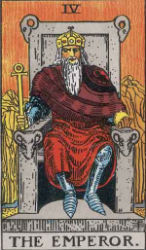
My symbol for the Male Archetype in our culture is The Emperor.  He’s strong, he’s heavily armored, he’s living in a barren environment, and he’s very much alone.  He rules, but he’s paid a heavy price for his crown.  He is, above all else, disconnected.

One of the best descriptions I’ve read of what psilocybin does to the human brain is that it’s just like a snow globe.  It picks up our brains, gives them a good shake, and a lot of our normal neural pathways are disrupted and fly off in totally new directions.  If you’re more into mechanistic models, it seems to instantly rewire our brain patterns.

Dig what Mark said in that interview:  “I just reconnected to nature and my past, where I was like a kid in the woods.”  That description is what we hear from many other people who have taken psilocybin:  an instant sense of reconnection with the earth and with meaning.

Now, there’s no suggestion that psilocybin caused a huge drop in Mark’s testosterone levels or that he suddenly became a eunuch and that’s what took away his aggression or his toxic male role modeling.  He simply instantly learned how to be a male in an entirely different way than what WE ARE TAUGHT that it means to be a male.

All of this is strongly indicative that, “manhood,” is much more in our heads than it is in our testicles.  Toxic masculinity may very well consist of a series of enculturated neural pathways that are so deeply burned into our brain tissue that they’re nearly impossible to overcome.  Unless someone picks up that snow globe and gives it a good shake.

We can’t expect that taking psilocybin will turn our culture around anytime soon.  For one thing, we’re taught from the cradle that some form or another of toxic masculinity is good, that this is the way that a real man behaves.  For another, there’s no money to be made by the pharma industries where psilocybin in concerned.  It’s out there and it’s relatively cheap, so why manufacture it?

Still, it’s a start.  If a man who was the most efficient killing machine the military can manufacture can suddenly turn into a warrior for butterflies that’s . . . a miracle.  

There’s hope.

Another way to almost instantly expand your consciousness is to buy my ebook, Just the Tarot, available dirt cheap on Amazon.

The Fool, Flowing into Fun, and Making Wu Wei Our Woo Hoo

A look at Flow State as a spiritual practice.

Most people know about being, “in the Flow,” also known as being, “in the Zone.”  It’s that feeling of engaging in an activity with such concentration and perfection that it’s as if we somehow become the activity and the activity becomes us.

Dancers and athletes talk about being in the Flow when they turn in a performance that’s absolutely flawless and they somehow go far beyond what they’ve ever been able to do before.  Artists and writers have the same sort of an experience when they plunge so deeply into their work that it’s almost as if the painting is painting itself, or the page is filling itself with beautiful images.

One of the fascinating things about Flow state is that the world seems to disappear for a while.  There’s nothing in our consciousness except the activity that we’re engaging in.  It’s like a trance. Painters will frequently start a painting and then, “wake up,” six hours later, having lost all track of time, their environment, and anything else but the surface of the canvas.

Oddly, we see very much the same phenomenon with people who are plagued by ADHD.  They may spend most of their lives jumping from one activity to another, unable to focus or stay on task for more than a few minutes.  When we take those same people, though, and sit them down in front of a video game, it’s a very different story.  They go into a state of hyper-focus and will frequently become so immersed in the game, so ultra-concentrated, that they may not leave it for hours.  They’re in a trance and the world has disappeared.  They’re in the Flow.

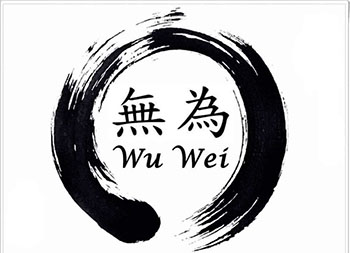
Hungarian psychologist Mihal Csikszentmihalyi first noted the Flow state in 1975, but Taoism pegged it centuries ago and calls it, “Wu Wei.”  Wu Wei can be translated as, “inaction,” or, “doing nothing,”  but a closer definition is, “effortless action.” Which is exactly how we feel when we’re in the Flow.  We feel that we’re completely in synch, in the groove, in harmony with whatever activity we’re engaged in and it becomes totally effortless.

Now, a lot of Westerners have had trouble with the idea of Wu Wei, because they glom onto the idea of just doing nothing, rather than doing something effortlessly. As lovely as it can be, sitting on a beach dangling our toes in the water is NOT Wu Wei.  

We are in the Flow state when we are involved in an activity for which we have some skill.  When we’re doing something completely. Somehow in that process our ego disappears, our environment disappears, and our sense of time disappears, which is pretty much the definition of a transcendent spiritual experience.

To put it another way, we’re co-creating with the Universe.

Mike Dooley hints at that process when he’s talking about the art of visualizing and manifestation.  He says that the Universe acts as a sort of a GPS system that guides us to our goals, constantly popping up directions and resources to get us where we want to go.  BUT . . . we have to actually start the car before the GPS system starts to work.  We have to get our asses in gear and move before the Flow state happens.

The closest that the Tarot gets to portraying that state is The Fool.  The Fool is dancing along at the edge of a cliff, so absorbed in his joy that he really doesn’t even see the precipice.  The message of the card is that even if he dances off of the edge he’ll just go on dancing on air.  He’s in the Flow.

The neat thing about all of this is that, when we look at being in the Flow AS an act of co-creating with the Universe, then it becomes a spiritual practice.  It becomes a way of communing with our higher powers or spirit guides or angels or whatever we want to call them.

All we have to do is to figure out what gets us into that state of Flow and DO IT.  It can be almost anything.  It can be painting or writing or dancing or gardening or cooking or having incredible, mind-blowing sex.  It’s just a matter of thinking about what activities come the closest to putting us into that trance state.  What is it that, when we do it, the world disappears for a while, time stops, and we completely forget our egos?

Once we identify the activity – and we all have at least one – then we build it into our lives more and more.  Every time that we engage in our particular Flow activity, we form a stronger and stronger bond with our higher powers and our higher selves.

And it’s fun.  It’s lots and lots of fun.

The Emperor, Robotic Cats, and Suicide Among Elderly Men

Examining the reasons for the high suicide rate among elderly males.

I was just reading an article about suicide in the elderly and the author – a certified therapist with a PhD, mind you – suggested that a good preventative might be a robotic cat or dog that we could talk to and sleep with.  That way, we wouldn’t be lonely and, if we weren’t lonely, we wouldn’t be offing ourselves at record numbers.

Now, if you weren’t already suicidal, the idea of having to get a little cat robot to be your best friend would surely drive you over the edge.  It’s such a radiant example of NOT understanding suicide in the elderly that it’s almost breathtaking.

Here, kitty kitty!  Oh, shit, her batteries are dead.  Might as well just kill myself.

The, “reasons,” for elder suicide are all over the place.  According to the experts, it’s because we’re lonely, or we’re socially isolated, or we’re sick, or we don’t have jobs anymore, or our spouses died, or we’re invisible in a youth-culture, or we never get touched by anyone.

My very favorite is that elderly people commit suicide because they’re . . . drumroll, please . . . depressed.  

You think?

After spending several days combing through articles and studies about why elderly people kill themselves, I came to two conclusions.  One – nobody really knows why.  Two – nobody is very motivated to find out.  From a purely dollars and cents perspective, it doesn’t make a lot of sense to social scientists to study elderly suicide because – hey! – old people are, you know, old.  Why spend a ton of money studying how to keep them alive when they’re supposed to die soon anyway?

They have pretty much pinned down the people at the highest risk. The person who is most likely to commit suicide in the United States is an elderly, white, male, introvert with a family history of suicide.

Males kill themselves four times more than females.  Apparently it’s one of our special skills, though it’s probably best to not note it on our resume’s.  No surprise, then, that those statistics would go across all of the age groups and extend into old age.

I can also understand the factor of the family history of suicide.  Perhaps that’s just a genetic predisposition to depression, but once you’ve seen suicide modeled in your own family, it’s hard to unsee it.

Introversion is a little harder to grasp, because it exists across such a broad spectrum and means so many different things to different people.  About 52% of the general population are introverts but most of them are obviously not suicidal.

Researchers have been quick to make the leap from introversion to loneliness and social isolation, though.  Under that model, introversion = social isolation, which = loneliness, which = depression which causes suicide.

Leaving aside the fact that those us with robotic cats are hardly lonely, other statistics would seem to refute this approach.  Elderly women actually report much higher levels of feeling socially isolated and much higher levels of feeling lonely than elderly men.  If there was causation from those factors, we’d expect to see the gender statistics reversed, with women killing themselves at four times the rate of men.

There’s another interesting difference we can discern when we look at a recent study from UCLA.  Dig this:

“What’s striking about our study is the conspicuous absence of standard psychiatric markers of suicidality across all age groups among a large number of males who die by suicide,” said Kaplan, a professor of social welfare at the UCLA Luskin School of Public Affairs. They found that 60% of victims had no documented mental health conditions.

In other words, the standard perception of suicide as being caused by long term mental illness simply isn’t born out.  Suicidal men aren’t crazy, they’re just suicidal.

So, if elderly men aren’t killing themselves because they’re more lonely, more isolated, crazier, or more introverted than everyone else, what’s causing it?

I suspect that a large part of it may lie in another part of the description, which is, “white male.”

Of all of the many groups in the United States, there is no group that is more likely to fully participate in the toxic masculine paradigm than the Caucasian male.  We have, simply by being born with white skin, more access to the education and financial resources that enable us to become completely enmeshed in the insane pursuit of money, power, and position.  We abandon our own authenticity in that lifelong pursuit.

When we look at the Tarot card, The Emperor, we see the ultimate outcome of that paradigm.  Yes, he’s sitting on a throne and he’s powerful.  He’s also completely and totally alone, covered from head to toe in his armor.  Everything around him is a blasted, sterile wasteland. No friends.  No lovers.  No family.

He doesn’t even have a fucking robotic cat to sit on his lap.

When we talk about toxic masculinity, we mainly frame it in terms of the negative effects that it has on women who come into contact with it.  We tend to forget that it’s the men who are carrying all of those toxins around with us.  And it’s killing us.

Is it likely that white American males will begin to look at the female paradigm or perhaps people of color and try to figure out why we’re killing ourselves and they’re not?  Probably not.  On the other hand, artificial intelligence is improving by leaps and bounds.  It’s only a matter of time – hopefully a very short time – until we’ll all have robotic cats and dogs who can actually talk to us and help us deal with our emotional problems more realistically.

Here kitty kitty!  I have some brand new batteries for you, sweetheart.

I am very pleased to announce that my ebook, “Just the Tarot,” is now available FOR FREE on Amazon for anyone who has a Kindle Unlimited membership. The cheapest robotic cat that they offer is $113.00 so this is just one hell of a deal.

EMPATHS, EARTHING, AND MEDITATING CODEPENDENTS

Staying grounded as an empath.

So I just received my Amazing Hooga Earthing Mat from the very nice UPS driver and I should be incredibly spiritual after just a few days of using it.  

The basic theory behind them is that our energy systems get in a kerfuffle because we’re exposed to negative people, places, and things and, when we walk barefoot on the Earth, it restores our systems to their natural, harmonious balance.  Earthing Mats simulate that very same energy and get our auras all fluffy and pretty again.

I decided to get one because I’ve recently become aware of the fact that it is of tantamount importance for empaths to stay thoroughly grounded.  If we don’t, we start to dissolve like a piece of salt in the rain.  Earthing is a dandy way to avoid that.

EMPATHS AND EMPATHY

Being an empath is sort of hard to describe to a, “normal,” person.  First of all, of course, being an empath is not equivalent to being empathetic, although most empaths are highly empathetic.  An empathetic person might sympathize with another individual to a point where they can imagine what the other person is feeling and thinking.  Empaths actually experience what the other person is feeling in real time.

Empaths are also not psychics, although most psychics are empaths.  A psychic will focus on another person, “read,” their energy, their emotions and their thoughts, and then weave all of that into a coherent meaning, much like telling a story.  Empaths, on the other hand, are simply bombarded with information about the other person without really knowing what it all means.  We automatically glean far more details about the other person’s energetic and emotional state than what’s on the surface, but we don’t necessarily know how to put it all together.

To make it even more confusing, there isn’t just one type of empath.  There are empaths who actually hear what other people are thinking.  Other empaths feel other people’s emotions as they occur.  Some are telemetric empaths who, “get a reading,” merely by touching a piece of clothing or jewelry that someone else has owned.  A few empaths are highly attuned to the feelings of animals, but won’t pick up anything from other human beings.  Precognitive empaths may get very strong insights about what’s going to happen to a person in the future.

EMPATHS AND EGO STRUCTURE

One thing that all empaths have in common is a relatively weak ego structure.  It makes perfect sense, when we think about it.  Our ego is our sense of who we are, and the first part of knowing who we are is knowing that you’re over there and I’m over here.  Your, “you,” starts with your skin and all of your emotions, energy, and thoughts reside inside of your skin and all of mine reside in mine.  The only way that another human could possibly know what we’re thinking is if we tell them.

Which is very much not true for empaths.  For an empath, what’s going on in the other person’s mind is also going on in our minds, simultaneously with what WE’RE thinking.

All of which can make for a very confusing state of affairs, because we’re never quite sure which part of the conversation is ours and which part is yours.  For an un-grounded empath, there really ARE no significant boundaries or borders.  

There’s an old Spanish expression which goes, “Mi casa, su casa,” or, “My house is your house.”  Now change that to, “My brain is your brain,” and you get an idea of how truly weird it can be for an empath to hold a simple conversation.  Most empaths have to sit quietly after a meaningful exchange and decode exactly what thoughts came from which person.

EMPATHS AND CODEPENDENCY

One of the ways that the weak ego structure of empaths shows up is in codependent behavior.  Codependents tend to revolve around other people, much like the moon revolves around the earth.  Sometimes that’s a result of having been raised in an alcoholic or abusive family.  Sometimes it’s because we have a particular personality type.  And sometimes it’s because we’re empaths who haven’t learned to separate ourselves from other people.  

What happens with empaths is that we become enmeshed in the other person’s energy, in their thoughts, emotions, and their life patterns.  Since empaths already have a weakened sense of boundaries, they can easily dissolve into a more dominant person’s energy system.  In essence, they become overwhelmed and end up as bit players in someone else’s movie, instead of starring in their own.  They not only feel the other person’s emotions, they become the other person’s emotions.

EMPATHS AND MEDITATION

Empaths also need to be very careful about the type of meditation they practice.  

Many types of meditation are geared toward weakening the ego structure.  We’re basically trying to get past that chattering mind stream that prevents us from truly relaxing into deep meditation.  Those techniques involve what’s referred to as a, “bare awareness,” method, where we might focus on our breath or a mantra, or a candle flame, until the chattering mind calms down and recedes into the background.

BUT . . . studies have increasingly shown that meditation is highly correlated with PSI or psychic abilities.  If we tritty trot off to a meditation center for a two week retreat, we’re probably going to be more psychic coming out of it than we were going in.  For a normal person, that involves a significant decrease in ego control and, “becoming one,” with the universe and our fellow humans.

An empath, though, is already wide open and our challenge lies in shutting down some of that in-flow of information.  Deep meditation can destroy whatever barriers we’ve managed to erect and leave us completely adrift in other people’s energies.

Mindfulness meditation seems to be the, “go to,” method for empaths.  It’s a constant reminder to stay in our own bodies in the present moment and to separate from all of the drama out there.

THE EIGHT OF WANDS

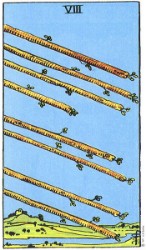
Being an empath can feel very much like the Eight of Wands looks.  Wands represent ideas and this card shows inspired ideas raining down from heaven.  For an empath, though, the ideas may be far from inspired and not at all our own.  

If everyone we met was in a perfect, loving place, being an empath could be pure heaven.  We’d just walk around grinning while all of those good vibes poured straight into us. Unfortunately, that’s far from the current state of affairs and a tremendous amount of what we absorb is toxic.

The answers for empaths seem to be strengthening ego structure, not weakening it.  Building boundaries and borders, not letting them down.  And, above all, staying grounded.  Which we can begin to do by planting our tootsies firmly on the Amazing Hooga Earthing Mat.