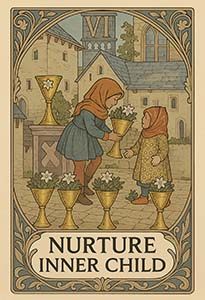
The Six of Cups — Protecting the Inner Child of Your Art

The Six of Cups reminds us that our creativity flows from the innocence of the inner child. Protecting that child means honoring your art, choosing who sees it, and never letting careless criticism silence your joy.

When Beauty Meets Criticism

Have you ever created something you thought was beautiful — a painting, an essay, even a garden — and when you finally shared it, the first thing someone did was point out the flaws? Instead of seeing what you were trying to express, they zeroed in on what they thought was wrong.

There’s always a tension between creating and sharing. When we make something real — assuming we’re not just hacking away — we’re revealing a piece of our heart, our soul, our lived experience. A careless critique can feel like a personal attack. It can leave us feeling exposed, vulnerable, even ashamed.

The Inner Child at Play

Picasso once said, “All children are born artists; the problem is to remain an artist as we grow up.” Creativity flows from the same source as play — from the child who once molded mud into castles or splashed finger paints across paper just for the joy of it.

That inner child still lives inside us, but it’s easily wounded. A thoughtless comment can silence it. A dismissive tone can make it retreat. And when that happens, the creative flow — the very essence of who we are — begins to dry up.

The Birth of the Critic

Mel Brooks joked that with the birth of art came the inevitable afterbirth — the critic. And he wasn’t wrong. If you take your creativity seriously, you’ll eventually encounter people who feel compelled to “fix” your work.

Julia Cameron wrote that before we can become good artists, we must first give ourselves permission to be bad ones. Every artist, writer, gardener, or musician produces clumsy beginnings — and even seasoned creators sometimes turn out a piece that just doesn’t land.

The creative process is messy and human. Yet while you’re admiring what went right, someone else may focus only on what went wrong.

The Wound of the Inner Artist

Cameron also warned that exposing your inner artist to harsh criticism is the emotional equivalent of child abuse. It’s like taking the eager, innocent child who offers you their finger painting and saying, “That’s terrible. You don’t really have any talent, do you?”

If you choose a creative life, criticism is inevitable. Some people simply won’t resonate with your vision, and occasionally you’ll make something that misses the mark. That’s part of the territory. But you can — and must — protect your inner artist with the same fierce loyalty you’d show a child under attack.

Learning by Heart

I became an artist late in life and am entirely self-taught. I picked up a mallet and chisel and learned to carve wood through trial, error, and stubborn joy. I learned to paint the same way.

Looking back, I can see how rough those early pieces were — primitive, awkward, untrained — and yet they were full of life. I still remember the pride I felt each time I saw progress take shape beneath my hands.

Claiming the title artist took courage. The first time I walked into a gallery and asked, “Would you show my work?” was absolutely terrifying.

A Pact of Protection

One simple, unbreakable pact guides me still: when someone criticizes my art, that’s the last time they see my art.

Showing your work is an act of intimacy — an unveiling of something deeply personal. The art flows from the child within you, and that child deserves protection.

How to Choose an Oracle Deck

Factors to consider in choosing an Oracle deck.

I’ve been having a lot of fun playing with Colette Baron-Reid’s Wisdom of the Oracle deck lately.  They seem to be highly accurate and the illustrations are really magical.

There are, of course, about 80 kazillion different decks out there by now, so it can be difficult to decide which one to get.  On average, they’re about 20 bucks a pop, so it’s not like most people can order a dozen of them and figure it out later.    If you’re in the market for a new deck, here are a few things to consider.  

ARE THEY REALLY ORACLE DECKS?

That’s not as silly as it sounds.  There are quite a few decks that really have nothing to do with, “fortune telling.”  For instance, Louise Hay has several decks like, “Heart Thoughts Cards: A Deck of 64 Affirmations,” which are collections of affirmations printed on separate cards.  They’re lovely, inspiring thoughts, but they have nothing to do with predicting the future or understanding the past.

“Healing the Inner Child Oracle: A Transformative Quest,” is another example.  It’s a charming deck that offers words of solace for anyone with a wounded Inner Child, but it isn’t in any sense, “oracular.”  Basically, what we’re looking for in an oracle deck is one that’s capable of saying, “You are here.  This is how you got here.  This is what’s going to happen if you keep on your present course.”  If it can’t fulfill those simple parameters, it’s not an oracle deck.

DO YOU TRUST THE AUTHOR?

A little bit of research can tell us a lot about the author of a deck.  Some basic questions we can ask are:  is the author experienced?  Does the author have some sort of psychic ability that would lend her credence in designing a deck of cards?  Is the author in a positive flow of energy?

Colette Baron Reid, for instance, is a psychic and has been reading cards professionally for 25 years. (Check out her web site here:  https://www.colettebaronreid.com/)\].  For me, personally, the fact that she’s gone through some serious shit in her life and emerged with a positive message and positive energy adds greatly to her credibility.

We can contrast that with Aleister Crowley’s Thoth Tarot deck.  It’s a well designed deck and Crowley had a deep knowledge of occultism.  He was also deeply involved with black magic, sacrificed animals in his rituals, and was a heroin addict.  I wouldn’t want his deck or his energy anywhere near my house.

IS THE DECK MAGICAL?

This is obviously highly subjective.  The question here is, “Does the deck call out to your Deep Mind?”  Does it stir something inside of you that resonates and feels magical?

I would answer, “absolutely,” with Baron-Reid’s deck.  The illustrations are by Jenna DellaGrottaglia and her art is like something channeled from another world.  The second I picked up the deck I could almost feel it vibrating in my hands. 

They’re whimsical, thought provoking, and perfect illustrations of the situations we find ourselves in on a daily basis.  You can see more of her art here.

On the other hand, we can look at cards like those from Doreen Virtue’s original angel decks and feel a resounding, “Blechhh.”  They’re really just Hallmark greeting cards compiled into a deck.  Despite the fact that they sold in the hundreds of thousands, they’re flat and low vibration.

ARE THEY ACCURATE?

Although this is, of course, the most important question, it’s hard to ascertain without actually buying one of the decks and trying them.  We can try to get a, “feel,” for them by reading the reviews on sites like Amazon, but even those can be highly suspect.  

If you’re just starting out on your card reading adventure, one indicator you might use is how long the deck has been around.  Decks that don’t work tend to disappear fairly quickly. The Waite Tarot deck, for instance, is pretty much the gold standard for accuracy and was first published in 1909.  The much, much older Marseilles deck has been used for centuries, but is a little more difficult for beginners to work with.

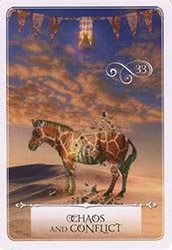
In the limited period of time that I’ve been using Baron-Reid’s deck, I’ve found it to be highly accurate.  I inquired, for instance, about the outcome of the presidential election here in the U.S. and drew a card titled Conflict and Chaos.  Perfect.

WHAT ARE YOU USING THEM FOR?

Finally, it’s good to consider how we’ll actually be using the cards.  If we’re deeply into metaphysical inquiries and are looking for the underlying currents in life, we might want to go for a deck that relies heavily on archetypes.  One example is Baron-Reid’s Goddess deck.  Or we might want to go straight to the source and use an archetype deck like this one from Caroline Myss.

I tend to use my cards much more for mundane inquiries than for metaphysical explorations.  In other words, my questions are more like, “What in the hell am I supposed to be doing this week?” And less like, “What is the meaning of life?”

Which is another reason why I particularly like this deck.  The cards are mainly flat out, practical, day to day advice, like, “You need to get more rest.”  Or, “this venture isn’t going to work so make a u-turn.”  Or, “use your imagination, not your logic.”

We can achieve much the same result by taking a classic Tarot deck like the Waite deck and simply removing all of the Major Arcana (archetype) cards.  When we use only the Minor Arcana, we’re only looking at the mundane, practical factors in life.  That’s kind of a hassle but it works.

Ultimately, the deck you choose will be all about you.  If it calls out to you, if it resonates with your vibrations, if you trust it, that’s your deck.

The Five of Wands, Louise Hay, and Becoming the Grown Up Who Lives in Our Heads.

A look at childhood programming and using affirmations.

If I were to say, “Your thoughts are total bullshit,” you’d probably feel highly insulted.  On the other hand, if I were to say, “My thoughts are total bullshit,”  you might agree with me or you might tell me that’s not true and wonder where I got such a terrible self-image.

But if I were to say, “A lot of OUR thoughts, as human beings, are total bullshit,” that’s a more fertile ground for discussion simply because it depersonalizes it and takes us out of a fight-or-flight reaction.  We don’t have to defend anything or run away from being criticized.

In, “You Can Heal Your Life,” Louise Hay made the point that, at their base, our thoughts really mean nothing at all.  They’re just words that we string together and they don’t take on any meaning by themselves.  We have to ASSIGN meaning to them.  We have to say, “I believe these thoughts are true.”

And, oddly, our beliefs are nothing more than thoughts that we’ve repeated over and over and over until we believe that they’re true.  When we take a little closer look at those thoughts we can understand exactly why so many of them really are bullshit.

First of all, a lot of our thoughts were, “installed,” in our little brains when we were far, far too young to make any rational judgements about their validity.  By the time that we reach late adolescence most of us have been thoroughly programmed with unexamined thoughts that we believe to be true.  The richest source of the programming is our families, of course, but we get a hefty dose of it from our teachers and peers, as well.  Some of those thoughts might be things like:

I’m no good at math.

I can’t dance.

I’m a terrible athlete.

I’m not very good looking.

I’m too fat or too skinny or too tall or too short.

I don’t fit in.

Nobody likes me.

Or the thoughts might be something like:

Democrats are communists.

Republicans are fascists.

Rich people are heartless.

People who don’t practice my religion are evil.

Black people are scary or white people are arrogant honkies.

Immigrants are too lazy to work AND they’re going to steal my job.

These are all just words, strung together to make thoughts, which were repeated over and over when we were young until we came to believe that they must be true.

The truth of these beliefs were totally unexamined when we were kids because we didn’t have the mental capacity to evaluate them.  If our parents or teachers told us they were true, well then – hey –  they must be true because that’s what the grownups said. For the most part, though, they remain unexamined when we’re adults, which is the second reason that many or our thoughts are total bullshit.

Most of our thoughts are subliminal, which literally means, “below the light.”  In this case, we mean, “below the light of consciousness.”  We just think them, without even being aware of the fact that we’re thinking them.  That’s the infamous, “stream of consciousness,” or, “monkey mind,” that engages about 20 seconds after we wake up in the morning.  It’s just a ceaseless chatter that runs along by itself and contains – buried in its content – all of that programming that we got as kids.  It sounds like this:

Gotta get the coffee going, godamn it’s cold, I wonder if I have enough gas in the car, should have balanced the checkbook but I’m no good at math, gotta get the kids up and make breakfast, can’t believe the price of eggs, it’s the rich Republicans driving the prices up, nobody cares about working people, if only I had a better job but I’m not smart enough to get a better job, where are my socks . . .”

The unexamined thoughts that were programmed into us when we were kids are running over and over again, all the time, and remain unexamined.  And, yes, thoughts that are repeated over and over become beliefs and, like the people in the Five of Wands, we’ll fight to the death to defend our beliefs.

Which is the third reason that most of our thoughts are bullshit.  We’re totally ego involved with them.  Most of us, most of the time, completely identify with that subliminal thought stream.  We experience it as, “These are MY thoughts in MY mind, therefore, they’re a part of me.”  It never occurs to us that they’re not really our thoughts.  They’re our parent’s thoughts and our teacher’s thoughts and maybe even the thoughts of that bully who tortured us at recess in the third grade.

Affirmations, as Louise Hay points out, are a simple way to step out of that thought stream and start changing our beliefs by changing our thoughts.  Let’s face it:  most of don’t have the time to just sit there all day and watch our thoughts.  “Ah HA!  There’s another negative thought from my childhood programming!  Take THAT, negative thought!”

What we can do, though, is to become a little more conscious of our thought streams.  Even when we’re working or driving to the store or taking a shower, we can watch the mind chattering away and consciously think, “Okay, that’s a pretty negative thought,  And it’s probably not MY thought; it’s just something my mind was taught when I was a kid.”

When we begin to dis-identify with that constant stream of thoughts, we immediately lose the need to defend them.  After all, they’re not really my thoughts, so why should I care about them?  And then we can begin to replace all of that subliminal programming with programming that we consciously choose.

Just pick a positive thought – any positive thought – and repeat it 3 or 400 times a day.  Does that seem like a lot?  Well, how many times a day do we say something negative to ourselves with that childhood programming?  Hundreds of times, right?

If that sounds like a sort of a forced, Pollyanna Positivity it’s because it is. We are quite literally pushing our thoughts in a new direction and it can feel completely unnatural to begin with.  But that’s the whole point:  there’s nothing, “natural,” about our unhappy beliefs, either.  They were just thoughts that were repeated again and again, often by the miserably unhappy adults who raised us.  That’s all that happy beliefs are, too – thoughts that are repeated again and again until they become beliefs.  And we get to be the adults who are repeating them, which is pretty cool.

The Fool, Double Dorjes, and Saying Yippee to the Universe

A look at the underlying, happy energy of the Universe.

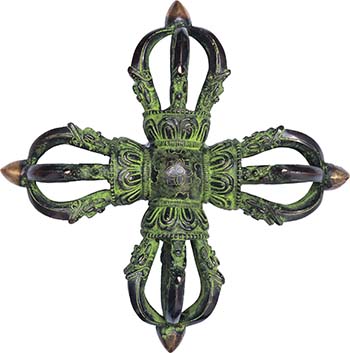
I’ve been playing around with making altar cards to sell on my Etsy shop (synergyfolkart.etsy.com) and trying to put together a line of them for Buddhists.   The other day I was looking at a picture of a double dorje – a very powerful symbol in Vajrayana Buddhism –  and I thought, “I wonder if I could make that gold, instead of bronze?”

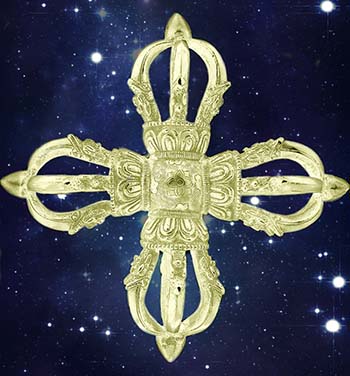
Lo and behold, after several hours of research, clicking, layering, re-layering, and praying to the mighty goddess of Adobe Photoshop, I went from this:

to this:

Now, it hasn’t been that long since I had sex with someone – probably not more than 5 or 6 hundred years – but completing this transformation was very much like that feeling.  When I saw the final image there was a huge, internal, “YIPPEE!,” from my Inner Child and I got up and danced around my studio.  (And, yes, when I used to Get Lucky I would frequently shout, “YIPPEE!” and dance around the bedroom.)

There are probably about 30 million 10 year olds who are far more adept at Adobe Photoshop than I’ll ever be,  and I only get a few bucks for each card, so there was nothing earthshaking about this. But that’s not the point.

The point is that the Universe is doing something . . . somehow . . . for some reason. 

I don’t think I can put it any more clearly than that.

Scientists tell us that about 13 billion years ago there was a tiny dot of super-concentrated energy in the center of the Universe.  Well . . . it wasn’t the center of the Universe because there wasn’t any Universe, yet, but just for the sake of argument, pretend there was a Universe and there was this dot in the middle of it.  And then – KABLAMMM!!!!!!!!! – the tiny dot of energy suddenly exploded for no particular reason and started expanding outwards into . . . you know . . . nothing. 

The energy carried with it all of the . . . um . . . stuff . . . that would later form into solar systems and suns and planets and moons and Donald Trump’s hair.

That’s what they call the Big Bang Theory.

AND . . . according to the scientists, the Universe is STILL expanding.

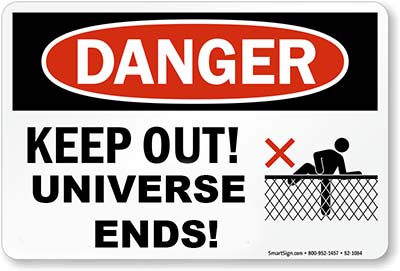
I’ve always had a little trouble with that part because I’ve never been able to figure out exactly what it’s expanding INTO.   I mean, if the Universe is everything and it’s expanding, then there must be a whole lot of nothing out there somewhere for it to expand into and I wonder if there’s some sort of a fence between the Universe and the Nothing.

But I digress.

Modern science has pronounced that the Big Bang was sort of an incredibly powerful firecracker that blew up and scattered detritus all across the Universe.  And they’re very proud of that pronouncement because they feel it gets rid of all of the superstitious nonsense like gods and goddesses and creation myths and fables.  But just saying that there was a giant cherry bomb in the middle of the Universe before there was a Universe and it somehow blew up and somehow made the Universe, doesn’t really explain anything.  There are still those questions like, “Who made the cherry bomb?” And, “Who lit the fuse?”  And, “What’s the point?”

For centuries, Sages, Mystics, Philosophers and other people with far too much spare time on their hands have tried to figure out exactly what that primal energy that exploded outward from the Big Bang is composed of.  Is it alive?  Is it conscious?  Is it thinking?  Is it feeling?  Is it in a bad mood or does it have a sense of humor?

There are a few religions and philosophies out there – like Taoism and Vedanta – that assert that the primal energy is very much alive and conscious.  And, although our egos tend to make us forget it, we ARE that energy.  In many ways, we may actually be the spear tip of that energy because we’re one of the few species we know of who have evolved into thinking, self-reflective, beings.

It makes sense, then, that we feel at our best when we’re in alignment with that energy.  And we feel at our best when we’re loving, creative, and playful, much like the energy of The Fool, dancing along with his little doggie.

It’s not a HUGE leap, then, to extrapolate that the basic, primal energy of the Universe is loving, creative, and playful.  When we’re laughing, having great sex, or making Golden Double Dorjes. To me, at least, that’s a lot more logical than thinking that we’re the left over wrappings of some giant firecracker.

Yippee!!!!

My ebook, “Just the Tarot,” is now available for free for anyone who has a Kindle Unlimited membership. For those of you who don’t, it’s still DIRT CHEAP!

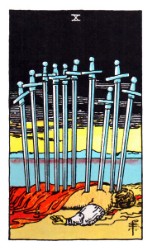
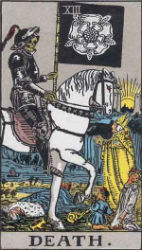
The Ten of Swords, the Death Card, Child Abuse and Forgiveness

It’s hard to put an exact figure on it because child abuse tends to operate in the darkness, but most statistics indicate that about one in five people were abused as children. That abuse can, of course, be a broad spectrum of behaviors from physical abuse to emotional and social abuse to sexual abuse, or a combination of all of those. And therapists will take different approaches in treating those abuses, depending upon the type and severity.

We can simplify that by just lumping it all under one word: trauma. Victims of child abuse suffered severe trauma at a point in their lives when they were totally ill-equipped to process it intellectually or psychologically. Child abuse is normally committed by those who are closest to us – our parents, siblings, uncles, teachers, priests, pastors – and so it involves a deep betrayal of the most basic sense of trust. It leaves its victims with an enduring, often unconscious, feeling that the world is NOT a safe place and that we can never feel secure or at peace, even in our own homes. To use a current phrase, we suffer from Post Traumatic Stress Disorder, just like people who have been in combat for extended periods of time.

Eventually, that lack of trust in life, that basic inability to ever really relax into safety, will cause us to build impenetrable walls that destroy the quality of life. We are so wounded that we just can’t let other people all the way into our lives because they might hurt us, too. Very much like the figure in the Ten of Swords, the battle is over and we lost. And how could we not? We were just children when the battle took place.

We may seek help through therapy or spiritual resources in an attempt to remove the toxins, to tear down the walls of distrust and fear. If we’re blessed with a really good therapist or a wonderful teacher, we may actually make progress with our issues and begin to engage in life in a more open, loving way. We still feel wounded, though, pierced with countless swords of pain when we recall what happened to us as children.

And then an odd thing happens somewhere along the journey: our abusers die. Abusers, like everyone else, are ultimately mortal and they age and die like everyone else.

When that happens it can be a very odd time in our lives. There may initially be a real feeling of catharsis, a sort of a joyful crying out into the world: “I’m still here and you’re not, you son of a bitch.” Or there may be a total numbness and lack of grief. After all, they taught us the value of learning to feel nothing again and again and again while they beat us. Later, if we go into therapy, there may be a deep regret: “Why didn’t I confront him when he was still alive? Why didn’t I ever ask her why she couldn’t love me?”

At the end of the day, though, they’re dead. As the coroner in Wizard of Oz put it, “She isn’t simply merely dead, she’s really most sincerely dead.”

Or is she?

The terrible truth of the matter is that, for most of us, they go on living in our own heads and hearts long, long after they’re physically dead. There are constant inner dialogues with them, sometimes dozens a day, that we carry on as if they were right there in the room with us, instead of lying in a grave. There are the critical, shaming voices that intrude on our every activity.

“That was stupid.”

“Can’t you do anything right?”

“Well, THAT was typical. You screwed up again.”

Many times these inner critics have become so natural to us, so much a part of our existences, that we don’t even realize that they aren’t us. They’re the disembodied voices of our dead abusers.

So how do we ever get rid of them? How do we ever get to a point where we can say, “You know what? You’re dead. Go away now?” The answer for me came in the form of forgiveness, but not forgiveness in the normal sense of the word. At least not the way I’d ever thought about it.

At first, the idea of forgiving your abusers feels grotesque, even outrageous. “Wait a minute . . . I was a little tiny, helpless kid and this person beat me (fucked me, fondled me, burned me, shamed me – fill in the blank with your particular form of abuse.) Why in hell should I forgive them? Just because they’re dead?”

Well, there are two reasons and, oddly, neither one of them has a thing to do with the abuser.

First of all, yes, they’re dead. Yes, in a physical sense, they really ARE most sincerely dead. Whatever they are now, they aren’t any longer the specific person who abused us.

And that means that, as Louise Hay pointed out, all that they are right now is thought constructs in our heads. That’s it: they are literally just our memories now and they have no existence beyond that. When that really hit me, when I finally GOT that, my first thought was, “Wow! I’m CHOOSING to live with my abusers. All they are is my thoughts and I’m in charge of my thoughts. This is a choice to continue the abuse.”

And once I got that, I realized that if I continued to keep those thought patterns alive, it was a CONSCIOUS choice to live with abuse.

That’s where forgiveness comes in. Louise Haye also pointed out that forgiveness is, ultimately, an act that takes place in our own minds. We don’t tend to think of it that way. We tend to think of it as always involving another person and it usually has a lot of drama attached. It goes something like this:

“I forgive you for the fact that – even though I was deeply in love with you, had your three children, and was a good and faithful wife who adored you with all of her heart – you just couldn’t keep your dick in your pants and you screwed my best friend. That slut.”

In other words, we’re SAYING that we’re forgiving the other person, but we’re really not. What we’re really doing is pointing out what a total piece of shit the other person is and saying that we’ll live with that, as long as they feel good and guilty about what they did wrong. It’s a power thing disguised as a kindness thing.

Real forgiveness, though, is truly letting it go, not choosing to live in it, and that’s why it’s so important in healing the wounds of abuse. It means recognizing that we’re keeping the abusers alive in our own minds, acknowledging what they did to us and honoring ourselves as survivors, and then just . . . letting them go . . . for once and for all . . . back into Universe. “If hating you means I’m keeping you alive, then I can let go of that hatred. I forgive you, I bless you, I release you.” And in doing that, we’re really blessing ourselves. We’re really releasing ourselves from the prisons they built in our minds.

You can invent your own rituals for doing that. I like to use Nick Ortner’s Meridian Tapping with three rounds of what they did to me and three rounds of letting them go. You might prefer to build a Day of the Dead Altar with their picture on it. Talk to the picture, tell them what they did and how it felt, and then throw the picture away.

Light a candle, meditate on the abuser and then release him or her as you blow out the flame.

Do a Buddhist Sur Ceremony and release them with love and compassion.

They don’t exist anymore. We’re free.