The Hidden Difference: How Empathic Readers and Psychics Use Tarot Differently

A comparison between psychic and empathic tarot readers, explaining how psychics use tarot as a focus for intuitive insights, while empaths interpret emotional and energetic patterns for guidance.

If you’ve had more than a few Tarot readings, you’ve probably encountered a reader who, “pulls,” the cards for you.  They may mix or shuffle the deck a few times and then they pick some cards which are supposed to represent you and your situation.  They lay those cards out and then interpret them for you.

There’s a real question in my mind whether we can even properly call that technique a Tarot reading.  Still, it illustrates the difference between two highly different styles of reading cards:  the psychic approach and the empathic approach.

PSYCHIC TAROT READERS:  USING THE CARDS AS A FOCUS TOOL

Psychic Tarot readers tend to use the cards as a tool to focus their extrasensory abilities.  Think of the classic movie scene where a  gypsy woman is huddled over a crystal ball and utters a pronouncement like, “You are going to meet a tall dark stranger and have incredible sex in a variety of nearly impossible positions.”  There’s no suggestion that the crystal ball is talking to her or texts are appearing inside of it.  Rather, she’s using it to focus her attention on receiving messages from spirit guides or opening herself to intuitive flashes.

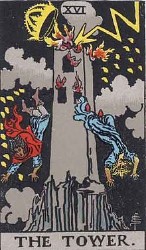
In the same way, a psychic reader might pull The Tower card out of the deck and say something like, “Towers are tall buildings and that’s what I’m picking up on.  I’m seeing a tall building in your future and there’s something wrong with it.  I’m getting that you’re thinking of buying a house and I’d caution you about any two story house you look at it.”

Now, that interpretation HAS ABSOLUTELY NOTHING TO DO WITH THE DEFINITION OF THE CARD.  Not even close.  That doesn’t mean that the reader is wrong, though.  If you’re dealing with a genuine psychic, she may be totally right on.  

But it’s not a Tarot reading.  It’s a psychic reading using Tarot cards as prompts.

Put another way, the knowledge is coming from the reader and not from the cards.  That’s a major clue that you’re dealing with a psychic reader – they deemphasize the actual definitions of the cards and substitute their own.  The images on the cards are actually much more important to them than the definitions because the images are what trigger their psychic flashes.

EMPATHIC TAROT READERS:  READING EMOTIONAL AND ENERGETIC PATTERNS

Empathic readers tend to take a much more traditional approach.  

First of all, they want YOU to handle the cards as much as possible, rather than simply picking out the cards for you.  This is a recognition that there is some sort of a synchronistic link between the cards and the person who’s receiving the reading.  It’s almost like the cards have to get to know the person – they need to pick up your unique vibrations and then the cards will match those vibrations and give you a reading.

An empathic reader will also rely much more heavily on structure and definitions.  He’ll use readings with predetermined positions such as past, present and future.  He’ll have a set of definitions that won’t change simply because he’s getting a different, “impression,” of what the card should mean.  In the example of drawing The Tower card, he’d tell you that some cataclysmic event is about to occur in your personal life, but he won’t mention two story houses.

In one sense, an empath’s Tarot reading might seem to be a little psychic because she will connect deeply with the emotional and energetic state of the the person receiving the reading. Rather than receiving psychic downloads, an empathic reader will sense the feelings, fears, and desires of the client and interpret the cards in a way that reflects these energies.

Because empaths absorb emotions, their interpretations of the cards mirror what the client is going through.  For instance, they might sense the client’s anxiety over drawing The Tower card and interpret it as need for an emotional breakthrough, rather than pure destruction.  In that sense, an empath’s Tarot reading might feel more like a therapy session than a psychic prediction because they’re much more heart focussed.

WHICH TAROT READER IS RIGHT FOR YOU?

Both types of readings are perfectly valid, but one or the other might be preferable for us.  It depends on what we’re looking for.

If we’re looking for guidance about what may happen in the future, then a psychic reader may be the better choice.  That’s assuming, of course, that we’re convinced that the person we’re dealing with is a genuine psychic.

We’d approach that type of a reading in precisely the same way that we’d approach a psychic reading without the Tarot cards.  After all, the cards are just there to focus the psychic’s abilities.  We might go to a psychic to try to establish communication with a loved one who’s passed over.  Or perhaps we feel a need for direction from a spirit guide or angel and can’t communicate directly with them ourselves.  The psychic is the channel and the cards are secondary, so we’re not really looking for the wisdom of the Tarot itself.

A reading with an empath, on the other hand, would be much more oriented toward trying to make sense of our daily lives using the cards and their actual definitions.  Empaths process information in patterns and so they’d be looking at all of the factors in our lives and trying to stitch them into a coherent whole.

A reading with an empath is also much more about how we feel about what’s happening to us, rather than just predicting events.  After all, that sensitivity to other people’s emotions and energy is what empaths do best.

In either case, we always need to remember that a Tarot reading is just a snap shot in time.  It’s about what MAY happen if the current circumstances continue.  Nothing in a Tarot reading is written in stone and we have the ability to change the outcome by changing our behavior.

The Most Powerful Card in the Tarot – Getting Downright Foolish

An explanation of why The Fool is the most powerful card in the Tarot.

There’s an ongoing debate among Tarot aficionados about which card is THE strongest card in the deck.  The most prominent candidates are usually the first two cards of the Major Arcanum:  The Fool and The Magician.  I tend to lean toward The Fool, for reasons which I’ll explain, but the truth is that we need both of their energies in our personal and spiritual growth.  The Fool is pure potential, whereas The Magician is pure mastery.  Growth occurs when those two energies intersect.

LOOKING AT THE SYMBOLISM

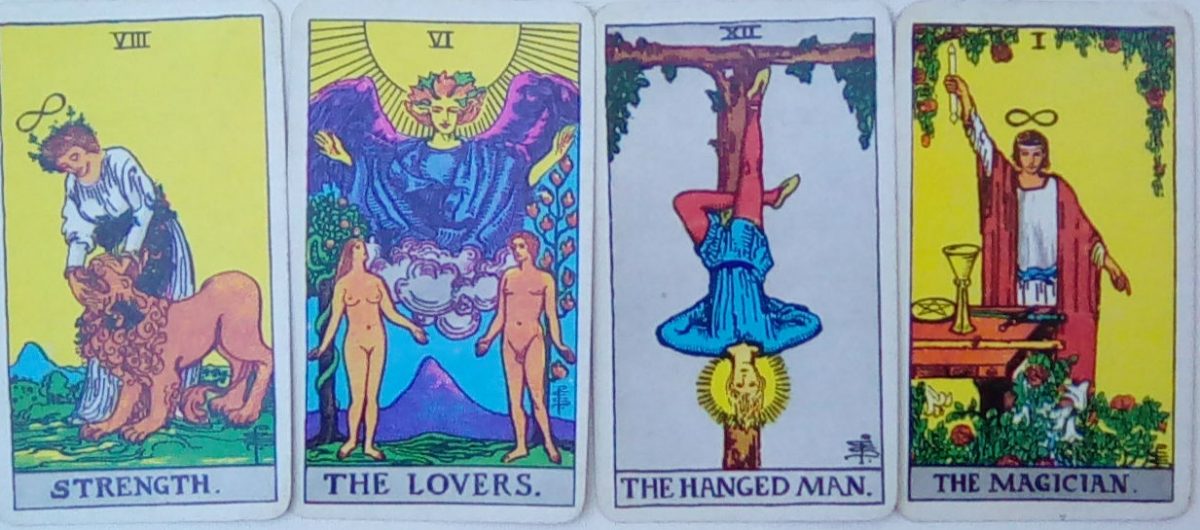
In The Fool, we see a young, ambisexual person dancing along at the edge of a cliff.  He lightly holds a rose in one hand, and his meager possessions are contained in a satchel hanging from a pole that he carries over his shoulder.  A small dog joyously cavorts at his feet, despite the fact that The Fool appears to be about to walk straight off of the cliff.

If we had to select a couple of words to describe the image, they would probably be, “happy,” and, “unfocused.”  The person in the card seems to not have a care in the world.  He’s to telling us to stop and smell the roses, to trust in the present moment. The message is that if he walks off of the cliff, he’ll just keep strolling along on thin air.

The Magician card, on the other hand, is an image of total concentration and focus.  He’s dressed in the formal robes of a ceremonial magician and looking very serious.  One hand, holding a wand with two points, is pointed toward the sky and the other is pointed at the ground.  His robe is belted with the ouroboros symbol of eternity, a snake eating it’s own tail, and that message is reinforced by the eternity symbol floating over his head.  The four symbols of earthly existence, the wand, pentacle, cup, and sword, lie on his altar.

“Just the Tarot” by Dan Adair – A complete set of definitions, layouts and instructions for reading Tarot cards.

The Magician is channeling the divine energy into the Earth Plane.  He’s using it to control the four elements and manifest his desires through the use of his will power.  If we had to select a couple of words to describe this image, they would be, “control,” and, “focus.”

THE MAGICIAN AS THE WESTERN PARADIGM OF POWER

The Magician is very much the Western paradigm of power.  We use phrases like, “He’s a take-charge sort of a guy,” or, “She’s always in control,” to describe this kind of power, and we tend to admire it.

The Magician is the type of a person who is very conscious of what she wants to accomplish, has a detailed plan for doing it, has the necessary skills to make it happen, and works the plan until she reaches her goals.

This is the type of linear, step-by-step thinking that Westerners have traditionally employed, and it can be very effective.  

It’s also very much an ego-based sort of a power.  It’s saying, “This is what I want and I’m going to use all of my abilities and will to make it manifest.”

THE FOOL AS THE EASTERN PARADIGM OF POWER

The Fool’s energy is much more in keeping with the Eastern paradigm of power.  It has more to do with aligning ourselves with a deeper, universal  power, rather than trying to run the whole show with our egos.

There’s a basic trust implicit in The Fool.  It’s a trust that, as the Desiderata put it, “whether or not it is clear to you, no doubt the universe is unfolding as it should.”  The idea is that there IS an underlying force in the Universe and that it’s a loving, compassionate force.  When we’re in alignment with that force, then we’re in The Flow, or the Tao, and our lives are much easier and happier because of it.  And, paradoxically, the more that we try to control that Flow, as the Magician does, the less in alignment we are and the harder life becomes.

VISUALIZING AND MANIFESTATION

We can see this sort of tension between The Magician energy and The Fool energy when we begin to delve into visualization and manifestation.  

Most of the books and seminars on the subject run pretty close to The Magician model of power. (A) We figure out what we want (the usual example being a million dollars.)  (B) We concentrate all of our will power on that goal by visualizing it, writing affirmations, and making vision boards.  (C) We cause that goal to manifest in our lives through repetition and the sheer power of our wills.  The Magician model is also very one-pointed and specific, as in, “I want a million bucks by September the first and I want it to be in unmarked hundred dollar bills.”

Of course, that frequently doesn’t work, as evidenced by the fact that most of us aren’t millionaires.  This is the point where many teachers will bring in the concept of The Fool energy.  The idea here is to relax, stay in the present moment, and quit telling the Universe how it’s supposed to behave.  Instead of setting a specific goal, right down to every detail, we set a general goal, but let the Universe work out the details.

Mike Dooley, in particular, works with this concept in many of his books like, “Manifesting Change.”  He refers to our trying to control all of the details (Magician energy) as, “the cursed hows.”  In other words, “I want a million bucks, Universe, and this is exactly HOW I want you to manifest it.”  The point that he’s making is that we may think we’re opening one door to financial abundance, but in reality we’re slamming shut a thousand other doors.  The Universe is infinite and it has an infinite number of ways of delivering what we want to manifest, unless we get too specific about how we want it done.

So, we bring in Fool energy.  We use a general statement like, “I’d like to manifest happiness and abundance in my life, Universe, and I’m sure you can work out the details.  After all, you make stars and solar systems, so this shouldn’t be much of a challenge for you.” And then we butt out and let it happen, while we stay happy and in the present moment.

CONSCIOUS AND SUBCONSCIOUS MINDS

The Kybalion – a discussion of Hermetic magic – talks about this dance between Magician energy and Fool energy in terms of the conscious and subconscious minds.

Our conscious mind is our everyday mind, which is the mind that we mostly identify with.  It’s ego based, logical, and linear and it’s very clever at performing mundane tasks.  It’s the mind that balances our budgets, pays the rent, buys groceries, and gets the kids to school on time.  We could call it Magician energy but it’s really just a tiny part of our larger mind.

The subconscious mind, on the other hand, comprises the majority of our minds.  Unlike the conscious mind, it never needs to sleep and it’s working 24/7, processing information, calculating what the future may look like and telling us when something’s wrong.

The most important thing about the subconscious mind, though, is that it’s our connection to the super-conscious mind, AKA the Universe.  Though that connection, it has almost infinite power to manifest anything that we truly desire.  That’s Fool energy.

Those two minds – conscious and subconscious – need to work together.  Although the subconscious mind is infinitely powerful, it just drifts without direction from the conscious mind.  Even worse, it can construct our reality based on the crap that flows through the internet, our televisions, our cultures and our religions, which may have very little to do with what we really want to manifest.

So we need to use that Magician energy – the conscious mind – to sort through our options and figure out where we want to actually go with our lives.  Do I want to be rich?  Do I want to be an artist?  Do I want more love in my life?  Once we determine what our overall goals and desires are, then we say, “Hey, subconscious mind/Universe – this is what I’d like to see happen.  Please get to work on that.”

THE FOOL DOES THE HEAVY LIFTING

Here’s the most important thing about all of that:  The Fool does the heavy lifting.  The SOLE PURPOSE of the conscious mind is to figure out where we want to go and turn it over to the subconscious mind/Universe.  

The conscious mind has a terrible time accepting that notion, because it’s ego based.  It wants to control every little detail of the manifestation process, and so it keeps snatching it back from the Universe and imposing more and more cursed hows on the process.  Every single time that we do that, we’re slamming doors shut instead of letting the subconscious mind open more doors.

And so, yes, in my opinion there can be no doubt that the most powerful card in the Tarot deck is The Fool.  It’s the primal energy that makes good things manifest in our lives.  The Magician can guide that energy but, by itself, it’s nothing but a control freak in a red robe.

Blasted Towers, Bad Ju-Ju, and the Unluckiest Card in the Tarot

A look at the five unluckiest cards in the Tarot deck.

I recently received an email from a reader who asked, “What’s the unluckiest Tarot card?”  I had to scratch my head about that one because the whole concept of good luck versus bad luck can get pretty complex.  Nonetheless, there are some Tarot cards that can always be considered harbingers of bad luck

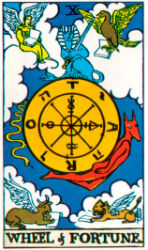
THE WHEEL OF FORTUNE, REVERSED

The Wheel of Fortune, Reversed, is the most obvious choice for a, “bad luck,” card.  We actually talk about luck in terms of good fortune and bad fortune and that’s what this card is all about.  It depicts life as a wheel, where sometimes our luck is ascending and expanding and sometimes it’s descending and decreasing.  When The Wheel of Fortune, Reversed, shows up in a reading it indicates that we’re in for a patch of bad luck.

The Kybalion, which is a book about Hermetic Magic, compared it to the pendulum of a clock.  The pendulum swings first in one direction and then back in the other.  Life can be seen in much the same way:  sometimes we’re swinging into really good luck and then we swing back into a period of bad luck.

The obvious underlying message is to just hang on, because things will inevitably change.  When we can stand back and look at good luck/bad luck as a rhythmic cycle, then periods of ill fortune will affect us much less severely.  We just need to stay centered and calm and wait for the cycle to reverse itself.

THE TOWER

Also known as, “the lightning struck tower,” and, “the blasted tower,” The Tower would probably be my pick as THE unluckiest card in the deck.  

“Just the Tarot,” by Dan Adair – complete definitions, layouts, and instructions for reading Tarot cards, available on Amazon.

At it’s most severe level, it can indicate that everything that you’ve loved and invested in is about to be blasted right down to the ground.  The last time that I had it showing up in my personal readings, my life partner died, I lost my house, and I was involved in a horrible law suit over the probate of the estate.  It can be that bad, depending on the other cards in the reading, but it usually isn’t.

On a mundane level, The Tower is usually just a powerful warning that we’ve gone down the wrong path and the Universe is about to provide a course correction.  Perhaps we’ve been treating our fellow employees badly and – Shazam – we’re suddenly fired or demoted.  Or perhaps we’ve been emotionally abusive or neglectful of our lover and they leave us for someone else.

In my experience, there’s always a level of hubris involved with this card.  We’re not only taking things for granted, but we’re also being arrogant.  We’re assuming that everything is under our control and the Universe is going to show us that we’re not.

The most positive message in this card – which we usually fail to appreciate at the time – is that we get to completely start over.  It’s like that line from, Me and Bobby McGee:  “Freedom’s just another word for nothing left to lose.”  When our lives (or our projects or relationships, etc.) have been blasted right down to the foundations, we have the freedom to consciously design something new and better.

DEATH

Even if it isn’t the unluckiest card in the deck, Death definitely wins the award for the creepiest card in the Tarot.  In her wonderful book, “Fortune Telling by Tarot Cards,” Sasha Fenton puts it in this perfectly understated, British way:  “This card usually puts the wind up people when it appears . . .”

Yes.

Now, first of all, I have never seen the Death card appear before someone’s death.  It will pop up after someone has died, but it’s usually just a comment on what’s happened.  It’s more like, “Well, you’ve lost someone you loved, so you’re dealing with death and grief.”

What it can indicate, though, is that there’s going to be a radical, life changing turn in events in a person’s life.  The querent is suddenly going to find herself going in a completely different direction than she has in the past.  In an emotional and spiritual sense, it really is as if their previous life has died and they’re off in a completely new direction.

I knew a woman who had been happily married for 15 years, had a home, a loving husband, and 2 kids.  She woke up one morning with this thought ringing in her head:  “Shit, I’m not in love with him anymore and I hate my life.”  Within six months she’d obtained a divorce, turned custody of her children over to her ex-husband and was working as a river guide in West Texas.  That’s the kind of radical change that we’re talking about here.

Whether that kind of change is good luck or bad luck is just a matter of interpretation.  If it’s something that we consciously plan, we usually view it as good fortune.  If it was something that was forced on us by circumstance, we may think it was bad fortune.

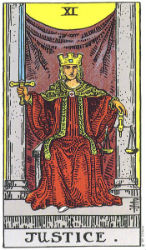
JUSTICE, REVERSED

I’m a little hesitant to include the Justice card in this list because it has more to do with people and circumstances than luck per se.  Nonetheless, it’s frequently seen as bad luck so I’ll stick it in here.

Classically, as you might guess from the image, Justice has to do with the legal system.  If we’re involved in some sort of litigation and Justice is upright, it can mean that we’ll prevail.  If it’s reversed, it can mean that we’ll lose.

On a personal level, it can mean that the people around you – your family, co-workers, boss, etc. – are making judgements about you and they’re not good if the card is reversed.  

Losing a court case can obviously be seen as bad luck.  Or it can be seen as a sign that we have a bad case, a bad lawyer, or a bad judge.  In the same way, having people we care about judging us harshly can be seen as being treated unfairly.  Or it might be that we’re being jerks and we need to clean up our acts.

Justice, Reversed, can be a sign of a bad luck to come, but it also serves as a warning.  It’s saying, “You’re about to have some bad luck, so you need to take a careful look at your own actions before that happens.”

TEN OF SWORDS

It doesn’t take but a glance at the Ten of Swords to realize that there’s some serious bad ju-ju happening here.  If we’re lying face down stuck full of swords like a human pin cushion, something’s a little wrong. This card can indicate treachery, deceit or a very, very bad ending to a relationship or a job.

The suit of Swords symbolizes our personal power.  That’s the way that we project ourselves out into the world.  There’s nothing innately wrong with that.  Whether it’s standing up to a school yard bully when we were kids or pushing hard for a project we really believe in at work, there are always times when we have to be a bit aggressive.

But . . . when we’re overly and chronically aggressive, that puts us into a power cycle. We’re trying to dominate other people and run over their emotions and desires.  We become the school yard bully instead of the person standing up to the bully.  We see this mentality frequently with primitive men who brag about being the, “alpha dog.”  It’s dominance for the sake of dominance, rather than for the sake of getting anything done.

The message of this card is the old cliche’: live by the sword, die by the sword.  If we’ve been treating other people harshly, if we’ve been abusive in our love relationships, or domineering in work relationships, we’ve got some bad karma heading our way.

So those are the top five, “bad luck,” cards in the Tarot deck.  There are, of course, other cards that may indicate bad fortune in one aspect or another of our lives, but these are the red flags.  And, of course, we should always remember that a Tarot reading is just a snap shot in time.  It tells us what’s likely to happen, but we have the free will to change it.

How to Choose an Oracle Deck

Factors to consider in choosing an Oracle deck.

I’ve been having a lot of fun playing with Colette Baron-Reid’s Wisdom of the Oracle deck lately.  They seem to be highly accurate and the illustrations are really magical.

There are, of course, about 80 kazillion different decks out there by now, so it can be difficult to decide which one to get.  On average, they’re about 20 bucks a pop, so it’s not like most people can order a dozen of them and figure it out later.    If you’re in the market for a new deck, here are a few things to consider.  

ARE THEY REALLY ORACLE DECKS?

That’s not as silly as it sounds.  There are quite a few decks that really have nothing to do with, “fortune telling.”  For instance, Louise Hay has several decks like, “Heart Thoughts Cards: A Deck of 64 Affirmations,” which are collections of affirmations printed on separate cards.  They’re lovely, inspiring thoughts, but they have nothing to do with predicting the future or understanding the past.

“Healing the Inner Child Oracle: A Transformative Quest,” is another example.  It’s a charming deck that offers words of solace for anyone with a wounded Inner Child, but it isn’t in any sense, “oracular.”  Basically, what we’re looking for in an oracle deck is one that’s capable of saying, “You are here.  This is how you got here.  This is what’s going to happen if you keep on your present course.”  If it can’t fulfill those simple parameters, it’s not an oracle deck.

DO YOU TRUST THE AUTHOR?

A little bit of research can tell us a lot about the author of a deck.  Some basic questions we can ask are:  is the author experienced?  Does the author have some sort of psychic ability that would lend her credence in designing a deck of cards?  Is the author in a positive flow of energy?

Colette Baron Reid, for instance, is a psychic and has been reading cards professionally for 25 years. (Check out her web site here:  https://www.colettebaronreid.com/)\].  For me, personally, the fact that she’s gone through some serious shit in her life and emerged with a positive message and positive energy adds greatly to her credibility.

We can contrast that with Aleister Crowley’s Thoth Tarot deck.  It’s a well designed deck and Crowley had a deep knowledge of occultism.  He was also deeply involved with black magic, sacrificed animals in his rituals, and was a heroin addict.  I wouldn’t want his deck or his energy anywhere near my house.

IS THE DECK MAGICAL?

This is obviously highly subjective.  The question here is, “Does the deck call out to your Deep Mind?”  Does it stir something inside of you that resonates and feels magical?

I would answer, “absolutely,” with Baron-Reid’s deck.  The illustrations are by Jenna DellaGrottaglia and her art is like something channeled from another world.  The second I picked up the deck I could almost feel it vibrating in my hands. 

They’re whimsical, thought provoking, and perfect illustrations of the situations we find ourselves in on a daily basis.  You can see more of her art here.

On the other hand, we can look at cards like those from Doreen Virtue’s original angel decks and feel a resounding, “Blechhh.”  They’re really just Hallmark greeting cards compiled into a deck.  Despite the fact that they sold in the hundreds of thousands, they’re flat and low vibration.

ARE THEY ACCURATE?

Although this is, of course, the most important question, it’s hard to ascertain without actually buying one of the decks and trying them.  We can try to get a, “feel,” for them by reading the reviews on sites like Amazon, but even those can be highly suspect.  

If you’re just starting out on your card reading adventure, one indicator you might use is how long the deck has been around.  Decks that don’t work tend to disappear fairly quickly. The Waite Tarot deck, for instance, is pretty much the gold standard for accuracy and was first published in 1909.  The much, much older Marseilles deck has been used for centuries, but is a little more difficult for beginners to work with.

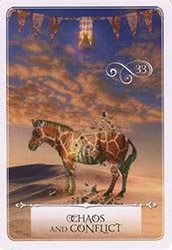
In the limited period of time that I’ve been using Baron-Reid’s deck, I’ve found it to be highly accurate.  I inquired, for instance, about the outcome of the presidential election here in the U.S. and drew a card titled Conflict and Chaos.  Perfect.

WHAT ARE YOU USING THEM FOR?

Finally, it’s good to consider how we’ll actually be using the cards.  If we’re deeply into metaphysical inquiries and are looking for the underlying currents in life, we might want to go for a deck that relies heavily on archetypes.  One example is Baron-Reid’s Goddess deck.  Or we might want to go straight to the source and use an archetype deck like this one from Caroline Myss.

I tend to use my cards much more for mundane inquiries than for metaphysical explorations.  In other words, my questions are more like, “What in the hell am I supposed to be doing this week?” And less like, “What is the meaning of life?”

Which is another reason why I particularly like this deck.  The cards are mainly flat out, practical, day to day advice, like, “You need to get more rest.”  Or, “this venture isn’t going to work so make a u-turn.”  Or, “use your imagination, not your logic.”

We can achieve much the same result by taking a classic Tarot deck like the Waite deck and simply removing all of the Major Arcana (archetype) cards.  When we use only the Minor Arcana, we’re only looking at the mundane, practical factors in life.  That’s kind of a hassle but it works.

Ultimately, the deck you choose will be all about you.  If it calls out to you, if it resonates with your vibrations, if you trust it, that’s your deck.