Empaths, Elections, and Staying True to Our Own Energy

Building effective boundaries for empaths.

If you’re an empath and you’ve been feeling kind of sick to your stomach lately, believe me – you’re not alone.  Many of us have experienced the recent election in the United States as something that makes us want to curl up in a ball under a blanket for the next four years.

It’s important for us to explore how this is affecting us from a bioenergetic perspective, though, and not just from a political or emotional perspective.  What is all of this DOING to our energy and our energy fields?

What’s one of the first words that come to mind when we contemplate being an empath?  Boundaries, right?  Boundaries, boundaries, BOUNDARIES!  

Empaths have extremely porous personal boundaries and very leaky energetic boundaries.  In a way, that’s what makes us empaths.  “Normal,” people have fairly strong boundaries and a strong sense of, “I’m over here and you’re over there and we’re two separate beings.”  For a normie, what another person is feeling stays inside of the other person, unless the other person decides to share it.  For an empath, other people’s feelings are constantly flooding into us. It’s very easy for us to merge with those feelings and mistake them for our own.

That’s one of the reasons that many empaths become codependent.  We merge so totally (and so easily) with other people’s emotions that we mistake them for our own.  If someone we’re close to is having emotional or mental problems, we think that we have to manage their drama because it feels like it’s our own. We end up taking care of their lives instead of our own.

So one of the first steps to becoming a healthy empath is to learn to identify our own energy and separate it out from other people’s energies.  We learn this at an early age and many of us become socially avoidant as a result.  We realize that if we’re around people who are angry, depressed, or violent, that we just soak all of that in and it fucks us up.  One strategy we use to deal with that is to just avoid people in general: many empaths become radical introverts.  Which works, but it’s not the BEST strategy, right?  We really can’t cover our heads with the blankets for the next four years.

Can we?  Um . . . no.  I guess not.

We have to learn to separate our energy fields in better ways.

The human energy system is really quite simple to visualize.  As Alla Svirinskaya says in her book, “Own Your Energy – Develop Immunity to Toxic Energy and Preserve Your Authentic Life Force,”  we can think of it as the physical body or core, which is surrounded by a couple of other energetic layers or bodies which are the emotional body and the mental body.  Those other bodies are usually seen as egg shaped, so we end up with a picture of it that looks like this:

For a normie, those extra layers act as a wall to keep out other people’s energy. They filter out negative energies so that they never reach the core of the physical body. For an empath, though, they act as a bridge.  Instead of blocking us off from the emotional identity of people who aren’t us, they allow it to flow right into our personal energy fields which frequently overwhelms us, leaving us confused and injured.

Most empaths are dealing with those dynamics on a daily basis.  What we forget, though, is that our personal energy fields exist inside of larger energy fields.  Any time that you put a group of people together, their personal energy fields are going to merge to some extent and generate a group energy field that’s composed of the collective emotions of all of those people. And we live within those other energy fields.

In a very real sense, we could talk about the vibrations of a particular town or a county or a state.  Those vibrations are the collective energies of the people who live in those places.  Texas, for instance, has a very different vibration than California. And, yes, countries have a collective energy field, too, which is brings us back to the topic at hand:  dealing with this election.

About 72 million Americans got together and voted for a candidate who oozes hatred and anger out of every pore of his orange skin.  THAT is the collective energy that we’re dealing with right now and THAT is what’s making us feel sick.  Put simply, there’s a whole lot of hatred and anger out there in the collective energy field and it’s seeping in to our personal energy fields.  As empaths, we are especially vulnerable to this.

So what can we do about it? Well, we need to remember that the key to being a healthy empath is to be able to distinguish OUR energy from OTHER’S energy.  We need strong boundaries and we need that sense of, “this energy belongs to me and that energy doesn’t.”

Empaths are (for the most part) kind, loving, compassionate people.  That just goes with the territory.  When you really and truly understand another human being on the deepest level, it’s very difficult to stay angry with them.  Or to hate them.  Or to judge them too harshly.

Hatred, anger and judgements are NOT our energies and that’s why they make us sick.

A good strategy for us, then, is to be very conscious of those energies existing inside our personal fields. If we start to feel really, really, REALLY pissed off at the Trumpsters, we can stop and say, “This is NOT my energy.  This is their energy.  I won’t own it.”

Another strategy is to do what Chagdud Tulku called, “antidoting.”  The antidote for hatred is love and the antidote for anger is compassion.  I’m not suggesting that we turn ourselves into human doormats for the Trumpsters.  Rather, we’re just embracing our own nature.  By embracing our own nature, by being as compassionate, kind, and caring as we can, we automatically separate OUR energy from THEIR energy and – surprise, surprise! – we’ve got boundaries.  Suddenly, they’re over there and we’re over here and we don’t have to live in their hatred or let it blend into our energy.

Shazam!

Lucid Choices, The Four of Swords, and Living the Dream Life

Looking at our lives as lucid dreams.

Have you ever had a dream that seemed so real, so vivid and intense, that you were actually shocked when you woke up and realized it was just an illusion?

Sometimes they’re really GOOD dreams.  Perhaps we’re making incredible love with someone or maybe we’re floating through a starry, magical sky. Sometimes they’re really BAD dreams, where we’re being chased by monsters or night terrors.  Whether they’re good or bad, the one thing they have in common is that – at the moment that we’re having them – they seem absolutely, 100% real.

LIVING THE DREAM

There’s a strong case to be made for the idea that our so-called, “waking life,” is very much like a dream, as well.

In, “The Four Agreements,” that’s the term that Don Miguel Ruiz actually uses to describe our day to day existence:  a dream.  As we grow up, we’re programmed by our parents, our religions, and our societies to see the world in particular ways.  We don’t question those view points as they’re being installed in our little brains because we don’t have the ability to judge whether they’re true at that age.  By the time that we reach adulthood, we’re thoroughly convinced that the way that we see the world is the RIGHT way to see it, perhaps the ONLY way.  But those view points are just someone else’s dreams of how the world really is.

Buddhist and Hindu philosophies approach human life in much the same way:  life as we commonly experience it is an illusion, a dream that’s made up of our emotions, ideas, desires, and aversions.  We’re essentially sleep walkers who go through life laughing, crying, eating, procreating, raising families, working, and eventually dying, with no clue as to why we’re here or what it all means.  We just know that, like our dreams, it seems absolutely 100% real. 

WAKING UP

Occasionally, some of us will wake up just a little bit from the dream that we call our lives.  Usually it’s because our pleasant dreams have turned into a nightmare.  

One of our major dreams is, “I’m going to live happily ever after and nothing bad is going to happen to me.”  We’re taught that if we’re, “good,” people and we work hard and we’re responsible, everything is supposed to work out for us.  We’re going to fall madly in love with just the right person, have 2.5 beautiful children who will be extremely well adjusted, get a nice house, a new car, and all of the material toys. And we’ll live happily ever after.  Shit happens to, “bad,” people, not to us.

And then shit happens to us.

Perhaps we find our wife or husband in bed with someone else.  Perhaps we’re in a terrible auto accident.  Perhaps one of our beautiful children gets very, very sick.  Perhaps we get fired from our jobs and lose all of our material possessions.

It’s very much like suddenly waking up.  All of the things that seemed so rock solid and dependable in our lives turn out to be built on sand.  We may feel like life has betrayed us or the whole world has gone crazy.  Eventually, though, most of will go back to our dream worlds because the dream is so comfortable and waking up hurts.

LUCID DREAMING

There’s something that happens in some dreams where we’re dreaming but we suddenly become aware of the fact that it’s a dream.  We don’t wake up from the dream, but we exist within it, knowing that it’s a dream.  It’s called lucid dreaming and, if you’re not familiar with it you might enjoy reading, “Lucid Dreaming,” by Charlie Morley.

Now, one of the things that happens in lucid dreaming is that, to a large extent, we’re able to control the dream.  If we see a wall in front of us, we can consciously decide to simply grow wings and fly over it.  Or perhaps we can visualize a really beautiful woman or man and make love to them to our heart’s content.  

It’s a dream.  We know it’s a dream. But we can choose what happens in the dream.

LUCID LIVING

In his book, “Change of Heart,” Chagdud Tulku said that very few of us will ever be enlightened.  Most of us will continue to live in a dream state, perhaps for many incarnations.  BUT . . . we can choose whether we want to have a good dream or a bad dream.

Which sounds very much like lucid dreaming, doesn’t it?

When we have one of those life experiences where our day to day dream has turned into a nightmare, when we suddenly get a peek behind the curtain of what we thought was true, we have a choice.

Most people roll over and go right back to sleep, just as quickly as they can.

Some people decide to adopt a stance of total cynicism.  Life sucks.  People are rotten.  It’s all a lie.  These are the, “life is a bitch and then you die,” people.

But a few people will say, “Huh . . . it’s all just a dream.  But it’s an interesting dream.  I wonder if I can grow wings and fly over that wall?”

IT’S NOT ENLIGHTENMENT

One of the things that it’s important to remember is that just because we realize that life may be a dream, it doesn’t mean that we’re suddenly, “enlightened.”  Like the person in the 4 of Swords, we’re still solidly asleep, but now we know that we’re asleep.  Which is an improvement.

Unfortunately, as a brief stroll through the internet will teach us, there are many, many people out there who have decided that they must be gurus, spiritual adepts and geniuses just because they woke up a little bit.  Seeing through the illusions doesn’t mean that we’ve got an answer – it just means that we see the problem.

It’s a paradox, like lucid dreaming, where we’re asleep and awake at the same time.  If we keep meditating and keep working on our personal growth, we’ll wake up a little more and a little more and a little more.

In the meantime, we can choose to have good dreams.  We can have dreams that are full of love and healing and our dreams will make other people’s dreams a little better, too.

As Bob Dylan once said, “I’ll let you be in my dream if you’ll let me be in yours.”

Remember that my ebook, “Just the Tarot,” is available dirt cheap on Amazon. It’s not just a dream. Really. I think.

Happy Buddhists, Christian Apple Munchers and Garden Gnomes in Tutus

Why Buddhism is actually a happy religion.

The Dalai Lama giggles a lot.  Have you ever noticed that?  On a certain level, he seems to find life to be absolutely hilarious.  For instance, there’s this wonderful interview that Barbara Walters did with him and, toward the end of the video, he absolutely cracks up about the fact that Eskimos kiss each other by rubbing noses.

It seems a little strange because Buddhism has a reputation for being a very dark, solemn sort of a religion.  That reputation probably flows out of the Buddha’s admonition that, “life is suffering,” which is not exactly what he said, but it’s the way that it’s frequently translated.  So we have this religious doctrine that seems to say that life is suffering, yet we see Buddhists like the Dalai Lama and Thic Nhat Hahn who not only seem to be happy, they seem to be really, really, REALLY happy.

What’s up with that?

The tarot card, The Hierophant, is all about formal doctrine, rather than first hand experience.  Religion, rather than spirituality.  It represents what religions SAY they are, rather than the way that they’re actually practiced on a daily basis by their followers.  Oddly, there’s a curious optimism that permeates Buddhism once we get past the doctrines and get into the actual experience of, “living Buddhism.”  

Although I’m sure that the Buddha wouldn’t dig my doing this because it involves a lot of judgment,  one of the best ways to illustrate that optimism  is by contrasting it with the dominant Western religion, Christianity.  In particular, how do the two religions actually VIEW human beings?

Christianity starts out with the basic premise that humans are miserable, flawed sinners.  According to Christian doctrine, we’re actually born that way, which doctrine is referred to as, “original sin.”  Now, it’s kind of hard to get a grasp on what original sin really means, but when you wrestle it to the ground it seems to mean that every single one of us was born with, “the stain of Adam,” on our souls.  Which goes back to Adam and Eve getting thrown out of the Garden of Eden because that bitch Eve just HAD to have an apple

I know, right?  It’s kind of hard to figure the reasoning.  Still, it appears to say that because our great, great, great, great, great grandmother to the hundredth power munched on an apple, we’re all born sinners and destined to go straight to hell if we don’t find redemption.  That’s also, by the way, the reason that women have been, “cursed,” with having periods every month.

I’m not making this shit up.  

So, according to Christianity, at the core of every human being there’s a rotten, sinful, apple muncher and we come into the world that way.  That’s why you’ve got to get babies baptized right away, because babies are basically pure evil, as we all know.

The Buddhist viewpoint is very much the opposite.  Buddhists believe that at the core of every human being is absolute perfection.  We just don’t know it.  Tibetan Buddhist Master, Chagdud Tulku Rinpoche, described this by saying that we all have a beautiful jewel at the center of our hearts which is covered over by common rock.  Our job is to slowly chip away at the rock that’s covering our jewel so that more and more of it is exposed as we go through our lives. Yes, life is suffering, but it’s suffering because we remain ignorant of our true nature, which is bliss and joy.

To put all of that in a nutshell, Christianity says that we should pretty much hate ourselves and Buddhism says that we should pretty much love ourselves.  It shouldn’t be a major news flash to anyone that hating yourself feels really, really bad and loving yourself feels really, really good.

Which may be why the Pope doesn’t do a lot of giggling.

There’s another major implication here, which is that Chrisitanity views, “salvation,” as coming from an outside source and Buddhism sees it as very much of an inside job.  Christianity says that we are SO fucked up and miserable and down in the dirt that we literally have no chance of saving ourselves.  We just have to pray and hope that Jesus is going to ride in on his white horse and whack us with his redemption wand and THEN we get to go to heaven.

Buddhists believe that our salvation, our Buddha nature, is already inside of us, so ANYONE can become a Buddha.  That means you, me, our Aunt Gertrude, or even the weird guy down the block who collects garden gnomes and dresses them in tutus. And we don’t get there by some outside deity or force, “forgiving us,” we get there by sitting our asses down on the meditation cushion and by practicing love and compassion in our daily lives.

Which is a lot of work and a lot of responsibility but it’s also tremendously liberating.  It’s looking at ourselves and realizing that if we’re not happy it’s because we didn’t do the work.  We may have talked the talk but we didn’t walk the walk.  We didn’t uncover that jewel inside of us.  It’s TOTALLY up to us.

Wow!

Another probable reason that the Dalai Lama giggles a lot is that Buddhists believe that we are all connected.  I don’t mean that in some generalized sense of, “our common humanity,”  or, “our shared heritage,”  or the Christian sense that we’re all, “born in sin.”  No, I mean, really, genuinely, energetically connected to each other, just like there’s some invisible thread that runs from me to you and from you to another person and so on and on.  Whatever we’re feeling and experiencing emotionally and spiritually is going out into a sort of a giant, collective web of consciousness and affects not just us, but everyone else, as well.

Think of it this way:  if we’re going out grocery shopping and we’re in a really high vibrations, zippety doo dah sort of a mood, some of that positive energy is going to spark off of us to everyone we encounter, from the kid stacking tomatoes at the vegetable section to the cashier who checks us out.  On the other hand, if we’re in a really sour bah humbug fuck you mood, some of that negative energy will be transferred to other people as well.  We leave everyone we meet either feeling a little better or a little worse.

Now take that same phenomenon of energy transfer and magnify it to influencing every person on the entire planet.  That doesn’t mean that if we wake up in a rotten mood trains will crash and someone’s flower garden will die.  But it does mean that everything we’re feeling is radiating out to everyone else, even if it’s one little drip at a time.  The way that the Buddha put it was:

“Goodness, like rain in a bucket, gathers one drop at a time.

Evil, like rain in a bucket, gathers one drop at a time.”

So, if you’re a really highly evolved, spiritually aware person and you KNOW that everything you’re feeling is affecting everyone else, what are you going to do?  Are you going to sit around your house feeling like crap and radiating out bad vibes?  Or are you going to try to stay in as high and loving a place as possible, as much of the time as possible, and send out good vibes?

Obviously, you’re going to try to stay as happy as possible.  And if you stay as happy as possible, for a long enough period of time, you’ll probably start to giggle.

Eating Pancakes with Jesus, Having Lunch with Lucifer and Looking Inward with the Three of Pentacles

A contrast in Christian and Buddhist views of human nature and spirituality.

Are we on the outside looking in or on the inside looking out?

Do we think that heaven or redemption or satori or enlightenment or whatever we want to call it, is, “out there somewhere,” or do we think it’s inside of us, waiting to be uncovered?

Which direction are we gazing? Inside or out? It’s a fundamental, crucial question in terms of how we approach life and our personal spirituality.

In Western Christianity, there’s no question that the focus is very much outward.  Heaven, redemption, blessings are seen as things that exist but they’re not an innate part of us. Christian theology goes something like this:  

“God made you in his self-image but something kind of went wrong.  God is perfect, but you aren’t.  In fact, you’re really, really flawed.  In fact, let’s be honest here, you’re a real piece of  shit.   You like to fornicate and steal and lie to people and, um, eat bacon and shrimp.  You’re pretty much hopeless, unless you change your ways.  If you change your ways, you can eat pancakes with Jesus in heaven, and they use REAL maple syrup, not that Mrs. Butterworth’s crap.  On the other hand, if you DON’T change your ways, well, God is going to have to toss you into a flaming pit where you’ll burn in agony forever.  Because he loves you.”

Now, the salient point in all of that is that THERE IS NO GOOD INSIDE OF US.  Whatever blessings or grace may exist, they exist, “out there,” in God, and it’s only by overcoming our basic, sinful nature that we can have any hope of finding happiness and salvation.

It’s only by becoming, “not us,” that we can get God’s approval and get into that pancake breakfast with Jesus.  That sets us up for a lot of spiritual and psychological tension because, basically, everything we really like to do as human beings is a sin and sends us toward having snacks with Satan, instead of breakfast with Jesus.  Everything from sex, enjoying our possessions, loving a good meal, having a nice lazy day, eating shell fish or pork, even masturbating are ALL deadly sins.

What causes us to commit all of our sins?  Why, our bodies, of course!  It isn’t really ME that wants to get into bed with Mary Jo and fuck like bunnies, it’s my body.  It isn’t really me that wants a BLT, it’s my body.  More specifically, it’s my DAMNED body.  If it weren’t for my body, I could be, like, I dunno . . .  Mother Teresa . . . or maybe Mahatma Gandhi, except he wasn’t a Christian so he went straight to hell, of course. 

The end result of that is that we end up hating even our own bodies because the body is the source of all of those terrible impulses that cause us to sin.  That’s why Medieval christians developed wonderful traditions like whipping themselves and self-crucifixion.  The terrible, sinful body had to be literally beaten into submission so that it wouldn’t make them sin, or they’d end up having lunch with Lucifer or brunch with Beelzebub (also known as, “Beelzebubba,” if you live in Texas.)

It’s interesting and even a little startling to our Western minds, to compare that Christian model of spirituality with the Buddhist model.  Tibetan Buddhists speak of basic human nature in terms of a precious jewel or crystal that is covered with plain rock. Our job, our spiritual quest, is to uncover that beautiful jewel by chipping away at the rock, one little piece at a time.  By meditating, practicing mindfulness, and building loving/kindness into our lives, we gradually reveal more and more of the jewel, our true nature.  As Chagdud Tulku Rinpoche’ put it:

“Enlightenment is not anything new or something we create or bring into existence. It is simply discovering within us what is already there. It is the full realization of our intrinsic nature. 

In sharp contrast to Christian theology, we aren’t terribly flawed,”sinful,” beings.  Instead, we are beings that are incredibly beautiful, holy, and wonder-filled.  We just haven’t uncovered that part of our nature, that precious jewel, yet.

Our redemption isn’t, “out there,” it’s not something we’re going to find in heaven or a book.  It’s very much, “in here.”  It’s something that we find by looking inward, toward our true nature, by meditating, consciousness, and increasing the love in our hearts.

This isn’t to say that Buddhists don’t have their Greatest Hits list of, “sins.”  They condemn anger, judging others, envy, greed, etc.  But, they don’t condemn them in terms of their being a part of our basic nature.  Rather, they’re considered sort of side trips that lead us away from our basic goal of enlightenment.  They’re distractions, rather than definitions of who we really are.

There’s actually a major Buddhist doctrine called, “Precious Human Birth,” which not only says that we’re NOT terrible, sinful creatures, it says that if we were born human, we hit the fucking jackpot.  Only human beings are able to consciously contemplate life, make ethical decisions, and improve our spiritual state of being.  When we consider all of the trillions of other beings on our planet who were incarnated as insects and animals, being humans puts us in a very, very, VERY small minority.  We lucked out.

It’s a major shift in thinking for most of us who were raised in the West.  Our bodies aren’t sources of primal, evil urges; they are precious vessels that contain an ineffable beauty just waiting to be brought to the light.  They are a gift beyond comprehension.  Heaven and salvation aren’t up in the sky or hiding in a holy book – they’re in our hearts.

And if heaven is in our hearts, we are sacred.  Umm . . . really? Hmmm . . .  Are you sure?

The Three of Pentacles is a pretty good illustration of the two choices we can make.  The stone mason stands on a stool, mallet in hand, ready to carve.  Beside him there is a monk and a fool holding a plan.  The monk represents a religious creed, a looking outward to others for answers to our spiritual quest.  The fool represents our basic human nature, that surge of playful, happy spiritual energy that occurs when we gaze within and joyfully embrace what already exists in our hearts and souls.

We just have to understand that everything that we want to be, we already are.

Judgments, The Dalai Lama, and Putting Your Hat on the Table

How our belief systems affect our lives.

There’s an old saying that the reason our parents can push our buttons is that they installed the control panel. And there is so much truth in that.

I was watching a presentation from Mike Dooley the other day and he was talking about the importance of our belief systems. For those of you who aren’t familiar with Dooley’s work, he’s a strong advocate of the idea that, “thoughts become things,” and teaches visualization and manifestation techniques. His take on belief systems is that they act as, “regulators,” for what we allow ourselves to think, and since thoughts become things, our beliefs determine what we’re going to think and, therefore, what’s going to manifest in our lives. Our beliefs determine the Judgments that we make about life, which determine the course that our life takes.

For instance, if we have a strong, unconscious belief that we’re unattractive it’s very unlikely that we’ll be able to visualize ourselves with a good, loving partner. We can’t even THINK of that happening, and so it doesn’t. If we have a strongly held belief that rich people are evil, we’re not going to be able to attract money into our lives because we don’t want to see ourselves as evil.

Those are belief systems on a personal level. There are also what we might call, “meta belief systems,” that operate on a more elevated basis. These are systems like religions and politics and they interact with our personal belief systems. Most people in the United States are Christians and an inherent element in that religion is that people are, “sinners,” that life is suffering, and that there’s a loony tunes god in charge who might just throw you into a pit of eternal flames because you masturbated last night.

We can contrast that world view with this statement from the Dalai Lama: “I believe that the purpose of life is to be happy. From the moment of birth, every human being wants happiness and does not want suffering. . . From the very core of our being, we simply desire contentment. I don’t know whether the universe, with its countless galaxies, stars and planets, has a deeper meaning or not, but at the very least, it is clear that we humans who live on this earth face the task of making a happy life for ourselves.

If we believe in the so-called Law of Attraction – the idea that we draw into our lives people and events that are a match with our energy, emotions, and ideas – then we can see where these two belief systems would have massive implications in our personal lives. If we accept the classic Christian view that people are basically evil and life is shit because we got, “thrown out of the garden,” what are we going to attract into our lives? Evil people and shitty experiences. If we listen to the Dalai Lama and believe that the purpose of life is to be happy, we’ll automatically seek out happy people and create positive experiences in our lives.

All of this operates on an unconscious level, of course. If you were to ask the average Christian if she believes that people are rotten and life is meant to be suffering, she would very likely say no. But that’s exactly what we were taught in Sunday schools and church services when we were forming our views of life and were too young to make realistic assessments. All of those buttons – guilt, sin, life hurts – were installed on our control panels and they’re just waiting to be pushed.

Don Miguel Ruiz talks a lot about this in The Four Agreements. As he put it, most of our belief systems are just, “dreams,” illusions passed down from one generation to the next or forced onto us by our society and they remain largely unexamined. Democrats (or Republicans) are evil. People are no damned good. America loves peace (even though we sell more weapons than any other country in the world.) Monogamy works (even though about half of the people who try it get divorced.) Liberals are socialists. Conservatives are fascists. God’s a male. There is no God. We all have tons and tons of opinions and viewpoints that we live by, that we design our lives around, and, for the most part, we haven’t thought about them very much.

I once read about a woman who went into an absolute fury every time that her husband would put his cap on the kitchen table. When he questioned her about it, the only thing she could say was, “It’s just wrong.” She realized that her mother had taught her that lesson, so she asked her mother why it was wrong. Her mother’s response was that her mother had taught her that it was a terrible offense. She finally worked her way back to her great grandmother who started laughing and said, “Oh, lord, child, when I was young everyone had head lice. That’s why it was wrong to put your hat on the table.”

So three generations of her family had passed down a very strong belief and reaction about a simple behavior like putting a hat on a table. And none of them, until her, had ever questioned the belief or wondered what was behind it.

The sad part of this is that so many of our beliefs and judgements are just like that: totally unconscious ways of judging the world and ourselves that were passed down to us by people who weren’t thinking about them and accepted by us without thinking about them.

That’s also the good news.

Once we accept the idea that a lot of our most cherished beliefs – if not most of them – are constructed on total bullshit, then we can just get rid of them. It sounds like a really radical idea when we first encounter it but why not? Why not just get rid of beliefs that limit us and restrict us, and adopt beliefs that serve us better and allow us to expand our lives?

For instance, the belief that I’ll NEVER have enough money, shuts me down and keeps me frozen in place. The belief that the Universe is filled with abundance and I deserve my share opens me up to expanding and receiving. The belief that I have a RIGHT to be angry keeps me upset and repels positive people. The belief that I have a RIGHT to be a loving person attracts positive, loving people into my life and reinforces the idea that I’m lovable.

The Tibetan Buddhist teacher Chagdud Tulku Rinpoche said that most of us will never become enlightened in this life and that we’ll continue to live in the dream of illusion. But he also said that we CAN decide whether we want to have a good dream or a bad dream. And the road to a good dream starts with our beliefs about that dream.

The Justice Tarot Card

The meaning of the Justice card in the Tarot, including definitions for the upright and reversed positions.

justice

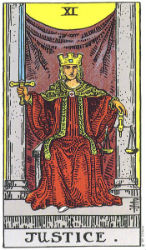
This is one of the simpler and least symbolic cards of the deck.  On a very basic level it represents justice and fairness.

Since justice is usually played out in the court systems in our society this may indicate a favorable legal settlement for the questioner.  On the same level it may indicate an honest lawyer or a fair and impartial judge or jury.

In the realm of relationships this may indicate a romantic or business relationship which is well balanced and in which both parties are getting what they deserve.

On a personal level this can indicate that the questioner is a fair and honest person who treats others carefully and with consideration.

REVERSED:  If there are legal matters pending there may be an unfavorable outcome for the questioner.  On a personal level this may indicate a person who overly judgmental and critical, even harsh.  The questioner needs to take a good hard look at his or her life and relationships and decide if she’s being honest, open, and fair.

How you perceive the Justice card depends upon whether you want to think of it as Justice-small-j or Justice-big-j.

If you have questions about this card or its meaning in one of your readings, please don’t hesitate to leave a comment.  I’ll get back to you as soon as I can.

A Few More Thoughts About Justice:

Justice-small-j has to do with our court systems and what you might call ordinary, earth based justice.  It will almost always appear in readings when the questioner is involved with some legal process or litigation.  

From a small-j perspective it looks very much like The Hierophant card.  A person sitting on a throne between two gray pillars. The Hierophant represents organized religion as opposed to true spirituality and, in the same sense, Justice represents organized justice as opposed to morality based justice.  The Hierophant is spirituality as it has been collected in books and organized into long standing traditions. Justice-small-j represents justice as it has been collected in books and organized into long standing precedents.

Justice-small-j is all about court rooms, judges, law books, and lawyers.  It’s what attorneys go to law school to learn.

Justice-big-j is a whole different kettle of fish.  It’s about the principle of justice and whether or not it exists independently from the court systems.  We don’t talk about that much anymore but it was actually a very hot topic from ancient times right through the early twentieth century.

Plato argued that there was a, “form,” of Justice, sort of an archetype of righteousness that descended into the material plane and the human mind and heart.

In her wonderful book, “Jung and Tarot, An Archetypal Journey,”  Sallie Nichols quotes Carl Jung as saying this:

“It should never be forgotten . . . that morality was not brought down on tables of stone from Sinai and imposed on the people, but is a function of the human soul, as old as humanity itself.”

Dig that:  morality is a function of the human soul.  In other words, we instinctively seek to do right and to avoid doing what’s wrong.  

The Tibetan Buddhists talk about the human soul in much the same way.  Chagdud Tulku Rinpoche described it as a beautiful, glowing crystal that’s encased in rock.  Each time that we meditate or intentionally act with love and compassion a little more of the rock obscuring the crystal gets chipped away.  A little more of our beauty emerges.

We know that at the time the Tarot first appeared Plato was still being studied as the Great Master of philosophy.  And we know that the rest of the cards in the Major Arcana are very much archetypal images. So it’s not a stretch at all to assume that Justice was included in the Tarot deck not as a small-j but as a big-j.  

When you get Justice in a reading, yes, look for legal matters to crop up in your life.  But also look for the principle of Justice to be blowing through your life.  Something has been out of balance in the way you’ve been treated and karmic principles are stepping in to adjust that and bring it back into balance.  

BIG J!

 
“Just the Tarot,” by Dan Adair – a kindle ebook available on Amazon