The Chariot, Choices, and Man in the Moon Epaulettes

Choosing new lives after devastating loss.

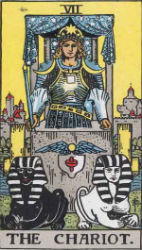
I’ve always loved the way that the guy is dressed in The Chariot Tarot card.    I mean, what a spiffy outfit!  He’s got a crown with a star on it, his very own scepter, and he’s rocking a sort of a skirt with all of the signs of the zodiac on it.  And the pièce de résistance is those wonderful Man in the Moon epaulettes. I mean, this is a guy that, if we saw him walking down the street, we’d definitely be impressed with how put together he is.   Not to mention his bold sartorial choices.

Of course, there’s a major wink in this card.  When we look at the two sphinxes that are pulling the chariot he stands in, we realize that (a) they’re sitting down; (b) they’re facing in opposite directions; and (c) there are no harnesses or reins attached to them.  In other words, the Charioteer, despite his glorious finery, is going nowhere any time soon.

The reason he’s not cruising is a matter of choice, and I don’t mean that he’s chosen not to move.  He’s psychically paralyzed.  The black and white sphinxes represent duality. The second that duality comes into the picture, we’ve got choices to make.  Should I go right or left?  Should I get this job or that job?  Should I get married or stay single?  Should I follow the Yellow Brick Road or just hang here with the Munchkins?

When we suddenly have too many choices, we can become frozen in place, like the classic deer in the headlights.  Which is ironic, because for so much of our lives we bitch about NOT having any choices.  We’re stuck in a dead end job.  Or we can’t leave a toxic relationship because we’re worried about the kids.  Or we’re living in a town we hate but we don’t have the money to move.

If only . . . if only . . . we had a choice.  Things would be different.  Life would be good.

Now, when our lives suddenly blow up – and I mean really blow up – we may not have much left.  If we go through a devastating divorce or our partner dies or we lose all of our money, we’re left standing there with nothing.  The one thing we DO have left is choices.  

It sounds paradoxical, because when we, “lose,” everything, we feel powerless.  We feel as if all of our usual, reliable resources have been stripped away from us and we have nothing left to work with.  Oddly, though, we find out that we have much more to work with than we did before we lost everything, and that’s because we suddenly have choices.  As Kristofferson said, “Freedom’s just another word for nothing left to lose.”  When we lose everything, we can actually be free, perhaps for the first time in our lives.

The Chariot is a wonderful metaphor for how we traverse our lives in ordinary times.  We may not actually be going anywhere, we may have no sense of direction, we may feel that our lives lack any real meaning, but by god we’re well dressed.  Before we step out into the world every day, we make sure our crowns are on straight, our zodiac skirts are clean and pressed, and we have a firm grasp on our scepters.  We may be, “leading lives of quiet desperation,” on the inside, but we see to it that our outsides are impeccable.

We’re standing there in our glorious, glittery chariots that we call our lives and – BOOM – we get fired or we come home and find our wife/husband shtupping our best friend or we get run over by an out of control ice cream truck.  Suddenly we’re lying there in the ditch with our crown all bent to hell, our scepter broken in two and our epaulettes torn off.

And, of course, we’re filled with immense grief for all that we’ve lost.

One of the first things that happens in the grief process is that we try to pretend that everything is normal.  Nora McInerny talks about that in one of her videos on grief. In a period of just a few months, her father died, her husband died and she had a miscarriage.  When friends and family would ask how she was doing, her constant refrain was, “I’m fine.  I’m alright.  I’m perfectly fine,” though she was shattered inside.

So basically, our first impulse is to pick ourselves up out of the ditch, dust off our zodiac skirts, glue our scepters together and put our bent crowns on our heads.  We’re fine.  Perfectly fine.

That works for some of us, after a fashion.  If we get our outsides together, then we can reassure ourselves that our insides must be okay, too.  Hey, I’m going to work, I’m paying my bills, I eat meals . . . sort of . . . so I must be okay.  Our friends and family will shine that back at us, too, because they really, really don’t want to deal with us NOT being okay.  Right around the six month mark after a death they’ll start to be worried and say something like, “Look, isn’t it time you start to get over this?  Maybe get out and meet someone?  You know . . . get on with your life?”

For many of us, though, that doesn’t work.  We know that the crown is never going to fit on our heads again, the goddamned scepter won’t stay glued together and our Man in the Moon epaulettes are in shreds.

At first blush, that can feel incredibly overwhelming, because there’s a realization that so much of what we used to call our lives was total bullshit.   If everything that we thought was so solid, so dependable, so . . . normal . . . can be taken away in a flash, then it wasn’t worth much to begin with, was it?

Then we enter into another phase of the grieving that can be just as painful as the first, shocking, phase, which is, “what do I do now?”  How do I put my life back together in such a way that it can’t be exploded into pieces by the next shit storm that blows through?  We have to make choices.

That secondary phase can be agonizingly slow and filled with crushing anxiety.  Like the Chariot, we can end up frozen in place for months, perhaps years. Just the realization that we made SO many wrong choices in our previous, pre-disaster lives, can render us terrified of making any choices now.  How do I not screw this up again?

The ironic thing is that eventually it turns out that even the idea of making new choices is bullshit.  There’s a new self that begins to emerge spontaneously and, much like the birth process, it shouldn’t forced and it can’t be stopped.  The new self is kinder, more compassionate, more loving, more patient, more authentic.  And a lot less concerned with how our crowns fit.

It was there all along, just waiting for the right circumstances to be born.  

The Buddhists talk about it in terms of, “original nature.”  They say that we each have an incredibly beautiful gem inside of us that’s covered with common rock.  As we chip away at the rock, we gradually reveal the jewel that is our real selves.  Sometimes it may take decades of patient meditation and practicing loving/kindness to reveal it.  Sometimes it just takes getting run over by an ice cream truck.

Christmas Candy, the Meaning of Giving, and Tibetan Meditation Centers

Making our lives into gifts.

Here in the United States we’re just finishing up the annual emotional and commercial orgy of Christmas, also known as, “the season of giving.”  It started me thinking about the nature of giving and, oddly, a Tibetan meditation center I toured over 20 years ago.

Our guide was a woman who lived there with the improbable name of, “Candy.”  I’m guessing that trying to explain the intricacies of Buddhist philosophy to a group of tourists in Bermuda shorts was not the highlight of her day, but she was pleasant, kind, and patient.  One of the concepts that she put in a nutshell for us was the idea of accumulating merit.

“We get up in the morning with the idea of helping other sentient beings and, if we do that, it earns us karmic merit.  And then, instead of clinging to that merit for ourselves, we dedicate it to the good of other sentient beings.  Which accumulates more merit, which we dedicate to the good of other sentient beings.”

I glanced around at the people I was with and their faces were frozen in expressions that pretty much conveyed, “I don’t know what in the fuck you’re talking about, but you seem relatively harmless.”  To me, though, it was a major revelation.  In just those few sentences, I understood the concept of giving with absolutely no expectations of getting anything back.  It’s been something I’ve gone back to again and again over the last two decades.  A lasting treasure.

Now, here’s the thing:  I feel absolutely sure that Candy had no idea that she was making a major impact in another person’s life and thoughts.  We spent maybe 30 minutes with her and I’ve never seen her again, but I still remember that moment like it happened yesterday.  It was a gift, and the gift was her just living her life and telling her truth.

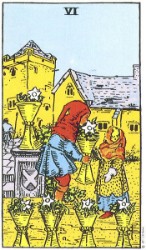
We tend to think of giving as being something that’s transactional and we can see that idea illustrated in the Six of Cups.  The little boy is giving a gift of love (symbolized by the Cup) to the little girl.  Implicit in that image is the next step in the transaction, where the little girl is going to say, “Oh, hey!  What a nice cup!  Thanks so much for thinking of me.”

And then we feel good because we’ve made someone we care about feel good and we feel good about ourselves because, after all, we were thoughtful enough to give something nice to someone we care about.  When we put all of the commercialism and forced jolliness aside, that’s part of the sweetness of Christmas – it’s a chance to give something to others and tell them we love them.

Most of us feel pretty disconnected with that in our general, everyday lives, though.  We may get up in the morning with the intentions of being, “good,” people.  We’re loving with our life partners, we don’t snap at the cashier in the grocery store, we smile at our co-workers and try to work hard at our jobs.  As near as I can tell, right around 90% of us are good people, in the sense that we make some effort to not be shit heads and to be decent to our fellow humans.

Still, a lot of us are afflicted with a sense of meaninglessness.  We feel like we’re slow walking through life in a sort of a daze and we’re not really making any difference.  It’s like we’re born, we eat a lot of t.v. dinners, and then we die and we wonder if anything we’ve done actually matters.

That’s where synchronicity and a leap of faith comes in.  That’s where giving with no sense of attachment to the results comes in.

Each one of us is absolutely unique.  There’s never been anyone exactly like us before and there will never be anyone exactly like us again.  To the extent that we celebrate that uniqueness and share our own individual truths in our lives, we become a walking, talking, breathing gift to the world.

But we almost HAVE to detach that gift from results.  If we make our giving transactional – which is to say, someone saying, “Thank you for being you,”  – we’re setting ourselves up for a lot of disappointment.  The fact of the matter is that most people don’t even see us, in any sort of a meaningful way.  Like us, they’re hustling and bustling through life, trying to pay their bills, hoping they’ve got some clean socks, trying to figure out what in the hell they can cook for their kids that isn’t a t.v. dinner.

And if they do notice us, the odds are that they’re seeing us through so many perceptual filters that they don’t see who we really are.  As the old Indian adage goes, “When a pickpocket looks at a saint, all he sees is pockets.”  

So, we have to make a little leap of faith that we ARE being seen without knowing that we are.  And that we ARE making a difference in other people’s lives and in the world, without any proof that it’s so.  Sometimes it may be like Candy at the meditation center, where words we speak become seeds that grow in other people’s lives.  Sometimes it may be as simple as smiling at a person we pass on the street, never knowing that they were depressed and suicidal until they saw our smile.

We can see that in another card, the Ace of Cups.  The cup represents love flowing into the world, but, unlike the Six of Cups, it’s not attached to anything.  It’s not something we have to earn.  It’s not dependent on being thanked or being noticed or appreciated.  It’s just there in the world and it makes life better by its very presence.

When we finally get it that we’re giving to the world around us and making a difference just by being us to the fullest extent that we can, then we shift into having meaning in our lives because we ARE making a difference.  We may not see it.  Perhaps no one will ever tell us.  Maybe it will take twenty years for that good to ripen in someone else’s life, but we DO matter.  Every single day.

My e-book, “Just the Tarot,” is still available on Amazon for less than the price of a meaningless t.v. dinner and it’s twice as nutritious!

The Magician, Apples and Bears and Cat’s Eye’s Marbles

The role of paying attention in magic.

Not too long ago a friend asked me, “Well, what IS magic, anyway?”  And it’s hard to explain, you see, because magic is all about bears and apples and cats eye marbles.

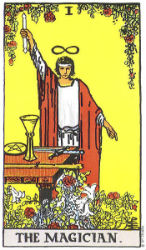
We encounter images like The Magician Tarot Card or Hollywood depictions of wizards and witches and we think that magic is very mysterious and as rare as a mustache on a frog.  It’s certainly nothing that those of us who are ordinary mortals will encounter, unless we trip over a  bottle with a genie in it.

Not true.  Not true . . . magic is everywhere.  We just don’t pay enough attention to see it.

I live in the mountains of Northern California and one of the things that comes along with mountains is bears.  Yes, large, furry, fearsome, 500 pound ursine critters with giant claws and paws and huge, scary teeth.

But it’s not so bad.  For the most part, bears mind their own business and humans mind theirs and seldom the twain shall meet.  You might occasionally step out on your back porch at night and say, “Oh, shit, it’s a bear.”  No problems.  The bear stares at you, you stare at the bear, you slowly step back into your house, close the door and repeat, “Oh, shit, it’s a bear.”

I don’t doubt that the bear is probably standing in the yard thinking, “Oh, shit, it’s a human.”

The one time that bears can become problematic is in the Autumn when they need to fatten up before they hibernate.  During that brief period of time, they will destroy anything that lies between them and food.  If you have a shed with trash cans in it, they will rip the roof off to get to the garbage.  They will eat goats and sheep if you leave them lying around at night.  They’ve been known to tear the doors off of cars because the owner left a bag of dog kibbles inside.  And they love, love, LOVE apples, which coincidentally ripen at exactly the same time that the bears get hungry.

When my partner, Carol, and I first moved to the mountains we purchased an old ranch style house.  It was built in 1950 and several generations of several families had lived in the house before us.  The deserted tree houses and forgotten toys lying in the weeds were testaments to the fact that many children had lived in that house and romped around on the surrounding property.

One of the things we were most excited about was that we had our very own apple grove on the hill behind the house.  There were about a dozen, gnarled old trees and we were thrilled when they burst into beautiful white and pink blossoms during our first Spring there.  The aroma of the blossoms was like something out of heaven. Fat, black and yellow bumble bees buzzed and droned from blossom to blossom and life was mellow.

As the summer progressed and the apples began to form and grow, we fantasized about harvesting them in the Autumn.  We knew we’d make apple pies and apple fritters and apple butter.  Perhaps we’d buy a small wine press and make apple cider or bottle apple vinegar.  Maybe we’d fill the bathtub with apple sauce and just squish around in it.

Oh, we were feeling very organic!  We were living in the country and we had a huge crop of apples coming ripe on our little farm.  Which actually began to worry me a bit, as I strolled through the grove, counting the apples.  I realized that, even on those few trees, there were hundreds of apples.  Maybe thousands.  It slowly began to dawn in the recesses of my mind that maybe thousands and thousands of apples coming ripe at the same time might not be such a swell idea.  What in the holy hell were we going to DO with all of them?

It was right about then that I first heard about the bears.  

One of our new neighbors dropped by unexpectedly and I was standing in the yard with him pretending that I liked it when neighbors dropped by unexpectedly.  He was chewing on a match stick, eyeing the apples trees critically and he said, “Best keep all of them apples picked up when they fall or you’ll draw every bear in the county.”

Gulp.  “Bears?  We’ve got . . . bears?”

“Oh, yeah,” he replied.  “The goddamned county is full of goddamned bears.  Better not go out at night without a gun or they could tear you apart.  Of course, they’re not near as bad as the mountain lions.  The goddamned mountain lions like to jump out of a tree, bite your head and crush it like a goddamned egg.  Goddamned, son of a bitch bears and mountain lions.  Best keep those goddamned apples picked up or you’ll be goddamned sorry.”

All of which leads up to the fact that I could not, in fact, keep the goddamned apples picked up despite frantic, manic efforts.  Apples fell like rain and covered the ground.  They fell into the rain gutters on the house.  They fell into pots full of flowers.  They fell on my head and shoulders as I rushed through the apple grove with a rake and wheel barrow.  They were everywhere.  Whoever said that an apple doesn’t fall far from the tree never had a goddamned apple tree.

Now, I only mention this because of the cat’s eye marble.

As it turned out, the neighbor was right about the apples and the bears.  There came the inevitable night when the dogs were howling and there was much huffing and puffing and the sounds of branching snapping in the apple grove.  When I ventured out the next morning, several of the trees had been thoroughly trashed.  The goddamned bear, not content to eat the goddamned apples that were on the ground, had ripped down dozens of branches and they lay broken and scattered around the grove.  

As I stood there, muttering to myself and examining the humongous mounds of bear shit, there was a loud cracking noise to my immediate right.  One of the larger branches had been broken nearly in two when the bear scaled the tree and it suddenly sagged almost to the ground.

And there, partially embedded in the wood at the point where the branch joined the tree, was a single cat’s eye marble.

I reached over and easily pulled it loose from the tree branch.  As I stood there staring at the marble in my hand, I felt a shiver run up my spine and the hair on my neck stood on end.  I realized that at some time, many, many years ago, a child stood by that very tree.  Perhaps it was getting dark and her mother called her in from playing.  Perhaps she was leaving a gift for the fairies.  For whatever reason, she had carefully balanced a marble at the convergence of the tree and branch and then forgotten about it.

Through the years, the tree grew and grew and the branch gradually enveloped the marble, holding it there safe inside of the tree.  Until I happened to be standing exactly next to the tree at the exact moment that the tree branch broke and revealed its treasure.

I felt as if the ghost of a small child was standing right there next to me, handing me that cat’s eye marble and saying, “Look what I’ve got, Mister.”

And that’s magic.

The odds against that happening are staggering.  It’s impossible.  Can’t happen. 

But it did.

The thing about it is that I didn’t cast a spell or wave a wand at the tree or ask the elementals to perform a magical feat.  It just happened and I was paying attention, so I saw it.

Maybe it was the ghost of that long ago child, but more likely it was the Universe laughing and saying, “Look what I’ve got, Mister.  Can you see?  Are you paying attention?”

Magic is out there.  It happens all of the time.  We just have to learn how to see it and when the Universe asks us to play with it, gather up our marbles and go.

*.  *.  *

PLEASE REMEMBER THAT MY E-BOOK, “JUST THE TAROT,” IS AVAILABLE ON AMAZON FOR LESS THAN THE PRICE OF WHOLE BAG FULL OF MARBLES.  YOU SHOULD BUY A COPY – IT’S MAGICAL!

Time Travelers, Blackberry Salmons, and Babies in Sunbeams

Religious concepts of time and the destruction of mindfulness.

I love Eckhart Tolle’s statement that, “it’s never not now.”  

It’s totally true, but we really have to bend our minds a lot to get into that space.  It’s not too difficult intellectually, because we can look at it rationally and realize that there really is no past (except in our heads) and there really is no future (except in our heads.)  I mean, it’s not like there’s some Past Land, like a Disney adventure ride, that we can go visit.  IT DOESN’T EXIST. Ditto with the Future, because all that it really consists of is our projections of what we think will probably happen.  Maybe.  Could be.

Despite that, we humans spend a MASSIVE amount of our lives Time Traveling to the future or the past and very little time in the Now.  Put another way, we use a lot of our mental space living in something that doesn’t even exist and, as a result of that, we spend very little time existing in the space that actually does exist.  We’re so bad at living in the Now that we actually have to take mindfulness classes to learn how to do it.

So how in the hell did this sorry state of affairs come to be?  We should find the person responsible for this and give him a good thrashing.

Oddly, the answer seems to be that it was our old buddy, Organized Religion, that did it.  In the Tarot, organized religion is represented by The Hierophant and The Hierophant has rules and regulations that we’re all supposed to bend our knees to.  One of his Big Rules is about time and it says, “There isn’t enough of it.”

Now, probably the original way that humans experienced time was sort of like this: 

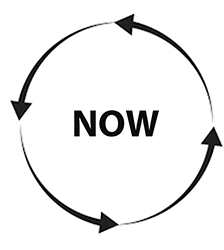
There was just a big NOW, with no concept of the past or the future.  We just sat there in the bliss of the present moment soaking it all in.  Or it might have been a little bit more like this, where one NOW moment just led into the next NOW moment. No concept of past or future, just NOW.

That’s much the way that babies seem to experience time.  They can lie there for hours staring at a sunbeam and not get worked up at all about what the sunbeams are going to look like tomorrow or worry about what the sunbeams were like yesterday.

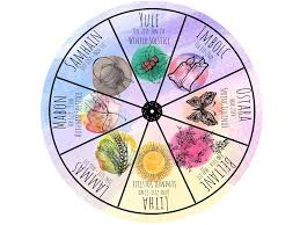
At a certain point in our evolution, our experience of time probably shifted more into the model we see with the Wiccan Wheel of Time.  

We started to notice the cycles of the Moon and the passing of the seasons.  There would have been some recognition of certain times of the year but not a great deal of worry about it.  The Native Americans of the Northwest expressed it in terms of activities.  “This is the time when we gather berries.  This is the time we catch salmon.  This is the time when we plant seeds.”  And so on.

Still, there was none of the huge anxiety that we seem to feel about time today.  Tribal people didn’t sit around their camp fires filling in dates on a calendar or trying to figure out how to, “use their time more productively.”  They just did what they needed to do when it was the right time of the year to do it.  “Hey, I’ll bet some fried salmon would go great with these blackberries!  We should probably stack up a little fire wood while we’re at it because it’s going to get cold sometime soon.”

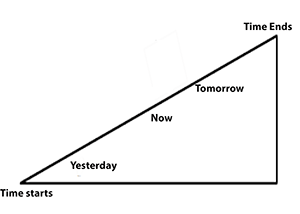
Unfortunately, while the Native Americans were sitting around having fish fries and enjoying their blackberry cobblers, humans in the Middle East were coming up with an entirely different concept of time, which historians refer to as the, “inclined plane,” model.  The reasoning behind this model of time ran very much like this:

  1. – If time exists, then there must have been a BEGINNING of time, because . . . you know . . . there just must have been.
  2. – And if someone, “started,” time, then it must have been someone who was OUTSIDE of time and that would be someone who was eternal and that would be God.
  1.  -And if there was a start to time, then there must also be a stop to time, which is when the world ends and God will do that, too, so I think we should call it The End Times.

Okay, so it wasn’t the best piece of human thinking that we’ve ever seen, but they didn’t have Google in those days so they couldn’t really look things up.  It also represents a HUGE shift in human perception and one that we’re still suffering from today.  All of a sudden, time looks like this:

So time has suddenly become a quantity, rather than a quality. It begins and it ends.  We can measure it, we can put it on calendars, we can plan it, we can carry it around on the daily planners of our phones. Shazam! – we have the concepts of the past and the future, of yesterdays and tomorrows.  We see this notion of time-as-a-quantity deeply ingrained in our languages.

I need to SPEND some time on that.

I’m not sure I want to INVEST that much time in it.

Time’s a WASTING.

This should be a real time SAVER.

I need to ORGANIZE my time.

We’re RUNNING OUT of time.

I’ll PAY you for your time.

When we look at all of those statements, the basic message is that THERE ISN’T ENOUGH TIME, goddamnit!  Which, of course, is ridiculous, because there’s all the time in the world.  Literally.

We’ve been so totally hypnotized by the religious concept of time that we  can’t imagine a world without it.  We’ve devolved from that perfect bliss of a baby tripping out on the sunbeams into beings who are missing our own lives because we’re constantly living in the past or in the future.  The only cure for it seems to be to re-train our brains back into living in the NOW through mindfulness meditations and living mindfully.

I mean, you know, if we can schedule the time for that.  I’ll have to look at my calendar . . .

Just a reminder that there is ALWAYS time to read my ebook, Just the Tarot, and it’s still available, dirt cheap, on Amazon

The Sun, the Moon, Julius Caesar, and Why There’s No Such Thing as a Free Lunch

A brief look at the origin of the concept of time and its link to money, capitalism, and lunch.

Didja ever notice that we tend to discuss time in almost exactly the same way that we discuss money?

Consider some of these phrases:

  • We spend time.
  • We save time.
  • We waste time.
  • We invest time.
  • We say that we’re running out of time.
  • We tell people that we don’t have enough time.

And, of course, the one that really lets the cat out of the bag:  “Time is money.”  

In other words, we’ve made time into a commodity.  We assure ourselves that we don’t have enough of it, but we trade substantial portions of it to our employers in exchange for money, which then allows us to take vacations when we’ve stacked up enough moolah, because we, “need some time off.”

Now, there are moments in human history when we, as a species, have made such monumentally stupid decisions about something that they amount to an evolutionary wrong turn and scar us forever.  I discussed one such moment in my previous post, “Happiness, Capitalists, Yellow Rocks, and Radical Meditators.”

At some point in ancient human history, a person picked up a piece of gold and said, “I have a yellow rock and you don’t.”  The appropriate response would have been to say, “Dude, what good is it?  You can’t eat it and you can’t fuck it.  Get over yourself.”

But, instead, we said, “I want one, too.”  What followed was centuries of murder, pillaging, and decimating native cultures, all in the name of determining who had the most yellow rocks.

In much the same way, there was a point in human history when some idiot asked, “What time is it?”  We have to imagine that the person standing next to him replied, “It’s day time.  What are you blind?  The sun’s up there in the sky and you can see your hand in front of your face.  It’s day time.”

“No,  I mean, exactly what time of the day is it?”

“Who cares?  If it’s day time, we get up.  If it’s night time, we go to sleep.  Who cares what part of It’s-Get-Up-Time it is?”

“Well, if we don’t know precisely what time of It’s-Get-Up-Time it is, how are we supposed to know when to have lunch?”

“Oh . . . shit . . . I never thought of it that way.  That’s an important point.  I don’t want to miss lunch.”

“I know what!  Let’s build a sundial!  Then we’ll know exactly how much time we’ve got in each day and when to eat lunch.”

Thus was born the concept of time as a commodity.   Something that could be measured and therefore controlled.

This form of insanity became SO popular that by 46 BC Julius Caesar said, “You know, we’ve actually got too much time going on and we need to get it under control, so I invented . . . the calendar.  From now on, there are exactly 365 days in each year.  Well . . . I mean, except for every fourth year when there’s an extra day and we’ll just throw that one in during February so no one notices.”

It seemed as if we finally had time under full control and everyone knew exactly when to eat lunch, when suddenly, 1600 years later, in 1582, Pope Gregory said, “Actually, I’ve been thinking about it, and I think that there are  365.2425 days in the year instead of 365.25.”  And thus was born the Gregorian calendar, which we use to this very day.

Hurrah!

Now, let’s be honest.  If we had a friend or a relative who was terribly, terribly, TERRIBLY worried about whether there are 365.25 days in the year or 365.2425 days, we’d say, “You know, that guy’s plumb nuts.  He actually stays up at night worrying how long the year is.” 

Really, there are only two natural measures of time here on the Earth school. The first is the number of times that the Moon gets full.

And the second is how many Full Moons occur while we rotate around the Sun.

It gets light and then it gets dark and that’s night and day.  We have more dark in the winter and more light in the summer and those are the seasons.  The, “shortest,” day of the year is right around December the twenty first, so the, “new,” year starts right around December the twenty second.  Easy peasy.

We can see that more natural approach to time with the Indigenous Peoples of the Pacific Northwest.  They had one month that was called, “the time to catch salmon.”  Another month was, “the time to gather berries.”  Another month was, “the time to catch eels.”  My favorite was February, which was, “the time to do nothing,” (probably because of that pesky extra day that Julius Caesar discovered.)  They didn’t have any concept of weeks or months or hours in the day and were totally amazed at our obsession with watches and clocks and calendars.

So where DID this need to measure and control time come from?  We can get a very clear picture on that when we consider the origin of the word, “calendar.”  It was, “Kalendorium,” which was defined as, “A book in which the interest on loans (due on the first of the month) was recorded.  An account book.  A ledger.”

So the concept of time wasn’t invented to be sure that we all had lunch at the right time.  It was invented to be sure that we paid back our loans on time.  

Basically, the guys who had collected all of the yellow rocks said, “I’m going to loan you this yellow rock because all you have is copper rocks and you can’t even buy lunch with that.  BUT . . . in exchange for my giving you one of my yellow rocks, you have to pay me back TWO yellow rocks.  Unless, of course, you hold onto my yellow rock for longer than the period of the loan, and then you have to give me THREE yellow rocks.”

And thus was born capitalism.

It became more radical, of course, with the beginning of the industrial age when we saw the birth of the wage slave.  That’s when the people who had collected all of the yellow rocks REALLY dug in and took control of our time.

“Look here,” they said,  “I don’t have a lot of time because I’m busy counting all of my yellow rocks.  You, on the other hand, don’t have any yellow rocks but you have a lot of time, which, up until now, was free time.  Now, I’ll give you the dust in the bottom of my bag of yellow rocks in exchange for you using all of your time to work in my factory, and then you can afford to buy lunch.  I mean, if I decide to give you a lunch break.”

And thus was born the minimum wage.

 And that is how we came to lose our time.  Now we can’t afford to waste our time, because we have to spend our time, in order to invest our time because . . . well, we’re running out of time.

Time is money!

My ebook, “Just the Tarot,”  is still available on Amazon.com for less than you’d pay for three rolled tacos, even without guacamole’.  You really can’t afford to turn down a bargain like that.

The Hitchhiker’s Guide to the Dark Ages, The Hierophant Card, and Eschewing Sheep

The Bible as an anachronistic guide for living.

The Bible was really the original Hitchhiker’s Guide to the Galaxy, at least for a big chunk of Western history.

In The Hitchhiker’s Guide to the Galaxy, Douglas Adams invented a sort of a tourist’s guide book that could be used while visiting various sections of  outer space.   No matter what bizarre planet or dystopian nebula a traveler might be visiting, she could simply consult the Guide to Galaxy to determine what in the hell was going on.

Now imagine, if you will, a world in which the inhabitants were so thoroughly stupid and ill-informed that they thought that the planets they saw in the night sky must be living creatures because, after all, they moved around instead of standing still.  Inhabitants who believed that their own planet was, in fact, flat as a board, and that you might fall off of the edge of it if you sailed your ship too far in any given direction.   People who believed that if a man had a wet dream it was because his, “vital fluids,” were being drained by a succubus.  People who believed that witches had secret teats that they used to nurse black cats.

To use the scientific nomenclature, people who were just as dumb as a bag of rocks.

For such people, life would seem very puzzling and, indeed, very frightening.  They were constantly surrounded by threats and mysteries.  Where does lightning come from?  Do demons live in trees?  Why do we sneeze?  What’s a clitoris and where do you find one?  Well . . . never mind that last one . . .  that’s still going on.

Fortunately, when confronted by this bizarre, evil, scary world, they had a book they could turn to for guidance on nearly any subject.  And not just any book.  This book was written by . . . God.  And, since God actually MADE the bizarre, evil, scary world, he’d be the one who’d have the answers about what in the hell was going on, wouldn’t he?  All of that secret God-knowledge was contained in The Christian Hitchhiker’s Guide to the Dark Ages, also known as the Bible.

Unfortunately, there were very few copies of the Bible in existence, they were enormous,  and those few copies were mainly kept locked away in castles and monasteries.  To make matters worse, even if the common folks were somehow able to get hold of a copy of the Bible, they didn’t know how to read it because . . . you know . . . ddumb as a bag of rocks.  All that they could do was to sit there and hold the Bible and try to guess what it might actually say, which didn’t work out too well.

And so they invented a special class of people who actually COULD read and actually HAD copies of the Bible and they called them, “priests,”  and sometimes, “monks.”  We see one such person in the Tarot card, The Hierophant.

The arrangement that the common people had with the priests was really quite simple.  When they – the common folks – were confronted with a problem or a conundrum in life, they would go to the priest and give him money, or some eggs, or perhaps a goat. Maybe an eggplant.  In return, the priest would bring out an enormous copy of the Bible, flip it open, read a bit, and then tell the common folks what God had to say about how to solve their problems.

We can imagine that this exchange might have gone something like this:

“Yes, hello Father Flanagan.  Top of the morning to you.  We’re here because our well has dried up and if there’s no water we don’t know how the village will come down with giardia this summer.  We can’t decide if we should dig a little deeper or maybe just start a new well, so if you could look in your giant book and tell us what the God person says, we’d appreciate it.  By the way, here’s an eggplant.”

The priest, for his part, would mutter a few incantations, heave open the big, fat book to a random section, and trace a few lines of the Holy Scripture with his finger.

“Ah, here it is, my children.  The Lord saith, “Thou shalt not curse the deaf, nor put a stumbling block before the blind,.”  Leviticus 19:14.

“Oh.  Um . . . begging your pardon, your holiness, but what does that mean?”

“It means, don’t trip blind people.”

“Ah . . . yes . . . and that’s very good advice, Father.  I personally try to avoid tripping blind people as much as possible.  Anyone here who trips blind people?”

The common people glance around at each other, shaking their heads.

“Nope, none of us trip blind people.  Well, there was Fred, but that was years ago.  Still, your honorableness, that doesn’t hardly tell us whether to dig a new well.  Could we maybe give it another try?  Here’s another eggplant.”

“Oh, very well.  Let’s see . . . um . . . “You must not lie carnally with any animal, thus defiling yourself with it; a woman must not stand before an animal to mate with it.”  Leviticus 18:23

“Uh, what does THAT mean?”

“It means don’t have sex with your sheep.”

“Eeeeeewww!  Gross!  Jesus.  I’ll have a hard time getting THAT out of my head.  Anyone here sheep fuckers?  No?  Even Fred?  No?  Sigh . . . now, about that well, your priestliness.”

And so on and so on, until the priest had all of the people’s eggplants and the people had, verily, nothing but a dry well to spit in.  

The problem, of course, was that The Hitchhiker’s Guide to the Dark Ages, aka The Bible, wasn’t really designed for the Dark Ages, it was designed for the Stone Ages.  While knowledge such as how to kill a giant with a slingshot or how to plug up the Nile River with frogs might have been interesting, it hardly solved the more complex problems of the Dark Ages.  People of the Dark Ages were facing more technologically intricate matters, like how to fight dragons or what charcoal worked best when burning heretics at the stake.

The Bible simply didn’t have the answers, no matter how many eggplants they threw at it.

Now, in the very same sense, it’s entirely possible that the Bible doesn’t contain the answers to the questions we’re facing today.

How do we fight a worldwide pandemic?  And the Bible says . . . nothing about that subject.

How do we stop this horrific gun violence?  Nothing.

Should abortion be legal?  Nothing.

Why is Donald Trump orange?  Nothing.

Is Marjorie Taylor Green an alien life form?  Nothing.

Why have we been cursed with the Kardashians?  Nothing

It may very well be that the Bible isn’t just a very, very, very old book that lost a lot in the translation.  It may be that the Bible is totally irrelevant to most of what we call daily life.  That may be why the number of people who self-identify as christians has fallen from 90% in the 1950s to a mere 64% today.

It’s difficult to deal with fundamentalist christians.  They’re still waving The Hitchhiker’s Guide to the Dark Ages in the air and screaming that the earth is flat and we might fall off of the edges.  Nonetheless, it may be time to look for a different paradigm and different answers.

At least we’ll get to keep our eggplants.

If you enjoyed this post, please remember that my book, JUST THE TAROT, is available on Amazon for much less than the cost of a Bible and doesn’t contain one single word about sheep.

Cheatin’ Horndogs, Vibrators in the Refrigerator, and Tarot Cards that Indicate Infidelity

Tarot cards that indicate infidelity in a relationship.

“She just started liking cheating songs,
And what’s bothering me,
I don’t know if it’s the cheating she likes,
Or just the melody.” – John Anderson

If you read Tarot cards for other people, you’ll find that one of the major topics that those people want to know about is love and romance.

Is she the right one for me?
Does he feel the same about me that I feel about him?
Should I ask her out?
Should we move in together?
Are we meant to get married?
Will this relationship last?

And, of course, with love and romance there are frequently questions about fidelity and cheating. Most marriages and relationships are, “monogamous,” which is derived from the Greek, meaning, “keep your dick in your pants,” (except when you’re with me.) A very large part of the marital and partnership contract is that when we fall in love we’ll be sexually and emotionally exclusive to that one other person.

Just the Tarot by Dan Adair – a kindle ebook available on Amazon

Having sex with or becoming emotionally attached to a third party is seen as a major violation of that contract and is grounds for terminating it. And there are major penalties that go along with that violation, such as being locked out of your house in your bathrobe, or having your partner pour maple syrup all over your best clothes just before she throws them out into the front yard. And many times, it’s not even REAL maple syrup, it’s that cheap, artificially flavored crap like Mrs. Butterworths.

Quite naturally, then, people who are cheating on their partners will go to great lengths to conceal it. And, quite naturally, the partner who’s being cheated on will somehow know, on a very deep, almost psychic level, that their mates are being unfaithful. There may be extremely subtle, subliminal clues, such as your husband having a giant hickey on his neck, or finding a pair of jockey shorts under the pillow when you wear boxer shorts. Or perhaps coming home early from work and seeing a naked man running out your back door, or finding a strange vibrator in the refrigerator next to the carton of eggs.

Those are the kinds of subdued, low key signals that will often make a person stop and ponder if there’s something more going on in their marriage than meets the eye. Still, their partners will tend to deny it. The vibrator in the refrigerator must have accidentally fallen into the grocery bag at the supermarket and really belongs to someone else. The naked man running out the backdoor was the plumber, who was sleepwalking, and was completely shocked when he awakened without clothes while he was working on the dripping faucet in the bathroom. The hickey on your husband’s neck was the result of a near tragic vacuum cleaner accident at work. The jockey shorts under the pillow were meant to be a present and now you’ve gone and ruined the surprise.

Even though these are all perfectly rational, reasonable explanations, there may still be lingering suspicions and so your client will want to consult the Tarot cards to determine the truth. Here are a few cards that may indicate that the questioner’s partner is what is clinically referred to as a, “cheatin’ horndog.”

THE LOVERS REVERSED

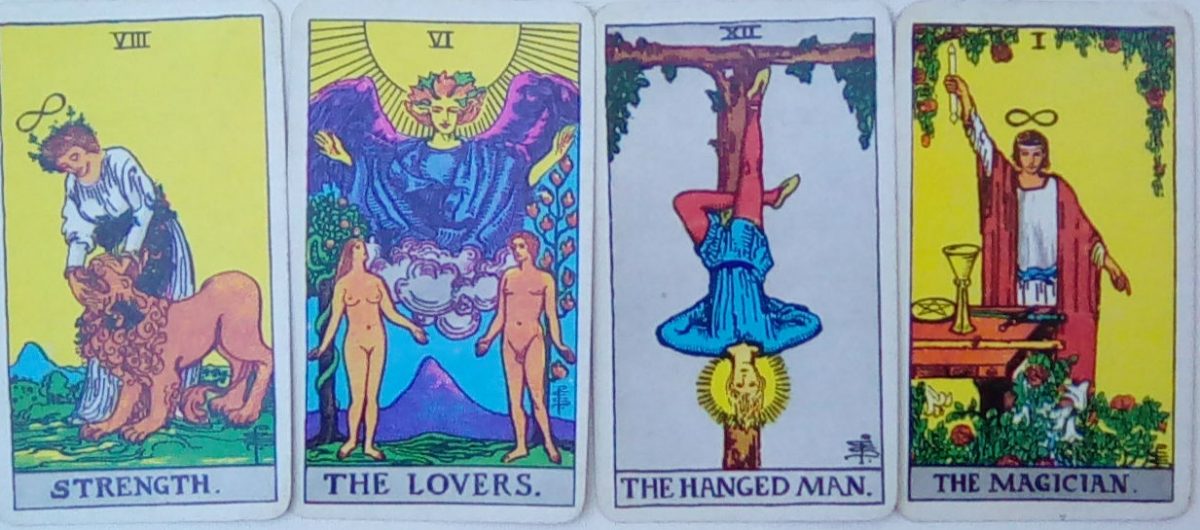
The Lovers is obviously THE romantic relationship card in the Tarot deck. It shows that period of time when you’re first together with your romantic partner and the whole world seems magical and glowing. It’s just the two of you, in your shining little garden. Just you and the angels and . . . um . . . that pesky snake climbing up the tree. When it’s reversed, the party’s over, baby. You’ve been thrown out of the garden and it’s time to deal with reality.

THE DEVIL (UPRIGHT OR REVERSED)

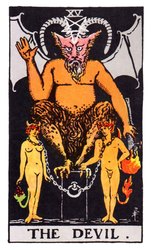
The Devil card shows the same two figures from The Lovers card, only things don’t seem to be as peachy anymore. For one thing, instead of an angel hovering over them, there’s a great big horny kind of a goat/bat demon thingie. They’re chained to a black stone or altar and they have tails which are on fire. (Having your tail burst into flames is another one of those subtle signs that there may be something wrong.) The Devil card can mean a lot of rotten things, such as addictions, super negativity, etc, etc,, but in this context – cheatin’ horndogs – it probably indicates a sexual affair that’s going on and it probably indicates that it’s a pretty heavy duty affair that may have strong elements of BDSM. I mean, horny goats, chains and flaming tails? Really?

THE TOWER (UPRIGHT OR REVERSED)

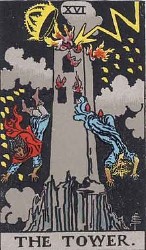
The Tower, as you might guess, is NOT a positive card. It usually indicates a freaking disaster that’s happening right in the middle of our happy little lives. The flash of the lightning bolts indicates that it’s sudden and shocking. It tends to destroy our lives right down to the foundation and then we’ve got to start rebuilding them, piece by piece. Having this show up in a reading about fidelity would indicate the sudden knowledge that your partner has been unfaithful and the relationship has been completely destroyed by that lack of fidelity.

FIVE OF WANDS

The Five of Wands may show up in a relationship where there’s a LOT of emotional turmoil. In the South, they talk about, “fight and fuck,” relationships. These are relationships where the two people involved have huge fights with much screaming and throwing of plates, and then they reconcile and have make-up sex that’s incredibly good. There are spoken phrases in there like, “Oh, baby, I’m so sorry,” and, “I promise this will never happen again, ‘cause you’re the dumplings in my chicken soup, honey buns.” Yes, I know honey buns and chicken soup are a disgusting combination, but you get the idea. There’s cheating going on, but they’ll probably reconcile and spend the next week in bed.


QUEEN OF WANDS REVERSED

The Queen of Wands has a lot of good characteristics and, among them, is fidelity. If she shows up reversed, there’s a very good chance that someone isn’t practicing that virtue.

ACE OF CUPS REVERSED

The Ace of Cups shows pure, unadulterated love pouring into the world. It tends to appear when someone is just starting off on a new romantic relationship and their hearts are full of love. When it’s reversed, there’s a good chance that their love got adulterated by a cheatin’, adulterating horndog.

THREE OF CUPS REVERSED

Obviously, this is very much of a party hardy card. When it’s upright, it’s healthy, joyous and free partying. When it’s reversed and shows up in this kind of a reading it can indicate that the joy is leaving or that your partner is partying with someone else.

TEN OF CUPS REVERSED

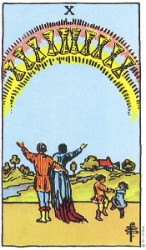
Among other things, the Ten of Cups is the Happy Family card. When it’s reversed it can be a sign that the happy family is breaking up, particularly if it’s a family with children involved.

KNIGHT OF CUPS REVERSED

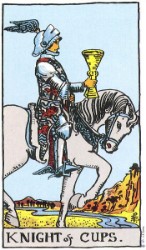
The Knight of Cups is riding out on a sincere quest for love. Reversed, it indicates that the love wasn’t found.

THREE OF SWORDS

LOL – well . . . yeah . . . that one’s pretty obvious. Stabbed right in the heart.

SEVEN OF SWORDS

The Seven of Swords is all about sneaking around and stealing someone else’s power. This is the kind of person who has an affair right in front of everyone’s eyes and somehow gets away with it. This card also shows up frequently when you’re involved with a malignant narcissist who’s just using you for their own ego gratification.

TWO OF PENTACLES

The Two of Pentacles may show up in a reading like this to indicate someone who’s trying to juggle two different love affairs and keep both of them going.

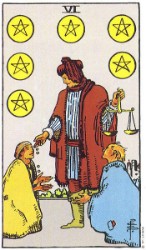
SIX OF PENTACLES

This may indicate a lover who’s not really giving with a whole, loving heart. Love is being measured out very carefully.

Those are just a few of the red flags that may show up if your questioner wants to know if his or her partner is running around.

Remember to be very careful with these types of readings. Many people are in a great deal of denial when relationships are falling apart and really, really DON’T want you to tell them what you see in the reading. What they want is for you to tell them that they were wrong and that the vibrator in the refrigerator is really just a whipped cream dispenser. If you’re doing a reading for your best friend and you tell her that her husband is playing hide-the-sausage with his secretary, she may not be pleased with you. At all.

And, of course, it’s always possible that the questioner’s partner might NOT be a cheatin’ horn dog. He could just be a rat faced dingleberry, which is an entirely different kettle of fish. In either case, approach this topic with caution. Practice using phrases such as:

It seems that all may not be as it appears.
There’s a certain murkiness here.
There appears to be a fork in the road of life.

Avoid using phrases such as:

I think he’s dipping his wick with your best friend.
She’s a real bottom feeder and believe me, I MEAN bottom.
You should have listened to your mother. By the way, does your mother still have that spare room?

Happy Buddhists, Christian Apple Munchers and Garden Gnomes in Tutus

Why Buddhism is actually a happy religion.

The Dalai Lama giggles a lot.  Have you ever noticed that?  On a certain level, he seems to find life to be absolutely hilarious.  For instance, there’s this wonderful interview that Barbara Walters did with him and, toward the end of the video, he absolutely cracks up about the fact that Eskimos kiss each other by rubbing noses.

It seems a little strange because Buddhism has a reputation for being a very dark, solemn sort of a religion.  That reputation probably flows out of the Buddha’s admonition that, “life is suffering,” which is not exactly what he said, but it’s the way that it’s frequently translated.  So we have this religious doctrine that seems to say that life is suffering, yet we see Buddhists like the Dalai Lama and Thic Nhat Hahn who not only seem to be happy, they seem to be really, really, REALLY happy.

What’s up with that?

The tarot card, The Hierophant, is all about formal doctrine, rather than first hand experience.  Religion, rather than spirituality.  It represents what religions SAY they are, rather than the way that they’re actually practiced on a daily basis by their followers.  Oddly, there’s a curious optimism that permeates Buddhism once we get past the doctrines and get into the actual experience of, “living Buddhism.”  

Although I’m sure that the Buddha wouldn’t dig my doing this because it involves a lot of judgment,  one of the best ways to illustrate that optimism  is by contrasting it with the dominant Western religion, Christianity.  In particular, how do the two religions actually VIEW human beings?

Christianity starts out with the basic premise that humans are miserable, flawed sinners.  According to Christian doctrine, we’re actually born that way, which doctrine is referred to as, “original sin.”  Now, it’s kind of hard to get a grasp on what original sin really means, but when you wrestle it to the ground it seems to mean that every single one of us was born with, “the stain of Adam,” on our souls.  Which goes back to Adam and Eve getting thrown out of the Garden of Eden because that bitch Eve just HAD to have an apple

I know, right?  It’s kind of hard to figure the reasoning.  Still, it appears to say that because our great, great, great, great, great grandmother to the hundredth power munched on an apple, we’re all born sinners and destined to go straight to hell if we don’t find redemption.  That’s also, by the way, the reason that women have been, “cursed,” with having periods every month.

I’m not making this shit up.  

So, according to Christianity, at the core of every human being there’s a rotten, sinful, apple muncher and we come into the world that way.  That’s why you’ve got to get babies baptized right away, because babies are basically pure evil, as we all know.

The Buddhist viewpoint is very much the opposite.  Buddhists believe that at the core of every human being is absolute perfection.  We just don’t know it.  Tibetan Buddhist Master, Chagdud Tulku Rinpoche, described this by saying that we all have a beautiful jewel at the center of our hearts which is covered over by common rock.  Our job is to slowly chip away at the rock that’s covering our jewel so that more and more of it is exposed as we go through our lives. Yes, life is suffering, but it’s suffering because we remain ignorant of our true nature, which is bliss and joy.

To put all of that in a nutshell, Christianity says that we should pretty much hate ourselves and Buddhism says that we should pretty much love ourselves.  It shouldn’t be a major news flash to anyone that hating yourself feels really, really bad and loving yourself feels really, really good.

Which may be why the Pope doesn’t do a lot of giggling.

There’s another major implication here, which is that Chrisitanity views, “salvation,” as coming from an outside source and Buddhism sees it as very much of an inside job.  Christianity says that we are SO fucked up and miserable and down in the dirt that we literally have no chance of saving ourselves.  We just have to pray and hope that Jesus is going to ride in on his white horse and whack us with his redemption wand and THEN we get to go to heaven.

Buddhists believe that our salvation, our Buddha nature, is already inside of us, so ANYONE can become a Buddha.  That means you, me, our Aunt Gertrude, or even the weird guy down the block who collects garden gnomes and dresses them in tutus. And we don’t get there by some outside deity or force, “forgiving us,” we get there by sitting our asses down on the meditation cushion and by practicing love and compassion in our daily lives.

Which is a lot of work and a lot of responsibility but it’s also tremendously liberating.  It’s looking at ourselves and realizing that if we’re not happy it’s because we didn’t do the work.  We may have talked the talk but we didn’t walk the walk.  We didn’t uncover that jewel inside of us.  It’s TOTALLY up to us.

Wow!

Another probable reason that the Dalai Lama giggles a lot is that Buddhists believe that we are all connected.  I don’t mean that in some generalized sense of, “our common humanity,”  or, “our shared heritage,”  or the Christian sense that we’re all, “born in sin.”  No, I mean, really, genuinely, energetically connected to each other, just like there’s some invisible thread that runs from me to you and from you to another person and so on and on.  Whatever we’re feeling and experiencing emotionally and spiritually is going out into a sort of a giant, collective web of consciousness and affects not just us, but everyone else, as well.

Think of it this way:  if we’re going out grocery shopping and we’re in a really high vibrations, zippety doo dah sort of a mood, some of that positive energy is going to spark off of us to everyone we encounter, from the kid stacking tomatoes at the vegetable section to the cashier who checks us out.  On the other hand, if we’re in a really sour bah humbug fuck you mood, some of that negative energy will be transferred to other people as well.  We leave everyone we meet either feeling a little better or a little worse.

Now take that same phenomenon of energy transfer and magnify it to influencing every person on the entire planet.  That doesn’t mean that if we wake up in a rotten mood trains will crash and someone’s flower garden will die.  But it does mean that everything we’re feeling is radiating out to everyone else, even if it’s one little drip at a time.  The way that the Buddha put it was:

“Goodness, like rain in a bucket, gathers one drop at a time.

Evil, like rain in a bucket, gathers one drop at a time.”

So, if you’re a really highly evolved, spiritually aware person and you KNOW that everything you’re feeling is affecting everyone else, what are you going to do?  Are you going to sit around your house feeling like crap and radiating out bad vibes?  Or are you going to try to stay in as high and loving a place as possible, as much of the time as possible, and send out good vibes?

Obviously, you’re going to try to stay as happy as possible.  And if you stay as happy as possible, for a long enough period of time, you’ll probably start to giggle.

Introverts, Extroverts, Neon Nose Rings and Being True to Our Selves

The difficulty of being seen and heard as an authentic person.

There’s an interesting – and somewhat paradoxical – psychological principle which is that THE MORE WE BECOME OURSELVES, THE LESS LIKELY WE ARE TO BE UNDERSTOOD BY OTHER PEOPLE.  That may sound a little grim, but there’s a lot of truth in it.

By way of an example, I’m a male.  In a very basic sense, I have NO idea what it’s like to be a female.  I can empathize with females, I can understand their political, emotional and social issues, I can be a strong supporter of feminism.  But I can’t understand, on a primal level, what it’s like to be a female.  There’s a whole slew of experiences in there – growing breasts, having your first period, prom dates, motherhood, etc. – that just aren’t a part of my being-in-the-world or my personal history.

I can take that up a notch and say that I’m an American male.  So I would definitely NOT understand what it’s like to be an Indonesian female.  Or I could say that I’m an older American male, so I would really, really not understand what it’s like to be a young Indonesian female.

The more different we are, the less we understand each other.

There’s also a very natural human drive called individuation, where we want to become separate, unique individuals.  We see it most clearly in adolescents.  For the first ten years of their lives they’ve been nothing more than extensions of their parents and their families.  Suddenly, as puberty approaches, they want to dress differently, act differently, and explore new ways of thinking.  They are compelled to differentiate themselves from their parents and if that means they get a neon nose ring to prove they’re different, so be it.

Although it’s less obvious, that drive to be, “different,” continues into adult life.  In the United States, we mainly express it through our adult toys and our clothing.  We talk about someone making a unique, “fashion statement,” or we’ve got a friend who drives around in a rare, restored 59 Chevy, or we raise Venus Flytraps .  We take a lot of pride in our uniqueness and tend to denigrate being, “a part of the herd.”.

For some people, though, that drive to be different, to fully express themselves as unique individuals, can have a downside to it as well. The reason for that is that we also have an equally strong drive TO BE HEARD, not just to be seen.  To be understood.  To have meaningful conversations and interactions with other human beings who really get what we’re feeling and thinking.

As Michael P.Nichols put it in, “The Lost Art of Listening,”

“Few aspects of human experience are as powerful as the yearning to be understood. When we think someone listens, we believe we are taken seriously, that our ideas and feelings are acknowledged, and that we have something to share.”

That transaction of communicating and being understood and validated assumes that we have some common ground with the other person.  The more that we have in common with the other person, the more quickly and easily they’ll understand what we’re saying.  If the only language I speak is English and the only language you speak is Spanish, we’re not going to do much meaningful communicating.  If you’re from New York City and I live in a small town in the mountains, we are NOT going to rock and roll.

It’s really a simple ratio:  the more we’re alike, the more easily we’ll communicate.  The more that we’re different, the more difficult it is to communicate.

So what happens if you’re not just different, but radically different from most people?  So different that you share very little common ground?

Here’s an example from the Jungian personality types.  We know that some people are introverts and some people are extroverts.  The more introverted we are, the less likely we are to understand how extroverts see the world, and vice versa.  Then take that up a notch by looking at an introverted personality type called the INFJ.  Only one percent of the people in the world share that personality type.  Take it up another notch by looking at males who have the INFJ personality type.  Only 0.5 percent of the people in the world share that person’s personality.  

That means that if you are a male INFJ personality type, over 99% percent of the people you meet will NOT understand how you process and view the world.  That’s not a lot of common ground.  That’s not even a pebble.

Or suppose you’ve taken a radical spiritual route such as we see in the Tarot card, The Hermit.  You’ve intentionally withdrawn yourself from the world and consciously sought another path like meditation or extreme solitude. After a few years of that kind of a lifestyle, there isn’t just a minor rift between your vision of the world and the way the average person sees it, there’s a giant, fucking chasm.

The more different you are, the less people will understand you.

Now, experts tell us that there’s a sort of an arc in that process that eventually leads people who are very different back to understanding that, on a spiritual level, we’re all the same.  Marsha Sinetar in her book, “Ordinary People as Monks and Mystics,” says that pursuing your true authentic self will inevitably lead to greater compassion and empathy with other people.  People who are largely detached from society eventually reattach on a much deeper level.

But . . . until that happens, until we reach that point of reattachment, it can be a very painful ride.  There can be the realization that people we really care about just don’t understand us.  The feeling that we don’t fit in, not anywhere.  There can be a terrible hunger to have just one person meet us on common ground.  There can be a severe sense of loneliness, isolation, and, yes, not being heard, a despairing feeling that we will never have a real friend or lover.

Put another way, being true to yourself is not for the faint hearted.  If the average person moves into an isolated cabin in the woods with no phone, no neighbors and no social media, he’ll go nuts in very short order.    Being true to yourself and your unique perceptions of the world can feel very much like living in that isolated cabin, even in the middle of a very busy city.

It requires a strong ego structure.  It requires the ability to enjoy emotional solitude, rather than seeing it as a curse.  It takes a lot of resiliency.  More than anything, though, it takes an ability to ferociously believe in ourselves.  Not to criticize others or try to force them to share our visions, but to say, “I am me.  I have a right to be here.  I have a right to be my own unique expression in the world.  I hope that someday you’ll be able to see me.  I hope that someday you’ll be able to hear me.  But the most important thing is that I can see me and I can hear me.”

Judgments, The Dalai Lama, and Putting Your Hat on the Table

How our belief systems affect our lives.

There’s an old saying that the reason our parents can push our buttons is that they installed the control panel. And there is so much truth in that.

I was watching a presentation from Mike Dooley the other day and he was talking about the importance of our belief systems. For those of you who aren’t familiar with Dooley’s work, he’s a strong advocate of the idea that, “thoughts become things,” and teaches visualization and manifestation techniques. His take on belief systems is that they act as, “regulators,” for what we allow ourselves to think, and since thoughts become things, our beliefs determine what we’re going to think and, therefore, what’s going to manifest in our lives. Our beliefs determine the Judgments that we make about life, which determine the course that our life takes.

For instance, if we have a strong, unconscious belief that we’re unattractive it’s very unlikely that we’ll be able to visualize ourselves with a good, loving partner. We can’t even THINK of that happening, and so it doesn’t. If we have a strongly held belief that rich people are evil, we’re not going to be able to attract money into our lives because we don’t want to see ourselves as evil.

Those are belief systems on a personal level. There are also what we might call, “meta belief systems,” that operate on a more elevated basis. These are systems like religions and politics and they interact with our personal belief systems. Most people in the United States are Christians and an inherent element in that religion is that people are, “sinners,” that life is suffering, and that there’s a loony tunes god in charge who might just throw you into a pit of eternal flames because you masturbated last night.

We can contrast that world view with this statement from the Dalai Lama: “I believe that the purpose of life is to be happy. From the moment of birth, every human being wants happiness and does not want suffering. . . From the very core of our being, we simply desire contentment. I don’t know whether the universe, with its countless galaxies, stars and planets, has a deeper meaning or not, but at the very least, it is clear that we humans who live on this earth face the task of making a happy life for ourselves.

If we believe in the so-called Law of Attraction – the idea that we draw into our lives people and events that are a match with our energy, emotions, and ideas – then we can see where these two belief systems would have massive implications in our personal lives. If we accept the classic Christian view that people are basically evil and life is shit because we got, “thrown out of the garden,” what are we going to attract into our lives? Evil people and shitty experiences. If we listen to the Dalai Lama and believe that the purpose of life is to be happy, we’ll automatically seek out happy people and create positive experiences in our lives.

All of this operates on an unconscious level, of course. If you were to ask the average Christian if she believes that people are rotten and life is meant to be suffering, she would very likely say no. But that’s exactly what we were taught in Sunday schools and church services when we were forming our views of life and were too young to make realistic assessments. All of those buttons – guilt, sin, life hurts – were installed on our control panels and they’re just waiting to be pushed.

Don Miguel Ruiz talks a lot about this in The Four Agreements. As he put it, most of our belief systems are just, “dreams,” illusions passed down from one generation to the next or forced onto us by our society and they remain largely unexamined. Democrats (or Republicans) are evil. People are no damned good. America loves peace (even though we sell more weapons than any other country in the world.) Monogamy works (even though about half of the people who try it get divorced.) Liberals are socialists. Conservatives are fascists. God’s a male. There is no God. We all have tons and tons of opinions and viewpoints that we live by, that we design our lives around, and, for the most part, we haven’t thought about them very much.

I once read about a woman who went into an absolute fury every time that her husband would put his cap on the kitchen table. When he questioned her about it, the only thing she could say was, “It’s just wrong.” She realized that her mother had taught her that lesson, so she asked her mother why it was wrong. Her mother’s response was that her mother had taught her that it was a terrible offense. She finally worked her way back to her great grandmother who started laughing and said, “Oh, lord, child, when I was young everyone had head lice. That’s why it was wrong to put your hat on the table.”

So three generations of her family had passed down a very strong belief and reaction about a simple behavior like putting a hat on a table. And none of them, until her, had ever questioned the belief or wondered what was behind it.

The sad part of this is that so many of our beliefs and judgements are just like that: totally unconscious ways of judging the world and ourselves that were passed down to us by people who weren’t thinking about them and accepted by us without thinking about them.

That’s also the good news.

Once we accept the idea that a lot of our most cherished beliefs – if not most of them – are constructed on total bullshit, then we can just get rid of them. It sounds like a really radical idea when we first encounter it but why not? Why not just get rid of beliefs that limit us and restrict us, and adopt beliefs that serve us better and allow us to expand our lives?

For instance, the belief that I’ll NEVER have enough money, shuts me down and keeps me frozen in place. The belief that the Universe is filled with abundance and I deserve my share opens me up to expanding and receiving. The belief that I have a RIGHT to be angry keeps me upset and repels positive people. The belief that I have a RIGHT to be a loving person attracts positive, loving people into my life and reinforces the idea that I’m lovable.

The Tibetan Buddhist teacher Chagdud Tulku Rinpoche said that most of us will never become enlightened in this life and that we’ll continue to live in the dream of illusion. But he also said that we CAN decide whether we want to have a good dream or a bad dream. And the road to a good dream starts with our beliefs about that dream.