I have to admit that I’m always a little puzzled when I run across one of those news columns discussing, “Donald Trump’s Toxic Brand of Masculinity.” To me, a guy who gets daily manicures, has his dyed hair styled every morning, and bakes under a sun lamp until he turns orange isn’t masculine ANYTHING, toxic or otherwise.
But maybe I’m just being defensive on behalf of all of the sane men in the world.
Today IS the International Day of the Woman, though, so perhaps it’s a good time to talk about all of this.

The Emperor and The Empress, sharing the same exalted positions and residing side by side in the Tarot deck, are often – in fact usually – held up as examples of male and female energy in the world. But let’s a take a step back from that. Let’s just consider them as examples of energy in the world. Different ways of being.
Ram Dass has a rap in Grist for the Mill: Awakening to Oneness that says you can consider people on a number of different levels. You can look at their skins and see black and white and brown. Or you can look at their signs of the zodiac and see Aries and Scorpios and Capricorns. Or you can approach it like a psychologist and see obsessive compulsives and narcissists and dependent personalities.
Or you can take it right down to the bedrock and see Souls. Fellow travelers on this very strange journey through this beautiful world who just happen to be incarnate as a Taurus or a Leo in black or brown or pink skin and seem to have developed a little problem with OCD.
Or to put that another way, we are all multiple patterns of energy existing in the Earth Plane.
And two of those patterns of energy are male and female.
There are, obviously, very valid and real differences between the two patterns. The human body responds quite differently to testosterone and estrogen. Males tend to have more muscle mass and extra cones in their eyes. Women tend to have more fat cells and to visualize more in patterns than lines.
We can take those differences and we can celebrate them as we do when we recognize both the God and the Goddess. The problems start to arise when we view those differences as being absolute and we turn them into stereotypes. “Real,” men are always muscular and silently strong. “Real,” women are always soft and fluttery and vulnerable.
I’ve known women who were so physically powerful that they could have bounced me down the driveway like a basketball. And I’ve known men who were nervous nellies residing in very frail bodies. You can take any stereotype of masculinity or femininity and find examples of it in both men and women.
Likewise, we know that we all have both testosterone and estrogen in our bodies. We all have both, “male,” and, “female,” hemispheres in our brains. Some men retain massive amounts of fluids when the moon is full. Some women are natural born weight lifters.
So masculinity and femininity are much more of a continuum than a dichotomy. It’s a lot more gray than it is black and white.
From that perspective it’s much easier to drop the idea of looking at The Emperor and The Empress as masculine and feminine energy and just look at them as ways that energy can exist on the Earth Plane.
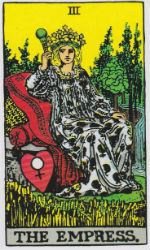
The Empress is relaxed. Comfortable. At ease in her world. She reclines on a velvet throne, legs slightly spread, wearing an unfettered, flowing robe and she is crowned with stars. She holds a sceptre – her symbol of power – but she holds it loosely, almost as if she’s forgotten she has it. A lovely waterfall flows out of a verdant forest behind her and wheat – the symbol of nourishment – grows in front of her. And . . . is that a box of chocolate leaning up against her throne?
The Empress is very, very powerful. She is the power of life and fertility but it’s a gentle, unassuming power. Most of all, she BELONGS in her world and she blesses it and it blesses her.
And now look at The Emperor.

Kind of a nasty faced old man who looks like he’s suffering from a severe case of hemorrhoids. He sits on a hard, stone throne (ouch) and tightly grasps a vaguely Egyptian looking sceptre. His garments are tight, as well, and reveal that he is fully armored beneath them. Mountains rise behind him, barren of any vegetation, and far, far below him a river flows at the base of the cliffs.
The Emperor is also very powerful, but he’s very different from the energy of The Empress. It’s tempting to view him as the alpha-dog but he’s so obviously, painfully alone that you know he doesn’t even have a pack to run with. The Empress exists IN her world, as a part of her world. The Emperor has, “conquered,” his world, destroying anyone and anything that got in his way. He’s at the top of the heap but his heap is a pile of ashes.
Sadly, there are still many people in the world (and, yes, they’re mostly men) who choose to adopt the energy patterns of The Emperor rather than The Empress. And we all pay a price for their choice.
/Disclaimer: “As an Amazon Associate I earn from qualifying purchases.”