How to Lighten the Fuck Up by Fooling Around with Magic

A Quick Look at the Playful Nature of Magic.

Magic.  

What is it, anyway?  We talk about magic a fair amount.  We say that something, “felt really magical,”  or we, “feel a lot of magic,” when we’re with another person,”  or a solution to a problem appeared, “just like magic.”  But what, exactly, is it?  Is it just a feeling, or is it a real thing that exists in the world independent of our feelings?

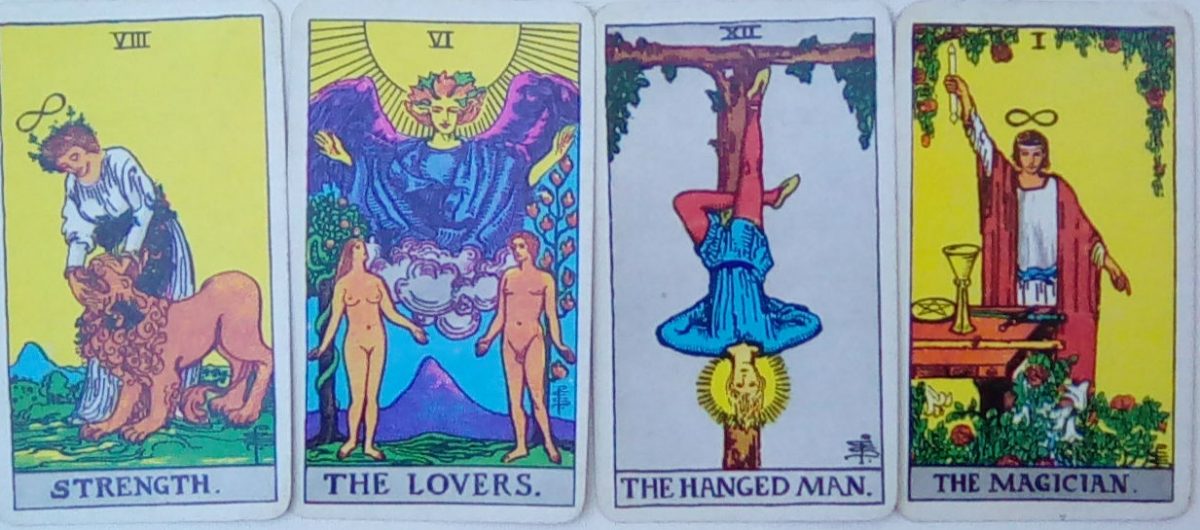
In The Magician card, we see a person channeling magical energy from, “above,” into the material plane.  He’s using his concentration, his will power, and his skills to pull that energy into what he wants to manifest.

Which, of course, is a major clue.  Magic is an energy, just like light, sound, radio waves, or solar flares.  What’s more, it is it’s own energy, meaning that it’s distinct from other energies.

We tend to get it mixed up with other energies, because it appears coincident with them.  When we’re madly in love with someone, it feels magical, and so we tend to mix magical energy up with being in love.  When we’re joyous, it feels magical, and so we tend to mix magic up with great happiness.  But magic is it’s own energy that appears with joy and love, but isn’t just joy and love.

We can see an analog of this with emotions and brain chemicals.  When we have a lot of serotonin in our bodies, we feel happier.  When we have a lot of cortisol and adrenaline in our bodies, we feel more stressed and anxious.  But . . . happiness causes serotonin to appear and serotonin causes happiness to appear, so it’s a definite, “which came first, the chicken or the egg?” situation.  They’re not equivalent – they just appear at the same time.

Reductionists would have us believe that serotonin = happiness, but it’s not true.  Antidepressants, which increase serotonin levels, can be a very effective band aid for depression, but they pretty much have to go along with good therapy to deal with the underlying problems.  If we don’t build in the therapy, the happiness goes away when we stop taking the antidepressants because – guess what? – the things that were making us unhappy are still there.

In very much the same way, magic appears in our lives coincident with love and and joy, but the love and joy don’t cause the magic.  Nor does the magic cause the love and joy.  They just appear at the same time.

There are some other clues we can find that point to what magic actually is.  Two major markers that appear in our lives when we’ve got magical energy flowing through us are synchronicity and serendipity.  Synchronicity and serendipity are really just short hand for, “life is easy.”  Solutions to our problems appear out of nowhere.  People, places and things that feel like gifts from the universe manifest with no effort at all.  

And, “life is easy,” is really just short hand for, “life is light.  Life is playful. Life is fun.”

Which are some more major clues about what magical energy really is.  In the same way that magic tends to appear when we’re joyous or in love, magic tends to appear when we’re happy and playful.  It’s almost as if the universe is saying, “You know, you really need to lighten the fuck up if you want me to play with you.  I get that you’re all sad and dour, but it’s a drag and I can find someone else to hang out with.”

So magic is an energy that tends to appear in our lives when we’re loving, joyous, happy and playful.  It doesn’t cause them and they don’t cause magic, but they definitely appear at the same time.

Which brings us to another card, The Fool.

The Fool is FULL of magic.  He’s dancing along at the edge of a cliff and he really doesn’t give a fuck about the danger because he’ll just float right off into the air and keep dancing.  His little dog is picking up on his joy and dancing right along with him, in just the way that dogs always will.

Now, the interesting thing about The Fool is that he’s the Zero card in the Tarot deck.  Every other card has a number, but The Fool is Zero.  Which means that he doesn’t belong anywhere and he belongs everywhere.  We can literally take any card in the Tarot deck, drop The Fool on top of it and things will start to get better.  Even extremely bad cards like Death and The Tower start to improve the second that we bring in magical energy.  

There are people in the world who will tell us that life is insane, tragic, and brutal and that there’s very little to be optimistic about.  And, when we look at the daily news, it can be hard to argue with that view.  Believing in love, joy, playfulness, happiness and lightness can seem downright . . . Foolish.   

But that’s the point.  No matter how bad the situation may be, if we start to drop The Fool on it, if we start to increase the magic in our lives, it will get better.  

Magic brings love, joy, happiness, playfulness, easiness, and lightness with it.

Yes, please.  I’ll have some of that.

My e-book, Just the Tarot, is still available on Amazon at a price that’s SO reasonable that it would be downright Foolish not to buy a copy.

Toxic Masculinity, The Inner Marriage, and Percolating Testicles

On the exterior level, the Two of Cups obviously represents two people who are falling in love.  On a deeper level, though, it represents the Inner Marriage, the harmonious joining of the Divine Feminine and the Sacred Masculine in one person’s Soul.  In a sense, it represents learning to fall in love with yourself.  Or maybe your Self.

I was watching an interview about that the other day and I got plumb confused.  The speaker was discussing the way that her Tantric Tradition deals with the Yin/Feminine and Yang/Masculine energies that we all contain.  I followed the beginning of it with no great problem.  Obviously, every human being incorporates both Yin and Yang and we give greater or lesser expressions to those energies at different times in our lives.

Then she got off into some territory where I felt like I needed to make a chart to keep track of it all.  She said that every person has a Yin and a Yang, but women’s Yin have a Yang within the Yin and men’s Yang have a Yin within the Yang.   The Yang in women’s Yin is apparently centered at  the birth canal, because that’s where they project their being into the world.  The Yin in men’s Yang is located in their testicles because that’s where they hold life and sort of . . . . um . . . percolate it.

It all just seemed really complicated.

Now, I want to be clear that I’m not in any way making fun of that tradition or denigrating it.  In fact, I was really impressed that someone had invested that much time and effort thinking about testicles because most of us are perfectly happy to let them just hang around without analyzing them too much.  Men, in particular, consider their testicles as really good buddies, despite the fact that they seem to cause a lot of problems in the world.

What came through to me, though, is how much more women have advanced than men in thinking about all of this.  Despite the recent legal set-backs in reproductive rights, the women’s movement remains relatively robust.  Women continue to question and examine their roles in society and try to sort out their emotional energies.  The men’s movement on the other hand . . . um . . . oh, that’s right . . . there IS no men’s movement.

Well, there IS a sort of a men’s movement, but it’s pretty horrifying.  It seems to be based on the idea that men have a divine right to be belching, farting, weight lifting, muscle car driving, gun toting swine and that anyone who questions that is a bitch or a fairy.  If you type, “Toxic Masculinity,” into the YouTube search bar, here are a few of the videos that come up:

THE WAR ON MEN

START INCREASING TOXIC MASCULINITY LIKE A REAL MAN

THE RISE OF WEAK MEN: BREAKING DOWN TOXIC MASCULINITY IN AMERICA TODAY

THE INSIDIOUS TOXIC MASCULINITY MYTH IS HARMING HUMANITY

Here’s a screen shot from one of them that kind of says it all:

Ironically, there’s a female side to that story, as well.   Under the same topic we find vids (by women) with titles like:

DON’T BE A SIMP:  WOMEN LIKE BAD BOYS

WOMEN HATE MEN WHO ARE IN TOUCH WITH THEIR, “FEMININE

SIDE”

WHY WOMEN CRAVE DOMINANCE

and my personal favorite:  MEN TRY TO GUILT US BY BEING, 

“NICE.”

So there seem to be a fair number of women who don’t want any Yin in their Yangs.  Men, of course, take note of that and process it as, “Yeah, I know they SAY they want sensitive men but I’ll never get laid by being evolved.”  And, really, we even see quite a few, “feminists,” who are still dating knuckle draggers because it, “just feels right.”

Despite all of that, I still see a fair amount of hope on the sexual horizon.  For one thing, we virtually never see a debate over what it means to be a REAL woman.  Women seem to be pretty accepting of each other’s life choices now days and career women and lesbians are just as welcome in the tribe as homemakers and mommies. 

Kansas City Chiefs football player Harrison Butker recently got into some serious trouble by suggesting that women are much more fulfilled by having babies than they are by having careers.  A lot of Yins suggested cutting his Yang off, but it really hasn’t been that long since that would have been considered normal speech.

Up until the late 1960s, it was commonly accepted that the only, “natural,” role for women was producing babies until their uteruses fell out.  A corollary to that was the widely held stereotype that only women who had large breasts were truly sexy, a belief that must have made most women feel fairly uncomfortable. 

Thankfully, a huge amount of the sexual stereotyping around women has fallen away.  Unfortunately, men seem to still be stuck at first base, he said, using a very masculine, butch sports metaphor.  So what is it going to take for men to dribble their balls down the court and kick one over the goal posts for a home run?

Well, first and foremost, it’s going to involve men actually claiming that Yin side of their nature and saying, “Yes, REAL men have sensitivities and emotions and needs and men who don’t have them aren’t real in any human sense of the word.”

And, second, it going to involve more women letting go of that toxic stereotype, as well.  As long as women continue to have sex with emotionally primitive men, men will continue to be emotionally primitive.

I mean, why wouldn’t they?

The Ten of Wands, Energy Healing, and Over-Thinking Enchiladas

Using energy healing to overcome overthinking.

I find myself understanding the poor dude in the 10 of Wands more and more as time goes by.

In the Tarot, the four suits of cards represent different realms of the human experience.  Swords = personal power.  Cups = emotions. Pentacles = material possessions.  And wands = ideas.

So we see this guy in the 10 of Wands who has SO MANY ideas that he can barely stagger along under the weight of them.  His head is pressed firmly into the bundle of wands and he can’t even see what’s going on around him.  He’s just trudging toward a distant destination, hoping he’s going in the right direction and trying to put one foot in front of the other.  His ideas own him, not the other way around.

I was watching an interview with Eileen McKusick, author of, “Electric Body, Electric Health,” and she flat out said, “Overthinking is a cultural brain virus.  Overthinking never, ever solves anything.”  Naturally, my reaction was, “I’ll need to overthink that statement.”

She’s right, though.  What we refer to as, “thinking,” usually means shuffling around a lot of different concepts, trying to make them fit some sort of a coherent pattern.  It’s like a Rubik’s Cube that we keep flipping and flipping and flipping, hoping that all of the squares will line up. 

But conceptualizing is just one part of a much larger process and when we get stuck in that one part, it doesn’t work.  We can never, ever solve anything by just thinking at it.

Somewhere along the line in human evolution -probably about the time we began to develop alphabets and writing – we started to pull out of our bodies and into our heads.  Which is to say that we started to think of our heads, our brains and thoughts, as being somehow separate from our bodies.  Philosopher Gilbert Ryle referred to that as, “the ghost in the machine.”

That name is so apt because most of us suffer from this incredible, mass hallucination that there’s some separate, non-material, “self,” much like a ghost, that sort of rides around in our bodies, as if they were machines that we’re driving.  The ghost, of course, lives in our heads and we peer out at the world through our eyes, just as if they were windshields.

We call the ghost in our heads our, “selves,” or our, “personalities,” or even our, “souls.”  So there’s a ghost that’s our REAL self and then there’s the body, which we’re sort of temporarily driving around in.  That scene is very much like our real self landed at the Earth Airport and went straight to the Hertz Rent a Body so that we’d have a cool ride to tool around in.  “Hey, I’ll take something with fins and a lot of chrome.  Bucket seats.”

We even see that dualism in New Age philosophy, right?  How often have we heard that expression, “You’re not a body that has a Soul;  you’re a Soul that has a body?”  Which is a nice shift toward the spiritual, but it still maintains that strange hallucination that our bodies are somehow NOT our real selves. 

Which is exactly what McKusick was getting at:  we’re not just our brains and we’re not just our bodies – we’re our body/brains/nervous systems/emotions/thoughts/memories, Soul – the whole enchilada.

Or perhaps I should say, “the Soul Enchilada.”

She’s an energy worker who uses the energy of sound to heal us.  Like most energy workers, she heals from the outside in, which is contrary to some New Age thinking.  The basic New Age formula for life runs like this:

Our beliefs create our thoughts.

Our thoughts create our emotions.

Our emotions create our vibrations.

Our vibrations create what we draw into our lives.

New Agers have tended to jump in at the level of thought and say, “Well, if we change our thoughts, we change our emotions, which changes our vibrations, which changes our lives.”  Also known as the power of positive thinking and it’s true.

Energy healers like McKusick, though, are flipping the script on that.  They’re saying, “If we change our vibrations, we change our emotions, which changes our thoughts.”  She’s taking the same holistic approach – we’re all one great big electromagnetic vibration and if you change one thing, you change all of it – but she’s working from the vibration inward to the thoughts.

Her idea is that sound is a form of energy and so are we.  When we listen to certain sound frequencies that are coherent, solid frequencies, it reorganizes the energy in our bioelectric field into a solid, coherent vibration.  As our vibrations become more coherent, so do our emotions and our thoughts.

Does it work?  I don’t know, yet.  I’m spending a significant part of my day banging away on my Tibetan meditation bowl and grooving on the rising and falling of the sounds.  It does seem to be very soothing and it does take me out of my head and into my body.

And now that I’ve over-thought it, I like it.  I really do.

Please remember that my amazing e-book, Just the Tarot, is still available on Amazon for MUCH less than an order of enchiladas. Hell, it’s less than a side of refried beans. What an incredible bargain!

The Four of Pentacles, New Age Capitalists, and Buddha in an F-150 Pickup Truck

A look at the New Age fascination with money.

“I wanted to be able to help people financially.  If you have enough money, you can buy health.  A rich man can always find a woman.  If you have enough money, you can buy almost anything.” – Jerry Hicks

There is a very peculiar – and very strong – connection between the New Age/New Thought movement and good old American capitalism.

The Four of Pentacles shows a guy with his feet on money, holding money, and money on his mind, and that’s a LOT of the New Age movement and its leaders.

Mike Dooley, who is best known for his credo, “Thoughts become things,” was an international tax specialist for Price Waterhouse and his primary client was Saudi Freaking Arabia.

Prior to channeling Abraham, Esther Hicks was a business accountant and Jerry Hicks was THE leading Amway salesman in the United States.

Stuart Wilde made a fortune selling Mod clothing on Carnaby Street before he took up Taoism and made another fortune selling books about how spiritual it is to make a fortune.

Even the much beloved Ram Dass was born into a very wealthy family, never experienced a day of poverty or want, franchised his spirituality very successfully and died on his massive estate in Hawaii.

I have to admit that I was somewhat puzzled by the extreme emphasis on money and material possessions when I first stumbled into the New Age movement.  I started my spiritual journey as a young kid in a midwestern state, taking LARGE amounts of LSD, reading Tarot cards, and convinced that it really was the Dawning of the Age of Aquarius.

Racism, war and poverty would be eliminated.  We’d all live in peace and harmony and people would really and truly realize that love is all that matters.  Those were my dreams when I was a young man.

Duh.  I know.  It didn’t exactly turn out that way, did it?  Still, there was a nobility and a grandeur to the dreams that I think all young people should have. 

And so, when Mike Dooley talked about his dreams as a young man, I was a bit mystified.  “I wanted to make a million bucks, own my own private plane and travel internationally with a beautiful woman by my side.”

Or Stuart Wilde’s statement that, “Money doesn’t imply that rich people are spiritual but it does infer that poor people probably are not.”

Or the (I’m sure inadvertent but telling) juxtaposition in Jerry Hicks statement, “A rich man can always find a woman.  If you have enough money, you can buy almost anything.”

Esther and Jerry Hicks probably took the wedding of capitalism to spirituality further than anyone else.  Their basic position is that our desire for material goods – for the goodies in life – is what drives us into greater and greater spiritual growth.  In their view, we have a sort of an internal wish list that’s composed of things like boats, cars, money, houses. As we tell the Universe what we want, the Universe provides all of those things on the wish list.

BUT . . . as we fulfill one wish list, another list spontaneously arises and we want even more, which the Universe provides and then we want even more, and so on. 

Oddly, that very process is exactly what the Buddha described as the source of all suffering.  It’s the constant desire for more and more and more, without the realization that more is never enough to make us happy. One wish list will always be replaced by another.

What I eventually realized is that these people – despite being rampant, unapologetic capitalists – ARE spreading a lot of spirituality through the world, no matter how paradoxical that might sound. 

Here’s the thing:  American capitalism is the dominant force in the world right now.  And the lingua franca of capitalism is M-O-N-E-Y.  

Who are the people who are going to all of the seminars and retreats of the New Age gurus and buying all of the millions of books they produce every year?  They sure as hell aren’t Buddhist monks or old hippies.  

They’re business people.  Amway salesmen.  Used car dealers.  Advertising guys.  Executive secretaries and career women.  Their dreams aren’t about world peace or brotherhood; their dreams are composed of F-150 pick up trucks, big houses, ski boats, and, yes, all the women they can buy with their fabulous wealth.

The ironic thing about it is that as they’re attending the Let’s-All-Get-Rich rallies, they’re also getting a HUGE dose of spirituality.  What’s really behind the idea of visualization and manifestation is that the physical world is not at ALL what it looks like.  We really CAN manifest whatever we want, seemingly out of nothing.  Magic really DOES exist.  There IS huge abundance in the world and we can tap into it with the power of attraction.

These are exactly the same people who love to mock California woo-woos and think that psychics and sensitives are crack pots.  But there they are, hunkered down in their split level homes in Nebraska, Utah, and Kentucky, pasting together vision boards and writing out affirmations.

LOL – which is doing magic.  Plain and simple.  If you’re trying to make something appear out of nothing using the power of your mind, you’re casting a magic spell.  Surprise!

It’s all very bizarre and puzzling, but it’s an improvement.  It’s a definite improvement.

EMPATHS, EARTHING, AND MEDITATING CODEPENDENTS

Staying grounded as an empath.

So I just received my Amazing Hooga Earthing Mat from the very nice UPS driver and I should be incredibly spiritual after just a few days of using it.  

The basic theory behind them is that our energy systems get in a kerfuffle because we’re exposed to negative people, places, and things and, when we walk barefoot on the Earth, it restores our systems to their natural, harmonious balance.  Earthing Mats simulate that very same energy and get our auras all fluffy and pretty again.

I decided to get one because I’ve recently become aware of the fact that it is of tantamount importance for empaths to stay thoroughly grounded.  If we don’t, we start to dissolve like a piece of salt in the rain.  Earthing is a dandy way to avoid that.

EMPATHS AND EMPATHY

Being an empath is sort of hard to describe to a, “normal,” person.  First of all, of course, being an empath is not equivalent to being empathetic, although most empaths are highly empathetic.  An empathetic person might sympathize with another individual to a point where they can imagine what the other person is feeling and thinking.  Empaths actually experience what the other person is feeling in real time.

Empaths are also not psychics, although most psychics are empaths.  A psychic will focus on another person, “read,” their energy, their emotions and their thoughts, and then weave all of that into a coherent meaning, much like telling a story.  Empaths, on the other hand, are simply bombarded with information about the other person without really knowing what it all means.  We automatically glean far more details about the other person’s energetic and emotional state than what’s on the surface, but we don’t necessarily know how to put it all together.

To make it even more confusing, there isn’t just one type of empath.  There are empaths who actually hear what other people are thinking.  Other empaths feel other people’s emotions as they occur.  Some are telemetric empaths who, “get a reading,” merely by touching a piece of clothing or jewelry that someone else has owned.  A few empaths are highly attuned to the feelings of animals, but won’t pick up anything from other human beings.  Precognitive empaths may get very strong insights about what’s going to happen to a person in the future.

EMPATHS AND EGO STRUCTURE

One thing that all empaths have in common is a relatively weak ego structure.  It makes perfect sense, when we think about it.  Our ego is our sense of who we are, and the first part of knowing who we are is knowing that you’re over there and I’m over here.  Your, “you,” starts with your skin and all of your emotions, energy, and thoughts reside inside of your skin and all of mine reside in mine.  The only way that another human could possibly know what we’re thinking is if we tell them.

Which is very much not true for empaths.  For an empath, what’s going on in the other person’s mind is also going on in our minds, simultaneously with what WE’RE thinking.

All of which can make for a very confusing state of affairs, because we’re never quite sure which part of the conversation is ours and which part is yours.  For an un-grounded empath, there really ARE no significant boundaries or borders.  

There’s an old Spanish expression which goes, “Mi casa, su casa,” or, “My house is your house.”  Now change that to, “My brain is your brain,” and you get an idea of how truly weird it can be for an empath to hold a simple conversation.  Most empaths have to sit quietly after a meaningful exchange and decode exactly what thoughts came from which person.

EMPATHS AND CODEPENDENCY

One of the ways that the weak ego structure of empaths shows up is in codependent behavior.  Codependents tend to revolve around other people, much like the moon revolves around the earth.  Sometimes that’s a result of having been raised in an alcoholic or abusive family.  Sometimes it’s because we have a particular personality type.  And sometimes it’s because we’re empaths who haven’t learned to separate ourselves from other people.  

What happens with empaths is that we become enmeshed in the other person’s energy, in their thoughts, emotions, and their life patterns.  Since empaths already have a weakened sense of boundaries, they can easily dissolve into a more dominant person’s energy system.  In essence, they become overwhelmed and end up as bit players in someone else’s movie, instead of starring in their own.  They not only feel the other person’s emotions, they become the other person’s emotions.

EMPATHS AND MEDITATION

Empaths also need to be very careful about the type of meditation they practice.  

Many types of meditation are geared toward weakening the ego structure.  We’re basically trying to get past that chattering mind stream that prevents us from truly relaxing into deep meditation.  Those techniques involve what’s referred to as a, “bare awareness,” method, where we might focus on our breath or a mantra, or a candle flame, until the chattering mind calms down and recedes into the background.

BUT . . . studies have increasingly shown that meditation is highly correlated with PSI or psychic abilities.  If we tritty trot off to a meditation center for a two week retreat, we’re probably going to be more psychic coming out of it than we were going in.  For a normal person, that involves a significant decrease in ego control and, “becoming one,” with the universe and our fellow humans.

An empath, though, is already wide open and our challenge lies in shutting down some of that in-flow of information.  Deep meditation can destroy whatever barriers we’ve managed to erect and leave us completely adrift in other people’s energies.

Mindfulness meditation seems to be the, “go to,” method for empaths.  It’s a constant reminder to stay in our own bodies in the present moment and to separate from all of the drama out there.

THE EIGHT OF WANDS

Being an empath can feel very much like the Eight of Wands looks.  Wands represent ideas and this card shows inspired ideas raining down from heaven.  For an empath, though, the ideas may be far from inspired and not at all our own.  

If everyone we met was in a perfect, loving place, being an empath could be pure heaven.  We’d just walk around grinning while all of those good vibes poured straight into us. Unfortunately, that’s far from the current state of affairs and a tremendous amount of what we absorb is toxic.

The answers for empaths seem to be strengthening ego structure, not weakening it.  Building boundaries and borders, not letting them down.  And, above all, staying grounded.  Which we can begin to do by planting our tootsies firmly on the Amazing Hooga Earthing Mat.

Love, Therapy, Ram Dass, and God in Drag

A look at the sources of love.

I’ve been reading a book called, “Getting the Love You Want,” by a psychotherapist named Harville Hendrix.  The theme of the book is basically, “We all fall in love, a lot of us fall out of love, and here’s how to fix that.”  He’s a smart guy, did some excellent analysis, and I’d probably recommend the book.

But he never did get into that basic question of, “What IS love?”

Now, there’s been an awful lot of brain and biochemistry research over the last 20 years.  What the scientists have determined is that when we magically meet, “the right person,”  giant sparks fly out of both our genitals and our subconscious minds, then our brains start pumping huge amounts of endorphins, and – SHAZAM! – we’re in love.

That’s what we could call the, “reductionist,” approach to love.  What we call love is ultimately reduced to brain and body chemicals that cause us to feel wonderful.  From that point of view, love is nothing more than a biochemical reaction – probably based on the need for the species to procreate – that we dress up with a lot of romantic notions, boxes of candy, and Hallmark cards.

It’s a classic case of the whole being more than the sum of the parts, though.  Love isn’t just hormones.

Love is an energy.  When we have it in our lives, we don’t just feel better, our lives actually work better.  Its presence seems to trigger huge amounts of synchronicity and serendipity, we suddenly have solutions to most of the problems that we encounter, and we’re harmonious with the Tao, the Universal Flow.  When we don’t have it, life can feel like a meaningless slog through knee deep mud.

So the obvious course of action seems to be that we should all run right out, throw a net over someone, and fall in love with them.  Unfortunately, as Hendrix pointed out, right around 50% of us fall out of love, which is extremely painful, and we’re right back where we started, only we hurt a little more than we did before and we’re a lot more cynical.  Then we go back out, find another person to fall in love with, and rinse and repeat. 

 As much as Americans revere the idea of finding our Soul Mates, most of us are actually serial monogamists, who find one Soul Mate after another after another until one of them finally sticks.

I got a BIG clue on all of this a few years ago when I was listening to a Ram Dass talk after my partner had died.  He said that the reason that we feel so devastated after a death, a divorce, or a break up is that we mistake the person for the love.  The person is the vehicle that gets us to the love, not the love itself.  Since we have so totally identified the love with the person, though, when they go away it feels as if all of the love has gone away.

As near as I’ve been able to figure out, there are basically three sources of love.  There’s the love we derive from our relationships with other people.  There’s self-love, which so many of us struggle to achieve.  And then there’s the love that flows out of our spiritual connection with Source Energy, the god-head, the Tao, the Flow.

The trick is to understand that all three of the different forms are actually the same energy, the Source Energy, dressed up in different costumes.

Human beings are hardwired to receive love from other human beings.  And that’s a very good thing, indeed.  It’s like a built in on-ramp to Source Energy and it should be an effortless, natural process.  Unfortunately, the second that we enter the world, a lot of other ingredients get added to that process.  We start out with pure love and then we throw in crazy parents, cultural expectations, dysfunctional partners, etc., etc., etc, until the love becomes a shit show.  

Then we find ourselves sitting in a therapist’s office, asking, “What happened?  All I wanted was for someone to love me.  What happened?”  If we’re blessed with a really good therapist, we can start to untangle those knots and sort it all out.  “Okay, this part of the shit show came from your depressed mother and this part of the shit show came from high school and this part of the shit came from your ex-husband.”  As we identify and subtract more and more of the added ingredients that doomed our relationships, we move closer to that model of pure love that we were born with.

Where our culture lets us down, though, is in not identifying the actual origin of that energy that we call, “love.”  When we finally realize that the love is flowing OUT of Source and THROUGH our partners, then we can wake up and realize, “Huh . . .the love is always there and it’s abundant.  I can find it through my partners, but I can find it in a lot of other ways, too.  I can actually love myself.  I can meditate on Source.  I can connect with that energy in a zillion different ways.”

That’s not to put down romantic love in any way.  Romantic love is a grand sort of a feeling and it’s probably the fastest way for us, as a species, to reach that love energy.  BUT . . . it’s not the origin of the energy.

Perhaps the best solution is something else that Ram Dass suggested:  “Treat everyone you meet as if they were God in drag.”  When we start looking at the people we love as little bits of that God/Goddess/Love energy shining out at us through their human forms, then we can honor them, honor the process, and honor the love.

Being a Misfit, Being Heard, and the Five of Pentacles

The pain of never being understood and how to use it for growth.

About a year and a half ago, I took the Myers-Briggs Type Indicator (MBTI) personality test and discovered that I belong to a group called the, “INFJ.”  INFJs are essentially introverted intuitives and are as rare as hair on a frog.  Only 1% of the population are INFJs and less than 1/2 of 1% of the population are INFJ males.

Americans love to think of themselves as being special and unique, of course, so a small cottage industry has arisen around being an INFJ.  Claiming to be an INFJ has become sort of a short hand to tell other people how incredibly evolved and spiritual and sensitive you are. 

There are a kazillion videos and books pointing out how FABULOUSLY wonderful INFJs are and you can even buy INFJ tee shirts and bumper stickers just in case some mere mortals missed the bulletin.

I, on the other hand, looked at the description of the personality type and thought, “Oh, I am SO fucked.”

One of the strongest human drives is the need to be heard and acknowledged.  To have the feeling that other human beings – or even ONE human being – truly hears what we’re saying and understands what we’re feeling and thinking.

American couples spend millions of dollars every year going to therapists to learn how to communicate and to listen to each other.  In other words, how to be heard by our partners.

Many of us derive a great deal of pleasure from social media sites like FaceBook because we feel that someone out there is actually hearing us and acknowledging our existence.

Thic Nhat Hahn and other Buddhist masters have stressed the importance of deep and compassionate listening.  Hearing what the other person is really saying rather than composing a clever response while they’re speaking.

Actually being heard for who we are seems to heal the human heart.

While Americans may worship the concept of being, “unique,” they don’t really see the flip side of it, which is that the more different you are, the less likely it is that other people will actually understand you.  Some people might look at the INFJ personality configuration and think, “Oh, boy, I’m SO special.”  What they’re not seeing is that 99% of the people in the world don’t see the world the same way that the INFJ sees it and probably never will.

And that can break your heart. That can drive you to end it.

There are, of course, many other ways besides being an INFJ that will cause a person to not, “fit in.”  I was born into an Army family and military brats are renowned for feeling like perpetual outsiders in the civilian community.  It might be caused by belonging to a racial or ethnic minority, or having a disability, or being gay or trans, or not fitting the cultural standards of being physically attractive.  Janis Ian expressed that so poignantly in her song, “At Seventeen”,:

I learned the truth at seventeen 

That love was meant for beauty queens 

And high school girls with clear-skinned smiles 

Who married young and then retired . . .

High School, perhaps above all else, teaches us the cruel realities of not fitting in.  

Oddly, not fitting in – being a misfit –  can eventually quit breaking our hearts and act as a springboard to spiritual growth.  That only happens, though, when we finally surrender and just give up.  

What happens to a person who truly doesn’t fit in when they try to fit in?  Essentially, they deny their own reality and desperately attempt to, “blend in.”  They try to become what they think other people will like.  They hollow themselves out more and more in the quest to have someone, even one person, understand them and love them for who they really are.

The paradox, of course, is that they’re trying to trick someone into loving them for who they are by being who they aren’t, so even if they snag a friend or a lover or a partner, they’re still not really being seen or loved.

Eventually, if we keep that up, we come to feel like the beggars in the Five of Pentacles, always on the outside in the cold while the, “normal,” people are inside the church receiving all of the blessings that seem to be their birthrights.

There’s something incredibly liberating, though, when we finally admit to ourselves that we don’t fit in and never will.  When we finally admit that we’re never going to be one of the beautiful, golden people who seem to wear their lives like a tailored glove.

No, it doesn’t mean that we’ll finally be heard or acknowledged by other people.  In fact, the more we become our authentic selves, the more likely it is that other people will not hear us.

But . . . we can finally hear our Selves.

The Secret, The Law of Attraction, and Game Show Gods

A look at manifesting what we think we want when the Universe has different ideas.

Once upon a time, when I was in my mid-forties, I found myself standing beside a wild, rushing stream in Northern California.  It was a chilly Autumn day and the forest was a wonderful mix of giant redwoods, twisting madrones, and towering, ancient oaks.

I was alone that day and the feeling of magic seemed to positively vibrate through the air.  I came to a rocky promontory where the stream poured over a limestone outcropping and dropped twenty feet into a crystal clear pool.  I thought that if there was any place in the world where the Fairie Folk would be likely to hide their enchanted treasures, it would be in that mystical glade.  And so I asked them, “Fairies, show me your gold!”

Seemingly out of nowhere, there was a powerful blast of wind in the tree tops and thousands and thousands of golden leaves fluttered to the forest floor.

I learned two valuable lessons that day.  First of all, don’t get uppity with the Fairies, particularly on their home turf.  Secondly, Fairies may have an entirely different idea of what’s really valuable than humans do.  I suspect that they may find a shower of golden leaves far more precious than a lump of yellow rock.

I was cogitating about all of that today because I just discovered that the movie, “The Secret,” is now available for free on YouTube.  If you haven’t seen it, it’s all about how we can have absolutely anything that we want in life, if we really, really understand the Law of Attraction.  It has a sort of a breathless, Dan Brown meets Norman Vincent Peale feeling to it, but it was a groundbreaking film at the time of its release and it’s been a positive force in many people’s lives.

The thing about the Law of Attraction is that it definitely works.  Sometimes.  And sometimes it doesn’t.  For most of us, it works just enough for us to scratch our heads and think, “There’s something going on here and I want to know what it is.”

There is  a general principle that if we think positive thoughts, more positive events and people will enter into our lives.  If we become more loving, then we’ll start to encounter more loving people.  If we’re grateful for the abundance that we have right now, then more abundance will flow into our lives.  On the other hand, if we’re constantly depressed and anxious, then the Universe will flow things into our lives to get anxious and depressed about.  If we’re constantly cynical and negative, we’ll attract cynical and negative people.

So, yes, “like attracts like,” and the energy we’re putting out will attract energy just like it.  The problem seems to be that the Universe may have very different ideas than we do about what we’re looking for.

I have a friend who was completely jazzed when, “The Secret,” came out.  She literally watched it several dozen times and took reams of notes so that she could get The Method of Manifesting down perfectly.  She made vision boards and spent many hours visualizing and writing out affirmations and she was so relentlessly positive that it was irritating to be around her.

Shortly after that, her husband lost his job, their house was repossessed and they had to live in a travel trailer parked at a camping site in the forest.

Quite understandably, she threw up her hands, pronounced it all, “New Age bullshit,” and even went so far as to become a dedicated atheist.  So what went wrong there?

Most Americans approach spirituality and religion as if it were a television game show.  For most of us, those are issues we don’t much think about right up until we get our asses caught in a crack.  We float right along through life, mostly happy, mostly decent to other people, mostly content with our new cars, new computers, new lovers.  

And then – KABLAM!!! – something awful happens.  We learn that we have some terrible illness or our life partners leave us or we get fired from our jobs and our houses get repossessed.  That’s the point where a lot of us get POWERFULLY religious and we suddenly remember that there’s a God-person who’s supposed to fix everything that’s bad.

We might call that particular God-person the, “Let’s Make a Deal God.”  As in, “Let’s make a deal, God.  If you’ll just get me out of this mess, I PROMISE I’ll never be bad again.  I’ll be a lot better person, God, and . . . and . . . I’ll start going to church and I’ll adopt a puppy and . . . I’ll be good, God.  Just PLEASE get me out of this!”

Now, here’s the thing:  the God-person (or the Fairies or the Angels or the Universe or Jesus or whatever our particular religious configuration is) does answer our prayers, just not necessarily in a way that makes any sense to us at the time it happens.  Like the Fairies on that Autumn day, the Higher Powers out there may have a very different idea about what constitutes gold in our lives than we do.  And so, we don’t get exactly what we wanted.

When that happens, we tend to carry the Let’s Make a Deal scenario even further and get really pissed off at the God-person for not holding up his end of the deal.  “Look, I wanted the shiny new Jeep that was behind Door Number Three and you gave me the crappy toaster oven that was behind Door Number Two.  Well, just forget that part about me adopting a puppy, God.  In fact, I just won’t believe in you anymore.  Neener, neener, neener!”

Many people approach visualization, manifestation, and the law of attraction in exactly the same way.  They think that if they can just find THE method that will make it all work right, they’ll suddenly own a mansion, a sports car, a private jet and they’ll get laid every single night and perhaps every morning, too.

Let’s face it, though:  if there was ONE method that worked EVERY SINGLE TIME for EVERY SINGLE PERSON, we’d all be millionaires and we’d be so tired from having great sex that we could barely crawl out of bed.  Hell, our butlers would have to serve us our meals in bed, only there wouldn’t BE any butlers because they’d all be millionaires, too.

What a conundrum!

It’s very possible that there’s a guardian angel standing at our shoulders saying, “Yes, dear, I know that you wanted the shiny new Jeep but you really can’t afford the payments or the insurance and you don’t know how to drive a stick shift.  On the other hand, we could put some bread in the toaster oven and, look:  I brought butter and raspberry jam and Red Zinger tea.”

Or perhaps my friend’s guardian angel was saying, “Yes, dear, I know that you wanted a pot full of Krugerands to appear in your living room, but maybe what you really need is to stop sitting in front of a t.v. watching a movie 30 times in a row and have a little adventure.  Life is short. Here’s a nice travel trailer and there’s a beautiful forest. Go.”

Einstein said, “Either everything is a miracle or nothing is a miracle.”  It can be really hard to wrap our heads around the idea that we’re getting precisely what we need, when we need it, even if it’s not exactly what we wanted.  The key seems to be to realize that miracles are constantly unfolding in our lives, but they tend to unfold slowly and in their own peculiar ways.

Just be patient, wait for the magic to work it out, don’t try to make toast with a Jeep, and don’t get uppity with the Fairies.

Remember that my ebook, “Just the Tarot,” is available on Amazon for less than a jar of raspberry jam. 

The Five of Pentacles, Karma, and God’s Little Baskets of Muffins

Transforming ourselves through karmic selfishness.

I have a younger friend who HATES karma.

More specifically, he hates when he’s in the middle of an, “Oh poor me,” bitching session and someone shrugs her shoulders and says, “Well, that’s karma.”  

First of all, it interrupts the rhythm of his complaining and he has to go back and remember what he was so upset about.  

“What was I saying?  I know it was important . . . oh, I remember . . . life is meaningless and no one understands me . . .”

Secondly, it infuriates him because it suggests that the mess he finds himself in is somehow HIS fault and the whole point of his rap is that it’s everything and everyone else’s fault.  Which is just further proof that no one understands him.

This guy was raised by a Buddhist and that may have something to do with his constant irritation.  It’s developmentally important that teenagers be able to rebel against their parents.  The first way that we really begin to define who we are in the world is by making it clear that we aren’t our parents.  I imagine that it must be pretty damned difficult for a teenager to get any rebellion traction against a Buddhist parent.

“You know, Dad, sometimes I really hate you.”

“Well, son, all strong emotions will pass if we simply do a little deep breathing.  Remember, you’re the sky and your emotions are just clouds drifting by.”

Or

“I’ve been think about getting a tattoo.  What do you think about that?”

“Ah . . . perhaps you should get a tattoo of a double dorje or some other sacred symbol.  In a sense, it would be a constant reminder of the spiritual nature that dwells in physical matter.”

Or

“Maybe I’ll paint my face blue and dye my hair orange.”

“Hmmm . . . I wonder if you were a Druid in a past life.  Do you feel a particular attraction to oak trees?”

Aargh!  So it’s possible that this guy was deeply emotionally scarred by all of that loving kindness and unconditional acceptance from his parents.  If only they’d yelled at him or told him he was an idiot occasionally!  

Still, he does have a bit of a point about the notion of karma.

It’s perfectly understandable that people get a little riled up over the idea of crappy things happening to them because of what they may have done in a past life.  After all, most of us have absolutely no memory of our past lives and so it feels like we’re being punished for something that someone else did.  

Suppose I was Attila the Hun in a past life and in a fit of Barbarian Rage I whipped out my scimitar and beheaded a turtle.  Then 200 lifetimes later –   as Dan Adair –  I’m in a traffic accident and I get whiplash BECAUSE I decapitated that turtle.  That seems a little . . . unjust.  I mean, I’m NOT Attila in any sort of a meaningful sense, so why should I get sent to the principal’s office because Attila was a dick?

And then, to make it even worse, when I’m sitting there in my cervical collar reflecting on exactly HOW unjust it all is, an acquaintance says, “Oh, well, that’s karma.”  As my younger friend would put it:  “Fuck you.”

Now, there’s a particularly odious Christian doctrine called, “predestination.”  It holds that some people are born with the unchangeable destiny that they’re going to heaven when they die. Other people are born with the unchangeable destiny that they’re going straight to hell when they die.  It doesn’t matter what we do or how we behave, our ultimate destiny has already been decided at the moment of birth.

It’s like God is up there in the Kosmic Kitchen baking up human Souls and, as he pulls each one out of the Soul Muffin Pan, he tosses them into separate baskets marked, “Heaven,” and, “Hell.”

“Okay, heaven, heaven, heaven – whoops, you’re fucked – hell, heaven, fucked again, heaven . . .”  Like the beggars in the Five of Pentacles, we’re out in the cold and we’re going to stay there.

Theologians came up with a perfectly logical reason for this totally insane doctrine.  The idea is that God is all powerful and all knowing.  So if God knows everything, then that must mean that he knows everything that happened in the past, the present, AND the future!  And if God already knows what’s going to happen in the future, then he must already know who’s going to heaven and who’s going to hell.  Shazam!  There you are – it’s already determined.

That’s the kind of weird, Left-Brain, cuckoo for coco puffs vibe that a lot of people get off of the notion of karma.  It seems to be some sort of an inexorable process that was put into motion a long time before we came along and there’s not a damned thing we can do about it.  We’re either in the Heaven Basket or we’re in the Oh, You’re So Fucked Basket.  Like it’s something that happens TO us for no particular reason.

Of course, the important point that most of us miss is that karma isn’t happening to us, we’re happening to karma.  It’s a totally dynamic process and it’s something that we can change every single day simply by the ways that we behave right now.

The most simplistic way to think of it is as a sort of a bank account.  Rather than being born into a You’re-Going-to-Hell Basket or a You’re-Going-to-Heaven Basket, we’re born with a certain amount of Karmic Kash that we earned (or didn’t earn) in past lives.  The Dalai Lama will probably be reborn with several savings accounts, a really huge checking account, many certificates of deposit and a great coin collection.  Attila the Turtle Beheader, on the other hand, will be reborn with 50 cents in the bank and a lot of overdue bills.

The thing is, though, that the way that we’re born isn’t our destiny.  The way that we behave is our destiny.  Attila, for instance, might start a refuge for homeless turtles.  Every single time that he saves a turtle and gives it a meaningful life – KA -CHING – that’s another deposit in his Karma Account.  The Dalai Lama, on the other hand, might decide to support Eric Trump for President and – ZAP – that’s a major withdrawal from his Karmic Account.

As David Michie said in, “Buddhism for Busy People,” 

In what is one of the most outstandingly ingenious aspects of Buddhist teachings, we come to realize that our own selfish interests lie in being altruistic . . .months, years or decades of being generous for selfish reasons begin to have a predictable effect . . .what starts out as a contrived and self-conscious change of attitude and behavior results in a genuine metamorphosis.

In other words, we don’t have to start out as Mother Theresa or an Awakened Master.  We can start out as perfectly normal, selfish, self-centered human beings who are being kind to other beings because we DON’T want to end up wearing a cervical collar.  When we pick up a turtle that’s in the middle of the road and leave it safely on the other side, we can be doing it for the completely selfish reason of wanting to fill up our Karmic Account.

As we continue those little acts of kindness they gradually transform us.  They become acts of loving/kindness, where we’re actually noticing and caring about the welfare of the people and beings around us.  The translation of the word, “karma,” is, “action,” and that’s the key.  Our actions change us, even if they originate in selfishness.

And that’s how Attila the Hun becomes the Dalai Lama.  Pretty simple.

The Chariot, Choices, and Man in the Moon Epaulettes

Choosing new lives after devastating loss.

I’ve always loved the way that the guy is dressed in The Chariot Tarot card.    I mean, what a spiffy outfit!  He’s got a crown with a star on it, his very own scepter, and he’s rocking a sort of a skirt with all of the signs of the zodiac on it.  And the pièce de résistance is those wonderful Man in the Moon epaulettes. I mean, this is a guy that, if we saw him walking down the street, we’d definitely be impressed with how put together he is.   Not to mention his bold sartorial choices.

Of course, there’s a major wink in this card.  When we look at the two sphinxes that are pulling the chariot he stands in, we realize that (a) they’re sitting down; (b) they’re facing in opposite directions; and (c) there are no harnesses or reins attached to them.  In other words, the Charioteer, despite his glorious finery, is going nowhere any time soon.

The reason he’s not cruising is a matter of choice, and I don’t mean that he’s chosen not to move.  He’s psychically paralyzed.  The black and white sphinxes represent duality. The second that duality comes into the picture, we’ve got choices to make.  Should I go right or left?  Should I get this job or that job?  Should I get married or stay single?  Should I follow the Yellow Brick Road or just hang here with the Munchkins?

When we suddenly have too many choices, we can become frozen in place, like the classic deer in the headlights.  Which is ironic, because for so much of our lives we bitch about NOT having any choices.  We’re stuck in a dead end job.  Or we can’t leave a toxic relationship because we’re worried about the kids.  Or we’re living in a town we hate but we don’t have the money to move.

If only . . . if only . . . we had a choice.  Things would be different.  Life would be good.

Now, when our lives suddenly blow up – and I mean really blow up – we may not have much left.  If we go through a devastating divorce or our partner dies or we lose all of our money, we’re left standing there with nothing.  The one thing we DO have left is choices.  

It sounds paradoxical, because when we, “lose,” everything, we feel powerless.  We feel as if all of our usual, reliable resources have been stripped away from us and we have nothing left to work with.  Oddly, though, we find out that we have much more to work with than we did before we lost everything, and that’s because we suddenly have choices.  As Kristofferson said, “Freedom’s just another word for nothing left to lose.”  When we lose everything, we can actually be free, perhaps for the first time in our lives.

The Chariot is a wonderful metaphor for how we traverse our lives in ordinary times.  We may not actually be going anywhere, we may have no sense of direction, we may feel that our lives lack any real meaning, but by god we’re well dressed.  Before we step out into the world every day, we make sure our crowns are on straight, our zodiac skirts are clean and pressed, and we have a firm grasp on our scepters.  We may be, “leading lives of quiet desperation,” on the inside, but we see to it that our outsides are impeccable.

We’re standing there in our glorious, glittery chariots that we call our lives and – BOOM – we get fired or we come home and find our wife/husband shtupping our best friend or we get run over by an out of control ice cream truck.  Suddenly we’re lying there in the ditch with our crown all bent to hell, our scepter broken in two and our epaulettes torn off.

And, of course, we’re filled with immense grief for all that we’ve lost.

One of the first things that happens in the grief process is that we try to pretend that everything is normal.  Nora McInerny talks about that in one of her videos on grief. In a period of just a few months, her father died, her husband died and she had a miscarriage.  When friends and family would ask how she was doing, her constant refrain was, “I’m fine.  I’m alright.  I’m perfectly fine,” though she was shattered inside.

So basically, our first impulse is to pick ourselves up out of the ditch, dust off our zodiac skirts, glue our scepters together and put our bent crowns on our heads.  We’re fine.  Perfectly fine.

That works for some of us, after a fashion.  If we get our outsides together, then we can reassure ourselves that our insides must be okay, too.  Hey, I’m going to work, I’m paying my bills, I eat meals . . . sort of . . . so I must be okay.  Our friends and family will shine that back at us, too, because they really, really don’t want to deal with us NOT being okay.  Right around the six month mark after a death they’ll start to be worried and say something like, “Look, isn’t it time you start to get over this?  Maybe get out and meet someone?  You know . . . get on with your life?”

For many of us, though, that doesn’t work.  We know that the crown is never going to fit on our heads again, the goddamned scepter won’t stay glued together and our Man in the Moon epaulettes are in shreds.

At first blush, that can feel incredibly overwhelming, because there’s a realization that so much of what we used to call our lives was total bullshit.   If everything that we thought was so solid, so dependable, so . . . normal . . . can be taken away in a flash, then it wasn’t worth much to begin with, was it?

Then we enter into another phase of the grieving that can be just as painful as the first, shocking, phase, which is, “what do I do now?”  How do I put my life back together in such a way that it can’t be exploded into pieces by the next shit storm that blows through?  We have to make choices.

That secondary phase can be agonizingly slow and filled with crushing anxiety.  Like the Chariot, we can end up frozen in place for months, perhaps years. Just the realization that we made SO many wrong choices in our previous, pre-disaster lives, can render us terrified of making any choices now.  How do I not screw this up again?

The ironic thing is that eventually it turns out that even the idea of making new choices is bullshit.  There’s a new self that begins to emerge spontaneously and, much like the birth process, it shouldn’t forced and it can’t be stopped.  The new self is kinder, more compassionate, more loving, more patient, more authentic.  And a lot less concerned with how our crowns fit.

It was there all along, just waiting for the right circumstances to be born.  

The Buddhists talk about it in terms of, “original nature.”  They say that we each have an incredibly beautiful gem inside of us that’s covered with common rock.  As we chip away at the rock, we gradually reveal the jewel that is our real selves.  Sometimes it may take decades of patient meditation and practicing loving/kindness to reveal it.  Sometimes it just takes getting run over by an ice cream truck.