Animal Companions, Heart Chakras, and Learning to Love

Our pets abilities to heal our Souls.

“I’ve known several Zen Masters and they were all cats.” – Eckhart Tolle

The image in The Fool tarot card shows a person dancing with joy at the edge of a cliff.  It’s meant to portray a Soul that’s so fully in the Flow that, even if she were to dance off of the cliff into thin air, she wouldn’t fall.  It’s a beautiful card, but we seldom take much note of the little dog that dances right along with The Fool.

In her book, “Animal Soul Contracts: Sacred Agreements for Shared Evolution”, Tammy Billups addresses the idea that animals come into our lives for specific reasons and they’re often instrumental in helping us to recover and evolve.  As she puts it, we have a Soul Contract with our animals.  We heal them and they heal us.

She tells the story of a man who was living alone when a stray dog suddenly showed up on his doorstep.  He took the dog in and they formed a strong, loving bond. The one problem was that the dog developed terrible separation anxiety and suffered greatly whenever his new owner had to leave the house.

He finally contacted Ms. Billups in the hope that she could work with the dog and help it to feel more secure.  In the course of treating the dog, though, the man had a sudden epiphany:  every relationship he’d ever had ended up with his lover walking away from him.  He had severe abandonment issues of his own and so he’d attracted an abandoned dog.  He started therapy and, as he learned to deal with his own fears of abandonment, the dog healed from its separation anxieties.

She posits that animals – and particularly that class of animals that we refer to as our, “pets,” – have a very deep and ancient Soul connection with human beings.  They not only mirror who we are, as the dog did with the young man, but they also point us toward a better way of existing in the world.

One thing that they provide to us abundantly is pure, unconditional love.  Getting that kind of love as an infant is vital to the development of a healthy, well adjusted human being.  Sadly, though, we have a lot of people in our world who were beaten more than they were hugged as children.  We emerge as adults who are convinced that (a) we can’t be loved; (b) somehow it’s our fault, rather than the fault of our crazy parents; and (c) it’s never safe to reach out to other people for love.

And then a puppy or a kitten shows up in our lives and loves us unconditionally.  The dog or the cat doesn’t give a flip about how smart we are or how we dress or how much money we have or any of the other parameters we may find in human relationships.  They just love us, totally and unconditionally, for who we are.  And, yeah, we learn that lesson on a deep Soul level:  it’s safe to love and to receive love.  They fill that hole in our hearts that’s been there since we were babies.

Another example that Ms. Billups gives is that highly empathetic people (and particularly empaths) will tend to attract highly empathetic animals.  We run into that sometimes with an animal that literally seems to be peering straight into our Souls when it looks at us.  There’s a sort of a tickle in our energy systems and a voice that says, “This dog somehow understands exactly who I am and what I’m feeling.”

The common bond is that both animals and empathetic people are primarily, “feelers,” rather than just thinkers.  We exist on that energy level of emotions and almost instantly perceive the hidden vibrations in another being.  And the, “training,” that we receive from that kind of an animal is to learn to keep our own vibrations as loving and kind as possible because they’re feeling them just as much as we are.

Which brings me to the part of Ms. Billups discussion that really blew me away, which is emotional support animals.

We’ve seen a fairly substantial increase in the presence of emotional support animals as a result of the wars in Iraq and Afghanistan.  Many of the troops were returning home with severe PTSD and social anxiety.  Psychologists found that pairing them with animals – usually dogs – helped to soothe their nervous systems and allowed them to interact more peacefully in social settings.

It makes sense, even on a superficial level.  If we’re feeling extreme anxiety, the presence of a calm, loving animal would obviously settle us down.  Ms. Billups takes that a step further, though.

She says that some animals, especially emotional support animals, are able to hold what she calls a, “transformational healing presence.”  In other words, it isn’t just their presence as a trusted companion that’s calming down the person’s nervous system.  Rather, these are animals that are SO evolved that they’re able radiate calmness, serenity and love out of their very core.

We can actually see that with our own eyes.  The next time that you encounter someone with a support dog in a store, stop and look at the people around you.  Most of them will suddenly slow down, smile, and begin to radiate calmness of their own.  It isn’t just because they think the dog is cute, either.  Rather, they’re walking into that energy field of a healing presence that the dog is holding and it transforms them.

There’s a lesson in there for humans, as well.  It takes work – sometimes a lot of work – but we can become that same sort of a transformational healing presence in the world.  Through therapy, affirmations, meditation, and working with our heart chakras, we can nurture a core energy that’s calm, loving, and compassionate.

We don’t need to develop a philosophy or a method around that.  We don’t need to become gurus or convince anyone that they should behave in this way or that way.  All that we need to do is to build the love in our hearts and radiate it out into the world.

One of the neat things about that is, like the support dog in the store, we can step out of all of that judgment about who’s going to receive the love.  The dog isn’t standing there thinking, “Oh, that one’s a Republican – no love for him.”  Or, “Uh, oh, it’s a liberal, shut down the love.”  It’s there for anyone who wants to receive it, no questions asked.  And if someone doesn’t want to receive it, the dog doesn’t get upset or neurotic about it – she just keeps shining that light.

So I’m going to start paying a lot more attention to the animals in my life and begin actively looking for the messages that they’re bringing me.  Perhaps I’ll put my cat in my lap the next time I meditate and see if she has anything she’d like to add.  I’m guessing she does.

The Eight of Pentacles, Bras Burning Bright, and the Importance of Social Deviance

A look at the importance of personal and social deviance as illustrated by the war over brassieres.

Imagine a culture that was SO rigid that the people in it actually dictated what kind of underwear you had to put on in the morning.  Sounds pretty crazy, doesn’t it?

Still, that was exactly the situation that we had right here in the United States just 50 short years ago.  It’s a short tale and well worth looking at.

The modern brassiere was invented by Mary Phelps Jacob in 1910.  From that point on it was declared that, “decent,” women would wear bras and breasts would henceforth be encased in cotton cups when they were transported out in public view.

Now, in the late 1960’s, a growing group of women said, “I don’t wanna.”  It wasn’t that they were rigidly opposed to brassieres because, as any woman will tell you, bras can be comfy cosy in winter months and in cold climates.  Rather, they were making the radical assertion that any human being should have the right to decide whether they want to wear underwear on any given day.

Many people in our culture were shocked and appalled at the notion of unfettered breasts.  Women who went braless were actually arrested for, “public indecency,” in some Southern states.  “Decent,” women sneered at them and, “god-fearing,” men leered at them.

Still, the revolutionary bra warriors persisted and even went so far as to hold public bra burning to make their point.

By today, of course, no one cares if a woman wears a bra or not.  Generally speaking, bras go on in the winter time and come off in the summer time, which is perfectly sensible and the way it should have been all along.

The Great Bra Culture War is a perfect illustration of what sociologists refer to as, “tolerated social deviance.”  They actually have a very precise definition of deviance, which goes like this:

Deviance is a behavior, trait, or belief that departs from a social norm and generates a negative reaction in a particular group. In other words, it is behavior that does not conform to the norms of a particular culture or society.

Tolerated social deviance is behavior that’s outside of the social norm, but not so far outside of it that it warrants severe punishment.  We can think of it as a series of concentric circles where the inner circle is the norm, the second circle is outside of the norm but it’s tolerated, and the outer circle is SO far outside of the norm that it will get you arrested.

In that model, during the first half of the 20th century not wearing a bra in public was in the outer circle and would result in a woman being shunned, slut-shamed, or arrested.  After the 1960s, not wearing a bra moved into the second circle of being outside the norm, but tolerated.  And by now, it’s moved into the inner circle of perfectly acceptable behavior, except in Mississippi.

The point of all of this is that freedom and creativity exist OUTSIDE of the norm.  That inner circle of social norms consists of people behaving in exactly the same way as everyone else.  The behavior is, “acceptable,” precisely because everyone else is doing it.

The world of the social norm is what Stuart Wilde was talking about when he referred to the Tick-Tock world.  As he pointed out in his book, “Affirmations: How to Expand Your Personal Power and Take Back Control of Your Life,” the Tick-Tock world involves getting up every day and doing the same things over and over and over because that’s what society expects of us and we don’t want anyone to think we’re being weird or unusual.  “I have to wear a bra because everyone else wears a bra and what would the neighbors think if I didn’t?”

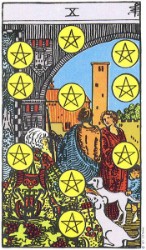
To put it in terms of energy, it’s a closed system.  There’s nothing new or different flowing into it, because everyone is acting and thinking exactly the same way.  It’s like the guy in the Eight of Pentacles who’s just making the same product over and over again, but not creating anything new.

Deviance is thinking outside of that closed box.  Deviance is what allows fresh, different energy into the system.  Deviance is what makes us evolve.

We see this in cultures all across the world.  The most creative, vibrant cultures are the ones that tolerate the highest levels of diversity.  China and Russia, for instance, have extremely low tolerance for diversity and social deviance.  Are they producing any great literature?  Any amazing art?  Fabulous music?  Is anyone desperately trying to get into their countries?  Nope.

Put very simply, the best cultures are the cultures that maximize freedom and diversity.  Those are the cultures that are the most alive and evolving the fastest.

I’ve lived in both California and Texas.  I CHOOSE to live in California because California maximizes my opportunity to be just as different, weird, and unusual as I want to be.  California values social deviance and so I have a much greater opportunity to be my authentic self, to the best of my abilities.

It’s important to ponder all of this as we move into the new era of the Trump administration.  Are we going to continue to be a society that values  and encourages diversity or are we going to become a closed, intolerant  and stagnant energy system?

Make no mistake:  there ARE people out there who are so crazy that they want to tell us what kind of underwear we should put on in the morning.  They want to shrink those two outside circles into one boring inner circle where everyone looks and acts precisely like everyone else.  

Don’t let them do it.

Empaths, Elections, and Staying True to Our Own Energy

Building effective boundaries for empaths.

If you’re an empath and you’ve been feeling kind of sick to your stomach lately, believe me – you’re not alone.  Many of us have experienced the recent election in the United States as something that makes us want to curl up in a ball under a blanket for the next four years.

It’s important for us to explore how this is affecting us from a bioenergetic perspective, though, and not just from a political or emotional perspective.  What is all of this DOING to our energy and our energy fields?

What’s one of the first words that come to mind when we contemplate being an empath?  Boundaries, right?  Boundaries, boundaries, BOUNDARIES!  

Empaths have extremely porous personal boundaries and very leaky energetic boundaries.  In a way, that’s what makes us empaths.  “Normal,” people have fairly strong boundaries and a strong sense of, “I’m over here and you’re over there and we’re two separate beings.”  For a normie, what another person is feeling stays inside of the other person, unless the other person decides to share it.  For an empath, other people’s feelings are constantly flooding into us. It’s very easy for us to merge with those feelings and mistake them for our own.

That’s one of the reasons that many empaths become codependent.  We merge so totally (and so easily) with other people’s emotions that we mistake them for our own.  If someone we’re close to is having emotional or mental problems, we think that we have to manage their drama because it feels like it’s our own. We end up taking care of their lives instead of our own.

So one of the first steps to becoming a healthy empath is to learn to identify our own energy and separate it out from other people’s energies.  We learn this at an early age and many of us become socially avoidant as a result.  We realize that if we’re around people who are angry, depressed, or violent, that we just soak all of that in and it fucks us up.  One strategy we use to deal with that is to just avoid people in general: many empaths become radical introverts.  Which works, but it’s not the BEST strategy, right?  We really can’t cover our heads with the blankets for the next four years.

Can we?  Um . . . no.  I guess not.

We have to learn to separate our energy fields in better ways.

The human energy system is really quite simple to visualize.  As Alla Svirinskaya says in her book, “Own Your Energy – Develop Immunity to Toxic Energy and Preserve Your Authentic Life Force,”  we can think of it as the physical body or core, which is surrounded by a couple of other energetic layers or bodies which are the emotional body and the mental body.  Those other bodies are usually seen as egg shaped, so we end up with a picture of it that looks like this:

For a normie, those extra layers act as a wall to keep out other people’s energy. They filter out negative energies so that they never reach the core of the physical body. For an empath, though, they act as a bridge.  Instead of blocking us off from the emotional identity of people who aren’t us, they allow it to flow right into our personal energy fields which frequently overwhelms us, leaving us confused and injured.

Most empaths are dealing with those dynamics on a daily basis.  What we forget, though, is that our personal energy fields exist inside of larger energy fields.  Any time that you put a group of people together, their personal energy fields are going to merge to some extent and generate a group energy field that’s composed of the collective emotions of all of those people. And we live within those other energy fields.

In a very real sense, we could talk about the vibrations of a particular town or a county or a state.  Those vibrations are the collective energies of the people who live in those places.  Texas, for instance, has a very different vibration than California. And, yes, countries have a collective energy field, too, which is brings us back to the topic at hand:  dealing with this election.

About 72 million Americans got together and voted for a candidate who oozes hatred and anger out of every pore of his orange skin.  THAT is the collective energy that we’re dealing with right now and THAT is what’s making us feel sick.  Put simply, there’s a whole lot of hatred and anger out there in the collective energy field and it’s seeping in to our personal energy fields.  As empaths, we are especially vulnerable to this.

So what can we do about it? Well, we need to remember that the key to being a healthy empath is to be able to distinguish OUR energy from OTHER’S energy.  We need strong boundaries and we need that sense of, “this energy belongs to me and that energy doesn’t.”

Empaths are (for the most part) kind, loving, compassionate people.  That just goes with the territory.  When you really and truly understand another human being on the deepest level, it’s very difficult to stay angry with them.  Or to hate them.  Or to judge them too harshly.

Hatred, anger and judgements are NOT our energies and that’s why they make us sick.

A good strategy for us, then, is to be very conscious of those energies existing inside our personal fields. If we start to feel really, really, REALLY pissed off at the Trumpsters, we can stop and say, “This is NOT my energy.  This is their energy.  I won’t own it.”

Another strategy is to do what Chagdud Tulku called, “antidoting.”  The antidote for hatred is love and the antidote for anger is compassion.  I’m not suggesting that we turn ourselves into human doormats for the Trumpsters.  Rather, we’re just embracing our own nature.  By embracing our own nature, by being as compassionate, kind, and caring as we can, we automatically separate OUR energy from THEIR energy and – surprise, surprise! – we’ve got boundaries.  Suddenly, they’re over there and we’re over here and we don’t have to live in their hatred or let it blend into our energy.

Shazam!

Karma, Having Sex with Republicans, and Being Kind to Yaks

Seeing karma as a way to change our past.

One of my favorite internet memes says, “Karma – It’s spelled K-A-R-M-A and it’s pronounced, ‘Ha, ha, fuck you.’”  

That’s a perfect explanation of our usual understanding of karma which is basically, “If you do some shit, you get some shit.”  If we do something terrible to another person, something terrible is going to happen to us. If we do something nice, something nice is going to happen to us.

OH, WELL, IT’S KARMA

Counter-intuitively, karma is also used an explanation for why bad things happen to good people.  We may have a friend who’s a wonderful person and goes through his life supporting and nurturing others, who’s full of love and gentleness and kindness.  And then something horrendous happens to him, like he falls of a cliff or discovers his wife is having sex with a Republican.

We simply can’t understand why such a good person would have such bad luck.  Certainly, he did nothing to deserve it and, according to the Law of Karma, all of his good behavior should have been rewarded with good things happening to him.

But . . . we’re told . . . perhaps he did something really, really terrible in a previous incarnation.  Maybe he pushed someone off of a cliff or maybe he had sex with a Republican.  Maybe he actually – shudder – enjoyed having sex with a Republican.

That allows us to restore some sense of cosmic balance and we say, “Oh, well, it’s just karma.”

IT AIN’T ME, BABE

We can certainly understand that concept when something bad happens to someone else, but it’s difficult to swallow when it happens to us.

Let’s face it, most of us are NOT the Dalai Lama and we have very little memory of our past lives.  We may accept the general idea that we’ve lived other lives, but we don’t actually remember being a Yak herder in Mongolia in 40 A.D. or a courtesan in Paris during World War I. 

From our current point of view, those people who we were in our past lives were literally someone else and not us.  

The idea that I broke my wrist today because some other guy kicked a Yak 2000 years ago seems entirely capricious and cruel and unjust.  It feels like . . . how shall I put this? . . . bullshit.

KARMA AND DETERMINISM

From that perspective, karma feels very much like determinism.  Determinism is the view that every single thing that happens to us is pre-determined from the moment of birth.  There really isn’t any free will or choice in life because our lives are a result of our genetics, our cultures, the families we’re born into, and the times we live in.

We can actually make a strong case for that.  Even in the United States, where we worship the idea of free will and choosing our own destinies, the statistics say it ain’t so.  If we’re born into a dirt poor family, we’ll probably die dirt poor.  If we’re born into great wealth, we’ll probably die rich.   If our parents were conservative Catholics, we’ll probably be conservative Catholics.  If our grandfather hated socialists for no particular reason, we’ll probably hate socialists for no particular reason.

We tell ourselves that we’re making choices about those issues, but for the most part we aren’t.  It was all programmed into us before we came down the birth canal.  Life is something that happens to us, not something that we create.

Karma can feel a lot the same way.  I, me, the person who I am right now, did NOT kick that Yak 2000 years ago, so why am I being punished for it?  It’s something that’s just happening to me, not something I can control or make any choices about.

BUT KARMA’S A CHOICE

Paradoxically, being the people who we are, right here, right now, is the good news about karma.  

Determinism basically says, “You’re fucked or you’re not fucked and there’s not one damned thing you can do about it.  You have NO choice in the matter.”  It’s all predetermined.

The Law of Karma, on the other hand, says that what we do right now is what really counts.  Far from saying that we have NO choice in the matter, karma is saying that we always have a choice.  And our choices are what determine our karma.

As David Michie said in, “Buddhism for Busy People,” 

“A lot of Western people wrongly think that karma equals fate or predestination.  They think it’s something you don’t have any power to change.  This is a misunderstanding.  It is we who create our own karma and we can change it in a powerful, dynamic way. We are creating hundreds, even thousands of such causes every day of our lives.”

Put another way, we are creating our own karma ALL THE TIME.  It’s not something from the past that just pops up to bite us in the ass every once in a while.  It’s not like The Wheel of Fortune, where we have good luck for a while and then bad luck, for no apparent reason.  It’s something we personally create by either being good people or being bad people.

THE PRESENT AS PROLOGUE TO THE PAST

Now, there’s a particularly fascinating doctrine in some schools of Buddhism that says that we can actually change our past karma by how we behave in our present lives.  

Suppose, for instance, that I was a really notorious Yak kicker in Mongolia in 40 A.D.  I didn’t just kick Yaks occasionally.  No, I was a mean, nasty, evil spirited son of a bitch who got up every single morning and kicked the hell out of as many Yaks as I could reach.

Fast forward 1985 years to my current life.  Suppose I start an, “adopt a Yak program,” and spend years rescuing and feeding homeless Yaks.  I learn to love Yaks and have great compassion for them.  Perhaps I even dress them in Yak finery for special occasions.

Under this particular doctrine, I wouldn’t JUST be creating good karma for my present self.  My good karma would go backwards through time and actually change the character and behavior of my previous self, the notorious Yak kicker. He might learn to love Yaks just as much as I do and my bad Yak karma would be erased.

IT’S NOT THAT WILD

If that sort of time traveling karma sounds a little too wild, just consider what most of us already believe about karma.

We believe that we have one Soul with many different historical identities and that what a previous identity does can travel through time to affect the life of our current identity.  So if all of these past identities are somehow in touch with our current identity, why wouldn’t our current identity be in touch with our past identities?  If they can affect us, it stands to reason that we can affect them.

KARMA AS AN ONGOING PROJECT

When we shift our perspective in that way, then karma becomes an on-going project.  We’re no longer victims of our past.  We’re actually re-creating our past through our current actions.

And if that isn’t free will and choice, I don’t know what is.

Being compassionate, decent people every day and right now is good for us and it’s good for the people around us.  And, ultimately, it’s good for the Yaks.  

Do it for the Yaks.

Just a reminder that my ebook, “Just the Tarot,” is available on Amazon for much less than a bag of Yak feed.

Lucid Choices, The Four of Swords, and Living the Dream Life

Looking at our lives as lucid dreams.

Have you ever had a dream that seemed so real, so vivid and intense, that you were actually shocked when you woke up and realized it was just an illusion?

Sometimes they’re really GOOD dreams.  Perhaps we’re making incredible love with someone or maybe we’re floating through a starry, magical sky. Sometimes they’re really BAD dreams, where we’re being chased by monsters or night terrors.  Whether they’re good or bad, the one thing they have in common is that – at the moment that we’re having them – they seem absolutely, 100% real.

LIVING THE DREAM

There’s a strong case to be made for the idea that our so-called, “waking life,” is very much like a dream, as well.

In, “The Four Agreements,” that’s the term that Don Miguel Ruiz actually uses to describe our day to day existence:  a dream.  As we grow up, we’re programmed by our parents, our religions, and our societies to see the world in particular ways.  We don’t question those view points as they’re being installed in our little brains because we don’t have the ability to judge whether they’re true at that age.  By the time that we reach adulthood, we’re thoroughly convinced that the way that we see the world is the RIGHT way to see it, perhaps the ONLY way.  But those view points are just someone else’s dreams of how the world really is.

Buddhist and Hindu philosophies approach human life in much the same way:  life as we commonly experience it is an illusion, a dream that’s made up of our emotions, ideas, desires, and aversions.  We’re essentially sleep walkers who go through life laughing, crying, eating, procreating, raising families, working, and eventually dying, with no clue as to why we’re here or what it all means.  We just know that, like our dreams, it seems absolutely 100% real. 

WAKING UP

Occasionally, some of us will wake up just a little bit from the dream that we call our lives.  Usually it’s because our pleasant dreams have turned into a nightmare.  

One of our major dreams is, “I’m going to live happily ever after and nothing bad is going to happen to me.”  We’re taught that if we’re, “good,” people and we work hard and we’re responsible, everything is supposed to work out for us.  We’re going to fall madly in love with just the right person, have 2.5 beautiful children who will be extremely well adjusted, get a nice house, a new car, and all of the material toys. And we’ll live happily ever after.  Shit happens to, “bad,” people, not to us.

And then shit happens to us.

Perhaps we find our wife or husband in bed with someone else.  Perhaps we’re in a terrible auto accident.  Perhaps one of our beautiful children gets very, very sick.  Perhaps we get fired from our jobs and lose all of our material possessions.

It’s very much like suddenly waking up.  All of the things that seemed so rock solid and dependable in our lives turn out to be built on sand.  We may feel like life has betrayed us or the whole world has gone crazy.  Eventually, though, most of will go back to our dream worlds because the dream is so comfortable and waking up hurts.

LUCID DREAMING

There’s something that happens in some dreams where we’re dreaming but we suddenly become aware of the fact that it’s a dream.  We don’t wake up from the dream, but we exist within it, knowing that it’s a dream.  It’s called lucid dreaming and, if you’re not familiar with it you might enjoy reading, “Lucid Dreaming,” by Charlie Morley.

Now, one of the things that happens in lucid dreaming is that, to a large extent, we’re able to control the dream.  If we see a wall in front of us, we can consciously decide to simply grow wings and fly over it.  Or perhaps we can visualize a really beautiful woman or man and make love to them to our heart’s content.  

It’s a dream.  We know it’s a dream. But we can choose what happens in the dream.

LUCID LIVING

In his book, “Change of Heart,” Chagdud Tulku said that very few of us will ever be enlightened.  Most of us will continue to live in a dream state, perhaps for many incarnations.  BUT . . . we can choose whether we want to have a good dream or a bad dream.

Which sounds very much like lucid dreaming, doesn’t it?

When we have one of those life experiences where our day to day dream has turned into a nightmare, when we suddenly get a peek behind the curtain of what we thought was true, we have a choice.

Most people roll over and go right back to sleep, just as quickly as they can.

Some people decide to adopt a stance of total cynicism.  Life sucks.  People are rotten.  It’s all a lie.  These are the, “life is a bitch and then you die,” people.

But a few people will say, “Huh . . . it’s all just a dream.  But it’s an interesting dream.  I wonder if I can grow wings and fly over that wall?”

IT’S NOT ENLIGHTENMENT

One of the things that it’s important to remember is that just because we realize that life may be a dream, it doesn’t mean that we’re suddenly, “enlightened.”  Like the person in the 4 of Swords, we’re still solidly asleep, but now we know that we’re asleep.  Which is an improvement.

Unfortunately, as a brief stroll through the internet will teach us, there are many, many people out there who have decided that they must be gurus, spiritual adepts and geniuses just because they woke up a little bit.  Seeing through the illusions doesn’t mean that we’ve got an answer – it just means that we see the problem.

It’s a paradox, like lucid dreaming, where we’re asleep and awake at the same time.  If we keep meditating and keep working on our personal growth, we’ll wake up a little more and a little more and a little more.

In the meantime, we can choose to have good dreams.  We can have dreams that are full of love and healing and our dreams will make other people’s dreams a little better, too.

As Bob Dylan once said, “I’ll let you be in my dream if you’ll let me be in yours.”

Remember that my ebook, “Just the Tarot,” is available dirt cheap on Amazon. It’s not just a dream. Really. I think.

The Three of Cups, Leela, and Playing in the Flow

A look at the Hindu concept of Leela and learning to be a part of a playful Universe.

We wouldn’t put water into the gas tank of our car and expect that it would somehow work alright, would we?  Of course not.  

Putting sadness, anxiety, depression and fear into our minds is exactly like that.  In order for human beings to, “run,” we need to put the right fuel into our energy systems, and that fuel is happiness.

WE ALL KNOW THAT

That proposition isn’t really something that we have to prove, because we already know that it’s true.  

We’ve all had the experience of having to go to work when we were sick.  Perhaps we had the flu or a bad cold, but we still had to drag our asses into work and somehow slog through the day.  No one – ourselves included – expected that we were going to be operating at peak efficiency or do a super duper job when we were ill.  We just had to show up and keep our bodies going through the motions until we could get back home to bed.

Getting through life when we’re extremely depressed, fearful, or anxious is just like that.  All of those states of mind are literally like a poison, like a bacteria or virus that seriously interferes with our abilities to function.  Our bodies are in place, doing what we have to do, but we’re far from being at our best.

HAPPINESS IS THE RIGHT FUEL

In contrast to that, we’ve all had the experience of living when we were extremely happy.  Perhaps we were in love.  Or we just got a promotion.  Or maybe it’s just Springtime and we feel completely zippety doo dah.

When we’re happy, life is easy.  We seem to sail right through difficult projects, our relationships with other people are much easier and more positive, and we attract even more happiness into our existence.

In a very real sense, choosing happiness instead of depression is like putting gasoline into our car instead of water.  It’s the right fuel to optimize human life.

HAPPINESS IS BEING IN THE FLOW

People talk a lot about being, “in the Flow.”  That’s also known as being in the zone, or, as Taoists put it, being in the Tao.

When we’re in the Flow, life is smooth and effortless.  We start to experience a lot of synchronicity and serendipity.  We have an unusual amount of focus and concentration and the task at hand is easy.

Exactly the same things happen when we’re in a state of happiness.  Some people might think that being in the Flow triggers the feeling of happiness, but it’s quite the opposite.  Being happy triggers being in the Flow.

BUT CAN WE REALLY CHOOSE HAPPINESS?

To a large extent, yes, we can.

There are, of course, a few glaring exceptions.  If we’re living in a war zone or someone we dearly love has just died or our house has just been destroyed by a disaster, it can be very difficult for those of us who aren’t spiritual masters to keep a smile on our faces.

The truth of the matter, though, is that for 90% of us, 90% of the time, NOTHING IS WRONG.  Yes, we may have very unhappy memories or we may be very anxious about the future, but right here, right now, in the present moment, nothing is wrong.

The past and the future are just movies that we’re running our own minds.  They literally have no existence outside of our mental images.  We can, in the present moment, choose to be happy or choose to be sad.  As Thich Nhat Hahn said in Peace Is Every Step: The Path of Mindfulness in Everyday Life, “Learn to love, enjoy and embrace what you have in the here and now. That’s all you really need to be happy.”

 HOW DO WE DO THAT?

Oddly, the answer to that seems to be simple:  play.

That can be difficult for us to grasp as Westerners, because our culture and our religions tell us that LIFE IS VERY SERIOUS!!!  We’re supposed to get up in the morning and work hard and sacrifice. We’re supposed to put off all of the things that give us pleasure.  That’s what it means to be a responsible adult, right?

The Hindu philosophy, on the other hand, has a delightful concept called, “Leela.”  Leela literally means, “divine play.” The idea is that when the Goddess made the universe, she didn’t do it as a job, or with a purpose, or even for anything very serious.  She did it because she was playing.  Because it was fun! 

“Hey, I think I’ll make the Universe.  Ooh, that’s a nice color!  Maybe I’ll throw a galaxy in over there.  Why not put some rings around that planet?  Oh, pretty . . .”  

Like the people in the Three of Cups, she was having a ball.

PLAYING IS BEING IN THE FLOW

The real idea behind being in the Flow is that there’s some underlying energy that flows through the entire Universe.  When we’re in alignment with that energy, everything goes smoothly because we’re moving with the natural flow of the Universe.  When we’re out of alignment with that energy, then life is difficult because we’re swimming against the current.

It’s easy to see, then, that if Leela is true – if playfulness is the energy that underlies the entire Universe – then the happier and more playful that we are, the more that we’ll be in alignment with that energy, and the easier life will be.

WHAT ABOUT WHEN LIFE IS HARD?

Life here on the Earth Plane is cyclical.  We see evidence of that everywhere we look.  The moon waxes and wanes, the tides come in and then go out, animals and humans are born, flourish, and then grow old and eventually die.  Even nations rise and then fall.

The Hermetic book, “The Kybalion,” refers to that as the Principle of Rhythm and likens it to the pendulum of a clock.  The Pendulum swings to the left and then it swings an equal amount to the right.  

Our emotions and our personal fortunes seem to operate according to that same principle.  We may have a period of our lives when everything is going perfectly and then that’s followed by a period when everything is difficult.  We may be incredibly happy for a while and then experience deep sorrow.  It’s just the pendulum swinging back and forth.

When we consciously realize that, when we know that any difficulties and sadness that we’re having will change back into happiness eventually, then we cease to take it all so seriously.  We can rise above it, and continue to play.

THE PLAY IS A PLAY

There’s another meaning to the word, “play,” that’s used in the concept of Leela.  That’s the idea of life AS a play.  As something that we might watch playing out on a stage at a theater.  

Like the Principle of Rhythm, that points to the notion that none of this is real or permanent.  These are just parts that we’re playing in this incarnation.  All of our, “sound and fury,” all of the ups and downs, all of the victories and defeats, are just temporary roles that we’re playing and we’ll shed them like old costumes when we move on to our next incarnation.  

All we have to do is learn to play at playing in the play.  We can do that!

Doing Justice to Our Beliefs With Byron Katie’s The Work

A look at how to change our core beliefs using the methods from Byron Katie’s, “The Work.”

The Justice card in the Tarot is, at its most basic level, about society judging us, but there are few harsher judgements than those which we make about ourselves.  And most of them are horribly unjust.

As Cynthia Kane points out in, “Talk to Yourself Like a Buddhist,”  we say things to ourselves that we would never, ever, in a million years, say to our friends and family.  When we really start listening to our inner dialogue, we may find little poisoned pellets like:

You’re so stupid.

I can’t believe that you fucked that up . . . again.

What in the hell is wrong with you?

Why can’t you ever get anything right?

Your problem is that you’re just lazy.

And on and on and on.  The more dysfunctional that our family of origin was, the more likely we are to have that harsh inner critic constantly deriding us.  Constantly telling us that we don’t measure up and we’re never quite good enough, no matter how hard we try.

Now, there’s a basic formula in New Age Thought that goes like this:

Our thoughts create our emotions.

Our emotions create our vibrations.

Our vibrations create our lives.

When we break that down, it just means that every single thought we have has an emotion attached to it, either positive or negative.  When we think of puppies or cookies, we feel good.  When we think of dentists and written tests, we feel bad.  Our feelings about those thoughts add up to create our overall vibration.  If we’re constantly thinking of things that make us sad or scared, we end up with negative vibrations.  If we’re constantly thinking of things that make us happy, we end up with positive vibrations.  And, eventually, our overall vibrations will draw similar vibrations into our lives.  If we have really negative vibrations, we’ll draw in negative people and failures.  If we have really positive vibrations, we’ll draw in positive people and abundance.

It’s really cool when we figure that out because it empowers us to make changes.  We can jump in at any one of those three points and start to transform our lives. Most of the self-help guides advocate one approach or another.  If we change our thoughts, we’ll change our emotions.  Or if we work on feeling happier about life, that will change our thoughts.  Or if we meditate on raising our vibrations, that will change what we attract.  Pull on any one of those three strings and our lives will start to change.

There’s one element that’s frequently left out of that equation, though, and that element is beliefs.  We can change our thoughts, our emotions, and our vibrations but if we don’t change our underlying beliefs, we’re not going to get anywhere.

The classic example of that is the person who wins the lottery and two years later he’s bankrupt.  Maybe he spent hundreds of hours visualizing getting that winning ticket and wrote out a kazillion affirmations and did vision boards and all of that helped him to win.  But he didn’t change that underlying belief, which was, “I’m poor,” so the money floated away.  It wasn’t a vibrational match for his basic beliefs about himself.

To put it in a nutshell, our beliefs create our thoughts which create our emotions which create our vibrations which create our lives.

Which begs the question, “What IS a belief?”  

A belief is nothing more than a thought that we repeat over and over until we think it’s true.  Sometime they ARE true, but frequently they aren’t.  If we want to know what our real beliefs are, all we have to do is to listen to that inner dialogue.  If we’re constantly degrading and belittling ourselves, then those are beliefs that we need to change before we can effect permanent changes in our lives.

So how do we change our basic, underlying beliefs?  We actually pull them out and look at them.

One of the most powerful tools for doing that is Byron Katie’s, “The Work.”  

To use The Work method, we take a, “work sheet,” (download one here) and focus on four areas:

1- What’s the belief that I need to change?

2- Is it true?

3 – What kind of a person would I be without that belief?

4 – What are some opposite turn arounds that I can substitute for that belief?

Here’s an example of a negative belief that a lot of us carry around:  “I’ll never have enough money.”

IS IT TRUE?  For most of us, it’s not true at all, at least for most of our lives. There are very few of us who have been homeless or starving.  That doesn’t mean that we haven’t gone through some bitchy, bad times.  There may very well have been times when paying our bills or even just buying groceries was a struggle.  Still, if we’re honest with ourselves, most of us, most of the time, manage to pull it together even through the occasional hard times.

Of course, one of the questions that we need to look at there is, “What do I mean by, ‘enough money.’ “  If we put together a vision board that’s covered with pictures of sports cars, McMansions, and private jets, we’ll probably feel like we don’t have, “enough.”  If we think in terms of food, clothing, shelter, a car that runs, and a job, though, we realize that we’ve usually had plenty.

WHO WOULD I BE WITHOUT THAT BELIEF?  Well, for one thing, we’d probably be a lot more grateful.  When we actually focus on the fact that we have always had enough money to eat, enough money for a warm place to live in the winter, enough money to pay our bills, then we can start to see how very lucky we’ve actually been.  

For another thing, we can start feeling a lot less anxious about the future.  If we’re able to look at our past and see that there’s always, somehow, been enough, then we can see that there’s absolutely no empirical evidence for the idea that we won’t have enough in the future.  It’s just a movie playing in our heads that’s based on a bad fantasy.

WHAT ARE SOME OPPOSITE TURN AROUNDS TO THIS BELIEF?  The obvious one, of course, is, “I always have enough money.”  Some others might be, “I manifest what I need as I go along,”  or “The Universe always provides for my needs.”

Once we’re able to flip that basic belief, then some miracles start to happen.  Our thoughts begin to be more positive (“I always have enough money.”). Since our thoughts have changed, our emotions start to change (“I really don’t have anything to worry about financially and I’m happy about that.”). Since our emotions have changed, our vibrations start to change (“I feel really secure, relaxed and positive about life.”).  And when our vibrations change, then we start to create the life that we always wanted.

It’s a really good and relatively simple method for changing our basic beliefs.  Of course, Byron Katie probably named it, “The Work,” for a reason, because it does take some work.  It’s not just a matter of sitting down and filling out a sheet of paper.  It’s actually taking the time to listen to our own thought stream, write down those negative beliefs, and then meditate on them as we fill out the sheets.

And changing negative beliefs is work on a whole different level, as well.  We tend to cling to beliefs about ourselves and the world around us simply because they’re comfortable and they’re what we’re used to.  When we adopt the very opposite of those beliefs, it can initially feel very strange and foreign.  The negatives will keep popping up in our thought streams for a while, but we now have the consciousness to stop and say, “Nope.  It’s not true, it doesn’t make me feel good, and it’s not who I am.”

Note: as a member of Amazon Associates, I may receive a tiny remuneration if you buy a product listed on this page. I am in no way associated with the authors of the books quoted.

The Hierophant, the Tangerine Blob, and the Moral Collapse of American Christianity

A look at the role of cognitive dissonance in American Christian voters.

One of the larger puzzles of the recent elections in the U.S. is the huge number of people who are self-professed Christians but voted for Trump.  Not to belabor the point, but Jesus was pretty much of a peace, love, and forgiveness dude and the Tangerine Blob is all about hatred, anger, and vengeance.

So how could they possibly reconcile being followers of Jesus with voting for the Malevolent Cheeto?  Hmmm . . .

It’s important to note that American Christianity (and Christianity in general) has always sort of run on two different tracks at the same time. As Dee Brown delineated in his classic book, “Bury My Heart At Wounded Knee,”  Christianity was a driving force behind the genocide that White settlers committed against Native Americans.  The peculiar notion of, “the White man’s burden,” dictated that all people of color MUST be forced to adopt Christianity or be exterminated.

And, of course, the resurgence of the Ku Klux Klan in the 1920s had massive support among the White Protestant churches of the South.  There’s a reason that the Kluxers burn crosses at their rallies.

We’ve regularly had this strange dissonance between the Christianity that purports to be a creed of peace and humility and the Christianity that feels more like a violent Spiritual Imperialism.  It’s like someone saying, “You have to believe in our God of love or we’ll kill you.”

It may be that, “dissonance,” is precisely the word to describe what happened with American Christians and this election.  In psychology, “cognitive dissonance,” is the term that’s used to describe the state where an individual holds two different sets of beliefs that contradict each other, or where their behavior is completely at odds with their values.  

Think of it like a good, family man who professes to love his wife and children but is constantly sneaking off to have liaisons with hookers.  Or a feminist woman who’s strongly attracted to primitive, abusive males.  What happens is that the differences between their self images and their behaviors cause a huge amount of psychic tension and eventually something’s got to give.  Either they change their behaviors or they change their beliefs and that eliminates the dissonance and relieves the tension.

If we start to think of American Christianity in terms of that same sort of a moral and behavioral dissonance, then all of this begins to make sense. The Hierophant card represents the formal teachings of a religion or creed, as opposed to actual spirituality.  It’s what the church tells us that we ought to believe and how we ought to behave.  It’s not necessarily who we truly are.

Jesus, of course, taught that we ought to love each other, we ought to forgive each other, we should help the powerless and the ill, that violence is wrong, and that rich people can’t get into heaven.  Americans, on the other hand, have always been at war more than we’ve been at peace, we love violence in our movies and our sports, we sell more weapons of destruction than any other country in the world, and we worship money and the people who have money.

If you’re a Christian, that’s cognitive dissonance.

Now, it would be inaccurate and melodramatic to describe Trump as, “the Anti-Christ.”  At the end of the day, he’s just one more puffed up wanna-be dictator strutting his stuff on the world stage.  It would be highly accurate, though, to describe him as, “the Anti-Jesus.”  Nearly all of his behaviors and beliefs – the anger, the hatred, the vanity, the vengeance, the gross materialism – are in direct opposition to everything that Jesus taught.

If we stick with our model of cognitive dissonance, Christians voting for Trump would be like the good family man leaving his wife and running off with a hooker.  Or the feminist woman getting married to a man who’s a sexist pig.  Rather than changing their behaviors, they changed their beliefs.

Put another way, the election of Donald Trump can be seen as a substantial shift away from what American Christians claimed to be and toward who they really are.  In fully embracing their Shadow of anger, xenophobia, sexism, and violence, they’ve relieved the psychic tension of that cognitive dissonance.  They feel a whole lot better, even if the rest of us are freaking out.

So it’s really not shocking at all.  That very dark side of Christianity has always been there, operating in the background.  What’s interesting, from a purely sociological point of view, is what American Christianity will become now that they’ve thoroughly expunged Jesus from the equation.  Without the doctrines of peace, love, and brotherhood, what’s left?

In her brilliant book, “The Power Worshippers – Inside the Dangerous Rise of Religious Nationalism,” Katherine Stewart argues that what’s left is essentially a political movement rather than a church.  She traces a nationwide network of religious fundamentalists, ultra-conservative oligarchs, and autocratic preachers who are determined to undermine democracy and impose their world view on the rest of us.  Their world view is that White males should be the ruling class in our society, that women should be subservient breeding stock, and that our constitutional democracy should be replaced with an Old Testament religious theocracy.

Will that movement be able to sustain itself in the long run?  Perhaps.  What’s clear at this moment, though, is that if it’s going to be defeated there will have to be a transformation of the basic values of many Americans.  Unfortunately, the normal vehicle for ethical change in America has always been the Christian church, which apparently isn’t very Christian anymore.  We shall see . . .

“Just the Tarot,” available dirt cheap on Amazon. As a member of the Amazon affiliate program I may receive a very small, itty bitty, tiny remuneration when you click through one of my links and make a purchase.

How to Choose an Oracle Deck

Factors to consider in choosing an Oracle deck.

I’ve been having a lot of fun playing with Colette Baron-Reid’s Wisdom of the Oracle deck lately.  They seem to be highly accurate and the illustrations are really magical.

There are, of course, about 80 kazillion different decks out there by now, so it can be difficult to decide which one to get.  On average, they’re about 20 bucks a pop, so it’s not like most people can order a dozen of them and figure it out later.    If you’re in the market for a new deck, here are a few things to consider.  

ARE THEY REALLY ORACLE DECKS?

That’s not as silly as it sounds.  There are quite a few decks that really have nothing to do with, “fortune telling.”  For instance, Louise Hay has several decks like, “Heart Thoughts Cards: A Deck of 64 Affirmations,” which are collections of affirmations printed on separate cards.  They’re lovely, inspiring thoughts, but they have nothing to do with predicting the future or understanding the past.

“Healing the Inner Child Oracle: A Transformative Quest,” is another example.  It’s a charming deck that offers words of solace for anyone with a wounded Inner Child, but it isn’t in any sense, “oracular.”  Basically, what we’re looking for in an oracle deck is one that’s capable of saying, “You are here.  This is how you got here.  This is what’s going to happen if you keep on your present course.”  If it can’t fulfill those simple parameters, it’s not an oracle deck.

DO YOU TRUST THE AUTHOR?

A little bit of research can tell us a lot about the author of a deck.  Some basic questions we can ask are:  is the author experienced?  Does the author have some sort of psychic ability that would lend her credence in designing a deck of cards?  Is the author in a positive flow of energy?

Colette Baron Reid, for instance, is a psychic and has been reading cards professionally for 25 years. (Check out her web site here:  https://www.colettebaronreid.com/)\].  For me, personally, the fact that she’s gone through some serious shit in her life and emerged with a positive message and positive energy adds greatly to her credibility.

We can contrast that with Aleister Crowley’s Thoth Tarot deck.  It’s a well designed deck and Crowley had a deep knowledge of occultism.  He was also deeply involved with black magic, sacrificed animals in his rituals, and was a heroin addict.  I wouldn’t want his deck or his energy anywhere near my house.

IS THE DECK MAGICAL?

This is obviously highly subjective.  The question here is, “Does the deck call out to your Deep Mind?”  Does it stir something inside of you that resonates and feels magical?

I would answer, “absolutely,” with Baron-Reid’s deck.  The illustrations are by Jenna DellaGrottaglia and her art is like something channeled from another world.  The second I picked up the deck I could almost feel it vibrating in my hands. 

They’re whimsical, thought provoking, and perfect illustrations of the situations we find ourselves in on a daily basis.  You can see more of her art here.

On the other hand, we can look at cards like those from Doreen Virtue’s original angel decks and feel a resounding, “Blechhh.”  They’re really just Hallmark greeting cards compiled into a deck.  Despite the fact that they sold in the hundreds of thousands, they’re flat and low vibration.

ARE THEY ACCURATE?

Although this is, of course, the most important question, it’s hard to ascertain without actually buying one of the decks and trying them.  We can try to get a, “feel,” for them by reading the reviews on sites like Amazon, but even those can be highly suspect.  

If you’re just starting out on your card reading adventure, one indicator you might use is how long the deck has been around.  Decks that don’t work tend to disappear fairly quickly. The Waite Tarot deck, for instance, is pretty much the gold standard for accuracy and was first published in 1909.  The much, much older Marseilles deck has been used for centuries, but is a little more difficult for beginners to work with.

In the limited period of time that I’ve been using Baron-Reid’s deck, I’ve found it to be highly accurate.  I inquired, for instance, about the outcome of the presidential election here in the U.S. and drew a card titled Conflict and Chaos.  Perfect.

WHAT ARE YOU USING THEM FOR?

Finally, it’s good to consider how we’ll actually be using the cards.  If we’re deeply into metaphysical inquiries and are looking for the underlying currents in life, we might want to go for a deck that relies heavily on archetypes.  One example is Baron-Reid’s Goddess deck.  Or we might want to go straight to the source and use an archetype deck like this one from Caroline Myss.

I tend to use my cards much more for mundane inquiries than for metaphysical explorations.  In other words, my questions are more like, “What in the hell am I supposed to be doing this week?” And less like, “What is the meaning of life?”

Which is another reason why I particularly like this deck.  The cards are mainly flat out, practical, day to day advice, like, “You need to get more rest.”  Or, “this venture isn’t going to work so make a u-turn.”  Or, “use your imagination, not your logic.”

We can achieve much the same result by taking a classic Tarot deck like the Waite deck and simply removing all of the Major Arcana (archetype) cards.  When we use only the Minor Arcana, we’re only looking at the mundane, practical factors in life.  That’s kind of a hassle but it works.

Ultimately, the deck you choose will be all about you.  If it calls out to you, if it resonates with your vibrations, if you trust it, that’s your deck.

The Moon, Processing the Election, and Summoning a New Reality

Processing the craziness of the U.S. election and waiting for a new world to manifest.

MORE THAN JUST THE BLUES

So how are you doing out there after this crazy election?  If you’re a liberal, an empath, or an intuitive, you’re probably feeling puzzled, sad, angry, depressed, and – to a certain extent – scared.

And, unless you’ve just sworn off rationality (like the other half of the country) you’re probably trying to figure this out.  What in the HELL just happened?  It’s more than just a normal case of post-election blues.  It’s a need to restore some sense of sanity to our daily lives.

YES, THEY REALLY ARE CRAZY

The first thing to acknowledge is that, yes, the Trumpsters really ARE crazy.  There’s an old argument that says, “A million people can’t be wrong.”  But they can be and frequently are.  Millions of people supported Hitler and Stalin.  Millions of people supported the Catholic church raping and burning and murdering it’s way across several centuries.  Not only is there not truth in numbers, there’s frequently collective insanity.

DEFINING CRAZY

If you joyously embrace something that’s going to fuck you up, you’re crazy.  We recognize that fact with addicts who stick the needle in their arms one more time or alcoholics who pick up a bottle again.  Bi-polars who quit taking their meds.  Abused spouses who go back to their abusers.  If we choose self-destruction, we’ve left the realm of sanity.

In my lifetime, there has never been an election where more people voted against their own self-interest.  Women voted for a man who wants to end their control over their own bodies.  Latinos voted for a candidate who calls them murderers and rapists.  So-called Christians voted for a serial adulterer who’s violated nearly everything that Jesus ever taught.  And on and on.  They’ve chosen someone who is going to destroy their lives, therefore they’re crazy.

TRYING TO RESTORE BALANCE

One of the first things that we do when we’re confronted with a whole lot of crazy is to try to restore a sense of balance and sanity.  There must be some reason why they acted so crazy, right?

That’s our rational, left-brain, linear thinking trying to understand why they acted as they did.  A sense of sanity is very important to human beings.  It makes our environments predictable, it makes our lives orderly and meaningful.  More than anything else, it gives us a sense of safety and we need a sense of safety to function.

This is why we’re seeing all of the post-election analysis.  “What is it that women really wanted?  What issues are really important to minorities?  What message was rural America really trying to send?”

PROCESSING CRAZY

The sad truth, though, is that if we try to process non-rational behavior from a rational perspective, it just makes us crazy.  There are million reasons out there for why different people voted for Trump.

I couldn’t bring myself to vote for a woman.

I didn’t like her laugh.

I’m paying too much for groceries.

I’m worried about immigrants.

I’ve always voted for Republicans.

I hate liberals.

He didn’t REALLY mean all of those things he said.

Any and all of those reasons pale in comparison to the reality of voting for a senile, hateful, con artist who announced that he intends to be a dictator and end democracy as we know it.  When we put the reasons next to the results, they’re all crazy.

THE MOON CARD AND CRAZY

The Tarot card, The Moon, is all about crazy.  It shows a dog and a wolf baying at the Moon, while a crustacean crawls out of a dark pool.  It illustrates that even our domesticated dogs still contain the genes of the wild wolf and our brains still contain the primitive, crocodile brain that motivates hatred and fear.  The light of the Moon illuminates but doesn’t delineate.  We see a shape on the ground and we don’t know if it’s a snake or a rope.

What happened in our last election was all about illusions, delusions, and trickery.  It was the wolf snapping it’s ravenous jaws at our doors and the crocodile gnashing it’s teeth.  It was a cultural and spiritual disaster.  It was crazy to the max.

CREATING ALTERNATIVE REALITIES

So if we can’t use our rational minds to really understand what just happened, what do we do?  Well, we ask for answers and wait for alternative realities to emerge.

We need to give our subconscious minds – which are also our links to our higher selves – time to process all of this craziness.  What we just got was the equivalent of a massive data dump.  We just now found out that over half the country supports a very evil (yep, I’m going to use that word) agenda.  It contains racism, sexism, homophobia, xenophobia, and fascism.  We simply can’t assimilate all of that data at once.

What we CAN do is to actively engage with our subconscious minds (and thus our higher selves), ask for answers, and wait for them to emerge.  That means doubling down on meditating, prayer, lucid dreaming, reading Tarot cards – whatever our particular means is of creating a dialogue with our subconscious and higher selves.  That means actively asking for answers.

IT TAKES A LITTLE WHILE

As we know, the subconscious mind doesn’t have a drive-through window.  We can’t just cruise up and order an answer to all of this with a side of onion rings or fries.

We also know, though, that our subconscious minds, our higher selves, and our guides and helpers are infinitely creative.  Right now, at this very moment, they are weaving together a tapestry that will contain the answers we need.  As spiritual seekers we don’t drive out the darkness – we bring in the light.  The light will start to emerge over the next couple of months and it will emerge through us.