What do we do when our best ideas don’t seem to work? When we’ve approached our problems with all the hard work, intelligence, and cleverness we can muster, and we still can’t seem to solve them?
Maybe we need to work harder. Maybe we need more information. Maybe we need a better plan.
Or maybe we need an upgrade in our thinking process.
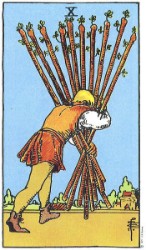
Consider the Ten of Wands.
You can start to feel tired just looking at this card. Here’s this poor guy trudging along with a load of sticks that’s so heavy he can’t even look up to see where he’s going.
Traditionally, the Ten of Wands represents burdens, responsibilities, overwork, and exhaustion. But I think there’s another way of looking at it.
The suit of Wands in the Tarot represents inspiration, creativity, passion, will, ambition, and personal power. It represents the energy that motivates us to turn our ideas into reality.
But what happens when we accumulate too many ideas, ambitions, and strategies? We become like the fellow in the Ten of Wands, carrying around an enormous collection of things that once seemed useful but have now become a burden.
It isn’t that he doesn’t HAVE any ideas. If anything, he seems to have too many of them. The problem is that his ideas aren’t working for him anymore.
The Problem With Habitual Thinking
Life coach Katarina Esko, in her video The Path to the Highest Forms of Intelligence, suggests that one of the reasons our thinking doesn’t always work for us is that we tend to have the same thoughts over and over again.
Rather than coming up with genuinely new solutions, we keep rearranging our old thoughts into slightly different patterns, hoping they’ll produce different results.
She refers to this as habitual thinking.
And there’s a good deal of psychology behind the general idea.
Our brains learn through repetition. When we repeatedly think, feel, or behave in certain ways, the neural networks involved can become more efficient at producing those familiar responses.
That’s how we learn everything from speaking a language to driving a car.
Unfortunately, the same general process also helps establish our habitual beliefs and ways of looking at the world. Our parents, schools, religions, and cultures repeatedly expose us to certain ideas about how life works, what we should value, and what we’re supposed to do.
Over time, many of those ideas become so familiar that we stop questioning them. We don’t even remember where they came from.
We simply assume they’re true.

The Path Through the Forest
Think about walking through a forest.
Suppose there’s a well-established pathway that leads from Point A to Point B. It’s relatively smooth, easy to follow, and you’ve walked it hundreds of times.
Now suppose somebody suggests that you abandon that familiar pathway and strike out through the underbrush.
You’d probably think they were nuts. Why struggle through blackberry bushes, climb over fallen trees, and risk getting lost when there’s a perfectly good path right in front of you?
Our brains tend to favor familiar mental pathways for much the same reason. Established ways of thinking are efficient. They require less conscious effort than developing entirely new approaches.
But what happens when the old pathway no longer leads where we want to go? Instead of exploring a new route, we keep walking down the old path, hoping that this time it will somehow take us somewhere different.
And when that doesn’t work, we try harder. We walk faster. We study maps. We read books about walking. We develop elaborate strategies for improving our walking technique.
But we’re still on the same old path.
And that’s where the Ten of Wands becomes such a wonderful metaphor.
Here’s someone who’s carrying around an enormous load of accumulated ideas, beliefs, and assumptions. Some of them may have been useful once. Some may still be useful. And some may never have been particularly useful in the first place.
But he’s so busy carrying them that he can’t even look around.
His problem isn’t that he needs another wand. His problem is that he needs to put some of them down.
Thinking About Thinking
So how do we begin to recognize which ideas are worth keeping and which ones have become unnecessary burdens?
Esko suggests developing the habit of metacognition, which is simply a fancy word for thinking about our own thinking.
Instead of automatically accepting our thoughts as accurate representations of reality, we begin examining them. Why do I believe this? Where did this idea come from?
Is this something I’ve actually discovered through experience, or is it something somebody told me forty years ago?
And perhaps most importantly: What if everything I think I know about this problem is preventing me from finding the solution?
Of course, we can’t necessarily solve the problem of habitual thinking simply by acquiring more information. After all, the people writing the books and making the videos may be operating within their own habitual thinking patterns.
We can spend years collecting new information without ever questioning the assumptions through which we interpret it. We may simply end up with an even bigger bundle of sticks.
And that’s where meditation enters the picture.
Making Room for New Ideas
One of the interesting things about meditation is that it offers us an opportunity to stop trying so hard.
Instead of analyzing our problems, developing strategies, and attempting to force our thoughts into productive arrangements, we temporarily set the whole business aside.
We become quiet.
And sometimes, something rather remarkable happens. An entirely new idea emerges.
Psychologists recognize a phenomenon called incubation, in which stepping away from a difficult problem can sometimes lead to an unexpected solution.
We’ve probably all experienced it. You struggle with a problem for hours, finally give up, and go take a shower. And halfway through washing your hair, the answer suddenly appears.
Where did it come from?
From a psychological perspective, our minds can continue processing information and forming associations outside our conscious awareness. But Esko suggests another, more metaphysical possibility.
What if our most original ideas aren’t necessarily manufactured through conscious thinking? What if we sometimes become receptive to ideas that seem to arrive from somewhere beyond our ordinary thought processes?
Whether we interpret these experiences psychologically or spiritually, there’s an important distinction between forcing an answer and allowing an answer to emerge.
And that brings us to one of my favorite subjects: synchronicity.
Synchronicity and the Ten of Wands
Carl Jung used the term synchronicity to describe meaningful coincidences that appear connected through significance rather than an identifiable causal relationship.
Suppose you’ve been struggling with a problem for months. You’ve analyzed it, researched it, worried about it, and approached it from every angle you can imagine.
Nothing works.
Finally, you decide to stop struggling. You meditate, question your assumptions, and become willing to consider possibilities that don’t fit your established ideas about how things are supposed to work.
And then something unexpected happens.
You pick up a book you wouldn’t ordinarily read, and a passage seems to address your problem directly. You have a casual conversation with a stranger who mentions something you’ve never considered. Or you encounter an apparently unrelated event that suddenly gives you an entirely new perspective.
Was it synchronicity? Was it intuition? Was it your unconscious mind making connections that your conscious mind had overlooked?
Those are fascinating questions, and we don’t necessarily have to settle them to appreciate the experience.
When we stop insisting that the answer must come from what we already know, we become more receptive to possibilities we haven’t considered.
And that brings us right back to the Ten of Wands.
There’s something particularly interesting about the progression of the suit of Wands.
It begins with the Ace, a single wand representing the spontaneous spark of inspiration, creativity, and possibility. But by the time we reach the Ten, that original creative energy has become an almost unbearable burden.
What began as inspiration has become obligation. What began as creativity has become repetition. And what began as an expression of personal freedom has become something that weighs us down.
Perhaps that’s one of the deeper lessons of the Ten of Wands.
Sometimes our problems don’t require more effort, more information, or more cleverness. Sometimes they require us to question the very ideas we’ve been relying upon to solve them.
Look at the person in the Ten of Wands one more time.
He’s so busy carrying his enormous bundle of sticks that he can’t even see the road ahead.
For all he knows, there may be a much easier path just a few feet away. There may even be somebody standing beside the road, trying to give him directions.
But he’ll never know until he puts down those sticks and looks around.
Maybe the answer isn’t pushing out another brilliant idea. Maybe the answer is just making room for one to come in.


