The Hierophant Card, Spirituality, and That Time That Ram Dass Got Conned

In this candid exploration of The Hierophant Tarot card, I unpack both the light and shadow sides of spiritual authority. From my own rocky history with organized religion to cautionary tales of gurus gone wrong, this post looks at how The Hierophant can represent both guidance and manipulation. Learn how to spot the difference between a true spiritual teacher and a false one, and why, in the end, your own connection to the Sacred should always be at the center.

The Hierophant Card from the Waite Tarot Deck

I’ve always had a hostile feeling toward The Hierophant card. I was raised in the old, Latin, fundamentalist Catholic Church, and like many a recovering Catholic, the mere sight of a priest, pope, or prelate is enough to make me start hissing and spitting.

The image of the Hierophant sitting on his golden throne while tonsured followers bow before him is a perfect example of what I don’t like about organized religion. It’s not the Sacred Divine that’s central to the image—it’s the priest. The priest is the intermediary you have to go through to get to the Sacred.

This setup isn’t limited to Catholicism, of course. We find it in all religions. There are countless priests, rabbis, pastors, vicars, imams, and gurus who claim to hold the Key to the Kingdom—and you’ve got to drop them a little sugar before they’ll let you see it.

Religion Versus Spirituality

“I’m more spiritual than religious.”

We’ve all heard that one—so often, in fact, it’s become almost a cliché in New Age circles. In very simple terms, religions claim to hold knowledge from God/dess—usually in the form of a book or oral teachings—and you have to pay someone (priest, rabbi, guru, etc.) to interpret it for you.

Spirituality, on the other hand, involves direct knowledge of the Sacred through personal meditation, taking psychedelic drugs, or having some other form of mystical insight. You don’t need to pay anyone to interpret it because you’re the one having the experience.

In Tarot terms, that’s the polarity between The High Priestess and The Hierophant: The High Priestess represents direct spiritual experience, while The Hierophant represents organized religion.

The Good and the Bad Faces of The Hierophant

I recently had a discussion with another Tarot reader who seemed mildly shocked by my open hostility to The Hierophant. I could have jumped right in with thousands of examples: pedophile priests, pastors who are sleeping with members of their flocks, imams and rabbis calling for each other’s destruction.

Organized religion makes that all too easy, right? There really are a lot of creepy critters living under that rock.

But I held off and listened to her. Her point was that The Hierophant can also represent the spiritual teacher who is genuinely a spiritual teacher. Examples might include yoga teachers, meditation guides, or instructors at temples and spiritual retreats.

And yes, I suppose that includes priests and pastors who sincerely try to teach compassion, love, and charity.

There are plenty of people who don’t know how to even begin their spiritual journey, much less reach the destination. For them, spiritual “instructors” can be a vital step on the ladder.

Still… be very, very careful.

The Guru Who Got Conned by a Guru

I’ve long been a fan of Ram Dass. Maybe it’s because he was a fellow Aries and I understood him on that level. Maybe it was his gentle, self-deprecating humor. Maybe it was because about 80% of what he said was solid truth.

If I were to name a “good” spiritual instructor, he’d be near the top of my list.

Despite all of that, he wrote an astounding article in a 1976 edition of Yoga Journal outlining how he had been thoroughly and totally conned by another guru named Joya.  

This was years after receiving his own spiritual transmission from his original guru in India. Despite that grounding, he stumbled right into Joya’s web. Within months, he was having sex with her, convinced she was channeling Indian goddesses, and buying her gold bracelets and rings to “protect her energy.”

He bought it—hook, line, and sinker.

Add to that the drunken sexual abuses of Chögyam Trungpa, the murders and kidnappings that evolved out of the Hari Krishna movement, and, of course, the horrors of the Bhagwan Rajneesh compound in Oregon, and you begin to get the picture.

Even the “good” face of The Hierophant can turn bad. No one following these leaders woke up and thought, “Hey, I’d really like to find a guru who’s going to rip me off, sexually abuse me, and get me involved in criminal activities.”

Who’s in the Center?

We can actually learn a lot just by looking at The Hierophant card.

A. The pope figure is in the center. If the spiritual teaching you’re receiving revolves around a particular person—if that person’s existence is central to the teaching—you’ve got a false teacher.

B. The figure is being worshipped. Unless your teacher can levitate six feet into the air and float around the room, don’t buy the idea that there’s something “divine” about them. Even then, check for wires. Real teachers may have siddhis—extraordinary spiritual powers—but they don’t flaunt them, expect worship, or claim to be gods or goddesses.

C. The figure sits on a throne wearing a golden crown. There’s a reason people contrast the spiritual with the material. Real spiritual teachers don’t hoard treasures. As the old country song asked, “Would Jesus wear a Rolex?”

Um… no. He wouldn’t.

Teachers Are Stepping Stones

If you’re involved in a religious practice—whether Tibetan Buddhism or American Christianity—and you feel it’s making you a better person, more power to you.

But remember: we are meant to evolve beyond teachers. We absorb what we need from them and then move on to the next plateau. Organized religion can be a stepping stone at the start of the journey, but it’s not the destination.

And no… I still don’t like The Hierophant.

“Just the Tarot,”  by Dan Adair, a kindle ebook available on Amazon.

Religion is Spirituality in Drag: La Papesse and the Disguised Goddess of the Tarot

A playful, insightful exploration of the tarot’s mysterious La Papesse—the High Priestess before she got rebranded. This post looks at her hidden connection to the Divine Feminine, contrasts her with the Hierophant, and makes the cheeky case that religion is just spirituality in drag. The Goddess, it turns out, never left—she just got creative.

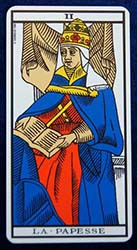
La Papesse – The High Priestess

The Lady Pope Who Wasn’t Supposed to Be

There she is—sitting calmly on her throne, robed like a pope, crowned like a queen, and holding an open book in her lap. Her name? La Papesse—The Popess. And she’s right there in the second card of the Tarot de Marseille, as if that’s a totally normal thing.

Spoiler: it wasn’t.

In the deeply patriarchal world of medieval Europe, the idea of a female pope was about as welcome as a lightning storm at Easter Mass. Women weren’t allowed in the priesthood, let alone the papacy. And yet, someone slipped this mysterious, serene woman into one of the most enduring tarot decks in history. Not just as a background figure, but as a Major Arcana—a gatekeeper to mysteries, positioned right after The Magician.

So how did La Papesse get past the spiritual bouncers?

Some say she’s a nod to the medieval legend of Pope Joan—the woman who supposedly disguised herself as a man, rose through the clerical ranks, and accidentally gave birth during a papal procession (oops). Historians mostly file that story under “colorful fiction,” but even fiction has staying power when it touches a nerve. Whether she was real or not, Pope Joan became a symbol of something that wouldn’t go away: the unspoken presence of feminine wisdom in a church that tried very hard to pretend it didn’t exist.

And that, dear reader, may be exactly what La Papesse is doing in the tarot. Sitting there quietly, book in hand, saying nothing—but also saying everything.

The Divine Feminine in Disguise

Let’s be honest: “Popess” is not a job title you hear every day. Even in a medieval tarot deck full of crowned figures, mythical beasts, and flying body parts, La Papesse still raises eyebrows. And that’s probably the point.

Because she’s not just a curiosity—she’s a symbolic insurgent.

In a time when religious authority was reserved strictly for men, slipping a female spiritual leader into the tarot wasn’t just bold—it was sly. If the Church said, “No women allowed,” the tarot quietly responded, “Cool story. Here’s one holding the Book of Secrets.”

Look closely and you’ll see: La Papesse isn’t just playing dress-up. She’s the real deal. She’s seated, grounded, radiating calm authority. The book in her lap? It’s open, but not for just anyone. This is hidden knowledge, sacred mystery, the kind of truth you don’t shout from a pulpit—you whisper behind a veil.

And oh yes—there’s often a veil behind her too, in later versions like the Rider-Waite-Smith deck where she evolves into The High Priestess. That veil is no accident. It’s the boundary between outer appearances and inner reality. Between dogma and direct experience. Between religion and… well, something deeper.

Maybe that’s why La Papesse feels like a divine trickster in holy robes—a way for the Goddess to sneak herself back into a story that tried to write her out. A kind of spiritual photobomb. She’s not angry. She’s not loud. She’s just there, like she’s always been, waiting patiently while the world catches up.

High Priestess vs. Hierophant: The Sacred Split

If La Papesse is the quiet keeper of spiritual truth, then The Hierophant is the guy with the microphone and the rulebook. You know the type—fancy hat, formal robes, sitting on a throne flanked by devotees. He’s not whispering behind veils. He’s declaring doctrine. Loudly.

In the tarot’s symbolic landscape, these two form a kind of spiritual odd couple.

On one side: the High Priestess (formerly La Papesse), guardian of the inner mysteries. She represents intuition, silence, dreams, the moon, and the feminine path of going within. No sermons. No commandments. Just you and your inner voice having a deep conversation.

On the other: the Hierophant (a.k.a. The Pope), representative of the outer structure of religion. He’s about tradition, hierarchy, sacred rituals, and the authority of institutions. He doesn’t just speak for God—he’s got a line of succession to prove it.

And here’s where things get fun.

If the High Priestess is the essence of spirituality—private, personal, often mysterious—then the Hierophant is what happens when that spirituality gets dressed up in official garb and turned into an organization.

You could say he’s spirituality in drag.

(And yes, the Goddess is laughing.)

It’s not a judgment—it’s an observation. Religion, at its best, is a ritualized way to connect to the sacred. But it borrows its power from something deeper, older, and quieter: that inner knowing, that wordless communion with the Mystery that no cathedral could ever fully contain.

So the next time you see these two cards in a spread, you might ask yourself: Am I being called to tune in… or to follow the program? One isn’t necessarily better than the other—but they’re very different energies. One whispers. The other chants.

And both, in their own way, are trying to bring the divine into human hands.

Drag as Divine Theater

Let’s talk about drag.

Real drag—the kind you see on stages and in parades—isn’t just about wigs and sequins. It’s ritual in heels. A transformation. A larger-than-life performance that says, “This is a costume, honey—but don’t be fooled. I’m showing you something real.”

Now think about religion.

The incense, the chanting, the golden goblets and embroidered vestments. The Latin. The choreography. The sacred props and elaborate entrances. Let’s be honest: religion is serving ceremony. And at its best, it’s doing exactly what drag does—turning up the volume on identity to invoke something beyond the everyday.

But here’s the twist: spirituality doesn’t need all that.

Spirituality can happen in silence. In nature. In dreams. In the moment you look at the stars and suddenly feel like you belong. It’s raw, receptive, feminine in essence—not because it’s about women, but because it flows instead of forcing. It listens instead of preaching. It descends like a dove, not marches like a bishop.

So when we say religion is spirituality in drag, we’re not mocking either one. We’re pointing out the costume change—and asking, Do we recognize who’s beneath the robes?

Because sometimes the High Priestess puts on a miter and becomes the Hierophant. And sometimes, behind all the stained glass and psalms, it’s still La Papesse, still holding the book, still smiling faintly as we play dress-up with the Divine.

The Goddess has always known how to play along.

A Word from the Goddess (She’s Smiling)

So here we are, circling back to La Papesse—that calm, veiled figure with the open book and the closed mouth. She never says a word, but somehow you can hear her perfectly.

She doesn’t need to raise her voice. She’s been here the whole time.

Through the centuries of bells and bulls, of councils and creeds, she sat quietly behind the veil, holding the thread of something older than any religion: the mystery at the heart of being. The part no doctrine can define, no priest can own, and no building can contain.

The Goddess never left. She just adapted.

Sometimes she put on papal robes. Sometimes she showed up as Mary, or Sophia, or Shekhinah, or Kali, or Isis, or just as a sudden knowing in your bones. And sometimes she let herself be hidden in plain sight—as a tarot card. A whisper of the sacred feminine preserved in a deck that survived inquisitions, revolutions, and centuries of shuffle.

And still, she waits—not with impatience, but with that timeless serenity of someone who knows exactly who she is.

So if you ever feel like religion has become a little too loud, too rigid, too ceremonial, too performative… just know that the real presence is still there, quietly inviting you inward. Into the mystery. Into the silence. Into the place where wisdom isn’t taught—it’s remembered.

Pull the card. Light the candle. Lift the veil.

And maybe—just maybe—you’ll hear her laugh.

Toxic Masculinity, The Inner Marriage, and Percolating Testicles

On the exterior level, the Two of Cups obviously represents two people who are falling in love.  On a deeper level, though, it represents the Inner Marriage, the harmonious joining of the Divine Feminine and the Sacred Masculine in one person’s Soul.  In a sense, it represents learning to fall in love with yourself.  Or maybe your Self.

I was watching an interview about that the other day and I got plumb confused.  The speaker was discussing the way that her Tantric Tradition deals with the Yin/Feminine and Yang/Masculine energies that we all contain.  I followed the beginning of it with no great problem.  Obviously, every human being incorporates both Yin and Yang and we give greater or lesser expressions to those energies at different times in our lives.

Then she got off into some territory where I felt like I needed to make a chart to keep track of it all.  She said that every person has a Yin and a Yang, but women’s Yin have a Yang within the Yin and men’s Yang have a Yin within the Yang.   The Yang in women’s Yin is apparently centered at  the birth canal, because that’s where they project their being into the world.  The Yin in men’s Yang is located in their testicles because that’s where they hold life and sort of . . . . um . . . percolate it.

It all just seemed really complicated.

Now, I want to be clear that I’m not in any way making fun of that tradition or denigrating it.  In fact, I was really impressed that someone had invested that much time and effort thinking about testicles because most of us are perfectly happy to let them just hang around without analyzing them too much.  Men, in particular, consider their testicles as really good buddies, despite the fact that they seem to cause a lot of problems in the world.

What came through to me, though, is how much more women have advanced than men in thinking about all of this.  Despite the recent legal set-backs in reproductive rights, the women’s movement remains relatively robust.  Women continue to question and examine their roles in society and try to sort out their emotional energies.  The men’s movement on the other hand . . . um . . . oh, that’s right . . . there IS no men’s movement.

Well, there IS a sort of a men’s movement, but it’s pretty horrifying.  It seems to be based on the idea that men have a divine right to be belching, farting, weight lifting, muscle car driving, gun toting swine and that anyone who questions that is a bitch or a fairy.  If you type, “Toxic Masculinity,” into the YouTube search bar, here are a few of the videos that come up:

THE WAR ON MEN

START INCREASING TOXIC MASCULINITY LIKE A REAL MAN

THE RISE OF WEAK MEN: BREAKING DOWN TOXIC MASCULINITY IN AMERICA TODAY

THE INSIDIOUS TOXIC MASCULINITY MYTH IS HARMING HUMANITY

Here’s a screen shot from one of them that kind of says it all:

Ironically, there’s a female side to that story, as well.   Under the same topic we find vids (by women) with titles like:

DON’T BE A SIMP:  WOMEN LIKE BAD BOYS

WOMEN HATE MEN WHO ARE IN TOUCH WITH THEIR, “FEMININE

SIDE”

WHY WOMEN CRAVE DOMINANCE

and my personal favorite:  MEN TRY TO GUILT US BY BEING, 

“NICE.”

So there seem to be a fair number of women who don’t want any Yin in their Yangs.  Men, of course, take note of that and process it as, “Yeah, I know they SAY they want sensitive men but I’ll never get laid by being evolved.”  And, really, we even see quite a few, “feminists,” who are still dating knuckle draggers because it, “just feels right.”

Despite all of that, I still see a fair amount of hope on the sexual horizon.  For one thing, we virtually never see a debate over what it means to be a REAL woman.  Women seem to be pretty accepting of each other’s life choices now days and career women and lesbians are just as welcome in the tribe as homemakers and mommies. 

Kansas City Chiefs football player Harrison Butker recently got into some serious trouble by suggesting that women are much more fulfilled by having babies than they are by having careers.  A lot of Yins suggested cutting his Yang off, but it really hasn’t been that long since that would have been considered normal speech.

Up until the late 1960s, it was commonly accepted that the only, “natural,” role for women was producing babies until their uteruses fell out.  A corollary to that was the widely held stereotype that only women who had large breasts were truly sexy, a belief that must have made most women feel fairly uncomfortable. 

Thankfully, a huge amount of the sexual stereotyping around women has fallen away.  Unfortunately, men seem to still be stuck at first base, he said, using a very masculine, butch sports metaphor.  So what is it going to take for men to dribble their balls down the court and kick one over the goal posts for a home run?

Well, first and foremost, it’s going to involve men actually claiming that Yin side of their nature and saying, “Yes, REAL men have sensitivities and emotions and needs and men who don’t have them aren’t real in any human sense of the word.”

And, second, it going to involve more women letting go of that toxic stereotype, as well.  As long as women continue to have sex with emotionally primitive men, men will continue to be emotionally primitive.

I mean, why wouldn’t they?

The Rules of Synchronicity Number Two: Lighten the Fuck Up and Walk on Some Water

Playfulness as a key to synchronicity.

In my previous post, The Rules of Synchronicity, Having Sex with Pizzas, and Becoming More Flow-ish, I began to lay out some basic rules for increasing synchronicity in our lives.  We then use that synchronicity to get into The Flow State and life becomes a lot easier.

  Rule number one, of course, is to ask for synchronicity.  It’s like knocking on a door – if you don’t knock, no one will answer.

Rule number two is . . . play.

Just play.  As in, don’t take ourselves so seriously.  Lighten the fuck up.  Mellow out.  Have some fun.

Now, to many people, that’s going to sound counter-intuitive.  After all, we’re asking the Universe for guidance in our lives!  And that’s serious stuff, by golly, and we should act very solemn about it.  Maybe dress all in black and look pained and tragic.  Or maybe even fall down on our knees and sob about it.

Not.

There is a, “Whatever-It-Is,” out there in the Universe that answers our questions and gives us guidance when we ask.  Call it god, call it the faery folk, call it angels, call it whatever you like.  It’s there and it engages with us when we engage with it.

Now, the Whatever-It-Is has some basic characteristics, just like a person.  In fact, it might be easier to think of Whatever-It-Is as a person or even a friend.  One of it’s characteristics is that it’s playful.  It likes to engage with people who have a sense of humor and a light heart.  It’s not that Whatever-It-Is WON’T engage with us if we’re all serious and dejected and depressed.  It would just rather engage with someone who’s a little more fun.

Using the analogy of a friend again, we all have friends who are in a dark, depressed place.  Everyone goes in and out of the light and some people stay in the darkness a little longer than others.  If we have a friend like that, we don’t turn our backs on him.  If she needs to have a cup of coffee and just unload about how miserable her life is, we’ll do that.  We’re willing to pat his shoulder and say, “There, there . . . it will all work out.”

On the other hand, if we see that particular friend coming toward us a block away, we might cross the street and peer into a shop window until he passes by.  We’re compassionate, but we’re not masochistic.  We’re there to help, but we don’t seek out the darkness they’re living in.

Put another way, we’re all attracted to people who are positive, humorous, and light hearted.  Their positive energy gives us a good energetic charge and, hopefully, we give them one as well.

In very much the same way, Whatever-It-Is is much more likely to engage with us when we’re living in a fun, humorous, positive space.  It has a light, playful energy and so it’s much more compatible with OUR energy when we’re light and playful.

This is, of course, completely contrary to what we’ve been raised to believe.  Traditionally, people have sought out a connection with Whatever-It-Is in churches.  And what do we know about going to church?  It’s very, very, very serious.  And solemn.  And pretty damned uncomfortable.  No giggling allowed, thank you very much.  

Catholics even have a tradition of smacking themselves in their chests with their fists and saying, “Mea culpa, mea culpa, mea MAXIMA culpa.”  That translates as, “I am guilty, I am guilty, I am SO FUCKING guilty.”

Would you like to have a conversation like that with a friend?  Of course not.  So why do we assume that Whatever-It-Is wants to have that conversation with us?  The ironic thing is that we’ve been taught that, in order to talk with Whatever-It-Is, we have to get into a really dark, serious emotional space and this is totally non-productive.  It just makes it that much harder for the positive energy and guidance to flow to us, because our vibration is incompatible.

Another problem that many of us – especially those of us who were raised as christians – encounter is that we’ve been taught from the get-go that GOD IS NOT OUR FRIEND!  The word, “god,” is just the term that most Westerners use to describe Whatever-It-Is.  It’s the something out there that we talk to when we need guidance and help, which we call, “praying,”  and when it answers us we call that, “miracles.”  

Unfortunately, we’ve also been taught that this god person pretty much doesn’t like anything that makes us happy.  That includes masturbation, sex, lying around being lazy, eating too much, and getting high.  He’s making a list and he’s checking it twice and he’s going to find out if we’re naughty or nice.  And if we’re naughty, we’re going straight to hell. Forever.  Period.

In other words, god doesn’t have much of a sense of humor.  In fact, you can flip through the entire bible and hardly find one single instance where god appeared to be having any fun or told a joke or did a dance.  The one exception I can think of was when Jesus decided to walk on the water just to freak out the local fishermen, but that’s a different story.

So, once again, this is a mind-set that we need to TOTALLY get out of.  Whatever-It-Is (call it god if you want to) LIKES for us to have fun.  Whatever-It-Is LIKES people who have sex and lie around in a hammock on a sunny day and tell jokes and dance.  Who wouldn’t?

Just to recap where we’re at in this discussion at this point:

  1. – We’re much happier, more fulfilled, and content when we’re living in the state of consciousness that we call, “The Flow.”
  2. – That state of consciousness always occurs coincident with synchronicity, so if we can increase our synchronicity, we increase the time we spend in The Flow.
  3. – Synchronicity means having contact with, asking questions of, and getting guidance from the spiritual source that some people call god/goddess or the faery folk or angels or spirit guides or even Whatever-It-Is.
  4. – The first step in achieving synchronicity is to actually, consciously ask for guidance and then watch for answers.
  5. – The answers will come a lot easier if we stay in a happy, light, positive vibration and remember that Whatever-It-Is is a benevolent friend who likes to have fun.

I’ll be posting some more about synchronicity in the near future, but for now just remember that the way to enlightenment is to lighten the fuck up.  We can do that!

Remember that my e-book, Just the Tarot, is available on Amazon for much less than what you’d pay for a box of chocolates and you’ll know EXACTLY what you’re getting.