The Hierophant Card, Spirituality, and That Time That Ram Dass Got Conned

In this candid exploration of The Hierophant Tarot card, I unpack both the light and shadow sides of spiritual authority. From my own rocky history with organized religion to cautionary tales of gurus gone wrong, this post looks at how The Hierophant can represent both guidance and manipulation. Learn how to spot the difference between a true spiritual teacher and a false one, and why, in the end, your own connection to the Sacred should always be at the center.

The Hierophant Card from the Waite Tarot Deck

I’ve always had a hostile feeling toward The Hierophant card. I was raised in the old, Latin, fundamentalist Catholic Church, and like many a recovering Catholic, the mere sight of a priest, pope, or prelate is enough to make me start hissing and spitting.

The image of the Hierophant sitting on his golden throne while tonsured followers bow before him is a perfect example of what I don’t like about organized religion. It’s not the Sacred Divine that’s central to the image—it’s the priest. The priest is the intermediary you have to go through to get to the Sacred.

This setup isn’t limited to Catholicism, of course. We find it in all religions. There are countless priests, rabbis, pastors, vicars, imams, and gurus who claim to hold the Key to the Kingdom—and you’ve got to drop them a little sugar before they’ll let you see it.

Religion Versus Spirituality

“I’m more spiritual than religious.”

We’ve all heard that one—so often, in fact, it’s become almost a cliché in New Age circles. In very simple terms, religions claim to hold knowledge from God/dess—usually in the form of a book or oral teachings—and you have to pay someone (priest, rabbi, guru, etc.) to interpret it for you.

Spirituality, on the other hand, involves direct knowledge of the Sacred through personal meditation, taking psychedelic drugs, or having some other form of mystical insight. You don’t need to pay anyone to interpret it because you’re the one having the experience.

In Tarot terms, that’s the polarity between The High Priestess and The Hierophant: The High Priestess represents direct spiritual experience, while The Hierophant represents organized religion.

The Good and the Bad Faces of The Hierophant

I recently had a discussion with another Tarot reader who seemed mildly shocked by my open hostility to The Hierophant. I could have jumped right in with thousands of examples: pedophile priests, pastors who are sleeping with members of their flocks, imams and rabbis calling for each other’s destruction.

Organized religion makes that all too easy, right? There really are a lot of creepy critters living under that rock.

But I held off and listened to her. Her point was that The Hierophant can also represent the spiritual teacher who is genuinely a spiritual teacher. Examples might include yoga teachers, meditation guides, or instructors at temples and spiritual retreats.

And yes, I suppose that includes priests and pastors who sincerely try to teach compassion, love, and charity.

There are plenty of people who don’t know how to even begin their spiritual journey, much less reach the destination. For them, spiritual “instructors” can be a vital step on the ladder.

Still… be very, very careful.

The Guru Who Got Conned by a Guru

I’ve long been a fan of Ram Dass. Maybe it’s because he was a fellow Aries and I understood him on that level. Maybe it was his gentle, self-deprecating humor. Maybe it was because about 80% of what he said was solid truth.

If I were to name a “good” spiritual instructor, he’d be near the top of my list.

Despite all of that, he wrote an astounding article in a 1976 edition of Yoga Journal outlining how he had been thoroughly and totally conned by another guru named Joya.  

This was years after receiving his own spiritual transmission from his original guru in India. Despite that grounding, he stumbled right into Joya’s web. Within months, he was having sex with her, convinced she was channeling Indian goddesses, and buying her gold bracelets and rings to “protect her energy.”

He bought it—hook, line, and sinker.

Add to that the drunken sexual abuses of Chögyam Trungpa, the murders and kidnappings that evolved out of the Hari Krishna movement, and, of course, the horrors of the Bhagwan Rajneesh compound in Oregon, and you begin to get the picture.

Even the “good” face of The Hierophant can turn bad. No one following these leaders woke up and thought, “Hey, I’d really like to find a guru who’s going to rip me off, sexually abuse me, and get me involved in criminal activities.”

Who’s in the Center?

We can actually learn a lot just by looking at The Hierophant card.

A. The pope figure is in the center. If the spiritual teaching you’re receiving revolves around a particular person—if that person’s existence is central to the teaching—you’ve got a false teacher.

B. The figure is being worshipped. Unless your teacher can levitate six feet into the air and float around the room, don’t buy the idea that there’s something “divine” about them. Even then, check for wires. Real teachers may have siddhis—extraordinary spiritual powers—but they don’t flaunt them, expect worship, or claim to be gods or goddesses.

C. The figure sits on a throne wearing a golden crown. There’s a reason people contrast the spiritual with the material. Real spiritual teachers don’t hoard treasures. As the old country song asked, “Would Jesus wear a Rolex?”

Um… no. He wouldn’t.

Teachers Are Stepping Stones

If you’re involved in a religious practice—whether Tibetan Buddhism or American Christianity—and you feel it’s making you a better person, more power to you.

But remember: we are meant to evolve beyond teachers. We absorb what we need from them and then move on to the next plateau. Organized religion can be a stepping stone at the start of the journey, but it’s not the destination.

And no… I still don’t like The Hierophant.

“Just the Tarot,”  by Dan Adair, a kindle ebook available on Amazon.

Dreaming Big vs. Building Bridges

Why don’t manifestation techniques work for everyone? This post explores the pitfalls of one-size-fits-all manifesting advice, including why “dreaming big” may backfire for some people — and how “bridge affirmations” and quiet repetition can be just as powerful. Learn how to tailor your visualization style to your own emotional wiring, and find a manifestation method that actually fits you.

Ace of Pentacles – A Tarot affirmations poster available at Synergy Studio.

Why some manifestation advice doesn’t work — and what to do instead

One of the sillier ideas floating around in the world of visualizing and manifesting is the notion that “one size fits all.”

The way this usually goes is that a manifesting guru announces they’ve been studying this stuff for decades, and they’ve refined all of that knowledge into THE ONE TRUE METHOD that will make us rich, famous, and sexually irresistible.

A variation on that is the guru was visited by beings from another dimension who gave them the real lowdown. A variation of that is that the guru is now channeling spirit guides, divine beings, angels, or ancient Atlanteans who have imparted secret knowledge for the good of all mankind.

Now, I happen to be a huge fan of manifesting, visualization, and affirmations. But there are a couple of big fallacies baked into these presentations.

 Fallacy #1: One method works for everyone

If any one guru truly had the one method that worked for everyone, we’d all have signed up for that seminar by now. We’d all be millionaires. And we’d be so busy in bed we’d have to replace our mattresses every three months.

And… um… there still seem to be a lot of us who aren’t millionaires. Have you noticed?

I know that the last time I looked at my bank balance, I was shocked — shocked, mind you — to discover I still wasn’t rich.

Maybe you’ve had a similar experience.

Fallacy #2: Any method works for you

This is the one I want to dig into today: the idea that any particular method is going to work for everyone who uses it.

It’s understandable that the gurus would push that narrative. After all, the more seminars, books, and videos they sell, the more fully they manifest their vision of wealth. If they came right out and said, “You know… this might work for some of you but not all of you,” their book sales would definitely decline.

But the truth is: we’re all different, and we need to find the method that fits us best.

Dreaming Big vs. Building Bridges

One helpful concept from the psychology side of affirmations is the idea of “bridge affirmations,” also known as “ladder affirmations.”

Here’s the basic idea:

Your visualizations need to at least resemble your current reality enough that your brain doesn’t reject them outright. If you’re living under a bridge, eating beans out of a can, and you’ve just lost your can opener, it’s going to be really hard to visualize yourself living in a mansion with a butler serving you caviar.

A more realistic visualization might be:

• You have a brand new can opener

• That can opener lives in a drawer

• That drawer lives in a kitchen

• That kitchen lives in a cozy little apartment you can afford

Bit by bit, you’re bridging the gap between your present and your vision.

I won’t get too deep into the science here, but our brains have a filtering system called the reticular activating system (RAS). It decides what information to notice based on what we already believe is possible.

So if you try to visualize something your brain sees as ridiculous, the RAS stands behind you whispering: “Uh, uh. Not happening.”

“I’m a wildly wealthy kazillionaire!”

No, you’re not.

“I attract money like a magnet!”

Then why can’t you pay your bills?

“I’m irresistible to the opposite sex!”

So why don’t you ever HAVE sex?

Now, it’s possible that you are one of those super-manifesters the gurus talk about — the kind who visualizes a million dollars falling from the sky and then has to wear a helmet for protection from the cash downpour.

But if you’re not? That’s okay.

You may just be a bridge manifester, not a straight-to-the-moon manifester.

Sometimes your subconscious doesn’t need the big dream — it just needs the next step.

“Feel It Big!” Doesn’t Work for Everyone

Another favorite bit of advice from the manifestation gurus is: You have to really FEEL it.

Like, really really.

Don’t just visualize the million dollars — visualize all the wonderful stuff you’re going to buy with it.

Visualize how damn happy you’re going to be.

Do a happy dance.

Flap your arms.

Howl at the moon.

Shake your booty and cackle because you’re rich, rich, RICH, I tell you!

The idea is that emotion supercharges visualization — the more passion you inject, the faster it manifests.

But what if you’re just… not a very emotional person?

Maybe you’re a trauma survivor.

Maybe you’re neurodivergent.

Maybe you’re just a pragmatic flatliner who feels fine but doesn’t emote like a Broadway actor.

Does that mean you’re out of luck when it comes to manifestation?

Absolutely not.

Some of us don’t feel our way to manifestation — we focus our way.

That’s where repetitive affirmations come in.

What we’re trying to do is impress the visualization on the subconscious mind so that it starts working on it behind the scenes.

Yes, a giant burst of emotional energy can plant the seed deep.

But so can steady repetition — even without fireworks.

Write:

“I am attracting abundance into my life.”

Twenty or thirty times every morning.

Or listen to gentle affirmation recordings while you go about your day.

The subconscious doesn’t need drama. It just needs consistency.

Find Your Flavor

So if you’re not rich, famous, and ravishing just yet — relax.

Maybe you don’t need to “dream bigger.”

Maybe you just need to cross the next bridge.

By all means, try the big, bold, wildly emotional manifesting techniques. If that works for you — congratulations! (And maybe lend me a hundred grand while you’re at it.)

But if it doesn’t work?

Don’t give up.

Just try a different route.

Build bridges.

Use repetitions.

Focus instead of forcing.

As Ram Dass said:

“Ultimately, we’re our own gurus.”

And nobody knows you better than you.

“Just the Tarot,” by Dan Adair.  A kindle ebook available on Amazon.

The Four of Pentacles, New Age Capitalists, and Buddha in an F-150 Pickup Truck

A look at the New Age fascination with money.

“I wanted to be able to help people financially.  If you have enough money, you can buy health.  A rich man can always find a woman.  If you have enough money, you can buy almost anything.” – Jerry Hicks

There is a very peculiar – and very strong – connection between the New Age/New Thought movement and good old American capitalism.

The Four of Pentacles shows a guy with his feet on money, holding money, and money on his mind, and that’s a LOT of the New Age movement and its leaders.

Mike Dooley, who is best known for his credo, “Thoughts become things,” was an international tax specialist for Price Waterhouse and his primary client was Saudi Freaking Arabia.

Prior to channeling Abraham, Esther Hicks was a business accountant and Jerry Hicks was THE leading Amway salesman in the United States.

Stuart Wilde made a fortune selling Mod clothing on Carnaby Street before he took up Taoism and made another fortune selling books about how spiritual it is to make a fortune.

Even the much beloved Ram Dass was born into a very wealthy family, never experienced a day of poverty or want, franchised his spirituality very successfully and died on his massive estate in Hawaii.

I have to admit that I was somewhat puzzled by the extreme emphasis on money and material possessions when I first stumbled into the New Age movement.  I started my spiritual journey as a young kid in a midwestern state, taking LARGE amounts of LSD, reading Tarot cards, and convinced that it really was the Dawning of the Age of Aquarius.

Racism, war and poverty would be eliminated.  We’d all live in peace and harmony and people would really and truly realize that love is all that matters.  Those were my dreams when I was a young man.

Duh.  I know.  It didn’t exactly turn out that way, did it?  Still, there was a nobility and a grandeur to the dreams that I think all young people should have. 

And so, when Mike Dooley talked about his dreams as a young man, I was a bit mystified.  “I wanted to make a million bucks, own my own private plane and travel internationally with a beautiful woman by my side.”

Or Stuart Wilde’s statement that, “Money doesn’t imply that rich people are spiritual but it does infer that poor people probably are not.”

Or the (I’m sure inadvertent but telling) juxtaposition in Jerry Hicks statement, “A rich man can always find a woman.  If you have enough money, you can buy almost anything.”

Esther and Jerry Hicks probably took the wedding of capitalism to spirituality further than anyone else.  Their basic position is that our desire for material goods – for the goodies in life – is what drives us into greater and greater spiritual growth.  In their view, we have a sort of an internal wish list that’s composed of things like boats, cars, money, houses. As we tell the Universe what we want, the Universe provides all of those things on the wish list.

BUT . . . as we fulfill one wish list, another list spontaneously arises and we want even more, which the Universe provides and then we want even more, and so on. 

Oddly, that very process is exactly what the Buddha described as the source of all suffering.  It’s the constant desire for more and more and more, without the realization that more is never enough to make us happy. One wish list will always be replaced by another.

What I eventually realized is that these people – despite being rampant, unapologetic capitalists – ARE spreading a lot of spirituality through the world, no matter how paradoxical that might sound. 

Here’s the thing:  American capitalism is the dominant force in the world right now.  And the lingua franca of capitalism is M-O-N-E-Y.  

Who are the people who are going to all of the seminars and retreats of the New Age gurus and buying all of the millions of books they produce every year?  They sure as hell aren’t Buddhist monks or old hippies.  

They’re business people.  Amway salesmen.  Used car dealers.  Advertising guys.  Executive secretaries and career women.  Their dreams aren’t about world peace or brotherhood; their dreams are composed of F-150 pick up trucks, big houses, ski boats, and, yes, all the women they can buy with their fabulous wealth.

The ironic thing about it is that as they’re attending the Let’s-All-Get-Rich rallies, they’re also getting a HUGE dose of spirituality.  What’s really behind the idea of visualization and manifestation is that the physical world is not at ALL what it looks like.  We really CAN manifest whatever we want, seemingly out of nothing.  Magic really DOES exist.  There IS huge abundance in the world and we can tap into it with the power of attraction.

These are exactly the same people who love to mock California woo-woos and think that psychics and sensitives are crack pots.  But there they are, hunkered down in their split level homes in Nebraska, Utah, and Kentucky, pasting together vision boards and writing out affirmations.

LOL – which is doing magic.  Plain and simple.  If you’re trying to make something appear out of nothing using the power of your mind, you’re casting a magic spell.  Surprise!

It’s all very bizarre and puzzling, but it’s an improvement.  It’s a definite improvement.

Love, Therapy, Ram Dass, and God in Drag

A look at the sources of love.

I’ve been reading a book called, “Getting the Love You Want,” by a psychotherapist named Harville Hendrix.  The theme of the book is basically, “We all fall in love, a lot of us fall out of love, and here’s how to fix that.”  He’s a smart guy, did some excellent analysis, and I’d probably recommend the book.

But he never did get into that basic question of, “What IS love?”

Now, there’s been an awful lot of brain and biochemistry research over the last 20 years.  What the scientists have determined is that when we magically meet, “the right person,”  giant sparks fly out of both our genitals and our subconscious minds, then our brains start pumping huge amounts of endorphins, and – SHAZAM! – we’re in love.

That’s what we could call the, “reductionist,” approach to love.  What we call love is ultimately reduced to brain and body chemicals that cause us to feel wonderful.  From that point of view, love is nothing more than a biochemical reaction – probably based on the need for the species to procreate – that we dress up with a lot of romantic notions, boxes of candy, and Hallmark cards.

It’s a classic case of the whole being more than the sum of the parts, though.  Love isn’t just hormones.

Love is an energy.  When we have it in our lives, we don’t just feel better, our lives actually work better.  Its presence seems to trigger huge amounts of synchronicity and serendipity, we suddenly have solutions to most of the problems that we encounter, and we’re harmonious with the Tao, the Universal Flow.  When we don’t have it, life can feel like a meaningless slog through knee deep mud.

So the obvious course of action seems to be that we should all run right out, throw a net over someone, and fall in love with them.  Unfortunately, as Hendrix pointed out, right around 50% of us fall out of love, which is extremely painful, and we’re right back where we started, only we hurt a little more than we did before and we’re a lot more cynical.  Then we go back out, find another person to fall in love with, and rinse and repeat. 

 As much as Americans revere the idea of finding our Soul Mates, most of us are actually serial monogamists, who find one Soul Mate after another after another until one of them finally sticks.

I got a BIG clue on all of this a few years ago when I was listening to a Ram Dass talk after my partner had died.  He said that the reason that we feel so devastated after a death, a divorce, or a break up is that we mistake the person for the love.  The person is the vehicle that gets us to the love, not the love itself.  Since we have so totally identified the love with the person, though, when they go away it feels as if all of the love has gone away.

As near as I’ve been able to figure out, there are basically three sources of love.  There’s the love we derive from our relationships with other people.  There’s self-love, which so many of us struggle to achieve.  And then there’s the love that flows out of our spiritual connection with Source Energy, the god-head, the Tao, the Flow.

The trick is to understand that all three of the different forms are actually the same energy, the Source Energy, dressed up in different costumes.

Human beings are hardwired to receive love from other human beings.  And that’s a very good thing, indeed.  It’s like a built in on-ramp to Source Energy and it should be an effortless, natural process.  Unfortunately, the second that we enter the world, a lot of other ingredients get added to that process.  We start out with pure love and then we throw in crazy parents, cultural expectations, dysfunctional partners, etc., etc., etc, until the love becomes a shit show.  

Then we find ourselves sitting in a therapist’s office, asking, “What happened?  All I wanted was for someone to love me.  What happened?”  If we’re blessed with a really good therapist, we can start to untangle those knots and sort it all out.  “Okay, this part of the shit show came from your depressed mother and this part of the shit show came from high school and this part of the shit came from your ex-husband.”  As we identify and subtract more and more of the added ingredients that doomed our relationships, we move closer to that model of pure love that we were born with.

Where our culture lets us down, though, is in not identifying the actual origin of that energy that we call, “love.”  When we finally realize that the love is flowing OUT of Source and THROUGH our partners, then we can wake up and realize, “Huh . . .the love is always there and it’s abundant.  I can find it through my partners, but I can find it in a lot of other ways, too.  I can actually love myself.  I can meditate on Source.  I can connect with that energy in a zillion different ways.”

That’s not to put down romantic love in any way.  Romantic love is a grand sort of a feeling and it’s probably the fastest way for us, as a species, to reach that love energy.  BUT . . . it’s not the origin of the energy.

Perhaps the best solution is something else that Ram Dass suggested:  “Treat everyone you meet as if they were God in drag.”  When we start looking at the people we love as little bits of that God/Goddess/Love energy shining out at us through their human forms, then we can honor them, honor the process, and honor the love.

The Ace of Cups, Love Without a Pronoun, and Purple Thongs in the Back Seat of the Mercedes

A look at love as existing independently from people.

In the esoteric system of the Tarot, Cups represent emotions and the Ace of Cups represents pure love.  This is a card of love-as-an-energy, pouring into the world out of thin air, magically filling our lives with wonder and ecstasy. The love isn’t, “attached,” to anything, it’s just there, existing by itself.

Love-as-an-energy is a notion that’s foreign to most Westerners, so it takes a little bit of work to wrap our heads around it.  We can see a similar notion in Reiki energy healing. The Reiki practitioner directs healing energy (which we could call, “love”) to the person or situation that is sick.  BUT . . . and this is a subtle and important distinction . . . the practitioner doesn’t tell the energy what to do.  She just sends the energy and the energy solves the problems.

Huh?  What in the hell does that mean?

Well, suppose we’ve got a friend who’s got kidney problems, or at least that’s what the doctor told him.  So we sit down and light our white candles and incense and we try to visualize as much healing and love flowing toward our friend’s kidneys as we possibly can.  Only the doctor our friend saw was distracted that morning because his mistress had left her purple thong in the back seat of his Mercedes and his wife found it and now his wife and his children aren’t speaking to him and his mistress wants her thong back and his life has just turned into a shit burger.  So he accidentally grabs the wrong chart and diagnoses a kidney problem when our friend actually has exhausted adrenals.

There we are, then, sending tons of healing energy to our friend’s kidneys when his kidneys are perfectly fine and it’s his adrenals that need a little TLC.  Instead of helping, we’re accidentally short circuiting the healing process because we decided what the problem is and we were wrong.  

The Reiki practitioner, on the other hand, just sets the intention of sending the healing energy to his friend but lets the energy figure out what the real problem is and what really needs to be healed.  In other words, he views the energy of love and healing as something that exists independently of the healer and something that has its own intelligence, an intelligence that’s far greater than ours.  You send it, but you don’t direct it.

All of which seems completely weird to most of us, because we view love as coming out of SOMEONE.  We view love as always being attached to a pronoun.  I love YOU.  YOU love me.  SHE loves him.  We view it as something that people generate themselves and bestow on others, not something that flows THROUGH us, but isn’t really ours.  Even when we talk about divine love, we view it as a very personal transaction where God or the Goddess or the Angels or the Guides are personally sending us love because, you know, we’re really nice people and why wouldn’t they?  We don’t just want the love, we want the hug that goes with it.

Ram Dass expressed a lot of the same ideas when he talked about love and relationships.  What happens when we fall in love?  We’re tritty-trotting down The Great Road of Life when we suddenly see another human being and, for whatever reason, something inside of us says, “YUM!!!  I want some of that.”  So, penises get hard, vaginas get moist, we leap into the nearest bed at the first opportunity and make love like bunnies until we fall over in an intertwined heap of sweat and hormones.  Big, silly grins for everyone.  Yay!

There’s a lot going on beneath the surface, of course.  Our brains are pumping out oxytocin and we feel high as a kite because, “we’re in love.”  That very feeling and all of those pleasure hormones predispose us to view the other person favorably and as someone who’s wonderful and magical and the source of that amazing feeling of being in love.  Many times we’re totally puzzled because our friends see our love object as a schlub with a bad haircut, instead of the Amazing Wizard of Love and Happiness that we perceive, and so we begin to cut our friends out of our lives and our lover becomes the SOLE source of love in our existence.

What happens when our lovers die or we break up because we caught them playing hide the sausage with the neighbor’s teenage daughter?  Grief happens.  Deep, devastating, profound grief.

Ram Dass looked at that whole process and said, “Yup, that’s what happens,” but he put an interesting twist on it.  He said that it isn’t the loss of the person that we’re grieving, it’s the loss of love.  The person was just a vehicle in human form that GOT us to the love that we craved and we thought he or she was the source.  Put another way, we mistook the car for the destination.  

That’s basically seeing love-as-an-energy.  It isn’t an energy that comes FROM our lovers, it’s an energy that flows THROUGH them.

None of that denigrates or diminishes the wonderful process that we call, “falling in love.”  Falling in love seems to be one of the ways that nature has hard wired us to reach that state of love that heals us and makes us whole.  It’s a good thing.

What it DOES do, though, is to remove a lot of the negative qualities that too frequently go along with that process.  When we realize that love is out there, that it exists independently of other people, then falling in love loses its addictive and dependent nature.  We don’t view the other person as the source of love, we view them as a portal in our lives – sometimes temporary and sometimes lasting – through which the love flows.  We don’t depend on them for our source of love, like a junkie depends on his dealer for heroin.

If the other person goes away, that’s okay, because the love remains and we can tap into it any time that we want to, just by opening our hearts to that energy.  In a very real sense, we become the source of our own love, because we’re the ones who are making the conscious decision to stay open to that amazing energy, no matter what happens or who comes and goes in our lives.

And then we’re living in love, instead of falling in love.

It’s a good thing.

Lost Car Keys, Emotional Ladders and Being Ram Dass’s Illegitimate Child

Learning to climb our emotional ladders.

Did you ever have one of those morning meditations that was absolutely perfect?  Maybe you get up out of bed, light a candle on your altar, close your eyes, and the love and peace just FLOW into you as you sit there.  You feel compassion for all living beings and you feel oneness with the entire cosmos.  You feel that if you aren’t totally Buddha-like, you must at least be the illegitimate child that Ram Dass never acknowledged.  You are just SO high, SO spiritual, SO totally in the flow!

The feeling may continue as you take your shower, allowing the warm water to wash all the negativity from your aura.  And then again, as you eat your oatmeal, reminding yourself that you honor all living beings by not eating the flesh of animals.  You know you’ll have a perfect day at work.

And then . . . and then . . . you can’t find your car keys.  You go through the pockets of the clothes you wore the day before.  Check your night stand.  Look under the bed.  Scour your sock drawer.  Crawl around on the floor in case you dropped them.  Within the span of a few moments you’ve been transformed from Pema Chodron into a snarling, wild eyed beast.

“Where are you, you goddamned little jingly bastards?  Where in the fuck ARE you?”

Ironically, at the very height of your fury and hysteria, you locate the keys.  On your altar.

Sigh.  Another failed leap into enlightenment.

In their book, “Ask and It Is Given,”  Esther and Jerry Hicks make the point that sometimes it’s perfectly okay to feel angry.  In fact, sometimes getting really pissed off can be a sign that our mental health is improving.

It’s kind of a breath of fresh air in the New Age/New Thought movement.  We are constantly being told that we must stay positive and that, because of the Law of Attraction, being angry will do nothing but attract angry people and unpleasant events into our lives.  We find ourselves trying to censor our emotions, consistently trying to not feel what we’re feeling –  if what we’re feeling is anger –  and then feeling guilty when we can’t do it.

The Hicks look at it from a slightly different vantage point, which is that angry emotion is better than no emotion.  The basic premise is that our emotions are what motivate us, what keep us moving in life, what draw us toward love and make us run away from hatred.  Without emotions, we’re just stuck, dead in the water.

They say we live on a sort of a ladder of emotions, with apathy and depression at the bottom rungs of the ladder and love and joy at the top. In between joy and depression there are our other emotional states like irritation, feeling overwhelmed, pessimism, hopefulness, and so on.  As we climb the ladder and become more fully emotionally engaged with joy, we become more fully alive. When we descend the ladder into depression and apathy, we’re not really living, we’re just existing.  The ladder would look a lot like this:

JOY

POSITIVE EXPECTATION

OPTIMISM

HOPEFULNESS

PESSIMISM

IRRITATION

OVERWHELM

BLAME

ANGER

REVENGE 

RAGE

DEPRESSION

APATHY

I really like that idea of an emotional ladder because it allows me to be the mess that I frequently am and be honest with myself about where I’m at.  As the Hicks said in another book, it’s easy to program a GPS to take you from Phoenix to L.A. but first you have to know that you’re in Phoenix.  If we’re on the second to the top rung of the ladder – positive expectation – then it’s relatively easy to take that next step up to joy.  On the other hand, if we’re stuck WAY down the ladder in anger and we try to jump straight  up into joy, we’re probably going to fall off of the ladder and land on our asses.  It’s important to be honest with ourselves about where we really are on our emotional journey.  It saves us from broken asses.

And that leads into another neat concept which the Hicks came up with: the, “emotional set point.”  Basically, that’s just the rung of the emotional ladder that we live on most of the time.  We humans tend to be creatures of habit and so we pretty much maintain a consistent emotional state.  If we’re happy most of the time, we’ll stay happy most of the time.  If we’re sad most of the time, we’ll stay sad most of the time.  We may occasionally climb up and down a few rungs on the emotional ladder as life brings us good or bad events, but we tend to return to what feels like our, “natural,” state of being.

And there is a certain natural, genetic component involved in that.  According to The Harvard Health Blog, about half of the reason we may be happy or sad is based on the disposition we were born with.  So that person you know who’s always chirpy and perky and bright and annoyingly happy?  Yeah, that’s probably real.  They were likely just born that way.  And the friend who always seems a little sad may have just inherited it from his parents.  It’s their natural emotional set points.

The good news behind that, though, is that we can change our emotional set points.  Just because it feels, “natural,” to be in a certain emotional state doesn’t mean that we have to stay in that emotional state.

Suppose, for instance, that I’m a perfectionist.  I would want everything to go exactly according to plan and turn out just the way I’d envisioned it. 

What would flow out of that state of being would be a great deal of impatience with my co-workers and/or family members because they weren’t living up to the high standards that I set.  I might be constantly criticizing them, sniping at them, belittling their efforts and generally acting like an insufferable prick.

The cure for that could be to do loving-kindness meditations.  Starting to actively envision what other people are going through and building in empathy for the fact that they’re struggling with life the same way that I am.  As I continued to do that, my perfectionist expectations would drop away and I’d begin to see the people around me as fully dimensional human beings who deserve caring and patience.  I’m changing my emotional set point.

Or perhaps, like so many of us, we grew up in physically or emotionally abusive families.  Our, “go to,” response to stress in life might then be emotional flatness.  We learned very early in life that it’s easier to just turn off our emotions rather than feel the pain of the abuse.  

What flows out of that is becoming emotionally absent with our partners or children whenever there’s a problem.  Even worse, we abandon ourselves emotionally and fail to experience joy and deep love because we’re so shut down.

The cure for that could be to start doing, “happiness meditations.”  Just sit down once or twice a day and meditate on something that makes us happy, even if it’s a distant childhood memory of a beloved dog.  Start learning to live in that emotion again.  Stopping several times during the day and asking ourselves, “Am I happy right now?”  And, if we’re not, pull up that memory again until happiness becomes a habit.

The point is that it’s a practice, the same way that yoga or meditation are practices.  We don’t get where we want to go all at once.  If we come home and find our life partner shtupping our best friend, it’s okay to be angry.  In fact, it’s a hell of a lot better to be angry than it is to be depressed.  Anger can empower us but depression takes our power away.

As long as we’re feeling something, we’re still okay.  We’re still moving.  We’re still growing.  And, as the Hicks said, we can reach up for that next best emotion on the ladder. We can change our emotional set point.  It’s better to feel irritation than to feel overwhelmed.  It’s better to feel pessimism than to feel irritation.  It’s better to feel hopefulness than to feel irritation.  We can steadily, consciously move our emotional set point upward toward joy as long as we’re honest about what we’re feeling and we don’t shut ourselves down.

If we don’t feel it, we don’t heal it.  If we don’t heal it, we don’t grow.  And growing toward happiness is even better than knowing where your car keys are hiding.

Old Souls, Young Souls and Reflections on the Death of Thich Nhat Hahn

Upon the death of Thich Nhat Hahn . . .

The great spiritual master, Thich Nhat Hanh, just died.  And the world took little note of his passing.  There was a brief note from the Dalai Lama. The United States State Department put out about a three paragraph memo recognizing him.  The Pope, as near I can tell, didn’t say a word.

I actually scanned through the pages of my FaceBook friends and found a total of three people who mentioned his death.  There were far more discussions of the death of a rock star named Meatloaf than there was of Thich Nhat Hanh.

Initially, I was fairly dismayed.  And saddened.  And a wee bit shocked.  I can’t tell you how many memes I’ve seen on FaceBook over the years that were quotations from Thich Nhat Hanh.  I’m sure you’ve seen them, too.  They’re usually posted with a picture of someone meditating or doing yoga or sitting blissfully under a tree.  I would guess that the number of them I’ve seen runs into the hundreds or possibly the thousands. 

 I found myself wondering – did all of those quotations actually mean anything to the people who posted them?  Did they read his books?  Did they watch his videos?  Did they in any way absorb anything that he said or believed?

I remembered a few months ago when Ram Dass passed over and there was very much the same reaction.  “Oh, yeah . . . I heard something about that.  Oh, well . . . he was pretty old, wasn’t he?”

Between the two of them, these people had a MASSIVE spiritual transmission.  They brought concepts and perspectives to the table that have helped millions – literally millions – of people across the world.  I don’t know what I expected at the news of their passing but it wasn’t, “Man, did you hear Meatloaf died?”

I know as I’m writing this that they’d both be laughing at the idea that their deaths were somehow important.  Both of them stressed throughout their decades of teachings that the whole, “my death matters,” rap is just an ego trip.  Ram Dass said that, “death is not an outrage,” it’s the most natural thing in the world.  Thich Nhat Hanh said that there is no death and no birth, just transitions of our forms.

Still, I think they were both exemplars of the fact that LIFE matters.  That the way we live our lives, that the amount of love and compassion and caring that we manifest matters very much.  In the middle of an ocean of pain and suffering and cruelty and despair, they continued to repeat that one simple, brave message:  love each other.

So . . . I  ponder over the fact that this beautiful human being, this compassionate, loving, deeply insightful man could pass away and it made such a tiny ripple on the consciousness of the world.

I think that the answer is probably that people have become accustomed to NOT having any sort of a spiritual practice, in the sense of consciously integrating spiritual values into their daily lives.  There’s a sort of a cliche’ in Texas about the good old boy Southern Baptist businessman who goes to church on Sundays and Wednesdays and screws people over the rest of the week.  When you ask him why he’d behave that way, the response is, “Well, that’s just binness (business).”

In other words, there’s a clear demarcation in his mind between spirituality – which happens on Sunday and Wednesday – and business, which happens on Monday, Tuesday, Thursday, Friday, and Saturday.  There’s a sort of a spirituality cubby hole in his existence that needs to be filled, but he manages to keep it very much in the background for most of his life.

I would guess that, for many people, posting, “spirituality memes,” on FaceBook operates in much the same way.  It’s a way of saying to others – and to ourselves – “Hey, I’m actually a deeply spiritual person.  See – I just posted a meme from Ram Dass or Thich Nhat Hanh or Pema Chodron.” And then our friends shine that right back at us and that fills that spirituality cubby hole.

Spirituality becomes a sort of a bon bon rather than a steady diet.  It’s something we post, not something we live.  It’s scratching an itch, rather than wondering why we’re itching to begin with.

I know that neither Ram Dass nor Thich Nhat Hanh would say, “Yeah, people are pretty much shallow assholes.”  I suspect they would say, “Yeah, there’s still a lot of work to do.  We need to get back on to our part of it.”

I’m finding a lot of comfort in a paradigm from the 1960s, which is that there are Old Souls and Young Souls.  If you’re an Old Soul, if you’ve been around the reincarnation cycle a few thousand times, then people like Thich Nhat Hanh resonate a lot more deeply in your heart than they might for a Young Soul.  This isn’t to say that being an Old Soul is somehow superior to or better than or wiser than a Young Soul.  It’s not an elitist trip.  It’s not a superiority trip.  It’s just being in a different place on the path.

The world seems to be awash in Young Souls right now and the best thing to do seems to be to constantly and consistently repeat that message from Ram Dass and Thich Nhat Hanh: love each other. 

Ironically, they’d both agree with the assessment of the Young Souls that their deaths didn’t really matter.  But their lives did.

Love each other.

Namaste’ Thich Nhat Hanh.  

Valentine’s Day, The Lovers Tarot Card, Ram Dass, and Snakes in a Tree.

Uh, oh . . . Valentine’s Day is just around the corner.  The Lovers tarot card could almost be an emblem for it. 

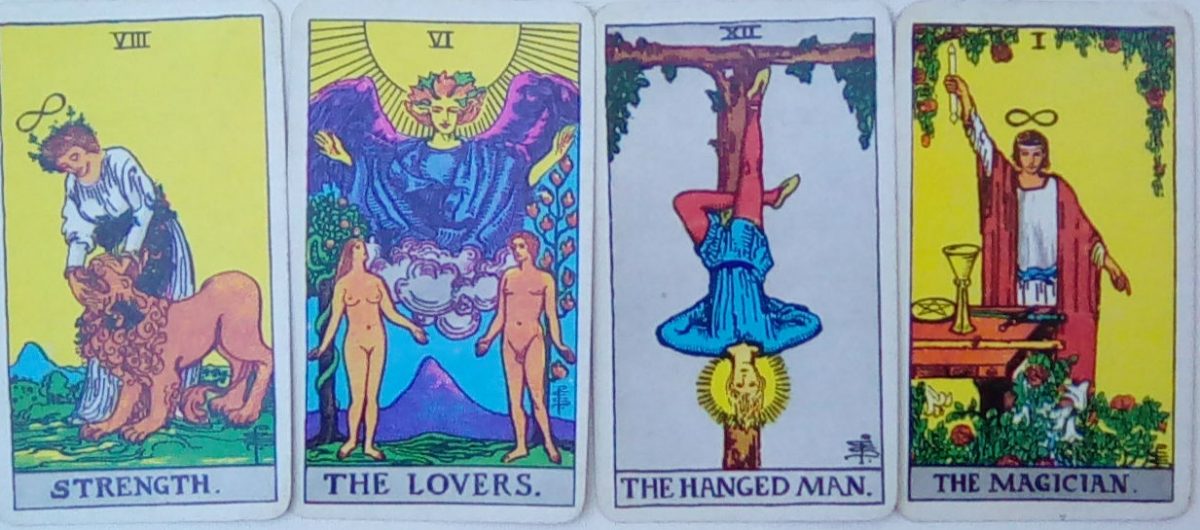
 The Waite tarot deck portrays it as a pretty little scene from the Garden of Eden:  a nude man and woman are posed in the foreground while an angel with flaming wings floats protectively overhead.  Their love is pristine and pure and heavenly. Don’t look at the snake climbing up the tree.

I said, DON’T LOOK.  They’re in love. No snakes, goddamnit.

Well, okay.  Probably we can get a better picture from an earlier Tarot deck.

In the Swiss deck, we see a couple who are actually touching each other.  An old hag of a witch has obviously just whomped them with a love spell and – just in case that’s not enough – an angel is about to shoot a Love Arrow right THROUGH that girls head.  

They’re thunderbolted and flabbergasted, glimmered and glamored.  They’re in Love, L-U-V!

And it’s wonderful and it’s fabulous and it’s the best thing in the world.  But . . . what IS it, exactly? What is it that makes our brains pump out floods of endorphins, walk around with silly grins on our faces, and talk about our partners to a point where our friends want to strangle us?

A reductionist would tell you that it’s just chemicals in the body.  Hormones. Random encounters in the process of looking for a mate that somehow become permanent relationships.  Ultimately it’s all driven by the need to fuck and reproduce and then we . . . sort of . . . get fond of each other after we’ve had our orgasms and THAT, by golly, is love.

Ram Dass spoke of it quite differently.  He said that sometimes another person is the key that unlocks us and we’re the key that unlocks them and we exist in love.  That the other person is the vehicle for us to get to love.  And, when the other person dies or leaves, it feels like all of the juice, all of the magic, all of the love has gone out of our lives.

Think about that:  the vehicle that gets us to love.

One of the more interesting meditation exercises we can do is to just sit with the feeling of love.  Open our heart chakras and let ourselves relax into love. It may be that when we start that kind of meditation we need something to refer to in order to start the flow of love.  Perhaps we think of a person we love deeply or a place that brings us great peace or even a dog or a cat or a horse. The thought of the beloved starts the flow of loving energy. The beloved is the vehicle that takes us to love.

As we continue to practice that meditation, though, the need for an outside reference, for a thought, memory, or person to take us to that place of love lessens.  Our heart chakras become stronger and clearer and more open and we find that we can enter into loving feelings spontaneously.

We can just exist in, just float in, a sea of love.  And it feels SO good. At that point we’ve gone from needing something outside of us to, “cause,” love to just being love.

Here’s another way to look at it:  the Buddhists teach us that clinging and desire bring suffering.  We feel miserable and we tell ourselves, “If I just had that ___________ (fill in the blank with new car, new computer, iphone, house, dress, shoes, degree, etc.) then I’d be really happy.”  

And so we torture ourselves with what we don’t have, that thing that will finally make us happy, and the more we lust after it, the more miserable it’s absence makes us feel.  Maybe we get two jobs so we can afford it. Maybe we eat rice and beans for a year so we can scrimp and save and FINALLY we can buy the thing that will make us happy.

And it does!  For a while. But it’s a total sugar rush and after a very short period of time we don’t feel so happy anymore.

And then we start thinking about the NEXT one thing that will finally make us happy and we feel miserable because we don’t have it.

That’s really the basis of capitalist society and advertising:  convincing us that there is some THING outside of us that’s going to make us happy.  And, by golly, when that happiness wears off, we’ve got some other neat stuff to sell you that will make you REALLY happy.  For a while.

Or . . . we can just short circuit all of that process and say, “I’m happy.”  We really can. Like the love meditation, we can start out just thinking about things or places or people that make us happy.  We don’t have to buy them or worry about losing them because they’re our thoughts.

The trees make me happy, the clouds make me happy, my lover makes me happy, my vibrator makes me happy, a stream, or a river, or a lake, or the ocean . . . those thoughts make me happy.  And, as we continue that process, we can eventually move straight into BEING happy, without having to possess anything external to us to MAKE us happy. 

Walmart hates that, but it’s one of the most important lessons we can learn.  Happiness exists independent of things.

And it’s the same dynamic with love.  When our lover leaves us or dies we feel crushed because it feels like we’ve lost all of the magic of love.  But love exists independent of people. We’ve lost the vehicle that brought us to love, but we haven’t lost the love.  It’s always right there waiting for our hearts to open and return to it’s embrace.

And there’s no snake climbing up a tree.  Just love, L-U-V!

The Fool – Alone but not Lonely

In the first (or the last, depending on your perspective) card of the Major Arcana we see The Fool starting off on his Spiritual Quest, a dog barking at his feet, his eyes turned toward the heavens.

And he’s very much alone.  But maybe not lonely.

What starts us on a Spiritual Quest?  It’s certainly not because things are going swimmingly.  Sometimes it just a chronic, nagging feeling that something in our lives is just not quite right.  Sometimes it’s a sudden flash of insight that’s like the first rolling stone that starts an avalanche.

Frequently it’s some life event that knocks us ass over teakettle and forces us to look at the fact that our assumptions and beliefs have been wrong all along.  That what we took for granted isn’t worth a bag of spit. The death of a loved one. The suicide of a coworker. Surviving a crash or a deadly disease.

Even then, many people will embrace what might be called “a pseudo-quest,” or perhaps, “an aborted quest.”    Shocked and shaken right down to their toes by some near catastrophe they respond by pulling the covers over their heads and crawling into the safe, warm womb of organized religions.  Like the men kneeling in front of the pope in The Hierophant card they look to others for spiritual truth rather than seeking it in their own hearts.

The person on a true Spiritual Quest is there because he or she HAS to be.  The choices of pretense, dull lassitude, and being a comfortable member of the herd no longer exist for them.  They have a burning desire to know – or at least seek – the truth and that desire can’t be ignored.

And, yes,  that can feel lonely at times.

For one thing most people aren’t really very interested in looking at the verities of Spiritual life.  The next time that you’re at a family gathering just casually mention that everyone in the room is going to die sooner or later if you don’t believe me.  You may not be invited back and, if you are, I guarantee no one will want to sit next to you at Thanksgiving Dinner. People actually seek out toys, money, meaningless sex, and anything else they can think of to AVOID talking about death and they don’t appreciate it when someone puts the subject right up in their faces.

A second factor, though, is that your Spiritual truths are YOUR Spiritual truths and not necessarily anyone else’s.  As you tread your way down the path of The Fool you will discover certain things that you know in your heart are true but the people around you, even your loved ones, may think that you’re out of your mind.  Or very much a Fool.

I remember when I first realized that visualization actually causes the things we visualize to manifest in our lives.  And I don’t mean just reading about it or acknowledging it as an abstract idea. I mean actually sitting my butt down, doing the visualizations and having them actually manifest.

I was blown away.  “This,” I thought, “is magic.  Real, honest to goddess, freaking magic!”

And that realization was followed by a whole series of other realizations.  If my thoughts and emotions can cause things to manifest in my life, then my life is . . . a manifestation of my thoughts and emotions.

Which means that I made this mess.  Not my parents, not my environment, not my culture, not random circumstances.  This thing I call my life is . . . ME. My thoughts. My emotions.

Which means that I’m responsible for it.  It’s my karma that I made. BUT . . . it also means I can change it.  And, man, that’s not just magic . . . that’s freedom!

It was a major turning in The Fool’s Path and I was tremendously excited about it.  The people I tried to share it with . . . not so much. My New Agey friends sort of yawned and said things like, “Oh, yeah, I think I read something like that a long time ago in Ram Dass.  Or was it, ‘A Course in Miracles?’ Maybe it was, ‘Codependent No More . . .”

My more conventional friends either edged slowly away or their mouths hung open for a moment before they changed the subject.

I realized eventually that it was MY Spiritual truth.  It was a result of my Tarot readings and my studies and my meditations and it fit perfectly at that exact moment in MY life.  The fact that other people didn’t understand it or know it or really, really dig it in their own hearts didn’t matter. What mattered was that I had found one of my truths.

And there’s a Spiritual truth in that realization, too.  Just because you’re alone in your beliefs doesn’t mean you have to feel lonely.  In all likelihood the people around you don’t share or understand your truths because they haven’t done the work that you have or they just don’t care.  That doesn’t diminish what you know by one little bit. Every truth that you find along the path is a jewel to be treasured and uncovers a little bit more of who you really are.

Donald Trump, The Empress, and The Emperor

A juxtaposition of male and female energy patterns as exemplified in the Emperor and Empress Tarot cards.

I have to admit that I’m always a little puzzled when I run across one of those news columns discussing, “Donald Trump’s Toxic Brand of Masculinity.”  To me, a guy who gets daily manicures, has his dyed hair styled every morning, and bakes under a sun lamp until he turns orange isn’t masculine ANYTHING, toxic or otherwise.

But maybe I’m just being defensive on behalf of all of the sane men in the world.

Today IS the International Day of the Woman, though, so perhaps it’s a good time to talk about all of this.

The Emperor and The Empress, sharing the same exalted positions and residing side by side in the Tarot deck, are often – in fact usually – held up as examples of male and female energy in the world.  But let’s a take a step back from that. Let’s just consider them as examples of energy in the world. Different ways of being.

Ram Dass has a rap in Grist for the Mill: Awakening to Oneness that says you can consider people on a number of different levels.  You can look at their skins and see black and white and brown. Or you can look at their signs of the zodiac and see Aries and Scorpios and Capricorns.  Or you can approach it like a psychologist and see obsessive compulsives and narcissists and dependent personalities.

Or you can take it right down to the bedrock and see Souls.  Fellow travelers on this very strange journey through this beautiful world who just happen to be incarnate as a Taurus or a Leo in black or brown or pink skin and seem to have developed a little problem with OCD.

Or to put that another way, we are all multiple patterns of energy existing in the Earth Plane.

And two of those patterns of energy are male and female.

There are, obviously, very valid and real differences between the two patterns.  The human body responds quite differently to testosterone and estrogen. Males tend to have more muscle mass and extra cones in their eyes.  Women tend to have more fat cells and to visualize more in patterns than lines.

We can take those differences and we can celebrate them as we do when we recognize both the God and the Goddess.  The problems start to arise when we view those differences as being absolute and we turn them into stereotypes. “Real,” men are always muscular and silently strong.  “Real,” women are always soft and fluttery and vulnerable.

I’ve known women who were so physically powerful that they could have bounced me down the driveway like a basketball.  And I’ve known men who were nervous nellies residing in very frail bodies. You can take any stereotype of masculinity or femininity and find examples of it in both men and women.

Likewise, we know that we all have both testosterone and estrogen in our bodies.  We all have both, “male,” and, “female,” hemispheres in our brains. Some men retain massive amounts of fluids when the moon is full.  Some women are natural born weight lifters.

So masculinity and femininity are much more of a continuum than a dichotomy.  It’s a lot more gray than it is black and white.

From that perspective it’s much easier to drop the idea of looking at The Emperor and The Empress as masculine and feminine energy and just look at them as ways that energy can exist on the Earth Plane.


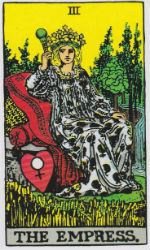
The Empress is relaxed.  Comfortable. At ease in her world.  She reclines on a velvet throne, legs slightly spread, wearing an unfettered, flowing robe and she is crowned with stars.  She holds a sceptre – her symbol of power – but she holds it loosely, almost as if she’s forgotten she has it. A lovely waterfall flows out of a verdant forest behind her and wheat – the symbol of nourishment – grows in front of her.  And . . . is that a box of chocolate leaning up against her throne?

The Empress is very, very powerful.  She is the power of life and fertility but it’s a gentle, unassuming power.  Most of all, she BELONGS in her world and she blesses it and it blesses her.

And now look at The Emperor.


Kind of a nasty faced old man who looks like he’s suffering from a severe case of hemorrhoids.  He sits on a hard, stone throne (ouch) and tightly grasps a vaguely Egyptian looking sceptre. His garments are tight, as well, and reveal that he is fully armored beneath them.  Mountains rise behind him, barren of any vegetation, and far, far below him a river flows at the base of the cliffs.

The Emperor is also very powerful, but he’s very different from the energy of The Empress.  It’s tempting to view him as the alpha-dog but he’s so obviously, painfully alone that you know he doesn’t even have a pack to run with.  The Empress exists IN her world, as a part of her world. The Emperor has, “conquered,” his world, destroying anyone and anything that got in his way.  He’s at the top of the heap but his heap is a pile of ashes.

Sadly, there are still many people in the world (and, yes, they’re mostly men) who choose to adopt the energy patterns of The Emperor rather than The Empress.  And we all pay a price for their choice.

/Disclaimer: “As an Amazon Associate I earn from qualifying purchases.”