The Wheel of Fortune and Flowing with these Strange Rhythms

This post explores the deeper meaning of The Wheel of Fortune Tarot card and its connection to the Kybalion’s Principle of Rhythm. Life’s ups and downs are not random but part of a greater pattern that ultimately arcs toward the positive. Discover how to maintain perspective, rise above collective fear, and navigate dark times with love, compassion, and inner strength.

Let’s face it: we’re all a little exhausted from the constant insanity in the world right now. Whether you’re right, left, or middle-of-the-bird, it can feel like we’re adrift in a sea of chaos. When it goes on long enough, we start to lose our perspective and wonder if things will ever be “normal” again.

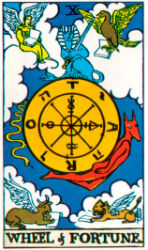
The message of The Wheel of Fortune is that everything passes and everything changes. The people who are at the top of the wheel right now will eventually be cast down, and the people who are at the bottom will eventually be elevated again.

Life is always cyclical — and this, too, shall pass.

The Principle of Rhythm

As I discussed in my book about The Kybalion, Western Occultism calls this The Principle of Rhythm. Here in Earth School, everything is rhythmic, and we only have to open our eyes to see it.

The tides come in and then go out.

The Moon waxes and then wanes.

Life explodes into the richness of spring and then recedes into the cold bleakness of winter.

Even great nations expand and then ultimately diminish into shadows of what they once were.

Everything rises and falls — and then rises again.

The same principle applies to human beings and all our affairs. We may have a string of incredibly good luck and then a period where we can’t buy a break. We may feel joyously happy for a while and then deeply depressed and anxious before we find our way back to happiness. We may fall deeply in love with someone and then end up despising them.

The Pendulum

The Kybalion envisions this process as the pendulum of a clock. It swings to the left, and then it swings to the right. And as the Principle of Rhythm states: “The swing to the left is always equal to the swing to the right.”

Modern science recognizes this in Newton’s Third Law of Motion: “Every action has an equal and opposite reaction.”

When we think about human life, we can see it in terms of alternating energies. We may go through incredibly negative periods — full of stress, sadness, and anxiety — only to be followed by times of great happiness, when everything seems to go our way.

We may have moments where we’re counting quarters to buy groceries, followed by periods of real abundance when the cash flows in like a river.

The collective energy of politics follows the same law – a hard swing to the right is inevitably followed by a hard swing to the left. Hatred is eventually replaced by compassion.

But It’s Not a Closed System

If that was all there was to the rhythms of life, it would be a pretty depressing scenario. It would feel like: “Okay, things are going well right now, but I can’t really enjoy it because it’s all going to turn to shit again.”

If life were nothing but good/bad/good/bad — ad infinitum — it would be the spiritual equivalent of one step forward and one step back. We’d be living, but not progressing. Stuck in an endless cycle of growth and degeneration. A closed system where nothing ever really improves.

The good news is that, as The Kybalion puts it, “nature favors the positive.” Positive energy will always overcome negative energy. Love will always be stronger than hate. Compassion will always conquer cruelty.

Put another way: yes, as long as we’re in Earth School, the pendulum will appear to move equally in both directions. The truth, though, is that it’s always arcing just a little more toward the positive — whether we can see it or not.

So What Should We Do Right Now?

We are, right now, in dark times. As Asha Nayaswami says in this wonderful video, there is demonstrable evil in the world, and some humans are acting out their darkest impulses.

So how do we deal with that? What should we do right now?

The advice of The Kybalion is to “rise above it.” We can’t control the Principle of Rhythm or the turns of the Wheel of Fortune. Those are built into the fabric of Earth School. We don’t have to be swung by the pendulum, though. We can rise above it spiritually.

What we can control is our reaction to it. We can make a conscious effort not to be swept along in the collective energies of hatred, fear, and anger. We can maintain our own little bubbles of love and compassion and keep putting out as much positive energy as we can.

As Nayaswami says, that doesn’t mean we become spiritual doormats. It doesn’t mean we avoid confronting evil when we encounter it. It means we confront it with truth, with as much gentleness and understanding as we can muster, and that we refuse to join it in any way, shape, or form.

Perspective

Above all, it means maintaining perspective. Keep your eyes on the horizon, not just on the dirt road full of potholes. Remember that the pendulum will swing back in the opposite direction.

When it does, life will not only be positive again — it will be more positive. People will learn from these experiences, and they’ll use that knowledge to build a better world.

We just have to be patient… and wait for the wheel to turn.

“Just the Tarot,” by Dan Adair – a kindle ebook available on Amazon.

Beyond Isolation: How Introverts Can Truly Recharge

A look at creating healing solitude.

If introverts had a battle flag, it would probably have The Hermit card printed on it.  We absolutely love to withdraw into our own cozy little shells and let the world turn without us participating in it.

So, we’ve finally canceled our plans, turned off our phone, and settled into solitude. But after hours of scrolling or zoning out, we still feel drained. What gives?

THE MYTH OF THE INTROVERT RECHARGE

Introverts often mistake social withdrawal for true recharging but miss the neurological component (acetylcholine release) that actually restores their energy.  Just sitting at home is not going to refresh or restore us, although that’s where we need to begin the process.

DOPAMINE VERSUS ACETYLCHOLINE

There are, of course, about a kazillion different chemicals and hormones doing a tango in our busy brains at any given time.  For purposes of this discussion, though, let’s focus in on just two of them, the neurotransmitters called dopamine and acetylcholine.  And let’s just call them, “happy juices,” because they make different people happy in different ways.

Our brains discharge dopamine when we’re exposed to a lot of social stimuli like loud music, parties, crowded shopping malls and lots of other people.  Extroverts actually have many more, “receptors,” for dopamine in their brains than introverts do, so they can soak up an ocean of it and it makes them really happy campers. They feel jazzed, excited, and alive.

Since introverts can’t absorb a lot of dopamine, it basically kicks our asses.  For us, it’s like drinking six cups of really strong Espresso – it makes us jittery, nervous, and quickly worn out.  It’s introvert poison.

Acetylcholine, on the other hand, gives our brains a mellow, quiet buzz.  It’s less like ecstatic dancing at a concert and more like snuggling into a warm bed with nice clean sheets.  It’s quiet and peaceful.  Introverts love it and it drives extroverts crazy with boredom.  It’s our happy juice.

THE ISOLATION TRAP

Now,  since too much dopamine makes us feel like crap, it’s perfectly natural to think that just getting away from situations that cause dopamine will make us feel ever so much better.  After all, if too much, “peopling,” is wearing us out, then non-peopling should recharge us.

So, we fill the moat around our introvert castles with alligators, pull up the drawbridges, and put up a big sign that says, “GO AWAY!”  Free at last!

Unfortunately, by that point, we’re frequently so worn out that we just sit there staring out the window, doom-scrolling on our computers for hours, or binge-watching NetFlix.  Those are what therapists call low-nourishment activities because they don’t do anything to feed our emotions or bodies.  And, specifically with introverts, they don’t feed us any acetylcholine to make our brains happy.

PLANNING FOR A BRAIN BOOST

A good question for introverts to ask when we’re planning for our recharge time is, “Will this activity leave me feeling nourished or merely distracted?” We know that there are specific, fairly low energy activities that refresh and recreate us by increasing acetylcholine production.

Reading and Deep Learning: Encourages relaxed but engaged attention.

Mindfulness Meditation or Breathwork: Activates the parasympathetic nervous system, reducing cortisol and boosting calm focus.

Creative Flow States: Writing, drawing, or music allow for contemplative immersion.

Nature Walks or Gentle Movement: Combines physical and sensory stimulation with mental quiet.

MINDFUL INTENTIONS

Another way of putting that is that we need to be intentional with our solitude.  We need to design an Acetylcholine-Rich Hermit Phase.  We can learn to structure our alone time for maximum benefit.

Conscious solitude planning: Schedule blocks for purposeful recharging activities instead of just avoiding people.

Minimize mindless distraction: Replace passive screen time with meaningful, immersive solo activities.

Create mini rituals: Tea-making, journaling, or slow stretching to ease into relaxation.

And, hell, if we’re not quite ready to jump into being Zen Master Introverts, we can combine some of those activities.  Maybe do some Tai Chi while we’re bing-watching Netflix.

REDEFINING OUR SOLITUDE

We’re all different, of course, and introverts tend to be really different.  For me, painting, writing, or meditating brings on that acetylcholine recharge.  For you, it may be gentle dance motions, working in your garden or reading a good book. For others it might be sitting in the sunshine sipping a cup of tea.

The point is that we all know what makes us feel good.  For an introvert it’s like a lover gently kissing the back of your neck or touching your cheek with her finger tips.  It’s sweet, it’s calm, it’s gentle, and it makes us feel better almost instantly.  Those are the activities that we want to build into our solitude.

Yes, we need to get away from other people on a regular basis, but simply being alone isn’t the answer.  Living in intentional, mindful, loving solitude is what makes us whole again.

Lucid Choices, The Four of Swords, and Living the Dream Life

Looking at our lives as lucid dreams.

Have you ever had a dream that seemed so real, so vivid and intense, that you were actually shocked when you woke up and realized it was just an illusion?

Sometimes they’re really GOOD dreams.  Perhaps we’re making incredible love with someone or maybe we’re floating through a starry, magical sky. Sometimes they’re really BAD dreams, where we’re being chased by monsters or night terrors.  Whether they’re good or bad, the one thing they have in common is that – at the moment that we’re having them – they seem absolutely, 100% real.

LIVING THE DREAM

There’s a strong case to be made for the idea that our so-called, “waking life,” is very much like a dream, as well.

In, “The Four Agreements,” that’s the term that Don Miguel Ruiz actually uses to describe our day to day existence:  a dream.  As we grow up, we’re programmed by our parents, our religions, and our societies to see the world in particular ways.  We don’t question those view points as they’re being installed in our little brains because we don’t have the ability to judge whether they’re true at that age.  By the time that we reach adulthood, we’re thoroughly convinced that the way that we see the world is the RIGHT way to see it, perhaps the ONLY way.  But those view points are just someone else’s dreams of how the world really is.

Buddhist and Hindu philosophies approach human life in much the same way:  life as we commonly experience it is an illusion, a dream that’s made up of our emotions, ideas, desires, and aversions.  We’re essentially sleep walkers who go through life laughing, crying, eating, procreating, raising families, working, and eventually dying, with no clue as to why we’re here or what it all means.  We just know that, like our dreams, it seems absolutely 100% real. 

WAKING UP

Occasionally, some of us will wake up just a little bit from the dream that we call our lives.  Usually it’s because our pleasant dreams have turned into a nightmare.  

One of our major dreams is, “I’m going to live happily ever after and nothing bad is going to happen to me.”  We’re taught that if we’re, “good,” people and we work hard and we’re responsible, everything is supposed to work out for us.  We’re going to fall madly in love with just the right person, have 2.5 beautiful children who will be extremely well adjusted, get a nice house, a new car, and all of the material toys. And we’ll live happily ever after.  Shit happens to, “bad,” people, not to us.

And then shit happens to us.

Perhaps we find our wife or husband in bed with someone else.  Perhaps we’re in a terrible auto accident.  Perhaps one of our beautiful children gets very, very sick.  Perhaps we get fired from our jobs and lose all of our material possessions.

It’s very much like suddenly waking up.  All of the things that seemed so rock solid and dependable in our lives turn out to be built on sand.  We may feel like life has betrayed us or the whole world has gone crazy.  Eventually, though, most of will go back to our dream worlds because the dream is so comfortable and waking up hurts.

LUCID DREAMING

There’s something that happens in some dreams where we’re dreaming but we suddenly become aware of the fact that it’s a dream.  We don’t wake up from the dream, but we exist within it, knowing that it’s a dream.  It’s called lucid dreaming and, if you’re not familiar with it you might enjoy reading, “Lucid Dreaming,” by Charlie Morley.

Now, one of the things that happens in lucid dreaming is that, to a large extent, we’re able to control the dream.  If we see a wall in front of us, we can consciously decide to simply grow wings and fly over it.  Or perhaps we can visualize a really beautiful woman or man and make love to them to our heart’s content.  

It’s a dream.  We know it’s a dream. But we can choose what happens in the dream.

LUCID LIVING

In his book, “Change of Heart,” Chagdud Tulku said that very few of us will ever be enlightened.  Most of us will continue to live in a dream state, perhaps for many incarnations.  BUT . . . we can choose whether we want to have a good dream or a bad dream.

Which sounds very much like lucid dreaming, doesn’t it?

When we have one of those life experiences where our day to day dream has turned into a nightmare, when we suddenly get a peek behind the curtain of what we thought was true, we have a choice.

Most people roll over and go right back to sleep, just as quickly as they can.

Some people decide to adopt a stance of total cynicism.  Life sucks.  People are rotten.  It’s all a lie.  These are the, “life is a bitch and then you die,” people.

But a few people will say, “Huh . . . it’s all just a dream.  But it’s an interesting dream.  I wonder if I can grow wings and fly over that wall?”

IT’S NOT ENLIGHTENMENT

One of the things that it’s important to remember is that just because we realize that life may be a dream, it doesn’t mean that we’re suddenly, “enlightened.”  Like the person in the 4 of Swords, we’re still solidly asleep, but now we know that we’re asleep.  Which is an improvement.

Unfortunately, as a brief stroll through the internet will teach us, there are many, many people out there who have decided that they must be gurus, spiritual adepts and geniuses just because they woke up a little bit.  Seeing through the illusions doesn’t mean that we’ve got an answer – it just means that we see the problem.

It’s a paradox, like lucid dreaming, where we’re asleep and awake at the same time.  If we keep meditating and keep working on our personal growth, we’ll wake up a little more and a little more and a little more.

In the meantime, we can choose to have good dreams.  We can have dreams that are full of love and healing and our dreams will make other people’s dreams a little better, too.

As Bob Dylan once said, “I’ll let you be in my dream if you’ll let me be in yours.”

Remember that my ebook, “Just the Tarot,” is available dirt cheap on Amazon. It’s not just a dream. Really. I think.

Thought-Forms, Astral Pornography, and The Ace of Wands

Are our thoughts actually energy forms?

A few years ago I was reading a fascinating book called, “You Are Not Your Brain,” and the authors made a statement that was positively shocking to me:  “To this day, scientists and psychologists cannot agree on exactly what a thought is.”

At first blush, that sounds completely ridiculous because we all know what thoughts are.  They’re . . . um . . . they’re like . . . these little things that jump up in our heads and live in our brains, right?  

There . . . I solved that one.  You’re welcome.

Seriously, though, there really isn’t a good working definition of what a thought actually is.  There’s a sort of reductionist explanation of how our nervous systems and brains produce thoughts.  We can hook someone up to a brain monitor and see which parts of their brains light up with activity when they’re thinking about a particular subject.  Perhaps their fear center – the amygdala – lights up because they’re thinking of something really scary.  Or their prefrontal cortex – the thinking brain – lights up because they’re doing some heavy problem solving.  

That doesn’t really do anything but describe the process of making the idea, though.  It doesn’t tell us what the finished product is.  That theory – that the brain makes ideas – exists cheek by jowl with the stimulus/response model where something in our environment makes us think certain things.  Perhaps we see a picture of Donald Trump and we think, “Ohhh, scary clown,” which makes us think of circuses which makes us think of Stephen King horror novels about murderous clowns which makes us think about our overdue library book.

That concept seems to be counter-intuitive when we think about . . . well . . . intuition.  When we have  intuitions or  flashes of insight, it feels as if they’ve popped right up in our brains without anything else making them happen.  When someone asked Einstein how he invented the theory of relativity he said, “Oh, it just dropped in while I was playing the piano.”

For centuries, human beings viewed some types of ideas in just that way:  as something that came into our minds from an outside source.  That’s why the word, “inspire,” means to have something breathed into you.  The notion was that something out there – perhaps the Universe or the Gods or the fairies – inserted the idea into your mind.

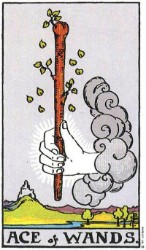
That’s what’s portrayed in the Tarot card, The Ace of Wands.  Wands represent ideas and this is an idea or thought coming into the world in its purest form of mental energy.  It’s, “divinely inspired.”

That STILL doesn’t tell us exactly what an idea IS, though.  It’s just talking about it’s source, rather than it’s contents.

Now, the Theosophists and Victorian occultists had very specific ideas of exactly what an idea is.  They viewed ideas as thought-forms, which is to say, individual little packets of energy produced by our brains and emotions and auric fields.  And – important point – they felt that they were independent of the human being once they were produced.

We’ve all seen those cartoons where there’s a person having a thought that appears as a bubble with text in it, hovering over the character’s head.  That’s a convenient way to visualize what the Theosophists were talking about.  Every time that we have a thought, it’s like our bio-field – our brains, emotional energies, energy bodies – are extruding a little, tiny thought-form bubbles that exists outside of us.

Most of the bubbles don’t last very long because they don’t contain much energy.  Let’s face it, many of us are NOT thinking about the theory of relativity while we play the piano.  Instead, we’re having really profound thoughts like, “Where’d I put my car keys?  Need a cup of coffee.  Gotta walk the dog.  Did I do the laundry?”   So these are little bubbles that appear for a moment, pop, and disappear.

When the thought forms are really heavily charged with energy, though, they stick around.  How do they get charged?  Well, through emotions and through repetition.

Suppose you just went to bed with someone and you had a super-duper, unbelievable, I-think-my-ears-just-fell-off orgasm at the exact moment that you thought, “I love you.”  That, “I love you,” thought is super-charged with energy and it will last.  Ditto, if you’ve been badly shocked or frightened by something.  The more intense the emotion, the more of an energetic charge the thought-form has and the longer it will exist.

We can also charge the thought-forms with energy by thinking of them over and over and over.  On a positive note, we can see that happen when someone thinks of their lover constantly, as we tend to do in the early stages of falling in love.  The obsessive thinking keeps adding energy to that same, “I love you,” thought-form and makes it’s last.  On a negative note, we can see the same pattern with chronic anxiety and depression.  Constantly thinking of things that frighten us or make us sad just increases the charge in the thought-forms and so the depression will linger long after the original cause.

Two of the early Theosophists, Annie Besant and Charles Leadbeater, published a book called, “Thought Forms.” It had illustrations of the forms as they emerged from people’s auras, as seen by psychic mediums.  Here’s one of a peaceful thought:

And here’s one of an angry thought.

I would have liked to have seen one of a horny thought – sort of astral pornography, I guess – but the Victorians didn’t roll that way.

So is all of this true?  Maybe.  It certainly forms the basis for much of what we call visualization and manifestation, as well as the concepts of either cursing or blessing someone.  I’ll be writing more about that in the immediate future but for the time being it’s a fun concept to play with.  What if our thoughts are actual things that exist in our personal energy space and exert an influence on us and those around us?  How can we change the negative thought-forms and increase the positive-forms?  Can we pick up someone else’s thought-forms, much like a virus?

Before you dismiss the idea out of hand, remember what we started off with here: the most preeminent psychologists and scientists in the world have absolutely no idea what a thought is.  The theory of thought-forms is just as good – and maybe better – than most of their theories.

Remember that my e-book, “Just the Tarot,” is still available – dirt cheap! – on Amazon. In fact, I’m sending thought-forms at you right now. You should buy this book . . . you should buy this book . . . you should buy this book . . .

The Fool, Flowing into Fun, and Making Wu Wei Our Woo Hoo

A look at Flow State as a spiritual practice.

Most people know about being, “in the Flow,” also known as being, “in the Zone.”  It’s that feeling of engaging in an activity with such concentration and perfection that it’s as if we somehow become the activity and the activity becomes us.

Dancers and athletes talk about being in the Flow when they turn in a performance that’s absolutely flawless and they somehow go far beyond what they’ve ever been able to do before.  Artists and writers have the same sort of an experience when they plunge so deeply into their work that it’s almost as if the painting is painting itself, or the page is filling itself with beautiful images.

One of the fascinating things about Flow state is that the world seems to disappear for a while.  There’s nothing in our consciousness except the activity that we’re engaging in.  It’s like a trance. Painters will frequently start a painting and then, “wake up,” six hours later, having lost all track of time, their environment, and anything else but the surface of the canvas.

Oddly, we see very much the same phenomenon with people who are plagued by ADHD.  They may spend most of their lives jumping from one activity to another, unable to focus or stay on task for more than a few minutes.  When we take those same people, though, and sit them down in front of a video game, it’s a very different story.  They go into a state of hyper-focus and will frequently become so immersed in the game, so ultra-concentrated, that they may not leave it for hours.  They’re in a trance and the world has disappeared.  They’re in the Flow.

Hungarian psychologist Mihal Csikszentmihalyi first noted the Flow state in 1975, but Taoism pegged it centuries ago and calls it, “Wu Wei.”  Wu Wei can be translated as, “inaction,” or, “doing nothing,”  but a closer definition is, “effortless action.” Which is exactly how we feel when we’re in the Flow.  We feel that we’re completely in synch, in the groove, in harmony with whatever activity we’re engaged in and it becomes totally effortless.

Now, a lot of Westerners have had trouble with the idea of Wu Wei, because they glom onto the idea of just doing nothing, rather than doing something effortlessly. As lovely as it can be, sitting on a beach dangling our toes in the water is NOT Wu Wei.  

We are in the Flow state when we are involved in an activity for which we have some skill.  When we’re doing something completely. Somehow in that process our ego disappears, our environment disappears, and our sense of time disappears, which is pretty much the definition of a transcendent spiritual experience.

To put it another way, we’re co-creating with the Universe.

Mike Dooley hints at that process when he’s talking about the art of visualizing and manifestation.  He says that the Universe acts as a sort of a GPS system that guides us to our goals, constantly popping up directions and resources to get us where we want to go.  BUT . . . we have to actually start the car before the GPS system starts to work.  We have to get our asses in gear and move before the Flow state happens.

The closest that the Tarot gets to portraying that state is The Fool.  The Fool is dancing along at the edge of a cliff, so absorbed in his joy that he really doesn’t even see the precipice.  The message of the card is that even if he dances off of the edge he’ll just go on dancing on air.  He’s in the Flow.

The neat thing about all of this is that, when we look at being in the Flow AS an act of co-creating with the Universe, then it becomes a spiritual practice.  It becomes a way of communing with our higher powers or spirit guides or angels or whatever we want to call them.

All we have to do is to figure out what gets us into that state of Flow and DO IT.  It can be almost anything.  It can be painting or writing or dancing or gardening or cooking or having incredible, mind-blowing sex.  It’s just a matter of thinking about what activities come the closest to putting us into that trance state.  What is it that, when we do it, the world disappears for a while, time stops, and we completely forget our egos?

Once we identify the activity – and we all have at least one – then we build it into our lives more and more.  Every time that we engage in our particular Flow activity, we form a stronger and stronger bond with our higher powers and our higher selves.

And it’s fun.  It’s lots and lots of fun.

The Ten of Wands, Energy Healing, and Over-Thinking Enchiladas

Using energy healing to overcome overthinking.

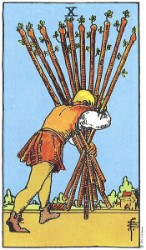
I find myself understanding the poor dude in the 10 of Wands more and more as time goes by.

In the Tarot, the four suits of cards represent different realms of the human experience.  Swords = personal power.  Cups = emotions. Pentacles = material possessions.  And wands = ideas.

So we see this guy in the 10 of Wands who has SO MANY ideas that he can barely stagger along under the weight of them.  His head is pressed firmly into the bundle of wands and he can’t even see what’s going on around him.  He’s just trudging toward a distant destination, hoping he’s going in the right direction and trying to put one foot in front of the other.  His ideas own him, not the other way around.

I was watching an interview with Eileen McKusick, author of, “Electric Body, Electric Health,” and she flat out said, “Overthinking is a cultural brain virus.  Overthinking never, ever solves anything.”  Naturally, my reaction was, “I’ll need to overthink that statement.”

She’s right, though.  What we refer to as, “thinking,” usually means shuffling around a lot of different concepts, trying to make them fit some sort of a coherent pattern.  It’s like a Rubik’s Cube that we keep flipping and flipping and flipping, hoping that all of the squares will line up. 

But conceptualizing is just one part of a much larger process and when we get stuck in that one part, it doesn’t work.  We can never, ever solve anything by just thinking at it.

Somewhere along the line in human evolution -probably about the time we began to develop alphabets and writing – we started to pull out of our bodies and into our heads.  Which is to say that we started to think of our heads, our brains and thoughts, as being somehow separate from our bodies.  Philosopher Gilbert Ryle referred to that as, “the ghost in the machine.”

That name is so apt because most of us suffer from this incredible, mass hallucination that there’s some separate, non-material, “self,” much like a ghost, that sort of rides around in our bodies, as if they were machines that we’re driving.  The ghost, of course, lives in our heads and we peer out at the world through our eyes, just as if they were windshields.

We call the ghost in our heads our, “selves,” or our, “personalities,” or even our, “souls.”  So there’s a ghost that’s our REAL self and then there’s the body, which we’re sort of temporarily driving around in.  That scene is very much like our real self landed at the Earth Airport and went straight to the Hertz Rent a Body so that we’d have a cool ride to tool around in.  “Hey, I’ll take something with fins and a lot of chrome.  Bucket seats.”

We even see that dualism in New Age philosophy, right?  How often have we heard that expression, “You’re not a body that has a Soul;  you’re a Soul that has a body?”  Which is a nice shift toward the spiritual, but it still maintains that strange hallucination that our bodies are somehow NOT our real selves. 

Which is exactly what McKusick was getting at:  we’re not just our brains and we’re not just our bodies – we’re our body/brains/nervous systems/emotions/thoughts/memories, Soul – the whole enchilada.

Or perhaps I should say, “the Soul Enchilada.”

She’s an energy worker who uses the energy of sound to heal us.  Like most energy workers, she heals from the outside in, which is contrary to some New Age thinking.  The basic New Age formula for life runs like this:

Our beliefs create our thoughts.

Our thoughts create our emotions.

Our emotions create our vibrations.

Our vibrations create what we draw into our lives.

New Agers have tended to jump in at the level of thought and say, “Well, if we change our thoughts, we change our emotions, which changes our vibrations, which changes our lives.”  Also known as the power of positive thinking and it’s true.

Energy healers like McKusick, though, are flipping the script on that.  They’re saying, “If we change our vibrations, we change our emotions, which changes our thoughts.”  She’s taking the same holistic approach – we’re all one great big electromagnetic vibration and if you change one thing, you change all of it – but she’s working from the vibration inward to the thoughts.

Her idea is that sound is a form of energy and so are we.  When we listen to certain sound frequencies that are coherent, solid frequencies, it reorganizes the energy in our bioelectric field into a solid, coherent vibration.  As our vibrations become more coherent, so do our emotions and our thoughts.

Does it work?  I don’t know, yet.  I’m spending a significant part of my day banging away on my Tibetan meditation bowl and grooving on the rising and falling of the sounds.  It does seem to be very soothing and it does take me out of my head and into my body.

And now that I’ve over-thought it, I like it.  I really do.

Please remember that my amazing e-book, Just the Tarot, is still available on Amazon for MUCH less than an order of enchiladas. Hell, it’s less than a side of refried beans. What an incredible bargain!

The Four of Pentacles, New Age Capitalists, and Buddha in an F-150 Pickup Truck

A look at the New Age fascination with money.

“I wanted to be able to help people financially.  If you have enough money, you can buy health.  A rich man can always find a woman.  If you have enough money, you can buy almost anything.” – Jerry Hicks

There is a very peculiar – and very strong – connection between the New Age/New Thought movement and good old American capitalism.

The Four of Pentacles shows a guy with his feet on money, holding money, and money on his mind, and that’s a LOT of the New Age movement and its leaders.

Mike Dooley, who is best known for his credo, “Thoughts become things,” was an international tax specialist for Price Waterhouse and his primary client was Saudi Freaking Arabia.

Prior to channeling Abraham, Esther Hicks was a business accountant and Jerry Hicks was THE leading Amway salesman in the United States.

Stuart Wilde made a fortune selling Mod clothing on Carnaby Street before he took up Taoism and made another fortune selling books about how spiritual it is to make a fortune.

Even the much beloved Ram Dass was born into a very wealthy family, never experienced a day of poverty or want, franchised his spirituality very successfully and died on his massive estate in Hawaii.

I have to admit that I was somewhat puzzled by the extreme emphasis on money and material possessions when I first stumbled into the New Age movement.  I started my spiritual journey as a young kid in a midwestern state, taking LARGE amounts of LSD, reading Tarot cards, and convinced that it really was the Dawning of the Age of Aquarius.

Racism, war and poverty would be eliminated.  We’d all live in peace and harmony and people would really and truly realize that love is all that matters.  Those were my dreams when I was a young man.

Duh.  I know.  It didn’t exactly turn out that way, did it?  Still, there was a nobility and a grandeur to the dreams that I think all young people should have. 

And so, when Mike Dooley talked about his dreams as a young man, I was a bit mystified.  “I wanted to make a million bucks, own my own private plane and travel internationally with a beautiful woman by my side.”

Or Stuart Wilde’s statement that, “Money doesn’t imply that rich people are spiritual but it does infer that poor people probably are not.”

Or the (I’m sure inadvertent but telling) juxtaposition in Jerry Hicks statement, “A rich man can always find a woman.  If you have enough money, you can buy almost anything.”

Esther and Jerry Hicks probably took the wedding of capitalism to spirituality further than anyone else.  Their basic position is that our desire for material goods – for the goodies in life – is what drives us into greater and greater spiritual growth.  In their view, we have a sort of an internal wish list that’s composed of things like boats, cars, money, houses. As we tell the Universe what we want, the Universe provides all of those things on the wish list.

BUT . . . as we fulfill one wish list, another list spontaneously arises and we want even more, which the Universe provides and then we want even more, and so on. 

Oddly, that very process is exactly what the Buddha described as the source of all suffering.  It’s the constant desire for more and more and more, without the realization that more is never enough to make us happy. One wish list will always be replaced by another.

What I eventually realized is that these people – despite being rampant, unapologetic capitalists – ARE spreading a lot of spirituality through the world, no matter how paradoxical that might sound. 

Here’s the thing:  American capitalism is the dominant force in the world right now.  And the lingua franca of capitalism is M-O-N-E-Y.  

Who are the people who are going to all of the seminars and retreats of the New Age gurus and buying all of the millions of books they produce every year?  They sure as hell aren’t Buddhist monks or old hippies.  

They’re business people.  Amway salesmen.  Used car dealers.  Advertising guys.  Executive secretaries and career women.  Their dreams aren’t about world peace or brotherhood; their dreams are composed of F-150 pick up trucks, big houses, ski boats, and, yes, all the women they can buy with their fabulous wealth.

The ironic thing about it is that as they’re attending the Let’s-All-Get-Rich rallies, they’re also getting a HUGE dose of spirituality.  What’s really behind the idea of visualization and manifestation is that the physical world is not at ALL what it looks like.  We really CAN manifest whatever we want, seemingly out of nothing.  Magic really DOES exist.  There IS huge abundance in the world and we can tap into it with the power of attraction.

These are exactly the same people who love to mock California woo-woos and think that psychics and sensitives are crack pots.  But there they are, hunkered down in their split level homes in Nebraska, Utah, and Kentucky, pasting together vision boards and writing out affirmations.

LOL – which is doing magic.  Plain and simple.  If you’re trying to make something appear out of nothing using the power of your mind, you’re casting a magic spell.  Surprise!

It’s all very bizarre and puzzling, but it’s an improvement.  It’s a definite improvement.

EMPATHS, EARTHING, AND MEDITATING CODEPENDENTS

Staying grounded as an empath.

So I just received my Amazing Hooga Earthing Mat from the very nice UPS driver and I should be incredibly spiritual after just a few days of using it.  

The basic theory behind them is that our energy systems get in a kerfuffle because we’re exposed to negative people, places, and things and, when we walk barefoot on the Earth, it restores our systems to their natural, harmonious balance.  Earthing Mats simulate that very same energy and get our auras all fluffy and pretty again.

I decided to get one because I’ve recently become aware of the fact that it is of tantamount importance for empaths to stay thoroughly grounded.  If we don’t, we start to dissolve like a piece of salt in the rain.  Earthing is a dandy way to avoid that.

EMPATHS AND EMPATHY

Being an empath is sort of hard to describe to a, “normal,” person.  First of all, of course, being an empath is not equivalent to being empathetic, although most empaths are highly empathetic.  An empathetic person might sympathize with another individual to a point where they can imagine what the other person is feeling and thinking.  Empaths actually experience what the other person is feeling in real time.

Empaths are also not psychics, although most psychics are empaths.  A psychic will focus on another person, “read,” their energy, their emotions and their thoughts, and then weave all of that into a coherent meaning, much like telling a story.  Empaths, on the other hand, are simply bombarded with information about the other person without really knowing what it all means.  We automatically glean far more details about the other person’s energetic and emotional state than what’s on the surface, but we don’t necessarily know how to put it all together.

To make it even more confusing, there isn’t just one type of empath.  There are empaths who actually hear what other people are thinking.  Other empaths feel other people’s emotions as they occur.  Some are telemetric empaths who, “get a reading,” merely by touching a piece of clothing or jewelry that someone else has owned.  A few empaths are highly attuned to the feelings of animals, but won’t pick up anything from other human beings.  Precognitive empaths may get very strong insights about what’s going to happen to a person in the future.

EMPATHS AND EGO STRUCTURE

One thing that all empaths have in common is a relatively weak ego structure.  It makes perfect sense, when we think about it.  Our ego is our sense of who we are, and the first part of knowing who we are is knowing that you’re over there and I’m over here.  Your, “you,” starts with your skin and all of your emotions, energy, and thoughts reside inside of your skin and all of mine reside in mine.  The only way that another human could possibly know what we’re thinking is if we tell them.

Which is very much not true for empaths.  For an empath, what’s going on in the other person’s mind is also going on in our minds, simultaneously with what WE’RE thinking.

All of which can make for a very confusing state of affairs, because we’re never quite sure which part of the conversation is ours and which part is yours.  For an un-grounded empath, there really ARE no significant boundaries or borders.  

There’s an old Spanish expression which goes, “Mi casa, su casa,” or, “My house is your house.”  Now change that to, “My brain is your brain,” and you get an idea of how truly weird it can be for an empath to hold a simple conversation.  Most empaths have to sit quietly after a meaningful exchange and decode exactly what thoughts came from which person.

EMPATHS AND CODEPENDENCY

One of the ways that the weak ego structure of empaths shows up is in codependent behavior.  Codependents tend to revolve around other people, much like the moon revolves around the earth.  Sometimes that’s a result of having been raised in an alcoholic or abusive family.  Sometimes it’s because we have a particular personality type.  And sometimes it’s because we’re empaths who haven’t learned to separate ourselves from other people.  

What happens with empaths is that we become enmeshed in the other person’s energy, in their thoughts, emotions, and their life patterns.  Since empaths already have a weakened sense of boundaries, they can easily dissolve into a more dominant person’s energy system.  In essence, they become overwhelmed and end up as bit players in someone else’s movie, instead of starring in their own.  They not only feel the other person’s emotions, they become the other person’s emotions.

EMPATHS AND MEDITATION

Empaths also need to be very careful about the type of meditation they practice.  

Many types of meditation are geared toward weakening the ego structure.  We’re basically trying to get past that chattering mind stream that prevents us from truly relaxing into deep meditation.  Those techniques involve what’s referred to as a, “bare awareness,” method, where we might focus on our breath or a mantra, or a candle flame, until the chattering mind calms down and recedes into the background.

BUT . . . studies have increasingly shown that meditation is highly correlated with PSI or psychic abilities.  If we tritty trot off to a meditation center for a two week retreat, we’re probably going to be more psychic coming out of it than we were going in.  For a normal person, that involves a significant decrease in ego control and, “becoming one,” with the universe and our fellow humans.

An empath, though, is already wide open and our challenge lies in shutting down some of that in-flow of information.  Deep meditation can destroy whatever barriers we’ve managed to erect and leave us completely adrift in other people’s energies.

Mindfulness meditation seems to be the, “go to,” method for empaths.  It’s a constant reminder to stay in our own bodies in the present moment and to separate from all of the drama out there.

THE EIGHT OF WANDS

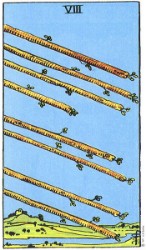
Being an empath can feel very much like the Eight of Wands looks.  Wands represent ideas and this card shows inspired ideas raining down from heaven.  For an empath, though, the ideas may be far from inspired and not at all our own.  

If everyone we met was in a perfect, loving place, being an empath could be pure heaven.  We’d just walk around grinning while all of those good vibes poured straight into us. Unfortunately, that’s far from the current state of affairs and a tremendous amount of what we absorb is toxic.

The answers for empaths seem to be strengthening ego structure, not weakening it.  Building boundaries and borders, not letting them down.  And, above all, staying grounded.  Which we can begin to do by planting our tootsies firmly on the Amazing Hooga Earthing Mat.

Christmas Candy, the Meaning of Giving, and Tibetan Meditation Centers

Making our lives into gifts.

Here in the United States we’re just finishing up the annual emotional and commercial orgy of Christmas, also known as, “the season of giving.”  It started me thinking about the nature of giving and, oddly, a Tibetan meditation center I toured over 20 years ago.

Our guide was a woman who lived there with the improbable name of, “Candy.”  I’m guessing that trying to explain the intricacies of Buddhist philosophy to a group of tourists in Bermuda shorts was not the highlight of her day, but she was pleasant, kind, and patient.  One of the concepts that she put in a nutshell for us was the idea of accumulating merit.

“We get up in the morning with the idea of helping other sentient beings and, if we do that, it earns us karmic merit.  And then, instead of clinging to that merit for ourselves, we dedicate it to the good of other sentient beings.  Which accumulates more merit, which we dedicate to the good of other sentient beings.”

I glanced around at the people I was with and their faces were frozen in expressions that pretty much conveyed, “I don’t know what in the fuck you’re talking about, but you seem relatively harmless.”  To me, though, it was a major revelation.  In just those few sentences, I understood the concept of giving with absolutely no expectations of getting anything back.  It’s been something I’ve gone back to again and again over the last two decades.  A lasting treasure.

Now, here’s the thing:  I feel absolutely sure that Candy had no idea that she was making a major impact in another person’s life and thoughts.  We spent maybe 30 minutes with her and I’ve never seen her again, but I still remember that moment like it happened yesterday.  It was a gift, and the gift was her just living her life and telling her truth.

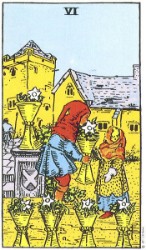
We tend to think of giving as being something that’s transactional and we can see that idea illustrated in the Six of Cups.  The little boy is giving a gift of love (symbolized by the Cup) to the little girl.  Implicit in that image is the next step in the transaction, where the little girl is going to say, “Oh, hey!  What a nice cup!  Thanks so much for thinking of me.”

And then we feel good because we’ve made someone we care about feel good and we feel good about ourselves because, after all, we were thoughtful enough to give something nice to someone we care about.  When we put all of the commercialism and forced jolliness aside, that’s part of the sweetness of Christmas – it’s a chance to give something to others and tell them we love them.

Most of us feel pretty disconnected with that in our general, everyday lives, though.  We may get up in the morning with the intentions of being, “good,” people.  We’re loving with our life partners, we don’t snap at the cashier in the grocery store, we smile at our co-workers and try to work hard at our jobs.  As near as I can tell, right around 90% of us are good people, in the sense that we make some effort to not be shit heads and to be decent to our fellow humans.

Still, a lot of us are afflicted with a sense of meaninglessness.  We feel like we’re slow walking through life in a sort of a daze and we’re not really making any difference.  It’s like we’re born, we eat a lot of t.v. dinners, and then we die and we wonder if anything we’ve done actually matters.

That’s where synchronicity and a leap of faith comes in.  That’s where giving with no sense of attachment to the results comes in.

Each one of us is absolutely unique.  There’s never been anyone exactly like us before and there will never be anyone exactly like us again.  To the extent that we celebrate that uniqueness and share our own individual truths in our lives, we become a walking, talking, breathing gift to the world.

But we almost HAVE to detach that gift from results.  If we make our giving transactional – which is to say, someone saying, “Thank you for being you,”  – we’re setting ourselves up for a lot of disappointment.  The fact of the matter is that most people don’t even see us, in any sort of a meaningful way.  Like us, they’re hustling and bustling through life, trying to pay their bills, hoping they’ve got some clean socks, trying to figure out what in the hell they can cook for their kids that isn’t a t.v. dinner.

And if they do notice us, the odds are that they’re seeing us through so many perceptual filters that they don’t see who we really are.  As the old Indian adage goes, “When a pickpocket looks at a saint, all he sees is pockets.”  

So, we have to make a little leap of faith that we ARE being seen without knowing that we are.  And that we ARE making a difference in other people’s lives and in the world, without any proof that it’s so.  Sometimes it may be like Candy at the meditation center, where words we speak become seeds that grow in other people’s lives.  Sometimes it may be as simple as smiling at a person we pass on the street, never knowing that they were depressed and suicidal until they saw our smile.

We can see that in another card, the Ace of Cups.  The cup represents love flowing into the world, but, unlike the Six of Cups, it’s not attached to anything.  It’s not something we have to earn.  It’s not dependent on being thanked or being noticed or appreciated.  It’s just there in the world and it makes life better by its very presence.

When we finally get it that we’re giving to the world around us and making a difference just by being us to the fullest extent that we can, then we shift into having meaning in our lives because we ARE making a difference.  We may not see it.  Perhaps no one will ever tell us.  Maybe it will take twenty years for that good to ripen in someone else’s life, but we DO matter.  Every single day.

My e-book, “Just the Tarot,” is still available on Amazon for less than the price of a meaningless t.v. dinner and it’s twice as nutritious!

The Hierophant, The Sky Thingie, and Noshing at the Spiritual Buffet.

An exploration of religion versus spirituality as illustrated by buffet lines.

The Tarot card The Hierophant shows us a Pope-like figure seated on a throne, with acolytes bowing down to him.  In a general sense, The Hierophant represents all that is traditional, conformist, and conventional.  In a more specific sense, he represents dogmatic religion, as opposed to spirituality.

The basic idea here is that if you want to learn about religion and what it teaches, you go to a priest, a pastor, a rabbi, or an imam.  If you want to learn about spirituality, you meditate or you take psychedelics or get involved with a tradition such as shamanism or ecstatic dance.  Religion involves learning about other people’s interactions with the divine.  Spirituality is about having your own interaction with the divine.

I started thinking about all of this the other day when I read this passage from David Michies sweet little book, “Buddhism for Busy People:”

“One of the refreshing things about Buddhism, however, is its insistence that you should only take up those practices which benefit you.  If certain aspects aren’t helpful, simply put them to one side.  You can always come back to them later.  You won’t go to hell because you don’t believe in karma.  Nor will believing in it guarantee you a place in heaven – like everything else in Buddhism, it is what you DO that counts, not what you say you believe.”

I was contrasting that in my own mind to a Catholic priest I saw on a news show recently inveighing on the subject of Catholics who supported a woman’s right to have an abortion.  “We don’t agree with, ‘super-market Catholicism,’ “ he said.  “You’re not allowed to push your cart down the aisle and pick out this part of the Catholic faith but reject other parts.  You have to accept the entire doctrine or you’re not really a practicing Catholic.”

The differences in the two approaches couldn’t be any clearer.  Buddhism is basically saying, “Hey, here’s what we think the truth is but you need to pick out what works for you.”  Traditional religions are saying, “Here’s what the truth is and you need to agree with it, even if it seems like nonsense to you.”  The Buddha actually encouraged his followers to debate him on concepts  they disagreed with and cast aside whatever they thought was wrong.  On the other hand, it’s Catholic doctrine that whatever the Pope says about faith is infallibly true.  Always.  From god’s mouth to his ear.  Period.

The difference in those approaches probably lies in ancient human history when our cultures had shamans rather than priests and pastors.  Our ancestors undoubtedly found the world to be a scary place that was full of mysterious and sometimes life threatening occurrences.  We can easily imagine a cave woman leaning against a tree enjoying a rainstorm when -KABLAM!!!!!!!! – a bolt of lightning blows the tree into splinters and flings her twenty feet through the air.

Her first response would probably be something along the lines of, “Holy shit, what was THAT?!?”

As she clambered to her feet, though, and brushed the mud and splinters from her loin cloth she’d have a brilliant insight:  something must have CAUSED the lightning thingie that blew up  the tree.  And since the lightning thingie came out of the sky, whatever caused it must live . . . up there . . . in the sky.  

She’d probably spend many nights around the cave fire discussing this with the other tribe members, comparing notes, and arguing about the exact nature of the . . . Sky Thingie . . . that threw the . . . lightning thingie . . . at the tree.  What was it like?  Was it like a human being?  Why would it do such a thing?  Did it hate trees?  Perhaps it had been aiming the lightning at the woman and missed her and hit the tree?  Did it have poor eyesight, then?  What was it so pissed off about, anyway?  Was it a male or a female thingie?  And if it was a male thingie, did it have . . . you know . . . a thingie?

So there would have been many complex disputations arising out of the tree being hit by the lightning.  At a certain point, a cave person would step out of the shadows and say, “Hey, I had a dream about the Sky Thingie that threw the lightning thingie.  He says that if you’ll sacrifice a goat and not eat shellfish he won’t do it again.”

“Oh, really?” someone might reply.  “So the Sky Thingie is definitely a male?”

“Well, yes.  And he has a beard and wears sandals and sits on a golden rock.”

“So, you can talk to him, then?  Did he say why he’s throwing lightning thingies at us?”

“He did it because you didn’t sacrifice a goat and you ate clams.  Those are the rules.  He told me.”

Thus was born the shaman:  a special class of human beings who had knowledge of and were able to intervene with supernatural forces.  He or she would no doubt have been seen as just as important – or more so – than the tribal hunters, fishers, or gatherers.  After all, she had a special relationship with the Sky Thingie and could protect the tribe from supernatural temper fits and, um, sky anomalies. 

The tribe would have soon realized two things:  (a) like all humans the shaman was mortal and would die at some point; (b) therefore, he needed to train other shamans to take his place and keep a record of the Sky Thingie’s rules.

Thus were born priests and religions.

As the centuries passed and the priest/shamans had more and more visions and wrote down more and more rules from the Sky Thingies, the rules got more and more complex and began to include things like:

  • Don’t eat bacon.
  • Don’t trip blind people.
  • Don’t have sex with sheep.
  • Don’t work on Saturday.
  • It’s okay to have slaves, but only for seven years.
  • The Sky Thingie loves you and if you don’t believe that we’ll kill you.
  • Always capitalize the Sky Thingie’s name.  If you don’t, we’ll kill you.
  • Never draw a picture of the Sky Thingie or we’ll kill you.
  • Women are property and they should cover their heads and faces.  Or we’ll kill you.

You can tell from the last few rules that things started to take a nasty turn somewhere along the way and that the priests and religions were getting more powerful in society.  Not only had they established themselves as the only people who could interpret what the Sky Thingie wanted, they could also kill anyone who even tried to talk to the Sky Thingie on their own.

That’s really the point that we’re at with many of today’s formal religions.  They consist of centuries of barnacle-like accretions of irrational rules that can only be interpreted by the priests and pastors and rabbis.  Intelligent self inquiry is NOT encouraged.

Which is why the Buddhist approach is so refreshing.  

Formal religions have rules like, “Don’t eat bacon because the Sky Thingie says not to.”   Buddhist discussions are more like:

“Don’t eat bacon.”  

“Why not?  I really like BLT’s.”

“Do you want to be happy and avoid pain?”

“Well, yes.”

“Do you think pigs want to be happy and avoid pain?”

“Um . . . well . . . yes.  I suppose they do.”

“Do you think it’s painful to be raised in a tiny pen and killed when you’re young?”

“Well . . . yes.”

“Would you be happy if someone cut you up, fried you in a teflon pan and slapped you on a piece of bread with some tomatoes and lettuce?”

“Well, no.”

“Then don’t eat bacon.”

And, of course, even then, you’re free to eat bacon sandwiches if you want to.  No one will kill you and you won’t go to hell.  You might reincarnate as a pig, but, hey, fair’s fair, right?

As long as we’re on the subject of food, think of it this way:  religion is like being invited to a huge Thanksgiving dinner.  There are platters full of turkey and mashed potatoes and baked yams and apple pies and cornbread dressing and green bean casseroles with those strange fried onion things on top.  

Maybe you really hate baked yams or green beans and you just want a little turkey and dressing with mashed potatoes and gravy.  But, no, there’s a huge scary guy with a baseball bat at the head of the table and he says that you have to eat EVERYTHING!!!  Especially the green beans and yams.  Or he’ll kill you.  And then you’ll go to hell.  Gulp.

Spirituality, on the other hand, is more like a buffet line.  You walk along, looking at the varieties of food and you only pick out the food that appeals to YOU.  You don’t force down every single thing on the line just to prove that you’re faithful.  If you feel like a shrimp salad instead of Swedish meatballs, that’s what you get.  

“Meditation?  Yes, I think I’ll take a bit of that. Hmmm . . . Wicca . . . does that fit on my plate right now?  Maybe as a side dish?  Oh, look . . . it’s affirmations and positive thinking.  Man, I haven’t had those in FOREVER.  Yum. . .”

There are no priests or pastors standing at your shoulder telling you that you REALLY want the roast beef instead of the tacos.  YOU choose what’s nourishing for you at that moment and take a pass on what doesn’t feed your soul.  And it’s an all you can eat buffet.  You’re always free to go back for second helpings.

But maybe skip the bacon sandwich.  Just consider it.