Solstice Thoughts: For Empaths Standing at the Edge of a New Year

Reflections on the past year and strategies for empathic coping with the year to come.

Sunday is the Solstice — the darkest day of the year — before our beautiful Earth begins its long, slow climb back into the light. In many ancient traditions, this moment marked the true New Year: not a calendar flip, but a turning point.

Light returns.

And this year, that matters.

A Difficult Year for Sensitive Souls

2025 has been a particularly rough year for many of us. It’s not surprising if you’re ending it feeling exhausted, raw, or strangely unsteady.

We’ve been inundated with horrific images. Norms we once relied on for stability have been violated again and again. The overall effect has been a pervasive sense of unsafety — not just politically or socially, but emotionally.

And while it feels endless, it helps to remember this:

in the span of a lifetime, five years is a very short time.

It’s only been five years since a global pandemic placed our very existence in question. Many of us were still recovering from a prolonged fight-or-flight response when the world was thrown into further chaos. What once felt “crazy” somehow got even crazier.

That constant state of activation takes a toll.

Why This Has Been Especially Hard on Empaths

If you’re an empath, this year may have felt truly overwhelming.

Empaths naturally absorb the emotional atmosphere around them. Other people’s suffering draws us in. Compassion isn’t optional — it’s automatic.

And that means one of our greatest challenges is keeping the outside, outside.

This year has been a near-constant boundary violation.

There has been a deliberate strategy — politically and culturally — to keep people off balance, upset, and reactive. A lack of empathy and compassion at a societal level doesn’t just distress empaths; it can destabilize us.

When the collective feels unhinged, empaths feel it in their nervous systems.

A Choice at the Turning Point

At this Solstice, we face a choice.

We can tell ourselves:

“The world has gone mad, and I need to hide.”

Or we can reframe this moment as:

“This is a difficult — but perfect — environment for learning new skills.”

Skills that help us survive and stay open.

The Core Skill Empaths Need Right Now

To navigate what’s coming, empaths must learn to distinguish:

What energy is mine — and what does not belong to me.

Right now, there is a lot of chaotic energy in the air. That means we need to perform regular internal “fact checks.”

Ask yourself:

• Am I actually in danger right now?

• Am I personally unstable — or do I just feel unstable?

And yes — it’s okay if you are occasionally a little crazy. We all are.

But if you’re not objectively falling apart and yet you feel like you are, that’s a strong sign the energy is coming from outside you.

Once you recognize that, the next question becomes:

How do I respond — without absorbing it?

Practical Strategies for the Year Ahead

Here are a few grounded ways empaths can protect their nervous systems:

Unplug intentionally.

Turn off the news. Step back from social media. Don’t answer every text like Pavlov’s dog. Your attention is precious.

Curate what you consume.

If you spend five minutes wading through the sewage of daily news, balance it with ten minutes of something hopeful — music, art, a book, a walk, a moment of beauty.

Name the manipulation.

Much of what we’re experiencing is designed to keep people in fight-or-flight. This isn’t accidental. Recognizing that helps break its spell.

When fear and outrage are being deliberately amplified, our most radical response is calm, mindfulness, and conscious detachment.

That doesn’t mean indifference.

It means sovereignty.

Walking Toward the Light

The Solstice reminds us that even at the darkest point, the turn has already begun. The light doesn’t return all at once — it comes back slowly, almost imperceptibly, day by day.

As we move into the new year, especially those of us who feel deeply, the work isn’t to harden or shut down. It’s to strengthen boundaries, choose what we engage with, and care for our nervous systems with intention.

That, too, is a form of courage.

May the coming year bring more steadiness, more discernment, and moments of real peace — both within us and, slowly, in the world we share.

Blessed Be.

The Top Ten Tarot Cards That Indicate Healing

Discover the top ten Tarot cards that symbolize healing, recovery, and renewal. From The Star to The Hermit, explore how the cards reveal your path toward balance, peace, and wholeness.

When you’re working with the Tarot, certain cards appear as gentle messengers of recovery, renewal, and wholeness. Whether it’s physical, emotional, or spiritual healing, these ten cards remind us that balance and well-being are always within reach.

1. The Star

The ultimate card of healing and hope. It promises renewal after hardship and invites you to open your heart to divine light and self-trust.

2. Temperance

Balance, integration, and moderation — the alchemy of opposites. Healing flows when extremes are softened and peace returns.

3. The Sun

The warmth of vitality and joy. The Sun restores the life force, illuminating health, positivity, and the return of childlike energy.

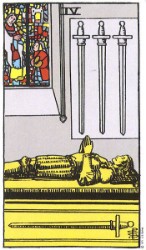
4. The Four of Swords

The body and mind’s call for rest. Recovery through stillness, meditation, and withdrawal from stress.

5. The Six of Swords

Moving away from turbulence toward calm waters. Healing through distance, clarity, and emotional peace.

6. The Ace of Cups

Renewal of the heart. Healing through love, forgiveness, and self-compassion; a cleansing flow of feeling.

7. The Queen of Pentacles

Earthy nurturing energy. Healing through care, nourishment, and connection to the body and natural rhythms.

8. The Three of Cups

Healing through friendship and community. Emotional recovery by rejoining the circle of support and joy.

9. The Ten of Pentacles

Long-term stability and health. Healing in the sense of “wholeness” — when life feels safe, abundant, and grounded again.

10. The Hermit

Healing through introspection and solitude. Finding the inner light that guides you back to your own wisdom.

 Using the Cards for Healing

When these cards appear in a spread, ask yourself: What part of me is ready to recover?

Healing doesn’t always mean fixing something broken — sometimes it means remembering you were whole all along.

“Just the Tarot,” by Dan Adair – a complete set of definitions for all of the cards, including layouts and instructions, available on Amazon.

How to Shine Your Star and NOT Be a Good Codependent

Do you ever feel invisible, like you’ve disappeared into someone else’s needs? The Star reversed shows how codependency drains us — and how to take back your light.

Of all of the forms of codependency, perhaps the most insidious is the, “good,” kind.  The kind where we’re actually making ourselves less, because it’s the right thing to do.  

Or so we think.  

Our personal light, our Spirit becomes dimmed because we’re trying to make someone else’s shine a little brighter.  If it goes on for too long, we can even forget who we really are.

WHAT CODEPENDENCY REALLY MEANS

When we hear the word, “codependency,” most of us think of the classic scenario involving an alcoholic/addict and the person taking care of him.  In that sort of a relationship, the alcoholic may have the money, but he’s too screwed up to really take care of himself.  The codependent takes care of him – sees that the bills are paid on time, buys the groceries, cleans the house, defends him from criticism, but doesn’t have any personal funds.  

The result, of course, is that neither party is able to survive on their own.  They are mutually dependent on the other for survival and they may hate each other but they also need each other.

At its root, though, codependency is any relationship where we chronically subordinate our own needs and desires to someone else’s.  

That can actually take the form of a noble pursuit.  In a very real sense, good parents subordinate their own needs and desires to rearing their children until the children can fly on their own.  We can also see it in home healthcare situations, where one partner in the relationship is literally too ill to care for herself and the other partner becomes a full-time caretaker.

These are the, “good,” forms of codependency where we’re basically just doing what’s right and what’s loving.  But they can still destroy us over the long haul.

MAKING OURSELVES SMALLER

One of the hallmarks of codependency is shrinking ourselves while inflating someone else.

In the home healthcare situation that I just mentioned, the partner who is healthy may be devoting her entire life to taking care of the partner who is ill, yet insisting that, “it’s no big deal.”  She may sacrifice her social life, her hobbies, her time for herself to an endless round of cooking, cleaning, medications, and taking her partner to medical appointments.  She may have completely given up her own life in order to preserve his.

Because the other person’s light is so dimmed, we do everything we can to make it shine a little brighter.  We praise them, we prop them up, we take care of their every need and we never, ever, let them feel that they are, “less than,” because of their illness.

Over time, this creates an energy imbalance that leaves us feeling like invisible ghosts, like we never had the chance to live as our fullest, most authentic selves because we’ve disappeared into someone else’s needs.

The real tragedy of codependency isn’t just exhaustion – it’s the slow erosion of Self.

THE STAR REVERSED

In the Tarot, the exemplar of codependency is The Star reversed.  When it’s upright, The Star is a beacon of hope, inspiration, and healing.  It’s someone who is fully shining his light into the world.

When it’s reversed, it can point directly to codependent patterns such as:

• Outsourcing your self-worth to another person.

• Over-giving and self-sacrifice until your own cup is bone dry.

• Healing others while neglecting your own healing.

• Depending on someone’s approval to feel hopeful.

• Pretending everything’s fine just to keep the relationship intact.

The Star reversed doesn’t mean you’ve lost your light, though. It means you’ve been dimming it.

THE ANTIDOTE IS RECLAIMING YOUR OWN LIGHT

The medicine for The Star reversed is to consciously reclaim your own radiance:

• Affirm your intrinsic value through affirmations, creative expression, and celebrating small achievements.  That can be as easy as taking a few moments to journal every morning and write about what YOUR dreams are.

• Set boundaries and practice saying “no” without guilt. That can be as simple as saying, “No, I don’t watch that television show,” or, “I’d rather listen to MY music.”

• Shift your focus from “I’ll fix them” to “I’ll care for myself first.” You DO have a right to savor your morning coffee before you make their breakfast.

• Anchor hope internally by nurturing personal goals, spiritual practices, or creative outlets.  Do you love to paint or write or garden?  Insist on taking some time for that every week.  No excuses and no interruptions.  Even if it’s only an hour, that’s your sacred space.

• Practice radical honesty — with yourself and others.  If you hate what you’re doing, you’ve got a right to express that.  If you think you deserve some extra praise and kindness instead of being taken for granted, you’ve got a right to that, too.

• Cultivate interdependence, where two whole people choose connection rather than two halves clinging to each other.  Especially if there’s an imbalance in money, remind your partner frequently of all of the things that you do and how much he’d have to pay to have someone other than you do them.  

Each of these steps helps you pour back into your own cup — and when you shine, you inspire others to shine too.

THE PARADOX OF HEALING

The paradox of this type of codependency is that we usually take it on precisely because we ARE good, loving, kind people. If we see someone who needs help, we help them.  If our child is troubled, we’re there for them 200%.  If our partners are ill, of COURSE we’re going to move heaven and earth to take care of them.

But as it goes on . . . and on . . . and on . . . that good, loving person who is our core being begins to erode.  It isn’t that we become bad people or quit caring – it’s that we simply begin to disappear.  We become nothing but appendages to the needs of the people that we’re caring for.

The lesson of The Star is to let our light shine again.  That core of ourselves that we’re losing through the codependency is what was healing the other person to begin with.  When we lose it, we lose our ability to heal, not just them, but ourselves.

We have to let our lights shine.

“The Star,” a personal affirmation poster available on my etsy site

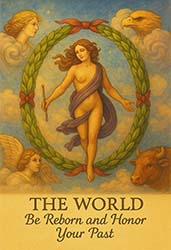
Recovery, Shame, and The World Card

In therapy or recovery but still haunted by your past? This post explores how The World card can help transform shame and regret into growth. By embracing even painful histories, we can find “closure without a bow” — turning painful memories into guides instead of burdens.

Are you in recovery from alcoholism or addiction but still feel really deep shame about your past?

Are you in therapy but just can’t seem to shake off the depression and anxiety that springs from old beliefs and the ghosts of trauma?

Believe me – you’re not alone.  Many of us can stay sober or work our asses off in counseling, but still feel like we’re going through it with a cinder block chained around our necks.  Guilt, shame, and memories of what we were can weigh us down to a point where we’re almost paralyzed.

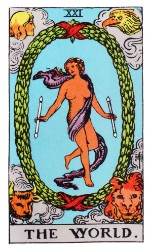
The World card from the Tarot can offer a powerful lens for looking at this struggle and finding a way forward.

A SYMBOL OF COMPLETION

In its traditional meaning, The World card celebrates the completion of one cycle and moving onto the next one.  It’s the, “and they lived happily ever after,” card for, “normal,” people

For instance, a person might leave their job after many successful years and move on to another one that presents new challenges.

Or perhaps a parent has spent 18 years raising a child and when the kid goes off to college, the parent finally has time for her own dreams.

Or maybe a writer has spent 2 years putting a book together, it’s finally been published, and now they’re moving on to a new project.

The common theme there is that all of these people can look back and honestly say, “Well done.”

But what happens when we look back at our past and all we can say is, “Oh, christ, what a freaking mess.”

WHEN SATISFACTION ISN’T POSSIBLE

For many of us, the past doesn’t exactly sparkle with bright and cheery accomplishments.  Instead, it can feel like an extended disaster zone.

Maybe we worked at the same job for years and got fired because of poor performance.

Perhaps we wasted many years in a toxic, codependent relationship.

Or we might have been so drunk or drugged up that we destroyed everything and everyone we touched.

Trying to get into a sustained recovery can seem almost impossible under the weight of regret.  The question is:  How do we process all of this and move on to a new life?

WHAT DOES AA SAY ABOUT IT?

When I was trying to help a relative get into recovery, I sat through literally hundreds of Alcoholics Anonymous meetings with her.

Let me hasten to say, I’m not trying to push an AA agenda or wave a Big Book in your face.  It works for some people, it doesn’t work for others, and it’s not everyone’s cup of tea.

What really struck me in those meetings, though, was that some of their members had figured out a way to do this.  They’d sit there and calmly tell the most horrific stories imaginable about their drinking careers and then talk about how happy they were now.

The phrase that was always repeated was, “We will not regret the past nor wish to shut the door on it.”  There are two powerful statements in that:

1 – Even if we totally screwed up, we can CHOOSE not to regret it.

2 – We don’t slam the door on it or pretend that it never happened.

It’s not about denying the past.  It’s about reclaiming it.

FACING THE PAST WITH COURAGE

Facing what we’d rather forget requires a lot of courage, and we need to give ourselves credit for that struggle.  It can also mean that we can mine a few diamonds out of the sewage and become better human beings.

The heartbreak of being totally broken can teach us greater compassion for those who are still struggling.

The mistakes that we made can teach us humility.  It’s mighty hard to look down on someone else when you’re lying in a gutter.

The chaos that we endured can teach us resilience and we can realize how strong we truly are to have survived it.

True courage isn’t erasing our story but owning it without shame.

LESSONS FROM NOT SHUTTING THE DOOR

When we keep our past in view – without wallowing in it – we transform it into guidance.  Painful memories can evolve into teachers, showing us what to avoid and what truly matters.

Even more, our honesty can become a gift.  By sharing our experiences, we offer others a road map through their own dark terrain.

We can look at a friend, a lover, or a neighbor and honestly say, “Oh, man, I know what you’re going through.”  Because we do.

The World Affirmation Poster available on my etsy site

CLOSURE WITHOUT TAKING A BOW

I guess that there are, “normal,” people who live more or less all of the time in Happy Land.  They move from one wonderful accomplishment to the next and life comes at them with ease and grace.  That’s what The World card is all about.

For the rest of us, closure means accepting the whole mess that we may have made of things and integrating it, rather than forgetting it.  We accept the fact that we’ve had a lot heavier karma to deal with than most people.  

And we remind ourselves that wholeness isn’t about perfection.  It’s about embracing all that we are as human beings – our triumphs, our failures, and the courage it takes to live through them.

Learning to Live Without Joy

Many people feel disconnected, numb, or unable to access joy—especially after childhood trauma. This post explores emotional flatness, toxic positivity, and why realness may matter more than happiness.

Did you get ACED when you were a kid?

ACE stands for Adverse Childhood Experience, and the odds are fairly high that you experienced one. ACEs include things like emotional abuse, neglect, parental mental illness, substance abuse, and divorce or separation of the parents.

We tend to think of those kinds of negative experiences as relatively rare. Maybe we got the hell beaten out of us by a crazed, drunk parent—but most people didn’t, right?

After all, just look at how happy everyone else seems.

But according to the CDC-Kaiser ACEs Study, 61% of adults across 25 states reported experiencing at least one ACE. And nearly 1 in 6 (16.7%) reported four or more.

The truth is, a sizable portion of the population is living with the long-term effects of unresolved trauma—including dissociation, emotional blunting, chronic anxiety, and difficulty accessing joy.

The Cultural Pressure to Be Happy

One of the strongest side effects of long-term trauma is the belief that, “Man, I must really be fucked up, because I’m just not happy. Everyone else is happy, but I’m a train wreck. In fact, I’m not even a train wreck, I’m completely off of the tracks.”

That belief is especially potent if you’re American.

American culture—especially through media and marketing—places enormous value on positivity, confidence, and personal success. Like the figures in the Three of Cups, we’re all supposed to be dancing with joy, smiling through life, bubbling over with gratitude. The message is:

“You should be happy, empowered, and in control of your life at all times.”

And if you’re not?

Then something must be seriously wrong with you.

This pressure to appear happy, even when we’re not, creates:

Emotional dissonance: A split between what we feel and what we think we should feel.

Shame about feeling bad: A second layer of suffering on top of the original pain.

Social masking: We say we’re “fine” or “happy” because it’s expected—and we believe others are genuinely feeling that way (even when they aren’t).

Antidepressants and the Emotional Economy

A recent Gallup poll reported that a whopping 78% of Americans say they feel satisfied or very satisfied with their lives. The poll even bemoaned the fact that the “happiness index” was down by two points.

Meanwhile, the U.S. is among the highest consumers of antidepressants in the world.

Some people take them for serious clinical issues—but many of us take them simply to cope with lives that feel emotionally flat or chronically overwhelming.

Years ago, psychologists discovered that one of the most useless surveys in the world was asking teenage boys if they’d had sex. The overwhelming majority said, “yes, of course I have,” —even though many of them didn’t have the slightest clue how to unfasten a bra, let alone what to do next. They thought they were supposed to be having sex, because they assumed all the other boys were doing it—even though they weren’t.

In much the same way, Americans seem to be lying to pollsters about how happy we are, because we think we’re supposed to be happy.

After all, everyone else is smiling.

Even if they’re not.

We’re taking pills to create artificial happiness because we think we should be happy, even when we’re not.

Living With “Flat” Emotions

What if, instead of constantly trying to fix our feelings, we first learned to live with them?

Assuming there’s no organic brain issue involved, there’s always a reason that we’re not happy.

As Gabor Maté points out, when we suffer trauma that we can neither fight nor flee from, we dissociate. We leave our bodies. We stop feeling.

Not feeling becomes a survival mechanism—a way of coping with pain that would otherwise overwhelm and break us.

If you’re among the 61% who’ve had at least one ACE, you’ve probably experienced dissociation and emotional flatness.

If you’re in the 16% who had four or more ACEs, emotional flatness may be how you live most of the time. It’s not that we don’t want to be happy—we just don’t know how.

And that, in itself, can be traumatic, because we’ve been programmed to believe that we should be happy—even when we can’t feel it.

But we can reframe that.

Rather than chasing a happiness ideal that may not be accessible—especially after trauma—it’s possible to:

• Honor emotional flatness as a survival adaptation.

• Shift the goal from happiness to authenticity.

• Value calmness, neutrality, or quiet presence as valid emotional states.

• Find meaning not in chasing joy, but in living gently and truthfully with what is.

This doesn’t mean giving up on healing, but healing might not look like “feeling great all the time.”

It might look more like “being okay with feeling whatever I feel.”

A New Emotional Ethic: Realness Over Happiness

Ideally, we need a massive cultural shift—from:

“I must feel good in order to be okay”

to:

“I’m okay because I’m allowing myself to feel what’s true for me.”

But… yeah. Don’t hold your breath on that one.

What is possible—what’s powerful—is to make that shift within ourselves.

If you’ve had the hell beaten out of you, either physically or emotionally, as a child or as an adult, it’s okay to feel sad.

It’s okay to feel numb.

It’s not just okay—it’s rational.

That doesn’t mean we want to live there forever.

That doesn’t mean we resign ourselves to an existence without joy. But maybe healing begins when we stop pretending. When we stop performing. When we let ourselves feel—or not feel—exactly where we are.

In this new ethic:

• Sadness is not a problem.

• Numbness is a messenger.

• Joy, when it comes, is a gift—not a requirement.

Back in the 1960s the Transactional Psychology movement came up with the catch phrase:  “I’m Okay, You’re Okay.”

To which Elisabeth Kubler-Ross replied:  “I’m Not Okay, You’re Not Okay.  And That’s Okay.”

The first step in the path seems to be honestly saying, “This is who I am.  This is where I’m at. I hurt when I feel and so I try not to feel. And for right now, that’s okay.”

The Alchemy of the Mind: Transforming Your Life With the Seven Principles of the Kybalion

Empath Ethics 101: Don’t Help?

Why respecting emotional boundaries is essential for empaths—and how not helping can sometimes be the most loving choice.

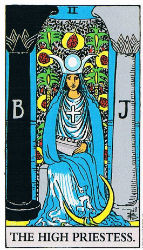
The High Priestess – Intuition

If you’re an empath, you’ve probably been in this situation: you’re having a perfectly normal conversation with someone, but your intuition is screaming that something’s wrong. You sense they’re deeply hurting. Their emotional shields are up, their energy has pulled inward — but underneath it all, you can feel the pain.

The first instinct of an empath is to say, “Hey, what’s wrong? What can I do to help?” Especially if it’s someone we love, we want to reach out and offer comfort.

But sometimes, that’s exactly the wrong thing to do.

It’s Not Intrusive… to Us

The first thing to understand is: we’re not being deliberately intrusive. We channel other people’s emotions as naturally as breathing. When we’re in a one-on-one conversation with someone we care about, we pick up on their energetic patterns — even if they’re trying to hide them. It’s not something we try to do. We just do.

But to someone who isn’t an empath, that does feel intrusive. It can feel like we’re reading their private diary without permission.

Expecting an empath not to process someone else’s energy is like telling someone not to notice faces or colors. It’s simply how we experience the world. But we have to remember: “normal” people don’t operate this way, and many feel invaded or exposed when we reflect their hidden emotions back to them.

Language as a Boundary

For most people, language functions as an energetic boundary. Let’s say we’re sitting with someone and sense something is wrong. The conversation might go like this:

“How are you today?”

“I’m fine, thank you.”

“So everything’s good with you?”

“Yes, it is.”

That’s the moment we need to stop. We’ve given them a verbal cue that we’re open to listening. They’ve responded by clearly saying they don’t want to talk about it.

That doesn’t mean our intuition is wrong. We can trust what we’re sensing. But they’ve drawn a boundary with language — and emotionally healthy people honor boundaries.

Don’t Get Loopy

For empaths — especially intuitive types like INFJs and INFPs — this can trigger a kind of informational loop. Our intuition says something’s wrong, but the person says everything’s fine. It feels disorienting — like being told the sky is green and the grass is blue.

This can easily lead to obsessive thinking. We replay conversations, analyze patterns, try to intuit what they won’t say. When we can’t resolve it, we go over it again and again.

It becomes a loop — rearranging the same puzzle pieces, but still not seeing the picture. It’s a huge drain on time and energy.

The truth is: if they want to tell us what’s wrong, they will. If they don’t, it’s not our business.

Give Them the Gift of Space

Sometimes, the greatest gift we can offer someone we love is space.

Yes, we may know — deeply, clearly — that they’re hurting. And we want to help. But we must also respect the context of our relationship.

If you’re a therapist and they’ve asked for support — of course, help them.

If you’re giving a Tarot or psychic reading and they’re open — of course, help.

But outside those contexts, no matter how close we feel to someone, it’s always up to them to invite us in. If they don’t, we honor that. We don’t push. We don’t intrude.

Yes, It’s Confusing

Yes — this can feel confusing as hell to empaths.

In many ways, we’re always intimate with those we love. We feel their emotions. We know how they’re doing even when they’re not physically present. Sometimes it feels like their pain is our pain.

But we must remember: feeling something doesn’t mean we need to act on it.

If someone we care about is struggling, and they don’t ask for help, we let them be. We can still support them energetically — by holding space, sending love, offering healing from a distance.

But anything more? That’s up to them.

Animal Companions, Heart Chakras, and Learning to Love

Our pets abilities to heal our Souls.

“I’ve known several Zen Masters and they were all cats.” – Eckhart Tolle

The image in The Fool tarot card shows a person dancing with joy at the edge of a cliff.  It’s meant to portray a Soul that’s so fully in the Flow that, even if she were to dance off of the cliff into thin air, she wouldn’t fall.  It’s a beautiful card, but we seldom take much note of the little dog that dances right along with The Fool.

In her book, “Animal Soul Contracts: Sacred Agreements for Shared Evolution”, Tammy Billups addresses the idea that animals come into our lives for specific reasons and they’re often instrumental in helping us to recover and evolve.  As she puts it, we have a Soul Contract with our animals.  We heal them and they heal us.

She tells the story of a man who was living alone when a stray dog suddenly showed up on his doorstep.  He took the dog in and they formed a strong, loving bond. The one problem was that the dog developed terrible separation anxiety and suffered greatly whenever his new owner had to leave the house.

He finally contacted Ms. Billups in the hope that she could work with the dog and help it to feel more secure.  In the course of treating the dog, though, the man had a sudden epiphany:  every relationship he’d ever had ended up with his lover walking away from him.  He had severe abandonment issues of his own and so he’d attracted an abandoned dog.  He started therapy and, as he learned to deal with his own fears of abandonment, the dog healed from its separation anxieties.

She posits that animals – and particularly that class of animals that we refer to as our, “pets,” – have a very deep and ancient Soul connection with human beings.  They not only mirror who we are, as the dog did with the young man, but they also point us toward a better way of existing in the world.

One thing that they provide to us abundantly is pure, unconditional love.  Getting that kind of love as an infant is vital to the development of a healthy, well adjusted human being.  Sadly, though, we have a lot of people in our world who were beaten more than they were hugged as children.  We emerge as adults who are convinced that (a) we can’t be loved; (b) somehow it’s our fault, rather than the fault of our crazy parents; and (c) it’s never safe to reach out to other people for love.

And then a puppy or a kitten shows up in our lives and loves us unconditionally.  The dog or the cat doesn’t give a flip about how smart we are or how we dress or how much money we have or any of the other parameters we may find in human relationships.  They just love us, totally and unconditionally, for who we are.  And, yeah, we learn that lesson on a deep Soul level:  it’s safe to love and to receive love.  They fill that hole in our hearts that’s been there since we were babies.

Another example that Ms. Billups gives is that highly empathetic people (and particularly empaths) will tend to attract highly empathetic animals.  We run into that sometimes with an animal that literally seems to be peering straight into our Souls when it looks at us.  There’s a sort of a tickle in our energy systems and a voice that says, “This dog somehow understands exactly who I am and what I’m feeling.”

The common bond is that both animals and empathetic people are primarily, “feelers,” rather than just thinkers.  We exist on that energy level of emotions and almost instantly perceive the hidden vibrations in another being.  And the, “training,” that we receive from that kind of an animal is to learn to keep our own vibrations as loving and kind as possible because they’re feeling them just as much as we are.

Which brings me to the part of Ms. Billups discussion that really blew me away, which is emotional support animals.

We’ve seen a fairly substantial increase in the presence of emotional support animals as a result of the wars in Iraq and Afghanistan.  Many of the troops were returning home with severe PTSD and social anxiety.  Psychologists found that pairing them with animals – usually dogs – helped to soothe their nervous systems and allowed them to interact more peacefully in social settings.

It makes sense, even on a superficial level.  If we’re feeling extreme anxiety, the presence of a calm, loving animal would obviously settle us down.  Ms. Billups takes that a step further, though.

She says that some animals, especially emotional support animals, are able to hold what she calls a, “transformational healing presence.”  In other words, it isn’t just their presence as a trusted companion that’s calming down the person’s nervous system.  Rather, these are animals that are SO evolved that they’re able radiate calmness, serenity and love out of their very core.

We can actually see that with our own eyes.  The next time that you encounter someone with a support dog in a store, stop and look at the people around you.  Most of them will suddenly slow down, smile, and begin to radiate calmness of their own.  It isn’t just because they think the dog is cute, either.  Rather, they’re walking into that energy field of a healing presence that the dog is holding and it transforms them.

There’s a lesson in there for humans, as well.  It takes work – sometimes a lot of work – but we can become that same sort of a transformational healing presence in the world.  Through therapy, affirmations, meditation, and working with our heart chakras, we can nurture a core energy that’s calm, loving, and compassionate.

We don’t need to develop a philosophy or a method around that.  We don’t need to become gurus or convince anyone that they should behave in this way or that way.  All that we need to do is to build the love in our hearts and radiate it out into the world.

One of the neat things about that is, like the support dog in the store, we can step out of all of that judgment about who’s going to receive the love.  The dog isn’t standing there thinking, “Oh, that one’s a Republican – no love for him.”  Or, “Uh, oh, it’s a liberal, shut down the love.”  It’s there for anyone who wants to receive it, no questions asked.  And if someone doesn’t want to receive it, the dog doesn’t get upset or neurotic about it – she just keeps shining that light.

So I’m going to start paying a lot more attention to the animals in my life and begin actively looking for the messages that they’re bringing me.  Perhaps I’ll put my cat in my lap the next time I meditate and see if she has anything she’d like to add.  I’m guessing she does.

Donald Trump Voodoo Dolls, Recovering from the Election, and the Burning Times

Developing a strategy for dealing with Christian Nationalism and recovering from the trauma of the election.

Well, it’s been a few days since the United States election and many of us are still trying to get over the shock, sadness, and anger of what happened.  Still, it’s important to focus on how we’re going to survive for the next couple of years.  That’s especially true for people who are empaths and intuitives.

IT’S A GRIEF PROCESS

First of all, it’s important to realize that this is a genuine grief process.  Millions of us are experiencing this just as if something we’ve loved deeply has died.  There’s a sense that the America we believed in, the America that we thought we knew and could depend upon, is gone.

If you’ve experienced the death of someone you treasured, you know this feeling.  It’s as if the entire world has tilted off of it’s axis and nothing will ever be the same.  There is deep sadness, anger, and fear.

So the first step is to be as gentle with ourselves as we can be.  Acknowledge and honor our emotions.  Try to do all of the things that a therapist might recommend in the midst of grief.  Stay in the present moment.  Take care of ourselves physically.  Deal with the sadness without descending into depression.  Deal with with the fear without descending into anxiety. Deal with the anger without losing our compassion. 

We have a little over two months to move through the grief and heal our energy.  We need to use that time wisely.

RECOGNIZING REALITY

Healing our energy and staying positive does NOT mean being foolishly optimistic.  We can and we must contribute as much light and love to the collective energy as we can.  That doesn’t mean that we can visualize this election out of existence or immediately change things here on Earth School.  There are some harsh realities ahead and we need to be prepared for them.

IT ISN’T DONALD TRUMP

Donald Trump is a gibbering idiot.  He’s always had serious personality disorders and they’ve gotten much worse.  This is a 78 year male who is morbidly obese, in a constant state of narcissistic rage, and is suffering from dementia.  It’s obvious to any objective observer that he is not going to last for four years in the White House and will either die or be replaced because of mental incompetence.

In a word, Trump is nothing more than a figurehead.  He was used by a political group to seize power in the United States, but he is not in charge of them.  They are extremely intelligent and have planned this meticulously, so there can be no doubt that they know Trump is a paper tiger.

THE CHRISTIAN TALIBAN

The people who are really in charge of this political coup d’état are Christian nationalist extremists.  Many people refer to them as, “the Christian Taliban” because they share so many views with that group.  They are misogynistic to a point where they’re determined to turn women into breeding livestock and take away all of their basic rights.  They are racist, they are xenophobic, and they are fascists.  They have already taken over our Supreme Court and at least one branch of our legislature and now they’ve claimed the prize of the Presidency.  

These are the people who are now running our country and Donald Trump and his supporters mean nothing to them.  

THE BURNING TIMES

Wiccans and Witches refer to the Inquisition as, “the burning times,” in obvious reference to the thousands of people who were burned at the stake.  It’s important to remember that it wasn’t, “only,” witches who were massacred in that period of madness.  It was also Jews, Gypsies, Wise Women, Heretics, and anyone else who didn’t fit in to the mold of, “good Christians.”

We saw a reiteration of that in Hitler’s reign of terror.  The, “norm,” is defined very narrowly as a certain entitled class of people and anyone who is outside of the norm is, “the enemy within.”  Any time that a fascistic movement takes over the rule of a population, they will immediately start weeding out anyone who disagrees with them and they don’t care how brutal they have to be to do that.

IT’S OUR FIGHT, TOO

Am I suggesting that the Christian fascists who have taken over our country are going to start burning people in the public square?  No.  I’m simply saying that – left unchecked – they’re fully capable of it.  

If you’re a Tarot reader, or you like to toss the I Ching or play with Oracle cards, you’re on their list.  It may not happen immediately, but they WILL get around to it.  It’s in their book:

“Thou shalt not suffer a witch to live.” – Exodus, 22-18

They will first go after the marginalized minorities and the people who are powerless, but they will eventually go after us, as well.

SPIRITUAL WARFARE

I have no doubt that a certain number of my brothers and sisters here have already unpacked their black candles and voodoo dolls and are busily sticking pins into Donald Trump effigies.  That’s certainly one way to approach the coming threat and I totally understand it if that’s where you’re at.

The problem, though, is that you can’t be an empathic person or an intuitive and carry hatred in your heart at the same time.  Not for long.  It’s not our energy.  It’s not our essence at our core. It will eventually destroy who we are rather than change who they are.

A STRATEGY FOR RIGHT NOW

At this moment, there are only 4 things that we can do:

1 – Heal – Give ourselves time to heal psychologically and spiritually.  If our basic energy is fucked up, we’ll be much less effective when we need to be.

2 – Think and Ask for Guidance – We are much more creative than they are.  We need to come up with new solutions for dealing with this new reality and I have every confidence that we will.

3 – Stand Up and Speak Out – We can’t let this temporary loss silence us.  They are planning to start setting up concentration camps in our country in about two months and that’s just the beginning.  We have to speak out against every single injustice and atrocity that they have planned.

4 – Love – Yes, I understand that getting our heads and hearts into a place of love right now is extremely difficult.  Think of it as energy, though.  The collective unconscious has been filled with a flood of hatred and the ONLY spiritual antidote to hatred is love.  That doesn’t mean we need to go out and hug a Trumpster or even try to send healing to them.  It does mean that we need to generate as much love in our hearts, our auras and our environments as we possibly can as a counter force to their energy.  If they’re the disease, we’re the cure.

And finally, I would just like to say, “Namaste’” to all of you who are reading this.  That translates as, “I bow to the sacred within you.”  Let’s keep that sacred light burning bright.

PEACE AND LOVE – DAN

The Ten of Wands, Energy Healing, and Over-Thinking Enchiladas

Using energy healing to overcome overthinking.

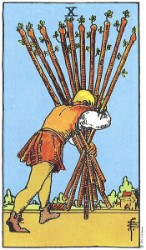
I find myself understanding the poor dude in the 10 of Wands more and more as time goes by.

In the Tarot, the four suits of cards represent different realms of the human experience.  Swords = personal power.  Cups = emotions. Pentacles = material possessions.  And wands = ideas.

So we see this guy in the 10 of Wands who has SO MANY ideas that he can barely stagger along under the weight of them.  His head is pressed firmly into the bundle of wands and he can’t even see what’s going on around him.  He’s just trudging toward a distant destination, hoping he’s going in the right direction and trying to put one foot in front of the other.  His ideas own him, not the other way around.

I was watching an interview with Eileen McKusick, author of, “Electric Body, Electric Health,” and she flat out said, “Overthinking is a cultural brain virus.  Overthinking never, ever solves anything.”  Naturally, my reaction was, “I’ll need to overthink that statement.”

She’s right, though.  What we refer to as, “thinking,” usually means shuffling around a lot of different concepts, trying to make them fit some sort of a coherent pattern.  It’s like a Rubik’s Cube that we keep flipping and flipping and flipping, hoping that all of the squares will line up. 

But conceptualizing is just one part of a much larger process and when we get stuck in that one part, it doesn’t work.  We can never, ever solve anything by just thinking at it.

Somewhere along the line in human evolution -probably about the time we began to develop alphabets and writing – we started to pull out of our bodies and into our heads.  Which is to say that we started to think of our heads, our brains and thoughts, as being somehow separate from our bodies.  Philosopher Gilbert Ryle referred to that as, “the ghost in the machine.”

That name is so apt because most of us suffer from this incredible, mass hallucination that there’s some separate, non-material, “self,” much like a ghost, that sort of rides around in our bodies, as if they were machines that we’re driving.  The ghost, of course, lives in our heads and we peer out at the world through our eyes, just as if they were windshields.

We call the ghost in our heads our, “selves,” or our, “personalities,” or even our, “souls.”  So there’s a ghost that’s our REAL self and then there’s the body, which we’re sort of temporarily driving around in.  That scene is very much like our real self landed at the Earth Airport and went straight to the Hertz Rent a Body so that we’d have a cool ride to tool around in.  “Hey, I’ll take something with fins and a lot of chrome.  Bucket seats.”

We even see that dualism in New Age philosophy, right?  How often have we heard that expression, “You’re not a body that has a Soul;  you’re a Soul that has a body?”  Which is a nice shift toward the spiritual, but it still maintains that strange hallucination that our bodies are somehow NOT our real selves. 

Which is exactly what McKusick was getting at:  we’re not just our brains and we’re not just our bodies – we’re our body/brains/nervous systems/emotions/thoughts/memories, Soul – the whole enchilada.

Or perhaps I should say, “the Soul Enchilada.”

She’s an energy worker who uses the energy of sound to heal us.  Like most energy workers, she heals from the outside in, which is contrary to some New Age thinking.  The basic New Age formula for life runs like this:

Our beliefs create our thoughts.

Our thoughts create our emotions.

Our emotions create our vibrations.

Our vibrations create what we draw into our lives.

New Agers have tended to jump in at the level of thought and say, “Well, if we change our thoughts, we change our emotions, which changes our vibrations, which changes our lives.”  Also known as the power of positive thinking and it’s true.

Energy healers like McKusick, though, are flipping the script on that.  They’re saying, “If we change our vibrations, we change our emotions, which changes our thoughts.”  She’s taking the same holistic approach – we’re all one great big electromagnetic vibration and if you change one thing, you change all of it – but she’s working from the vibration inward to the thoughts.

Her idea is that sound is a form of energy and so are we.  When we listen to certain sound frequencies that are coherent, solid frequencies, it reorganizes the energy in our bioelectric field into a solid, coherent vibration.  As our vibrations become more coherent, so do our emotions and our thoughts.

Does it work?  I don’t know, yet.  I’m spending a significant part of my day banging away on my Tibetan meditation bowl and grooving on the rising and falling of the sounds.  It does seem to be very soothing and it does take me out of my head and into my body.

And now that I’ve over-thought it, I like it.  I really do.

Please remember that my amazing e-book, Just the Tarot, is still available on Amazon for MUCH less than an order of enchiladas. Hell, it’s less than a side of refried beans. What an incredible bargain!

The Ace of Cups, Love Without a Pronoun, and Purple Thongs in the Back Seat of the Mercedes

A look at love as existing independently from people.

In the esoteric system of the Tarot, Cups represent emotions and the Ace of Cups represents pure love.  This is a card of love-as-an-energy, pouring into the world out of thin air, magically filling our lives with wonder and ecstasy. The love isn’t, “attached,” to anything, it’s just there, existing by itself.

Love-as-an-energy is a notion that’s foreign to most Westerners, so it takes a little bit of work to wrap our heads around it.  We can see a similar notion in Reiki energy healing. The Reiki practitioner directs healing energy (which we could call, “love”) to the person or situation that is sick.  BUT . . . and this is a subtle and important distinction . . . the practitioner doesn’t tell the energy what to do.  She just sends the energy and the energy solves the problems.

Huh?  What in the hell does that mean?

Well, suppose we’ve got a friend who’s got kidney problems, or at least that’s what the doctor told him.  So we sit down and light our white candles and incense and we try to visualize as much healing and love flowing toward our friend’s kidneys as we possibly can.  Only the doctor our friend saw was distracted that morning because his mistress had left her purple thong in the back seat of his Mercedes and his wife found it and now his wife and his children aren’t speaking to him and his mistress wants her thong back and his life has just turned into a shit burger.  So he accidentally grabs the wrong chart and diagnoses a kidney problem when our friend actually has exhausted adrenals.

There we are, then, sending tons of healing energy to our friend’s kidneys when his kidneys are perfectly fine and it’s his adrenals that need a little TLC.  Instead of helping, we’re accidentally short circuiting the healing process because we decided what the problem is and we were wrong.  

The Reiki practitioner, on the other hand, just sets the intention of sending the healing energy to his friend but lets the energy figure out what the real problem is and what really needs to be healed.  In other words, he views the energy of love and healing as something that exists independently of the healer and something that has its own intelligence, an intelligence that’s far greater than ours.  You send it, but you don’t direct it.

All of which seems completely weird to most of us, because we view love as coming out of SOMEONE.  We view love as always being attached to a pronoun.  I love YOU.  YOU love me.  SHE loves him.  We view it as something that people generate themselves and bestow on others, not something that flows THROUGH us, but isn’t really ours.  Even when we talk about divine love, we view it as a very personal transaction where God or the Goddess or the Angels or the Guides are personally sending us love because, you know, we’re really nice people and why wouldn’t they?  We don’t just want the love, we want the hug that goes with it.

Ram Dass expressed a lot of the same ideas when he talked about love and relationships.  What happens when we fall in love?  We’re tritty-trotting down The Great Road of Life when we suddenly see another human being and, for whatever reason, something inside of us says, “YUM!!!  I want some of that.”  So, penises get hard, vaginas get moist, we leap into the nearest bed at the first opportunity and make love like bunnies until we fall over in an intertwined heap of sweat and hormones.  Big, silly grins for everyone.  Yay!

There’s a lot going on beneath the surface, of course.  Our brains are pumping out oxytocin and we feel high as a kite because, “we’re in love.”  That very feeling and all of those pleasure hormones predispose us to view the other person favorably and as someone who’s wonderful and magical and the source of that amazing feeling of being in love.  Many times we’re totally puzzled because our friends see our love object as a schlub with a bad haircut, instead of the Amazing Wizard of Love and Happiness that we perceive, and so we begin to cut our friends out of our lives and our lover becomes the SOLE source of love in our existence.

What happens when our lovers die or we break up because we caught them playing hide the sausage with the neighbor’s teenage daughter?  Grief happens.  Deep, devastating, profound grief.

Ram Dass looked at that whole process and said, “Yup, that’s what happens,” but he put an interesting twist on it.  He said that it isn’t the loss of the person that we’re grieving, it’s the loss of love.  The person was just a vehicle in human form that GOT us to the love that we craved and we thought he or she was the source.  Put another way, we mistook the car for the destination.  

That’s basically seeing love-as-an-energy.  It isn’t an energy that comes FROM our lovers, it’s an energy that flows THROUGH them.

None of that denigrates or diminishes the wonderful process that we call, “falling in love.”  Falling in love seems to be one of the ways that nature has hard wired us to reach that state of love that heals us and makes us whole.  It’s a good thing.

What it DOES do, though, is to remove a lot of the negative qualities that too frequently go along with that process.  When we realize that love is out there, that it exists independently of other people, then falling in love loses its addictive and dependent nature.  We don’t view the other person as the source of love, we view them as a portal in our lives – sometimes temporary and sometimes lasting – through which the love flows.  We don’t depend on them for our source of love, like a junkie depends on his dealer for heroin.

If the other person goes away, that’s okay, because the love remains and we can tap into it any time that we want to, just by opening our hearts to that energy.  In a very real sense, we become the source of our own love, because we’re the ones who are making the conscious decision to stay open to that amazing energy, no matter what happens or who comes and goes in our lives.

And then we’re living in love, instead of falling in love.

It’s a good thing.