Trauma, The Tower, and The Shit Happens Factor

The causes of trauma and how to deal with it.

Philosophers and religious leaders have long been fascinated with what we might call the, “shit happens,” factor in life.  Perhaps it’s because of our human tendency toward binary thinking, but most creeds will fall into one of two categories:  life is good and the universe is benevolent and loving; or life is hard and the universe is cold, capricious, and/or meaningless.  The more spiritual religions tend toward the first view that life is good and the more primitive religions tend toward the view that life is hard.

If we look at it objectively, life is pretty good, pretty much most of the time.  Unless we have the severe misfortune of living in a war zone or a climate disaster, most of us don’t have something terrible happening to us, right around 98% of the time.  Most of us aren’t starving to death, suffering from a terrible disease, or in a constant series of car wrecks.  To the extent that we’re unhappy or dissatisfied, it’s because of our own view of the world and not because something exterior is wrong.

It’s fairly easy, then, to build a case for the idea that life is good and the universe is benevolent and loving.  Food is good, drink is good, sex is good, friends are good, creative fulfillment is good.  Butterflies are good, birds are good, crystals and candles and incense and vibrators are good.  There are a LOT of things about life that are good, and very few things that are bad.

Most of the time.  But shit happens.  Sometimes, really SERIOUS shit happens.

We can be walking along, singing a song, happy and free, when suddenly a speeding ice cream truck jumps the curb, runs over us and we’re in the hospital for months.  And while we’re there, we lose our job, our house and car are repossessed, and our partner runs off to Tierra del Fuego with a tattoo artist.

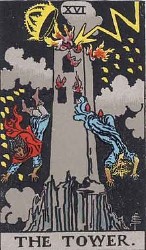
That kind of an experience is exemplified in The Tower card.  It’s the kind of an experience where everything in our lives is absolutely blasted into dust and we’re left standing there, psychically naked and bleeding, realizing that everything we believed in, everything we took to be solid and dependable, was nothing more than an illusion.

There’s a word for what happens to us internally when we go through that kind of experience:  trauma.  Gabor Mate’, who is one of the leading experts on trauma, says that trauma is a perfectly normal reaction to a completely abnormal event.  

There are several components to trauma that have to be unpacked.  First of all, it’s not a mild or everyday experience.  We tend to overuse the word and talk about how a scary movie was traumatizing or it was traumatizing to spend Thanksgiving with relatives we don’t like.  That’s not it.  Trauma is caused by events that completely overwhelm the individual’s resources and leave her feeling absolutely powerless.  These are things like rape, beatings, war, abandonment or abuse as a child, the death of a partner.  These are HUGE events in a person’s life.

Another element in trauma is a sort of a psychic frozenness, a process where the person gets stuck in the traumatic experience.  A very important point here is that deep suffering does not necessarily equal trauma.  In the Tarot card, The Hanged Man, we see someone who has gone through very deep suffering but has come out on the other side with profound emotional and spiritual growth.  He didn’t get stuck in the pain, he grew from it.

Put another way, he had the emotional and spiritual tools that were necessary to deal with the pain, therefore he wasn’t overwhelmed by it, therefore he wasn’t traumatized.

If we look at it on a purely physiological level, there’s a defined sequence of events that takes place in our brains when we’re confronted by a dangerous event.

1 – The amygdala (the so-called, “lizard brain”) starts the fight or flight reaction.  We’re flooded with stress hormones, our hearts race, our hands shake. We either attack what’s threatening us or we run away from it.  Either way, we resolve the danger.

2 – The amygdala shuts down the fight or flight reaction and our bodies and brains return to a normal state.

3 – The hippocampus, which is the part of our brains that controls memory, basically says, “Whew, glad that’s over,” and files it away as a completed event.

4 – Just in case that sequence doesn’t happen, the prefrontal cortex, which is like the CEO of our brains, says, “HEY!  It’s over.  Settle down, kids.”

We know from functional brain scans that this normal sequence doesn’t take place in trauma.  The amygdala starts the fight or flight reaction but it never ends it.  The hippocampus never properly files away the experience as being over and so we keep re-experiencing the traumatic event in the form of flashbacks and anxiety triggers.  And the prefrontal cortex shows markedly diminished activity so it never says, “Hey, there’s nothing out there to threaten you.”

That’s why a combat veteran may end up cowering in a corner from hearing fireworks on the 4th of July.  That’s why a rape victim may go into a full blown panic attack when she sees a harmless stranger in a parking garage.  That’s why so many trauma victims become alcoholics and drug addicts in an attempt to numb what they’re feeling.  Because, in a very real sense, it’s NOT over for them.  They’re still living in active fight or flight mode, they’ve never been able to digest the event as a memory, and they’re not able to intervene rationally and say, “There’s no danger.”

So what can we do about all of that?  What can we do to draw ourselves out of the disaster of The Tower card and into the spiritual wisdom of The Hanged Man?

First and foremost, a good therapist can be invaluable.  Remember, the trauma happened because the person felt overwhelmed and didn’t have the resources to deal with it.  A good therapist can start to fill up our emotional and spiritual tool boxes and give us those resources that we didn’t have when we were overwhelmed.  We can learn to reframe the experience, to intervene with compulsive anxiety patterns, to stop in the middle of a panic attack and really tell ourselves, “There is NOTHING wrong.  Breathe deeply.  Relax.”

There are a couple of simple techniques we can use at home, as well.  Harvard Medical School and Dr. Dawson Church have both demonstrated that EFT Tapping sessions can dramatically reduce the presence of the stress hormone cortisol and calm the activity of the amygdala.  Tapping basically takes us out of the endless loop of the fight or flight reaction and begins to turn the traumatic event into a neutral memory.  There are resources for tapping all over the internet but a good place to start is with Rick Ortner, who’s done so much to disseminate the technique.

Another simple technique is mindfulness meditation.  Like tapping, mindfulness meditation reduces cortisol and calms the amygdala’s fight or flight response.  Even more dramatically, though, after only 8 weeks of practicing mindfulness meditation, the amygdala actually shrinks and the prefrontal cortex grows.  Literally, anxiety and fear are physically shrinking while rational thought is growing.  Again, there are resources all over the internet for practicing mindfulness, but here’s a nice guided meditation from Great Meditations to get you started.

Most of us who are on a spiritual path prefer to think that life is basically good and that the universe has an underlying energy of love and creativity.  Nonetheless, shit happens.  To all of us, sooner or later.  We don’t have to make it a continuing feature of our lives, though.  We can move out of painful experiences stronger, wiser, and more evolved than when they occurred and get back to enjoying butterflies and birds, crystals and incense, good friends and vibrators.  L’chaim!

The Knight of Swords, Fight or Flight, and Getting Frumious Bandersnatches Out of Our Heads

Ending the endless cycle of stress.

I had a, “learning dream,” about the Knight of Swords last night and it was very interesting.  Learning dreams – for me at least – are quite different from ordinary dreams.  They’re dreams that answer questions that we really need solutions to, and sometimes we don’t even know it.  In my world, they’re instructions from Spirit Guides and Mentors who are helping me along my path.  In your world, you may see them as a sort of intuitive understanding of truths that have eluded you in waking life.

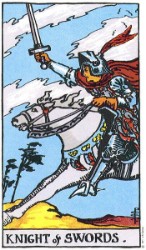
The Knight of Swords shows a Knight in full armor, sword extended, in a balls out gallop.  It’s a totally concentrated, furious charge toward whatever he or she means to conquer.  If you look carefully, you’ll see that the eyes of the horse are rolled backward, as if to say, “Okay, you’ve got the spurs, you’re in charge, but WHAT IN THE FUCK are you doing?”

Now, aggression is a perfectly normal part of human life, so much so that the Tarots suit of swords can be seen as representing a variety of aggressive ego states.  Aggression is, after all, one half of the famous Fight or Flight reaction.  There are times when it seems that we have no choice but to fight to defend ourselves or to stand up for what we consider to be right.  

But what happens when we get, “stuck,” in that reaction?  What happens when we live in a state of Fight or Flight?

Well, we start to break down and fall apart.  Our bodies are constantly flooded with stress hormones and we develop high blood pressure, heart problems, and sleep deficits.  Our minds become paranoid, habitually anxious, and we start to feel increasingly isolated and alone.  It’s not pretty.

The revelation that came to me in my dreams last night is that there are really two elements operating in concert when we get stuck in Fight or Flight. The first is the internal dialogue.   Buddhists refer to that as, “monkey mind,” the constant, chattering thoughts that will really mess up your meditation sessions.  Eckhart Tolle discusses it quite a bit in terms of, “ego,” which he views as a sort of an artificial construct of the mind that was a result of a wrong turn in our evolution.

Whatever you want to call it, it’s there:  an endless stream of thoughts that tend to operate just below the level of our conscious control.  And we really can’t do much about that.  As Emily Fletcher says in Stress Less, Accomplish More: The 15-Minute Meditation Programme for Extraordinary Performance the mind thinks involuntarily in the same way that the heart beats involuntarily.  Thoughts are a natural by-product of the mind, in the same way that waves are a natural by-product of the ocean.

The second element in a stuck Fight or Flight reaction is the body, that wonderful amalgam of proteins and hormones and electrons that’s constantly whizzing around creating and recreating our physical selves.  More specifically, we’re talking about that part of the body that’s intimately connected with Fight or Flight, the amygdala in the brain and the stress hormones.

When we’re confronted with something that the brain interprets as being dangerous, the amygdala jumps up and screams, “Holy Shit!  Watch out!  It’s a Frumious Bandersnatch!”  And then our brain dumps about 80 million gallons of adrenaline and cortisol into our systems, our blood pressure shoots up, we become hyper-focussed and we’re ready, by god, to fight!

All of that’s good when we’re confronting Bandersnatches and Jabberwocks and we need to stay alive.  But we were never meant to live in Fight or Flight for extended periods of time.  We were meant to engage in intense physical activity – fighting or running – that burns up the adrenaline and the cortisol rapidly and allows us to return to a normal state of consciousness. 

When we live through an extended period of stress – military combat or a marriage from hell or taking care of a loved one who is dying by inches for years – then the Fight or Flight reaction becomes habitual.  It becomes our normal way of behaving and of perceiving the world.

It becomes a self-feeding cycle that operates independently of what’s really going on in our world.

The first thing that happens is that the quality of our internal dialogues change.  We begin to see the world, “through a glass darkly,” and it shows up in the quiet chatter at the backs of our minds.

My life is so fucked up.

I can’t get a break.

I’m such a loser.

Why does this shit keep happening to me?

The kicker is that the Fight or Flight system in our brains is so ancient that it’s literally pre-verbal.  It evolved long, long before we developed speech or nuances in thought.  So it’s not hearing, “the world was a dangerous place,” or, “I’m having obsessive thoughts about something that’s over.”  All it’s hearing is, “There is danger,” and it’s continually dumping more and more stress hormones into our bodies so that we can respond to the danger.

And there’s a feed-back loop that starts up.  Our bodies are incredibly stressed from the hormones and our brains pick up that stress and interpret it as, “Something’s wrong.  Something’s dangerous.”  Which in turn makes the amygdala jump up and scream, “Holy Shit!  It must be another Frumious Bandersnatch!  Dump some more stress hormones!”

At a certain point it really does become almost like an independent, autonomous personality that we can’t control any longer.  Our circumstances may change completely.  We may be OUT of combat, we may have divorced the horrible, abusive spouse, we may have gone through the death of a partner and emerged on the other side of the grief.  But that Fight or Flight personality just keeps on trucking.

The problem is two pronged – the inner dialogue and the body – and so the solution needs to be two pronged.  First of all, we need to be very, very conscious of our inner dialogue and start transforming it.  It’s like a radio operating at a very low volume that we only half hear.  TURN IT UP.  Listen to it.  Start flipping every negative thought into a positive affirmation.  When we can turn that constant stream of negatives into a constant stream of positives, it interrupts the self-feeding cycle and starts to shut down the stress reaction.

Second, soothe the hell out of our bodies.  I mean that literally.  If we’ve lived through years of stress, our bodies are pretty tortured by it.  Take the time for hot baths, listen to quiet, peaceful music, take naps, lie in the grass, visualize beautiful scenes, masturbate or make love, BE GENTLE.  The more we soothe our bodies, the fewer stress hormones we’ll have.  The fewer stress hormones we have, the more our inner dialogues will change to healthy, grateful thoughts.

Like any big change in behavior, it can feel very complicated at first, but it’s not.  It’s really just a matter of transforming ourselves into the kinds of people that we’d LOVE to live with.  Because . . . you know . . . we are the people we live with, and who wants to live with a depressed roommate?

The Three of Swords and Healing a Broken Heart

Did you know that having a broken heart can actually . . . well . . . break your heart?

There is a medically recognized condition called, “broken heart syndrome,” that can cause all of the symptoms of a heart attack and lead to hospitalization.  Although it’s most commonly associated with middle aged women it can strike anyone and it’s brought on by intense grief such as the death of a loved one, a divorce, or breaking up with a lover.  One side of the heart actually enlarges for a period of time and fails to beat normally causing chest pains and shortness of breath.

The Three of Swords is a perfect illustration of that pain.  Most of us have been there: being deeply, completely in love with someone who betrays our trust, or falls out of love with us, or, sometimes, dies.  It literally feels as if we’ve been stabbed in the heart, wounded to our very core.

The question then becomes, how do we recover from that?  Or do we? One strategy, of course, is to just swear off falling in love and vow that we’ll never be suckers like that again.  Oh, sure, maybe we’ll have sex every once in a while – maybe a LOT – but we’ll never fall in love with or completely trust another human being again.  Ever!

Probably not the best plan.  In one of her always excellent podcasts called, “The Courage to Love,” Tara Brach asserts that moving away from love is actually moving away from the best and most authentic part of ourselves.  Which is not hard to recognize when we stop and think about it. When do we feel best about ourselves? When we’re loving and kind.  When do we feel best about the world? When we’re receiving love and kindness. It really IS hard wired into us: even a baby happily recognizes a smile and is frightened by a scowl.

As Brach points out, though, it can be difficult to remember that.  We are right now JUST starting to evolve out of that fight, flight or freeze response that’s always lurking in our amygdalas.  When someone shuts us down, when someone breaks our hearts, it feels like danger, like a terrible threat to our very being and we want to fight back against them, run away, or become emotionally frozen in place.  (Never again! Ever!)

We do have a couple of assets that we’ve evolved into, though, that can help:  consciousness and intentionality. We can consciously recognize our emotions and just sit with them.  “Okay, I hurt like hell. I feel betrayed. I feel like I can’t trust anyone.”  And that’s okay.

And we can intentionally move toward love.  “Okay, I really hurt but I recognize that I’m a loving, caring person and I’m not going to let someone else remove love from my heart.  I claim my autonomy and I choose love.”

We can also remember that the Heart Chakra just feels love and it doesn’t discriminate about where it’s coming from.  It’s wonderful to receive love from another human being but it’s not the only source.

When we’re broken hearted we can bring in a lot of self-love.  We can write out affirmations about what good, loving and deserving people we are.  We can visualize ourselves bathed in love and compassion and we can be especially nourishing and kind to ourselves.

Divine love can be another source for many people.  In Red Tara practice meditators will visualize Tara hovering before them, sending golden beams of love into their bodies and hearts.  We can do the same practice and replace Tara with the deity, spirit guide, or angel of our choice.

And, of course, we can just love.  Love generates love. The more we act with loving kindness and compassion toward our fellow travelers on the earth plane, the more the heart chakra opens and heals.  The more it opens, the more love we attract and receive.

“Neither be cynical about love;

for in the face of all aridity and disenchantment

it is as perennial as the grass.” – The Desiderata