What To Do When Our Lives Turn Into Crap – Wheel of Fortune Reversed

How to deal with it when you hit a period of bad luck

I recently got The Wheel of Fortune reversed in one of my personal readings and we all know where that’s at:  a period of bad luck coming.  Get ready, because things are NOT going to go the way that you want them to, at least not for a while.

And, since I’m an intuitive, I started thinking about exactly what, “luck,” is.  When we say we’re lucky or we’re unlucky, just what exactly are we talking about?

KARMA

Some of it can be karma, of course.  We’ve all met those people who seem to be blessed with nothing but good fortune.  They were born into families that loved and nurtured them, they were the beauty queens and football heroes in their high schools, and they went on to have wonderful careers, lots of money, and 2.5 semi-perfect children.  Into every life a little rain must fall, but they seem to live under giant umbrellas.

And then there are people who just can’t buy a fucking break.  No matter how hard they try, no matter how they struggle and strive, nothing goes right for them.  They’re always at the right place at the wrong time and money and love evade them like a bunny rabbit on speed.

Many of the people who are blessed with Hallmark Card lives have done little to deserve those lives, and many of the people who are cursed with disastrous existences have done little to deserve THAT fate.  

So all we can do is to shake our heads and say, “Well, it must be karma.  They must have been very, very good or very, very bad in a previous incarnation and now they’re getting what they deserve.”

Because if we DON’T say that, there’s no real justice or balance in it. Then life becomes this sort of an insane lottery where it’s all just a matter of . . . luck.

TIME AND TIDE

Another approach to dealing with bad luck is the Principle of Rhythm that’s discussed in books like The Kybalion.  The idea here is that there’s a natural rhythm to life where sometimes everything’s coming up rainbows and sometimes it all turns to shit.  

The way that the Kybalion explains it is that life is very much like the pendulum of a clock.  It swings first in one direction and then in the opposite direction and each swing is equal to the other.  We may have a period of great good fortune but it will be followed by a period of bad luck and vice versa.  

They reinforced that idea by looking at nature.  The moon waxes and then wanes.  The tides rise and then fall.  People are born, spring into maturity and then die.  Our emotions may be ecstatic one day and really depressed the next.  

There seems to be a natural rhythm where we swing from one extreme to the next on a regular basis but spend most of our time somewhere in the middle.

Of course, the problem with that theory is that it ends up being one-step-forward and one-step-back.  If our bad luck is always equal to our good luck, then we ain’t got no luck at all, brothers and sisters.

The way that they solved it was to say that life TENDS toward the positive.  That even if we have swings between good and bad luck, we have a little more good luck than bad.  So we’re actually making progress even if it feels like our feet are stuck in concrete.

And, yes, they turned to reincarnation to explain why some people have nothing but good luck and some people have nothing but bad luck.  Even if it seems like the clock’’s pendulum got permanently stuck on one side, it’s really just swinging very slowly because we can’t remember our past lives.

Okay . . .

WHO THE HELL KNOWS?

Humans have been trying to explain luck since the beginning of time.  There are a million different theories and formulas about it and they really just boil down to, “How do I get me some of that GOOD luck?”  Or, “How do I avoid that BAD ju-ju?”

A lot of the advice has involved figuring out ways to bribe the crazy gods that we’ve invented.  The Old Testament tells us to burn a fatted calf, because god likes a good barbecue.  The Taoist religions burn fake money because apparently that’s a way of making a deposit in their god’s bank accounts (yes, even gods need a little pocket change.). And, of course, many modern day Christians go to church every Sunday to sort of hedge their bets.  “Hey, Lord, I just put a twenty in the collection plate, and I could use a really lucky week.”

All we really know is that there seems to be something out there that we call, “luck.”  It’s some sort of a force or energy that brings good fortunes into the lives of some people. Its absence brings bad fortunes into the lives of others.  No matter how much we may want to, we can’t buy it or cajole it into our lives or pay a priest or pastor to make it go away when it turns bad.

SO WHAT DO WE DO?

So what do we do when we’re going through a patch of really bad luck?  When we flip over the card and it’s The Wheel of Fortune reversed?  

One solution is to just hunker down and ride it out.  Bad luck can feel like a huge storm that’s raging through our lives and we just need to get into the tornado shelter.  Try to turn off our emotions, grit our teeth, and wait for it to pass.

The Kybalion suggests trying to, “rise above it.”  In other words, there’s not a goddamned thing we can do about that clock pendulum swinging, but we can try to raise our vibrations to a point where it affects us less than it would otherwise.  Eventually the pendulum will swing back in the other direction.  If we stay calm, try to stay positive, and remember that this too shall pass, it will lessen the effects.

BEEN DOWN SO LONG IT LOOKS LIKE UP TO ME

Of course, if we ARE one of those people who seem to have been born under a bad moon, that’s a different kettle of fish.  If there’s been nothing but bad luck for a very long time, then we need to learn to adjust to that, too.

And the only solutions I can come up with there are to try a little harder than the Hallmark Card people and build in the fact that we’re not luck magnets.  We actually need to take the time to write the affirmations, do the visualizations, make the vision boards, and feng shui our houses until they shine like newly minted dimes.  Because it’s NOT going to come naturally to us.  

Maybe we were terrible people in a past life.  Maybe our clock pendulums broke when we were born.  Who knows?  What we do know is that we’ve got to put in a little more effort.  

Ultimately, good luck or bad luck, we make our own lives.

“Just the Tarot,” by Dan Adair – a kindle ebook available on Amazon

The Wheel of Fortune and Flowing with these Strange Rhythms

This post explores the deeper meaning of The Wheel of Fortune Tarot card and its connection to the Kybalion’s Principle of Rhythm. Life’s ups and downs are not random but part of a greater pattern that ultimately arcs toward the positive. Discover how to maintain perspective, rise above collective fear, and navigate dark times with love, compassion, and inner strength.

Let’s face it: we’re all a little exhausted from the constant insanity in the world right now. Whether you’re right, left, or middle-of-the-bird, it can feel like we’re adrift in a sea of chaos. When it goes on long enough, we start to lose our perspective and wonder if things will ever be “normal” again.

The message of The Wheel of Fortune is that everything passes and everything changes. The people who are at the top of the wheel right now will eventually be cast down, and the people who are at the bottom will eventually be elevated again.

Life is always cyclical — and this, too, shall pass.

The Principle of Rhythm

As I discussed in my book about The Kybalion, Western Occultism calls this The Principle of Rhythm. Here in Earth School, everything is rhythmic, and we only have to open our eyes to see it.

The tides come in and then go out.

The Moon waxes and then wanes.

Life explodes into the richness of spring and then recedes into the cold bleakness of winter.

Even great nations expand and then ultimately diminish into shadows of what they once were.

Everything rises and falls — and then rises again.

The same principle applies to human beings and all our affairs. We may have a string of incredibly good luck and then a period where we can’t buy a break. We may feel joyously happy for a while and then deeply depressed and anxious before we find our way back to happiness. We may fall deeply in love with someone and then end up despising them.

The Pendulum

The Kybalion envisions this process as the pendulum of a clock. It swings to the left, and then it swings to the right. And as the Principle of Rhythm states: “The swing to the left is always equal to the swing to the right.”

Modern science recognizes this in Newton’s Third Law of Motion: “Every action has an equal and opposite reaction.”

When we think about human life, we can see it in terms of alternating energies. We may go through incredibly negative periods — full of stress, sadness, and anxiety — only to be followed by times of great happiness, when everything seems to go our way.

We may have moments where we’re counting quarters to buy groceries, followed by periods of real abundance when the cash flows in like a river.

The collective energy of politics follows the same law – a hard swing to the right is inevitably followed by a hard swing to the left. Hatred is eventually replaced by compassion.

But It’s Not a Closed System

If that was all there was to the rhythms of life, it would be a pretty depressing scenario. It would feel like: “Okay, things are going well right now, but I can’t really enjoy it because it’s all going to turn to shit again.”

If life were nothing but good/bad/good/bad — ad infinitum — it would be the spiritual equivalent of one step forward and one step back. We’d be living, but not progressing. Stuck in an endless cycle of growth and degeneration. A closed system where nothing ever really improves.

The good news is that, as The Kybalion puts it, “nature favors the positive.” Positive energy will always overcome negative energy. Love will always be stronger than hate. Compassion will always conquer cruelty.

Put another way: yes, as long as we’re in Earth School, the pendulum will appear to move equally in both directions. The truth, though, is that it’s always arcing just a little more toward the positive — whether we can see it or not.

So What Should We Do Right Now?

We are, right now, in dark times. As Asha Nayaswami says in this wonderful video, there is demonstrable evil in the world, and some humans are acting out their darkest impulses.

So how do we deal with that? What should we do right now?

The advice of The Kybalion is to “rise above it.” We can’t control the Principle of Rhythm or the turns of the Wheel of Fortune. Those are built into the fabric of Earth School. We don’t have to be swung by the pendulum, though. We can rise above it spiritually.

What we can control is our reaction to it. We can make a conscious effort not to be swept along in the collective energies of hatred, fear, and anger. We can maintain our own little bubbles of love and compassion and keep putting out as much positive energy as we can.

As Nayaswami says, that doesn’t mean we become spiritual doormats. It doesn’t mean we avoid confronting evil when we encounter it. It means we confront it with truth, with as much gentleness and understanding as we can muster, and that we refuse to join it in any way, shape, or form.

Perspective

Above all, it means maintaining perspective. Keep your eyes on the horizon, not just on the dirt road full of potholes. Remember that the pendulum will swing back in the opposite direction.

When it does, life will not only be positive again — it will be more positive. People will learn from these experiences, and they’ll use that knowledge to build a better world.

We just have to be patient… and wait for the wheel to turn.

“Just the Tarot,” by Dan Adair – a kindle ebook available on Amazon.

Blasted Towers, Bad Ju-Ju, and the Unluckiest Card in the Tarot

A look at the five unluckiest cards in the Tarot deck.

I recently received an email from a reader who asked, “What’s the unluckiest Tarot card?”  I had to scratch my head about that one because the whole concept of good luck versus bad luck can get pretty complex.  Nonetheless, there are some Tarot cards that can always be considered harbingers of bad luck

THE WHEEL OF FORTUNE, REVERSED

The Wheel of Fortune, Reversed, is the most obvious choice for a, “bad luck,” card.  We actually talk about luck in terms of good fortune and bad fortune and that’s what this card is all about.  It depicts life as a wheel, where sometimes our luck is ascending and expanding and sometimes it’s descending and decreasing.  When The Wheel of Fortune, Reversed, shows up in a reading it indicates that we’re in for a patch of bad luck.

The Kybalion, which is a book about Hermetic Magic, compared it to the pendulum of a clock.  The pendulum swings first in one direction and then back in the other.  Life can be seen in much the same way:  sometimes we’re swinging into really good luck and then we swing back into a period of bad luck.

The obvious underlying message is to just hang on, because things will inevitably change.  When we can stand back and look at good luck/bad luck as a rhythmic cycle, then periods of ill fortune will affect us much less severely.  We just need to stay centered and calm and wait for the cycle to reverse itself.

THE TOWER

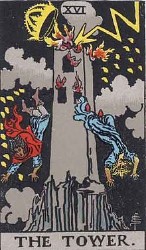
Also known as, “the lightning struck tower,” and, “the blasted tower,” The Tower would probably be my pick as THE unluckiest card in the deck.  

“Just the Tarot,” by Dan Adair – complete definitions, layouts, and instructions for reading Tarot cards, available on Amazon.

At it’s most severe level, it can indicate that everything that you’ve loved and invested in is about to be blasted right down to the ground.  The last time that I had it showing up in my personal readings, my life partner died, I lost my house, and I was involved in a horrible law suit over the probate of the estate.  It can be that bad, depending on the other cards in the reading, but it usually isn’t.

On a mundane level, The Tower is usually just a powerful warning that we’ve gone down the wrong path and the Universe is about to provide a course correction.  Perhaps we’ve been treating our fellow employees badly and – Shazam – we’re suddenly fired or demoted.  Or perhaps we’ve been emotionally abusive or neglectful of our lover and they leave us for someone else.

In my experience, there’s always a level of hubris involved with this card.  We’re not only taking things for granted, but we’re also being arrogant.  We’re assuming that everything is under our control and the Universe is going to show us that we’re not.

The most positive message in this card – which we usually fail to appreciate at the time – is that we get to completely start over.  It’s like that line from, Me and Bobby McGee:  “Freedom’s just another word for nothing left to lose.”  When our lives (or our projects or relationships, etc.) have been blasted right down to the foundations, we have the freedom to consciously design something new and better.

DEATH

Even if it isn’t the unluckiest card in the deck, Death definitely wins the award for the creepiest card in the Tarot.  In her wonderful book, “Fortune Telling by Tarot Cards,” Sasha Fenton puts it in this perfectly understated, British way:  “This card usually puts the wind up people when it appears . . .”

Yes.

Now, first of all, I have never seen the Death card appear before someone’s death.  It will pop up after someone has died, but it’s usually just a comment on what’s happened.  It’s more like, “Well, you’ve lost someone you loved, so you’re dealing with death and grief.”

What it can indicate, though, is that there’s going to be a radical, life changing turn in events in a person’s life.  The querent is suddenly going to find herself going in a completely different direction than she has in the past.  In an emotional and spiritual sense, it really is as if their previous life has died and they’re off in a completely new direction.

I knew a woman who had been happily married for 15 years, had a home, a loving husband, and 2 kids.  She woke up one morning with this thought ringing in her head:  “Shit, I’m not in love with him anymore and I hate my life.”  Within six months she’d obtained a divorce, turned custody of her children over to her ex-husband and was working as a river guide in West Texas.  That’s the kind of radical change that we’re talking about here.

Whether that kind of change is good luck or bad luck is just a matter of interpretation.  If it’s something that we consciously plan, we usually view it as good fortune.  If it was something that was forced on us by circumstance, we may think it was bad fortune.

JUSTICE, REVERSED

I’m a little hesitant to include the Justice card in this list because it has more to do with people and circumstances than luck per se.  Nonetheless, it’s frequently seen as bad luck so I’ll stick it in here.

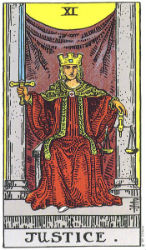
Classically, as you might guess from the image, Justice has to do with the legal system.  If we’re involved in some sort of litigation and Justice is upright, it can mean that we’ll prevail.  If it’s reversed, it can mean that we’ll lose.

On a personal level, it can mean that the people around you – your family, co-workers, boss, etc. – are making judgements about you and they’re not good if the card is reversed.  

Losing a court case can obviously be seen as bad luck.  Or it can be seen as a sign that we have a bad case, a bad lawyer, or a bad judge.  In the same way, having people we care about judging us harshly can be seen as being treated unfairly.  Or it might be that we’re being jerks and we need to clean up our acts.

Justice, Reversed, can be a sign of a bad luck to come, but it also serves as a warning.  It’s saying, “You’re about to have some bad luck, so you need to take a careful look at your own actions before that happens.”

TEN OF SWORDS

It doesn’t take but a glance at the Ten of Swords to realize that there’s some serious bad ju-ju happening here.  If we’re lying face down stuck full of swords like a human pin cushion, something’s a little wrong. This card can indicate treachery, deceit or a very, very bad ending to a relationship or a job.

The suit of Swords symbolizes our personal power.  That’s the way that we project ourselves out into the world.  There’s nothing innately wrong with that.  Whether it’s standing up to a school yard bully when we were kids or pushing hard for a project we really believe in at work, there are always times when we have to be a bit aggressive.

But . . . when we’re overly and chronically aggressive, that puts us into a power cycle. We’re trying to dominate other people and run over their emotions and desires.  We become the school yard bully instead of the person standing up to the bully.  We see this mentality frequently with primitive men who brag about being the, “alpha dog.”  It’s dominance for the sake of dominance, rather than for the sake of getting anything done.

The message of this card is the old cliche’: live by the sword, die by the sword.  If we’ve been treating other people harshly, if we’ve been abusive in our love relationships, or domineering in work relationships, we’ve got some bad karma heading our way.

So those are the top five, “bad luck,” cards in the Tarot deck.  There are, of course, other cards that may indicate bad fortune in one aspect or another of our lives, but these are the red flags.  And, of course, we should always remember that a Tarot reading is just a snap shot in time.  It tells us what’s likely to happen, but we have the free will to change it.

The Wheel of Fortune – Good Luck, Bad Luck, Flying Monkeys and Eckhart Tolle

A closer look at good luck and bad luck in The Wheel of Fortune

Luck.  It seems to be a universal concept, found in every human culture.  There are blues songs bemoaning the fact that, “if it wasn’t for bad luck, I wouldn’t have no luck at all.”  People talk about how their luck’s been so bad they’d have to look up to see the belly of a snake.  Then there are other people who seem to live enchanted lives, lives where one good thing after another happens to them for no apparent reason other than they’ve got really good luck.

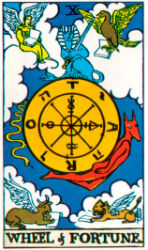
The Wheel of Fortune Tarot card is obviously about luck, but the modern, Waite Deck depiction of it is really just about good luck.  It shows a wheel bedecked with Egyptian deities and surrounded by symbols of the four elements or, perhaps, the four apostles.  There’s nothing threatening or scary about this version of the card.

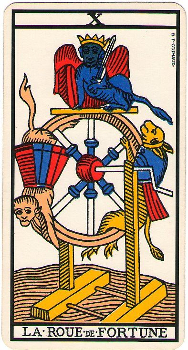
When we look at the old, Marseilles deck version of the card, though, we see a different story.  Instead of Egyptian deities, we see . . . um . . . monkey critters.  Wizard of Oz flying monkeys, one perched atop the wheel, wearing a crown and wielding a sword, one being carried upward on the wheel and one being cast down by the wheel.  This is really much more in keeping with that very primal perception of luck that we humans have always had about luck.  It’s something kind of creepy, magical, and outside of us, outside of our control.  We can never tell when a flying monkey might swoop down out of nowhere and carry us away in its nasty little talons

Humans are always trying to find a way to harness luck, to somehow bring it under our control.  There are dozens of gods of good luck that we’ve worshiped through history – Hotei, Fortuna, Lakshmi, etc. – hoping that they’ll bless us with strong luck.  Many people carry a rabbit’s foot or a lucky penny or have, “lucky socks,” or jeans that they favor.  A lot of obsessive compulsive behavior flows out of a ritualistic quest for luck.  OCDs may feel an urgent need to wipe the counter exactly seven times or wash their hands three times in order to avoid something catastrophic happening.  Most of us were taught the basics of avoiding bad luck as children.  Don’t step on a crack or you’ll break your mother’s back.  Don’t walk under a ladder.  Don’t break a mirror.  Oh, shit, it’s a black cat!

The older Tarot card shows both good luck and back luck – one monkey is rising on the Wheel of Fortune and one is descending.  The two phenomena seem to go together, to be attached, one rising from the other.  The second verse of the Tao Te Ching alludes to this when it says:

Once we know beauty, we know ugliness.

Once we know good, we know evil.

High and low, long and short—all these opposites support each other and can’t exist without one another.

That duality, that sense of opposites always going together, seems to apply to everything on the material plane, including luck.  Good luck seems to give way to bad luck and bad luck gives way to good luck, or that’s the way that we conceptualize it.

Eckhart Tolle suggests that, at least to some extent, it really is just about the way that we conceptualize it.  Many times, what we view as bad luck is just the end of a cycle.  Everything grows and then it diminishes and then it grows again.  We don’t view plants dying at the onset of winter as a tragedy, but we do view humans dying at the end of their incarnations as tragic.

Louise Hay has much the same view of the ends of relationships.  When we break up with someone or we get a divorce or our partners die, it feels like a horrible, painful tragedy.  It feels like bad luck.  She suggests viewing it instead as a sort of a graduation.  At the point the relationship ends, it means that we’ve learned everything we were supposed to learn from the dynamic of that relationship and it’s time to say, “thank you for the wisdom,” and move on.

The Law of Attraction people tell us that good luck and bad luck can actually be learned behaviors, patterns that we get into that, “attract,” more of the same.  If we can learn how to maintain a positive, healthy outlook on life, we tend to attract positive, healthy people and things into our lives.  In the same sense, if we see life as a terrible, crappy experience where we’ve got nothing but bad luck happening, that’s what we attract.  Even worse, we attract people with the same negative vibes and then we get to deal with their shit in addition to our own.  That can go a long way toward explaining why some people always seem to be lucky and some people seem to have a curse on them.

Pema Chodron said that life is all about being constantly thrown out of our nest. Constantly forced to give up our security and adapt to new experiences.  Quite a bit of what we call, “bad luck,” is that simple, elemental human experience of not wanting things to change.  We envision an idyllic, static existence where nothing new or challenging ever happens to us because change is scary.  Getting fired from our jobs, losing our partners, having to move out of our houses – these are all bad luck because they’re changes that we don’t want.

There are a couple of things worthy of noting about that, though.  The more that we resist change – the more that we say, “no,” to the end of a cycle –  the more dramatic that change is eventually going to be.  It’s almost like an explosive force that just keeps getting more and more powerful the longer we sit on it, until it eventually blows our existence into tiny, smoldering pieces.  A small change that we resist can easily grow into a catastrophe that we could have avoided.

The other thing to note is that good luck so often grows out of bad luck.  After we’ve had a period of seriously rotten luck, we frequently find our lives being showered with blessings of all sorts.  It could be that, as the Taoists assert, good luck is attached to bad luck and one inevitably gives rise to the other.  Or, as Tolle said, perhaps we’re just ending one cycle and plowing the dead weeds under the ground to make room for the new growth.

That can make a huge difference in how we experience those periods of, “bad luck.”  We can realize that The Wheel of Fortune is a wheel that’s constantly turning and that we’re never stuck in one place.  It just feels like it.  Being thrown out of the nest may feel incredibly uncomfortable emotionally.  It may be terrifying.  It may feel like horrible luck.  But it’s the only way we learn how to fly.

Dan Adair is the author of, “Just the Tarot,” available on Amazon.com at a very reasonable price.

The Wheel of Fortune

The meaning of The Wheel of Fortune card in the Tarot, including definitions for the upright and reversed positions.

wheel

The Waite deck obviously went all out on this card and crammed as much occult symbolism into one little package as the mind can conceive.  I personally think you’re pretty much always going in the wrong direction when you combine the new testament with Egyptian gods, but – hey! – to each his own.

The word Taro in the center of the wheel is a reversal of the word Rota, meaning wheel and it emphasizes that our journey through this life is very much like being affixed to a turning wheel.  What goes up must inevitably come down and then, in the nature of the wheel, go back up again. This card is talking about the fact that change is inevitable.  Nothing remains fixed or static in this world and you may be riding high one day and fall off your horse the next.  You may be flat busted and then have a crazy idea that makes you a fortune. Life is always changing and we just pretend that it isn’t because it makes us more comfortable.

When the Wheel of Fortune shows up in a reading you know that a large change is about to happen.  The card doesn’t speak to whether the change is good, bad, or indifferent: it’s just telling you that something big is about to happen and you should be prepared for it.  When it happens it will probably feel like a bolt from the blue, a sudden stroke of good luck or a lightning flash of bad luck. Other cards in the reading may give clues as to the area of life in which you can expect the changes.

REVERSED:  There’s not a huge difference between the upright and reversed card, except the reversed card shows more of an aspect of bad luck.  It’s possible that the questioner is about to enter into a period of hard times or that he or she is simply going to have a string of bad luck.  The main lesson for this card is to use the tough times to develop stronger character. Persevere and grow.

If you have questions about this card or its meaning in one of your readings, please don’t hesitate to leave a comment.  I’ll get back to you as soon as I can.

A Few Other Thoughts About The Wheel of Fortune:

The Wheel of Fortune represents a glitch in the fabric of their well-ordered universes which organized religions have been trying to ignore since their inception.

Which is to say . . . luck.  Good luck, bad luck, and no luck.  

If The Hierophant represents the well-oiled machinery of organized religion, the The Wheel of Fortune represents a huge monkey wrench that got thrown into the gears of that machinery.  Organized religions teach – put simplistically – that if you’re a good person then good things will happen to you. And if you’re a bad person, then bad things will happen to you.

And, of course, that flies in the face of much of what we see around us.  Why do kind, gentle people of faith sitting in a synagogue in Philadelphia get gunned down by a vile racist who is consumed with hate?   Why do billionaires who celebrate avarice and greed live lives of luxury while the pious frequently don’t have enough food for their children?

It’s a conundrum that religions have been hard put to explain.  In the christian religion we see the rather sickening tale of god and the devil deciding to turn Job into a human ping pong ball, kill his children and his livestock, and give him some sort of a leprous disease just to, “test his faith.”

The most logical explanation I’ve run across is the Buddhist idea of karma.  We plant seeds of hate and violence in past lives and they may bloom into poisonous flowers hundreds of lifetimes later.  Thus, bad things happening to us aren’t the random, crazy things that they seem to be but just natural consequences of our past actions.

That’s what I personally believe but, like all metaphysical assertions, it’s an unprovable hypothesis based on my experiences, thoughts, and feelings.

The Wheel of Fortune pushes aside all of the metaphysical hypotheses and organized religions and just says, “Look:  shit happens. And good things happen.” Period. You don’t have to have an explanation for it to recognize that it happens.

The nicest, most successful person in the world can hit a string of really putrid luck and have everything she’s worked for destroyed.  The biggest bastard in the world can hit a string of really good luck and end up in the White House.

It’s a principle of randomness that seems to be built into the universe.  What goes up, must come down, and vice verse. Today’s rooster is tomorrow’s feather duster.  Life moves in cycles and we have no choice but to move with them and do the best that we can. The Wheel of Fortune is a reminder of that.  

Ultimately none of the castles that we build – or lose – on this earth plane are real.  Figure out what things ARE real. Your values. Your heart. Your love for and from others.  Those are things we create ourselves with the way that we live our lives. No change of fortune can give them to you and no change of fortune can take them away.

“Just the Tarot,” by Dan Adair – a kindle ebook available on Amazon