Dreaming Big vs. Building Bridges

Why don’t manifestation techniques work for everyone? This post explores the pitfalls of one-size-fits-all manifesting advice, including why “dreaming big” may backfire for some people — and how “bridge affirmations” and quiet repetition can be just as powerful. Learn how to tailor your visualization style to your own emotional wiring, and find a manifestation method that actually fits you.

Ace of Pentacles – A Tarot affirmations poster available at Synergy Studio.

Why some manifestation advice doesn’t work — and what to do instead

One of the sillier ideas floating around in the world of visualizing and manifesting is the notion that “one size fits all.”

The way this usually goes is that a manifesting guru announces they’ve been studying this stuff for decades, and they’ve refined all of that knowledge into THE ONE TRUE METHOD that will make us rich, famous, and sexually irresistible.

A variation on that is the guru was visited by beings from another dimension who gave them the real lowdown. A variation of that is that the guru is now channeling spirit guides, divine beings, angels, or ancient Atlanteans who have imparted secret knowledge for the good of all mankind.

Now, I happen to be a huge fan of manifesting, visualization, and affirmations. But there are a couple of big fallacies baked into these presentations.

 Fallacy #1: One method works for everyone

If any one guru truly had the one method that worked for everyone, we’d all have signed up for that seminar by now. We’d all be millionaires. And we’d be so busy in bed we’d have to replace our mattresses every three months.

And… um… there still seem to be a lot of us who aren’t millionaires. Have you noticed?

I know that the last time I looked at my bank balance, I was shocked — shocked, mind you — to discover I still wasn’t rich.

Maybe you’ve had a similar experience.

Fallacy #2: Any method works for you

This is the one I want to dig into today: the idea that any particular method is going to work for everyone who uses it.

It’s understandable that the gurus would push that narrative. After all, the more seminars, books, and videos they sell, the more fully they manifest their vision of wealth. If they came right out and said, “You know… this might work for some of you but not all of you,” their book sales would definitely decline.

But the truth is: we’re all different, and we need to find the method that fits us best.

Dreaming Big vs. Building Bridges

One helpful concept from the psychology side of affirmations is the idea of “bridge affirmations,” also known as “ladder affirmations.”

Here’s the basic idea:

Your visualizations need to at least resemble your current reality enough that your brain doesn’t reject them outright. If you’re living under a bridge, eating beans out of a can, and you’ve just lost your can opener, it’s going to be really hard to visualize yourself living in a mansion with a butler serving you caviar.

A more realistic visualization might be:

• You have a brand new can opener

• That can opener lives in a drawer

• That drawer lives in a kitchen

• That kitchen lives in a cozy little apartment you can afford

Bit by bit, you’re bridging the gap between your present and your vision.

I won’t get too deep into the science here, but our brains have a filtering system called the reticular activating system (RAS). It decides what information to notice based on what we already believe is possible.

So if you try to visualize something your brain sees as ridiculous, the RAS stands behind you whispering: “Uh, uh. Not happening.”

“I’m a wildly wealthy kazillionaire!”

No, you’re not.

“I attract money like a magnet!”

Then why can’t you pay your bills?

“I’m irresistible to the opposite sex!”

So why don’t you ever HAVE sex?

Now, it’s possible that you are one of those super-manifesters the gurus talk about — the kind who visualizes a million dollars falling from the sky and then has to wear a helmet for protection from the cash downpour.

But if you’re not? That’s okay.

You may just be a bridge manifester, not a straight-to-the-moon manifester.

Sometimes your subconscious doesn’t need the big dream — it just needs the next step.

“Feel It Big!” Doesn’t Work for Everyone

Another favorite bit of advice from the manifestation gurus is: You have to really FEEL it.

Like, really really.

Don’t just visualize the million dollars — visualize all the wonderful stuff you’re going to buy with it.

Visualize how damn happy you’re going to be.

Do a happy dance.

Flap your arms.

Howl at the moon.

Shake your booty and cackle because you’re rich, rich, RICH, I tell you!

The idea is that emotion supercharges visualization — the more passion you inject, the faster it manifests.

But what if you’re just… not a very emotional person?

Maybe you’re a trauma survivor.

Maybe you’re neurodivergent.

Maybe you’re just a pragmatic flatliner who feels fine but doesn’t emote like a Broadway actor.

Does that mean you’re out of luck when it comes to manifestation?

Absolutely not.

Some of us don’t feel our way to manifestation — we focus our way.

That’s where repetitive affirmations come in.

What we’re trying to do is impress the visualization on the subconscious mind so that it starts working on it behind the scenes.

Yes, a giant burst of emotional energy can plant the seed deep.

But so can steady repetition — even without fireworks.

Write:

“I am attracting abundance into my life.”

Twenty or thirty times every morning.

Or listen to gentle affirmation recordings while you go about your day.

The subconscious doesn’t need drama. It just needs consistency.

Find Your Flavor

So if you’re not rich, famous, and ravishing just yet — relax.

Maybe you don’t need to “dream bigger.”

Maybe you just need to cross the next bridge.

By all means, try the big, bold, wildly emotional manifesting techniques. If that works for you — congratulations! (And maybe lend me a hundred grand while you’re at it.)

But if it doesn’t work?

Don’t give up.

Just try a different route.

Build bridges.

Use repetitions.

Focus instead of forcing.

As Ram Dass said:

“Ultimately, we’re our own gurus.”

And nobody knows you better than you.

“Just the Tarot,” by Dan Adair.  A kindle ebook available on Amazon.

Doing Justice to Our Beliefs With Byron Katie’s The Work

A look at how to change our core beliefs using the methods from Byron Katie’s, “The Work.”

The Justice card in the Tarot is, at its most basic level, about society judging us, but there are few harsher judgements than those which we make about ourselves.  And most of them are horribly unjust.

As Cynthia Kane points out in, “Talk to Yourself Like a Buddhist,”  we say things to ourselves that we would never, ever, in a million years, say to our friends and family.  When we really start listening to our inner dialogue, we may find little poisoned pellets like:

You’re so stupid.

I can’t believe that you fucked that up . . . again.

What in the hell is wrong with you?

Why can’t you ever get anything right?

Your problem is that you’re just lazy.

And on and on and on.  The more dysfunctional that our family of origin was, the more likely we are to have that harsh inner critic constantly deriding us.  Constantly telling us that we don’t measure up and we’re never quite good enough, no matter how hard we try.

Now, there’s a basic formula in New Age Thought that goes like this:

Our thoughts create our emotions.

Our emotions create our vibrations.

Our vibrations create our lives.

When we break that down, it just means that every single thought we have has an emotion attached to it, either positive or negative.  When we think of puppies or cookies, we feel good.  When we think of dentists and written tests, we feel bad.  Our feelings about those thoughts add up to create our overall vibration.  If we’re constantly thinking of things that make us sad or scared, we end up with negative vibrations.  If we’re constantly thinking of things that make us happy, we end up with positive vibrations.  And, eventually, our overall vibrations will draw similar vibrations into our lives.  If we have really negative vibrations, we’ll draw in negative people and failures.  If we have really positive vibrations, we’ll draw in positive people and abundance.

It’s really cool when we figure that out because it empowers us to make changes.  We can jump in at any one of those three points and start to transform our lives. Most of the self-help guides advocate one approach or another.  If we change our thoughts, we’ll change our emotions.  Or if we work on feeling happier about life, that will change our thoughts.  Or if we meditate on raising our vibrations, that will change what we attract.  Pull on any one of those three strings and our lives will start to change.

There’s one element that’s frequently left out of that equation, though, and that element is beliefs.  We can change our thoughts, our emotions, and our vibrations but if we don’t change our underlying beliefs, we’re not going to get anywhere.

The classic example of that is the person who wins the lottery and two years later he’s bankrupt.  Maybe he spent hundreds of hours visualizing getting that winning ticket and wrote out a kazillion affirmations and did vision boards and all of that helped him to win.  But he didn’t change that underlying belief, which was, “I’m poor,” so the money floated away.  It wasn’t a vibrational match for his basic beliefs about himself.

To put it in a nutshell, our beliefs create our thoughts which create our emotions which create our vibrations which create our lives.

Which begs the question, “What IS a belief?”  

A belief is nothing more than a thought that we repeat over and over until we think it’s true.  Sometime they ARE true, but frequently they aren’t.  If we want to know what our real beliefs are, all we have to do is to listen to that inner dialogue.  If we’re constantly degrading and belittling ourselves, then those are beliefs that we need to change before we can effect permanent changes in our lives.

So how do we change our basic, underlying beliefs?  We actually pull them out and look at them.

One of the most powerful tools for doing that is Byron Katie’s, “The Work.”  

To use The Work method, we take a, “work sheet,” (download one here) and focus on four areas:

1- What’s the belief that I need to change?

2- Is it true?

3 – What kind of a person would I be without that belief?

4 – What are some opposite turn arounds that I can substitute for that belief?

Here’s an example of a negative belief that a lot of us carry around:  “I’ll never have enough money.”

IS IT TRUE?  For most of us, it’s not true at all, at least for most of our lives. There are very few of us who have been homeless or starving.  That doesn’t mean that we haven’t gone through some bitchy, bad times.  There may very well have been times when paying our bills or even just buying groceries was a struggle.  Still, if we’re honest with ourselves, most of us, most of the time, manage to pull it together even through the occasional hard times.

Of course, one of the questions that we need to look at there is, “What do I mean by, ‘enough money.’ “  If we put together a vision board that’s covered with pictures of sports cars, McMansions, and private jets, we’ll probably feel like we don’t have, “enough.”  If we think in terms of food, clothing, shelter, a car that runs, and a job, though, we realize that we’ve usually had plenty.

WHO WOULD I BE WITHOUT THAT BELIEF?  Well, for one thing, we’d probably be a lot more grateful.  When we actually focus on the fact that we have always had enough money to eat, enough money for a warm place to live in the winter, enough money to pay our bills, then we can start to see how very lucky we’ve actually been.  

For another thing, we can start feeling a lot less anxious about the future.  If we’re able to look at our past and see that there’s always, somehow, been enough, then we can see that there’s absolutely no empirical evidence for the idea that we won’t have enough in the future.  It’s just a movie playing in our heads that’s based on a bad fantasy.

WHAT ARE SOME OPPOSITE TURN AROUNDS TO THIS BELIEF?  The obvious one, of course, is, “I always have enough money.”  Some others might be, “I manifest what I need as I go along,”  or “The Universe always provides for my needs.”

Once we’re able to flip that basic belief, then some miracles start to happen.  Our thoughts begin to be more positive (“I always have enough money.”). Since our thoughts have changed, our emotions start to change (“I really don’t have anything to worry about financially and I’m happy about that.”). Since our emotions have changed, our vibrations start to change (“I feel really secure, relaxed and positive about life.”).  And when our vibrations change, then we start to create the life that we always wanted.

It’s a really good and relatively simple method for changing our basic beliefs.  Of course, Byron Katie probably named it, “The Work,” for a reason, because it does take some work.  It’s not just a matter of sitting down and filling out a sheet of paper.  It’s actually taking the time to listen to our own thought stream, write down those negative beliefs, and then meditate on them as we fill out the sheets.

And changing negative beliefs is work on a whole different level, as well.  We tend to cling to beliefs about ourselves and the world around us simply because they’re comfortable and they’re what we’re used to.  When we adopt the very opposite of those beliefs, it can initially feel very strange and foreign.  The negatives will keep popping up in our thought streams for a while, but we now have the consciousness to stop and say, “Nope.  It’s not true, it doesn’t make me feel good, and it’s not who I am.”

Note: as a member of Amazon Associates, I may receive a tiny remuneration if you buy a product listed on this page. I am in no way associated with the authors of the books quoted.

Judgments, The Dalai Lama, and Putting Your Hat on the Table

How our belief systems affect our lives.

There’s an old saying that the reason our parents can push our buttons is that they installed the control panel. And there is so much truth in that.

I was watching a presentation from Mike Dooley the other day and he was talking about the importance of our belief systems. For those of you who aren’t familiar with Dooley’s work, he’s a strong advocate of the idea that, “thoughts become things,” and teaches visualization and manifestation techniques. His take on belief systems is that they act as, “regulators,” for what we allow ourselves to think, and since thoughts become things, our beliefs determine what we’re going to think and, therefore, what’s going to manifest in our lives. Our beliefs determine the Judgments that we make about life, which determine the course that our life takes.

For instance, if we have a strong, unconscious belief that we’re unattractive it’s very unlikely that we’ll be able to visualize ourselves with a good, loving partner. We can’t even THINK of that happening, and so it doesn’t. If we have a strongly held belief that rich people are evil, we’re not going to be able to attract money into our lives because we don’t want to see ourselves as evil.

Those are belief systems on a personal level. There are also what we might call, “meta belief systems,” that operate on a more elevated basis. These are systems like religions and politics and they interact with our personal belief systems. Most people in the United States are Christians and an inherent element in that religion is that people are, “sinners,” that life is suffering, and that there’s a loony tunes god in charge who might just throw you into a pit of eternal flames because you masturbated last night.

We can contrast that world view with this statement from the Dalai Lama: “I believe that the purpose of life is to be happy. From the moment of birth, every human being wants happiness and does not want suffering. . . From the very core of our being, we simply desire contentment. I don’t know whether the universe, with its countless galaxies, stars and planets, has a deeper meaning or not, but at the very least, it is clear that we humans who live on this earth face the task of making a happy life for ourselves.

If we believe in the so-called Law of Attraction – the idea that we draw into our lives people and events that are a match with our energy, emotions, and ideas – then we can see where these two belief systems would have massive implications in our personal lives. If we accept the classic Christian view that people are basically evil and life is shit because we got, “thrown out of the garden,” what are we going to attract into our lives? Evil people and shitty experiences. If we listen to the Dalai Lama and believe that the purpose of life is to be happy, we’ll automatically seek out happy people and create positive experiences in our lives.

All of this operates on an unconscious level, of course. If you were to ask the average Christian if she believes that people are rotten and life is meant to be suffering, she would very likely say no. But that’s exactly what we were taught in Sunday schools and church services when we were forming our views of life and were too young to make realistic assessments. All of those buttons – guilt, sin, life hurts – were installed on our control panels and they’re just waiting to be pushed.

Don Miguel Ruiz talks a lot about this in The Four Agreements. As he put it, most of our belief systems are just, “dreams,” illusions passed down from one generation to the next or forced onto us by our society and they remain largely unexamined. Democrats (or Republicans) are evil. People are no damned good. America loves peace (even though we sell more weapons than any other country in the world.) Monogamy works (even though about half of the people who try it get divorced.) Liberals are socialists. Conservatives are fascists. God’s a male. There is no God. We all have tons and tons of opinions and viewpoints that we live by, that we design our lives around, and, for the most part, we haven’t thought about them very much.

I once read about a woman who went into an absolute fury every time that her husband would put his cap on the kitchen table. When he questioned her about it, the only thing she could say was, “It’s just wrong.” She realized that her mother had taught her that lesson, so she asked her mother why it was wrong. Her mother’s response was that her mother had taught her that it was a terrible offense. She finally worked her way back to her great grandmother who started laughing and said, “Oh, lord, child, when I was young everyone had head lice. That’s why it was wrong to put your hat on the table.”

So three generations of her family had passed down a very strong belief and reaction about a simple behavior like putting a hat on a table. And none of them, until her, had ever questioned the belief or wondered what was behind it.

The sad part of this is that so many of our beliefs and judgements are just like that: totally unconscious ways of judging the world and ourselves that were passed down to us by people who weren’t thinking about them and accepted by us without thinking about them.

That’s also the good news.

Once we accept the idea that a lot of our most cherished beliefs – if not most of them – are constructed on total bullshit, then we can just get rid of them. It sounds like a really radical idea when we first encounter it but why not? Why not just get rid of beliefs that limit us and restrict us, and adopt beliefs that serve us better and allow us to expand our lives?

For instance, the belief that I’ll NEVER have enough money, shuts me down and keeps me frozen in place. The belief that the Universe is filled with abundance and I deserve my share opens me up to expanding and receiving. The belief that I have a RIGHT to be angry keeps me upset and repels positive people. The belief that I have a RIGHT to be a loving person attracts positive, loving people into my life and reinforces the idea that I’m lovable.

The Tibetan Buddhist teacher Chagdud Tulku Rinpoche said that most of us will never become enlightened in this life and that we’ll continue to live in the dream of illusion. But he also said that we CAN decide whether we want to have a good dream or a bad dream. And the road to a good dream starts with our beliefs about that dream.

The Nine of Wands, Spiritual Post-It-Notes, and Being Okay With Not Being Okay

I was recently watching an interview with Brad Yates, author of A Garden of Emotions: Cultivating Peace through EFT Tapping, and he made the point that social media can have the inadvertent effect of making us feel pretty inadequate.  It can slide us right into the, “comparison trap,” and we start to think that there must be something really wrong with us and our way of thinking.   I sat right up and took notice when he said that, because it rang a major, huge, giant brass bell in my head.

What he was talking about was FaceBook, “positivity.”  If we’re involved with the New Age or New Thought movements at all, we run into a LOT of positivity with our on-line friends.  We get up in the morning, crank up our Internet Machines, and there’s a virtual blizzard of Spiritual Post-It-Notes.  Things like, “I am SO grateful for this beautiful morning!”

Or, “I count my blessings with every breath!”

Or, “Healthy boundaries make for healthy relationships!”

Or, “Always live in an attitude of gratitude!”

And –  as actual human beings – sometimes we feel like shit.  In fact, sometimes we feel like shit a lot of the time.  But we’re looking at all of these bright, shiny thoughts from all of these bright, shiny people and THEY don’t seem to feel like shit all of the time, or even some of the time, or even, for god’s sake, EVER.  

Almost inevitably we slide into comparing ourselves to them and start thinking that there must be something really wrong with US.  How come I don’t feel like a million dollars every single goddamned day the way that they do?  I must be a really low-vibes, depressing/depressed human being because a lot of the time I hurt and I don’t feel very freaking grateful.

Of course, the truth of the matter is that if someone says that they’re grateful, happy, joyous and free EVERY SINGLE DAY, they’re either shallow or they’re a saint or they’re in denial or they’ve got some really, really good weed.

All right, granted, there are some people out there who really are happy most of the time and more power to them.  Some of them were born with a basically happy disposition.  Some of them have worked very, very hard to get into a place of grace and joy.  I’m not denigrating or diminishing that at all.  

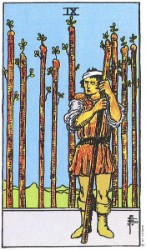
Most of us, though,  don’t wake up grinning every single freaking morning. For some of us life feels very much like the Nine of Wands tarot card:  we’re still standing, we’re still upright and strong, but we’ve had the crap beaten out of us by life and we’re pretty wounded.

And that’s okay.  

That’s where we’re at.  That’s our starting point on the map for the rest of our journey.

Mike Dooley, who has done such wonderful teaching about manifesting and visualizations, often compares reaching our goals to setting a GPS in our cars.  We feed in the information about where we want to go and then the gizmo just takes it from there.  We don’t argue with it or second guess it – we just follow the directions.  In the same sense, he says, we can just set our goals and then let the Universe take it from there.  We don’t need to constantly obsess about the details (what he calls, “the poisoned hows,”) because the Universe will keep popping up new road signs and different paths to get us there.

Implicit in that, though, is the idea that we KNOW where we’re located at the beginning of the journey and we’re HONEST about it.  If I’m in San Jose and I want to get to Phoenix, but I tell my GPS that I’m in Dallas, it ain’t gonna work out too well.

And, in just the same way, if I’m beat up, knocked down, drug around, and life has beaten the stuffing right out of my meditation pillow, putting up Spiritual Post-It-Notes about how grateful I am ain’t gonna work out too well.

Unfortunately, social media sites are generally piss-poor places to be honest about what we’re really feeling.  It’s difficult to admit publicly that we’re NOT the Great and Mighty Wizard of Oz and there may be a lonely, sometimes sad, sometimes frightened person behind the curtain who’s just pulling levers.  It’s especially difficult when so many other people seem to be doing so well.  At least, all of their posts say they’re doing so well.

In a way – and perhaps a healthy way – this impossibly cheerful positivity has intensified since the start of the pandemic.  People really ARE struggling with depression and fear and loneliness and we’re trying to encourage each other to stay in healthy, positive frames of mind as much as we can.

So it may be a good, temporary coping mechanism.  Maybe we DO need to be as optimistic and up-beat as we can be, until we find our way out of this weird, scary virus maze.  It’s what we used to call, “whistling past the graveyard,” and in this case the graveyard is very real and it’s got a half a million Americans in it.

Long term, though, simply pretending that everything is alright when it’s not, doesn’t really work.  It doesn’t get us to our destinations because we’re not being honest about where we’re starting from.

Brad Yates went on to say that there are no such things as negative emotions.  WOW!  But . . . but . . . but . . . I thought I was supposed to be happy all of the time!

Not.  

Repeat – there are no such things as negative emotions.  There are no BAD emotions. 

There are emotions that are uncomfortable.  There are emotions that feel sad or that arise out of situations that are depressing or painful.  But they are all our emotions, they are all part of our story, and they serve to tell us where we are before we take the next step in our journeys.

In 1967, Thomas Harris published a wonderfully cheery book entitled, “I’m Okay, You’re Okay.”  In a nutshell, it promulgated the idea that we’re all just fine, we just misunderstand one another sometimes, and we should always remember that you and I and – gee whiz! –  pretty much everyone is . . . well . . . okay.

To which Elisabeth Kubler-Ross, that amazing wizardess who spent a lifetime studying death and dying, replied:

“I’m Not Okay.

You’re Not Okay.

And That’s Okay.”

And it really IS okay.  It’s right where we’re supposed to be when we take our next step on the journey.

The Ace of Cups and Generating Your Own Hugs

Psychotherapist Virginia Satir rather famously said, “We need 4 hugs a day for survival. We need 8 hugs a day for maintenance. We need 12 hugs a day for growth.”   And there’s a lot of truth in that. Babies who aren’t stroked and touched and held develop a syndrome called failure to thrive and can actually die from not  receiving enough contact.  There are many, many recent studies showing that animals also require an abundance of physical touching to develop and maintain healthy bodies and nervous systems.  What one psychologist referred to as, “skin hunger,” has been linked to depression, apathy, heart disease, and a lack of empathy.

The conundrum, of course, is that a lot of us don’t have anyone to hug.  Eleanor Rigby is real. A recent survey by Cigna found that an astonishing 46 percent of U.S. adults report sometimes or always feeling lonely and 47 percent report feeling left out.

Just think about that:  when you pass someone on the street there’s almost a fifty percent chance that he or she feels very much alone.  And the same thing may be true when you look in the mirror.

So where do we get that hug-energy that we need to be happy?

We might consider getting frequent massages, which is fine, but most of us can’t pop for 60 to a 100 bucks a week.  And we can’t go around hugging strangers because, as The Searchers have already told us, they’ll break our little bottle of Love Potion #9.

We might find the help we need in contemplating The Ace of Cups.  As I said in my original definition:

 It emphasizes the divine origin of love and how it flows into the world and nourishes all that it touches.  The lotuses echo the Buddhist symbol for the divine in the human spirit. They begin life in the mud and yet grow into the air and produce beautiful flowers.

The scientists who documented the need to touch and be touched ignored an important part of the phenomenon because it’s not in their purview:  love. It doesn’t help us at all to be touched angrily or hit or jabbed or abused. Quite the opposite, it’s worse than not being touched at all.

No, what makes us grow, what makes us thrive, what makes us healthy is being touched with affection.  That’s what a hug is, right?

The Heart Chakra is attuned to the vibration of love and love is what makes it healthy and glowing and open.  It doesn’t in the least bit discriminate about where the love is coming from, it just vibrates to that energy.  The love can come from another human being or a pet or a divine entity or from . . . our Selves.

Psychologist Gay Hendricks believes that we only find true abundance when we cease viewing ourselves as consumers of abundance and start viewing ourselves as generators of abundance.  In other words, we don’t have to look for external sources of abundance because we can make it ourselves.

And that’s true of any energy, including love.  The Heart Chakra doesn’t just receive love, it also generates it and, paradoxically, in generating it, it receives it.

When we have genuine, conscious compassion, when we practice loving-kindness, even when we pet our dogs or cats, we’re generating love straight out of our heart chakras.  It’s not hard. We don’t have to be meditation masters. We can just sit and visualize the face or touch of someone we love, really feel that love, and every time we do, we surround ourselves with love.

Or, to put it another way, we give ourselves a hug.  We can do it 4 times a day, or 8 times a day, or – if we want to grow – 12 times a day.

As The Beatles said, “The love you take is equal to the love you make.”  And we can make as much as we want to. We ARE the Ace of Cups if we choose to be.

The World Card, Rebirth, and Designing Your Next Body


The World seems to be the only Tarot card that deals with birth, which is odd because you couldn’t find a more archetypal, universal experience than birth.  As I noted in my book, “Just the Tarot,” the wreath in The World card strongly resembles the shape of the birth canal and suggests a totally new beginning.

We all associate birth with that initial entry into the world, that first thrust through the placenta and into a whole new universe.  In reality, though, we’re being reborn constantly. It’s fairly well known that ALL of the cells in our bodies are completely replaced by new cells about every seven to ten years but many cells are constantly dying and being regenerated.  Red blood cells are replenished about every four months. White blood cells every few days. Fat cells, of course, last the longest. Wouldn’t you know it?

And here’s an interesting slant on all of that.  While the molecules in your body are busy whizzing around and making sure everything that’s supposed to stay inside doesn’t fall out and everything that’s supposed to come out doesn’t stay in, they’re also making these amazing substances called neuropeptides.

I don’t know about you but I totally suck at science and math and just a word like neuropeptides makes my brain freeze with anxiety.  Nonetheless, it’s important to know about them and here’s why.

Neuropeptides are the physical correspondents of our emotions.  They come and go together. Adrenaline is one of them. If you get a big spurt of adrenaline it totally triggers your fight or flight reaction.  Your heart races, your fists clench, your eyes dilate – you’re ready to kick some ass or run like a rabbit. Adrenaline doesn’t CAUSE the fight or flight reaction, they just always occur together.

Same deal with another neuropeptide, serotonin.  If you have a lot of serotonin in your system, you’re happy.  If you don’t have enough, you’re sad. Serotonin = happiness and happiness = serotonin.

The kicker is that our bodies manufacture neuropeptides to MATCH the emotions we’re feeling.  So, if you’re a very happy, positive person, then you’ll have a lot of serotonin being pumped out.  If you go through a sustained period of stress and unhappiness, then your serotonin levels drop like a rock in water and your adrenaline levels go up.

Kicker number two:  we have receptors for these neuropeptides in cells ALL OVER OUR BODIES, not just in our brains.  So if you’re pumping out massive amounts of serotonin, it’s attaching to molecules throughout your entire system and your body is basically happy.  Massive amounts of adrenaline and your body is basically stressed and unhappy.

Where it gets really interesting is when we consider that our emotions are actually dictating what types of molecules are going to make up our bodies AND we’re constantly replacing and replenishing those molecules.  We’re literally remaking our bodies all the time based on our emotional states. We are – right now – designing the types of bodies we’ll have in a couple of months when all of those cells get replaced with cells that match our current emotional state.

To put it another way, if you’re chronically negative and unhappy, your body is going to manufacture molecules that are negative and unhappy.  Serotonin = happiness and low serotonin = unhappiness. It can turn into an endless cycle of misery. Crappy emotional states CAUSE crappy body and brain chemistry which CAUSE more crappy emotional states and on and on.  

That’s where visualizations and affirmations come in.  When we do them, we’re interrupting that repetitive cycle.  When we do affirmations we’re rewiring the Deep Mind and telling it that we’re happy and successful people and – guess what – happy and successful people have oodles of serotonin.  When we visualize being happy and successful, we FEEL happy and successful and happy emotions MAKE serotonin appear.

It’s a very odd phenomenon.  We are literally giving birth to . . . ourselves . . . all the time.  And we have a choice as to what kind of a body and person we’re creating.  Happy thoughts = happy cells = happy thoughts. We choose our World every single day.

* If you’re interested in learning more about this, look up Dr. Candace Pert, who pioneered the research.

The High Priestess, Affirmations, and Writing Your Own Story

I realized many years ago that I was an absolute genius at manifestation . . . with one big problem.  My problem was that my genius was hitched to my unconscious programming instead of what I consciously wanted to create.”  Gay Hendricks, “Attracting Genuine Abundance,”  DailyOm

I grew up in one of those families from hell.  Alcoholic, abusive father, detached, depressive mother, a military family so we were constantly moving and never growing roots.  

And, as Melody Beattie said in, “Codependent No More,” one of the real curses of that is that you accept the insanity you’re living in as, “normal.”  Being beaten, screaming fights, drunks passed out on the floor – it’s all perfectly normal in YOUR household.  Doesn’t everyone live like that? Hell, you’re just a kid, how are you supposed to know the difference?

Someone once said that your parents always know how to push your buttons because they installed the control panel.  There’s a lot of truth in that – on a primal, cellular level no one knows you better than your parents. And, in addition to installing the control panel, they also installed the programming.

If you were raised in a less than benign household that programming can be pretty awful.  You probably grew up hearing things like:

“You’re a very, very bad girl.”

OR

“Why did you do something so stupid?”

OR

“I don’t like hitting you but you don’t leave me any choice.”

And your poor little subconscious, your subconscious that was too young and too trusting and too inexperienced to know any better just soaked that shit up and believed it, the same way that you believed that drunken, crazy parents were normal.  And – voila! – you end up as an adult who believes that he’s very, very bad, stupid, and deserves to be abused. After all, your parents told you so, didn’t they?

I was talking with a therapist about all of that subconscious, self-defeating programming and I asked if affirmations and visualizations were a way to sort of short circuit it.  She looked very thoughtful for a minute and said, “No, I think of them more as a way of writing your own story. Who do YOU want to be in your story? How do YOU want to live and feel in your story?”

That’s a wonderful distinction that we miss too often.  Affirmations and visualizations aren’t just ways of overcoming negative beliefs that we absorbed in the past.  They’re also ways of consciously creating what we want our futures to look and feel like.

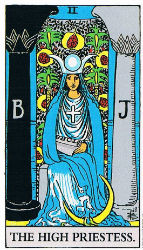
A great deal of The High Priestess is about the deep mind, the subconscious and unconscious part of our minds that holds both our creativity and our self-defeating beliefs.  Too often it’s like a one way door. Magic, symbols, dreams emerge from the Right, feminine, side of the brain, but we don’t consciously interact with it, we don’t, “input,” data, we just passively receive content.

When we dream or meditate that realm of magic that resides in the Right Brain flows into our lives.  When we visualize or do affirmations, we’re talking directly to the Right Brain. We’re dropping what we want our lives to be, what we want our stories to be, into our subconscious and then it performs the magic and makes it real.

In my original definition of The High Priestess, I wrote this about what happens when the card is reversed, when we’re ignoring that interactive process with our subconscious:

The creative, intuitive, feminine right side of the brain is being overpowered and held hostage by the logical, sequential, male left side of the brain.  Intuition and creativity are being ignored in favor of so-called rational thinking. There is a need here to reconnect with your primal self. Take the time for meditating, long hot baths, dancing, art.  Get back in touch with your creative energy.

We need to take the time to visualize, to affirm what we want in our lives, to have a nice, quiet talk with the High Priestess.   We need to take the time to write our own story or someone else will write it for us.

“Just the Tarot,” by Dan Adair, a book of basic Tarot definitions available on Amazon.com.

The Fool – Alone but not Lonely

In the first (or the last, depending on your perspective) card of the Major Arcana we see The Fool starting off on his Spiritual Quest, a dog barking at his feet, his eyes turned toward the heavens.

And he’s very much alone.  But maybe not lonely.

What starts us on a Spiritual Quest?  It’s certainly not because things are going swimmingly.  Sometimes it just a chronic, nagging feeling that something in our lives is just not quite right.  Sometimes it’s a sudden flash of insight that’s like the first rolling stone that starts an avalanche.

Frequently it’s some life event that knocks us ass over teakettle and forces us to look at the fact that our assumptions and beliefs have been wrong all along.  That what we took for granted isn’t worth a bag of spit. The death of a loved one. The suicide of a coworker. Surviving a crash or a deadly disease.

Even then, many people will embrace what might be called “a pseudo-quest,” or perhaps, “an aborted quest.”    Shocked and shaken right down to their toes by some near catastrophe they respond by pulling the covers over their heads and crawling into the safe, warm womb of organized religions.  Like the men kneeling in front of the pope in The Hierophant card they look to others for spiritual truth rather than seeking it in their own hearts.

The person on a true Spiritual Quest is there because he or she HAS to be.  The choices of pretense, dull lassitude, and being a comfortable member of the herd no longer exist for them.  They have a burning desire to know – or at least seek – the truth and that desire can’t be ignored.

And, yes,  that can feel lonely at times.

For one thing most people aren’t really very interested in looking at the verities of Spiritual life.  The next time that you’re at a family gathering just casually mention that everyone in the room is going to die sooner or later if you don’t believe me.  You may not be invited back and, if you are, I guarantee no one will want to sit next to you at Thanksgiving Dinner. People actually seek out toys, money, meaningless sex, and anything else they can think of to AVOID talking about death and they don’t appreciate it when someone puts the subject right up in their faces.

A second factor, though, is that your Spiritual truths are YOUR Spiritual truths and not necessarily anyone else’s.  As you tread your way down the path of The Fool you will discover certain things that you know in your heart are true but the people around you, even your loved ones, may think that you’re out of your mind.  Or very much a Fool.

I remember when I first realized that visualization actually causes the things we visualize to manifest in our lives.  And I don’t mean just reading about it or acknowledging it as an abstract idea. I mean actually sitting my butt down, doing the visualizations and having them actually manifest.

I was blown away.  “This,” I thought, “is magic.  Real, honest to goddess, freaking magic!”

And that realization was followed by a whole series of other realizations.  If my thoughts and emotions can cause things to manifest in my life, then my life is . . . a manifestation of my thoughts and emotions.

Which means that I made this mess.  Not my parents, not my environment, not my culture, not random circumstances.  This thing I call my life is . . . ME. My thoughts. My emotions.

Which means that I’m responsible for it.  It’s my karma that I made. BUT . . . it also means I can change it.  And, man, that’s not just magic . . . that’s freedom!

It was a major turning in The Fool’s Path and I was tremendously excited about it.  The people I tried to share it with . . . not so much. My New Agey friends sort of yawned and said things like, “Oh, yeah, I think I read something like that a long time ago in Ram Dass.  Or was it, ‘A Course in Miracles?’ Maybe it was, ‘Codependent No More . . .”

My more conventional friends either edged slowly away or their mouths hung open for a moment before they changed the subject.

I realized eventually that it was MY Spiritual truth.  It was a result of my Tarot readings and my studies and my meditations and it fit perfectly at that exact moment in MY life.  The fact that other people didn’t understand it or know it or really, really dig it in their own hearts didn’t matter. What mattered was that I had found one of my truths.

And there’s a Spiritual truth in that realization, too.  Just because you’re alone in your beliefs doesn’t mean you have to feel lonely.  In all likelihood the people around you don’t share or understand your truths because they haven’t done the work that you have or they just don’t care.  That doesn’t diminish what you know by one little bit. Every truth that you find along the path is a jewel to be treasured and uncovers a little bit more of who you really are.

Karmic Re-Set with the Nine of Swords

I remember the last time I pulled the Nine of Swords in one of my personal readings.  I had a very spiritual reaction, which was, “Well . . . shit.” Swiftly followed by another, which was, “Why me?”

It probably wasn’t one of my better days.

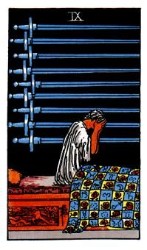
The Nine of Swords absolutely screams, “karma.”  The individual is lying in bed with his head in his hands, a perfect image of someone who has just awakened from a screaming nightmare.  The quilt on the bed is covered with astrological symbols showing past incarnations in different signs of the zodiac. The swords behind him seem locked together like the bars in a prison cell.

Just the Tarot by Dan Adair – a kindle ebook available on Amazon

There can be no doubt that this is someone who has just realized that he’s accumulated some terrible, terrible karma and is going to have to pay a serious price for it.

There’s another way of looking at it, though.

If you’ve spent any substantial time in spiritual exploration then you’ve had that, “Ah HA!” moment when you realize that you are a co-creator of your life.  It goes something like this:

I control my thoughts.  My thoughts cause my emotions.  My emotions cause my energy vibrations.  My energy vibrations, through the Law of Attraction, determine what’s going to manifest in my life.  Therefore, I control (or create) what’s manifesting in my life.

To put it more succinctly, if I’m broadcasting a lot of negative vibrations I’m going to attract a lot of negative crap into my life.  If my vibrations are positive, positive things will flow into my life.

There’s a real rush that goes along with that revelation.  We feel very liberated from random circumstances and from people victimizing us.  We realize that all of this isn’t being done TO us, we’re making it happen to ourselves, which means that we can change it.

But there are a couple of, “Well . . . shit,” moments that go along with that.

The first one is, “Well . . . shit . . . I made this.  This is MY karma. I’m totally responsible for this mess.”

It wasn’t our abusive fathers, or our crazy ex-wife or husband, or the country or culture we grew up in, or the opportunities we did or didn’t have, or anything OUT THERE.  We manifested all of it into our lives or we chose to NOT manifest something better. We made it.

Well . . . shit . . .

The second appallingly scary moment happens when we realize that it means that we’re also creating what happens next.

Alcoholics Anonymous and the other 12 Step Programs have a saying:  “You can start your day over whenever you want to.” In other words, if you’re having a terrible day you can always take a deep breath, reconnect with your serenity, and change how your day is going.

Tibetan Buddhism embraces the concept that we can start our karma over whenever we want to.  No, we can’t escape the unfolding of consequences from our previous actions but we can make those consequences a lot better by starting to live our lives with love and compassion and the creation of good karma.

And when we realize – truly realize – that we are creating our lives right now, right here, with the choices that we’re making, that we’re starting over,  that’s a pretty heavy responsibility.

For one thing we have to get really clear on just what we DO want.  What are my values? What do I want in my life? Peace? Serenity? Happiness?  Family? Sex? Money? What do I want to create in my life? If all of this isn’t just stuff that’s happening to me, if it isn’t just things that people are doing to me, if I’m MAKING my life . . . what do I want it to look like?

And if we’re going to choose to consciously create our own lives – and we don’t have to, we can stay unconscious – then we have to consciously choose, every day, every hour, to control our emotions, our vibrations, and our manifestations.  

And that’s not easy.

Well . . . shit . . .