Time Travelers, Blackberry Salmons, and Babies in Sunbeams

Religious concepts of time and the destruction of mindfulness.

I love Eckhart Tolle’s statement that, “it’s never not now.”  

It’s totally true, but we really have to bend our minds a lot to get into that space.  It’s not too difficult intellectually, because we can look at it rationally and realize that there really is no past (except in our heads) and there really is no future (except in our heads.)  I mean, it’s not like there’s some Past Land, like a Disney adventure ride, that we can go visit.  IT DOESN’T EXIST. Ditto with the Future, because all that it really consists of is our projections of what we think will probably happen.  Maybe.  Could be.

Despite that, we humans spend a MASSIVE amount of our lives Time Traveling to the future or the past and very little time in the Now.  Put another way, we use a lot of our mental space living in something that doesn’t even exist and, as a result of that, we spend very little time existing in the space that actually does exist.  We’re so bad at living in the Now that we actually have to take mindfulness classes to learn how to do it.

So how in the hell did this sorry state of affairs come to be?  We should find the person responsible for this and give him a good thrashing.

Oddly, the answer seems to be that it was our old buddy, Organized Religion, that did it.  In the Tarot, organized religion is represented by The Hierophant and The Hierophant has rules and regulations that we’re all supposed to bend our knees to.  One of his Big Rules is about time and it says, “There isn’t enough of it.”

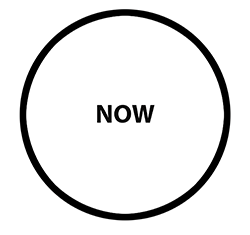
Now, probably the original way that humans experienced time was sort of like this: 

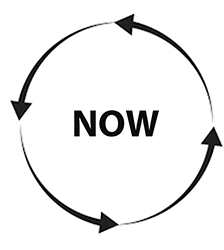
There was just a big NOW, with no concept of the past or the future.  We just sat there in the bliss of the present moment soaking it all in.  Or it might have been a little bit more like this, where one NOW moment just led into the next NOW moment. No concept of past or future, just NOW.

That’s much the way that babies seem to experience time.  They can lie there for hours staring at a sunbeam and not get worked up at all about what the sunbeams are going to look like tomorrow or worry about what the sunbeams were like yesterday.

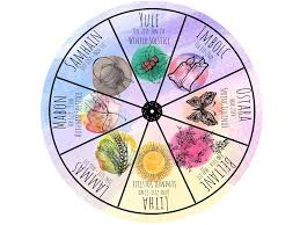
At a certain point in our evolution, our experience of time probably shifted more into the model we see with the Wiccan Wheel of Time.  

We started to notice the cycles of the Moon and the passing of the seasons.  There would have been some recognition of certain times of the year but not a great deal of worry about it.  The Native Americans of the Northwest expressed it in terms of activities.  “This is the time when we gather berries.  This is the time we catch salmon.  This is the time when we plant seeds.”  And so on.

Still, there was none of the huge anxiety that we seem to feel about time today.  Tribal people didn’t sit around their camp fires filling in dates on a calendar or trying to figure out how to, “use their time more productively.”  They just did what they needed to do when it was the right time of the year to do it.  “Hey, I’ll bet some fried salmon would go great with these blackberries!  We should probably stack up a little fire wood while we’re at it because it’s going to get cold sometime soon.”

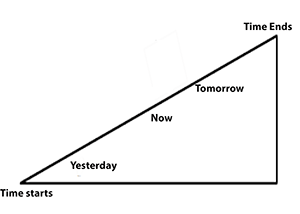
Unfortunately, while the Native Americans were sitting around having fish fries and enjoying their blackberry cobblers, humans in the Middle East were coming up with an entirely different concept of time, which historians refer to as the, “inclined plane,” model.  The reasoning behind this model of time ran very much like this:

  1. – If time exists, then there must have been a BEGINNING of time, because . . . you know . . . there just must have been.
  2. – And if someone, “started,” time, then it must have been someone who was OUTSIDE of time and that would be someone who was eternal and that would be God.
  1.  -And if there was a start to time, then there must also be a stop to time, which is when the world ends and God will do that, too, so I think we should call it The End Times.

Okay, so it wasn’t the best piece of human thinking that we’ve ever seen, but they didn’t have Google in those days so they couldn’t really look things up.  It also represents a HUGE shift in human perception and one that we’re still suffering from today.  All of a sudden, time looks like this:

So time has suddenly become a quantity, rather than a quality. It begins and it ends.  We can measure it, we can put it on calendars, we can plan it, we can carry it around on the daily planners of our phones. Shazam! – we have the concepts of the past and the future, of yesterdays and tomorrows.  We see this notion of time-as-a-quantity deeply ingrained in our languages.

I need to SPEND some time on that.

I’m not sure I want to INVEST that much time in it.

Time’s a WASTING.

This should be a real time SAVER.

I need to ORGANIZE my time.

We’re RUNNING OUT of time.

I’ll PAY you for your time.

When we look at all of those statements, the basic message is that THERE ISN’T ENOUGH TIME, goddamnit!  Which, of course, is ridiculous, because there’s all the time in the world.  Literally.

We’ve been so totally hypnotized by the religious concept of time that we  can’t imagine a world without it.  We’ve devolved from that perfect bliss of a baby tripping out on the sunbeams into beings who are missing our own lives because we’re constantly living in the past or in the future.  The only cure for it seems to be to re-train our brains back into living in the NOW through mindfulness meditations and living mindfully.

I mean, you know, if we can schedule the time for that.  I’ll have to look at my calendar . . .

Just a reminder that there is ALWAYS time to read my ebook, Just the Tarot, and it’s still available, dirt cheap, on Amazon

The Hitchhiker’s Guide to the Dark Ages, The Hierophant Card, and Eschewing Sheep

The Bible as an anachronistic guide for living.

The Bible was really the original Hitchhiker’s Guide to the Galaxy, at least for a big chunk of Western history.

In The Hitchhiker’s Guide to the Galaxy, Douglas Adams invented a sort of a tourist’s guide book that could be used while visiting various sections of  outer space.   No matter what bizarre planet or dystopian nebula a traveler might be visiting, she could simply consult the Guide to Galaxy to determine what in the hell was going on.

Now imagine, if you will, a world in which the inhabitants were so thoroughly stupid and ill-informed that they thought that the planets they saw in the night sky must be living creatures because, after all, they moved around instead of standing still.  Inhabitants who believed that their own planet was, in fact, flat as a board, and that you might fall off of the edge of it if you sailed your ship too far in any given direction.   People who believed that if a man had a wet dream it was because his, “vital fluids,” were being drained by a succubus.  People who believed that witches had secret teats that they used to nurse black cats.

To use the scientific nomenclature, people who were just as dumb as a bag of rocks.

For such people, life would seem very puzzling and, indeed, very frightening.  They were constantly surrounded by threats and mysteries.  Where does lightning come from?  Do demons live in trees?  Why do we sneeze?  What’s a clitoris and where do you find one?  Well . . . never mind that last one . . .  that’s still going on.

Fortunately, when confronted by this bizarre, evil, scary world, they had a book they could turn to for guidance on nearly any subject.  And not just any book.  This book was written by . . . God.  And, since God actually MADE the bizarre, evil, scary world, he’d be the one who’d have the answers about what in the hell was going on, wouldn’t he?  All of that secret God-knowledge was contained in The Christian Hitchhiker’s Guide to the Dark Ages, also known as the Bible.

Unfortunately, there were very few copies of the Bible in existence, they were enormous,  and those few copies were mainly kept locked away in castles and monasteries.  To make matters worse, even if the common folks were somehow able to get hold of a copy of the Bible, they didn’t know how to read it because . . . you know . . . ddumb as a bag of rocks.  All that they could do was to sit there and hold the Bible and try to guess what it might actually say, which didn’t work out too well.

And so they invented a special class of people who actually COULD read and actually HAD copies of the Bible and they called them, “priests,”  and sometimes, “monks.”  We see one such person in the Tarot card, The Hierophant.

The arrangement that the common people had with the priests was really quite simple.  When they – the common folks – were confronted with a problem or a conundrum in life, they would go to the priest and give him money, or some eggs, or perhaps a goat. Maybe an eggplant.  In return, the priest would bring out an enormous copy of the Bible, flip it open, read a bit, and then tell the common folks what God had to say about how to solve their problems.

We can imagine that this exchange might have gone something like this:

“Yes, hello Father Flanagan.  Top of the morning to you.  We’re here because our well has dried up and if there’s no water we don’t know how the village will come down with giardia this summer.  We can’t decide if we should dig a little deeper or maybe just start a new well, so if you could look in your giant book and tell us what the God person says, we’d appreciate it.  By the way, here’s an eggplant.”

The priest, for his part, would mutter a few incantations, heave open the big, fat book to a random section, and trace a few lines of the Holy Scripture with his finger.

“Ah, here it is, my children.  The Lord saith, “Thou shalt not curse the deaf, nor put a stumbling block before the blind,.”  Leviticus 19:14.

“Oh.  Um . . . begging your pardon, your holiness, but what does that mean?”

“It means, don’t trip blind people.”

“Ah . . . yes . . . and that’s very good advice, Father.  I personally try to avoid tripping blind people as much as possible.  Anyone here who trips blind people?”

The common people glance around at each other, shaking their heads.

“Nope, none of us trip blind people.  Well, there was Fred, but that was years ago.  Still, your honorableness, that doesn’t hardly tell us whether to dig a new well.  Could we maybe give it another try?  Here’s another eggplant.”

“Oh, very well.  Let’s see . . . um . . . “You must not lie carnally with any animal, thus defiling yourself with it; a woman must not stand before an animal to mate with it.”  Leviticus 18:23

“Uh, what does THAT mean?”

“It means don’t have sex with your sheep.”

“Eeeeeewww!  Gross!  Jesus.  I’ll have a hard time getting THAT out of my head.  Anyone here sheep fuckers?  No?  Even Fred?  No?  Sigh . . . now, about that well, your priestliness.”

And so on and so on, until the priest had all of the people’s eggplants and the people had, verily, nothing but a dry well to spit in.  

The problem, of course, was that The Hitchhiker’s Guide to the Dark Ages, aka The Bible, wasn’t really designed for the Dark Ages, it was designed for the Stone Ages.  While knowledge such as how to kill a giant with a slingshot or how to plug up the Nile River with frogs might have been interesting, it hardly solved the more complex problems of the Dark Ages.  People of the Dark Ages were facing more technologically intricate matters, like how to fight dragons or what charcoal worked best when burning heretics at the stake.

The Bible simply didn’t have the answers, no matter how many eggplants they threw at it.

Now, in the very same sense, it’s entirely possible that the Bible doesn’t contain the answers to the questions we’re facing today.

How do we fight a worldwide pandemic?  And the Bible says . . . nothing about that subject.

How do we stop this horrific gun violence?  Nothing.

Should abortion be legal?  Nothing.

Why is Donald Trump orange?  Nothing.

Is Marjorie Taylor Green an alien life form?  Nothing.

Why have we been cursed with the Kardashians?  Nothing

It may very well be that the Bible isn’t just a very, very, very old book that lost a lot in the translation.  It may be that the Bible is totally irrelevant to most of what we call daily life.  That may be why the number of people who self-identify as christians has fallen from 90% in the 1950s to a mere 64% today.

It’s difficult to deal with fundamentalist christians.  They’re still waving The Hitchhiker’s Guide to the Dark Ages in the air and screaming that the earth is flat and we might fall off of the edges.  Nonetheless, it may be time to look for a different paradigm and different answers.

At least we’ll get to keep our eggplants.

If you enjoyed this post, please remember that my book, JUST THE TAROT, is available on Amazon for much less than the cost of a Bible and doesn’t contain one single word about sheep.

Happy Buddhists, Christian Apple Munchers and Garden Gnomes in Tutus

Why Buddhism is actually a happy religion.

The Dalai Lama giggles a lot.  Have you ever noticed that?  On a certain level, he seems to find life to be absolutely hilarious.  For instance, there’s this wonderful interview that Barbara Walters did with him and, toward the end of the video, he absolutely cracks up about the fact that Eskimos kiss each other by rubbing noses.

It seems a little strange because Buddhism has a reputation for being a very dark, solemn sort of a religion.  That reputation probably flows out of the Buddha’s admonition that, “life is suffering,” which is not exactly what he said, but it’s the way that it’s frequently translated.  So we have this religious doctrine that seems to say that life is suffering, yet we see Buddhists like the Dalai Lama and Thic Nhat Hahn who not only seem to be happy, they seem to be really, really, REALLY happy.

What’s up with that?

The tarot card, The Hierophant, is all about formal doctrine, rather than first hand experience.  Religion, rather than spirituality.  It represents what religions SAY they are, rather than the way that they’re actually practiced on a daily basis by their followers.  Oddly, there’s a curious optimism that permeates Buddhism once we get past the doctrines and get into the actual experience of, “living Buddhism.”  

Although I’m sure that the Buddha wouldn’t dig my doing this because it involves a lot of judgment,  one of the best ways to illustrate that optimism  is by contrasting it with the dominant Western religion, Christianity.  In particular, how do the two religions actually VIEW human beings?

Christianity starts out with the basic premise that humans are miserable, flawed sinners.  According to Christian doctrine, we’re actually born that way, which doctrine is referred to as, “original sin.”  Now, it’s kind of hard to get a grasp on what original sin really means, but when you wrestle it to the ground it seems to mean that every single one of us was born with, “the stain of Adam,” on our souls.  Which goes back to Adam and Eve getting thrown out of the Garden of Eden because that bitch Eve just HAD to have an apple

I know, right?  It’s kind of hard to figure the reasoning.  Still, it appears to say that because our great, great, great, great, great grandmother to the hundredth power munched on an apple, we’re all born sinners and destined to go straight to hell if we don’t find redemption.  That’s also, by the way, the reason that women have been, “cursed,” with having periods every month.

I’m not making this shit up.  

So, according to Christianity, at the core of every human being there’s a rotten, sinful, apple muncher and we come into the world that way.  That’s why you’ve got to get babies baptized right away, because babies are basically pure evil, as we all know.

The Buddhist viewpoint is very much the opposite.  Buddhists believe that at the core of every human being is absolute perfection.  We just don’t know it.  Tibetan Buddhist Master, Chagdud Tulku Rinpoche, described this by saying that we all have a beautiful jewel at the center of our hearts which is covered over by common rock.  Our job is to slowly chip away at the rock that’s covering our jewel so that more and more of it is exposed as we go through our lives. Yes, life is suffering, but it’s suffering because we remain ignorant of our true nature, which is bliss and joy.

To put all of that in a nutshell, Christianity says that we should pretty much hate ourselves and Buddhism says that we should pretty much love ourselves.  It shouldn’t be a major news flash to anyone that hating yourself feels really, really bad and loving yourself feels really, really good.

Which may be why the Pope doesn’t do a lot of giggling.

There’s another major implication here, which is that Chrisitanity views, “salvation,” as coming from an outside source and Buddhism sees it as very much of an inside job.  Christianity says that we are SO fucked up and miserable and down in the dirt that we literally have no chance of saving ourselves.  We just have to pray and hope that Jesus is going to ride in on his white horse and whack us with his redemption wand and THEN we get to go to heaven.

Buddhists believe that our salvation, our Buddha nature, is already inside of us, so ANYONE can become a Buddha.  That means you, me, our Aunt Gertrude, or even the weird guy down the block who collects garden gnomes and dresses them in tutus. And we don’t get there by some outside deity or force, “forgiving us,” we get there by sitting our asses down on the meditation cushion and by practicing love and compassion in our daily lives.

Which is a lot of work and a lot of responsibility but it’s also tremendously liberating.  It’s looking at ourselves and realizing that if we’re not happy it’s because we didn’t do the work.  We may have talked the talk but we didn’t walk the walk.  We didn’t uncover that jewel inside of us.  It’s TOTALLY up to us.

Wow!

Another probable reason that the Dalai Lama giggles a lot is that Buddhists believe that we are all connected.  I don’t mean that in some generalized sense of, “our common humanity,”  or, “our shared heritage,”  or the Christian sense that we’re all, “born in sin.”  No, I mean, really, genuinely, energetically connected to each other, just like there’s some invisible thread that runs from me to you and from you to another person and so on and on.  Whatever we’re feeling and experiencing emotionally and spiritually is going out into a sort of a giant, collective web of consciousness and affects not just us, but everyone else, as well.

Think of it this way:  if we’re going out grocery shopping and we’re in a really high vibrations, zippety doo dah sort of a mood, some of that positive energy is going to spark off of us to everyone we encounter, from the kid stacking tomatoes at the vegetable section to the cashier who checks us out.  On the other hand, if we’re in a really sour bah humbug fuck you mood, some of that negative energy will be transferred to other people as well.  We leave everyone we meet either feeling a little better or a little worse.

Now take that same phenomenon of energy transfer and magnify it to influencing every person on the entire planet.  That doesn’t mean that if we wake up in a rotten mood trains will crash and someone’s flower garden will die.  But it does mean that everything we’re feeling is radiating out to everyone else, even if it’s one little drip at a time.  The way that the Buddha put it was:

“Goodness, like rain in a bucket, gathers one drop at a time.

Evil, like rain in a bucket, gathers one drop at a time.”

So, if you’re a really highly evolved, spiritually aware person and you KNOW that everything you’re feeling is affecting everyone else, what are you going to do?  Are you going to sit around your house feeling like crap and radiating out bad vibes?  Or are you going to try to stay in as high and loving a place as possible, as much of the time as possible, and send out good vibes?

Obviously, you’re going to try to stay as happy as possible.  And if you stay as happy as possible, for a long enough period of time, you’ll probably start to giggle.

The Three of Pentacles and the Creative Process

We know that humans essentially have two different brains in one skull.  The left hemisphere of the brain is involved in logical and linear processes such as math, writing, driving a car, and analyzing problems.  The right hemisphere is the, “creative brain,” and deals with dreams, symbols, intuition, inspiration, poetry and art.

While the right brain is more involved in the genesis of art, both sides of the brain are necessary to make it materialize.  Here’s an example: Janis is an artist and has a dream about a beautiful, glowing landscape. Upon awakening, she’s determined to paint the image she dreamed and share it with the world.  That’s right brain working.

She goes to her studio and has to select which paints will work best with the image, what size canvas she wants to paint it on, and which brushes she want to use.  That’s left brain working.

As she begins to paint she falls into a sort of a trance and hours go by without her being aware of anything but the painting.  Right brain is in charge again.

When she’s finished for the day she sits back and critiques what she’s done.  Did she get the lines right? Is the shading perfect? Did she capture the source of light?  That’s left brain engaging in the process.

So there’s this interesting back and forth between the two sides of the brain, each side contributing its’ own powers and skills to creating.  And that’s what we see in the Three of Pentacles.

The Three of Pentacles is unusual for a Minor Arcana card because it incorporates two figures from the Major Arcana.  A stonemason stands on a bench, mallet in hand, pausing between strokes to listen to two people who are conferring over a plan.  The two people are obviously The Fool and The Hierophant.

They are represented here, it seems, not so much as the formal individuals they are in the Major Arcana, but as the energies or vibrations associated with those two cards.

The Fool is wild, intuitive, intoxicated with divine energy but with no need to interpret or define what he’s doing.  The Hierophant is stodgy, stolid, conventional, not unkind but a stickler for the rules. The Fool is all about Right Brain energy and The Hierophant is all about Left Brain energy.

So we have this almost perfect representation of the creative process:  Left Brain and Right Brain working together while the craftsman waits to create their synthesis in the material world.

And one of the fun things about this card is that it’s not about art at all, according to its’ common definitions.  It’s about buying real estate and making improvements to your home, being enthusiastic about it but paying careful attention to details.  Which is a wonderful reminder that everything – everything – we do in life is a creative process. 

 Life is a canvas – use bright colors.

The Sex Cards in the Tarot

Everyone likes sex!  Well, nearly everyone.  I actually read an article recently about people who don’t like sex in any way shape or form and don’t feel any sexual desires.  They’re calling themselves, “asexuals,” and actually have their own organization.  How about that?  What an interesting world.

Just the Tarot, by Dan Adair – a kindle ebook available on Amazon

Anyway, nearly everyone likes sex and there are certain Tarot cards which definitely indicate its’ presence in a persons life.  It can be handy to know when it’s likely to pop up in a relationship, whether you’re interested in the other person or not. Come to think of it, it could even be handy for people who are official Asexuals because they’d know who to avoid.  Nearly everyone, right?

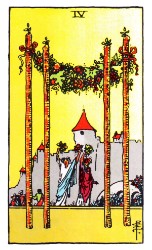
FOUR OF WANDS

Two people dancing beneath what looks very much like a wedding gazebo.  There is an element of sex here but in the more traditional sense of marriage and an on going union.  A happy card that includes the idea of sex without actually signifying it outright.

TWO OF CUPS

A man and a woman hold chalices and gaze into each others eyes.  This is a card of profound bonding and love, the start of a serious relationship.  While it can often indicate something as mundane as a good business partner or a best friend, it can also indicate a deep romantic and sexual relationship.

THREE OF CUPS

Three women dance together, chalices raised in mutual salute. Sex is not necessarily a central theme in this card but it’s a possibility because the central theme is PARTY!!!!  This is a card of joyous celebrations so why not sneak a little whoopee into the celebration? May also indicate a happy three way relationship.

THREE OF SWORDS 

A heart pierced by three swords.  This can often indicate a monogamous relationship in which one of the partners has decided to be not so monogamous.  He or she may be screwing around and it’s breaking the partners heart.

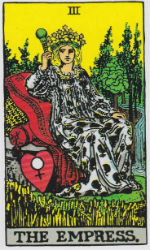
THE EMPRESS

An Earth Mother type of woman reclines on a couch holding a sceptre loosely in one hand.  Again, The Empress is not exclusively about sex but it’s definitely included in her vibrations.  Unlike her sister card, The High Priestess, who appears to be a little prim and proper, The Empress is openly sensual.  She reclines comfortably on her couch, legs slightly spread with a definite, “come hither,” look on her face. If you’re involved with The Empress, expect a good time.  On ALL levels.

THE HIEROPHANT

An individual who looks like a pope sits stiffly on a throne between two pillars while two monks bow down to him.  The Hierophant is mainly about organized religion and dogma, so it may seem strange to include it in this post. The point, though, is that The HIerophant is about CONVENTIONAL religion rather than spirituality.  In that sense, if this card shows up in a reading about a relationship you can expect it to be a very CONVENTIONAL relationship with very CONVENTIONAL sex. In other words, always the missionary position, probably with the lights turned out and only when the kids are fast asleep.  If you’re into sex toys and trapezes in your boudoir, RUN AWAY, RUN AWAY . . .

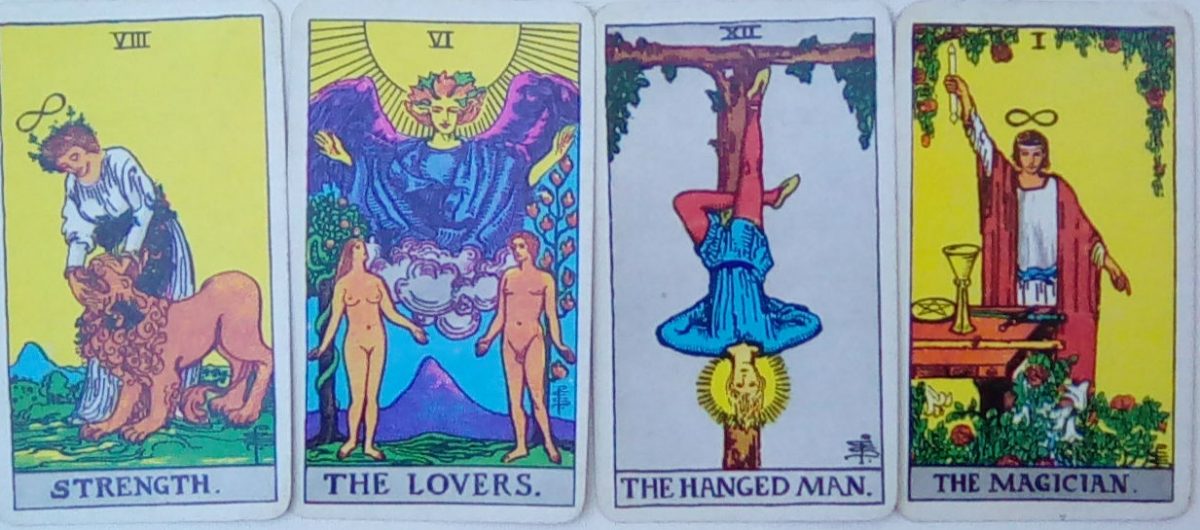
THE LOVERS

A nude man and woman stand in a Garden of Eden setting while a snake climbs a tree next to the woman and an angel hovers over them.  As the name indicates, this card is about love and not JUST love but triple whammie hit in the head with a sledge hammer love. These two people are absolutely thunder struck and there WILL be sex.  Really good sex.

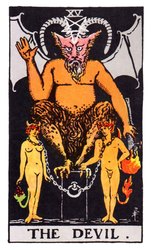
THE DEVIL

This is obviously the same couple from The Lovers, only they’ve been driven out of the Garden of Eden and are now sporting horns and tails while a demon hovers over them instead of an angel.  There is a very strong element of sexuality here but it’s not what you’d describe as happy sex. Instead of joy we find pain and enslavement. It can indicate sexual addiction, BDSM games that have gone WAY too far into pain and humiliation,  or the sexual element of a physically or emotionally abusive relationship. And, to me at least, it’s a sad card: it’s taking one of life’s greatest joys and turning into something sick and twisted.

So there you have it.  When you see these cards in a reading think about sex.  Or think about it anyway – it’s always fun.


The Fool – Alone but not Lonely

In the first (or the last, depending on your perspective) card of the Major Arcana we see The Fool starting off on his Spiritual Quest, a dog barking at his feet, his eyes turned toward the heavens.

And he’s very much alone.  But maybe not lonely.

What starts us on a Spiritual Quest?  It’s certainly not because things are going swimmingly.  Sometimes it just a chronic, nagging feeling that something in our lives is just not quite right.  Sometimes it’s a sudden flash of insight that’s like the first rolling stone that starts an avalanche.

Frequently it’s some life event that knocks us ass over teakettle and forces us to look at the fact that our assumptions and beliefs have been wrong all along.  That what we took for granted isn’t worth a bag of spit. The death of a loved one. The suicide of a coworker. Surviving a crash or a deadly disease.

Even then, many people will embrace what might be called “a pseudo-quest,” or perhaps, “an aborted quest.”    Shocked and shaken right down to their toes by some near catastrophe they respond by pulling the covers over their heads and crawling into the safe, warm womb of organized religions.  Like the men kneeling in front of the pope in The Hierophant card they look to others for spiritual truth rather than seeking it in their own hearts.

The person on a true Spiritual Quest is there because he or she HAS to be.  The choices of pretense, dull lassitude, and being a comfortable member of the herd no longer exist for them.  They have a burning desire to know – or at least seek – the truth and that desire can’t be ignored.

And, yes,  that can feel lonely at times.

For one thing most people aren’t really very interested in looking at the verities of Spiritual life.  The next time that you’re at a family gathering just casually mention that everyone in the room is going to die sooner or later if you don’t believe me.  You may not be invited back and, if you are, I guarantee no one will want to sit next to you at Thanksgiving Dinner. People actually seek out toys, money, meaningless sex, and anything else they can think of to AVOID talking about death and they don’t appreciate it when someone puts the subject right up in their faces.

A second factor, though, is that your Spiritual truths are YOUR Spiritual truths and not necessarily anyone else’s.  As you tread your way down the path of The Fool you will discover certain things that you know in your heart are true but the people around you, even your loved ones, may think that you’re out of your mind.  Or very much a Fool.

I remember when I first realized that visualization actually causes the things we visualize to manifest in our lives.  And I don’t mean just reading about it or acknowledging it as an abstract idea. I mean actually sitting my butt down, doing the visualizations and having them actually manifest.

I was blown away.  “This,” I thought, “is magic.  Real, honest to goddess, freaking magic!”

And that realization was followed by a whole series of other realizations.  If my thoughts and emotions can cause things to manifest in my life, then my life is . . . a manifestation of my thoughts and emotions.

Which means that I made this mess.  Not my parents, not my environment, not my culture, not random circumstances.  This thing I call my life is . . . ME. My thoughts. My emotions.

Which means that I’m responsible for it.  It’s my karma that I made. BUT . . . it also means I can change it.  And, man, that’s not just magic . . . that’s freedom!

It was a major turning in The Fool’s Path and I was tremendously excited about it.  The people I tried to share it with . . . not so much. My New Agey friends sort of yawned and said things like, “Oh, yeah, I think I read something like that a long time ago in Ram Dass.  Or was it, ‘A Course in Miracles?’ Maybe it was, ‘Codependent No More . . .”

My more conventional friends either edged slowly away or their mouths hung open for a moment before they changed the subject.

I realized eventually that it was MY Spiritual truth.  It was a result of my Tarot readings and my studies and my meditations and it fit perfectly at that exact moment in MY life.  The fact that other people didn’t understand it or know it or really, really dig it in their own hearts didn’t matter. What mattered was that I had found one of my truths.

And there’s a Spiritual truth in that realization, too.  Just because you’re alone in your beliefs doesn’t mean you have to feel lonely.  In all likelihood the people around you don’t share or understand your truths because they haven’t done the work that you have or they just don’t care.  That doesn’t diminish what you know by one little bit. Every truth that you find along the path is a jewel to be treasured and uncovers a little bit more of who you really are.

The Hierophant and the Gatekeepers

A discussion of the ways in which religious leaders act as gatekeepers to keep people from true spirituality.

In my book, “Just the Tarot,”  I wrote this about The Hierophant:

“In the earliest Tarot decks this card was simply labeled, “The Pope,” and that’s exactly what he represents:  established religions. In fact, the Hierophant represents religion as opposed to spirituality. This card is about dogma and priests and ministers interpreting spirituality for you, instead of you experiencing it directly.”

Despite – or perhaps because of – being reared in the old Catholic faith I’ve always had problems with organized religion.

That resistance to it has been increased by the never ending parade of pedophile priests and the evangelical preachers who want to fuck anything and everything.  Except their wives, of course.

Keep in mind that these, “frail reeds,” (as they like to describe themselves right after they get caught) CHOSE to stand up in front of their congregations and hold themselves out as the messengers of god.  Got a problem? NO problem: god’s got the answer. BUT . . . you have to go through me to get the answer because I’m god’s messenger.

In essence, they become the gatekeepers to the divine and they only let in the people they choose.  Alan Watts, the Zen/Beat philosopher of the 60s, pointed out in The Joyous Cosmology: Adventures in the Chemistry of Consciousness that this is a very calculated position.  If you go into 99% of the churches in the West you’ll see a pulpit that’s raised far above the seats of the congregants.  It’s a literal, physical telegram: I’m better than you and I’m closer to god than you.

It’s become somewhat of a cliche’ to talk about the difference between religion and spirituality (“I’m more spiritual than religious, man.”) but that’s it in a nutshell.  Highly religious people feel that you have to go through a third party (priest, preacher,rabbi,imam) to get to god and highly spiritual people feel that you can – and should – do it on your own.

Religiosity leads to spiritual and ethical laziness, both for the preachers and those who are being preached to.  

Religious leaders tend to think that they’ve got divine truth and spirituality in their books (bible, koran, etc.), sort of like a firefly trapped in a jar.    If you’re confronted with a moral dilemma, you don’t pray or meditate because you can just flip open your Book of Truth and find the answer.

Religious congregants don’t try to figure it out on their own, either.  They just go to their religious leader and ask what god says about it, the religious leader opens his book, reads a few paragraphs, and SHAZAM problem solved.

Unfortunately, spiritual truth dies when it’s confined to a book just as surely as a firefly dies when it’s confined to a jar.  And spirituality, the contact with the divine, atrophies when it goes unused, when we turn it over to someone else rather than doing it ourselves.

In short, you gotta walk the walk, not just talk the talk.  You don’t gain insight by putting someone else’s butt on a meditation pillow – it has to be yours.

The good thing about churches and mosques and synagogues is that they’re symbols of the deep seated yearning for unity with the divine that lives in the human heart.  The bad thing about them is that – for the most part – they don’t nurture and grow and encourage that yearning.

Disclaimer: “As an Amazon Associate I earn from qualifying purchases.”