Solstice Thoughts: For Empaths Standing at the Edge of a New Year

Reflections on the past year and strategies for empathic coping with the year to come.

Sunday is the Solstice — the darkest day of the year — before our beautiful Earth begins its long, slow climb back into the light. In many ancient traditions, this moment marked the true New Year: not a calendar flip, but a turning point.

Light returns.

And this year, that matters.

A Difficult Year for Sensitive Souls

2025 has been a particularly rough year for many of us. It’s not surprising if you’re ending it feeling exhausted, raw, or strangely unsteady.

We’ve been inundated with horrific images. Norms we once relied on for stability have been violated again and again. The overall effect has been a pervasive sense of unsafety — not just politically or socially, but emotionally.

And while it feels endless, it helps to remember this:

in the span of a lifetime, five years is a very short time.

It’s only been five years since a global pandemic placed our very existence in question. Many of us were still recovering from a prolonged fight-or-flight response when the world was thrown into further chaos. What once felt “crazy” somehow got even crazier.

That constant state of activation takes a toll.

Why This Has Been Especially Hard on Empaths

If you’re an empath, this year may have felt truly overwhelming.

Empaths naturally absorb the emotional atmosphere around them. Other people’s suffering draws us in. Compassion isn’t optional — it’s automatic.

And that means one of our greatest challenges is keeping the outside, outside.

This year has been a near-constant boundary violation.

There has been a deliberate strategy — politically and culturally — to keep people off balance, upset, and reactive. A lack of empathy and compassion at a societal level doesn’t just distress empaths; it can destabilize us.

When the collective feels unhinged, empaths feel it in their nervous systems.

A Choice at the Turning Point

At this Solstice, we face a choice.

We can tell ourselves:

“The world has gone mad, and I need to hide.”

Or we can reframe this moment as:

“This is a difficult — but perfect — environment for learning new skills.”

Skills that help us survive and stay open.

The Core Skill Empaths Need Right Now

To navigate what’s coming, empaths must learn to distinguish:

What energy is mine — and what does not belong to me.

Right now, there is a lot of chaotic energy in the air. That means we need to perform regular internal “fact checks.”

Ask yourself:

• Am I actually in danger right now?

• Am I personally unstable — or do I just feel unstable?

And yes — it’s okay if you are occasionally a little crazy. We all are.

But if you’re not objectively falling apart and yet you feel like you are, that’s a strong sign the energy is coming from outside you.

Once you recognize that, the next question becomes:

How do I respond — without absorbing it?

Practical Strategies for the Year Ahead

Here are a few grounded ways empaths can protect their nervous systems:

Unplug intentionally.

Turn off the news. Step back from social media. Don’t answer every text like Pavlov’s dog. Your attention is precious.

Curate what you consume.

If you spend five minutes wading through the sewage of daily news, balance it with ten minutes of something hopeful — music, art, a book, a walk, a moment of beauty.

Name the manipulation.

Much of what we’re experiencing is designed to keep people in fight-or-flight. This isn’t accidental. Recognizing that helps break its spell.

When fear and outrage are being deliberately amplified, our most radical response is calm, mindfulness, and conscious detachment.

That doesn’t mean indifference.

It means sovereignty.

Walking Toward the Light

The Solstice reminds us that even at the darkest point, the turn has already begun. The light doesn’t return all at once — it comes back slowly, almost imperceptibly, day by day.

As we move into the new year, especially those of us who feel deeply, the work isn’t to harden or shut down. It’s to strengthen boundaries, choose what we engage with, and care for our nervous systems with intention.

That, too, is a form of courage.

May the coming year bring more steadiness, more discernment, and moments of real peace — both within us and, slowly, in the world we share.

Blessed Be.

How to Shine Your Star and NOT Be a Good Codependent

Do you ever feel invisible, like you’ve disappeared into someone else’s needs? The Star reversed shows how codependency drains us — and how to take back your light.

Of all of the forms of codependency, perhaps the most insidious is the, “good,” kind.  The kind where we’re actually making ourselves less, because it’s the right thing to do.  

Or so we think.  

Our personal light, our Spirit becomes dimmed because we’re trying to make someone else’s shine a little brighter.  If it goes on for too long, we can even forget who we really are.

WHAT CODEPENDENCY REALLY MEANS

When we hear the word, “codependency,” most of us think of the classic scenario involving an alcoholic/addict and the person taking care of him.  In that sort of a relationship, the alcoholic may have the money, but he’s too screwed up to really take care of himself.  The codependent takes care of him – sees that the bills are paid on time, buys the groceries, cleans the house, defends him from criticism, but doesn’t have any personal funds.  

The result, of course, is that neither party is able to survive on their own.  They are mutually dependent on the other for survival and they may hate each other but they also need each other.

At its root, though, codependency is any relationship where we chronically subordinate our own needs and desires to someone else’s.  

That can actually take the form of a noble pursuit.  In a very real sense, good parents subordinate their own needs and desires to rearing their children until the children can fly on their own.  We can also see it in home healthcare situations, where one partner in the relationship is literally too ill to care for herself and the other partner becomes a full-time caretaker.

These are the, “good,” forms of codependency where we’re basically just doing what’s right and what’s loving.  But they can still destroy us over the long haul.

MAKING OURSELVES SMALLER

One of the hallmarks of codependency is shrinking ourselves while inflating someone else.

In the home healthcare situation that I just mentioned, the partner who is healthy may be devoting her entire life to taking care of the partner who is ill, yet insisting that, “it’s no big deal.”  She may sacrifice her social life, her hobbies, her time for herself to an endless round of cooking, cleaning, medications, and taking her partner to medical appointments.  She may have completely given up her own life in order to preserve his.

Because the other person’s light is so dimmed, we do everything we can to make it shine a little brighter.  We praise them, we prop them up, we take care of their every need and we never, ever, let them feel that they are, “less than,” because of their illness.

Over time, this creates an energy imbalance that leaves us feeling like invisible ghosts, like we never had the chance to live as our fullest, most authentic selves because we’ve disappeared into someone else’s needs.

The real tragedy of codependency isn’t just exhaustion – it’s the slow erosion of Self.

THE STAR REVERSED

In the Tarot, the exemplar of codependency is The Star reversed.  When it’s upright, The Star is a beacon of hope, inspiration, and healing.  It’s someone who is fully shining his light into the world.

When it’s reversed, it can point directly to codependent patterns such as:

• Outsourcing your self-worth to another person.

• Over-giving and self-sacrifice until your own cup is bone dry.

• Healing others while neglecting your own healing.

• Depending on someone’s approval to feel hopeful.

• Pretending everything’s fine just to keep the relationship intact.

The Star reversed doesn’t mean you’ve lost your light, though. It means you’ve been dimming it.

THE ANTIDOTE IS RECLAIMING YOUR OWN LIGHT

The medicine for The Star reversed is to consciously reclaim your own radiance:

• Affirm your intrinsic value through affirmations, creative expression, and celebrating small achievements.  That can be as easy as taking a few moments to journal every morning and write about what YOUR dreams are.

• Set boundaries and practice saying “no” without guilt. That can be as simple as saying, “No, I don’t watch that television show,” or, “I’d rather listen to MY music.”

• Shift your focus from “I’ll fix them” to “I’ll care for myself first.” You DO have a right to savor your morning coffee before you make their breakfast.

• Anchor hope internally by nurturing personal goals, spiritual practices, or creative outlets.  Do you love to paint or write or garden?  Insist on taking some time for that every week.  No excuses and no interruptions.  Even if it’s only an hour, that’s your sacred space.

• Practice radical honesty — with yourself and others.  If you hate what you’re doing, you’ve got a right to express that.  If you think you deserve some extra praise and kindness instead of being taken for granted, you’ve got a right to that, too.

• Cultivate interdependence, where two whole people choose connection rather than two halves clinging to each other.  Especially if there’s an imbalance in money, remind your partner frequently of all of the things that you do and how much he’d have to pay to have someone other than you do them.  

Each of these steps helps you pour back into your own cup — and when you shine, you inspire others to shine too.

THE PARADOX OF HEALING

The paradox of this type of codependency is that we usually take it on precisely because we ARE good, loving, kind people. If we see someone who needs help, we help them.  If our child is troubled, we’re there for them 200%.  If our partners are ill, of COURSE we’re going to move heaven and earth to take care of them.

But as it goes on . . . and on . . . and on . . . that good, loving person who is our core being begins to erode.  It isn’t that we become bad people or quit caring – it’s that we simply begin to disappear.  We become nothing but appendages to the needs of the people that we’re caring for.

The lesson of The Star is to let our light shine again.  That core of ourselves that we’re losing through the codependency is what was healing the other person to begin with.  When we lose it, we lose our ability to heal, not just them, but ourselves.

We have to let our lights shine.

“The Star,” a personal affirmation poster available on my etsy site

Sex and The Devil Card – Time for a New Definition?

This is an exploration of the meaning and definition of The Devil tarot card. Is it time to de-sexualize it?

It may be time to take the sex out of The Devil card, or at least scale it way back.

When we look at the traditional definitions of The Devil, he’s a pretty horny guy.  He’s linked with illicit affairs, cheating on your spouse, sexual “perversions,” and a variety of scandalous behaviors that good, decent folks just don’t do!

But maybe he’s been typecast.

THE LOVERS AND THE DEVIL – SAME COUPLE ON A DIFFERENT DATE

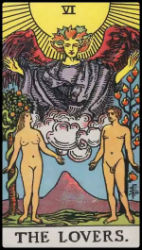
If you hold up The Lovers and The Devil side by side, you can’t help but notice that they’re the same couple.  

In The Lovers, they’re radiant and glowing.  They even have an angel hovering over them to let us know that their love is blessed by heaven above.

Fast forward to The Devil and we see them with chains, horns, and flaming tails.  There’s a serious, “We may have made some questionable choices,” vibe.

Which begs the question:  what happened to these two?  Did they skip couples therapy and just dive straight into the underworld?  Did he leave the toilet seat up one too many times?

A QUICK HISTORY LESSON

The Tarot as we know it shows up in the 1450s – prime time for the Catholic Inquisition.  This was NOT an era noted for swingers or free love.  Sexual morality was tightly policed:  adultery, premarital affairs, straying outside of monogamy, even masturbation could get you killed by the Bible Police.

So when Tarot artists painted two nude figures on a card, everyone knew what that meant.  It meant . . . you know . . . S – E – X.  But, nude figures with angel = good, approved sex and nude figures with devil = bad, nasty sex.  

Boom – association locked in.

FAST FORWARD TO MODERN TIMES

But here we are in the 21st Century and, my oh my, how things have changed.

Remember just a few years ago when people were totally titillated by the book (and movie) “Fifty Shades of Gray?”  It’s nothing but an exploration of bondage and domination dressed up as a novel and – despite the fact that it may have been one of the worst written books in history – it sold over 150 million copies.

We know that people were doing a lot more than just reading it, too, because emergency room visits related to sex toys jumped up by over 50%.  They were actively checking out those techniques, not just reading about them.

We also know that over a third of Americans admit to cheating on their spouses.  And there’s no doubt that THOSE stats are way under reported.

Only about 5% of Americans report being virgins on their wedding nights.  What was once mandatory is now more of a museum exhibit.

And monogamy?  Still popular but VERY flexible in its applications.  Given the divorce rates, it’s obvious that we’re more into serial monogamy than actual this-is-for-life monogamy.

In a nutshell, we’ve outgrown the black-and-white, “good sex versus bad sex” binary thinking.  The Devil’s definition is starting to feel more than a little outdated.

SO WHAT DOES THE DEVIL REALLY MEAN?

Here’s a thought:  maybe The Devil isn’t about sex gone wrong.  Maybe it’s about love gone wrong.

Look closely at the card:  the chains around the couple’s necks are so loose that they could slip them off at any time.  Which means that they’re staying bound by choice.  Or by fear.

That’s the real Devil.  The loveless marriage that drags on because it’s easier to stay than to leave.  The codependent relationship that’s fueled more by desperation than devotion.  The romantic partnership that’s built on money, appearances or habit instead of love.

Those are the heavy chains that we put on ourselves.  Not fiery lust, but destructive attachments that slowly erode our joy.

FINAL WORD: TIME TO RETIRE THE SCANDAL?

Maybe it’s time to let The Devil out of the dungeon of outdated sexual shame.  He’s got bigger (and scarier) fish to fry.  The next time this card lands in a spread, don’t ask, “Who’s cheating on who?”  Instead, ask:  “Where in my life am I bound by something that no longer serves me?”

That’s The Devil’s true temptation: not passion or sex, but the CHOICE to stay stuck in a loveless relationship when freedom is only a tug away.

“Just the Tarot,” by Daniel Adair – a kindle ebook available on Amazon

Love, Limerence, and The Ace of Cups? How to Heal Obsessive Attraction with Self-Generated Love

Ever fallen in love with someone you couldn’t have? Psychologists call it “limerence,” but spiritually it’s more than just a crush. This post explores the difference between obsessive attraction and true love, why we sometimes fall for the “wrong” people, and how to heal by generating love from within. Featuring insights from psychology, past-life theory, Ram Dass, and the Ace of Cups, it’s a guide to shifting from longing to self-created wholeness.

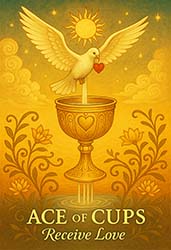
Ace of Cups – A Tarot affirmation poster available at Synergy Studio.

Did you ever fall in love with someone you shouldn’t have?  Someone who was unavailable, but you still felt intensely attracted to them?

Maybe it was your next door neighbor who was happily married.  Maybe it was a co-worker and you KNEW that a work place romance would be a disaster.  Hell, maybe it was your 8th grade teacher who was just SO perfect in every way.

GETTING CRUSHED

We used to call that, “getting a crush,” on someone.  We meet someone and we just know that we’re supposed to be together, even though everything else is saying, “No, you’re not.”

Psychologists – as psychologists tend to do – have invented a new term for it which is, “limerence.”  Here’s a definition:

Limerence is an involuntary, intense, romantic obsession characterized by intrusive thoughts and a longing for emotional reciprocation, often leading to emotional suffering due to unmet romantic needs.”

In other words, having a crush on someone you probably shouldn’t have a crush on.

IT’S ALL PERFECTLY NATURAL

Now, this has been going on ever since the world began and, of course, it’s caused a passel of trouble. Marriages end, people lose their jobs, reputations and careers are destroyed.  All in the name of love.

Which is puzzling, isn’t it?  Love is supposed to be this grand, wonderful adventure that lets us soar to new heights on the wings of the person we’re in love with.  So why is all of this so painful and frustrating?  

THE CALM, INNER VOICE

I had a teaching dream once about spirit guides and spiritual guidance.  I call them, “teaching dreams,” because they’re very lucid, very clear and they usually have to do with some issue that’s really bothering me.

The subject of this dream was, “How do I distinguish true spiritual guidance from my own desires and ego?”

And the answer was that spiritual guidance is never harsh, never critical, never ominous.  It’s always gentle, loving, and kind and leaves us feeling nurtured rather than criticized or beaten up.

The same principle applies to falling in love.  If it feels sweet and kind, it’s probably real love.  If it involves obsessive thinking, insecurity, self-doubt, or criticism . . . hey, it may be a hell of a crush, but it ain’t love.

WHY DOES IT HAPPEN?

Why do we fall in love with people who aren’t, “right,” for us?

Psychologists, philosophers and playwrights have been trying to figure that one out for hundreds of years and really haven’t made much progress.

My personal theory is that these are relationships that are, “out of time.”  And I don’t mean that in the sense of, “Whoops, we’re out of time.”

Rather, what I’m talking about is old relationships from previous incarnations that have been displaced in time.  The feelings are still there, but they’re no longer appropriate in their old form.

Perhaps we were married to someone or had a super, sizzling hot sexual affair with them two lifetimes ago.  Because of that intense attraction, we meet them again in this lifetime.

Only – guess what? – they’re married to someone else.  Or they’re our teacher or mentor.  Or perhaps we’re straight, but they’re the same sex that we are.

The feelings are just as intense.  The desire to be with them is just as strong.  But it just ain’t happening this go-round.

WHAT SHOULD WE DO?

Well . . . nothing, in most cases.  Just observe it and sit with it.  Realize that you love this person but that the love has to take a different form than romantic love.

We can feel it.  We can cherish it.  But we don’t have to act on it.  If there’s a huge internal conflict about getting romantically or sexually involved with someone, that’s not a very good way to start out, is it?

FILL YOUR HEART WITH LOVE

Ram Dass said that we frequently mistake other people as the source of love, rather than realizing that they’re just vehicles that get us to the love.

When we’re seriously crushing on someone we shouldn’t be crushing on, we feel that as a loss, as a deficit, as if we’ve got this Grand Canyon sized hole in our hearts that only they can fill.

Fortunately, we’ve got this wonderful part of our energy systems called, “the heart chakra.”    It can generate an infinite amount of love because love actually IS infinite.  

We can sit down at any time or place and just meditate on love, meditate on that chakra filling up with that sweet, kind essence that is love and the feeling of not being complete immediately goes away.

IT ISN’T THEM, IT’S US

We’ve been programmed into believing that love always flows out of someone else and into us.  That if someone, “out there,” doesn’t love us, we won’t get the love we need.

That’s really the source of the pain in limerence.  We’re convinced that without that other person’s love, we’re just going to be miserable and unfulfilled.  We can’t get to the love we want and so it hurts.

Not true.

We create our own love, in our own hearts.  We receive love when we open our heart centers and intentionally, consciously fill them up.

THE ACE OF CUPS

When we look at the Ace of Cups we can see this message very clearly.  The cup is our heart and the love isn’t flowing out of another person into the cup.  It’s flowing straight out of the Universe.  Love is everywhere.  It’s a Universal energy and we just need to open ourselves to receiving it.  If we occasionally receive it from another person, that’s great.

But if we don’t, that’s not a tragedy and it doesn’t need to be painful. The source of love is always in our own hearts.

“Just the Tarot,” by Dan Adair – A kindle ebook available on Amazon

Empaths, Elections, and Staying True to Our Own Energy

Building effective boundaries for empaths.

If you’re an empath and you’ve been feeling kind of sick to your stomach lately, believe me – you’re not alone.  Many of us have experienced the recent election in the United States as something that makes us want to curl up in a ball under a blanket for the next four years.

It’s important for us to explore how this is affecting us from a bioenergetic perspective, though, and not just from a political or emotional perspective.  What is all of this DOING to our energy and our energy fields?

What’s one of the first words that come to mind when we contemplate being an empath?  Boundaries, right?  Boundaries, boundaries, BOUNDARIES!  

Empaths have extremely porous personal boundaries and very leaky energetic boundaries.  In a way, that’s what makes us empaths.  “Normal,” people have fairly strong boundaries and a strong sense of, “I’m over here and you’re over there and we’re two separate beings.”  For a normie, what another person is feeling stays inside of the other person, unless the other person decides to share it.  For an empath, other people’s feelings are constantly flooding into us. It’s very easy for us to merge with those feelings and mistake them for our own.

That’s one of the reasons that many empaths become codependent.  We merge so totally (and so easily) with other people’s emotions that we mistake them for our own.  If someone we’re close to is having emotional or mental problems, we think that we have to manage their drama because it feels like it’s our own. We end up taking care of their lives instead of our own.

So one of the first steps to becoming a healthy empath is to learn to identify our own energy and separate it out from other people’s energies.  We learn this at an early age and many of us become socially avoidant as a result.  We realize that if we’re around people who are angry, depressed, or violent, that we just soak all of that in and it fucks us up.  One strategy we use to deal with that is to just avoid people in general: many empaths become radical introverts.  Which works, but it’s not the BEST strategy, right?  We really can’t cover our heads with the blankets for the next four years.

Can we?  Um . . . no.  I guess not.

We have to learn to separate our energy fields in better ways.

The human energy system is really quite simple to visualize.  As Alla Svirinskaya says in her book, “Own Your Energy – Develop Immunity to Toxic Energy and Preserve Your Authentic Life Force,”  we can think of it as the physical body or core, which is surrounded by a couple of other energetic layers or bodies which are the emotional body and the mental body.  Those other bodies are usually seen as egg shaped, so we end up with a picture of it that looks like this:

For a normie, those extra layers act as a wall to keep out other people’s energy. They filter out negative energies so that they never reach the core of the physical body. For an empath, though, they act as a bridge.  Instead of blocking us off from the emotional identity of people who aren’t us, they allow it to flow right into our personal energy fields which frequently overwhelms us, leaving us confused and injured.

Most empaths are dealing with those dynamics on a daily basis.  What we forget, though, is that our personal energy fields exist inside of larger energy fields.  Any time that you put a group of people together, their personal energy fields are going to merge to some extent and generate a group energy field that’s composed of the collective emotions of all of those people. And we live within those other energy fields.

In a very real sense, we could talk about the vibrations of a particular town or a county or a state.  Those vibrations are the collective energies of the people who live in those places.  Texas, for instance, has a very different vibration than California. And, yes, countries have a collective energy field, too, which is brings us back to the topic at hand:  dealing with this election.

About 72 million Americans got together and voted for a candidate who oozes hatred and anger out of every pore of his orange skin.  THAT is the collective energy that we’re dealing with right now and THAT is what’s making us feel sick.  Put simply, there’s a whole lot of hatred and anger out there in the collective energy field and it’s seeping in to our personal energy fields.  As empaths, we are especially vulnerable to this.

So what can we do about it? Well, we need to remember that the key to being a healthy empath is to be able to distinguish OUR energy from OTHER’S energy.  We need strong boundaries and we need that sense of, “this energy belongs to me and that energy doesn’t.”

Empaths are (for the most part) kind, loving, compassionate people.  That just goes with the territory.  When you really and truly understand another human being on the deepest level, it’s very difficult to stay angry with them.  Or to hate them.  Or to judge them too harshly.

Hatred, anger and judgements are NOT our energies and that’s why they make us sick.

A good strategy for us, then, is to be very conscious of those energies existing inside our personal fields. If we start to feel really, really, REALLY pissed off at the Trumpsters, we can stop and say, “This is NOT my energy.  This is their energy.  I won’t own it.”

Another strategy is to do what Chagdud Tulku called, “antidoting.”  The antidote for hatred is love and the antidote for anger is compassion.  I’m not suggesting that we turn ourselves into human doormats for the Trumpsters.  Rather, we’re just embracing our own nature.  By embracing our own nature, by being as compassionate, kind, and caring as we can, we automatically separate OUR energy from THEIR energy and – surprise, surprise! – we’ve got boundaries.  Suddenly, they’re over there and we’re over here and we don’t have to live in their hatred or let it blend into our energy.

Shazam!

EMPATHS, EARTHING, AND MEDITATING CODEPENDENTS

Staying grounded as an empath.

So I just received my Amazing Hooga Earthing Mat from the very nice UPS driver and I should be incredibly spiritual after just a few days of using it.  

The basic theory behind them is that our energy systems get in a kerfuffle because we’re exposed to negative people, places, and things and, when we walk barefoot on the Earth, it restores our systems to their natural, harmonious balance.  Earthing Mats simulate that very same energy and get our auras all fluffy and pretty again.

I decided to get one because I’ve recently become aware of the fact that it is of tantamount importance for empaths to stay thoroughly grounded.  If we don’t, we start to dissolve like a piece of salt in the rain.  Earthing is a dandy way to avoid that.

EMPATHS AND EMPATHY

Being an empath is sort of hard to describe to a, “normal,” person.  First of all, of course, being an empath is not equivalent to being empathetic, although most empaths are highly empathetic.  An empathetic person might sympathize with another individual to a point where they can imagine what the other person is feeling and thinking.  Empaths actually experience what the other person is feeling in real time.

Empaths are also not psychics, although most psychics are empaths.  A psychic will focus on another person, “read,” their energy, their emotions and their thoughts, and then weave all of that into a coherent meaning, much like telling a story.  Empaths, on the other hand, are simply bombarded with information about the other person without really knowing what it all means.  We automatically glean far more details about the other person’s energetic and emotional state than what’s on the surface, but we don’t necessarily know how to put it all together.

To make it even more confusing, there isn’t just one type of empath.  There are empaths who actually hear what other people are thinking.  Other empaths feel other people’s emotions as they occur.  Some are telemetric empaths who, “get a reading,” merely by touching a piece of clothing or jewelry that someone else has owned.  A few empaths are highly attuned to the feelings of animals, but won’t pick up anything from other human beings.  Precognitive empaths may get very strong insights about what’s going to happen to a person in the future.

EMPATHS AND EGO STRUCTURE

One thing that all empaths have in common is a relatively weak ego structure.  It makes perfect sense, when we think about it.  Our ego is our sense of who we are, and the first part of knowing who we are is knowing that you’re over there and I’m over here.  Your, “you,” starts with your skin and all of your emotions, energy, and thoughts reside inside of your skin and all of mine reside in mine.  The only way that another human could possibly know what we’re thinking is if we tell them.

Which is very much not true for empaths.  For an empath, what’s going on in the other person’s mind is also going on in our minds, simultaneously with what WE’RE thinking.

All of which can make for a very confusing state of affairs, because we’re never quite sure which part of the conversation is ours and which part is yours.  For an un-grounded empath, there really ARE no significant boundaries or borders.  

There’s an old Spanish expression which goes, “Mi casa, su casa,” or, “My house is your house.”  Now change that to, “My brain is your brain,” and you get an idea of how truly weird it can be for an empath to hold a simple conversation.  Most empaths have to sit quietly after a meaningful exchange and decode exactly what thoughts came from which person.

EMPATHS AND CODEPENDENCY

One of the ways that the weak ego structure of empaths shows up is in codependent behavior.  Codependents tend to revolve around other people, much like the moon revolves around the earth.  Sometimes that’s a result of having been raised in an alcoholic or abusive family.  Sometimes it’s because we have a particular personality type.  And sometimes it’s because we’re empaths who haven’t learned to separate ourselves from other people.  

What happens with empaths is that we become enmeshed in the other person’s energy, in their thoughts, emotions, and their life patterns.  Since empaths already have a weakened sense of boundaries, they can easily dissolve into a more dominant person’s energy system.  In essence, they become overwhelmed and end up as bit players in someone else’s movie, instead of starring in their own.  They not only feel the other person’s emotions, they become the other person’s emotions.

EMPATHS AND MEDITATION

Empaths also need to be very careful about the type of meditation they practice.  

Many types of meditation are geared toward weakening the ego structure.  We’re basically trying to get past that chattering mind stream that prevents us from truly relaxing into deep meditation.  Those techniques involve what’s referred to as a, “bare awareness,” method, where we might focus on our breath or a mantra, or a candle flame, until the chattering mind calms down and recedes into the background.

BUT . . . studies have increasingly shown that meditation is highly correlated with PSI or psychic abilities.  If we tritty trot off to a meditation center for a two week retreat, we’re probably going to be more psychic coming out of it than we were going in.  For a normal person, that involves a significant decrease in ego control and, “becoming one,” with the universe and our fellow humans.

An empath, though, is already wide open and our challenge lies in shutting down some of that in-flow of information.  Deep meditation can destroy whatever barriers we’ve managed to erect and leave us completely adrift in other people’s energies.

Mindfulness meditation seems to be the, “go to,” method for empaths.  It’s a constant reminder to stay in our own bodies in the present moment and to separate from all of the drama out there.

THE EIGHT OF WANDS

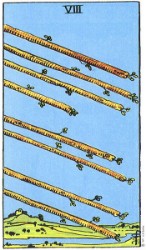
Being an empath can feel very much like the Eight of Wands looks.  Wands represent ideas and this card shows inspired ideas raining down from heaven.  For an empath, though, the ideas may be far from inspired and not at all our own.  

If everyone we met was in a perfect, loving place, being an empath could be pure heaven.  We’d just walk around grinning while all of those good vibes poured straight into us. Unfortunately, that’s far from the current state of affairs and a tremendous amount of what we absorb is toxic.

The answers for empaths seem to be strengthening ego structure, not weakening it.  Building boundaries and borders, not letting them down.  And, above all, staying grounded.  Which we can begin to do by planting our tootsies firmly on the Amazing Hooga Earthing Mat.

Love, Therapy, Ram Dass, and God in Drag

A look at the sources of love.

I’ve been reading a book called, “Getting the Love You Want,” by a psychotherapist named Harville Hendrix.  The theme of the book is basically, “We all fall in love, a lot of us fall out of love, and here’s how to fix that.”  He’s a smart guy, did some excellent analysis, and I’d probably recommend the book.

But he never did get into that basic question of, “What IS love?”

Now, there’s been an awful lot of brain and biochemistry research over the last 20 years.  What the scientists have determined is that when we magically meet, “the right person,”  giant sparks fly out of both our genitals and our subconscious minds, then our brains start pumping huge amounts of endorphins, and – SHAZAM! – we’re in love.

That’s what we could call the, “reductionist,” approach to love.  What we call love is ultimately reduced to brain and body chemicals that cause us to feel wonderful.  From that point of view, love is nothing more than a biochemical reaction – probably based on the need for the species to procreate – that we dress up with a lot of romantic notions, boxes of candy, and Hallmark cards.

It’s a classic case of the whole being more than the sum of the parts, though.  Love isn’t just hormones.

Love is an energy.  When we have it in our lives, we don’t just feel better, our lives actually work better.  Its presence seems to trigger huge amounts of synchronicity and serendipity, we suddenly have solutions to most of the problems that we encounter, and we’re harmonious with the Tao, the Universal Flow.  When we don’t have it, life can feel like a meaningless slog through knee deep mud.

So the obvious course of action seems to be that we should all run right out, throw a net over someone, and fall in love with them.  Unfortunately, as Hendrix pointed out, right around 50% of us fall out of love, which is extremely painful, and we’re right back where we started, only we hurt a little more than we did before and we’re a lot more cynical.  Then we go back out, find another person to fall in love with, and rinse and repeat. 

 As much as Americans revere the idea of finding our Soul Mates, most of us are actually serial monogamists, who find one Soul Mate after another after another until one of them finally sticks.

I got a BIG clue on all of this a few years ago when I was listening to a Ram Dass talk after my partner had died.  He said that the reason that we feel so devastated after a death, a divorce, or a break up is that we mistake the person for the love.  The person is the vehicle that gets us to the love, not the love itself.  Since we have so totally identified the love with the person, though, when they go away it feels as if all of the love has gone away.

As near as I’ve been able to figure out, there are basically three sources of love.  There’s the love we derive from our relationships with other people.  There’s self-love, which so many of us struggle to achieve.  And then there’s the love that flows out of our spiritual connection with Source Energy, the god-head, the Tao, the Flow.

The trick is to understand that all three of the different forms are actually the same energy, the Source Energy, dressed up in different costumes.

Human beings are hardwired to receive love from other human beings.  And that’s a very good thing, indeed.  It’s like a built in on-ramp to Source Energy and it should be an effortless, natural process.  Unfortunately, the second that we enter the world, a lot of other ingredients get added to that process.  We start out with pure love and then we throw in crazy parents, cultural expectations, dysfunctional partners, etc., etc., etc, until the love becomes a shit show.  

Then we find ourselves sitting in a therapist’s office, asking, “What happened?  All I wanted was for someone to love me.  What happened?”  If we’re blessed with a really good therapist, we can start to untangle those knots and sort it all out.  “Okay, this part of the shit show came from your depressed mother and this part of the shit show came from high school and this part of the shit came from your ex-husband.”  As we identify and subtract more and more of the added ingredients that doomed our relationships, we move closer to that model of pure love that we were born with.

Where our culture lets us down, though, is in not identifying the actual origin of that energy that we call, “love.”  When we finally realize that the love is flowing OUT of Source and THROUGH our partners, then we can wake up and realize, “Huh . . .the love is always there and it’s abundant.  I can find it through my partners, but I can find it in a lot of other ways, too.  I can actually love myself.  I can meditate on Source.  I can connect with that energy in a zillion different ways.”

That’s not to put down romantic love in any way.  Romantic love is a grand sort of a feeling and it’s probably the fastest way for us, as a species, to reach that love energy.  BUT . . . it’s not the origin of the energy.

Perhaps the best solution is something else that Ram Dass suggested:  “Treat everyone you meet as if they were God in drag.”  When we start looking at the people we love as little bits of that God/Goddess/Love energy shining out at us through their human forms, then we can honor them, honor the process, and honor the love.

The Ace of Cups, Love Without a Pronoun, and Purple Thongs in the Back Seat of the Mercedes

A look at love as existing independently from people.

In the esoteric system of the Tarot, Cups represent emotions and the Ace of Cups represents pure love.  This is a card of love-as-an-energy, pouring into the world out of thin air, magically filling our lives with wonder and ecstasy. The love isn’t, “attached,” to anything, it’s just there, existing by itself.

Love-as-an-energy is a notion that’s foreign to most Westerners, so it takes a little bit of work to wrap our heads around it.  We can see a similar notion in Reiki energy healing. The Reiki practitioner directs healing energy (which we could call, “love”) to the person or situation that is sick.  BUT . . . and this is a subtle and important distinction . . . the practitioner doesn’t tell the energy what to do.  She just sends the energy and the energy solves the problems.

Huh?  What in the hell does that mean?

Well, suppose we’ve got a friend who’s got kidney problems, or at least that’s what the doctor told him.  So we sit down and light our white candles and incense and we try to visualize as much healing and love flowing toward our friend’s kidneys as we possibly can.  Only the doctor our friend saw was distracted that morning because his mistress had left her purple thong in the back seat of his Mercedes and his wife found it and now his wife and his children aren’t speaking to him and his mistress wants her thong back and his life has just turned into a shit burger.  So he accidentally grabs the wrong chart and diagnoses a kidney problem when our friend actually has exhausted adrenals.

There we are, then, sending tons of healing energy to our friend’s kidneys when his kidneys are perfectly fine and it’s his adrenals that need a little TLC.  Instead of helping, we’re accidentally short circuiting the healing process because we decided what the problem is and we were wrong.  

The Reiki practitioner, on the other hand, just sets the intention of sending the healing energy to his friend but lets the energy figure out what the real problem is and what really needs to be healed.  In other words, he views the energy of love and healing as something that exists independently of the healer and something that has its own intelligence, an intelligence that’s far greater than ours.  You send it, but you don’t direct it.

All of which seems completely weird to most of us, because we view love as coming out of SOMEONE.  We view love as always being attached to a pronoun.  I love YOU.  YOU love me.  SHE loves him.  We view it as something that people generate themselves and bestow on others, not something that flows THROUGH us, but isn’t really ours.  Even when we talk about divine love, we view it as a very personal transaction where God or the Goddess or the Angels or the Guides are personally sending us love because, you know, we’re really nice people and why wouldn’t they?  We don’t just want the love, we want the hug that goes with it.

Ram Dass expressed a lot of the same ideas when he talked about love and relationships.  What happens when we fall in love?  We’re tritty-trotting down The Great Road of Life when we suddenly see another human being and, for whatever reason, something inside of us says, “YUM!!!  I want some of that.”  So, penises get hard, vaginas get moist, we leap into the nearest bed at the first opportunity and make love like bunnies until we fall over in an intertwined heap of sweat and hormones.  Big, silly grins for everyone.  Yay!

There’s a lot going on beneath the surface, of course.  Our brains are pumping out oxytocin and we feel high as a kite because, “we’re in love.”  That very feeling and all of those pleasure hormones predispose us to view the other person favorably and as someone who’s wonderful and magical and the source of that amazing feeling of being in love.  Many times we’re totally puzzled because our friends see our love object as a schlub with a bad haircut, instead of the Amazing Wizard of Love and Happiness that we perceive, and so we begin to cut our friends out of our lives and our lover becomes the SOLE source of love in our existence.

What happens when our lovers die or we break up because we caught them playing hide the sausage with the neighbor’s teenage daughter?  Grief happens.  Deep, devastating, profound grief.

Ram Dass looked at that whole process and said, “Yup, that’s what happens,” but he put an interesting twist on it.  He said that it isn’t the loss of the person that we’re grieving, it’s the loss of love.  The person was just a vehicle in human form that GOT us to the love that we craved and we thought he or she was the source.  Put another way, we mistook the car for the destination.  

That’s basically seeing love-as-an-energy.  It isn’t an energy that comes FROM our lovers, it’s an energy that flows THROUGH them.

None of that denigrates or diminishes the wonderful process that we call, “falling in love.”  Falling in love seems to be one of the ways that nature has hard wired us to reach that state of love that heals us and makes us whole.  It’s a good thing.

What it DOES do, though, is to remove a lot of the negative qualities that too frequently go along with that process.  When we realize that love is out there, that it exists independently of other people, then falling in love loses its addictive and dependent nature.  We don’t view the other person as the source of love, we view them as a portal in our lives – sometimes temporary and sometimes lasting – through which the love flows.  We don’t depend on them for our source of love, like a junkie depends on his dealer for heroin.

If the other person goes away, that’s okay, because the love remains and we can tap into it any time that we want to, just by opening our hearts to that energy.  In a very real sense, we become the source of our own love, because we’re the ones who are making the conscious decision to stay open to that amazing energy, no matter what happens or who comes and goes in our lives.

And then we’re living in love, instead of falling in love.

It’s a good thing.

The Two of Cups, Low Libidos, and Smoldering Men in Skirts

A brief look at the myths and expectations surrounding American sexuality.

It’s always kind of fun – and illuminating – to identify a cultural myth.  Cultural myths are strong beliefs and assumptions that we have about our societies or countries which are almost totally unsupported by facts.  But we still believe them.

I remember that my first experience in cultural, “myth busting,” concerned monogamy.  Most Americans hold a very strong faith in the notion that everyone has a Soul Mate, that we will eventually meet that Soul Mate, and that we will live happily ever after when that happens.  But, of course, our divorce rate has held steady at 45 to 50% for decades, so it’s pretty obvious that the standard monogamy model isn’t working out very well for at least half of us.  Nonetheless, we keep getting married.  And divorced.  And married.  And divorced.

It was such a liberating experience for me to finally get some perspective on that issue and be able to say, “Oh . . . it’s just bullshit.  I’m not a failure and all of my friends who’ve been divorced aren’t failures.  The model is flawed.  Happily Ever After Marriage for everyone is a cultural myth.”

Many cultural myths are relatively harmless exercises in ego.  Germans, for instance, have long considered themselves to be an extremely clean and fastidious people.  Yet, some polling in the 1970s found that they’re the least likely of all Europeans to change their underwear on a regular basis.  Italian men have always been seen as red hot lovers, but Italian women report that they have a dreadfully low rate of orgasm during sex.  The British think of themselves as wonderfully sophisticated but . . . you know . . . blood pudding and kidney pies?  Really?

Other cultural myths are darker and more disturbing.  Almost 50% of the Japanese identify as Buddhists, a religion which teaches the sacredness of all sentient beings.  That hasn’t prevented their culture from ruthlessly hunting down and slaughtering whales and dolphins, which are some of the most sentient beings on the earth.  A majority of Americans claim to follow the teachings of Jesus, which are all about love and compassion, but we’re one of the most violent societies in the world and half of us voted for Donald Trump.  In both cases, our cultural myths have allowed us to deny and rationalize our actual behavior.  “We’re not really like that.”

Yes, we are.

One of the most important things about cultural myths is that they carry with them a set of unconscious expectations.  We think of them, not just as the way things ARE, but as the way things OUGHT TO BE.   And when we feel that we haven’t lived up to those sets of expectations, we beat the hell out of ourselves psychologically.  In the example of monogamy, for instance, we have the expectation that our marriages OUGHT to succeed and, when they don’t, we feel like miserable failures.  If we can step back from that a little bit and realize that about half of all marriages DON’T last, then it removes the sense of personal failure.

It’s the expectations that are killing us, not the reality.

All of which is offered as an explanation for why my radar started pinging this week when I ran across this article about American sexuality.  Or, more specifically, American libido, also known as, “sex drive.”  Over 26% of American adults reported that they hadn’t had sex in the previous year.  Not even once.

The first thought, of course, is, “Oh, the damned pandemic.”  We’ve all been isolated so we couldn’t have as much sex.  Not true.  In 2018, the percentage of sexless Americans was 24% and in 2016 it was 23%.  So right around 1 in 4 of us are NOT getting any sugar and haven’t been for years. 

 It’s probably a higher number than that, simply because of the nature of the male ego.  If you ask a normal male if he’s gotten laid in the last year his immediate response is going to be, “Oh, yeah.  Lots of times.  Women are crazy about me.  Just can’t get enough.  I’m worn out from it, I tell ya.”

Not.

I’m tagging this as evidence of a cultural myth because Americans think of ourselves as being a HIGHLY sexual culture.  In so many ways we become obsessed with our bodies, not just to be healthy, but to make them more attractive sexually.  We spend millions of dollars every year on clothing and gym fees so that we can look as tight and sexy as possible.  Our pornography industry is booming.  Our movies and television shows and books are replete with sexual references and innuendo.  Our most popular comedians would be at a loss for words if they couldn’t rap about sex. 

Just looking at the surface of our culture, we’d have to conclude that Americans LOVE sex.  We think about it and talk about it and joke about it almost constantly.  We sell hundreds of books and videos on how to be better lovers and keep our partners so satisfied that they’ll melt into the mattress when we’re through making love.

But then we look at those statistics again.  One quarter of Americans aren’t having sex at all.  This isn’t some sexual blip that’s caused by the baby boomers getting older, either.  The people who aren’t having sex are young, middle aged, old, Republicans, Democrats, liberals, conservatives, the full spectrum.

Does it matter?  

It’s an interesting question because, as one sex researcher put it, “Low libido is only a problem if you think it’s a problem.”  The traditional approach has been to view it as a problem from the beginning and then look for the source of the problem, which is the real problem. What’s CAUSING your lack of libido?  Is it high blood pressure, low blood pressure, anxiety, depression, lack of exercise, obesity, sexual dysfunction, constant fatigue?  

But suppose it’s none of the above and a lot of Americans just don’t much like sex.  Is that a problem?

Not in and of itself.  If we can become dispassionate enough to look at having sex as merely a human activity, much like jogging or playing golf, then it’s no problem at all.  Some people like to get out and smack their balls around the old course and others don’t.  No problem.

It’s when we get into the expectations that go along with the cultural myth that we begin to encounter the, “problems.”  Historically, most of these libido studies have been aimed squarely at women.  There is a sort of an underlying assumption that all healthy, normal males like to fuck like bunnies under a full moon all the time and – if their wives and girlfriends aren’t willing to accommodate them –  that’s a problem.  The woman’s problem.

Realistically, yes, it is a problem when one romantic partner has a high sex drive and the other partner has a very low sex drive, but it has nothing to do with gender.  And it’s a problem that could be avoided by some honest discussion going into the relationship.  “Okay, I like sex a LOT and you don’t like it much at all.  What are we going to do about that?  Do we have an open marriage?  Is it okay for us to get our needs met outside of the relationship?  Is this a big enough problem that we just shouldn’t be together at all?”  

The basic expectation here is that all sex drives are created equal and that most of them are set on, “high.”  Therefore, if I like sex more than you like sex, then there’s obviously something wrong with you, like maybe you’re frigid.  Or, flipping that, maybe there’s something wrong with me, because I like sex too much and I must be some kind of a pervert.

There’s also a built in expectation that, somehow, everyone else must be having sex – really good sex – pretty much constantly and, since we’re not, there must be something dreadfully wrong with us.  We must be . . . uh, oh . . . sexually unattractive.  Or too fat.  Or too skinny.  Or too shy.  Or too outgoing.  Or too young.  Or too old.  Or our breasts aren’t perky enough or our dicks aren’t big enough.  Or maybe we’re just ugly and we dress funny.  

Again, if we can step back from that and realize that 1 out of every 4 people we meet apparently don’t have any sexual desire at all – or so little desire that it’s not even worth pursuing – then we can jettison all of those negative self images.  Perhaps, just perhaps, that person who doesn’t find us attractive doesn’t find ANYONE attractive.  

Hmmm . . .

The Two of Cups shows a couple staring deeply into each other’s eyes and the man’s hand reaching out to touch the woman.  A lion, the symbol of power and sensuality, hovers between them in the air and we can almost feel the sexual attraction smoldering like an ember that’s about to burst into flames.

Woof.  Smolder, smolder.

But suppose she’s looking at him and thinking, “What kind of a guy wears a skirt?”  Or he’s looking at her and thinking, “If she’s not going to drink her wine, maybe I could have it.”

Maybe they haven’t had sex in over a year and they don’t want to have it now.

As a society, we’ve made great strides in realizing that there’s nothing wrong with sex.  We pretty much accept it, in all of its amazing varieties, as perfectly normal and healthy, magical and fun.

We have a ways to go, though, in accepting that, while there’s nothing wrong with sex, there isn’t necessarily anything right with sex, either.  There’s no, “norm,” that we all have to meet, no perfect amount of sex that we’re supposed to have, no particular number of notches we’re supposed to cut into our bedposts to show that we’re, “healthy, well adjusted human beings.”  And judging our personal worth by the number of bed partners we have is insane.

If we have an extremely high sex drive, that’s okay.  If we have an extremely low sex drive, that’s okay, too.  It’s only a problem if we think it’s a problem. 

Everything else is just a myth.
Just the Tarot by Dan Adair – a kindle ebook available on Amazon

The Knight of Cups and Love as a Class Room

Developing a healthier model for love and romance.

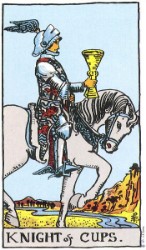
The Tarot suit of Cups is the suit of emotions and particularly of love, the grandest of all of the emotions.  The Knight of Cups shows a Knight riding forth on a quest, his cup extended in front of him.  He’s on a quest of some sort having to do with love, but we can’t see the contents of his cup. 

 Is it full of love that he wants to share with someone else?

Or is it empty and he wants someone to fill it for him?

Kind of a crap shoot, isn’t it?  And it’s pretty much like what we go through when we start a new relationship.  The other person is on his or her best behavior and we can feel quite certain that their armor is buffed to a high polish and their horse has been carefully groomed.  They look mighty good at first glance.  But what’s going on with that cup?  Are they full or are they empty?  Do they have something to share or do they want us to somehow fill up their emptiness?  Or maybe a little bit of both. . .

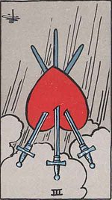
There is also, of course, the ass end of relationships, where they’ve ended, our hearts have been broken, and we’re recovering and trying to move on.  In the Tarot, that’s represented by the Three of Hearts reversed, showing that our hearts have been pierced with pain but the swords are falling out and the pain is going away.

Oddly, those two phases – the quest for love and the end of love – are very intimately connected in our culture. They’re connected with what we might call the, “til death do us part,” model of love.  The idea is that love is for life, that it’s a permanent, life-time commitment.  

Of course, the divorce statistics tell us – plain and simple – that that’s a bullshit idea.  Most relationships are NOT for life and about fifty percent of them end up in parting.

Still, we cling to that idea that a romantic relationship is for a lifetime. That belief causes us unbelievable amounts of pain when reality rears its’ ugly head and we have to split the sheets with someone we loved.  And then we beat the hell out of ourselves.

What went wrong?

What’s wrong with me?

Am I just totally unloveable?

Louise Hay, in her wonderful book, You Can Heal Your Life ,proposed a different model of love that takes away a lot of the pain, and it’s just a matter of having a different perspective on relationships.  And a different perspective on ourselves.

“Being needy is the best way to find an unhealthy relationship.”  Louise Hay.

That’s a pretty powerful statement when we take the time to think about it because it focuses straight onto the question of why we feel that we need (as opposed to want) a romantic relationship.  What is it that we’re trying to get from the other person?  Why is it that we feel so devastated when we don’t get it?

She suggests a simple exercise:  get out a pen and a pad of paper and make a list of all of the qualities that you want in your lover.  What should he or she be to make you feel fulfilled?  

Compassion?

Tenderness?

Strength?

Humor?

Empathy?

Now flip it around and ask yourself:  how much of those qualities do I have toward myself?  Do I treat myself with compassion?  With tenderness?  Am I strong and reassuring to myself?  Can I see the humor in my life and laugh out loud when it’s just me here?  Do I really have empathy and understanding for my self?  And then start working on building those qualities, in your self.

You get the drift:  the more we have those qualities in our own lives, the less we’ll feel the desperate need to find them in someone else.  And the less devastated we’ll feel when the other person goes away.

The other person going away is also a part of the process.

As I said, the divorce statistics don’t lie.  In our culture, nobody gets married with the idea that it’s for six months or a year, or maybe a three month contract with the option to renew.  It’s for a freaking lifetime.  Til death do us part.  

Which means that if you’re not RIGHT THERE AT MY BEDSIDE WHEN I CROAK at the age of 186, then you didn’t really love me, you bastard!  Uh, huh.

So . . . getting back to reality . . . as Hay said, all relationships eventually end, except for the one that we have with ourselves.  If we can get our heads around that reality and honestly say to ourselves, “I’m going to be with this person for a while,” then love gets a lot easier and relationships, paradoxically, become a lot more meaningful.

Because then we begin to really focus on why we’re with this person for this limited period of time and we don’t take it for granted that we’ve got forever to get it right.  

It also changes the meaning of what it means, “to get it right.”  Getting it right no longer means simple longevity.  It no longer means that our relationship with that person was somehow, “good,” just because we managed to hang in there through decades of not being heard or not being seen or not being loved back or putting up with a rotten sex life.

It shifts the focus to, “why are we here?”  We’re here, as two autonomous, strong, healthy human beings sharing our space, energy and love for this period of time – and that can be a month or sixty years – for a reason.  What lessons are we here to teach each other?  In what ways can we help each other grow?  In what ways can we support each other to evolve?

In other words, the relationship becomes a life lesson.  And when we’ve learned that lesson, class is over, we graduated, time to move on to another lesson.

There’s nothing inherently sad about that.  We’ve just been taught that it’s sad.  If we view the relationship as a life lesson, then we can be grateful to our ex-partners for what they taught us and for allowing us to teach them, and move on with gratitude and love in our hearts.

It ain’t easy.  The beliefs that love relationships are supposed to be permanent, that we’ve somehow failed if they aren’t, and that we should just go right back out and do the same stupid thing again, are so deeply ingrained in our culture that it takes a lot of conscious effort to pull out of them.

As Hay says, though, relationships ending is NORMAL AND NATURAL.  We don’t need to put up with a worn out relationship just to avoid the pain of the parting.  We’ve learned what we were supposed to learn.

I love her affirmation for ending relationships, which I shall keep near me in the future:  I bless you with love and I release you – you are free and I am free.

Yes.

Disclaimer: “As an Amazon Associate I earn from qualifying purchases.”