Karma, Having Sex with Republicans, and Being Kind to Yaks

Seeing karma as a way to change our past.

One of my favorite internet memes says, “Karma – It’s spelled K-A-R-M-A and it’s pronounced, ‘Ha, ha, fuck you.’”  

That’s a perfect explanation of our usual understanding of karma which is basically, “If you do some shit, you get some shit.”  If we do something terrible to another person, something terrible is going to happen to us. If we do something nice, something nice is going to happen to us.

OH, WELL, IT’S KARMA

Counter-intuitively, karma is also used an explanation for why bad things happen to good people.  We may have a friend who’s a wonderful person and goes through his life supporting and nurturing others, who’s full of love and gentleness and kindness.  And then something horrendous happens to him, like he falls of a cliff or discovers his wife is having sex with a Republican.

We simply can’t understand why such a good person would have such bad luck.  Certainly, he did nothing to deserve it and, according to the Law of Karma, all of his good behavior should have been rewarded with good things happening to him.

But . . . we’re told . . . perhaps he did something really, really terrible in a previous incarnation.  Maybe he pushed someone off of a cliff or maybe he had sex with a Republican.  Maybe he actually – shudder – enjoyed having sex with a Republican.

That allows us to restore some sense of cosmic balance and we say, “Oh, well, it’s just karma.”

IT AIN’T ME, BABE

We can certainly understand that concept when something bad happens to someone else, but it’s difficult to swallow when it happens to us.

Let’s face it, most of us are NOT the Dalai Lama and we have very little memory of our past lives.  We may accept the general idea that we’ve lived other lives, but we don’t actually remember being a Yak herder in Mongolia in 40 A.D. or a courtesan in Paris during World War I. 

From our current point of view, those people who we were in our past lives were literally someone else and not us.  

The idea that I broke my wrist today because some other guy kicked a Yak 2000 years ago seems entirely capricious and cruel and unjust.  It feels like . . . how shall I put this? . . . bullshit.

KARMA AND DETERMINISM

From that perspective, karma feels very much like determinism.  Determinism is the view that every single thing that happens to us is pre-determined from the moment of birth.  There really isn’t any free will or choice in life because our lives are a result of our genetics, our cultures, the families we’re born into, and the times we live in.

We can actually make a strong case for that.  Even in the United States, where we worship the idea of free will and choosing our own destinies, the statistics say it ain’t so.  If we’re born into a dirt poor family, we’ll probably die dirt poor.  If we’re born into great wealth, we’ll probably die rich.   If our parents were conservative Catholics, we’ll probably be conservative Catholics.  If our grandfather hated socialists for no particular reason, we’ll probably hate socialists for no particular reason.

We tell ourselves that we’re making choices about those issues, but for the most part we aren’t.  It was all programmed into us before we came down the birth canal.  Life is something that happens to us, not something that we create.

Karma can feel a lot the same way.  I, me, the person who I am right now, did NOT kick that Yak 2000 years ago, so why am I being punished for it?  It’s something that’s just happening to me, not something I can control or make any choices about.

BUT KARMA’S A CHOICE

Paradoxically, being the people who we are, right here, right now, is the good news about karma.  

Determinism basically says, “You’re fucked or you’re not fucked and there’s not one damned thing you can do about it.  You have NO choice in the matter.”  It’s all predetermined.

The Law of Karma, on the other hand, says that what we do right now is what really counts.  Far from saying that we have NO choice in the matter, karma is saying that we always have a choice.  And our choices are what determine our karma.

As David Michie said in, “Buddhism for Busy People,” 

“A lot of Western people wrongly think that karma equals fate or predestination.  They think it’s something you don’t have any power to change.  This is a misunderstanding.  It is we who create our own karma and we can change it in a powerful, dynamic way. We are creating hundreds, even thousands of such causes every day of our lives.”

Put another way, we are creating our own karma ALL THE TIME.  It’s not something from the past that just pops up to bite us in the ass every once in a while.  It’s not like The Wheel of Fortune, where we have good luck for a while and then bad luck, for no apparent reason.  It’s something we personally create by either being good people or being bad people.

THE PRESENT AS PROLOGUE TO THE PAST

Now, there’s a particularly fascinating doctrine in some schools of Buddhism that says that we can actually change our past karma by how we behave in our present lives.  

Suppose, for instance, that I was a really notorious Yak kicker in Mongolia in 40 A.D.  I didn’t just kick Yaks occasionally.  No, I was a mean, nasty, evil spirited son of a bitch who got up every single morning and kicked the hell out of as many Yaks as I could reach.

Fast forward 1985 years to my current life.  Suppose I start an, “adopt a Yak program,” and spend years rescuing and feeding homeless Yaks.  I learn to love Yaks and have great compassion for them.  Perhaps I even dress them in Yak finery for special occasions.
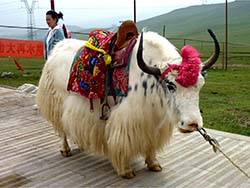
Under this particular doctrine, I wouldn’t JUST be creating good karma for my present self.  My good karma would go backwards through time and actually change the character and behavior of my previous self, the notorious Yak kicker. He might learn to love Yaks just as much as I do and my bad Yak karma would be erased.

IT’S NOT THAT WILD

If that sort of time traveling karma sounds a little too wild, just consider what most of us already believe about karma.

We believe that we have one Soul with many different historical identities and that what a previous identity does can travel through time to affect the life of our current identity.  So if all of these past identities are somehow in touch with our current identity, why wouldn’t our current identity be in touch with our past identities?  If they can affect us, it stands to reason that we can affect them.

KARMA AS AN ONGOING PROJECT

When we shift our perspective in that way, then karma becomes an on-going project.  We’re no longer victims of our past.  We’re actually re-creating our past through our current actions.

And if that isn’t free will and choice, I don’t know what is.

Being compassionate, decent people every day and right now is good for us and it’s good for the people around us.  And, ultimately, it’s good for the Yaks.  

Do it for the Yaks.
Just a reminder that my ebook, “Just the Tarot,” is available on Amazon for much less than a bag of Yak feed.

The Five of Pentacles, Karma, and God’s Little Baskets of Muffins

Transforming ourselves through karmic selfishness.

I have a younger friend who HATES karma.

More specifically, he hates when he’s in the middle of an, “Oh poor me,” bitching session and someone shrugs her shoulders and says, “Well, that’s karma.”  

First of all, it interrupts the rhythm of his complaining and he has to go back and remember what he was so upset about.  

“What was I saying?  I know it was important . . . oh, I remember . . . life is meaningless and no one understands me . . .”

Secondly, it infuriates him because it suggests that the mess he finds himself in is somehow HIS fault and the whole point of his rap is that it’s everything and everyone else’s fault.  Which is just further proof that no one understands him.

This guy was raised by a Buddhist and that may have something to do with his constant irritation.  It’s developmentally important that teenagers be able to rebel against their parents.  The first way that we really begin to define who we are in the world is by making it clear that we aren’t our parents.  I imagine that it must be pretty damned difficult for a teenager to get any rebellion traction against a Buddhist parent.

“You know, Dad, sometimes I really hate you.”

“Well, son, all strong emotions will pass if we simply do a little deep breathing.  Remember, you’re the sky and your emotions are just clouds drifting by.”

Or

“I’ve been think about getting a tattoo.  What do you think about that?”

“Ah . . . perhaps you should get a tattoo of a double dorje or some other sacred symbol.  In a sense, it would be a constant reminder of the spiritual nature that dwells in physical matter.”

Or

“Maybe I’ll paint my face blue and dye my hair orange.”

“Hmmm . . . I wonder if you were a Druid in a past life.  Do you feel a particular attraction to oak trees?”

Aargh!  So it’s possible that this guy was deeply emotionally scarred by all of that loving kindness and unconditional acceptance from his parents.  If only they’d yelled at him or told him he was an idiot occasionally!  

Still, he does have a bit of a point about the notion of karma.

It’s perfectly understandable that people get a little riled up over the idea of crappy things happening to them because of what they may have done in a past life.  After all, most of us have absolutely no memory of our past lives and so it feels like we’re being punished for something that someone else did.  

Suppose I was Attila the Hun in a past life and in a fit of Barbarian Rage I whipped out my scimitar and beheaded a turtle.  Then 200 lifetimes later –   as Dan Adair –  I’m in a traffic accident and I get whiplash BECAUSE I decapitated that turtle.  That seems a little . . . unjust.  I mean, I’m NOT Attila in any sort of a meaningful sense, so why should I get sent to the principal’s office because Attila was a dick?

And then, to make it even worse, when I’m sitting there in my cervical collar reflecting on exactly HOW unjust it all is, an acquaintance says, “Oh, well, that’s karma.”  As my younger friend would put it:  “Fuck you.”

Now, there’s a particularly odious Christian doctrine called, “predestination.”  It holds that some people are born with the unchangeable destiny that they’re going to heaven when they die. Other people are born with the unchangeable destiny that they’re going straight to hell when they die.  It doesn’t matter what we do or how we behave, our ultimate destiny has already been decided at the moment of birth.

It’s like God is up there in the Kosmic Kitchen baking up human Souls and, as he pulls each one out of the Soul Muffin Pan, he tosses them into separate baskets marked, “Heaven,” and, “Hell.”

“Okay, heaven, heaven, heaven – whoops, you’re fucked – hell, heaven, fucked again, heaven . . .”  Like the beggars in the Five of Pentacles, we’re out in the cold and we’re going to stay there.

Theologians came up with a perfectly logical reason for this totally insane doctrine.  The idea is that God is all powerful and all knowing.  So if God knows everything, then that must mean that he knows everything that happened in the past, the present, AND the future!  And if God already knows what’s going to happen in the future, then he must already know who’s going to heaven and who’s going to hell.  Shazam!  There you are – it’s already determined.

That’s the kind of weird, Left-Brain, cuckoo for coco puffs vibe that a lot of people get off of the notion of karma.  It seems to be some sort of an inexorable process that was put into motion a long time before we came along and there’s not a damned thing we can do about it.  We’re either in the Heaven Basket or we’re in the Oh, You’re So Fucked Basket.  Like it’s something that happens TO us for no particular reason.

Of course, the important point that most of us miss is that karma isn’t happening to us, we’re happening to karma.  It’s a totally dynamic process and it’s something that we can change every single day simply by the ways that we behave right now.

The most simplistic way to think of it is as a sort of a bank account.  Rather than being born into a You’re-Going-to-Hell Basket or a You’re-Going-to-Heaven Basket, we’re born with a certain amount of Karmic Kash that we earned (or didn’t earn) in past lives.  The Dalai Lama will probably be reborn with several savings accounts, a really huge checking account, many certificates of deposit and a great coin collection.  Attila the Turtle Beheader, on the other hand, will be reborn with 50 cents in the bank and a lot of overdue bills.

The thing is, though, that the way that we’re born isn’t our destiny.  The way that we behave is our destiny.  Attila, for instance, might start a refuge for homeless turtles.  Every single time that he saves a turtle and gives it a meaningful life – KA -CHING – that’s another deposit in his Karma Account.  The Dalai Lama, on the other hand, might decide to support Eric Trump for President and – ZAP – that’s a major withdrawal from his Karmic Account.

As David Michie said in, “Buddhism for Busy People,” 

In what is one of the most outstandingly ingenious aspects of Buddhist teachings, we come to realize that our own selfish interests lie in being altruistic . . .months, years or decades of being generous for selfish reasons begin to have a predictable effect . . .what starts out as a contrived and self-conscious change of attitude and behavior results in a genuine metamorphosis.

In other words, we don’t have to start out as Mother Theresa or an Awakened Master.  We can start out as perfectly normal, selfish, self-centered human beings who are being kind to other beings because we DON’T want to end up wearing a cervical collar.  When we pick up a turtle that’s in the middle of the road and leave it safely on the other side, we can be doing it for the completely selfish reason of wanting to fill up our Karmic Account.

As we continue those little acts of kindness they gradually transform us.  They become acts of loving/kindness, where we’re actually noticing and caring about the welfare of the people and beings around us.  The translation of the word, “karma,” is, “action,” and that’s the key.  Our actions change us, even if they originate in selfishness.

And that’s how Attila the Hun becomes the Dalai Lama.  Pretty simple.

Christmas Candy, the Meaning of Giving, and Tibetan Meditation Centers

Making our lives into gifts.

Here in the United States we’re just finishing up the annual emotional and commercial orgy of Christmas, also known as, “the season of giving.”  It started me thinking about the nature of giving and, oddly, a Tibetan meditation center I toured over 20 years ago.

Our guide was a woman who lived there with the improbable name of, “Candy.”  I’m guessing that trying to explain the intricacies of Buddhist philosophy to a group of tourists in Bermuda shorts was not the highlight of her day, but she was pleasant, kind, and patient.  One of the concepts that she put in a nutshell for us was the idea of accumulating merit.

“We get up in the morning with the idea of helping other sentient beings and, if we do that, it earns us karmic merit.  And then, instead of clinging to that merit for ourselves, we dedicate it to the good of other sentient beings.  Which accumulates more merit, which we dedicate to the good of other sentient beings.”

I glanced around at the people I was with and their faces were frozen in expressions that pretty much conveyed, “I don’t know what in the fuck you’re talking about, but you seem relatively harmless.”  To me, though, it was a major revelation.  In just those few sentences, I understood the concept of giving with absolutely no expectations of getting anything back.  It’s been something I’ve gone back to again and again over the last two decades.  A lasting treasure.

Now, here’s the thing:  I feel absolutely sure that Candy had no idea that she was making a major impact in another person’s life and thoughts.  We spent maybe 30 minutes with her and I’ve never seen her again, but I still remember that moment like it happened yesterday.  It was a gift, and the gift was her just living her life and telling her truth.

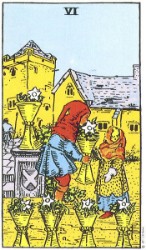
We tend to think of giving as being something that’s transactional and we can see that idea illustrated in the Six of Cups.  The little boy is giving a gift of love (symbolized by the Cup) to the little girl.  Implicit in that image is the next step in the transaction, where the little girl is going to say, “Oh, hey!  What a nice cup!  Thanks so much for thinking of me.”

And then we feel good because we’ve made someone we care about feel good and we feel good about ourselves because, after all, we were thoughtful enough to give something nice to someone we care about.  When we put all of the commercialism and forced jolliness aside, that’s part of the sweetness of Christmas – it’s a chance to give something to others and tell them we love them.

Most of us feel pretty disconnected with that in our general, everyday lives, though.  We may get up in the morning with the intentions of being, “good,” people.  We’re loving with our life partners, we don’t snap at the cashier in the grocery store, we smile at our co-workers and try to work hard at our jobs.  As near as I can tell, right around 90% of us are good people, in the sense that we make some effort to not be shit heads and to be decent to our fellow humans.

Still, a lot of us are afflicted with a sense of meaninglessness.  We feel like we’re slow walking through life in a sort of a daze and we’re not really making any difference.  It’s like we’re born, we eat a lot of t.v. dinners, and then we die and we wonder if anything we’ve done actually matters.

That’s where synchronicity and a leap of faith comes in.  That’s where giving with no sense of attachment to the results comes in.

Each one of us is absolutely unique.  There’s never been anyone exactly like us before and there will never be anyone exactly like us again.  To the extent that we celebrate that uniqueness and share our own individual truths in our lives, we become a walking, talking, breathing gift to the world.

But we almost HAVE to detach that gift from results.  If we make our giving transactional – which is to say, someone saying, “Thank you for being you,”  – we’re setting ourselves up for a lot of disappointment.  The fact of the matter is that most people don’t even see us, in any sort of a meaningful way.  Like us, they’re hustling and bustling through life, trying to pay their bills, hoping they’ve got some clean socks, trying to figure out what in the hell they can cook for their kids that isn’t a t.v. dinner.

And if they do notice us, the odds are that they’re seeing us through so many perceptual filters that they don’t see who we really are.  As the old Indian adage goes, “When a pickpocket looks at a saint, all he sees is pockets.”  

So, we have to make a little leap of faith that we ARE being seen without knowing that we are.  And that we ARE making a difference in other people’s lives and in the world, without any proof that it’s so.  Sometimes it may be like Candy at the meditation center, where words we speak become seeds that grow in other people’s lives.  Sometimes it may be as simple as smiling at a person we pass on the street, never knowing that they were depressed and suicidal until they saw our smile.

We can see that in another card, the Ace of Cups.  The cup represents love flowing into the world, but, unlike the Six of Cups, it’s not attached to anything.  It’s not something we have to earn.  It’s not dependent on being thanked or being noticed or appreciated.  It’s just there in the world and it makes life better by its very presence.

When we finally get it that we’re giving to the world around us and making a difference just by being us to the fullest extent that we can, then we shift into having meaning in our lives because we ARE making a difference.  We may not see it.  Perhaps no one will ever tell us.  Maybe it will take twenty years for that good to ripen in someone else’s life, but we DO matter.  Every single day.

My e-book, “Just the Tarot,” is still available on Amazon for less than the price of a meaningless t.v. dinner and it’s twice as nutritious!

The Fool, The Buddha, and the Corona Virus

Some Tarot interpretations say that the bag or satchel that dangles from the end of the pole on The Fool card is his karma. That he is a new born soul dancing into life and the memories of his experiences and actions – both good and bad – are carried with him into his next incarnation in that little bag.

And that’s a good question for all of us as we face this very profound experience of a world wide pandemic: What will we carry with us when it’s finally over?

Shit happens. We all know that. A lot of the time we experience life less as the Captains of our Fates and more as the silver ball in an old fashioned pin ball machine. We aren’t thinking, we aren’t planning, we aren’t really conscious of what’s happening to us or why. We just keep hitting and being hit by those paddles, bouncing around from one place to the next until a bright, neon sign lights up and says, “GAME OVER.”

And then we’re dead.

Did it make any sense? Did our journey through all of the joys and pains, the triumphs and shit sandwiches actually MEAN anything? Or was it just a random series of events that left us bruised and battered and ultimately puzzled over why it all happened?

A large component in that equation is consciousness. Actually being aware of what’s happening to you right now, right this moment and actively SEEKING for meaning.

Let me give you an example from personal experience. My life partner, Carol, died a couple of years ago and eventually I joined a bereavement support group, also known as a Grief Group. Basically, it’s a small group of people who have lost a loved one and we sit down together once a week and talk about that experience. In other words, we’re trying to find some meaning, some understanding of what we’ve gone through and where we go from here.

One of the most positive things I’ve carried out of that group is the realization of how very much alike we all are in the face of something that is as monumentally dreadful as death. It doesn’t matter if you’re an 81 year old great grandmother or a 25 year old newly wed; death is experienced in much the same way. There are periods of shock, then numbing, then panic and horrible anxiety, overwhelming sadness, and the feeling of being totally lost in the world. There can be great nobility and growth in that process if you can somehow stay connected to your feelings and look for answers. What does it mean? Why did they die? Why am I still here? What am I supposed to do with my life now?

And, sadly, there are other people who experience very little growth and get no spiritual or emotional insights from the process. They throw themselves into a flurry of social activities right after the funeral and, when they have to be home, they turn the t.v. up as loud as it can go and stay on the phone as much as they can. They spend as little time as possible in that Sacred Silence that follows death and they think as little as possible about what it means. In a phrase, “they move on,” from the grieving period as fast as they can. If they’ve lost a husband or a wife, they remarry or re-partner within a year, as if their loved one was an interchangeable part rather than a precious human soul who intermingled with their life stream.

In other words, they don’t carry anything out of it.

Perhaps that’s a form of basic, animal wisdom. As the Buddha said, all sentient beings seek to be happy and to avoid suffering, so there’s nothing unusual about not wanting to hurt. But he also said that suffering is inevitable. No matter how much we might wish otherwise, we each have our portion of pain and how we deal with that suffering – IF we deal with that suffering – that moment in time is the anvil on which we forge our karma. It isn’t just what we go through – it’s how we consciously integrate what we go through. Did we learn anything from the experience? Did we grow and evolve as human beings? Did our compassion and ability to love others increase or diminish? Did we make what happened to us MEAN something in our lives?

So . . . here we sit in the midst of a major historical event. And none of want to be in it. I haven’t met one single person who has said, “Damn, this is exciting! I’m so glad I’m here to see this happen!” But, we’re still here, like it or not. A lot of people are going to die before this all over. Many more will lose people they love with all of their hearts and souls. There’s going to be suffering and we know that.

Right now, millions of us are locked away in our houses and apartments, waiting for the storm to blow through, hoping we won’t be one of the people who are swept out into eternity by this goddamned virus. I guarantee you that many of us are spending this time with the television turned up as loud as it will go, constantly on the phone, constantly on the internet, constantly trying to be too busy to think or feel. They can’t wait to, “move on,” and, “get back to normal.”

In other words, they won’t carry anything out of it.

Right now, we are ALL fools dancing on the edge of a cliff. We can take the time to sit down and meditate, to read, to journal, to REALLY talk with people we love, or . . . we can turn up the volume on the t.v. If there’s one thing we should all know right now it’s that life is precious, time is precious. We can fill that little bag The Fool carries with some new found wisdom, compassion, and meaning. We can actually ask what all of this means, why we’re here, and what we’re supposed to do next.

Or not.

The Fool – Alone but not Lonely

In the first (or the last, depending on your perspective) card of the Major Arcana we see The Fool starting off on his Spiritual Quest, a dog barking at his feet, his eyes turned toward the heavens.

And he’s very much alone.  But maybe not lonely.

What starts us on a Spiritual Quest?  It’s certainly not because things are going swimmingly.  Sometimes it just a chronic, nagging feeling that something in our lives is just not quite right.  Sometimes it’s a sudden flash of insight that’s like the first rolling stone that starts an avalanche.

Frequently it’s some life event that knocks us ass over teakettle and forces us to look at the fact that our assumptions and beliefs have been wrong all along.  That what we took for granted isn’t worth a bag of spit. The death of a loved one. The suicide of a coworker. Surviving a crash or a deadly disease.

Even then, many people will embrace what might be called “a pseudo-quest,” or perhaps, “an aborted quest.”    Shocked and shaken right down to their toes by some near catastrophe they respond by pulling the covers over their heads and crawling into the safe, warm womb of organized religions.  Like the men kneeling in front of the pope in The Hierophant card they look to others for spiritual truth rather than seeking it in their own hearts.

The person on a true Spiritual Quest is there because he or she HAS to be.  The choices of pretense, dull lassitude, and being a comfortable member of the herd no longer exist for them.  They have a burning desire to know – or at least seek – the truth and that desire can’t be ignored.

And, yes,  that can feel lonely at times.

For one thing most people aren’t really very interested in looking at the verities of Spiritual life.  The next time that you’re at a family gathering just casually mention that everyone in the room is going to die sooner or later if you don’t believe me.  You may not be invited back and, if you are, I guarantee no one will want to sit next to you at Thanksgiving Dinner. People actually seek out toys, money, meaningless sex, and anything else they can think of to AVOID talking about death and they don’t appreciate it when someone puts the subject right up in their faces.

A second factor, though, is that your Spiritual truths are YOUR Spiritual truths and not necessarily anyone else’s.  As you tread your way down the path of The Fool you will discover certain things that you know in your heart are true but the people around you, even your loved ones, may think that you’re out of your mind.  Or very much a Fool.

I remember when I first realized that visualization actually causes the things we visualize to manifest in our lives.  And I don’t mean just reading about it or acknowledging it as an abstract idea. I mean actually sitting my butt down, doing the visualizations and having them actually manifest.

I was blown away.  “This,” I thought, “is magic.  Real, honest to goddess, freaking magic!”

And that realization was followed by a whole series of other realizations.  If my thoughts and emotions can cause things to manifest in my life, then my life is . . . a manifestation of my thoughts and emotions.

Which means that I made this mess.  Not my parents, not my environment, not my culture, not random circumstances.  This thing I call my life is . . . ME. My thoughts. My emotions.

Which means that I’m responsible for it.  It’s my karma that I made. BUT . . . it also means I can change it.  And, man, that’s not just magic . . . that’s freedom!

It was a major turning in The Fool’s Path and I was tremendously excited about it.  The people I tried to share it with . . . not so much. My New Agey friends sort of yawned and said things like, “Oh, yeah, I think I read something like that a long time ago in Ram Dass.  Or was it, ‘A Course in Miracles?’ Maybe it was, ‘Codependent No More . . .”

My more conventional friends either edged slowly away or their mouths hung open for a moment before they changed the subject.

I realized eventually that it was MY Spiritual truth.  It was a result of my Tarot readings and my studies and my meditations and it fit perfectly at that exact moment in MY life.  The fact that other people didn’t understand it or know it or really, really dig it in their own hearts didn’t matter. What mattered was that I had found one of my truths.

And there’s a Spiritual truth in that realization, too.  Just because you’re alone in your beliefs doesn’t mean you have to feel lonely.  In all likelihood the people around you don’t share or understand your truths because they haven’t done the work that you have or they just don’t care.  That doesn’t diminish what you know by one little bit. Every truth that you find along the path is a jewel to be treasured and uncovers a little bit more of who you really are.

Karmic Re-Set with the Nine of Swords

I remember the last time I pulled the Nine of Swords in one of my personal readings.  I had a very spiritual reaction, which was, “Well . . . shit.” Swiftly followed by another, which was, “Why me?”

It probably wasn’t one of my better days.

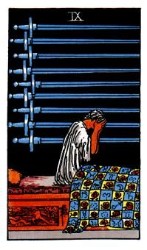
The Nine of Swords absolutely screams, “karma.”  The individual is lying in bed with his head in his hands, a perfect image of someone who has just awakened from a screaming nightmare.  The quilt on the bed is covered with astrological symbols showing past incarnations in different signs of the zodiac. The swords behind him seem locked together like the bars in a prison cell.

Just the Tarot by Dan Adair – a kindle ebook available on Amazon

There can be no doubt that this is someone who has just realized that he’s accumulated some terrible, terrible karma and is going to have to pay a serious price for it.

There’s another way of looking at it, though.

If you’ve spent any substantial time in spiritual exploration then you’ve had that, “Ah HA!” moment when you realize that you are a co-creator of your life.  It goes something like this:

I control my thoughts.  My thoughts cause my emotions.  My emotions cause my energy vibrations.  My energy vibrations, through the Law of Attraction, determine what’s going to manifest in my life.  Therefore, I control (or create) what’s manifesting in my life.

To put it more succinctly, if I’m broadcasting a lot of negative vibrations I’m going to attract a lot of negative crap into my life.  If my vibrations are positive, positive things will flow into my life.

There’s a real rush that goes along with that revelation.  We feel very liberated from random circumstances and from people victimizing us.  We realize that all of this isn’t being done TO us, we’re making it happen to ourselves, which means that we can change it.

But there are a couple of, “Well . . . shit,” moments that go along with that.

The first one is, “Well . . . shit . . . I made this.  This is MY karma. I’m totally responsible for this mess.”

It wasn’t our abusive fathers, or our crazy ex-wife or husband, or the country or culture we grew up in, or the opportunities we did or didn’t have, or anything OUT THERE.  We manifested all of it into our lives or we chose to NOT manifest something better. We made it.

Well . . . shit . . .

The second appallingly scary moment happens when we realize that it means that we’re also creating what happens next.

Alcoholics Anonymous and the other 12 Step Programs have a saying:  “You can start your day over whenever you want to.” In other words, if you’re having a terrible day you can always take a deep breath, reconnect with your serenity, and change how your day is going.

Tibetan Buddhism embraces the concept that we can start our karma over whenever we want to.  No, we can’t escape the unfolding of consequences from our previous actions but we can make those consequences a lot better by starting to live our lives with love and compassion and the creation of good karma.

And when we realize – truly realize – that we are creating our lives right now, right here, with the choices that we’re making, that we’re starting over,  that’s a pretty heavy responsibility.

For one thing we have to get really clear on just what we DO want.  What are my values? What do I want in my life? Peace? Serenity? Happiness?  Family? Sex? Money? What do I want to create in my life? If all of this isn’t just stuff that’s happening to me, if it isn’t just things that people are doing to me, if I’m MAKING my life . . . what do I want it to look like?

And if we’re going to choose to consciously create our own lives – and we don’t have to, we can stay unconscious – then we have to consciously choose, every day, every hour, to control our emotions, our vibrations, and our manifestations.  

And that’s not easy.

Well . . . shit . . .

The Wheel of Fortune and the Gifts of Karma

This is about dealing with bad luck and painful times in our lives. It discusses the Tarot card called The Wheel of Fortune. It also discusses the Tibetan Buddhist concept of accumulating merit through conscious, mindful suffering.


You’re rolling along doing great, happy as a clam, your life full of blue skies and smiles and – BLAM – you get fired from your job.  Or your girlfriend leaves you. Or even worse, you get fired from your job and get terrible, terrible reviews on your exit interview and you know your resume’ will be screwed up for years.  Or . . . wait . . . your girlfriend leaves you for a lesbian who ALSO happens to be your supervisor and fires you and they BOTH give you terrible, terrible reviews on your exit interviews and you know your resume’, your ego and your libido will be screwed up for years.

We’ve all had those moments when life suddenly turns to shit with no warning and for no discernable reason.  It happens to everyone. A rabbi named Harold Kushner even wrote a book about it called, When Bad Things Happen to Good People that sold millions of copies.

Of course, you could also write a book called, “When Good Things Happen to Bad People,” but it probably wouldn’t sell as well.  Or you could write a book called, “When Good People Have Their Lives Turn into Shit Sandwiches and Then All of a Sudden Things Get Better For No Particular Reason.”

As the King of Siam said, “It’s a puzzlement.”

One of the reasons it’s puzzling for most of us is that we get that training from the time that we’re infants:  if you’re good, good things will happen to you. If you’re bad, no fruit cup for dessert and you stand in the corner.  It’s supposed to be a straight, cause and effect transaction that if you’re good you get rewarded, not kicked in the head.

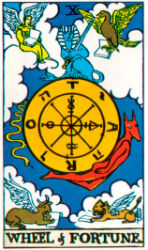
But life is full of ups and downs, and The Wheel of Fortune is a perfect illustration of that.  At best our ill fortune can seem terribly random and at worst it can seem just plain perverse. A turn of some invisible wheel over which we have no control.


As I’ve gotten older I’ve come to take a lot of comfort in the concept of karma.  When a stranger decides he doesn’t like me and he’s going to make my life hell it makes more sense to me to think that I must have screwed with him in a past life than to think that he  just doesn’t like my nose or my aftershave.

And if you really embrace the concept it can actually help you to get through some horrific times.  “Yes, this is terribly painful and I’m going through some serious suffering. On the other hand, think of all of the bad karma I’m burning off.”

I remember the first time I had a serious discussion about karma.  I was taking a tour of a Tibetan Buddhist Meditation Center and the woman who was the tour guide and who lived there said:  “When we get up in the morning we try to live virtuously and if we do that we accumulate merit, which is good karma. And then we consciously dedicate that merit that we’ve earned to anyone who is suffering or in need.  Which is also a virtuous thing to do so we accumulate more merit by doing it and then we consciously dedicate THAT merit to others.”

To which I replied, “Huh?”

It took me a few years to get it but the key words there are, “consciously dedicate.”  

When we encounter the bad times in life – as we always do – live them consciously.  Endure them with grace and dignity. Be determined to learn and to grow spiritually from them.  Consciously dedicate those bad times to earning merit.

And when we’re having good times in life, consciously dedicate some of that extra energy and fortune to helping others who are having hard times.  

Conscious living makes The Wheel of Fortune make sense.

Disclaimer: “As an Amazon Associate I earn from qualifying purchases.”

The Wheel of Fortune

The meaning of The Wheel of Fortune card in the Tarot, including definitions for the upright and reversed positions.

wheel

The Waite deck obviously went all out on this card and crammed as much occult symbolism into one little package as the mind can conceive.  I personally think you’re pretty much always going in the wrong direction when you combine the new testament with Egyptian gods, but – hey! – to each his own.

The word Taro in the center of the wheel is a reversal of the word Rota, meaning wheel and it emphasizes that our journey through this life is very much like being affixed to a turning wheel.  What goes up must inevitably come down and then, in the nature of the wheel, go back up again. This card is talking about the fact that change is inevitable.  Nothing remains fixed or static in this world and you may be riding high one day and fall off your horse the next.  You may be flat busted and then have a crazy idea that makes you a fortune. Life is always changing and we just pretend that it isn’t because it makes us more comfortable.

When the Wheel of Fortune shows up in a reading you know that a large change is about to happen.  The card doesn’t speak to whether the change is good, bad, or indifferent: it’s just telling you that something big is about to happen and you should be prepared for it.  When it happens it will probably feel like a bolt from the blue, a sudden stroke of good luck or a lightning flash of bad luck. Other cards in the reading may give clues as to the area of life in which you can expect the changes.

REVERSED:  There’s not a huge difference between the upright and reversed card, except the reversed card shows more of an aspect of bad luck.  It’s possible that the questioner is about to enter into a period of hard times or that he or she is simply going to have a string of bad luck.  The main lesson for this card is to use the tough times to develop stronger character. Persevere and grow.

If you have questions about this card or its meaning in one of your readings, please don’t hesitate to leave a comment.  I’ll get back to you as soon as I can.

A Few Other Thoughts About The Wheel of Fortune:

The Wheel of Fortune represents a glitch in the fabric of their well-ordered universes which organized religions have been trying to ignore since their inception.

Which is to say . . . luck.  Good luck, bad luck, and no luck.  

If The Hierophant represents the well-oiled machinery of organized religion, the The Wheel of Fortune represents a huge monkey wrench that got thrown into the gears of that machinery.  Organized religions teach – put simplistically – that if you’re a good person then good things will happen to you. And if you’re a bad person, then bad things will happen to you.

And, of course, that flies in the face of much of what we see around us.  Why do kind, gentle people of faith sitting in a synagogue in Philadelphia get gunned down by a vile racist who is consumed with hate?   Why do billionaires who celebrate avarice and greed live lives of luxury while the pious frequently don’t have enough food for their children?

It’s a conundrum that religions have been hard put to explain.  In the christian religion we see the rather sickening tale of god and the devil deciding to turn Job into a human ping pong ball, kill his children and his livestock, and give him some sort of a leprous disease just to, “test his faith.”

The most logical explanation I’ve run across is the Buddhist idea of karma.  We plant seeds of hate and violence in past lives and they may bloom into poisonous flowers hundreds of lifetimes later.  Thus, bad things happening to us aren’t the random, crazy things that they seem to be but just natural consequences of our past actions.

That’s what I personally believe but, like all metaphysical assertions, it’s an unprovable hypothesis based on my experiences, thoughts, and feelings.

The Wheel of Fortune pushes aside all of the metaphysical hypotheses and organized religions and just says, “Look:  shit happens. And good things happen.” Period. You don’t have to have an explanation for it to recognize that it happens.

The nicest, most successful person in the world can hit a string of really putrid luck and have everything she’s worked for destroyed.  The biggest bastard in the world can hit a string of really good luck and end up in the White House.

It’s a principle of randomness that seems to be built into the universe.  What goes up, must come down, and vice verse. Today’s rooster is tomorrow’s feather duster.  Life moves in cycles and we have no choice but to move with them and do the best that we can. The Wheel of Fortune is a reminder of that.  

Ultimately none of the castles that we build – or lose – on this earth plane are real.  Figure out what things ARE real. Your values. Your heart. Your love for and from others.  Those are things we create ourselves with the way that we live our lives. No change of fortune can give them to you and no change of fortune can take them away.

“Just the Tarot,” by Dan Adair – a kindle ebook available on Amazon